New on Archive.org, Ray Bradbury On Radio. A curated collection mostly from the 1940s and 50s, though the large collection carries on after that. Also a 1992 interview.


27 Friday Jan 2023
Posted in Odd scratchings, Podcasts etc.
New on Archive.org, Ray Bradbury On Radio. A curated collection mostly from the 1940s and 50s, though the large collection carries on after that. Also a 1992 interview.
27 Friday Jan 2023
Posted in Picture postals
This week on ‘Picture Postals from Lovecraft’, more from Boston. H.P. Lovecraft once recalled the time when he was a lad who was becoming interested in the wider world…
As soon as possible I procured an illustrated edition of Bulfinch’s Age of Fable, and gave all my time to the reading of the text, in which the true spirit of Hellenism [the Ancient Greek world] is delightfully preserved, and to the contemplation of the pictures, splendid designs, and half-tones of the standard classical statues and paintings of classical subjects. Before long I was fairly familiar with the principal Grecian myths, and had become a constant visitor at the classical art museums of Providence and Boston. I commenced a collection of small plaster casts of the Greek sculptural masterpieces, and learned the Greek alphabet and the rudiments of the Latin language.

The ‘old’ Boston Museum.
For Boston this meant the Museum of Fine Arts building on Copley Square, demolished in 1909. It was most likely best known by him in his middle-childhood circa 1898-1902 (age 8-12).
Some of the interior photographs currently available make the displays look extraordinarily dull, especially the painting galleries. What then was the attraction for the lad? Well, we know from the above memoir that the young Lovecraft once had an intense passion for classical sculpture and he was often seen haunting the sculpture hall in his own city. His city’s Museum had an entrance hall and exhibit of Greek sculptures, something I’ve posted about here before. As a boy he was fervent to see this when it opened as…
a recently opened exhibit of Greek antiquities at the Rhode Island School of Design
… and thus he pestered his family until he was taken there in 1897.
Therefore the next logical step for the family would be to take him to what is now known to archivists as the “old museum” in Boston, the pre-1909 Museum of Fine Arts.
before long I was fairly familiar with the principal Grecian myths and had become a constant visitor at the classical art museums of Providence and Boston
The attraction there would have been what was obviously a large and very fine collection of sculpture from Greece. He might have seen it from perhaps circa 1898 and onwards. On my assumption that the local 1897 visit in Providence came first, and then the trip(s) to Boston later.
Here then is a glimpse of what the young Lovecraft would have seen in the museum at Boston…

Entrance doors.

Main sculpture hall.


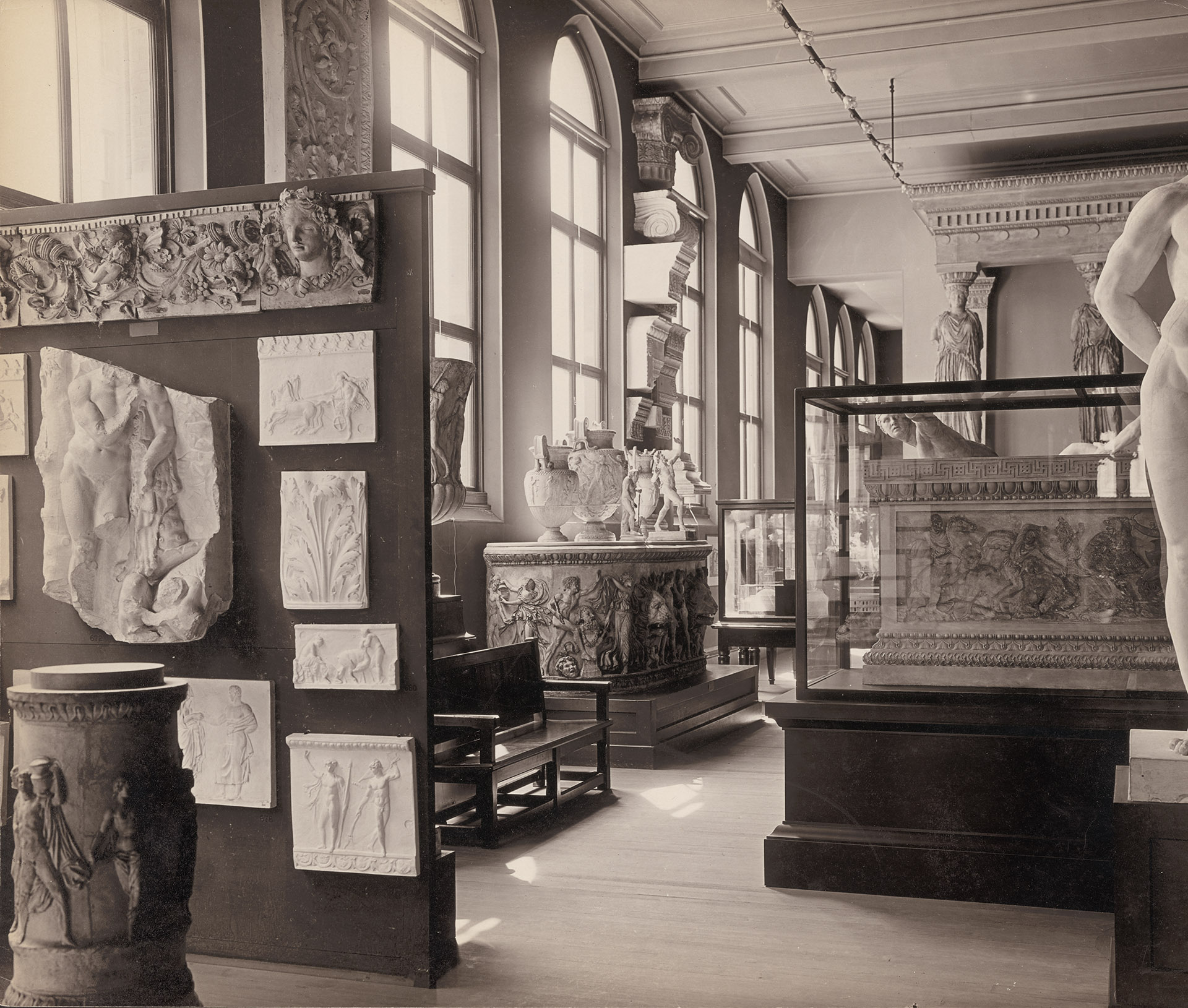
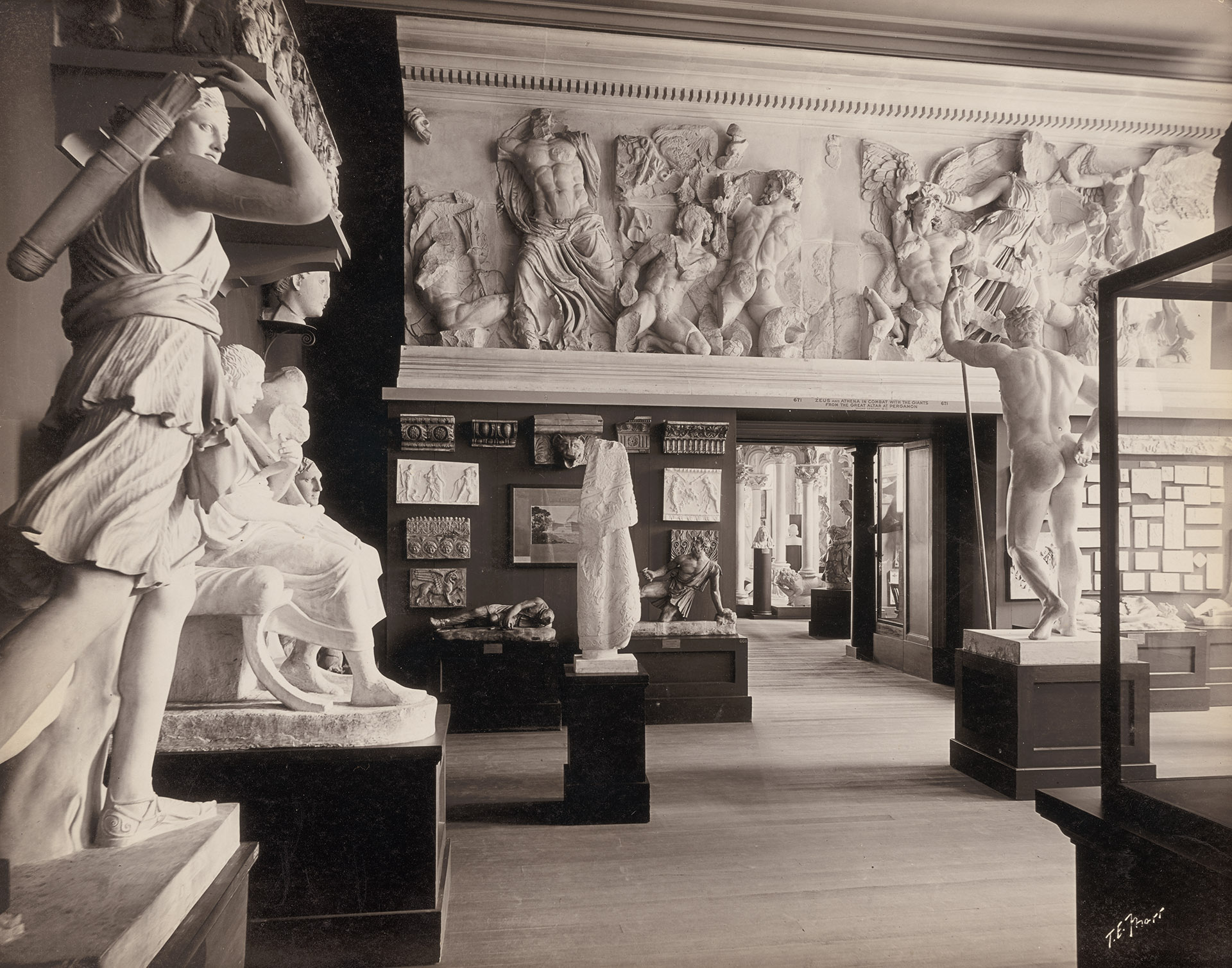

He must have been rapturous with all this, as he then had an “infatuation with the classical world” as S.T. Joshi puts it. This later fed into the setting though not the sentiment for his breakthrough poem “The City” (1919). Of which I have an annotated version from 2019.
This same Museum had several galleries of rather more stolid sculpture from Ancient Egypt.


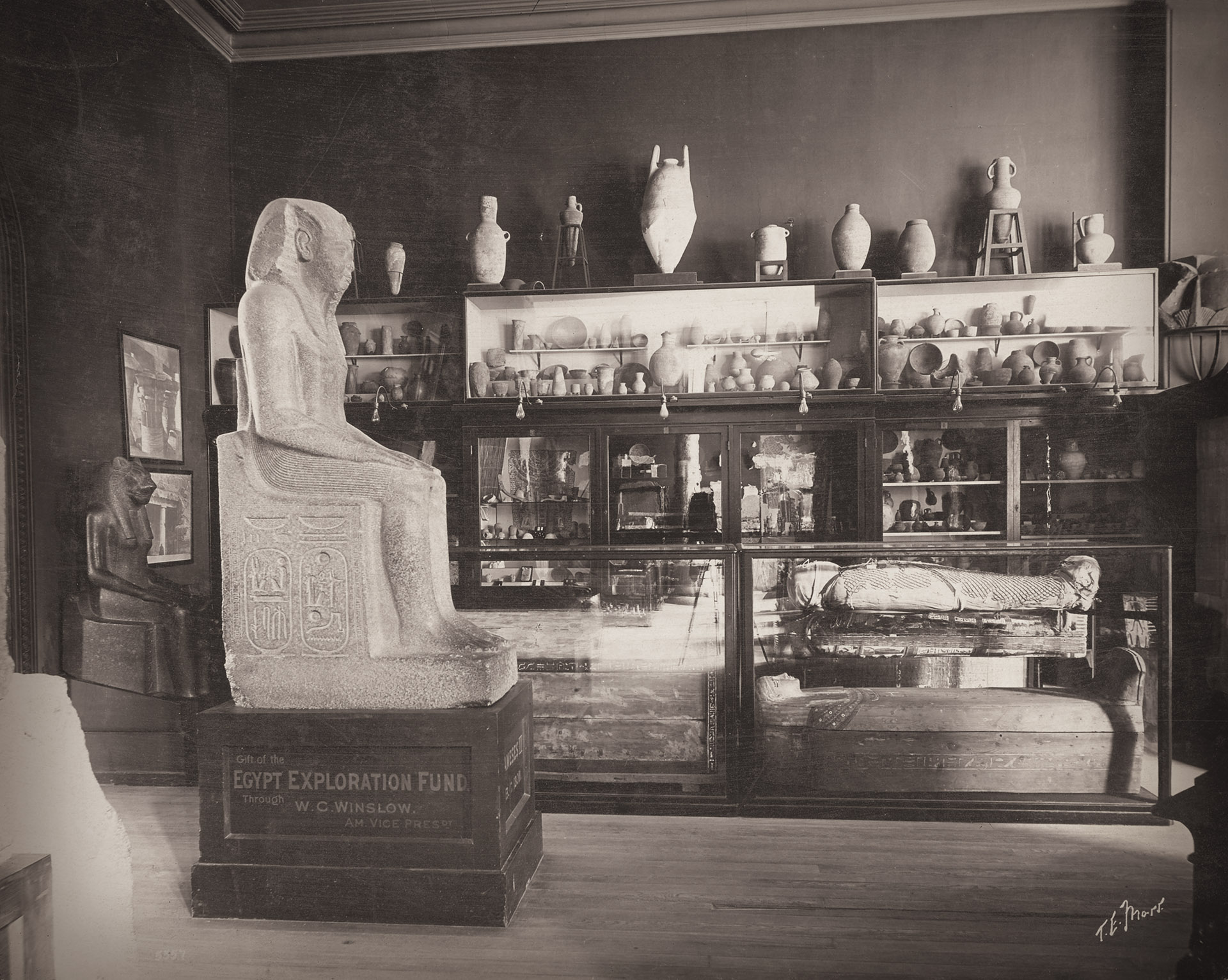
Quite possibly Lovecraft also later encountered old favourites in the new post-1909 museum building at Boston, which opened in 1909 as the old one came tumbling down. However, on probable re-visits circa 1919, his sense of exhilaration would not have been the same. Evidently some of the Puritan darkness of New England had seeped into his views by 1918, as seen when he remarked in his essay The Literature of Rome…
The Hellenes [Greeks], with their strange beauty-worship and defective moral ideas, are to be admired and pitied at once, as luminous but remote phantoms.
More cheerfully, he would in later years have been looking out for the work of his own ancestor in the Museum…
Samuel Casey, Jun. — my great-great-great-granduncle — was a silversmith of such art and skill that pieces of his work are in both the Boston Museum of Fine Arts and the Metropolitan Museum of New York.
I have a counterfeiter as a great-great-grand-uncle about whom I’ll tell you some time. He was also a silversmith — with pieces surviving in the Metropolitan Museum of N. Y., the Boston Museum of Fine Arts, & elsewhere.
26 Thursday Jan 2023
Posted in Odd scratchings
A serious set of proposals has been assembled to restore the Pennsylvania Station in New York City. The three options, one of which appears to be an actual brick-by-brick rebuilding, are being debated tonight in New York.
The (later demolished) station was where a certain Mr. H.P. Lovecraft arrived on his first ever visit to New York City in April 1922.

25 Wednesday Jan 2023
Posted in Scholarly works
Tolkien Gleanings issue 2 (Jan-Feb 2023) is now freely available. A handy PDF magazine for Tolkien scholars, collecting the recent ‘Tolkien Gleanings’ news items and adding articles, vintage pictures and a review. Contributions, especially scholarly book reviews, are welcome for future issues.
Can also be had via Gumroad.

25 Wednesday Jan 2023
Posted in Odd scratchings
Comic Book and Comic Art Auction Tops $13.5 Million. Including…
Conan the Cimmerian [who] made his first appearance in the December 1932 issue of the pulp magazine Weird Tales. Fine copies of that historic title have long been increasing in price, but it took a significant jump in this auction, realizing $19,200.
24 Tuesday Jan 2023
Posted in Kittee Tuesday, Lovecraftian arts
Chaosium has an interesting new interview video which looks at how Call of Cthulhu and other RPG books are put together, both in the past and today. The blurb uses “TTRPG” which is just industry-speak for = Tabletop Role-playing Game.
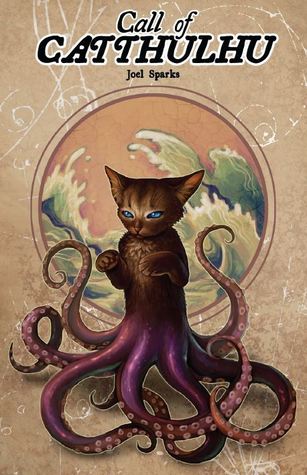
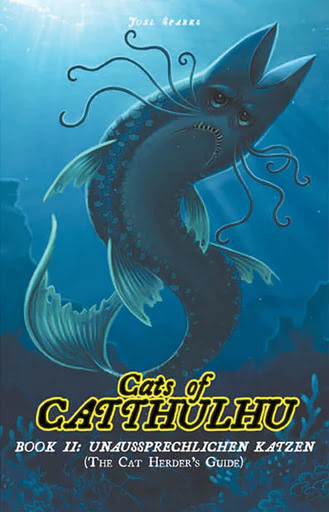
Elsewhere, Dave Higgins has a new player-review of Call of Catthulhu RPG. I think I may have spotted this back when it was a Kickstarter, but it’s expanded a bit since then…
the entire game is based in genuine cat behaviour seen through the lens of affection, creating a pervasive sense of whimsy, the rules based around play-acting veer even more strongly into the humorous.

For real-cats, ‘Strange Maps’ has the latest on the fast-changing picture of the great European house-cat migration in pre-history. Domesticated felines were in Poland in 6,000 B.C.
23 Monday Jan 2023
Posted in Odd scratchings
Just the thing for a dull Monday, Plant Monsters of Amazing Stories and Plant Monsters of Astounding. Both new illustrated surveys by G.W. Thomas at Dark Worlds Quarterly, with his survey of Thrilling Wonder Stories still to come.
There was also a survey of Plant Monsters in Weird Tales back in 2020, and a brief look at The Earliest Plant Monsters in 2019. Also to be found at Dark Worlds are various surveys of the subject in pre-Code comics.
22 Sunday Jan 2023
Posted in New books, Scholarly works
The Pulp Super-Fan makes an initial survey of Robert M. Price’s Lovecraftian collections. Since Price’s podcasts have become scarce, I was unaware of his two collections of his own Mythos fiction, in 2019 and a follow-on in 2020.
His main 588-page book one can now be had as an affordable ebook, Blasphemies & Revelations. While the shorter companion of the following year, Horrors & Heresies, still seems to be in paperback only.
A look at his Amazon page also reveals… ahaa… what’s this… Crypt of Cthulhu #114 (July 2022) on Amazon as an ebook. Yes, a substantial new issue of Crypt came out in summer 2022 and is the first since 2019. Who knew? Includes a look at “Lovecraft and Cinema in his Day”, and an interview with David E. Schultz, among others.

The earlier #113 issue is still the latest listed over at the PDF downloads page.
I’ve updated my recent survey of ‘Lovecraft in 2022’ with the new information on Crypt. I’ve also added there the news about Derleth slipping into the public domain in Canada, now that this is confirmed (their new 2023 ’70-year law’ is not retrospective). Idle notion: what if Robert M. Price were to re-write Derleth’s ‘Lovecraft collaborations’ as they should have been… now that would be something to behold!
21 Saturday Jan 2023
Posted in New books, Scholarly works
S.T. Joshi’s new Horror Fiction Index is published…
a listing of nearly 3,300 single-author horror collections from 1808 to 2010. The print edition is a whopping 741 pages, containing a list of the collections (arranged alphabetically by author, and chronologically within a given author’s books) with their tables of contents, followed by indexes of names, collection titles, and story titles (nearly 30,000 of them).
It’s a ‘story finding-aid’, so far as I’m aware, and thus doesn’t also list prefaces, scholarly notes (or not), etc. Now available in paperback and ebook. I was pleased to be able to supply two of his ‘unknown contents’ listings. Joshi reports than only ten such ‘unknown’ collections remained un-solved by the time the book went to print. Hopefully someone will now pick this up and produce an expanded second edition in due course.
20 Friday Jan 2023
Posted in Picture postals
This week on ‘Picture Postals from Lovecraft’, more Boston pictures. Rectified, cleaned and toned.
Firstly another contender for the Boston subway which is depicted toward the end of the dreamlike prose-poem “Nyarlathotep” (1920), in which a column of people…
filed down a weed-choked subway entrance, howling with a laughter that was mad.

This is the subway inbound entrance that sat beside the Boston Public Library, seen here in 1915. Suitably gothic and Lovecraftian, more so than the one seen last week. Lovecraft almost certainly knew this Library entrance after 1919.
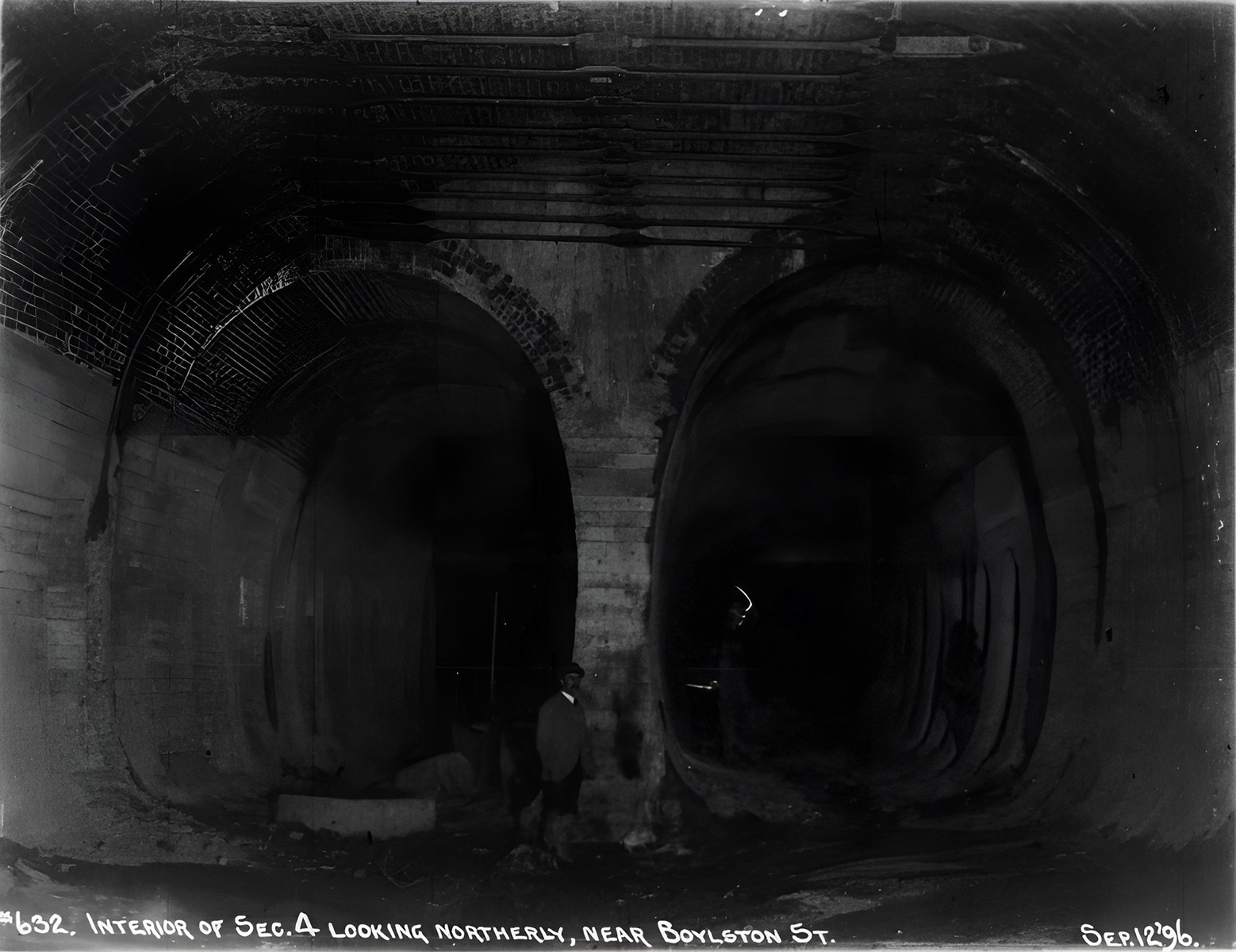
Then there’s his “Pickman’s Model” (1926), in which the artist depicts a scene in the Boston subway and names the station…
There was a study called ‘Subway Accident,’ in which a flock of the vile things were clambering up from some unknown catacomb through a crack in the floor of the Boylston Street subway and attacking a crowd of people on the platform.
Here is a picture of the subway station itself. It may have had two platforms, one for the subway…

And another where the Elevated train came down and in, to meet the subway at a wooden platform…

Elevated -to- subway platform.
So take your pick as to which one the “vile things” were emerging from and into. But the older wooden-slats one feels the more likely. Note the news-stand with magazines, albeit some 11 years before Lovecraft was (probably) sitting there and imagining ghouls emerging from the trackway.
Where They lurk…
19 Thursday Jan 2023
Posted in Scholarly works
I stumbled on a rare book listing, which made me aware of a book of possible interest. Romances of the Archive in Contemporary British Fiction (2001) was claimed to have something on Lovecraft…
Authors addressed in this collection of academic papers extend beyond the British canon despite the subtitle, among them H.P. Lovecraft, Umberto Eco.
I then found the TOCs for the book, which revealed more. The book is a general survey written by a single author, and obviously written from the American academic left as it was at the end of the 90s (expect Foucault, et al). Several of the fiction authors are slotted into themed chapters, and I imagine there must be quite a few plot-spoilers. The author knows enough to consider that Lovecraft can effectively qualify as British, which is encouraging.
There’s since been an explosion in ‘critical archival studies’ in academia, focused on institutional gate-keeping, erasure and memory, the making of art-chives by artists, technological impacts on presenting the past, etc. But I can’t say I’ve ever heard of this early book on the topic.
The first half of the book looks interesting as a set of informative surveys useful for anyone writing on the theme of archives and libraries in the weird. Specifically tales featuring archival access and deep research as a key feature of the plot. Here are the main items in that part of the contents-list…
Romances of the archive, identifying characteristics : A.S. Byatt and Julian Barnes.
Wellsprings : Edmund Spenser, Henry James, H.P. Lovecraft, Josephine Tey, Umberto Eco.
History or heritage? : Penelope Lively, Barry Unsworth, Peter Ackroyd.
Time magic and the counterfactual imagination : Kingsley Amis, Lindsay Clarke, Lawrence Norfolk, Nigel Williams.
The book is not on Archive.org, as yet.

The Reading Room, Boston Public Library. The room opened in 1895, and was likely visited by Lovecraft when he encountered the city some 25 years later.
18 Wednesday Jan 2023
Posted in Scholarly works
This week Pulp.net catches up with Crypt of Cthulhu, and along the way brings news that…
it looks like Price has restarted the old Eldritch Tales fanzine that used to be published by Necronomicon Press, this one billed as #8 (properly Vol. 2, No. 8) in September 2022.
I have a personal buy guide for Crypt issues, to September 2018 when the PDFs became available. But there were a couple more issues after that.