• About
  • Directory
  • Free stuff
  • Lovecraft for beginners
  • My Books
  • Open Lovecraft
  • Reviews
  • Travel Posters
  • SALTES

Tentaclii

~ News & scholarship on H.P. Lovecraft

Tentaclii

Category Archives: AI

HPLinks #80 – Golems, REH news, book reviews, comic adaptations, new Burleson book, librarians and more…

09 Thursday Apr 2026

Posted by asdjfdlkf in AI, HPLinks, Lovecraftian arts, REH, Scholarly works

≈ Leave a comment

HPLinks #80.

* An English abstract for a new conference paper from the city in Brno in the Czech Republic, “The Discipline of the Eye: Lovecraft’s Visual Epistemology, Atmospheric Proof, and the Horror of Display” (2026). Through “refusal and display”, Lovecraft…

disciplines the eye to treat atmosphere as evidence […] outline, surface, hue, and scene operate as atmospheric proof—signals of an alien order […] Indeterminacy, shared by narrator and reader, forces imaginative substitution, making the reader complicit in producing what cannot be stably seen.

* The latest (37.1) members-only Journal of the Fantastic in the Arts has a review of David Goudsward’s book Adventurous Liberation: H.P. Lovecraft in Florida. Not online.

* From Russia in Russian and open-access, an essay that translates as ‘The Fantastic Chronotope and the Image of the City in the works of G. Meyrink and H.P. Lovecraft’…

Meyrink’s Prague (The Golem and The Angel of the Western Window) and H.P. Lovecraft’s Innsmouth (“The Shadow over Innsmouth”) each offer a fantastic space with distinctive features [… I also suggest] that certain details of the descriptions of the fictional city of Innsmouth were most likely borrowed by H.P. Lovecraft from The Golem.

However, one can note that “Innsmouth” was written at the end of 1931 and yet Lovecraft didn’t finally read The Golem until several years later when Barlow was able to send him a copy… “I had seen the cinema version, and thought it was faithful to the original — but when I came to read the book only a year ago [i.e. April 1935]” …. Holy Yuggoth! The film had nothing of the novel save the mere title and the Prague ghetto setting — indeed, in the book the Golem-monster never appeared at all, but merely lurked in the background as a shadowy symbol.” (Lovecraft, in Selected Letters V, p.138). If there was any inspiration, it would have been from the movie. But Lovecraft was personally well acquainted with decrepit seafronts of all sorts.

* Also from Russia and in open-access, a new journal article which translates as “‘Lovecraftian Magic’ as a Form of Fictional Religion” (2026). In Russian, but easily auto-translated.

* A new philosophy article on the Medium platform on “H.P. Lovecraft’s Takedown of Islam” (a short free sample, then $ paywall).

* DMR notes the passing of “Lee Breakiron: A Gentleman and a (Howardian) Scholar”…

While Lee was all-around a gifted scholar of [R.E.] Howardiana, he was the undisputed king — by his own hand — when it came to scholarship regarding the history of Howardian fandom and literary criticism. He’d read and collected all of it during the decades before he strode into the REH scholarship arena.

* A review of Robert E. Howard: The Life and Times of a Texas Author.

* The REH Foundation podcast has a new chat surveying and discussing Robert E. Howard’s Pirate Stories.

* A new review of the Selected Letters of Clark Ashton Smith.

* On Kickstarter… Deep Space Lovecraft: 2 Cthulhu Mythos Horror Adaptations. Being… two “Mythos tales reimagined & visualized as hard science fiction” and done as comics. It’s heavily over-funded already. “The Haunter of the Dark” is imagined as a visit to a giant cathedral-like space station, and “The Hound” seemingly as a visit to another space station / museum? Despite the obviously AI-generated images, which by the looks of them were probably generated some years ago with now-primitive AI and then partly overpainted, the images have been carefully cohered into appealing pages. The pages are offered on the Kickstarter page as free samples. Looks to me like the Inverse Press / Flatline Comics could be a way to publish your AI generated comic in paper, without having to encounter the anti-AI hysteria currently being whipped up elsewhere.

* AI has moved on since then, and if you want a taster of that then have a look at this curious weird experiment. Simply feed the entire text of the seminal science-fiction novel The Time Machine into an AI, and have it make an apparently un-aided script and then generate a 17 minute movie version by itself… “this is the raw unrefined result with a single take, no cherry picking” says the experimenter.

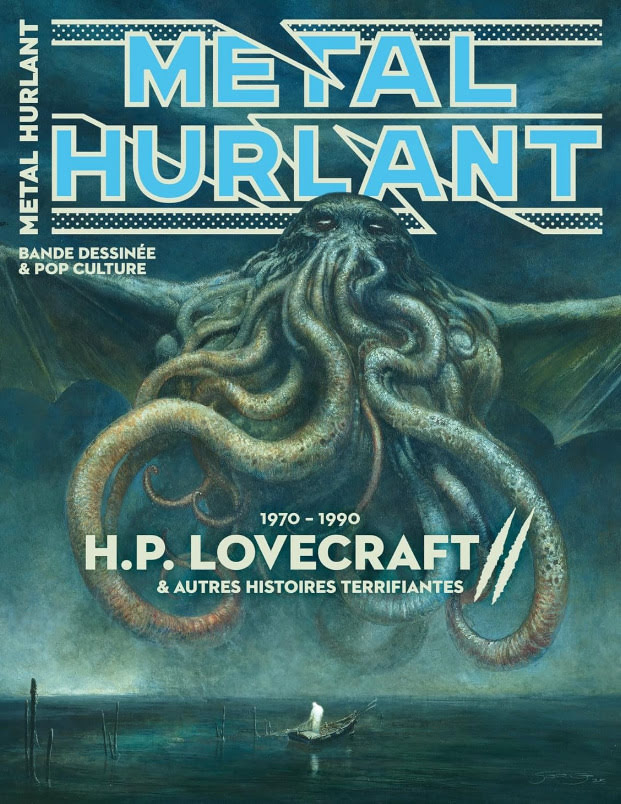
* The new French Metal Hurlant 18 (Lovecraft special, 2026) magazine is now available.

* Amazon UK is listing Donald R. Burleson’s new book Seed of the Gods: Lovecraft-Inspired Tales and Others as published in April 2026… “his first collection of short stories in more than a decade, [in which] Burleson gathers tales written over the past fifteen years”.

* A new free ebook, “Overworked, Undernourished, and Weak in the Eyes”: The Portrayal of Librarians in Comics. An assiduous annotated and seemingly completist survey in 365 pages, offered by the author. Freely available to download as a PDF. It’s under Creative Commons Non-Commercial, so one could have an AI extract all the references which refer in some way to supernatural/horror librarians and thus make a more compact themed survey.

* Taskerland has a short essay “On “The Man of Stone” by Hazel Heald and H.P. Lovecraft”. He finds this collaboration is…

not a great story, but it is an instructive one. In its mixture of cosmic suggestion and theatrical excess, it shows how readily Lovecraft’s ideas can be broken apart and made to function elsewhere. What emerges is not simply a change in tone, but a loosening of ownership, the same anxieties set loose from their original form and already beginning to move beyond the control of their author. This process is usually dated to Lovecraft’s afterlife, to obscurity, Derlethian appropriation, copyright murkiness, and the long slide into cultural ubiquity, but its beginnings may be earlier.

* Dark Worlds surveys “The Arkham Sampler Fiction”. Scans of Derleth’s Sampler issues can now be found at the Internet Archive.

* Up for auction at Heritage Auctions, a complete run of Arkham House books.

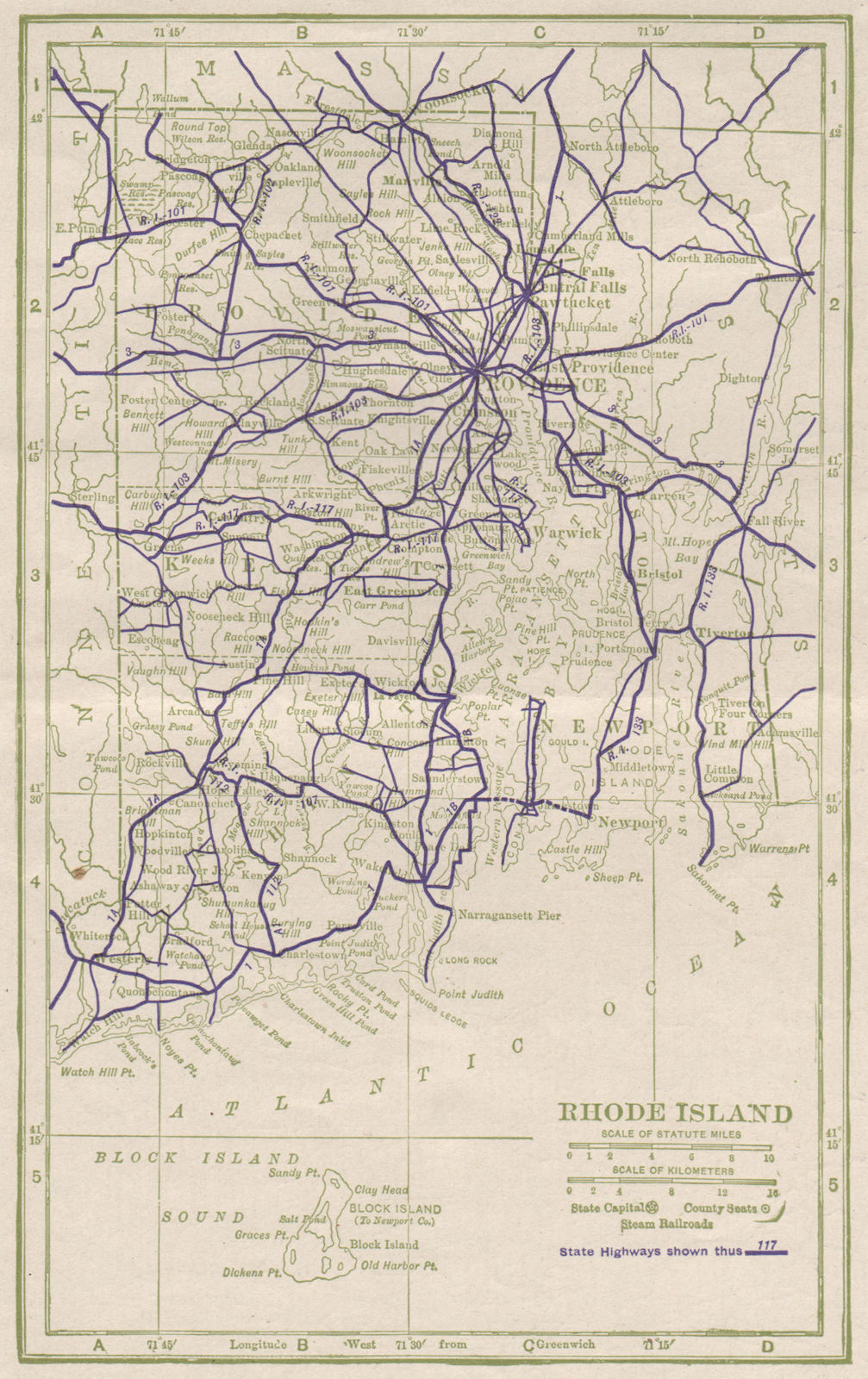
* Browsing eBay for scans, I’d not seen this one before. A pleasing and unwatermarked map of the highway system in Rhode Island, 1925. Could be upscaled to become a good RPG game prop?

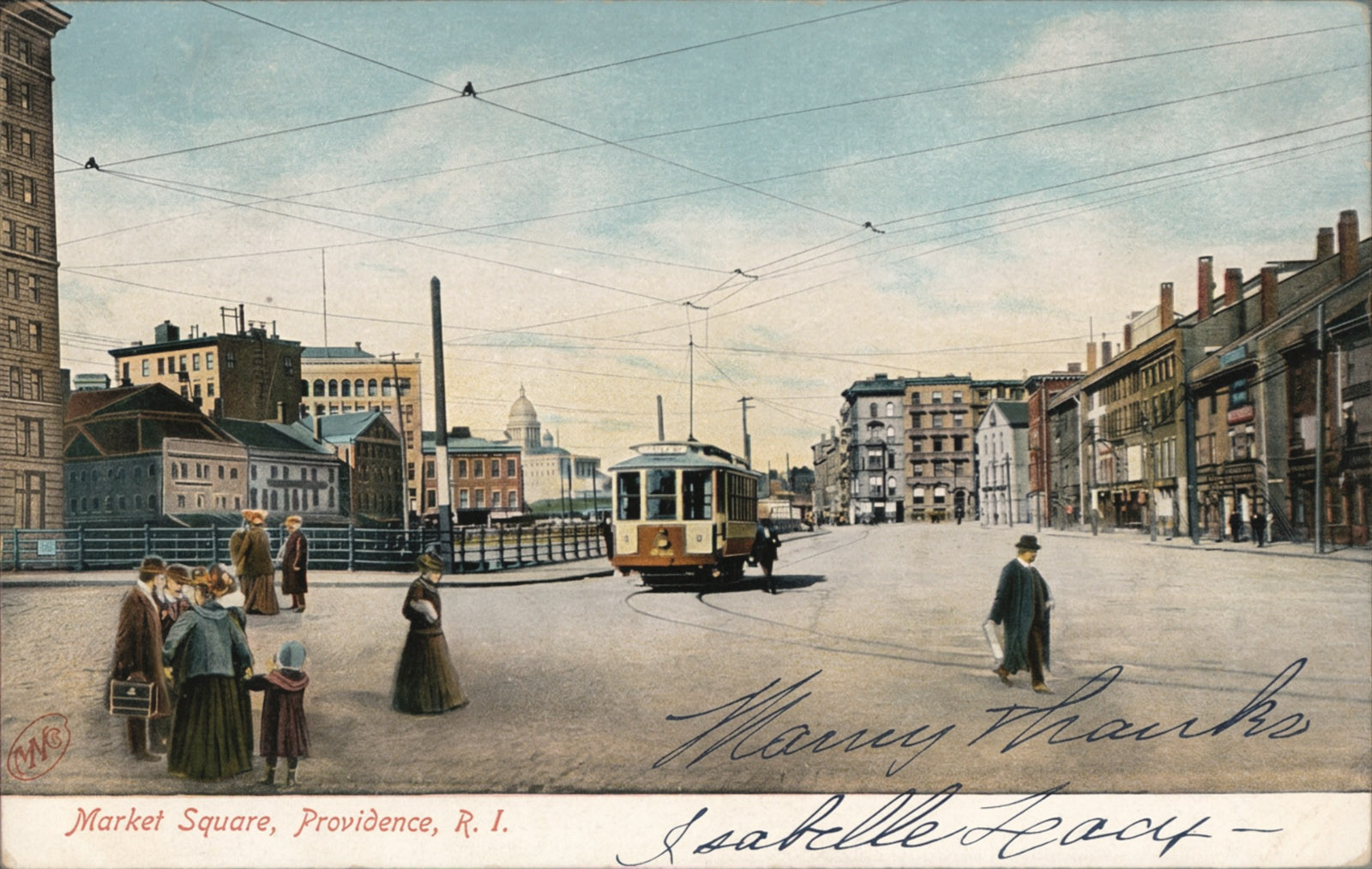
* And finally, a rare street-level view of the Market Square, Providence, as Lovecraft would have encountered it. Many other postcard views are elevated or bridge-views. The view here is north towards the State House dome. The city’s market was held around the railings on the left of the picture. One can almost imagine the fellow alighting from the tram car, holding a black bag, to be the young Lovecraft.


— End-quotes —

“My aunt is well acquainted with Mr. Champlin Burrage, an Oxford man, who is librarian of the John Carter Brown library at Brown. (I hope to meet him very soon.)” — Lovecraft to Kleiner, April 1917. Brown University in Providence.

“Like you I am absolutely devoid of actual friends outside of correspondence. Those whom I knew in youth are all active and successful now, […] one a librarian of the R.I. Historical Society” — Lovecraft to Kleiner, circa 1918.

“My other guest [in Providence], Carl Ferdinand Strauch — poet and Asst. Librarian of Muhlenberg University (a friend of Brobst’s) — was also highly interesting, and very appreciative of the local antiquities and and-wheres.” — Lovecraft to Morton, September 1932.

“Only the other day a correspondent of mine — a librarian who sees all the magazines — was remarking what a fixture of the small & select publications you [i.e. Derleth] are getting to be!” — Lovecraft to Derleth, September 1933.

“… some timid reader has torn out the pages [from the Necronomicon] where the Episode of the Vault under the Mosque comes to a climax — the deletion being curiously uniform in the copies at Harvard & at Miskatonic University. When I wrote to the University of Paris for information about the missing text, a polite sub-librarian, M. Lean de Vercheres, wrote me that be would make me a photostatic copy as soon as he could comply with the formalities attendant upon access to the dreaded volume. Unfortunately it was not long afterward that I learned of M. de Vercheres’ sudden insanity & incarceration, & of his attempt to burn the hideous book which he had just secured & consulted. Thereafter my requests met with scant notice.” — Lovecraft to C.A. Smith, November 1930.

HPLinks #79 – Lovecraft’s father, Lovecraft and urbanism, Herbert West BD, Claude Mythos, Lovecraft and machines, and more…

31 Tuesday Mar 2026

Posted by asdjfdlkf in AI, HPLinks, Lovecraftian arts, New books, Scholarly works

≈ 4 Comments

HPLinks #79.

* A new book, The Father’s Silence: H.P. Lovecraft and the Shadow of the Father (2026). Being a 100-page collection of “John L. McInnis III’s long unpublished scholarly work on Lovecraft”, newly published by his son. The book examines the long shadow that can be seen to have been cast by Lovecraft’s father, in relation to Lovecraft’s… “themes of inheritance, decay, forbidden knowledge, and unseen influence”.

* Deep Cuts considers “Howard Phillips Lovecraft and Sex” (1974) by R.A. Everts.

* New on Archive.org, to borrow, a scan of Barton Levi St. Armand’s The Roots of Horror in the Fiction of H.P. Lovecraft (1977).

* Also new on Archive.org, a scan of Zealia Bishop’s “H.P. Lovecraft: A Pupil’s Review” (1953).

* On Reddit, a long article on “Italian Cinema and Lovecraft”. In English.

* New in Italian, “Il mito di Lovecraft. H.P.L. come personaggio nel fumetto”, a journal article on Lovecraft as a character in two graphic novels (Alan Moore, Breccia). Freely available online.

* New in the latest edition of the journal Studies in the Fantastic, “Biophilia, New Urbanism, and “He”: H.P. Lovecraft’s Contribution to Environmental Thought” ($ paywall)…

Lovecraft presents readers with a compelling and original critique of twentieth-century American urbanism, one that bears little resemblance to either E.O. Wilson’s influential theory of biophilia or the environmental movement in general.

* New on YouTube, the R.E. Howard Foundation in a podcast conversation with the H.P. Lovecraft Historical Society.

* Heroic Fantasy Quarterly has news of the forthcoming Howard Days S&S Workshop for writers.

* Talking of writers, the $50 Windows desktop PC software NovelForge is now at version 4.0. At the end of last summer I made and released a free Lovecraft style module for it. In the new v4.0 this worthy script and novel-writing software adds “over 50 local neural voices” for text-to-speech, plus Word export and more. The voices are the excellent real-time Kokoro voices, in a ONNX wrapper (thus, no Python wrestling or $800 graphics-card is required). The installer size has increased accordingly, but is a reasonable 260Mb. The free-trial version doesn’t expire, has nearly all features working, and is only very lightly crippled. The third-party $20 WindowTop Pro would be required to give the software’s UI a full Dark Mode (tested and working), though NovelForge’s native ‘Distraction Free’ simple page now has a new dark option.

* ThePulp.Net has a handy new directory-page with fresh links to Doc Savage websites and more.

* Rue Morgue positively reviews the new Welsh anthology of Lovecraftian Mythos tales.

* On Archive.org, a good scan of the underground Skull Comics #4: Special Issue Lovecraft (1972), which was so popular they immediately followed it with Skull Comics #5 (1972) which was also a Lovecraft issue. #5 includes Corben and also an adaptation of the Lovecraft poem “To a Dreamer”.

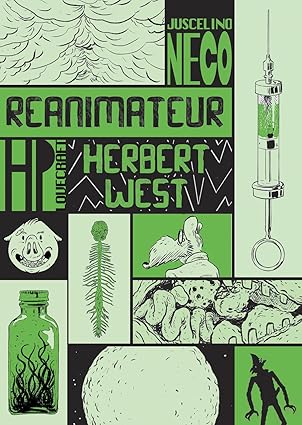
* New to me, a French BD comics adaptation of Lovecraft’s “Herbert West”. 136 pages, published in April 2025. The characters become cartoon animals.

* Hokusai’s famous “Mount Fuji” series of prints gets a Lovecraftian monster-makeover, in a new 126-page artbook from Japan. Could be a quick AI makeover, I’ve not sure. Buyer beware.

* A McFarland book I missed noticing around Christmas time last year, Fantastic Adventures in the Comics: Rockets, Genies, and Bug-Eyed Monsters, 1940s-1980s (December 2025). Only covers American comics, and in just 120 pages. So it sounds like it’s aimed at newbie readers/collectors looking for an authoritative survey?

* Ghost Clinic reports that Mike Lyddon’s new screen documentary Lovecraft In Florida: DeLand and the Barlow House won ‘Best Short Documentary’ at A Night of Horror Film Festival and will be released on Blu-ray later in 2026, along with…

his 2022 documantary Haunted Thrills which had tremendous success on the film festival circuit. The film explores the pre-code science fiction and horror comic book era of the late 1940’s to mid 1950’s. It features commentary by three living pre-code comic book artists – Joe Sinnott, Everett Raymond Kinstler, and Victor Carrabotta, all of whom have sadly passed away. The Blu-ray will be a special signed and numbered limited edition release, so please bookmark this website as we near the release date, probably in October of 2026.

* And finally, the leading mega-AI Claude has its latest hottest version. It’s named ‘Claude Mythos’. Nope, the name is not an April Fool, apparently. Said by official leaked documents to be the secret next-gen Claude that is already built, and which in the words of the developers is… “by far the most powerful AI model we’ve ever developed”. The name was apparently given because it’s so scary.


— End-quotes —

“I am, I hope, now a complete machine without a disturbing and biassing volition; a machine for the reception and classification of ideas and the construction of theories.” — Lovecraft to Anne Tillery Renshaw, June 1921.

“About Brown [University students] rioting — yes, I did take a genuine pride in the virile energy and healthy antinomianism displayed [by the boys] on Memorial Day. […] It makes me sad to reflect that I’ve grown too old and grey to mix into inspiring rough-and-tumbles like this. I’d love to crack skulls in the name of free individualism, and smash office-appliance-shop windows as a symbolic nose-thumbing at the age of commerce, machines, time-tables…” — Lovecraft to Morton, July 1929.

“Anybody who thinks that men […] are able consciously to mould the effect and influences of the devices they create, is behind the times psychologically. Men can use machines for a while, but after a while the psychology of machine-habituation and machine-dependence becomes such that the machines will be using the men — modelling them to their essentially efficient and absolutely valueless precision of action and thought …… perfect functioning, without any reason or reward for functioning at all. [We will] no longer measure men as human beings, but as effective fractions of a vast mathematical machine which has no goal or purpose save to increase the precision and economy of its own useless and rewardless motions.” — Lovecraft to Morton, October 1929.

“Just read the new Astounding [pulp magazine]. Essentially mediocre & conventional — machine-made stories with no distinction in style or atmosphere.” — Lovecraft to Derleth, September 1933.

Weeird Tales

14 Sunday Sep 2025

Posted by asdjfdlkf in AI, Lovecraft as character

≈ Leave a comment

In an alternative timeline, Lovecraft not only ‘got the cover’ of Weird Tales, he was the cover. As fantastic tales of his alter-ego Randolph Carter became as popular as those of Seabury Quinn did in our timeline…

SDXL + LoRAs inc. my new Lovecraft character LoRA. I find that SDXL can sometimes generate somewhat reasonable text if placed in inverted commas in the prompt and prompted for a vintage magazine or poster, e.g. “Weird Tales”. Who knew?

HPLinks #53 – Penumbra, Lovecraft Annual, Dreamlands RPG, del Toro collection for sale, Beowulf vs. Conan, Conan vs Cthulhu, and more…

03 Wednesday Sep 2025

Posted by asdjfdlkf in AI, HPLinks, Lovecraftian arts, Scholarly works

≈ Leave a comment

HPLinks #53.

* S.T. Joshi’s annual journal has a new issue listed, Penumbra: A Journal of Weird Fiction and Criticism, No. 6 (Autumn 2025). Among others…

Mario Sanchez Gumiel contributes a profound analysis of the Spanish writer Pompeu Gener, whose work shows analogies with Lovecraft, Machen, and other leading weird writers. John C. Tibbetts supplies a broad overview of the weird work of English writer Saki (H.H. Munro)

* S.T. Joshi’s Blog also announces a new volume of his essays, Aspects of the Weird Tale (2025), featuring among others… “several new essays on Lovecraft [and] a long essay on the weird work of Sir Arthur Conan Doyle”. Available now as a budget Amazon ebook, and on receiving the 10% free sample I also see an essay on the rural/city divide in Dunsany, and that the Lovecraft essays are on Lovecraft’s Egyptian mummies, poetry about Lovecraft, Arthur S. Koki on Lovecraft, “Mountains” (unknown focus), Lovecraft and Weird Art, and Lovecraft in Audio.

* Also on Amazon, the latest Lovecraft Annual No. 19 (2025) is now listed there and appears to be shipping. No sign of its fellow annual journal The Dark Man: Journal of Robert E. Howard and Pulp Studies since 2023, so far as I can find.

* New in English in a Turkish open-access journal, the substantial “Translating Violence and Horror in Lovecraft’s Cthulhu Mythos: A Comparative Study of English & Turkish Versions” (2025).

* From Charles University in Prague, a dissertation in English offering a “Literary Comparison of Beowulf and R.E. Howard’s Conan the Barbarian” (2024). Freely available online.

* A stop-motion short advert, publicising a new Conan action-figure toy… “features the new Conan figure in battle with Lovecraft’s Cthulhu”. No link here, as Animation Magazine blocks all VPN users in an obnoxious manner.

* My Tolkien Gleanings newsletter is now available at a new URL. Tracking and linking news of Tolkien scholarship, though only occasionally noting items concerning The Silmarillion and the invented languages. Please update your bookmarks and RSS feeds etc.

* Free and available now, my distillation of Lovecraft for NovelForge AI, the $50 novel-writing software. The packages should work with the trial version of this Windows software, which so far as I know never expires.

* The Tolkien and Fantasy blog has a new post “Correcting the ‘Facts’ about A. Merritt’s Autobiographical Writings”. As you’ll recall, Merritt was admired by Lovecraft and idolized by the early readers of Weird Tales magazine.

* New on Archive.org, a run of the British edition of Astounding magazine. Looks like it’s 1943-1955, and perhaps not a complete run for those years.

* How high will it go? A copy of Lovecraft’s Selected Letters Vol. 1 (1911-1924) in fine condition, on eBay with six days to go.

* A new issue of Undefined Boundary: The Journal of Psychick Albion.

* London Uncanny: A Gothic Guide to the Capital in Weird History and Fiction (2025).

* New to me, the forthcoming table-trembler The Palgrave Handbook of the Zombie (January 2026). Setting a new record in jaw-dropping academic book pricing, at £550 ($740), albeit for a brain-eating 1,900 pages. One hopes that the editor has read the recent essay in the Lovecraft Annual, which very persuasively demonstrates that Lovecraft created the modern zombie and states that the master’s standing as “the font of the modern zombie is unchallengeable” (Lovecraft Annual 2020). Lovecraft is, however, not mentioned in the book’s blurb.

* The risk of Californian wildfires, and concerns about his old age, are reportedly leading movie-maker Guillermo del Toro to auction off part of his magnificent collection. The auction is being held soon via Heritage Auctions, and one hopes there will be a fabulous free PDF catalogue. TheoFantastique has the details and links. I’m uncertain if del Toro’s life-size H.P. Lovecraft sculpture will be under the hammer. Possibly not, I would guess.

* And talking of large amounts of vintage pop culture, free at CivitAI is a new generator of Scooby-Doo backgrounds for use with SDXL image-generation models. Spooky old-school 1970s Scooby Doo-style animation backdrops galore, freely re-usable… just add your own prompts.

* Grognardia’s blog reports that he’s been so taken by Lovecraft’s Dreamlands tales of late that he’s… “now devoting myself to the development of an Old School Essentials-derived Dreamlands RPG, Dream-Quest.” Not AI, I assume. I would love a well-made text-based Dreamlands adventure as a solo role-play that was run and managed by an AI. With the player untroubled by fussy-dusty stats and rules, which would nevertheless still be whirring away in the background. Nothing like that is currently available, so far as I know.

* And finally, Pickman’s Hidden Atelier is a new YouTube channel that will aim to review only Lovecraftian videogames. And fairly obscure ones, by the look of it — first up is a 1991 Sega Mega Drive title.


— End-quotes —

“I studied Old London intensively years ago, & could ramble guideless around it from Hampstead Heath to the Elephant & Castle!” — Lovecraft to Galpin, November 1933. (Mooted in a letter as the basis for an unwritten Lovecraft story starting in Old London and ending in Roman horrors elsewhere).

“In London there is a man who screams when the church bells ring. He lives all alone with his streaked cat in Gray’s Inn, and people call him harmlessly mad.” — Lovecraft, opening lines of “The Descendent” (fragment).

“The [post]card from antique Londinium [London] duly came, & filled me with envy at your opportunity to behold civilisation’s capital, if only for a single full day. If I were in Europe, I would devote not less than 2 or 3 weeks to London — & might not get outside of Britain at all. The British Museum card surely reveals one of my (or Klarkash-Ton’s or Sonny Belknap’s) extra-human monsters in disguise — indeed, I am positive that this entity reached Java as a relique of sunken Mu, or of the still more monstrous & fabulous R’lyeh! Thanks!” — Lovecraft to Galpin, August 1932.

The most likely Java deity image in the current British Museum collection, which would also make for a postcard, would be this fine drawing of an elephant-god sculpture…

“Coming early to London, I saw as a Child many of the celebrated Men of King William’s Reign, including the lamented Mr. Dryden, who sat much at the Tables of Will’s Coffee-House. With Mr. Addison and Dr. Swift I later became very well acquainted, and was an even more familiar Friend to Mr. Pope, whom I knew and respected till the Day of his Death.” — Lovecraft uses his own childhood attic encounter with the 18th century wits, in his “A Reminiscence of Dr. Samuel Johnson”.

“I share most emphatically your regret at the distance between 278 Grove & 598 Angell, & wish we both lived in Old London, within walking distance of Will’s & of each other’s homes.” — Lovecraft to Kleiner, December 1918. “Will’s” coffee-house was a key London gathering place of 18th century wits and poets.


Release: Lovecraft for NovelForge

01 Monday Sep 2025

Posted by asdjfdlkf in AI, Lovecraftian arts, Scholarly works, Unnamable

≈ 2 Comments

As promised, I’ve released my free Lovecraft dictionary and assistant. This is a free add-on for installing into the creative-writing software NovelForge AI 3.x. The add-on enables the writer to be guided by words and examples from the fiction of H.P. Lovecraft, as they write.

The ‘made by one man’ software NovelForge can be had from Medichance, and is for Windows only. Last time I looked the free trial version does not expire and is only very lightly crippled, such as not allowing the creation of a new dictionary and assistant. I have the paid version of the software ($50, one-time purchase), so was able to use it to make these Lovecraft add-ons. Thus, if you’re on Windows then you can install the free trial and enjoy this free Lovecraft add-on in perpetuity.

NovelForge does support your local LLM AIs and also free cloud AIs, but this Lovecraft dictionary (thesaurus) and assistant are not AI. More of a unique ‘half-way house’ towards AI, guiding you toward the tone and style of Lovecraft… but not actually writing it for you.

The assistant add-on may also be useful for scholars, since it can instantly display all of Lovecraft’s sentences which use a word you just typed…

… though it won’t tell you which story they come from.


Download, unzip and then…

1) Place Lovecraft.ast and Lovecraft.jpg in C:\Users\YOUR_USER_NAME\Documents\NovelForge\Assistants

2) Place Lovecraft.dic and Lovecraft.jpg in C:\Users\YOUR_USER_NAME\Documents\NovelForge\Dictionaries

Then load NovelForge and use the user interface to load both add-ons.

Sadly NovelForge has no ‘dark mode’, which will be a deal-breaker for many writers. But Windowtop can force that. Not ideal, but it’ll do until NovelForge does ‘dark’ natively.


Lovecraft’s letters, poetry, essays, and ghost-writing have not been ingested. I may in time create dictionaries and assistants for those as well. For instance I have the Morton letters in .TXT format. Those were downloaded from Amazon as a .AZW3 local backup of a purchased Kindle ebook, before they stopped that. But I would first need to find an AI text processor that can identify and auto-remove all the footnotes, since that’s not something I’m going to do by hand.

A trip to Cydonia

23 Saturday Aug 2025

Posted by asdjfdlkf in AI

≈ Leave a comment

A first proper experiment with ‘modern, 2025’ AI writing, using Msty for Windows (not Msty Studio) as the desktop host. The Drummer’s new local Cydonia-24B-v4 Q2-K model proved the best and it also has very reasonable speed in its lightweight Q2 GGUF form, running on a basic entry-level 3060 12Gb graphics card.

I requested a story about a frog, a rocketship and a library, written in the style of Nabokov. A tough test, I thought.

Here’s the 30% re-written and slightly expanded result, blended with a few little ‘nice touches’ spotted in results had from the lesser models Gemma 3 12b and Mistral Instruct 7B.


An Encounter With The Unnatural:

Walking briskly through his high and labyrinthine aisles, the Unnatural History librarian wore his usual frown. He felt it was depressing to see so many dust motes dancing lazily, down the long light shafts that fell across his gloomy paths. Dust smacked of decay. Suddenly he adjusted his round spectacles and gasped. In all his time in this section he had passed many strange items left by the borrowers — potted fungi from the outer Solar System with some very peculiar growth patterns; student watercolor renderings of imaginary animals yet to be created by genetic engineering, a silvery packet of black seeds with a label that would send them plunging into the clouds of Venus — but nothing quite like what he now found where the aisles of ‘Classical Natural History’ shaded over into ‘Antique Philosophy’.

It was a tiny specimen of what appeared to be the Common Frog of Old Earth, Rana temporaria, its emerald hide standing out quite remarkably even in the dim light, and perched upon the silvery cone of a strangely detailed miniature rocketship. The frog made no damp and sudden movement that might show curiosity about its discovery. Its eyes blinked not at the observer’s presence. It was unaware that it had, for a moment, brilliantly excelled all the library’s surrealist poems. Not by words, but by such an unlikely proximity and stillness.

The librarian was an elderly man of Old Mars and thus a grandchild of colonists averse to the poetic. Yet he felt it his duty to wonder about the temporal history of this curious conjunction. Perhaps the creature had arrived with its tiny ship or perhaps — his prosy mind rejected this thought as absurd yet delightful — the tiny frog was itself the pilot. Some astronaut from a water planet, come to seek knowledge beyond his own amphibian ponds? Certainly the rocketship seemed to pulse faintly beneath the clinging frog, like a heart beating and as if newly arrived from destinations and light-years undreamed.

Deciding the matter to be far too curious and detailed to be some student prank, the librarian gently lifted both clinging frog and rocketship, walked some distance and placed them on a table exactly equidistant between ‘Old Earth Science Fiction’ and ‘Classical Natural Philosophy’. Then, with a swirl of his cloak, he continuing on his vigilant way. The frog, oblivious to its own absurdity, merely flicked out its tongue, tasting a few dust motes from the library’s honeyed light shafts. A few young library patrons passed it occasionally, without noticing.


Kind of reminds me of a strange 12-page standalone comic-strip that one might have once encountered in the pages of some old 1980s Heavy Metal magazine, illustrated by Caza.

HPLinks #51 – birthday presents, NecronomiCon dates, an Italian Lovecraft festival, Lovecraft’s Calculator, periwigs and more…

20 Wednesday Aug 2025

Posted by asdjfdlkf in AI, HPLinks, Lovecraftian arts, Scholarly works

≈ Leave a comment

HPLinks #51.

* Eusebeia – a mystical Lovecraftian short film… 3DVF has it that… “the film evokes a universe worthy of Lovecraft”. Freely available on YouTube.

* Dates have been announced for the NecronomiCon Providence 2026, 13th-16th August 2026. No further details or trailer-poster, as yet.

* My Lovecraft LoRA for SDXL and ComfyUI, now freely available in time for Lovecraft’s Birthday. My next HPLinks will hopefully have more links to birthday goodies from others.

* The 2025 birthday has been used as a means of re-promoting the Italian essay collection Yog-Sothothery (October 2024), and the new promo usefully has a few details of what’s inside.

Seven essays in Italian in total, including…

    – a survey of places in New York City frequented by Lovecraft

    – an examination of the scientific details in “At The Mountains of Madness”

    – a study of mass-media ‘adaptations’ of Lovecraft and their distortion by leftist politics

Also announced is a spin-off from the book…

The Yog-Sothothery project is a multimedia project inspired by Lovecraft’s imagination, evoking the profound symbiosis between Providence author and and his dark myths. It will be articulated through events, audiovisual productions and interactive content that will be presented in the coming months in Rome and L’Aquila, on the occasion of two symbolic anniversaries. 100 years of “The Call of Cthulhu” (set in 1925), and 50 years of the publisher Chaosium. Among the promoters and supporters of the project include L’Aquila Reborn, Rome Creative Hub, People and Territories, Lightson, Mokona’s, Studio Comunico, Rome Film Academy.

* Live on YouTube later today, the R.E. Howard Foundation on “Robert E. Howard & H.P. Lovecraft: Opinionated Pen Pals”.

* Newly released, the book Lovecraft’s Calculator: Physics, Paradox, and a Scientific Guide to Cosmic Horror…

This book doesn’t describe cosmic horror. It proves it. Using real equations, peer-reviewed papers, and a narrator who has clearly been awake too long reading arXiv at 3 a.m., Lovecraft’s Calculator drags you down the spiral staircase of reality, one unsettling scientific fact at a time. You’ll explore vacuum decay, black holes, dark energy, Boltzmann brains, and the nauseating possibility that the universe itself is a malfunctioning simulation with no tech support.

There’s an affordable Kindle ebook edition. How much it actually references Lovecraft’s work and his 1900s-1930s scientific context is unknown.

* In the latest edition of the journal Zeitschrift fur Katalanistik, the Catalan article which translates as “Ofelia Dracs and the reception of H.P. Lovecraft in Catalan literature”. Freely available online.

* From Poland in English, and published in the latest issue of a Malaysian open-access journal, “Which hollow is Witches’ Hollow? : an empirical study on translating toponyms”…

It was decided that the proper name for the study should be Witches’ Hollow — a toponym from a short story that was first published in a collection of weird fiction tales, “The Watchers Out of Time”, by August Derleth. […] it takes place in the cult world of Cthulhu Mythos, inspired by Lovecraft’s works and notes he left, and stylized as Lovecraftian, but not authored by Lovecraft.

* On DeviantArt, Red-Vanguard has new illustrations for The Horror at Martin’s Beach, The Black Bratt of Dunwich, and The Dunwich Horror, in the sort of artistic style one imagines Lovecraft might have had is he had been published on the covers of the ‘slicks’ rather than inside the ‘pulps’. Red-Vanguard also has earlier works for “The Lurking Fear” and others.

* Grognardia blogs on Lovecraft’s awe…

What often goes unspoken is how beautiful the weird can be. The shimmering city of the Elder Things beneath the ice of Antarctica; the dream-haunted vistas of Kadath; the mind-transcending journey of Randolph Carter through the stars. These are not scenes of mere terror. They are awe-inspiring in the truest sense — sublime and strange, but also profoundly glorious.

* Another new blog essay from Grognardia is “Of Periwigs and Pallid Masks”, which co-incides nicely with my now completed and very enjoyable re-reading of Dexter Ward…

[What fascinated the Anglophile Lovecraft was that time when] Boston remained loyal to the [British] Crown, when the [American] frontier still loomed dark and unknown, and when superstition and science existed in uneasy proximity. […] To the best of my knowledge, Chaosium has never released a full supplement set in 17th- or 18th-century British North America. […] The early 18th century was a period when science, superstition, and theology all vied for dominance in the human mind. A figure like Emanuel Swedenborg, for example, could be taken seriously not only as a scientist and engineer but also as a visionary who conversed with spirits. That intellectual ambiguity suits the Mythos perfectly.

* And finally, ‘Oh noes, we iz expozed… burn th periwigs, guyz!’ New on YouTube, the documentary Inside America’s Insane Lovecraft-Obsessed Fraternity.


— End-quotes —

“I’ve never attempted long hair [i.e. in the decadent manner] because I always think of myself in a periwig rather than following the post-1775 fashion of wearing my own hair. The common thing in periwig days was to clip or even shave the head — so I worry along with close haircuts and imagine my wig hanging on a wig-block or the bedpost.” — Lovecraft to Virgil Finlay, October 1936.

[My] “dream-self has come to represent me so perfectly that in waking hours I sometimes feel odd for lack of my three-cornered hat, powdered periwig, satin small-clothes, silver sword, and buckled shoes.” — Lovecraft to Robert E. Howard, January 1933.

“… one June day in 1917 I was walking through Swan Point Cemetery with my aunt and saw a crumbling tombstone with a skull and crossbones dimly traced upon its slaty surface; the date, 1711, still plainly visible. It set me thinking. Here was a link with my favourite aera of periwigs — the body of a man who had worn a full-bottom’d wig and had perhaps read the original sheets of The Spectator. Here lay a man who had lived in Mr. Addison’s day, and who might easily have seen Mr. Dryden had he been in the right part of London at the right time! Why could I not talk with him, and enter more intimately into the life of my chosen age? What had left his body, that it could no longer converse with me? I looked long at that grave, and the night after I returned home I began my first story [of my adult life]” — Lovecraft to Galpin, April 1920.

[Lovecraft recalls being a boy who had discovered Alden’s] THE READER [… This old book] was so utterly and absolutely the very thing I had been looking for, that I attacked it with almost savage violence [for it] reflected in all its completeness the Georgian rhetorical tradition of Addison, Pope, and Johnson, which had survived unimpaired in America even after the Romantic Movement had begun to modify it in England. This, I felt by instinct, was the key to the speech and manners and mental world of that old periwigged, knee-breeched Providence whose ancient lanes still climbed the hill […] Little by little I hammered every rule and precept and example into my receptive system, till in a month or so I was beginning to write coherent verse in the ancient style” […] “At the same time I was reading the 17th and 18th century poetical translations of the classics and the old Queen Anne essayists as fast as I could, so that periwigged Georgianism was absorbing me as utterly as if I had been actually born in its midst.” — Lovecraft to Dwyer, March 1927.


Lovecraft’s Birthday: my SDXL LoRA freebie

20 Wednesday Aug 2025

Posted by asdjfdlkf in AI, Lovecraftian arts

≈ 1 Comment

Happy Birthday, H.P. Lovecraft! My present this year is a ‘Lovecraft’s likeness’ add-on for guiding AI image generation. Specifically, my Lovecraft SDXL character LoRA. Included is a workflow that also does automatic facefix at a higher resolution, useful for when he’s in the middle-distance of an image. As you can see below, a middle-distance Lovecraft (that looks at bit more like William Burroughs) becomes more Lovecraft-like and especially so around the eyes. Not perfect, but better.

The middle-distance fix-up is achieved by an ‘automatic facefix’, which re-renders the face at a higher resolution then seamlessly patches it in. My supplied workflow gives you the auto-facefix plus a Controlnet which can process using either MistoLine (extract lineart as a guide to the image generation) or OpenPose (extract a posed figure as a guide). Above you see an old Sherlock Holmes film-still guiding the image via a MistoLine Controlnet, along with the Lovecraft LoRA. The head is angled, to show that angles are possible. Emotions can also be prompted for.

Note that making the workflow functional will require the host software ComfyUI, plus several ‘custom nodes’ and models. The ComfyUI workflow has the details of these. Of course one also requires a good NVIDIA graphics card in the PC, with a 3060 12Gb being generally regarded as the base entry-level.

Change the image-generation prompt to do things like having 18th century clothes and settings…

Include hpl in the prompt to trigger the LoRA into action.

Enjoy!

HPLinks #47 – vitalist Lovecraft, Lovecraft in the Po Delta, re-evaluating CAS, a new Lovecraft Atlas, and more…

24 Thursday Jul 2025

Posted by asdjfdlkf in AI, HPLinks, Lovecraftian arts, Maps, Podcasts etc., Scholarly works

≈ 2 Comments

HPLinks #47.

* More Lovecraft + philosophy. New from Hungary, “Lovecraft, antimodernism and new vitalisms” (2025)… “H.P. Lovecraft’s oeuvre is considered as a specific genre iteration of antimodernist themes, but also as a formative influence on the philosophy of speculative realism.” In Hungarian from the Dept. of Philosophy at Zagreb, and freely available for download.

* Overthink podcast Episode 134: Weirdness with Eric Schwitzgebel, interviewing Eric about his philosophy book Weirdness of the World (Princeton University Press, 2024). With a substantial discussion of the book Weird Realism: Lovecraft and Philosophy.

* Aetherium Arcana blog has a new short article on “Lovecraft and the Unconscious Structure of Empire”, followed by the new longer essay “Self-devouring Racism: Subversion and Collapse in Lovecraft’s Mythos”.

* New from Spain in English and open-access, “Development of Expert Systems by means of Large Language Models”. The authors feed Lovecraft’s fiction to a leading AI LLM, and have it try to find and map connections. Freely available online, those the images are rubbish quality and partly unreadable even in the source zip. This is as good as they get…

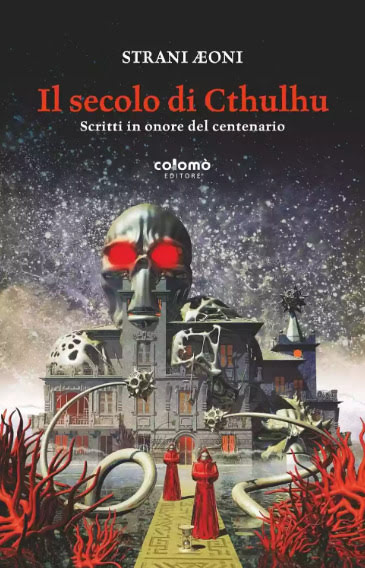
* Strange Aeons has a Catalog and Contacts link-list for the Italian Lovecraftians. Seems to have first appeared in 2023, and was last updated on 23rd July 2025.

* Also in Italy, Wu Ming 1 on Lovecraft, appearing at the Lunatico Festival. On 25th July 2025 he presents his new novel featuring Lovecraft-as-character, and then… “the geographer Francesco Visentin and Andrea Olivieri will dialogue with the author”. Followed by a presentation of…

The graphic-musical project [that depicts] the imaginary journey of H.P. Lovecraft in the Po Delta in 1926, between hallucinated visions, esoteric confraternities and monstrous water creatures. Designed by the Italian-English musician Jet Set Roger and the Serbian cartoonist Aleksandar Zograph, preseting a concert event that merges music and literature in a game of cross-media references with the Wu Ming novel.

* Decadent Serpent considers “The Reevaluations of Clark Ashton Smith”. Part of the discussion is of “The Quest of Iranon” by Lovecraft, compared to “Xeethra” by CAS.

* Black Gate has a long event-report with excellent photographs, “Post Oaks and Sand Roughs: A first trek to Howard Days” 2025.

* A useful new survey article of all the “Biographies of Robert E. Howard”, issued prior to the new and well-reviewed biography from the University of North Texas Press.

* Forthcoming in French, Atlas Lovecraft, a 180-page book that sounds like a cartographic atlas for Lovecaft. Due in October 2025 from reputable publisher Bragelonne.

A completely unprecedented atlas offering tangible geographic and cartographic representations of the emblematic places of Howard Phillips Lovecraft. An illustrated work in colour presenting plans of Providence, the State of Massachussetts, Arkham, Innsmouth, Kingsport, Dunwich and its region, a map of the Antarctic Expedition and a cartographic statement of mountain areas… [etc]

* And finally, a LoRA add-on for Flux, meant for generating images of whimsical toon Happy Shoggoths. Not on CivitAi, thankfully — since (as of today) the go-to site for creative AI is effectively banned here in the UK. I’m happy now that I nipped in just in time with my Windows 11 Superlite upgrade, and thus I now have the SD 1.5 turbo LoRAs, SDXL, Flux Kontext and Wan2.1 all downloaded and set up with workflows and ComfyUI to run them.


— End-quotes —

“I have always been fond of maps & geographical details (I’ve drawn a map of “Arkham’ to keep my local references straight), & my lifelong antiquarianism has caused me to lay zestful stress on historic backgrounds & traditional architectural minutiae.” — Lovecraft to Fritz Leiber, Jr., February 1936.

“I used to row [in a boat] considerably on the [River] Seekonk, which you’ll find on your city map … and also on general maps of R.I. Often I would land on one or both of the Twin Islands — for islands (associated with remote secrets, pirate treasure, and all that) always fascinated me.” — Lovecraft to Duane Rimel, April 1934.

[Lovecraft is delighted to find that he can circumnavigate the city of Charleston entirely via its many graveyards …] “the President of the Charleston Garden Club some time ago form’d the notion of mapping out an idyllic cross-town walk which might include as many as possible of these with a fair degree of continuity.” — Lovecraft, “An Account of Charleston”.

[Lovecraft rises to the very top of the highest building in New York City …] “The assembled clan’s first move was up — clean up to the top of N.Y.! It costs half a ducat [dollar] per rube [person], and is worth it. Loveman was dizzy, but your grandpa wasn’t — gawd knows how hard I worked when I was ten years old to conquer my native tendency to dizziness from altitudes! I walked on high railway trestles, and hell knows what not! But I digress. All Manhattan, Brooklyn, and Jersey City lay below, outspread like a map — in fact, I told Mortonius [Morton] that the city-planners had done an excellent job in making the place almost as good as the map in my Hammond Atlas at home.” — Lovecraft to Maurice Moe, May 1922.

HPL in the 18th century

12 Saturday Jul 2025

Posted by asdjfdlkf in AI, Lovecraftian arts

≈ 1 Comment

HPL in the 18th century. Would he have been a College Hill gent as he hoped, or (more likely) a jobbing waterfront printer and local news-sheet editor?

No, not the result of the new Flux Kontext, which is a bit ‘off’ in terms of this sort of thing since it works from a single image. Also slow. Instead I made an SDXL LoRa of his face and shoulders, and used it with the superfast four-step SDXL checkpoint realvisxlV50_v50LightningBakedvae.safetensors   Considering this generates a 1024px image in about 3 seconds on a very modest 12Gb graphics card, the quality here is acceptable. Not superb, a little glitchy if you look hard for it… but acceptable. And yes, tweaking the prompt will cause him to smile. But I thought I’d spare the reader that.

The new Flux Kontext does have its uses though, including easy manga-fication of images.

HPLinks #44 – Whelan in the Mountains, Howard Days recordings, sea serpents and saurians, and more…

02 Wednesday Jul 2025

Posted by asdjfdlkf in AI, Lovecraftian arts, Podcasts etc., REH, Scholarly works

≈ Leave a comment

HPLinks #44.

* Deep Cuts this week examines “Black Thirst” by C.L. Moore and notes Lovecraft’s several reactions to the story when it appeared in Weird Tales in 1934.

* From the Chalmers University of Technology in Sweden, a Musical Engineering team issue a final report for 2025. Freely available online…

We chose the Cthulhu mythos as a conceptual anchor — not for its narrative, but for its emphasis on the “indescribable” and the unseen, which aligns with sound’s capacity to express fear beyond the visual realm. Guided by psychoacoustic theory, we designed two contrasting video clips with different sonic objectives.

* On SubStack, “The Life of Michael – artist Michael Whelan at 75”. Showing and discussing his painting “The Astrophysicist” (2008). Elsewhere, DMR brings news that Whelan is not resting on his 50 years of laurels, and that… “he is, at this moment, finishing up a glorious illustrated version of Lovecraft’s ‘At the Mountains of Madness’ for Centipede Press.”

* Broken Frontier reviews Gou Tanabe’s “The Colour Out of Space” graphic-novel in its just-released English translation. Spoilers-alert (for those who haven’t read the tale, which apparently includes at least one of Lovecraft’s most vocal critics).

* The latest The Good Friends of Jackson Elias podcast has a long discussion of “Art and the Cthulhu Mythos”, and the topics-list suggests the listener will enjoy widely-spiralling flights through esoteric dreamlands.

* From an Argentine journal, a new survey of “Nueva ficcion extrana Latinoamericana: hibridaciones narrativas, cine y juegos de rol” (‘New Latin American Weird Fiction: narrative hybridations, cinema and role-playing games’) (2025). Freely available online.

* Faunus 51 has been published, this being the scholarly journal devoted to Arthur Machen.

* A new scholarly overlay journal which may interest some, Libertarian Literary and Media Criticism. The editors welcome your news of items and links of interest.

* Lots of R.E. Howard audio material this week, in the wake of the annual Howard Days event in Texas. Recordings now online include “Bob Howard & the Spicy Adventurers” (from PulpFest, rather than Howard Days), “Robert E. Howard in 1935, Professional and Personal”, “What’s Up with REH?” (on new publications coming down the dark river), “Spear & Fang” (REH’s first published story), and “Bob’s Photos”. Also, new on YouTube is a good free reading of the Solomon Kane tale “Rattle of Bones” by Robert E. Howard. A weary Solomon visits a forest inn for the night, with a travelling companion.

* Talking of rattling bones, a free LoRA add-on for models based on the AI image generator SDXL titled Wizard’s Vintage Creepy Creatures. This is Wizard as in ‘the vintage weekly British comic’. This well-loved title may recalled by British readers of a certain age, who may also recall the ‘Ken Reid’s Creepy Creations’ splash pages.

Ken (or perhaps a company heavily inspired by him) was also into generative art long before anyone else, shipping a long-ago ‘dial a monster’ cardboard-constructed frame to toy shops. Cleverly constructed with knobbed-dials which changed the head, eyes, nose, mouth/chin parts, to assemble an ever-changing random ‘creepy portrait’…

I recall it fondly from boyhood, but have never been able to find any trace of it since it was jettisoned during a house move. Until a Facebook page popped up recently, from the owner of what must now be one of the rarest vintage toys in the world. He too had been utterly unable to discover anything about it, but he managed to obtain one after a long search.

* Talking of generative image-making, I’m currently testing the new free image-editing AI called Flux Kontext Dev run in ComfyUI. I find it excellent for difficult watermark removal (e.g. a slip of cellophane with lettering on it saying “DO NOT COPY”, placed over the image of an eBay postcard). But it’s too crude for auto-colorisation of b&w images, compared to online services such as Palette or Kolorize. That’s a pity, and its line-art/comic style-transfer also leaves much to be desired in terms of subtlety. It can however easily take a head-and-shoulders picture and envision the person in a new environment. Such as Lovecraft riding the ‘last bus to Innsmouth’, here made by using Khoi Nguyen’s digital sculpt of Lovecraft’s head as the seed…

I’ve yet to explore its similar full-body capabilities, which apparently include the ability to keep intact the character costumes in the seed image (e.g. full-body character concept-art).

* For the real Lovecraft, visit the Wisconsin Historical Society H.P. Lovecraft | Photograph page, as there they offer the option to purchase a large version. Hopefully without what looks like a dreadful bit of scanner-moire across HPL’s cheek. Though perhaps that’s there to stymie AI upscaling using Gigapixel AI. Or maybe just original protective cellophane. From their ‘Harold Gauer papers, 1935-2008’.

* Now that I run Windows 11 as my OS, I can also test various locally-run “LLM” AIs. Next up, installing LM Studio AnythingLLM MSTY and trying out some of the local AIs. Eventually ones for audiobook and music/FX production, and Zork-style ‘choose your own adventure’ text-RPGs. Not to mention eventually distilling a ‘Lovecraft reanimated’ AI chatbot. I know… it’s a pleasant summer (for once) in England and I should be jigging around and eating dodgy hot-dogs at music festivals etc. However, living the high-life costs $’s and AI is free. No contest, and no dysentery.

* Talking of audiobooks… Librivox has just released a Weird Tales Double Feature public-domain audiobook. This being “The Salem Horror” by Henry Kuttner and “The Black Kiss” by Henry Kuttner and Robert Bloch.

* In the latest edition of The Fossil, the worthy and long-running journal of the Historians of Amateur Journalism… “David Goudsward describes a sea serpent that was the subject of a 1923 story written by Sonia Greene [Lovecraft’s wife]”. Freely available online.

* Hot from Pulpfest, a recording of a panel on Pulp Paleontology”, on dinosaurs and dinosaur-hunters in the pulps.

* And finally, talking of digging up fossils… “Startling Percentage of Neuroscientists Say We Could Extract Memories From Dead Brains”, referencing a paper published in the open-access megajournal PLOS One. Maybe we could store them inside the Moon in future?


— End-quotes —

“A few days ago I went over to Anastasia Island […] Tall trees casting a sinister twilight over shallow lagoons — funeral garlands of trailing Spanish moss — and the whole ground surface alive with scaly, wriggling saurians” — Lovecraft visits an alligator island in Florida, May 1925.

“… many things I had lightly noted in the frescoes came back to me with new and terrible significance — scenes representing the nameless city in its heyday, the vegetation of the valley around it, and the distant lands with which its merchants traded. The allegory of the crawling creatures puzzled me by its universal prominence, and I wondered that it should be so closely followed in a pictured history of such importance. In the frescoes the nameless city had been shewn in proportions fitted to the reptiles. I wondered what its real proportions and magnificence had been, and reflected a moment on certain oddities I had noticed in the ruins. I thought curiously of the lowness of the primal temples and of the underground corridor, which were doubtless hewn thus out of deference to the reptile deities there honoured; though it perforce reduced the worshippers to crawling.” — from “The Nameless City”.

“I am not only a non-modern but a violent anti-modern. Intellectually I believe in nothing; aesthetically I believe only in the irradiate dreams of childhood. Sophistication I loathe and abhor with all the venom inherited from aeons of reptile and saurian ancestors in palaeolithic abysms of terrestrial history, and I even despise intellect when not directly concerned in the process of philosophical and scientific intellection. By this latter paradox I mean that I see nothing of beauty or pleasure in intellect, but only the hideous fascination of the forbidden Golden Door for the miserable Agib who stands before it.” — Lovecraft to Galpin, October 1921.

Last bus to Innsmouth

30 Monday Jun 2025

Posted by asdjfdlkf in AI, Lovecraftian arts

≈ Leave a comment

Playing around with a local install of Flux Kontext Dev. Not much use for auto-colourising old postcards (too crude, compared to Palette or Kolorize) or comic book pages (too inaccurate across panels), I’ve concluded. But one of the things it can do is take an image of someone and ‘re-imagine them’ in a new situation. Here’s Lovecraft on the last bus to Innsmouth…

Thanks to Khoi Nguyen for his digital sculpt of Lovecraft’s head, a render of which provided the seed image.

← Older posts


Please become my patron at www.patreon.com/davehaden to help this blog survive and thrive.

Or donate via PayPal — any amount is welcome! Donations total at Easter 2025, since 2015: $390.

Archives

  • April 2026
  • March 2026
  • February 2026
  • January 2026
  • December 2025
  • November 2025
  • October 2025
  • September 2025
  • August 2025
  • July 2025
  • June 2025
  • May 2025
  • April 2025
  • March 2025
  • February 2025
  • January 2025
  • December 2024
  • November 2024
  • October 2024
  • September 2024
  • August 2024
  • July 2024
  • June 2024
  • May 2024
  • April 2024
  • March 2024
  • February 2024
  • January 2024
  • December 2023
  • November 2023
  • October 2023
  • September 2023
  • August 2023
  • July 2023
  • June 2023
  • May 2023
  • April 2023
  • March 2023
  • February 2023
  • January 2023
  • December 2022
  • November 2022
  • October 2022
  • September 2022
  • August 2022
  • July 2022
  • June 2022
  • May 2022
  • April 2022
  • March 2022
  • February 2022
  • January 2022
  • December 2021
  • November 2021
  • October 2021
  • September 2021
  • August 2021
  • July 2021
  • June 2021
  • May 2021
  • April 2021
  • March 2021
  • February 2021
  • January 2021
  • December 2020
  • November 2020
  • October 2020
  • September 2020
  • August 2020
  • July 2020
  • June 2020
  • May 2020
  • April 2020
  • March 2020
  • February 2020
  • January 2020
  • December 2019
  • November 2019
  • October 2019
  • September 2019
  • August 2019
  • July 2019
  • June 2019
  • May 2019
  • April 2019
  • March 2019
  • February 2019
  • January 2019
  • December 2018
  • November 2018
  • October 2018
  • September 2018
  • August 2018
  • August 2015
  • July 2015
  • April 2015
  • March 2015
  • February 2015
  • January 2015
  • December 2014
  • November 2014
  • October 2014
  • September 2014
  • August 2014
  • July 2014
  • June 2014
  • May 2014
  • March 2014
  • February 2014
  • January 2014
  • December 2013
  • November 2013
  • October 2013
  • September 2013
  • August 2013
  • July 2013
  • June 2013
  • May 2013
  • April 2013
  • March 2013
  • February 2013
  • January 2013
  • December 2012
  • November 2012
  • October 2012
  • September 2012
  • August 2012
  • July 2012
  • June 2012
  • May 2012
  • April 2012
  • March 2012
  • February 2012
  • January 2012
  • December 2011
  • November 2011
  • October 2011
  • September 2011
  • August 2011
  • July 2011
  • June 2011
  • May 2011
  • April 2011
  • March 2011
  • February 2011
  • January 2011
  • December 2010
  • November 2010
  • October 2010
  • September 2010
  • August 2010
  • July 2010

Categories

  • 3D (14)
  • AI (72)
  • Astronomy (70)
  • Censorship (14)
  • de Camp (7)
  • Doyle (7)
  • Films & trailers (101)
  • Fonts (9)
  • Guest posts (2)
  • Historical context (1,096)
  • Housekeeping (91)
  • HPLinks (79)
  • Kipling (11)
  • Kittee Tuesday (92)
  • Lovecraft as character (58)
  • Lovecraftian arts (1,630)
  • Lovecraftian places (19)
  • Maps (70)
  • NecronomiCon 2013 (40)
  • NecronomiCon 2015 (22)
  • New books (967)
  • New discoveries (165)
  • Night in Providence (17)
  • Odd scratchings (984)
  • Picture postals (276)
  • Podcasts etc. (431)
  • REH (185)
  • Scholarly works (1,472)
  • Summer School (31)
  • Unnamable (87)

Get this blog in your newsreader:
 
RSS Feed — Posts
RSS Feed — Comments

H.P. Lovecraft's Poster Collection - 17 retro travel posters for $18. Print ready, and available to buy — the proceeds help to support the work of Tentaclii.

Proudly powered by WordPress Theme: Chateau by Ignacio Ricci.