• About
  • Directory
  • Free stuff
  • Lovecraft for beginners
  • My Books
  • Open Lovecraft
  • Reviews
  • Travel Posters
  • SALTES

Tentaclii

~ News & scholarship on H.P. Lovecraft

Tentaclii

Category Archives: Lovecraftian arts

HPLinks #99 – HPL in Hebrew, lost tales, short pulp, vintage Providence pics, and more…

27 Thursday Aug 2026

Posted by asdjfdlkf in HPLinks, Lovecraftian arts

≈ Leave a comment

HPLinks #99.

* Catharsis Publishing has released new Hebrew translations of “The Call of Cthulhu” and Robert E. Howard’s “The Black Stone”, in one volume. Another companion volume has translations of Lovecraft’s “Pickman’s Model”, “The Music of Erich Zann”, paired with R.E. Howard’s “The Hoofed Creature” and “Doves from Hell”. The Israeli Institute for Hebrew Literature has a 2026 Frankfurt Book Fair interview with the publisher, in English, though sadly it’s trapped in a horrible Instagram format.

* 334digital on “The Shape Outside the Frame: Lovecraft, Identity and the Haunting of Contemporary Culture”. 334 also has musings on the Lovecraft that might-have-been in lost and unwritten tales.

* Jeffery Pintabona on “Why You Should Read Pulp In 2026”. Among other reasons he suggests the relatively brevity will appeal to many…

It’s often a lot shorter than literary fiction. Pulp magazines were dominated by short stories, novelettes, and novellas. Rarely would you find something longer than 40,000 words. [Plus, very little padding but lots of pace]. Pulp writing emphasizes story, action, and keeping things moving. [Modern readers] might be intimidated by the thought of attempting to read a 500 page book, but they might feel comfortable braving a 200 pager.

* MPorcius revisits Weird Tales magazine for July 1925…

All three of the stories [Hoffman Price, Lovecraft, R.E. Howard] present a philosophy and/or try to make arguments about groups of people instead of just offering simple entertainment, and the philosophies and arguments are striking (if not necessarily convincing) and so contribute to the value of the stories, to their ability to maintain the reader’s interest.

* Deep Cuts digs up a never-reprinted 1942 tale “Hell in the Village” (1942) by Hugh Raymond, noting that…

the name of the villain, Von Junzt, was likely inspired by the author of Nameless Cults in the Cthulhu Mythos fiction of Robert E. Howard. Michel also tipped in references to Lovecraft and Aleister Crowley, which suggests the whole might be a nod to Weird Tales — with tongue firmly in cheek.

* A new German translation, Die Weiden Neue deutsche Ubersetzung . Mit Einfuhrung, Anmerkungen, Chronologie und Bibliographie (‘The Willows: A New German Translation. With Introduction, Notes, Chronology and Bibliography’).

* In the new Edinburgh Companion to Irish Literature and Periodical Culture (2026), the chapter “A Lord Abroad: Tracing the Fiction of Lord Dunsany in British and American Periodicals”.

* Previously unseen 1980s Providence photos from Steven J. Mariconda. The real and later-demolished Federal Hill church in “Haunter of the Dark”, and the actual Shunned House with interiors. Also the Patterson Museum in New Jersey, established by Lovecraft’s good friend Morton.

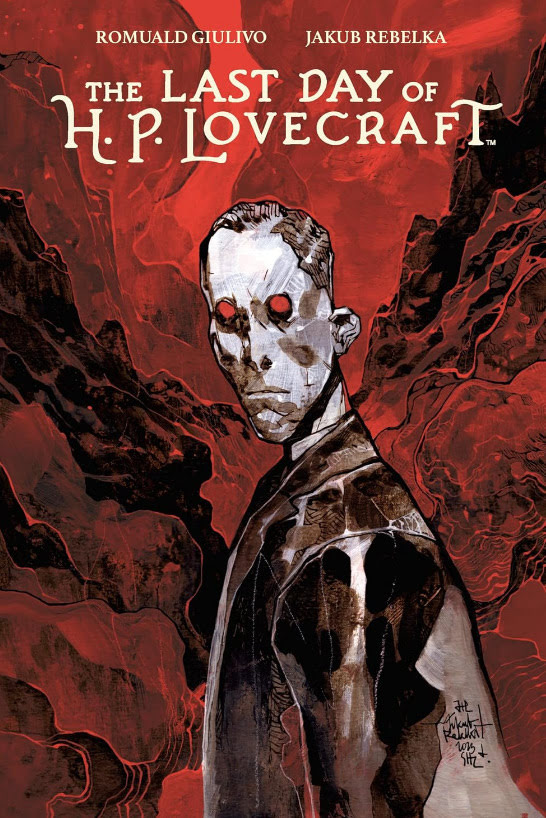
* Released as a Kindle ebook a week ago, The Last Day of H.P. Lovecraft graphic novel. Given the price and the download-size, I assume it’s the trade edition which collects all the floppy single-issues in one volume. I seem to recall it’s been a collected graphic novel before now, from a small indie publisher, but I assume this new trade edition from a bigger publisher will also include new extras?

* IGN‘s The Sinking City 2 Video Review…

Nobody really gets a happy ending in the Cthulhu mythos. But I was pretty satisfied with this latest, harrowing peek into its writhing innards.

* Now crowdfunding, the abandoned documentary Lovecraft: When the Stars are Right. Currently 20% funded with 33 days to go…

This is the first film ever made about H.P. Lovecraft — and almost no one has seen it. Shot in 1989–90, it features unique interviews with Lovecraft’s friends and colleagues. It has sat unfinished for more than thirty-five years. We need your help to complete it and release it for the first time.

* And finally, the very worthy HPLHS audiobook The Complete Fiction of H.P. Lovecraft, currently free for a “limited time” on Amazon UK when you get an Audible subscription. And seemingly free even if you just get the Trial…


— End-quote —

Talking of lost tales…

“I am still obsessed by the notion that one of the most extremely powerful of all tales would be an utterly realistic thing dealing with the sensations of a man deposited without a great amount of warning on another world. The one fatal weakness of nearly all interplanetary tales is that they almost completely ignore this factor of the situation. To my mind, the stupendous wave of emotion-incredulity, lostness, wonder, stark terror-incident to this supreme dislocation from mans immemorially fixed background would be so colossal a thing as almost to dwarf any events which might happen to a celestial traveller. I yet mean to write a tale whose one supreme climax shall be the hero’s discovery, after many torturing & ambiguous doubts, that he is on another world.” “… it would begin as a dream-phenomenon creeping on the victim in the form of recurrent nightmares, as a result of his concentration of mind on some dim trans-galactic world. Eventually it would enmesh him totally — leaving his body to vegetate in a coma in some madhouse whilst his mind roamed desolate & unbodied for ever above the half-litten stones of an aeon-dead civilisation of alien Things on a world that was in decay before the solar system evolved from its primal nebula. I doubt if I’d handle it as phantasy so much as a stark, macabre bit of quasi-realism. [..] In cold realistic fact any man with half an imagination would undergo a frightful mental shock at the mere idea of any contact with a planet other than this. This feeling would be the central element of any interplanetary story of mine; indeed, the whole thing would be more of a psychological study than an adventurous narrative…” — Lovecraft to C.A. Smith, letters of December 1929 and November 1930. Some basic components of the idea would appear to have been later woven into “The Shadow Out of Time” (written 1934-35).

HPLinks #98 – Night-gaunt puppetry, Avernus, NecronomiCon 2026, Providence litfest, thieves in the night, and more

22 Saturday Aug 2026

Posted by asdjfdlkf in HPLinks, Lovecraftian arts, New books, Podcasts etc., REH, Scholarly works

≈ Leave a comment

HPLinks #98.

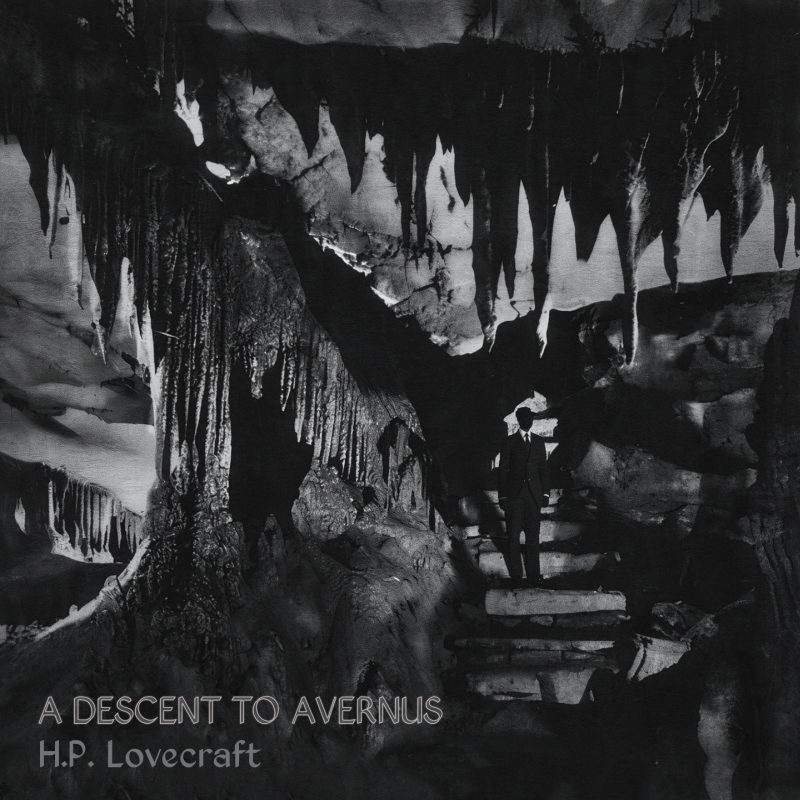
* For Lovecraft’s birthday, an audio reading of his “A Descent to Avernus” (1928).

* Released to YouTube especially for Lovecraft’s birthday, the handmade puppet film Night-gaunts (2023), and there’s also The Outsider (2024) from the same puppeteer.

* Edward Carmien reports from NeconomiCon 2026, in a series of posts. I Am a Man of Providence, 404: Lovecraft Not Found, A Day in Pictures, and a Post-NecronomiCon goodies round-up.

* The House of Shadows & Ink podcast interviews the Vendor Room Organizer at NeconomiCon 2026.

* A YouTube recording from this year’s Armitage Symposium at NecronomiCon, a paper on “Gothic Echoes: Lovecraft’s ‘Rats in the Walls’ and Walpole”.

* The latest 30+ Minutes with H.P. Lovecraft podcast considers Lovecraft’s letters, in the new episode “Letters from the Editor”.

* For Lovecraft’s birthday, philosopher Nick Nielsen considers “Lovecraft and the Epistemology of Cosmic Horror”.

* Grognardia has the birthday post “Reconsiderations: H.P. Lovecraft”.

* The Journal of Southern History reviews the 2025 Robert E. Howard biography from the University of North Texas Press. Mostly free.

* SpragueDeCampFan reviews the book Robert E. Howard’s Hyborian Age.

* A forthcoming book, The Strange World of H.P. Lovecraft: A Guide to the Characters and Creations of the Cthulhu Mythos which is …”due out in the UK on September the 1st” according to the author.

* New and free at Archive.org, the Peter Harrington well-illustrated auction catalogue for Quo Vadis? Visions of the Future.

* To Live and Let Die gives details about a forthcoming novel which will recount the full events behind Lovecraft’s Dexter Ward. All the events and meetings and trips that are only alluded to or mentioned in passing, apparently.

* A current Humble Bundle (i.e. digital goodies sold for charity) for Lovecraft videogames. 20 days left.

* Will Vigar considers pop culture and Lovecraft at length, in “Lovecraft Out of Context”, with his coda “Lovecraft Out of Mind”.

By turning Cthulhu into a plush toy, an encyclopaedic wiki database, or a videogame boss with a quantifiable health bar, contemporary culture is merely repeating the exact failure of Lovecraft’s academic protagonists.

* The Providence city council reportedly has plans to host Providence’s first official literary festival… “in late January 2027. Planning is still underway and details will be revealed soon”. Possibly an opportunity to talk about the siting of the Lovecraft statue? A plinth on the Twin Islands would be my suggestion, which would somewhat protect it from leftist vandalism.

* And finally, Locus magazine reports a break-in at L.W. Currey, during which a book thief stole first-editions of “The Shadow over Innsmouth” and “The Shunned House”, along with much else. The thief was apparently… “6’4″ tall, dressed in black and wearing pointed-toe dress shoes”. No night-black cape, which seems rather an oversight.


— End-quotes —

“… if any thief touches this outfit; why, by _____, I’ll smash his ______ for him with one fist whilst I pulverise his _____ _____ with the other, meanwhile kicking him posteriorly with both feet in their most pointed shoes and manner!” — Lovecraft to Morton, March 1926. [While living in Red Hook, Lovecraft has three suits, his overcoat, and Loveman’s radio set stolen one night by juvenile delinquents. Here he tells Morton that he has a new replacement outfit. In another letter, he comically remarked on his loss by drawing a cartoon of himself trudging the streets in a yeti-like costume composed only of his own hair.]

“… those night-daemons or personifications of darkness which appear in all Aryan mythologies as thieves or mischief-working entities more or less inimical to man. The element of thievery or mischief-making symbolises the theft of daylight by darkness.” — Lovecraft, “Some Backgrounds of Fairyland”.

[Lovecraft ligs his way into a party at the most fabulous private New Orleans mansion]. “I spend all my time in the Vieux Carre, & am constantly uncovering new street vistas, perspectives of massed chimneys, gables, & balconies, & garden-garnished inner courtyards. [… One very famous mansion is…] zealously guarded from vulgar sight by the proprietor. I hung around this place like a thief planning a large-scale cleanup, but was finally rewarded when a large party — evidently friends of the inhabitants — called & strolled about the patio & arcade with the gate open! [Lovecraft slips in on the tail, as if one of the party] — Lovecraft to Derleth, June 1932.

“I saw that Wollheim article dealing with Hugo the Rat [i.e. Gernsback] — through the kindness of a bright young member of the Science fiction League, Kenneth Sterling, who has recently moved to Providence. It was nothing new to me — for more than one friend of mine has been robbed by that thieving son-of-a-beachcomber.” — Lovecraft to William Frederick Anger, April 1935. Gernsback was notorious for not paying his pulp magazine writers. Wollheim had published an expose of his methods.

An audio reading of “A Descent to Avernus” (1928) by H.P. Lovecraft

19 Wednesday Aug 2026

Posted by asdjfdlkf in Lovecraftian arts, Podcasts etc.

≈ 3 Comments

Happy birthday, H.P. Lovecraft, for 20th August! This year, my present is an audio reading of “A Descent to Avernus” (1928) by H.P. Lovecraft.

Download: At the Internet Archive.

The text describing his descent into the underworld was extracted from a long travelogue titled “Observations on Several Parts of America”, written in 1928. The text has here been lightly abridged for audio production and to ensure wide distribution. With a small addition from a letter written to Zelia Bishop, 28th July 1928, describing the same trip. I’ve also let his “Observations” run on a little after the visit to the caverns, to encompass his return to the city of Providence immediately afterwards.

Note that Lovecraft uses the term “buried aeras”, which does not indicate historical eras. The word aeras is ancient Greek in origin, and indicates a sort of ethereal breath or tremulous atmosphere blown out into the air. Probably believed by the Greeks to be breathed by divine beings. In Lovecraft’s use it then poetically indicates a mighty breath trapped or frozen in rock deep beneath the surface of the earth. The same word is also used in his famous story “The Call of Cthulhu”…

… those first men formed the cult around small idols which the Great Ones shewed them; idols brought in dim aeras from dark stars.

There “dim aeras” would seem to indicate the scientific method of cosmic transportation, implying a dimly-lit atmospheric cloud which surrounded the Great Old Ones when they were traversing the depths of outer space. This would then seem to relate to the idea they could ‘sail the star-winds’ without the need of spacecraft, as hinted at slightly later in “The Call of Cthulhu”. Such enveloping seems especially likely when we hear in the story that they were not made of normal matter…

The [Great Old Ones] had shape — for did not this star-fashioned image prove it? — but that shape was not made of matter. When the stars were right, They could plunge from world to world through the sky; but when the stars were wrong, They could not live. But although They no longer lived, They would never really die. They all lay in stone houses in Their great city of R’lyeh, preserved by the spells of mighty Cthulhu for a glorious resurrection when the stars and the earth might once more be ready for Them.

HPLinks #97 – Bloch biography, Otto’s daemons, Worm ebook, Robert E. Price interview, sea-breezes and more…

13 Thursday Aug 2026

Posted by asdjfdlkf in HPLinks, Lovecraftian arts, New books, Scholarly works

≈ Leave a comment

HPLinks #97.

A less-full-than usual HPLinks this week, what with these being ‘the dog days’ of August and what with many goodies released last week ahead of NecronomiCon 2026.

* A new full biography of a member of the Lovecraft Circle, Psycho Century – Robert Bloch, American Horror Master (2026). Being… “the first full literary biography of this immensely influential author.”

* From the Concordia University Research Repository, the Masters dissertation “Daemons From the Stars: Discerning the Mysterium Horrendum in Otto and Lovecraft” (2026). Freely available online.

* In a timely post, amid the whirring of air-conditioning, Lonely Power Poles appreciates Lovecraft’s “Cool Air”.

* The Dreamands collection of tales by Gary Myers, The Country of the Worm: Excursions Beyond the Wall of Sleep (2022), now seemingly has a $10 ebook version. The last time I looked the ebook was of the 2013 version.

* The latest July 2026 edition of the podcast 30+ Minutes with H.P. Lovecraft is “The Price of Fiction”, a 90 minute interview with Robert E. Price.

* Possibly an interesting curiosity, Dunhams Destroys Lovecraft! ‘zine. Crowdfunding on Indiegogo, and also soliciting contributions. The ‘zine…

is an upcoming quarterly journal published by Dunhams Manor Press. It will feature parodies, satires, farces, art, and all around irreverent Lovecraftian fun. Note: This is NOT an anti-Lovecraft publication.

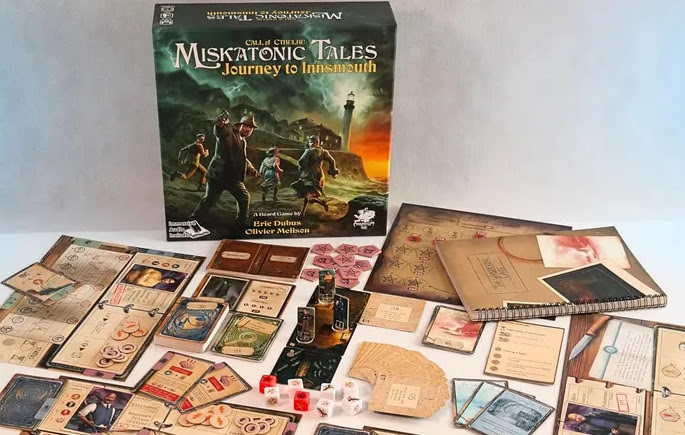
* IGN reviews Chaosium’s new Miskatonic Tales: Journey to Innsmouth Board Game.

* Avatar of Chaos examines Kadath (1979)… “which appears to be the first Lovecraftian video game, [and] is loosely inspired by H.P. Lovecraft’s The Dream-Quest of Unknown Kadath”.

* The acclaimed major AAA videogame The Sinking City 2 is set for an 18th August 2026 release, with an Innsmouth-alike setting and an open world.

* My quick and vaguely Lovecraftian demo video, from the amazing new Minimax H3 video generator. Generated locally and quickly on my entry-level RTX 3060 12Gb graphics-card. Surprisingly, all but the tech-press have ignored this major game-changing open and free model.

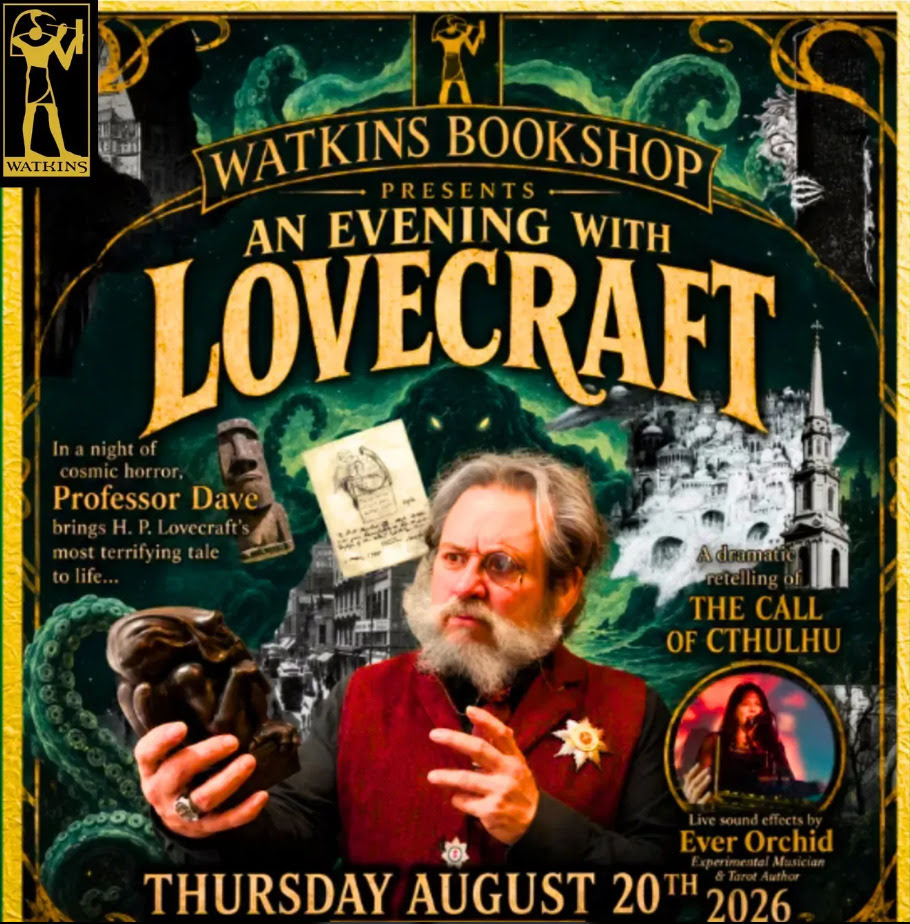
* London’s esoteric bookshops are starting to list their autumn talks. These include An Evening with Lovecraft at Watkins Books in London, set for 20th August 2026.

Another London bookshop talk of possible interest to some is “The Golden Dawn and the Arts”, set for 29th September 2026.

* And finally, those now arriving at NecronomiCon 2026 in Providence may want to note that the Extended Programming page was updated yesterday. The page also has flyers/posters for the theatrical events.


— End-quotes —

It seems suitable for high summer and for the advent of the beside-the-ocean Necronomicon 2026, to offer a little trawl of Lovecraft appreciating the cooling sea-breezes…

On the sea-breezes of Charleston… ” At twilight — a very brief subtropical twilight — the birds sang in the gardens, and an insidious perfume of many blossoms floated cryptically over the whole city. Cool breezes sprang up, and those who disliked warmth would walk along the Battery, or White Point Gardens, at the very tip of the peninsula, which fronts the spacious harbour and receives a sweep of air from across the low islands dividing the harbour from the open Atlantick.” — Lovecraft, “An Account of Charleston”.

“The atmosphere makes me feel twenty years younger and one hundred percent better — and I really seem to have a surplus fund of energy for the first time since last August. The sea breeze is always blowing, and I have become as tanned as an Indian in less than a week.” — Lovecraft in Charleston, to Moe, May 1930.

“And the screen Dracula in 1931 — I saw the beginning of that in Miami, Fla. [Florida] — but couldn’t bear to watch it drag to its full term of dreariness, hence walked out into the fragrant tropic moonlight!” — Lovecraft to Farnsworth Wright, February 1933.

“Darkness – sunset – dreams – mists – fever – madness – the tomb – the hills – the sea – the sky – the wind – all these, & many other things have seemed to me to retain a certain imaginative potency despite our actual scientific analyses of them.” — Lovecraft to Harold Farnese, September 1932.

“… his spirit had dwelt all the eternity of an hour one summer afternoon very long ago, when he had slipt away from his nurse and let the warm sea-breeze lull him to sleep as he watched the clouds from the cliff near the village.” [to dream of the city of Celephais, in the Valley of Ooth-Nargai] — Lovecraft, “Celephais”.

“But in Kingsport strange tales are abroad, and even the Terrible Old Man admits a thing untold by his grandfather. [That …] when the wind sweeps boisterous out of the north past the high ancient house that is one with the firmament, there is broken at last that ominous, brooding silence [of the Strange High House, a silence that was] ever before the bane of Kingsport’s maritime cotters. And old folk tell of pleasing voices heard singing there, and of laughter that swells with joys beyond earth’s joys; and say that at evening the little low windows are brighter than formerly.” — Lovecraft, “The Strange High House in the Mist”.

HPLinks #95 – NecronomiCon 2026, Oceanic Horror conference, Pulpster 35, fungi by the Seekonk, and more…

30 Thursday Jul 2026

Posted by asdjfdlkf in HPLinks, Lovecraftian arts, Scholarly works

≈ 1 Comment

HPLinks #95.

* NecronomiCon Providence is now less than a month away, and The Armitage Symposium 2026 wing of NecronomiCon has released details of the scholarly papers. There’s a PDF with abstracts. Titles include, among many others…

      — “Correlating the Mind’s Contents: Lovecraft’s Challenge to Philosophers”.
      — “From Quebec to Kadath: Echoes of Canada in Lovecraft’s Late Fiction”.
      — “Cold, Circulation, and Cosmic Affect: Bodily Experience and Sensory Language in Lovecraft’s Fiction”.
      — “Galahad in the Rubble: Frank Belknap Long’s Letters to Donald Wandrei, 1927–1975”.
      — “A Shared Bond through Greece and Rome: Classical References in the Letters of H.P. Lovecraft and Frank Belknap Long”.
      — “Lovecraft’s Influence on UFO/UAP Ontologies”.
      — “Lovecraft and the UFO”.
      — “Unwholesome Nocturnal Meetings: H.P. Lovecraft, Margaret Murray, and the Witches’ Sabbath”.
      — “Lovecraft and Eugenics: for HPL, It was Personal”.
      — “The Antipodean Weird in Lovecraft and Others”.

In the main programming for NecronomiCon, I spotted Fred Lubnow on “The Science of the Dreamlands”, and panels on “The Collectable Lovecraft” and “Librarians & Archivists in Weird Fiction”, among many more. A very rich year, by the look of it, but sadly I can’t be there. Still, hopefully recordings will surface on YouTube in due course.

* Lovecraft’s own Newport, Rhode Island, is to host an academic conference on “Oceanic Horror” in March 2027. Curiously, given the setting and theme, the call for papers neglects to mention Lovecraft. Given the current state of academia, perhaps they’re simply unaware of a Lovecraft connection? But some academics may be interested in the call. Deadline for proposals: 30th September 2026.

* New from Spain’s University of Salamanca, the open-access book Echoes of Fantasy and Reality (2026). In English. Contains, among others…

      — “Alphabets For The Shadows: The Design Of Three Alphabets To Talk To The Dead”.
      — “Impossible Mazes: Transmedia Representations Of The Fantastic Rhizome”.
      — “Unspeakable, The Art Of Talking About Forbidden Topics Through Fantasy & Horror”.
      — “A Visual Reflection On The Fantastic And Magical Realism: Fuseli’s Nightmare (1781) and Bocklin’s Triton And Nereid (1873)”.
      — “The Poetics Of The Immense: Scale And Visual Metaphor In The Cinema Of Denis Villeneuve”.
      — “The Long and Cinematic Shadow of the Vampire Nosferatu”.

* The new edition of Fafnir: Nordic Journal of Science Fiction and Fantasy has “Stay Strange: A Computational Stylistic Analysis of Altered Consciousness in American Science Fiction 1960–1979”. Freely available in open-access, in English. Related is the forthcoming NeconomiCon 2026 panel on “White Rabbits and Purple Haze: The Influence of the Psychedelic Era on Weird Fiction”.

* PulpFest details the contents of this year’s convention annual, in “Highlights from The Pulpster #35″.

* The scholarly annual journal Lovecraft Annual No. 20 (2026) is now listing on Amazon UK, and is set for an August 2026 release. As well as the articles and reviews, it includes… “a comprehensive index to issues 11-20.” No table-of-contents on the Hippocampus Press site as yet, but the Amazon blurb gives a flavour of the contents.

* The SpraguedeCampFan blog considers “Robert E. Howard and the American Fiction Guild”.

* A rare bit of CAS scholarship in the scholarly journal Odisea, “The Reversion of the Myth of Theseus and the Minotaur in Clark Ashton Smith’s ‘The Maze of the Enchanter’ (1933)”. Freely available online, in open-access.

* I see NecronomiCon 2026’s core programming has “The Pale Song of the Butterfly Collector: Nabokov as Weird Fiction” with a focus on the fabulous novel Ada, or Ardor (1969).

* Dark Worlds Quarterly surveys “The Fantasy Novels of Clifford D. Simak – Part 1”. The is ‘the late Simak’ of the mid 1970s paperback boom, his name firmly established and newly able to have fun in the space where fantasy and science-fiction meet. Which at the time didn’t endear him to the ‘genre police’ on either side, but the mood of the times was with him.

* The University of Chicago magazine has the new long article “Wonderland”, on their magnificent Stephen D. Korshak art collection and its collectors. Freely available online. The collection is online here, and also in an affordable hardcover artbook as Icons of the Fantastic: Illustrations of Imaginative Literature from The Korshak Collection (2025).

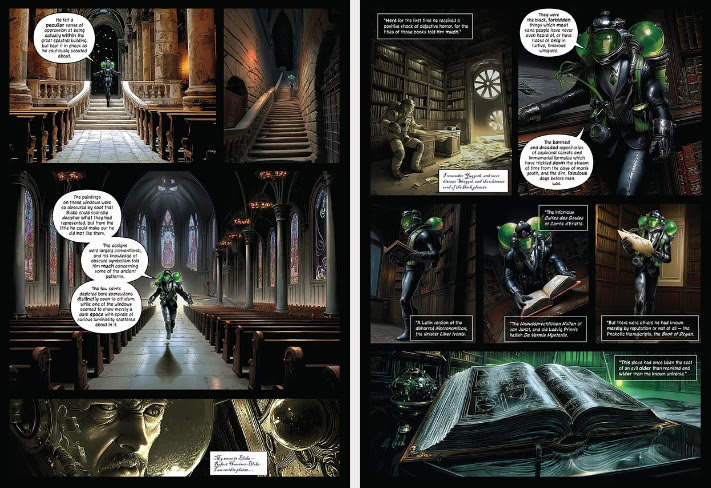
* Launching on Kickstarter on 4th August, Deep Space Lovecraft Collected Edition. A 184-page book collecting various one-man Lovecraft comics adaptations…

reimagined as tales of a retro-futuristic spacefarer encountering and enduring the very monstrosities conjured by Lovecraft’s own tortured mind, but in the environs and technologies of deep space and adapted to the artform of comics.

The book version adds two new adaptations, of “The Outsider” and “Dagon”.

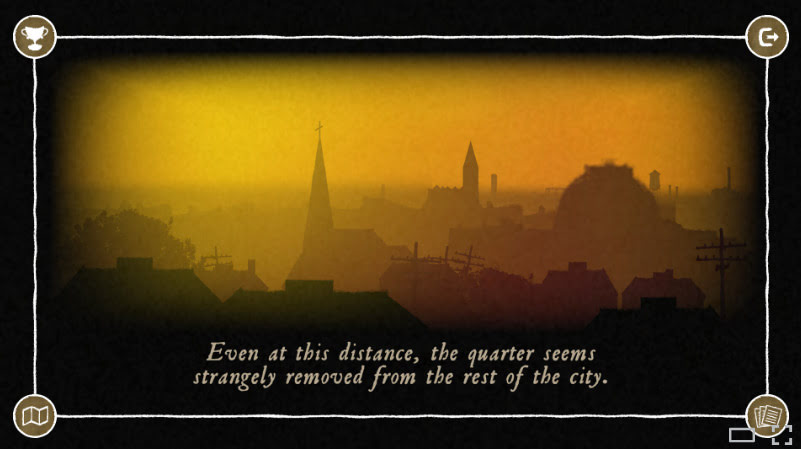
* Coming soon on the Steam gaming platform, The Steeple, a one-man indie videogame which apparently aims to be a faithful version of Lovecraft’s “The Haunter of the Dark”…

Explore a stylized recreation of 1935 Providence in this story-focused adaptation of H.P. Lovecraft’s final work.

* Keen Gamer has a long and pithy review of the new $30 videogame The Mound: Omen of Cthulhu (2026).

* From Chaosium, a new Call of Cthulhu: Innsmouth Sourcebook (2026) for table-top RPG players. Also potentially useful as reference for Mythos writers.

* Here in the UK, on stage at the annual Edinburgh Festival Fringe this summer is “Sherlock Holmes: The Adventure of the Innsmouth Crown”.

* In Austin, USA, this summer, the promenade theatre performance “Speak No More: Lovecraft”…

Physical theatre experimenters La Fenice [offer a] silent, site-specific, and immersive drama [which unleashes] Lovecraftian secrets, through an improvised narrative that audience members will walk through.

* This year’s NecronomiCon 2026 is also very strong on theatre presentations, with far too many to list here. Note also the performance of T.L. Wiswell’s Magic Lantern show of “The Call of Cthulhu”…

The magic lantern is an early version of the slide show, with hand-painted glass plates, phosphorus lighting (replaced for safety’s sake with an incandescent bulb), and a touch of the quirky.

* In Scotland, British Horror Studio have started filming for their indie “Lovecraft-inspired, feature-length horror anthology”, For We Are Many: Lovecraft. They plan a Kickstarter release in due course.

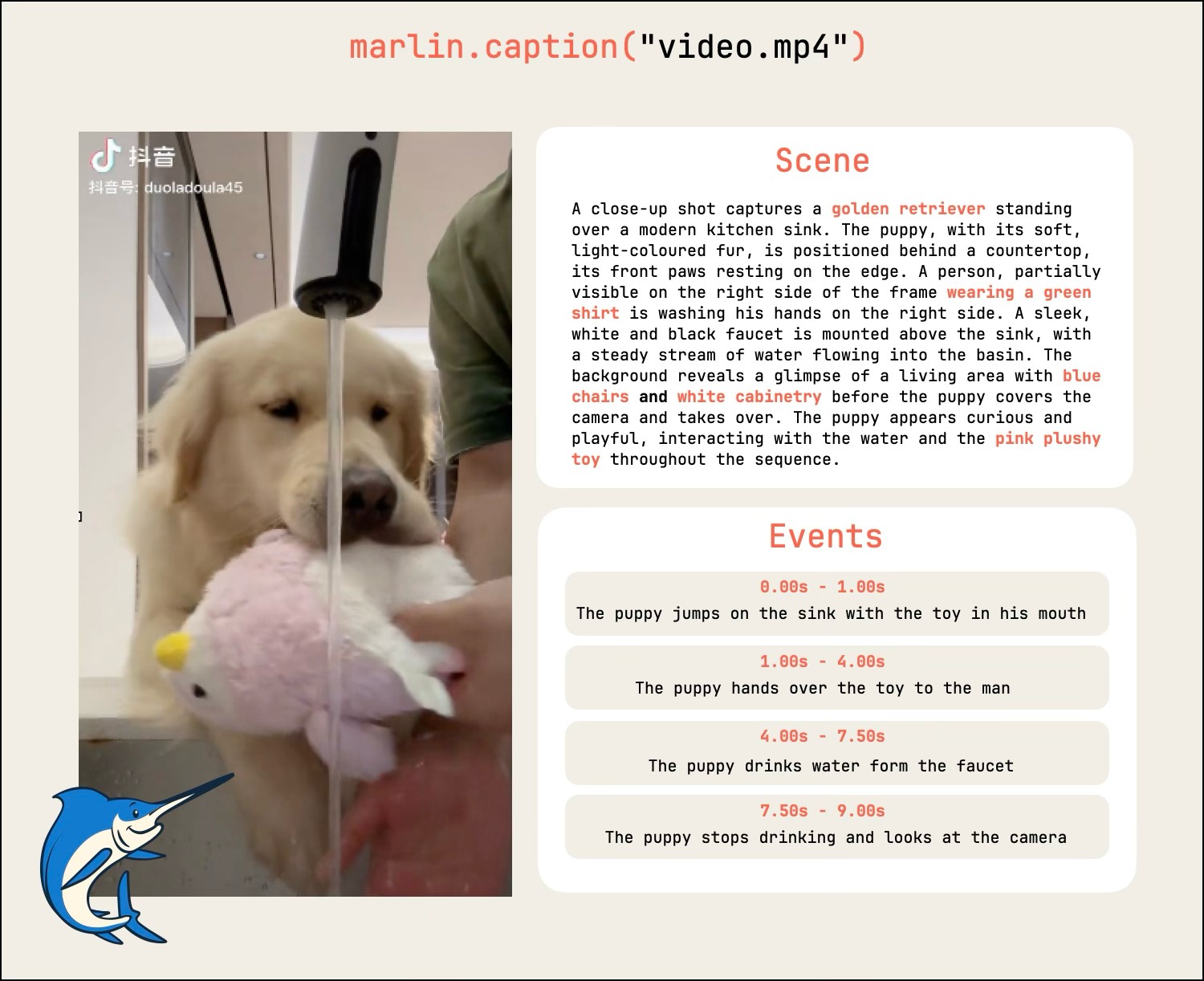
* Talking of film, the open source and local Marlin-2B (GGUF here) is a new small lightweight video-describing AI. It may be of use to some who wish to index (rather than transcribe the audio of) large video archives or film footage. The small 5Gb size means it can run even on entry-level Nvidia 3060 12Gb graphics-cards.

* On YouTube, this summer Strange Magick is making a series of YouTube Shorts visiting Lovecraft-related places. So far he has visited the Newport round-tower, the Dark Swamp, and Neutaconkanut Hill.

* And finally, I see NecronomiCon also has “Foraging Horrors: A NecronomiCon Mushroom Walk – OFF-SITE, at Blackstone Park” by the side of the Seekonk. Sunday 16th August 2026. Which suggests the humid and warm air of Providence in mid August yields early fungi? If so, then that changes how one imagines Lovecraft in his outdoor summer letter-writing grove on the bluff above York Pond, since there would also have been early-emerging fungi around? Note also the related Armitage Symposium talk “In the Absence of Light… An Assessment of Lovecraftian Non-Photosynthetic Ecosystems”, in the early morning of the same day.


— End-quotes —

The following seems somehow approprate for the advent of NecronomiCon 2026…


N’ggah-kthn-y’hhu! Cthua flh gup r’lhob-g’th’gg Igh thok! G’llh-ya, Tsathoggua! Y’kn’nh, Tsathoggua!

It hath come!
Homage, Lord Tsathoggua, Father of Night!
Glory, Elder One, First-Born of Outer Entity!
Hail, Thou Who wast Ancient beyond Memory
Ere the Stars Spawned Great Cthulhu!
Power, Hoary Crawler over Mu’s fungoid places!
Iä! Iä! G’noth-ykagga-ha!
Iä, Iä, Tsathoggua!!!

— Lovecraft, from Selected Letters III, 7th October 1930. Not included in The Ancient Track.

HPLinks #93 – Argentina, cosmic humour, Gaslight reviewed, Sanz illustrates “Colour”, Hypnos filmed, and more…

15 Wednesday Jul 2026

Posted by asdjfdlkf in HPLinks, Lovecraftian arts

≈ Leave a comment

HPLinks #93.

* Deep Cuts digs deep and brings up the complete never-reprinted “Something from Beyond” (1941) by Paul Dennis LaVond.

‘Something from Beyond’ is pure Lovecraftian pastiche, albeit in an uncommon space opera setting, which gives it the feel of a very stripped-down prototype of Event Horizon.

* New to me, the Spanish-language book Lovecraft en Argentina (‘Lovecraft in Argentina’) (2015) by Carlos Abraham…

an exhaustive tour of the history of Lovecraftian letters in our country [i.e. the translators, editors and publishers, and also touches on the influence on the nation’s writers]. In an appendix, he also takes the opportunity to review the [Spanish] first editions of Robert Howard’s works. It is an interesting work, essential for the collector who intends to complete his library, but at times the book becomes difficult to read due to small type or the technical nature of the contents.

   Contents:

  – Introduction.
  – Dark beginnings (1939-1956).
  – The dissemination of a secret author (1957-1990).
  – Lovecraft as a classic (1991-2015).
  – Conclusion.
  – Appendix: The first Spanish editions of Robert E. Howard.

* Four years after a devastating Russian cyber-attack, the British Library’s EThOS (E-Theses Online Service) is finally restored and back online. The latest relevant “Lovecraft” British PhD thesis is from Manchester in 2022, ‘Live. Laugh. Loathe.’: cosmic humour and contemporary pessimism in literature and on screen (1969-2019). Currently posted online in May 2026 but under a repository embargo with one year to go before release to the public. The same author published a new book with Bloomsbury in June 2026, titled Cosmic Humour and Philosophical Pessimism in Contemporary Culture, which I assume is the PhD text… but revised and polished for publication?

* New in the latest History Today magazine, the short article “Fringe beliefs” (2026, Volume 76, Issue 7, page 6). Possibly this is a regular column(?), and in this instance its indexing-service abstract says the article discusses Lovecraft’s posthumous influence on the 1960s-70s ‘ancient astronauts’ theories.

* The Obelisk reviews Michael Shea’s 1984 novel The Color Out of Time, in “Watchers on the Threshold vs. Vampiric Jelly”…

The Color Out of Time is a mess of a book. It is ‘Lovecraftian pulp’ rather than cosmic horror. Plus, Shea’s attempt to mirror the Master’s purple prose comes across as stiff, and it does little to help the simultaneously simple yet hard-to-follow plot. […] As a homage, it is nice enough. Shea writes like someone who actually enjoys Lovecraft and his works [which is refreshing today …]

* RPG Review reviews the late-Victorian London “Cthulhu by Gaslight” role-playing adventure book from Chaosium.

* The English translation of Gou Tanabe’s “The Dunwich Horror” is still on track for release as a deluxe hardcover at the end of September 2026, and now has cover. Also due around the same time, an 80-page illustrated German translation of “The Colour Out of Space”. A hardback “with four-color, full-page illustrations by Salvador Sanz”, an experienced Argentinian comic-book artist, animator and comics teacher. Looks promising, even in German.

* At the Annecy International animation festival, the U.S. Cartoon Network announced development on a Conan animated series, helmed by Genndy Tartakovsky (Primal). Reported to be an adult Conan animation series, and a project he’s been trying to get off the ground since 2008. Possibly set for 2029, judging by what’s said in animation trade journal reports?

* Lovecraft’s undervalued story “Hypnos” is being filmed, as part of a feature-length indie anthology currently on Kickstarter. No further details.

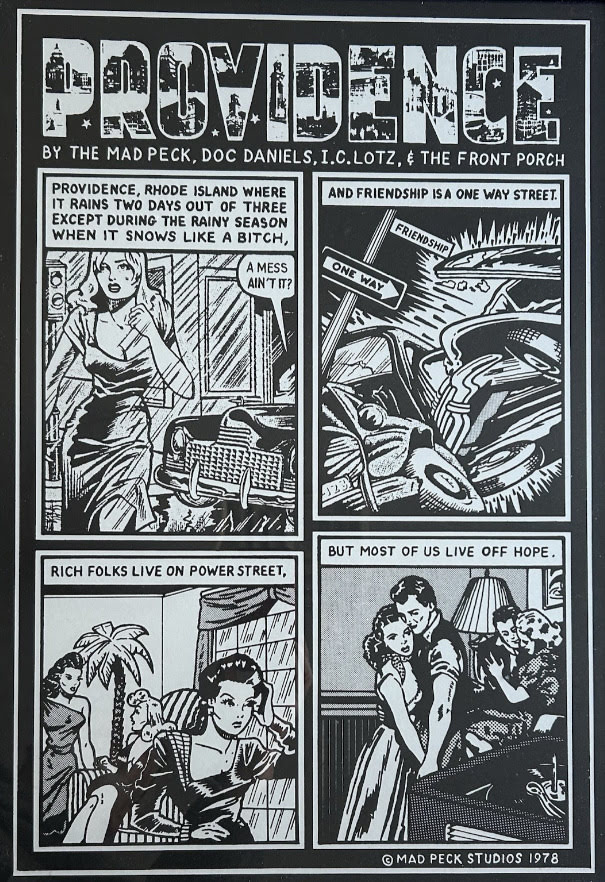
* And finally, plucked from eBay… I found an amusing one-page 1978 underground comix strip which riffs on street names in Lovecraft’s Providence. Was it a one-pager, or were there more pages? The one page is all that’s being sold on eBay.


— End-quotes —

Lovecraft on street-names.

“In 1912 my first bit of published verse appeared in The Evening Bulletin. It is a 62-line satire in the usual heroic couplet, ridiculing a popular movement on the part of the Italians of the Federal Hill slums to change the name of their main street from “Atwells’ Avenue” to “Columbus Avenue”. I pictured Providence in 2000 A.D., with all the English names changed to foreign appellations.” — Lovecraft to Kleiner, November 1916. The poem is “Providence in 2000 A.D.”

“Street names are notably picturesque [in Paris], including such specimens as Rue Git-le-Coeur (Street Where the Heart Lies), Rue Chat-qui-Peche (Street of the Fishing Cat — probably named from a bygone shop sign), Rue de l’Arbre Sec (Street of the Dry Trees), and so on. This quaint nomenclature is typically French, and is paralleled in other towns of France, and in Quebec on our own continent. Many streets are likewise named for the illustrious dead — not only statesmen and warriors, but men distinguished in the arts — a practice also common in Germany, but in America followed only in Boston.” — Lovecraft on Paris street-names, in “European Glimpses”.

“Amongst the [Boston] streets named for illustrious men I was pleas’d to note a Belknap-Street, commemorating the Revd. Jeremy Belknap, minister of a church in Federal-Street, and founder of the Boston Historical Society. The name of this street hath since been chang’d to Joy-Street, and I am sure that no reader of my small Belknap’s phantasies can deny that Belknaps invariably afford joy!” — Lovecraft to Galpin & Long, February 1923. Lovecraft’s story “Pickman’s Model” faithfully used Boston North End street-names in the tale.

“Providence thank heavens has avoided the stultifying custom of numbering [streets, as in New York City] ‐ our only numbered streets being ten obscure ones in the north end of the town.” — Lovecraft to Miss Toldridge, suggesting he knew the names of just about every street and lane in Providence.

As Providence grew into a large city… “still the little ancient lanes led off down the precipice to the west [of College Hill], spectral in their many-gabled archaism and dipping to a riot of iridescent decay where the wicked old waterfront recalls its proud East India days amidst polyglot vice and squalor, rotting wharves, and blear-eyed ship-chandleries, with such surviving alley names as Packet, Bullion, Gold, Silver, Coin, Doubloon, Sovereign, Guilder, Dollar, Dime, and Cent.” — Lovecraft, Dexter Ward.

“Some years ago Long and I attempted to explore the Fulton Fish Market section of New York — which is full of quaint scenes and buildings. I don’t know where I left the lunch I had eaten an hour previously — for I was too dizzy to read the street signs! In the end I managed to stagger out of the stench without actually losing consciousness …” — Lovecraft in a letter of 1933, Selected Letters IV.

HPLinks #92 – Clara and Lovecraft, bestiality, fandom research, the OED, film, theatre, and more…

09 Thursday Jul 2026

Posted by asdjfdlkf in HPLinks, Lovecraftian arts, REH, Scholarly works

≈ Leave a comment

HPLinks #92.

* Deep Cuts asks “Who is Clara in Lovecraft’s Letters?” and ably uncovers a new Lovecraft acquaintance in Providence. I’d add that the Westport Historical Society has a Clara Buffum page, with additional details of her summer home in Westport and her cataloguing work at the Providence Athenaeum. The Providence Athenaeum Bulletin reveals she also worked on the Delivery Desk in 1897, around the same time as the cataloguing work. Later the Providence Handicraft Club has her giving a talk on bookbinding to the Club in 1923, and her correspondence and mail-order sales address in 1926 was “42 College St., Providence, R.I.” which is that of the Club. Later the American Art Annual 1932 lists her as a member of the Club. Both the cataloguing work and the Club would tie Clara to Lovecraft’s aunts.

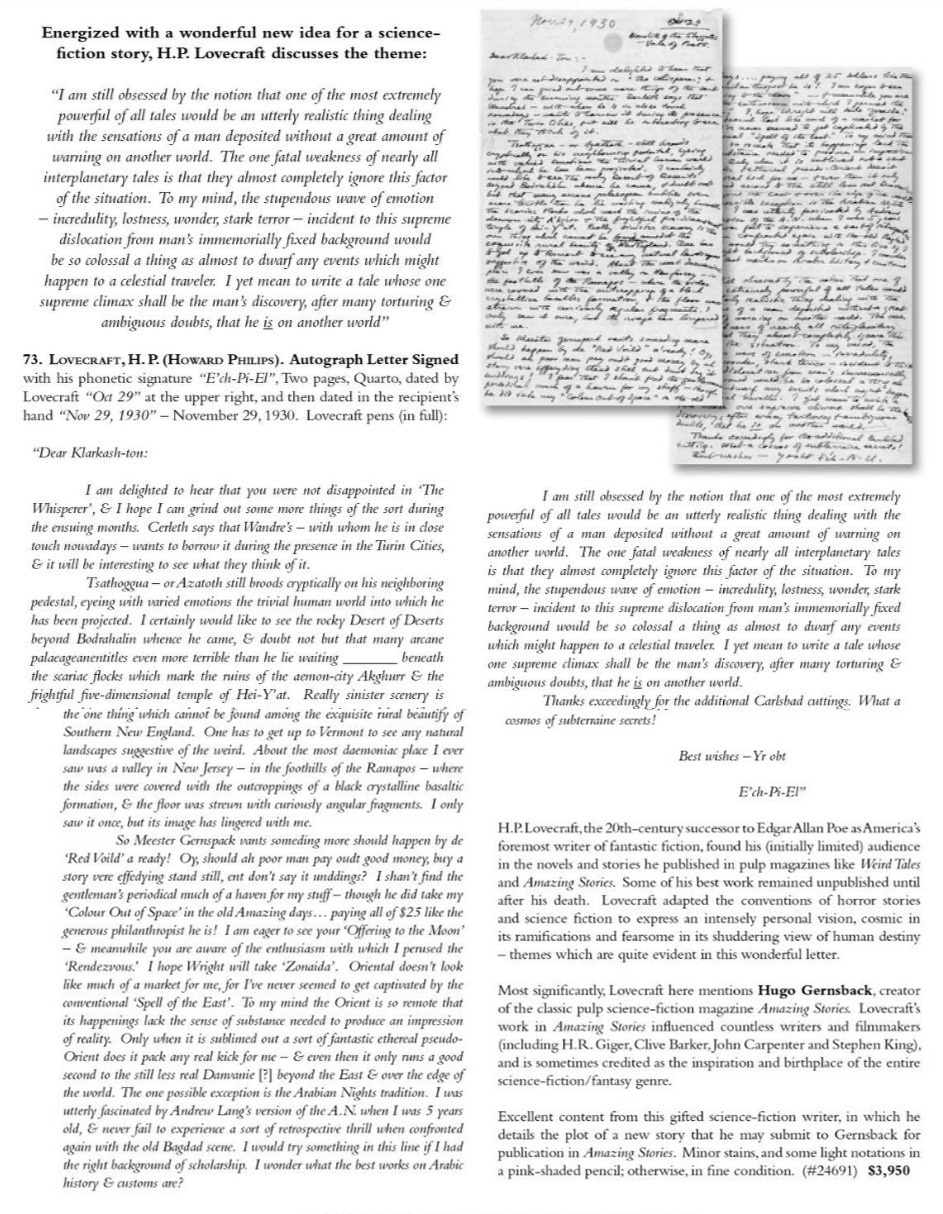
* New on Archive.org, a scan of the Profiles In History: Autograph Catalog 41 Winter 2006. Offers a 1930 Lovecraft letter to C.A. Smith, with transcript…

Carlsbad = the famous Carlsbad caverns. 20 years ago one could have had this letter for what today would be deemed a bargain price.

* From Indiana University, the Phd thesis The Edge of Cognition: Enchantment in Weird Fiction (2026). Freely available online.

* New in the 2026 of the French open-access annual journal Res Futurae, “Lovecraft sans Cthulhu. Epistemologie et esthetique de la bestialite dans l’oeuvre lovecraftienne” (‘Lovecraft without Cthulhu: Epistemology and the aesthetics of bestiality in Lovecraftian work’).

This article reconstructs the author’s intellectual landscape to better understand the interfaces between the pattern of bestiality and racialist zoo-anthropology. The study of the stories ‘Facts Concerning the Late Arthur Jermyn and His Family’, ‘The Shadow Over Innsmouth’, and ‘The Dunwich Horror’ allows us to articulate bestiality with an aestheticized evolutionary imagination.

* From the University of Marburg in Germany, a new open-access journal titled Fandom | Cultures | Research. Dedicated to fandom and fan-cultures research and research methodology. So far, four issues have been produced. Mostly English items.

* On YouTube, Archiving Horror! The S.T. Joshi Interview. A new Joshi interview.

* New on Archive.org, a scan of the Arkham House Catalog and Stock List With Addendum, 1986-1987.

* A new book Lunar Gothic: The Influence of the Moon on the Gothic Imagination (2025), which may interest some.

* Murray Ewing has a new blog post on “Lovecraftian Labatut”, musing on the curious similarities between the “strange and disturbing new insights” of the physicists and mathematicians, and the entities and cosmic vistas their workings can appear to glimpse.

* S.T. Joshi’s blog announces…

the Friends of August Derleth is a going concern, and we are actively soliciting members. As can be seen from our website at friendsofaugustderleth.org, which is still in a somewhat rudimentary stage, a membership is remarkably inexpensive, and at a later time members will be allowed special privileges (such as access to books published by the Friends) not available to non-members.

* Among other items, Joshi also notes his participation in a…

conference on Lovecraft’s philosophy put on by Steven K. Stakland and others and taking place in Japan on [29th June – 1st July. Other speakers] included papers by such veterans as Robert M. Price and Steven J. Mariconda. [The papers] will not be available online, but it appears that a book of all the papers is likely to be published by Routledge.

* DMR considers “R.E. Howard’s “The Garden of Fear”: Flowers of Evil and a Tower of Dread” and “”The Valley of the Worm”: Forging the Myth Behind the Myths”.

* On YouTube, “…when I last see him” The de Camp Interviews on Robert E. Howard…

Michael K. Vaughan discusses a rare, limited-edition book containing unedited interviews by L. Sprague de Camp regarding Robert E. Howard. These primary source transcripts offer fans and scholars a transparent look at the original accounts from those who knew the author

* Adventures Fantastic has A Brief Report from Robert E. Howard Days 2026.

* From veteran audiobook reader Horror Babble, what appears to be a new full reading of “The Shadow out of Time” (July 2026). I’ve not listened to it yet, but I assume it’s a more polished re-read of the earlier version HB released to YouTube some years ago. There’s also another fine unabridged reading free on Archive.org.

* The Obelisk has “Atom Age Lovecraft: A Review of Frank Belknap Long’s Journey Into Darkness”.

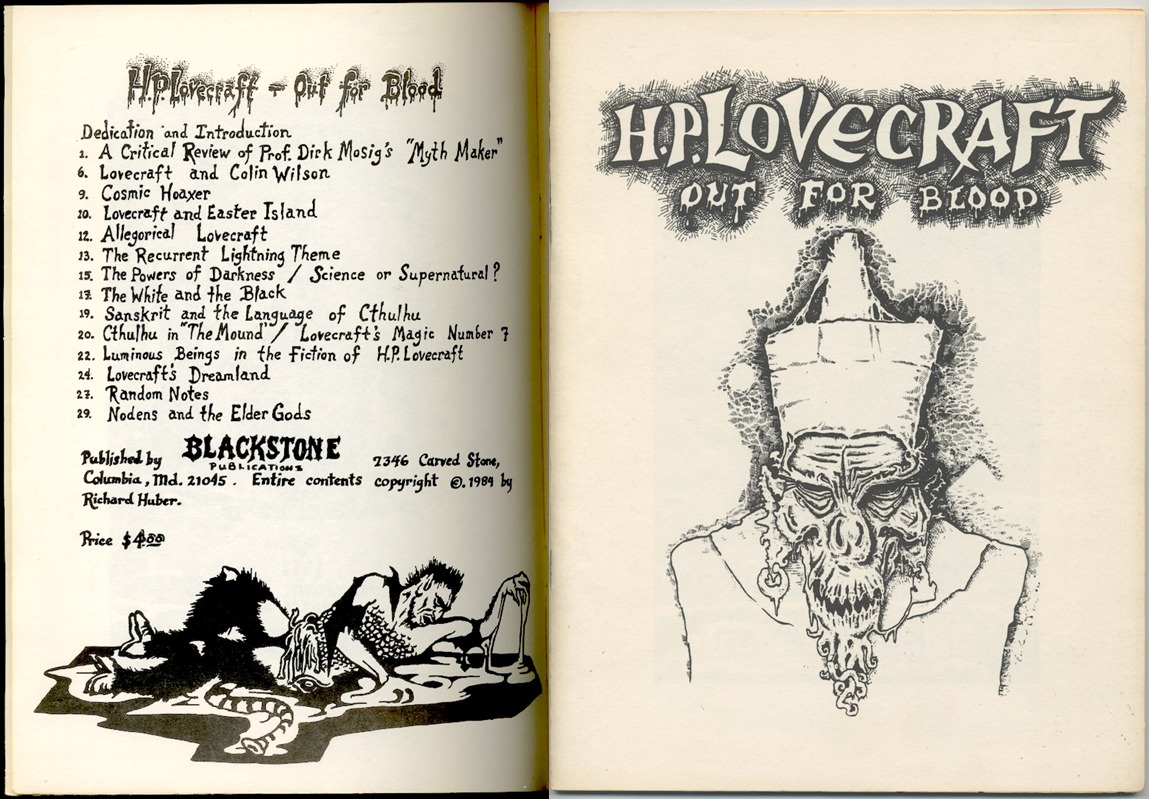
* New to me, an early item in Lovecraft scholarship Out for Blood (1984). A chunky A5 booklet, apparently aimed to “…prove that Lovecraftian analysis is not ‘worked out’ as many believe. [Gives] evidence to support my conviction that Lovecraft’s fictional concepts were developed with consistent logic and form a unified body of work”. However, the contents-list on the back suggests an essay selection with some intriguing topics.

* Comics publisher Dark Horse has announced a cover and a firm 2027 release date for the Gou Tanabe graphic novel of H.P. Lovecraft’s The Haunter of the Dark in English translation. To be paired with “Dagon”.

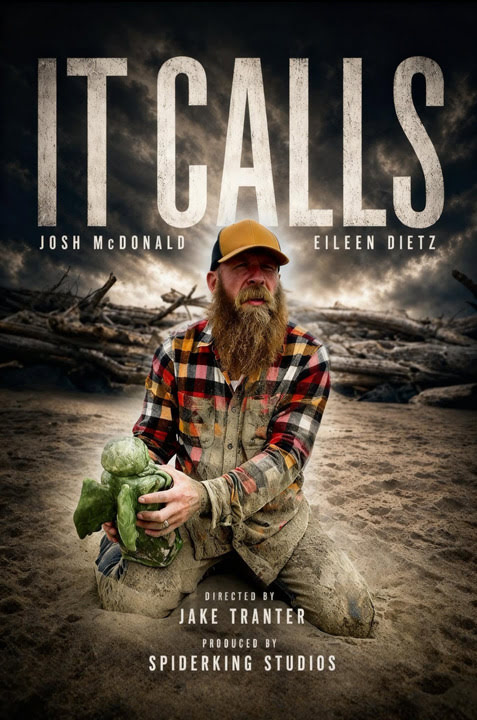
* “Crowdfunded $10K film ‘It Calls'”…

a psychological cosmic horror film inspired by the mythos created by H.P. Lovecraft […] Filming began in mid-May and is taking place throughout Roseburg, Bandon and other locations across Southern Oregon, with production expected to wrap on the 1st of August [2026]. Produced on a $10,000 budget raised entirely through crowdfunding, the studio said It Calls represents its most ambitious production to date.

* Germany’s Miskatonic Horror Theatre will be staging their biggest show yet, “The Call of Cthulhu” in Hamburg from 21st-23rd August 2026. Taking to the stage at the big open-air stage in Hamburg’s city park. Booking now.

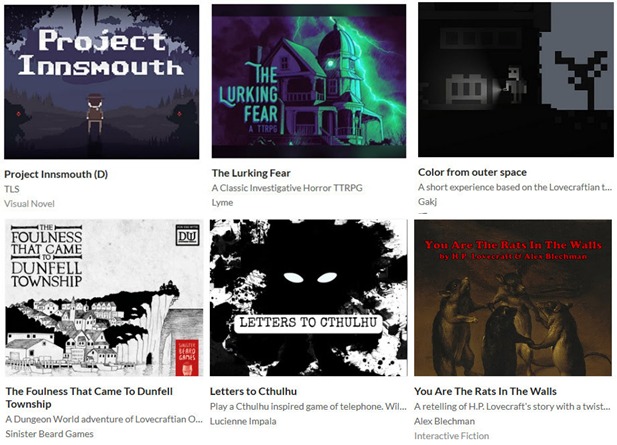
* RobbieTheRobot has a current page of the choice selections he’s making from the itch.io mini-games and interactive fiction which have Lovecraft as the theme.

* A long English abstract for the Polish undergraduate final dissertation “Horror in Pixels: How Ugly Games Generate Fear” (2025).

When coupled with a cosmic or Lovecraftian narrative, even modest graphics can transform a game into a masterpiece.

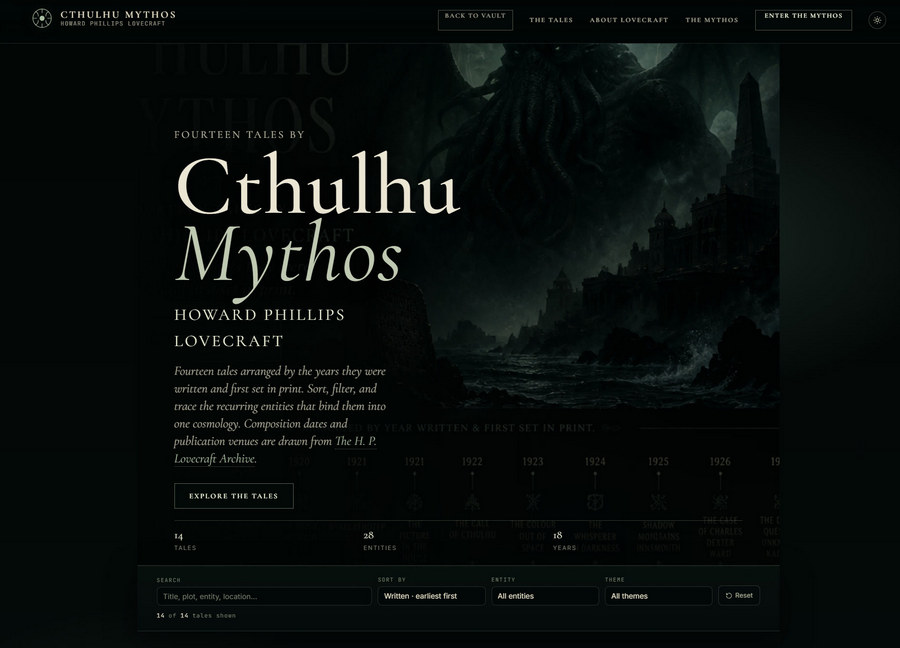
* A slick new Cthulhu Mythos – H.P. Lovecraft Concordance for 14 stories, as a new website.

* And finally, the venerable Oxford English Dictionary has added the word “Lovecraftian” in their latest update, tracing the first use of the word to 1936 and Robert Bloch in a letter to Weird Tales.


— End-quotes —

“… drifting down a stagnant river betwixt high basalt cliffs, & wondering why I drifted; since the water had no motion, & there was no breath of wind in the awful SILENCE.” (Lovecraft to Kleiner, May 1920). “… conscious of drifting down some hideous stagnant river in a rotting boat, between terrible overhanging cliffs of basalt. There was no wind, and I wondered why I moved down so still a stream. The insects were of strange form, and made me shudder as their numbers increased and they began to light all over me” (Lovecraft to Galpin, April 1920). — Lovecraft recalls a dream, to two correspondents, in 1920.

“About the most daemoniac place I ever saw was a valley in New Jersey — in the foothills of the Ramapos — where the sides were covered with the outcroppings of a black crystalline basaltic formation, & the floor was strewn with curiously angular fragments. I only saw it once, but its image has lingered with me.” — Lovecraft to C.A. Smith, November 1930.

“Primal Basalt Bridge over the black & oily River Gnar. Time of the Bulbous Shape’s passage up-stream” — Lovecraft to C.A. Smith, October 1933.

“Then, just as I approached that primal basalt crypt I had so dreaded, utter madness came. For as the echoes of the avalanche died down, there became audible a repetition of that frightful, alien whistling I thought I had heard before. This time there was no doubt about it — and what was worse, it came from a point not behind but ahead of me. Probably I shrieked aloud then. I have a dim picture of myself as flying through the hellish basalt vault of the Elder Things, and hearing that damnable alien sound piping up from the open, unguarded door of limitless nether blacknesses.” — Lovecraft, “The Shadow Out of Time”, just one example of various uses of basalt at key moments in Lovecraft’s tales and poetry.

HPLinks #91 – new reviews and papers, Lovecraft comics, film and animation, and more…

30 Tuesday Jun 2026

Posted by asdjfdlkf in HPLinks, Lovecraftian arts, Maps, New books

≈ Leave a comment

HPLinks #91.

* The Pulp Super-Fan reviews Ken Faig Jr’s book More Lovecraftian People and Places (2025).

* From Brazil, a new item that translates as “The Rhetoric Of Doubt: Unreliability, Inner Focusing And The Construction Of The Weird In H.P. Lovecraft’s Cosmic Horror Literature” (2026). Appears to be a final dissertation. Freely available online. Focuses on “The Whisperer in Darkness” and the second part… “analyzes the persona of the narrator Wilmarth, his limitations as a man of science, and the use of the epistolary genre as a resource for double unreliability”.

* New in the paywall journal American Gothic Studies, “Cosmic Horror and Acidic Apocalypse from the American Counterculture: The Psychedelic Gothic in Cinema and Beyond” (2026). This appears, judging by the partial free abstract, to focus on the feature film Eggshells (1969). But the title suggests the article then goes on to range more widely? Sadly, the paywall extends even to the full abstract.

* From Eastern Europe, a research repository has a new record and abstract for the 2026 journal article “Bibliographic Menace in Lovecraft’s ‘The Festival’: Terror by Quotation and Refusal”. Academic DOI links are useless half the time, and thus predictably the DOI link here gives an error. However, a little hand-searching gets me to the Ostrava Journal of English Philology issues-page and thus the full text of the article…

H.P. Lovecraft’s tale ‘The Festival’ (1925) makes the ‘Necronomicon’ frightening by scarcity: a supervised consultation of the grimoire at Miskatonic University and the translation of a single paragraph relocate horror from ‘contents’ to citation and refusal. ‘Bibliographic menace’ names the dread produced when an archive proves real and institutionally guarded, yet remains larger than any extract the narrative permits. Close reading traces the tale’s archaic cadence and pseudo-scholarly framing; brief comparison with other ‘Necronomicon’ tales clarifies its distinctive economy and later adaptability across media.

See also the related conference paper “Scarcity, Pseudobiblia, and the Literary Work of Lovecraft’s ‘Necronomicon’ in “The Festival””, previously linked in my HPLinks #89.

* Talking of the Necronimicon, it seems remarkable that… “90% of surviving Renaissance Latin texts have never been translated”. So says Amsterdam’s new Source Library, which is doing something about it. With the aid of one of the world’s greatest collections, harnessed to the new capabilities of AI. The “first 6,000 translations” are now online, with facing originals so Latin-reading AI-sceptics can instantly glance across and check. The Source Library has an apparent initial focus on Renaissance philosophy, esoterica and occultism. All freely available and open. No fragments from the Necronimicon have surfaced, as yet.

* Taskerland reviews reviews The Occult Lovecraft…

The Occult Lovecraft is a beautifully-made [1975] zine by contemporary standards and the sheer quality and discernment on display only become more apparent when you realise that the entire thing pre-dates the existence of desktop publishing. […] A beautifully produced historical artefact from a strange and revealing moment in Lovecraft fandom, where rationalism, occult enthusiasm, and personal testimony collide.

* The latest edition of the German open-access journal Das Mittelalter: Perspektiven Mediavistischer Forschung (‘The Middle Ages: Perspectives In Mediaevalist Research’) is a special issue on ‘Medieval Patterns in Modern Fantasy’. Includes an article on examples of Merlin in analogue games, which may be of interest to some.

* Public-domain Spanish audio for “Presentacion del libro Siempre nos quedara Lovecraft. El horror cosmico en los comics, los videojuegos y el sexo. Volumen 2″ (‘Presentation on the book We Will Always Have Lovecraft: Cosmic horror in comics, video games and sex. Volume 2.’). June 2026, 40 minutes.

While the first volume analyzed the literary work of Lovecraft, this new book explores how the concept of cosmic horror and the adjective ‘Lovecraftian’ have been expanded and adapted to multiple media

The new book is available in Spanish via Diabolo Ediciones.

* New from Italy, a book of four comics adaptations of Lovecraft, plus an original Lovecraftian tale as a comic. Lovecraft: Cinque strade nella follia…

Under the expert guidance of screenwriter Marco Cannavo, The Dunwich Horror, The Shadow Over Innsmouth, The Temple, and The Rats In The Walls are transformed into comic stories by Francesco Biagini, Francesca Giulia Massaglia, Paolo Massagli and Corrado Roi. Michele Penco also transforms an original story by Cannavo.

* Also new in Italian comics, Vanello Sergio’s H.P. Lovecraft: Dagon e altri racconti brevi (2025) (‘Dagon & Other Tales’). Eight Lovecraft tales as comic-book… “reinterpretations enriched by a new visual dimension”. A 96 page album, some b&w strips, some colour. Sergio produced a similar ‘Erich Zann and Other Tales’ book in 2019.

* Dream Apex Pictures have filmed Lovecraft’s “Celephais”…

H.P. Lovecraft film adaptations have largely ignored his Dream-cycle, and we are thrilled to bring the Dreamlands to life. Producer Joe Lemieux and director Michael Neel are passionate Lovecraft fans, and we have made the kind of film that we would like to see. […] special effects, by Jeff O’Brien and Nicholas Flanagan (Shuttle, Drive-In Horrorshow, God of Vampires) are all practical, including latex gore, puppetry, and camera tricks. With the exception of compositing our effects using a computer, there is nothing in this film that couldn’t have been done one hundred years ago. We filmed at fourteen locations in New England, Lovecraft’s home and ours.

Now available free on YouTube, or as a Blu-ray via IndieGoGo.

* It appears there’s to be no Colin Wilson conference in the UK this year, and instead there’s a new 2026 collection of essays to mark the 70th anniversary of Wilson’s famous book The Outsider (1956).

* New to me, Around the Outsider: Essays Presented to Colin Wilson on the Occasion of his 80th Birthday (2011), now available as an ebook on Amazon. Includes an essay on The Mind Parasites, which was Wilson’s tribute-novel to Lovecraft. Incidentally it’s interesting to learn that, apparently, Wilson once worked as a visiting lecturer at Brown University in Providence. One wonders if his archived papers have unexamined Lovecraft-related photographs and writings from his time on College Hill?

* Newly spotted on eBay, a framed 1932 hand-drawn map of Providence.

* Witch House: Amateur Magazine of Cosmic Horror. A new PDF ‘zine, now calling for contributions for issue 6. Fiction and poetry wanted, no non-fiction, reviews or interviews. Deadline: 2nd August 2026.

* New on Archive.org, a run of Different Worlds Magazine 1979-1987. A substantial general early RPG magazine, but with an obvious interest in Cthulhu mythos and R.E. Howard games/scenarios.

* More videos are surfacing from this year’s Howard Days event in Cross Plains, Texas. Specifically the recordings for the one-day conference ‘Afterlives of World Building: The Legacy of Robert E. Howard’: the Keynote by Sara Frazetta, the First Panel and Second Panel.

* New on Archive.org, Profiles In History: Comic & Illustration Art Auction 87 July 30, 2016. Being a sumptuous auction catalogue which offers a feast of Frazetta (Bran Mak Morn), Barry Windsor-Smith (Conan + the BWS 1970s wall-posters), Berni Wrightson, and some Moebius.

* Remember all those the old ‘magazines about comics and comics-artists’ that were recently uploaded to Archive.org? They now have Kwakk, a dedicated keyword search-engine. Said to search across more than a million pages, and counting.

* More details about the forthcoming Lovecraftian animated feature film from a studio of animation professionals, Ages of Madness: The Howling of the Jinn. Starting production in late 2026, and set to be an anthology movie consisting of “nine shorts” set across “four settings”, with each short connecting to the history of the Necronomicon. Aimed at adult audiences, not kids.

* And finally, talking of dazzling animation… see two literary immortals locked in mortal combat! Yes, it’s J.R.R. Tolkien vs H.P. Lovecraft.


— End-quotes —

“Raindrops [are felt]… but the sky shews a light rim near the horizon which impels me to take a chance and stay … for a moment. No — too much sprinkling. Have moved down into the piny valley toward the east. Am on a great rock beneath thick evergreen shade. Now let it rain (up to a certain limit) and be damn’d. This section of the wood is really primeval. Indians and 17th century colonists have seen these giant firs. There are houses as old as 1670 and 1687 within a mile of here. Rain increases — but what the hell? … Started pouring — with thunder and lightning — and my pine shelter proved inadequate. … I’m quite a bit irrigated …” — Lovecraft tries to write an outdoor letter to Barlow, as a heavy storm eases in, end of May 1935.

[A September visit to Providence by Donald Wandrei] “… was spoilt by a torrential rainstorm — which transformed most of the city to a lake & broke all weather-bureau records.” — Lovecraft to Derleth, September 1932.

[in Quebec] “I beheld several atmospherick spectacles of the highest interest […] a strangely burning flood of ruddy vespertine light upon roofs, spires, ramparts, & the trans-fluvial cliffs of Levis — coupled with a dense funnel of churning nimbus cloud extending from the zenith to the southeastern horizon. From this interloping mass jagged streaks of lightning darted frequently down to the distant country side beyond Levis, whilst low rumbles of thunder follow’d tardily after. Then, to crown all, a pallid arc of rainbow sprang into view above the verdant Isle d’Orleans, its upper end lost in the forbidding black cloud.” — Lovecraft to Galpin, October 1933.

“… the skies exert the utmost fascination upon me; nor is the weaving of wild dreams about their unplumbed deeps & suns & worlds in the least hampered by the precise astronomical data which my scientific side demands. Indeed, there is nothing in the baldest truth about the sky which does not enhance rather than enfeeble one’s awe at its fathomless & indescribable immensities.” — Lovecraft to Donald Wandrei, April 1927.

HPLinks #90 – Innsmouth Lit Fest, new Poe book, Cross Plain pictures, Beastarium book, and more…

23 Tuesday Jun 2026

Posted by asdjfdlkf in HPLinks, Lovecraftian arts, REH

≈ Leave a comment

HPLinks #90.

* I have tweaked Tentaclii’s CSS so as to change quote italics to a normal style. This should be retroactively affecting all quotes in posts on this blog. Quotations are now a bit less fancified, but more instantly readable.

* Here in the UK, the Innsmouth Literary Festival is a gathering of Mythos writers and more. It will run again on 19th September 2026. Early-bird tickets and trader table information, now available.

* Mark Fisher’s book The Weird and the Eerie has appeared in Portuguese translation as O Estranho e o Sinistro (June 2026).

* A new academic book Poe Spaces: Within and Beyond the Spatial Turn, with 19 new essays on Poe’s life, works, and literary afterlife.

* The latest issue of the Spanish journal Revista Helice has “Necronomicones Espanoles: La influencia del grimorio Lovecraftiano en las letras Espanolas recientes” (‘Spanish Necronomicons: the influence of the Lovecraftian grimoire on recent Spanish literature’). Freely available online.

* A few more items arising from the Howard Days event. The Dark Man Journal posts an Interview with Rusty Burke on YouTube. And GeoLiminal ponders Robert E. Howard and Evolution with the aid of the letters and more. I’ll add my own contribution, a couple of evocative images of Cross Plains, restored and colorised. Possibly early 1920s, judging by the female fashions?

* Up for sale… “Archive of over 125 letters, 1966-1983, on poetry, music, Korea, Lovecraft, horror stories, science fiction, Arkham House”… “from James Wade (1930-83) to fellow poet and ghost-story author John Alfred Taylor … Wade’s work appeared in [many Lovecraftian] Mythos anthologies”.

* New to me, a Lovecraft-as-character book titled Theory of MultiDreams: A Cosmic-Dream Investigation by H.P. Lovecraft (2017). In French, it seems — despite the English title, cover and blurb.

by author and poet Jean-Philippe Cazier [and] loosely inspired by the contemporary astrophysicist Aurelien Barrau’s work on “Multiverses” and by the stories of H.P. Lovecraft. The book entwines astrophysics and fantasy literature through fiction, deconstructing the frameworks of narration, logic, identity, space and time. The story commences with the disappearance of one of its characters, developing a kaleidoscopic narrative in which identities proliferate, when dreams become the means for travel through space and time and in which Lovecraft himself seemingly becomes one of the characters.

* The Blogging Goth celebrates Trent Reznor vs H.P. Lovecraft: Quake at 30…

Thirty years ago, legendary game studio id Software released Quake – the successor project to possibly the most influential first-person shooter in the world, Doom. The setting this time was dominated by medieval, gothic imagery and the player had to contend with entities directly referencing H.P. Lovecraft’s Cthulhu Mythos, all set to a dark ambient soundtrack by none other than Trent Reznor’s Nine Inch Nails.

* Feuilleton on his illustration of “The Father of Serpents”, together with a new portrait of Yig.

* Due in September 2026 in German, H.P. Lovecraft Bestiarium: Lovecrafts fantastische Wesen. Illustriert von Enrique Alcatena – Ubersetzt von Florian F. Marzin (‘H.P. Lovecraft Bestiary: Lovecraft’s fantastic creatures. Illustrated by Enrique Alcatena – Translated by Florian F. Marzin’). Appears to be a translation of Bestiario which was a 2008 Spanish edition.

* A large auction-scan of the original ink-and-whiteout header illustration for the 1925 Weird Tales appearance of “The Festival”.

* New on Archive.org, Fantastic Novels Magazine Reference Guide and Famous Fantastic Mysteries Reference Guide.

* And finally, also new on Archive.org, a 120-issue run of Fate Magazine: True Stories of the Strange and Unknown. Twaddle by the bucket-load, but also possible partial inspiration for Mythos fiction and RPGs?


— End-quotes —

[Lovecraft visits Wilbraham and Mrs Beebe and Mrs Miniter, and their household with] “… seven cats, two dogs, two horses, two kine, and one hired boy. Far to the west, across marshy meadows where at evening the fire-flies dance in incredibly fantastic profusion, the benign bulk of Wilbraham Mountain rises purple and mystical. The region, being very old and remote, is full of the most extraordinary folklore; some of which will certainly find lodgement in my future stories if I ever live to write any more.” — Lovecraft to Zelia Bishop, July 1928. The setting became that of “The Dunwich Horror”.

[Among my correspondents] “… I hear frequently from the old lady descended from Salem witches. She sent several moderately gruesome legends lately, but in general I find it more natural to invent cosmic horrors of my own rather than to utilize actual folklore incidents”. — Lovecraft to Miss Toldridge, October 1930. (The correspondent was likely to be Sarah Symonds, the correspondence now lost).

[my] “… artificial names of unearthly places and gods and persons and entities — there are different ways of coining them. To a large extent they are designed to suggest — either closely or remotely — certain names in actual history or folklore which have weird or sinister associations connected with them. Thus ‘Yuggoth’ has a sort of Arabic or Hebraic cast, to suggest certain words passed down from antiquity in the magical formulae contained in Moorish and Jewish manuscripts. Other synthetic names like ‘Nug’ and ‘Yeb’ suggest the dark mysterious tone of Tartar or Thibetan folklore.” — Lovecraft to Rimel, February 1934.

“I rather prefer purely original weird concepts as opposed to those derived from genuine folklore. Authentic folk-beliefs are likely to be insipid, ill-proportioned, freakish, and in general far less aesthetically effective than concepts formed by an author with a specific artistic purpose in mind.” — Lovecraft to Hoffmann Price, May 1935.

HPLinks #89 – newly-released Hoffman Price interview, Florida reviewed, forthcoming books, Howard Days, Ars Necronimica call, and more…

16 Tuesday Jun 2026

Posted by asdjfdlkf in HPLinks, Lovecraftian arts, New books

≈ Leave a comment

HPLinks #89.

* New from Radio KPFA, The Bookwaves Interview: Pulp Magazine Author E. Hoffman Price (1898-1988)…

This interview was conducted at Price’s house in Redwood City, California, most likely in the spring of 1979. Accompanying Dick, Lawrence and myself were Dick’s wife Pat Lupoff and science fiction fanzine editor Jim Purviance. Over two hours were recorded on multiple tapes, and parts of the transcription can be found in the book ‘Space Ships Ray Guns Martian Octopods: Interviews with Science Fiction Legends’. [This March 2026 version of the full] interview was digitized and then remastered using AI technology first, and then edited for clarity and coherence. […] This interview was first heard in a very truncated version in 1979, and has not been heard until now.

Freely available for download.

* RetroFuturista has a new interview, “The Art of Cosmic Terror: John Coulthart on Magick, Occult Diagrams and Impossible Cities”.

* The Pulp Super-Fan reviews the recent book Adventurous Liberation: H.P. Lovecraft in Florida. Provides a useful overview of the contents and concludes…

Overall, this is an excellent work. Readers interested in learning more about Lovecraft as a person, the people he interacted with, and what he did in Florida will find this book of interest.

* Forthcoming from McFarland, H.P. Lovecraft and Modern Philosophy. McFarland has it as set for a 2026 release, although Barnes & Noble USA is less certain and pegs it at June 2027.

[his] aesthetics form his own distinctive phenomenology, one concerned not with orderly representation but with the experience of confronting the unknowable [… placing him] alongside modern philosophical phenomenology reveals unexpected parallels between Lovecraft’s work and thinkers such as Martin Heidegger, Maurice Merleau-Ponty and Emmanuel Levinas.

* From Eastern Europe, a long abstract for a recent conference paper “Scarcity, Pseudobiblia, and the Literary Work of Lovecraft’s ‘Necronomicon’ in “The Festival””…

By orchestrating paratexts (archaic language, institutional custody, spurious authorities) that suggest an archive larger than the tale affords while simultaneously keeping the actual grimoire offstage, Lovecraft produces what can be termed ‘bibliographic sublime’: an apprehension of textual vastness through carefully curated absence.

* There’s what appears to be a chunky new Lovecraft biography. H.P. Lovecraft: The Herald of Cthulhu (2026) runs to over 400 pages and appeared in April 2026. No reviews as yet, and no indication if the many post-2012 discoveries are integrated or not. The long blurb is both encouragingly serious-minded and yet it also mentions Stephen King in approving tones. So it’s a bit of an unknown quantity at present.

* A new interview transcription of a very long chat in Polish with the highly acclaimed Polish translator of Lovecraft…

Mateusz Kopacz: Let me start by asking you to answer the question we’ve been hearing ever since ‘The Dunwich Horror’ [and other tales] was released [in Polish translation]: ‘Mr. Maciej, when is the new Lovecraft translation?!’

Maciej Plaza: Publishing a book, especially a book of enormous size, is a team effort, I am only one of the links — but I assure you that work on The Doom That Came to Sarnath [and other tales] is at the finishing stages and unless something unforeseen happens, the book will be published in mid-June [2026].

* Lovecraft appears at first glance to have a chapter in a new German/Austrian book. The book title in translation is Fictional Homeland: Identities, Bodies and Environments, and the chapter title would translate as something like “Terrible Origins: On the Horror of Home in H.P. Lovecraft”. However, judging by the pages on Google Books — most of them can be seen — the focus is barely on Lovecraft and most of the chapter discusses other authors.

* A new book, A Zoobiography of the Ancient Sea Monster, forthcoming in early September 2026 from Bloomsbury. Seemingly a sound mix of history and biological science. Regrettably the £85 price is likely to limit it to university libraries only.

* A good deal of Robert E. Howard activity is emerging, immediately after the annual Howard Days event. A few of the early ‘just got home from Texas’ links…

– Robert E. Howard Foundation’s 10-part video log on YouTube.
– Robert E. Howard Days 2026 (Substack, but free).
– REH on YouTube Panel Live from Cross Plains.
– Howard Days 2026 Hot Topics Roundtable.
– Travel with me to Howard Days 2026 via YouTube.
– Old Gods Wins the Costigan Award. (Substack, but free).

* The small-but-select art show at NecronomiCon Providence 2026 is called Ars Necronomica 2026, and its curators are now calling of submissions. Deadline: 5th July 2026.

* A new art gallery opens in Paris, at the Enki Bilal Foundation. Many will recall the leading French comics artist Bilal, from his work in Heavy Metal magazine.

* Ted White (1938-2026) has passed away. A science-fiction writer, and also editor at both Amazing Stories and Fantastic during the ‘new wave’ of 1969-1979, Heavy Metal during its seminal years of 1979-1980, and Stardate magazine at the height of the post-Star Wars ‘movie SF’ wave, 1985-1986. In 2016 he was Guest of Honor at PulpFest, and they have a recording of his talk about his career in writing and editing.

* A fledgling new magazine, Small Planet: Speculative Fiction in Translation. Issue 1 is dated May 2026.

* Talking of translation, seven hours of Wilum Pugmire’s Sesqua Valley tales can be had in a Spanish translation audiobook Bohemios del valle de Bohemios del valle de Sesqua (2022).

* Also new to me, a solo gamebook for “The Lurking Fear” (2018). Sounds like something that might be converted to a modern ‘Choose Your Own Adventure’ style videogame, but with real-time AI augmentation?

The Lurking Fear is a stand-alone solo-play roleplaying book written in the style of the ‘Choose Your Own Adventure’ series popular in the 1980s, and utilising Chaosium’s generic Basic Roleplaying system.

* An unusual item I’d not seen before, a “The Haunter of the Dark” reading on vinyl in 1977, via an old eBay listing. Apparently this was not only a full reading, but a reading with matching sound effects. Approved by Derleth, who was fine with approving small fannish projects and fanzine reprints of the tales.

* And finally, talking of 1977… just a note that 2027 will mark the 50th anniversary of a clutch of key early Lovecraft scholarship such as Barton Levi St. Armand’s seminal The Roots of Horror in the Fiction of H.P. Lovecraft (1977), The Weird Tales Story (1977) (history of the magazine), and Greenwood’s H.P. Lovecraft Companion (1977). It will also be the 50th anniversary of the start of the oft-regretted ‘movie-fication’ of science-fiction, as 1977 saw the huge success of the first Star Wars movie and also of Close Encounters of the Third Kind.


— End-quotes —

“I’m sure I don’t want anything more than non-existence when I round out a few decades more. I had it before I was born — through all the aeons prior to Aug. 20, 1890 — I don’t see why it will suit me any less after I die — through all the aeons subsequent to 1960 or 1970 or so. I’ve no complaint to enter about the way the cosmos treated me in the pre-1890 days when I didn’t exist, & the thought of other such days to come doesn’t disturb me in the least. On again, off again!” — Lovecraft to Miss Toldridge, April 1930. Lovecraft at this point obviously thinks be might live to see 1970.

“Much of the new stuff [in music and culture] will be laughed at in 1980 as heartily as 1880 stuff is laughed at now” — Lovecraft to Miss Toldridge, April 1930.

“When, as a youth of twenty, I laid in these ochraceous pads [of writing paper], did I ever think a grey-headed old has-been of almost forty-five would be scrawling on ’em in the virtually fabulous future year of 1935? 1935….. even today it has an unreal, far-ahead sound! Can I be living in a year whose numeral seems as fantastically remote as 2000 or 2500 or 5000?” — Lovecaft to Morton, April 1935.

“So far as future history is concerned, I’m damned if I know what lies ahead. […] Any one of a dozen possible courses may await mankind. Nobody knows what factors will pop up to prove the decisive ones. What will the next war bring — and leave? How much of existing knowledge and technology will survive — or leave recoverable keys — through the next dark age? How fatal will be the decadence or collapse toward which both western and eastern cultures seem to be moving? Will the modified behaviour-patterns created by the lapse of certain traditional beliefs produce unforeseen results?” — Lovecraft to Fritz Leiber, November 1936.

“There is absolutely no clue to the future, because its events are compounded of so many different chains of past events, each of which may be taking place all unknown to the spectators of any other. In our present, which is the future’s past, we can know of only one or two factors which will enter into any events of the future. There is no way of finding out the others, because we don’t know what to look for.” — Lovecraft to Nils H. Frome, February 1937.

HPLinks #87 – playful monsters, Moore esoterica, new journals, Colour from Germany, Martian loungers and more…

01 Monday Jun 2026

Posted by asdjfdlkf in HPLinks, Lovecraftian arts, Scholarly works

≈ Leave a comment

HPLinks #87.

* The Morris Everett Collection Part Two, free on Archive.org as a 391-page PDF catalogue.

* A call-for-papers for The Playful Monster. Set for September 2026 on the south coast of England. Deadline: 31st July 2026.

The Playful Monster is a conference hosted by Winchester School of Art, University of Southampton. It looks at how monsters are made playful, and how the monstrous appears in playful ways across games, media, and everyday culture.

* A call-for-papers for Esotericism in the Comics of Alan Moore. Deadline: 1st July 2026…

This proposed collection of essays will seek to deepen the awareness and importance of esotericism in the work of Alan Moore. It is time for a volume on the topic

* A journal from the University of Oviedo, Spain, plans a special issue themed around ‘Lands of Fear: Gothic and Horror in Literature, Art, and Culture’. The Journal of Artistic Creation and Literary Research now has a call for papers, and proposals for interviews, artworks and book reviews are also welcomed. Deadline: 31st October 2026.

* Wormwoodiana announces a new print journal in English, A Weird Occasional.

* A new Spanish journal invites papers for the forthcoming Legendaria: Revista de estudios sobre el mito y lo fantastico (‘Legendaria: the journal of studies on myth and the fantastic’). The publisher Legendaria Ediciones is a notable publisher of Tolkien scholarship in Spanish, but their new double-blind peer-reviewed journal will evidently range beyond Tolkien. The first issue is planned for later in 2026.

* In 2024 I see that the Mexican journal Historias had a profile of Robert Barlow… “Perhaps this is one of the first profiles of the literary executor of H.P. Lovecraft and editor of Tlalocan magazine.”

* SFcrowsnest reviews The Mind Parasites by Colin Wilson.

* Dread Central reappraises a Lovecraft screen adaptation, 25 Years Later: Revisiting the Lovecraftian The Resurrected…

The Resurrected is a completely mistreated and underseen gem. The film is an adaptation of the H.P. Lovecraft novella “The Case of Charles Dexter Ward”, and is an electric combination of slow-burn noir and supernatural horror. The film is also incredibly silly, and paired with the enthralling mystery, goopy gore, and southern gothic imagery, it truly feels like a singular creative piece.

* Up and Down These Mean Streets has Rediscovered: Ex Libris Virgil Finlay, with an image of a finely penned Finlay signature.

* An unusual item in Italian, the book Il Mistero di Lovecraft & Lovering (2026)….

In the early 1930s stories appeared in Amazing Stories magazine signed as P.H. Lovering, and with the note that it was the same author as The Color Out of Space. Journal error or deliberate choice? And if it were true, is P.H. Lovering actually one of H.P. Lovecraft’s pseudonyms? This essay, part of the Arkham Myths series, explores in depth this mystery […] through rigorous and exciting research, providing essential reading keys for scholars and enthusiasts of the “Providence Dreamer”. With the texts of the two stories for the first time in Italian in a single book.

Lovering was dialogue-heavy 1930s pulp with a love interest, so it seems unlikely. Also Lovecraft appears to have denied it to Hoffman Price in 1933…

Belknap slipped up un one thing — for he was absolutely and unqualifiedly wrong in believing that I have published non-weird fiction under a pseudonym. I not only have never done so, but have certainly never said anything from which such a mistaken inference could legitimately be made. That’s the kid’s one trouble — his imagination flies off on a tangent, and now and then goes beyond the plain facts.

* Now crowdfunded, a French…

edition of the official complete Cycle of Swords — all the short stories, all the novels by Fritz Leiber, in chronological order of the adventures, enriched with Adept’s Gambit with the notes of H. P. Lovecraft presented by S.T. Joshi — in a prestige edition.

* The latest History Today magazine has the article “H.P. Lovecraft: Haunted by History”…

Portrait of the Author as a Historian. H.P. Lovecraft asked us to imagine a much deeper past than modern comforts and science allow us to perceive — and the monsters that might dwell there.

* New on eBay, a pleasing sketch of the John Hay Reading Room at Brown University, in 1923…

* Advance notice that 16th July 2027 will be the 100th anniversary of the ‘escape from Innsmouth’…

It was I who fled frantically out of Innsmouth in the early morning hours of July 16, 1927, and whose frightened appeals for government inquiry and action brought on the whole reported episode.

* Germany’s theatrical/audio-visual show Die Farbe aus dem All now has an online version…

* And finally, ArchiScene profiles Summer on Mars, a long profile/interview featuring the professional designers who recently created a ‘Martian interior’ for a big Milan expo…

The exhibition was presented during Milan Design Week. […] Especially for the exhibition, I designed the Lovecraft chaise lounge – an organic form that looked almost as if it was walking across the surface of the red planet. For me, it was also a playful experiment with form and convention. It is technically a piece of furniture, but at the same time it feels slightly alive, as if it wanted to escape or came from another dimension. [… it] came from my fascination with the stories of H.P. Lovecraft and the atmosphere of cosmic horror. There was also a sense of humor behind it, this idea that on Mars, even objects designed for rest might look as if they want to escape from us. I wanted the piece to feel slightly inaccessible, almost like an alien organism or a futuristic algae form. You can still recognize soft surfaces and shapes that invite the body to sit or recline, but at the same time there is something unfamiliar and unsettling about it. That contrast was intentional. I was interested in creating a kind of grotesque tension between comfort and discomfort, familiarity and otherness.


— End-quotes —

[pulp SF readers…] “want their conventional best-seller values and motives kept paramount throughout the abysses of apocalyptic vision and extra-Einsteinian chaos, and would not deem an “interplanetary” tale in the least interesting if it did not have its Martian (or Jovian or Venerian or Saturnian) heroine fall in love with the young voyager from Earth, and thereby incur the jealousy of the inevitable Prince Kongros (or Zeelar or Hoshgosh or Norkog) who at once proceeds to usurp the throne etc.; [and add] something disagreeable and Semitic for the villain. Now I couldn’t grind out that sort of junk if my life depended on it. If I were writing an ‘interplanetary’ tale it would deal with beings organised very differently from mundane mammalia, and obeying motives wholly alien to anything we know upon Earth — the exact degree of alienage depending, of course, on the scene of the tale; whether laid in the solar system, the visible galactic universe outside the solar system, or the utterly un plumbed gulfs still farther out — the nameless vortices of never-dreamed-of strangeness, where form and symmetry, light and heat, even matter and energy themselves, may be unthinkably metamorphosed or totally wanting” — Lovecraft to Farnsworth Wright, July 1927.

[When depicting] “events on the alien planet [one’s fiction] must be in strict accord with the known or assumed nature of the orb in question — surface gravity, axial inclination, length of day and year, aspect of sky, etc. — and the atmosphere must be built up with significant details conducing to verisimilitude and realism. Hoary stock devices connected with the reception of the voyagers by the planet’s inhabitants ought to be ruled rigidly out. Thus we should have no overfacile language-learning; no telepathic communication; no worship of the travellers as deities; no participation in the affairs of pseudo-human kingdoms, or in conventional wars between factions of inhabitants; no weddings with beautiful anthropomorphic princesses; no stereotyped Armageddons with ray-guns and space-ships; no court intrigues and jealous magicians; no peril from hairy ape-men of the polar caps; and so on, and so on. […] What must always be present in superlative degree is a deep, pervasive sense of strangeness — the utter, incomprehensible strangeness of a world holding nothing in common with ours.” — Lovecraft, “Some Notes on Interplanetary Fiction”.

“If a story’s weirdness be due to scientific imagination voyages to other planets by mechanical means, creation of metal men, &c. instead of downright supernaturalism, it has at least a half-chance with the “scientifiction” magazines — Amazing, Astounding, & Wonder Stories. Clark Ashton Smith is now ‘going over big’ with Wonder Stories, & has been asked to write a whole series of tales (interplanetary voyaging in an atomic-energy spaceship) for it. If anyone has a knack at this kind of thing, there is really an excellent & increasing market open to him. I fear I’m not much in this line myself, but nevertheless believe I’ll try a few specimens & see how they are regarded by editors.” — Lovecraft to Miss Toldridge, October 1930.

HPLinks #86 – Innsmouth architecture, new Derleth group, D&D revisited, and quotes on Lovecraft’s sampling of the mephitic vapours

25 Monday May 2026

Posted by asdjfdlkf in HPLinks, Lovecraftian arts

≈ Leave a comment

HPLinks #86.

* From Brazil, the latest May 2026 issue of the open-access journal Abusoes is a special Gothic Arts issue. The lead essay is “Dagon a a Sombra Sobre Innsmouth: Duas Pecas Da Terrivel Arquitetura De Lovecraft” (‘Dagon and The Shadow Over Innsmouth: Two Examples Of Lovecraft’s Terrifying Architecture’. Freely available online. The same issue also has essays on Poe and H.R. Giger. In Portuguese, but easily auto-translated.

* An abstract for a forthcoming article in the Journal of Aesthetics and Art Criticism, “Epistemological Horror”. The author identifies three types of this horror, one of which is termed “Lovecraftian epistemological horror”.

* Wormwoodiana discovers more unknown non-pulp fantasy from the 1920s.

* A new YouTube recording of a panel of experts discussing “A Brief History of Robert E. Howard Scholarship”.

* S.T. Joshi announces the formation of The Friends of August Derleth…

“a new organization to promote the life and work of August Derleth has now been established: The Friends of August Derleth, Inc. […] We hope to begin the process of soliciting new members shortly, but we are not quite ready to do that yet. We also hope to augment the current board of directors with additional members.”

* PulpFest has a trailer blog post for the convention, which outlines this year’s themes. It will… “celebrate the centennials of Amazing Stories and Ghost Stories” pulp magazines, and the post also notes “Doc Con returns to PulpFest in 2026”, this being the Doc Savage convention. PulpFest will also… “be celebrating the sesquicentennial of writer Jack London’s birth, the centennial of the birth of artist Robert Kennedy Abbett”.

* The Colour Out of Space artist’s edition from Suntup Editions. New and finely printed, with seven woodcuts by Sally Hands. Introduction by S.T. Joshi.

* The Worlds Of Speculative Fiction podcast reaches Lecture 102: Robert Bloch’s Lovecraftian Tales.

* Methods & Madness ponders the omission of Clark Ashton Smith from Appendix N and thus early D&D…

“I have wondered many times (and even tried to investigate as best I could) why Clark Ashton Smith is not in the Appendix N. […] he would be even MORE fitting than most of the books that are actually listed there. […] Could it be that Gygax simply did not know Smith?”

* New on Archive.org, AFS Magazine No.2., in which an article by Robert J. Kuntz recalls how he infused Lovecraft and C.A. Smith into his own D&D Lake Geneva Original Campaign, 1973-1976 and its associated items, taking D&D and…

the PCs [player-characters] away from simple dungeon delving for treasure” and into… an ever-expanding story arc involving the advent of the Elder Ones in the known planes of existence [and ancient weird cities]. That beginning grew to span most of my published career

The run of six issues of Seattle’s substantial AFS (2012-2014) is now available as scans, described as… “A pulp literature and old school [RPG] gaming zine available in print only.” See also No.3 for “Adapting ‘The Uncharted Isle’ by Clark Ashton Smith to Adventure & Setting”, and No.5 for “Hyperborean Grimoires”.

* Bone and Silver ponders why D&D’s Appendix N didn’t make more of Manly Wade Wellman.

* The Second World War Lovecraftian RPG Achtung! Cthulhu is coming to an end, after a decade of gaming, and a… “vast 50-odd library of books, PDF adventures, and accessories”.

* Talking of RPGs, new at the HPLHS Store is Eternity at Sea…

Eternity at Sea is an original scenario written by the HPLHS’ Sean Branney with a fantastic set of props created by Andrew Leman. Set in 1925, the adventure makes extensive use of real history and locations from the Oregon coast to create the most authentic setting possible. Both newcomers to Call of Cthulhu and seasoned veterans will find this story an engaging mystery filled with perilous surprises.

Due in mid-July 2026 and pre-ordering now.

* Also at the HPLHS Store, I see that the The Starry Wisdom Library auction catalogue (2014) can now be had as an affordable ebook in .PDF or ePub format. The paper edition is sold out. This imagines the library of… “the disliked and unorthodox Starry Wisdom sect” in Lovecraft’s “The Haunter of the Dark”.

* There’s a table-of-contents for the new Atlas of Deep Ones anthology, planned since 2024 and available now. Not actually an Atlas, but an anthology of new tales and poems of the Deep Ones. It also has a few items that sound like they might be pseudo-scholarly in-world articles, e.g. “The Third Oath of Dagon, Part II: Towards a Scientific Treatise on Dagon and the Third Oath of Dagon”.

* Lovecraft by the Sea. In which the London Lovecraft Festival players visits the seaside at Brighton, England, on the evening of 10th July 2026. Presenting on stage…

‘The Doom That Came to Sarnath’, a silhouette puppetry performance [and] ‘The Haunter of the Dark’, an original adaptation

* Popping up on eBay, the old ‘Providence in 1810’, that I seem to recall Lovecraft saw painted on the drop-curtain of a local theatre…

* Also on eBay, a 1908 map of Rhode Island that has the Dark Swamp marked on it…

* Another eBay pick, a nicely-angled ground-level view of the Market Place in Providence, looking up College St. in the distance. Possibly the early 1900s?

* And finally, authors and publishers may be interested to know that PDF Index Generator is now at version 3.6. This adds AI divination of topic categories. The worthy one-man $70 desktop software auto-generates a back-of-the-book index for your book(s).


— End-quotes —

Tobacco smoke and smoking were very common in Lovecraft’s time.

“Philandering and Nicotinical Sir:- I’ve never smoked since donning long trousers; since the fragrant weed is to me no more than a choking nuisance. When I was small, I smoked because it was the grown-up, masculine, and forbidden thing to do; but as soon as I could present a reasonably grown-up appearance without it, I relievedly suffered it to become a none-too-cherished memory. I naturally have to tolerate clouds of mephitic vapour from most of my friends, and I flatter myself that I do it without complaint. But at least I don’t have to thicken the cloud of tear-gas by any voluntary exhalations of my own!” — Lovecraft to Rheinhart Kleiner, November 1919.

Really — what pleasure one can gain from puffing away at nauseating & stifling fumes is beyond me! I did it once— when 11 to 14 years old — for no boy in my vicinity was then considered manly unless he surreptitiously emulated the graceful smokestack either behind the stables or in the neighbouring sylvan retreats. I sampled cigars, cigarettes, pipe, & the like; & puffed like a veteran; but always detested the infernal stuff. Glad enough was I to fling away tobacco when long trousers & increased inches made my manliness an obvious fact which needed no nicotinical corroboration! Nor have I any literary need of tobacco. When I go in for drugs, I am no “tin-horn”, but buckle right down to opium — vide “Dagon”. Since it is not I, but my heroes, who indulge, I do not feel the ill effects. Incidentally — I think Alfredus [Galpin] has given up his cherished hasheesh!” — Lovecraft to Rheinhart Kleiner, February 1920.

“Anent the smoke nuisance — you may be correct in theory about the reason for my aversion for the weed, but I would lay a heavy wager that it would take years of practice for me to cultivate a taste which after all is not worth cultivating! I am a conservative soul, & am not as radically different in tastes from the 14-year-old Theobaldus as one might fancy from a mere reading of the numerals which proclaim my proximity to thirty. All I know is that smoke is smoke, & just as choking when from a pipe as when from a leaky stove! Of course, connoisseurs make fine distinctions — but I prefer to breathe pure air than to inhale malodorous fumes. To me the ultimate horror of earth is a smoking car [train carriage set aside for smokers]. As a rule, I avoid taking drugs to stimulate literary endeavour; but when I try to describe hell — if ever I do — I fancy I shall take a ride in a smoker to work up atmosphere! Of course, the quality of the tobacco doubtless means something — but I find I acquire just as severe headaches when calling on a friend of mine who smokes quarter cigars.” — Lovecraft to Rheinhart Kleiner, March 1920.

Lovecraft’s New York City poem “On the Double-R Coffee House” (1st February 1925), on the bohemian hang-out, has… “Mids’t them I sit with smoke-try’d eyes”. He also talks in one of his letters of the… “nicotined atmosphere” there. The mid-1920s Kalem Club meetings also appear to have been rather smoky at times, and what with that and the strong coffee, Lovecraft must have come away with quite a ‘buzz’.

“While I am peculiarly repelled by unpleasant odours, I have no vast hankering after perfumes, & always urge barbers not to smell up my old bean [his head] with patent citified lotions. I like the fresh scent of springtide on the hills, & the August aura of new-mown hay, but I’d never go to the trouble of building an organ of olfactory notes — with perfume-phials for pipes — as did des Esseintes in the tenth chapter of A Rebours!” — Lovecraft to Fritz Leiber, December 1936.

← Older posts


Please become my patron at www.patreon.com/davehaden to help this blog survive and thrive.

Or donate via PayPal — any amount is welcome! Donations total at Easter 2025, since 2015: $390.

Archives

  • August 2026
  • July 2026
  • June 2026
  • May 2026
  • April 2026
  • March 2026
  • February 2026
  • January 2026
  • December 2025
  • November 2025
  • October 2025
  • September 2025
  • August 2025
  • July 2025
  • June 2025
  • May 2025
  • April 2025
  • March 2025
  • February 2025
  • January 2025
  • December 2024
  • November 2024
  • October 2024
  • September 2024
  • August 2024
  • July 2024
  • June 2024
  • May 2024
  • April 2024
  • March 2024
  • February 2024
  • January 2024
  • December 2023
  • November 2023
  • October 2023
  • September 2023
  • August 2023
  • July 2023
  • June 2023
  • May 2023
  • April 2023
  • March 2023
  • February 2023
  • January 2023
  • December 2022
  • November 2022
  • October 2022
  • September 2022
  • August 2022
  • July 2022
  • June 2022
  • May 2022
  • April 2022
  • March 2022
  • February 2022
  • January 2022
  • December 2021
  • November 2021
  • October 2021
  • September 2021
  • August 2021
  • July 2021
  • June 2021
  • May 2021
  • April 2021
  • March 2021
  • February 2021
  • January 2021
  • December 2020
  • November 2020
  • October 2020
  • September 2020
  • August 2020
  • July 2020
  • June 2020
  • May 2020
  • April 2020
  • March 2020
  • February 2020
  • January 2020
  • December 2019
  • November 2019
  • October 2019
  • September 2019
  • August 2019
  • July 2019
  • June 2019
  • May 2019
  • April 2019
  • March 2019
  • February 2019
  • January 2019
  • December 2018
  • November 2018
  • October 2018
  • September 2018
  • August 2018
  • August 2015
  • July 2015
  • March 2015
  • February 2015
  • January 2015
  • December 2014
  • November 2014
  • October 2014
  • September 2014
  • August 2014
  • July 2014
  • June 2014
  • May 2014
  • March 2014
  • February 2014
  • January 2014
  • December 2013
  • November 2013
  • October 2013
  • September 2013
  • August 2013
  • July 2013
  • June 2013
  • May 2013
  • April 2013
  • March 2013
  • February 2013
  • January 2013
  • December 2012
  • November 2012
  • October 2012
  • September 2012
  • August 2012
  • July 2012
  • June 2012
  • May 2012
  • April 2012
  • March 2012
  • February 2012
  • January 2012
  • December 2011
  • November 2011
  • October 2011
  • September 2011
  • August 2011
  • July 2011
  • June 2011
  • May 2011
  • April 2011
  • March 2011
  • February 2011
  • January 2011
  • December 2010
  • November 2010
  • October 2010
  • September 2010
  • August 2010
  • July 2010

Categories

  • 3D (14)
  • AI (74)
  • Astronomy (70)
  • Censorship (14)
  • de Camp (7)
  • Doyle (7)
  • Films & trailers (101)
  • Fonts (9)
  • Guest posts (3)
  • Historical context (1,096)
  • Housekeeping (91)
  • HPLinks (98)
  • Kipling (11)
  • Kittee Tuesday (92)
  • Lovecraft as character (58)
  • Lovecraftian arts (1,643)
  • Lovecraftian places (19)
  • Maps (72)
  • NecronomiCon 2013 (40)
  • NecronomiCon 2015 (21)
  • New books (976)
  • New discoveries (166)
  • Night in Providence (17)
  • Odd scratchings (984)
  • Picture postals (278)
  • Podcasts etc. (433)
  • REH (190)
  • Scholarly works (1,480)
  • Summer School (31)
  • Unnamable (87)

Get this blog in your newsreader:
 
RSS Feed — Posts
RSS Feed — Comments

H.P. Lovecraft's Poster Collection - 17 retro travel posters for $18. Print ready, and available to buy — the proceeds help to support the work of Tentaclii.

Proudly powered by WordPress Theme: Chateau by Ignacio Ricci.