• About
  • Directory
  • Free stuff
  • Lovecraft for beginners
  • My Books
  • Open Lovecraft
  • Reviews
  • Travel Posters
  • SALTES

Tentaclii

~ News & scholarship on H.P. Lovecraft

Tentaclii

Author Archives: asdjfdlkf

HPLinks #89 – newly-released Hoffman Price interview, Florida reviewed, forthcoming books, Howard Days, Ars Necronimica call, and more…

16 Tuesday Jun 2026

Posted by asdjfdlkf in HPLinks, Lovecraftian arts, New books

≈ Leave a comment

HPLinks #89.

* New from Radio KPFA, The Bookwaves Interview: Pulp Magazine Author E. Hoffman Price (1898-1988)…

This interview was conducted at Price’s house in Redwood City, California, most likely in the spring of 1979. Accompanying Dick, Lawrence and myself were Dick’s wife Pat Lupoff and science fiction fanzine editor Jim Purviance. Over two hours were recorded on multiple tapes, and parts of the transcription can be found in the book ‘Space Ships Ray Guns Martian Octopods: Interviews with Science Fiction Legends’. [This March 2026 version of the full] interview was digitized and then remastered using AI technology first, and then edited for clarity and coherence. […] This interview was first heard in a very truncated version in 1979, and has not been heard until now.

Freely available for download.

* RetroFuturista has a new interview, “The Art of Cosmic Terror: John Coulthart on Magick, Occult Diagrams and Impossible Cities”.

* The Pulp Super-Fan reviews the recent book Adventurous Liberation: H.P. Lovecraft in Florida. Provides a useful overview of the contents and concludes…

Overall, this is an excellent work. Readers interested in learning more about Lovecraft as a person, the people he interacted with, and what he did in Florida will find this book of interest.
* Forthcoming from McFarland, H.P. Lovecraft and Modern Philosophy. McFarland has it as set for a 2026 release, although Barnes & Noble USA is less certain and pegs it at June 2027.

[his] aesthetics form his own distinctive phenomenology, one concerned not with orderly representation but with the experience of confronting the unknowable [… placing him] alongside modern philosophical phenomenology reveals unexpected parallels between Lovecraft’s work and thinkers such as Martin Heidegger, Maurice Merleau-Ponty and Emmanuel Levinas.

* From Eastern Europe, a long abstract for a recent conference paper “Scarcity, Pseudobiblia, and the Literary Work of Lovecraft’s ‘Necronomicon’ in “The Festival””…

By orchestrating paratexts (archaic language, institutional custody, spurious authorities) that suggest an archive larger than the tale affords while simultaneously keeping the actual grimoire offstage, Lovecraft produces what can be termed ‘bibliographic sublime’: an apprehension of textual vastness through carefully curated absence.

* There’s what appears to be a chunky new Lovecraft biography. H.P. Lovecraft: The Herald of Cthulhu (2026) runs to over 400 pages and appeared in April 2026. No reviews as yet, and no indication if the many post-2012 discoveries are integrated or not. The long blurb is both encouragingly serious-minded and yet it also mentions Stephen King in approving tones. So it’s a bit of an unknown quantity at present.

* A new interview transcription of a very long chat in Polish with the highly acclaimed Polish translator of Lovecraft…

Mateusz Kopacz: Let me start by asking you to answer the question we’ve been hearing ever since ‘The Dunwich Horror’ [and other tales] was released [in Polish translation]: ‘Mr. Maciej, when is the new Lovecraft translation?!’

Maciej Plaza: Publishing a book, especially a book of enormous size, is a team effort, I am only one of the links — but I assure you that work on The Doom That Came to Sarnath [and other tales] is at the finishing stages and unless something unforeseen happens, the book will be published in mid-June [2026].

* Lovecraft appears at first glance to have a chapter in a new German/Austrian book. The book title in translation is Fictional Homeland: Identities, Bodies and Environments, and the chapter title would translate as something like “Terrible Origins: On the Horror of Home in H.P. Lovecraft”. However, judging by the pages on Google Books — most of them can be seen — the focus is barely on Lovecraft and most of the chapter discusses other authors.

* A new book, A Zoobiography of the Ancient Sea Monster, forthcoming in early September 2026 from Bloomsbury. Seemingly a sound mix of history and biological science. Regrettably the £85 price is likely to limit it to university libraries only.

* A good deal of Robert E. Howard activity is emerging, immediately after the annual Howard Days event. A few of the early ‘just got home from Texas’ links…

– Robert E. Howard Foundation’s 10-part video log on YouTube.
– Robert E. Howard Days 2026 (Substack, but free).
– REH on YouTube Panel Live from Cross Plains.
– Howard Days 2026 Hot Topics Roundtable.
– Travel with me to Howard Days 2026 via YouTube.
– Old Gods Wins the Costigan Award. (Substack, but free).

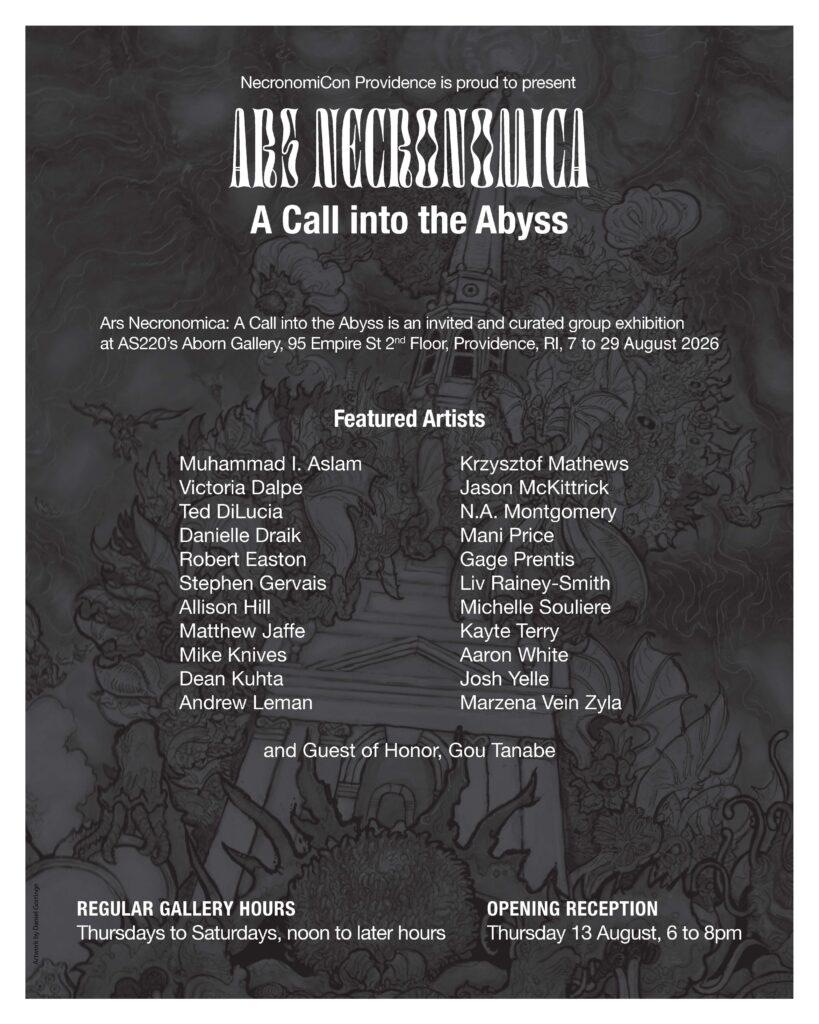
* The small-but-select art show at NecronomiCon Providence 2026 is called Ars Necronomica 2026, and its curators are now calling of submissions. Deadline: 5th July 2026.

* A new art gallery opens in Paris, at the Enki Bilal Foundation. Many will recall the leading French comics artist Bilal, from his work in Heavy Metal magazine.

* Ted White (1938-2026) has passed away. A science-fiction writer, and also editor at both Amazing Stories and Fantastic during the ‘new wave’ of 1969-1979, Heavy Metal during its seminal years of 1979-1980, and Stardate magazine at the height of the post-Star Wars ‘movie SF’ wave, 1985-1986. In 2016 he was Guest of Honor at PulpFest, and they have a recording of his talk about his career in writing and editing.

* A fledgling new magazine, Small Planet: Speculative Fiction in Translation. Issue 1 is dated May 2026.

* Talking of translation, seven hours of Wilum Pugmire’s Sesqua Valley tales can be had in a Spanish translation audiobook Bohemios del valle de Bohemios del valle de Sesqua (2022).

* Also new to me, a solo gamebook for “The Lurking Fear” (2018). Sounds like something that might be converted to a modern ‘Choose Your Own Adventure’ style videogame, but with real-time AI augmentation?

The Lurking Fear is a stand-alone solo-play roleplaying book written in the style of the ‘Choose Your Own Adventure’ series popular in the 1980s, and utilising Chaosium’s generic Basic Roleplaying system.

* An unusual item I’d not seen before, a “The Haunter of the Dark” reading on vinyl in 1977, via an old eBay listing. Apparently this was not only a full reading, but a reading with matching sound effects. Approved by Derleth, who was fine with approving small fannish projects and fanzine reprints of the tales.

* And finally, talking of 1977… just a note that 2027 will mark the 50th anniversary of a clutch of key early Lovecraft scholarship such as Barton Levi St. Armand’s seminal The Roots of Horror in the Fiction of H.P. Lovecraft (1977), The Weird Tales Story (1977) (history of the magazine), and Greenwood’s H.P. Lovecraft Companion (1977). It will also be the 50th anniversary of the start of the oft-regretted ‘movie-fication’ of science-fiction, as 1977 saw the huge success of the first Star Wars movie and also of Close Encounters of the Third Kind.


— End-quotes —

“I’m sure I don’t want anything more than non-existence when I round out a few decades more. I had it before I was born — through all the aeons prior to Aug. 20, 1890 — I don’t see why it will suit me any less after I die — through all the aeons subsequent to 1960 or 1970 or so. I’ve no complaint to enter about the way the cosmos treated me in the pre-1890 days when I didn’t exist, & the thought of other such days to come doesn’t disturb me in the least. On again, off again!” — Lovecraft to Miss Toldridge, April 1930. Lovecraft at this point obviously thinks be might live to see 1970.

“Much of the new stuff [in music and culture] will be laughed at in 1980 as heartily as 1880 stuff is laughed at now” — Lovecraft to Miss Toldridge, April 1930.

“When, as a youth of twenty, I laid in these ochraceous pads [of writing paper], did I ever think a grey-headed old has-been of almost forty-five would be scrawling on ’em in the virtually fabulous future year of 1935? 1935….. even today it has an unreal, far-ahead sound! Can I be living in a year whose numeral seems as fantastically remote as 2000 or 2500 or 5000?” — Lovecaft to Morton, April 1935.

“So far as future history is concerned, I’m damned if I know what lies ahead. […] Any one of a dozen possible courses may await mankind. Nobody knows what factors will pop up to prove the decisive ones. What will the next war bring — and leave? How much of existing knowledge and technology will survive — or leave recoverable keys — through the next dark age? How fatal will be the decadence or collapse toward which both western and eastern cultures seem to be moving? Will the modified behaviour-patterns created by the lapse of certain traditional beliefs produce unforeseen results?” — Lovecraft to Fritz Leiber, November 1936.

“There is absolutely no clue to the future, because its events are compounded of so many different chains of past events, each of which may be taking place all unknown to the spectators of any other. In our present, which is the future’s past, we can know of only one or two factors which will enter into any events of the future. There is no way of finding out the others, because we don’t know what to look for.” — Lovecraft to Nils H. Frome, February 1937.

HPLinks #88 – CAS biog, a new Commonplace Annotated, Lovecraft as tourist, Conservative in Italian, and more…

09 Tuesday Jun 2026

Posted by asdjfdlkf in HPLinks, New books

≈ Leave a comment

HPLinks #88.

* Due soon from Hippocampus Press, as a limited hardcover, Joshi’s new biography The Star-Treader: A Life of Clark Ashton Smith.

* Also forthcoming from Hippocampus Press, the Schultz H.P. Lovecraft’s Commonplace Book and Other Notes: An Annotated Edition, also as a limited edition hardcover.

This exhaustively annotated edition, based upon decades of study of both the text and sources of the commonplace book, illuminates the origins of many entries—from events in Lovecraft’s life, books or stories he read, and other sources—while also indicating their use in his fiction, even in cases where the use of the entries is by no means obvious. Other lists and notes relating to the commonplace book, including such works as “Weird Story Plots” and “Notes on Writing Weird Fiction,” are also presented, thoroughly annotated.

* S.T. Joshi’s blog brings news that…

I have nearly finished my monograph on Poe and Lovecraft, tentatively titled ‘Solitary Victims of Fate: Lovecraft’s Interactions with Poe’. The work is only about 35,000 words and not likely to get much bigger; it will be issued by Hippocampus Press next year. I have had great fun writing it, and I think I have found some Poe influences on Lovecraft’s tales that have not been cited before.

* The new McFarland multi-author book Literary Floridas: Essays on a Wild Peninsula Imagined (2026) has the chapter “Horror in the Sunshine State: H.P. Lovecraft, Tourist”. Judging by the preview pages from Google Books, the chapter appears to be a well-researched but lively introduction to the topic.

* The Complete Acolyte: A Historic 1940s Fanzine Reprint, available now in print. A key and quality early Lovecraft fanzine, now in print. I believe it’s also available as good page-scans elsewhere, for free.

* Now available in Italian, the complete run of H.P. Lovecraft’s amateur magazine The Conservative (2026)…

For the first time ever in the Italian language, this volume collects The Conservative in its entirety.

* Also new in Italian, a translation of the Joshi & Schultz Lovecraft’s Library (2026). Translating the fifth English edition, 2024.

* Feuilleton surveys The Art of Helmut Wenske. Scroll right down to the bottom to see two Lovecraft covers, indiscriminately used by the publisher Moewig for other books.

* An online conference set for later in June, Afterlives of World Building: The World of Robert E. Howard. Booking now.

Saturday 20th June 2026. The event is sponsored by The Dark Man: The Journal of Robert E. Howard and Pulp Studies, and will include pre-recorded interviews, two scholarly panels, and a keynote address by Sara Frazetta. Registration is required to receive the Zoom link and password.

* Sculptorium of Madness has a range of 3D printable figures for sale as downloadable 3D files. You can then print them yourself, paint them up as you like. I imagine one might also put them into home-made dioramas…

* David Thrussell & Shinjuku Thief Present: The Call of Cthulhu on two vinyl LPs, a reading with soundscape and soundtrack. Due 19th June 2026.

* Dark Worlds Quarterly exclaims “What?! More Plant Monsters!”, as more vegetable variants sprout from the old pulp magazines.

* Locus magazine reports “Subterranean Press to Close” at the end of 2027. The catalogue currently features Thomas Ligotti, Brian Lumley, Ramsey Campbell, T.E.D. Klein, and they have also published the nine-volume Collected Stories of Robert Silverberg.

* The editor of a planned Pop Culture Fandoms survey-book, apparently set for publication by Bloomsbury Press in 2028, is calling for short contributions…

I’m wide open to other suggestions. I’m particularly interested in non-US/UK fandoms and historical fandoms.

Send 200-300 word abstracts of your topic(s) by 30th August 2026. The aim is obviously not to be comprehensive with the book, as there will only be “100 short (1,000-word)” entries, when there could easily be 500 or more. So, you should probably also say why the fandom you’ve chosen is important to include. More important than, say, Elvis or Tolkien.

* New on Archive.org, the illustrated catalogue for Comic & Illustration Art Auction 114, December 12, 2019. Including Jack Kirby Eternals original b&w artwork, Mike Ploog’s Conan/Kull, and some Berni Wrightson pencil concept-sketches for a long-ago possible movie of “The Shadow over Innsmouth”…

* Popping up on eBay, and of possible use as a RPG prop, a local magazine ad for the Moses Brown school in Providence. “In the autumn of 1918, and with a considerable show of zest in the military training of the period, he [Charles Dexter Ward] had begun his junior year at the Moses Brown School” (The Case of Charles Dexter Ward).

* Those making RPG props and book designs may be interested in an excellent free Photoshop script to jitter the baseline for your text, thus making the lettering for a handwriting or calligraphic font more believable. Tested and working.

* And finally, Talkie: an LLM from 1930 (online test page) and talkie-1930-13b-it-GGUF (for local use in desktop software such as Jan.ai etc). Trained only on material from before 1931. The online version of the AI is censored, but the local GGUF is not. I can run the Q4_K_M variant GGUF on a 12Gb graphics card.

As you can see, of obvious use for 1920s Mythos writers and RPG makers. Seems best on topics related to the USA, though verifying its absolute accuracy could be a problem. It could not run much the same query re: detailing a Birmingham – Southampton rail route in the UK (the ill Tolkien being brought home from the Somme), seemingly having no knowledge of the westerly route and insisting on going aroundabout via London.


— End-quotes —

“I am glad you found my modification of your story interesting. I may use that plot — divested of any element connecting it with your tale — in supplying one of my amateur proteges with something to write about. It does not quite conform to the general idea of my own tales, so I shall not use it myself. I have lately — by the way — been collecting ideas & images for subsequent use in fiction. For the first time in my life, I am keeping a ‘commonplace-book’ — if that term can be applied to a repository of gruesome & fantastick thoughts.” — Lovecraft to Rheinhart Kleiner, January 1920.

“I was afraid those disjointed things bored you, but since they seem not to have done so, I will give you a few more, as I have recorded them for future fictional development in my commonplace-book. Remember, gents, that these crude sketches are the mere dreams themselves, not the stories. I relate only exactly what I dreamed, not what I am going to build up around the dreams.   I was walking or rather wading through a seemingly interminable and treeless marsh, under a leaden sky. My companion was an old man — a man so old that he frightened me…” — Lovecraft, ‘To the Gallomo’, April 1920.

“I think I have two kinds of moods in writing weird tales — one when I feel the need of scientific realism, & try to achieve a convincing air of objective sobriety against which the marvel itself stands out by contrast, (Colour Out of Space, Cthulhu, Whisperer, &c.) & the other when I feel myself half involved in the nebulous uncertainty of the pictured dream, & try to convey a hint of the febrile doubt & apprehension inherent in an imperfectly glimpsed vista, (Randolph Carter, Erich Zann, &c.). Of late the objective side has been uppermost, but that is because I have recently been writing from actual visual impressions gained in the New England countryside. When I get to a period of more fecund composition, & begin developing some of the odd items & subjective mood-jottings in my commonplace-book, I fancy the Erich Zann method will be called upon now & then.” — Lovecraft to C.A. Smith, November 1930.

“Glad you found the commonplace-book and cuttings of interest. […] Cosmic phantasy of some sort is as assured of possible permanence (its status subject to caprices of fashion) [however, in the future] its later & less irresponsible forms will doubtless differ vastly from most of the weird literature we have had so far. Like the lighter forms of dream-phantasy & Yog-Sothothery, it will require a delicate & precise technique; so that a crude old-timer like myself would never be likely to excel in it. Nevertheless, if I live much longer, I may try my hand at something of the sort — for it is really closer to my serious psychology than anything else on or off the earth. [… In thus] using up the ideas in my commonplace-book, I shall doubtless perpetrate a great deal more childish hokum, (gratifying to me only through personal association with the past) yet the time may come when I shall at least try something approximately serious.” — Lovecraft to F.B. Long, February 1927. Long had been sent the commonplace-book as it then stood, for perusal and return.

HPLinks #87 – playful monsters, Moore esoterica, new journals, Colour from Germany, Martian loungers and more…

01 Monday Jun 2026

Posted by asdjfdlkf in HPLinks, Lovecraftian arts, Scholarly works

≈ Leave a comment

HPLinks #87.

* The Morris Everett Collection Part Two, free on Archive.org as a 391-page PDF catalogue.

* A call-for-papers for The Playful Monster. Set for September 2026 on the south coast of England. Deadline: 31st July 2026.

The Playful Monster is a conference hosted by Winchester School of Art, University of Southampton. It looks at how monsters are made playful, and how the monstrous appears in playful ways across games, media, and everyday culture.

* A call-for-papers for Esotericism in the Comics of Alan Moore. Deadline: 1st July 2026…

This proposed collection of essays will seek to deepen the awareness and importance of esotericism in the work of Alan Moore. It is time for a volume on the topic

* A journal from the University of Oviedo, Spain, plans a special issue themed around ‘Lands of Fear: Gothic and Horror in Literature, Art, and Culture’. The Journal of Artistic Creation and Literary Research now has a call for papers, and proposals for interviews, artworks and book reviews are also welcomed. Deadline: 31st October 2026.

* Wormwoodiana announces a new print journal in English, A Weird Occasional.

* A new Spanish journal invites papers for the forthcoming Legendaria: Revista de estudios sobre el mito y lo fantastico (‘Legendaria: the journal of studies on myth and the fantastic’). The publisher Legendaria Ediciones is a notable publisher of Tolkien scholarship in Spanish, but their new double-blind peer-reviewed journal will evidently range beyond Tolkien. The first issue is planned for later in 2026.

* In 2024 I see that the Mexican journal Historias had a profile of Robert Barlow… “Perhaps this is one of the first profiles of the literary executor of H.P. Lovecraft and editor of Tlalocan magazine.”

* SFcrowsnest reviews The Mind Parasites by Colin Wilson.

* Dread Central reappraises a Lovecraft screen adaptation, 25 Years Later: Revisiting the Lovecraftian The Resurrected…

The Resurrected is a completely mistreated and underseen gem. The film is an adaptation of the H.P. Lovecraft novella “The Case of Charles Dexter Ward”, and is an electric combination of slow-burn noir and supernatural horror. The film is also incredibly silly, and paired with the enthralling mystery, goopy gore, and southern gothic imagery, it truly feels like a singular creative piece.

* Up and Down These Mean Streets has Rediscovered: Ex Libris Virgil Finlay, with an image of a finely penned Finlay signature.

* An unusual item in Italian, the book Il Mistero di Lovecraft & Lovering (2026)….

In the early 1930s stories appeared in Amazing Stories magazine signed as P.H. Lovering, and with the note that it was the same author as The Color Out of Space. Journal error or deliberate choice? And if it were true, is P.H. Lovering actually one of H.P. Lovecraft’s pseudonyms? This essay, part of the Arkham Myths series, explores in depth this mystery […] through rigorous and exciting research, providing essential reading keys for scholars and enthusiasts of the “Providence Dreamer”. With the texts of the two stories for the first time in Italian in a single book.

Lovering was dialogue-heavy 1930s pulp with a love interest, so it seems unlikely. Also Lovecraft appears to have denied it to Hoffman Price in 1933…

Belknap slipped up un one thing — for he was absolutely and unqualifiedly wrong in believing that I have published non-weird fiction under a pseudonym. I not only have never done so, but have certainly never said anything from which such a mistaken inference could legitimately be made. That’s the kid’s one trouble — his imagination flies off on a tangent, and now and then goes beyond the plain facts.

* Now crowdfunded, a French…

edition of the official complete Cycle of Swords — all the short stories, all the novels by Fritz Leiber, in chronological order of the adventures, enriched with Adept’s Gambit with the notes of H. P. Lovecraft presented by S.T. Joshi — in a prestige edition.

* The latest History Today magazine has the article “H.P. Lovecraft: Haunted by History”…

Portrait of the Author as a Historian. H.P. Lovecraft asked us to imagine a much deeper past than modern comforts and science allow us to perceive — and the monsters that might dwell there.

* New on eBay, a pleasing sketch of the John Hay Reading Room at Brown University, in 1923…

* Advance notice that 16th July 2027 will be the 100th anniversary of the ‘escape from Innsmouth’…

It was I who fled frantically out of Innsmouth in the early morning hours of July 16, 1927, and whose frightened appeals for government inquiry and action brought on the whole reported episode.

* Germany’s theatrical/audio-visual show Die Farbe aus dem All now has an online version…

* And finally, ArchiScene profiles Summer on Mars, a long profile/interview featuring the professional designers who recently created a ‘Martian interior’ for a big Milan expo…

The exhibition was presented during Milan Design Week. […] Especially for the exhibition, I designed the Lovecraft chaise lounge – an organic form that looked almost as if it was walking across the surface of the red planet. For me, it was also a playful experiment with form and convention. It is technically a piece of furniture, but at the same time it feels slightly alive, as if it wanted to escape or came from another dimension. [… it] came from my fascination with the stories of H.P. Lovecraft and the atmosphere of cosmic horror. There was also a sense of humor behind it, this idea that on Mars, even objects designed for rest might look as if they want to escape from us. I wanted the piece to feel slightly inaccessible, almost like an alien organism or a futuristic algae form. You can still recognize soft surfaces and shapes that invite the body to sit or recline, but at the same time there is something unfamiliar and unsettling about it. That contrast was intentional. I was interested in creating a kind of grotesque tension between comfort and discomfort, familiarity and otherness.


— End-quotes —

[pulp SF readers…] “want their conventional best-seller values and motives kept paramount throughout the abysses of apocalyptic vision and extra-Einsteinian chaos, and would not deem an “interplanetary” tale in the least interesting if it did not have its Martian (or Jovian or Venerian or Saturnian) heroine fall in love with the young voyager from Earth, and thereby incur the jealousy of the inevitable Prince Kongros (or Zeelar or Hoshgosh or Norkog) who at once proceeds to usurp the throne etc.; [and add] something disagreeable and Semitic for the villain. Now I couldn’t grind out that sort of junk if my life depended on it. If I were writing an ‘interplanetary’ tale it would deal with beings organised very differently from mundane mammalia, and obeying motives wholly alien to anything we know upon Earth — the exact degree of alienage depending, of course, on the scene of the tale; whether laid in the solar system, the visible galactic universe outside the solar system, or the utterly un plumbed gulfs still farther out — the nameless vortices of never-dreamed-of strangeness, where form and symmetry, light and heat, even matter and energy themselves, may be unthinkably metamorphosed or totally wanting” — Lovecraft to Farnsworth Wright, July 1927.

[When depicting] “events on the alien planet [one’s fiction] must be in strict accord with the known or assumed nature of the orb in question — surface gravity, axial inclination, length of day and year, aspect of sky, etc. — and the atmosphere must be built up with significant details conducing to verisimilitude and realism. Hoary stock devices connected with the reception of the voyagers by the planet’s inhabitants ought to be ruled rigidly out. Thus we should have no overfacile language-learning; no telepathic communication; no worship of the travellers as deities; no participation in the affairs of pseudo-human kingdoms, or in conventional wars between factions of inhabitants; no weddings with beautiful anthropomorphic princesses; no stereotyped Armageddons with ray-guns and space-ships; no court intrigues and jealous magicians; no peril from hairy ape-men of the polar caps; and so on, and so on. […] What must always be present in superlative degree is a deep, pervasive sense of strangeness — the utter, incomprehensible strangeness of a world holding nothing in common with ours.” — Lovecraft, “Some Notes on Interplanetary Fiction”.

“If a story’s weirdness be due to scientific imagination voyages to other planets by mechanical means, creation of metal men, &c. instead of downright supernaturalism, it has at least a half-chance with the “scientifiction” magazines — Amazing, Astounding, & Wonder Stories. Clark Ashton Smith is now ‘going over big’ with Wonder Stories, & has been asked to write a whole series of tales (interplanetary voyaging in an atomic-energy spaceship) for it. If anyone has a knack at this kind of thing, there is really an excellent & increasing market open to him. I fear I’m not much in this line myself, but nevertheless believe I’ll try a few specimens & see how they are regarded by editors.” — Lovecraft to Miss Toldridge, October 1930.

HPLinks #86 – Innsmouth architecture, new Derleth group, D&D revisited, and quotes on Lovecraft’s sampling of the mephitic vapours

25 Monday May 2026

Posted by asdjfdlkf in HPLinks, Lovecraftian arts

≈ Leave a comment

HPLinks #86.

* From Brazil, the latest May 2026 issue of the open-access journal Abusoes is a special Gothic Arts issue. The lead essay is “Dagon a a Sombra Sobre Innsmouth: Duas Pecas Da Terrivel Arquitetura De Lovecraft” (‘Dagon and The Shadow Over Innsmouth: Two Examples Of Lovecraft’s Terrifying Architecture’. Freely available online. The same issue also has essays on Poe and H.R. Giger. In Portuguese, but easily auto-translated.

* An abstract for a forthcoming article in the Journal of Aesthetics and Art Criticism, “Epistemological Horror”. The author identifies three types of this horror, one of which is termed “Lovecraftian epistemological horror”.

* Wormwoodiana discovers more unknown non-pulp fantasy from the 1920s.

* A new YouTube recording of a panel of experts discussing “A Brief History of Robert E. Howard Scholarship”.

* S.T. Joshi announces the formation of The Friends of August Derleth…

“a new organization to promote the life and work of August Derleth has now been established: The Friends of August Derleth, Inc. […] We hope to begin the process of soliciting new members shortly, but we are not quite ready to do that yet. We also hope to augment the current board of directors with additional members.”

* PulpFest has a trailer blog post for the convention, which outlines this year’s themes. It will… “celebrate the centennials of Amazing Stories and Ghost Stories” pulp magazines, and the post also notes “Doc Con returns to PulpFest in 2026”, this being the Doc Savage convention. PulpFest will also… “be celebrating the sesquicentennial of writer Jack London’s birth, the centennial of the birth of artist Robert Kennedy Abbett”.

* The Colour Out of Space artist’s edition from Suntup Editions. New and finely printed, with seven woodcuts by Sally Hands. Introduction by S.T. Joshi.

* The Worlds Of Speculative Fiction podcast reaches Lecture 102: Robert Bloch’s Lovecraftian Tales.

* Methods & Madness ponders the omission of Clark Ashton Smith from Appendix N and thus early D&D…

“I have wondered many times (and even tried to investigate as best I could) why Clark Ashton Smith is not in the Appendix N. […] he would be even MORE fitting than most of the books that are actually listed there. […] Could it be that Gygax simply did not know Smith?”

* New on Archive.org, AFS Magazine No.2., in which an article by Robert J. Kuntz recalls how he infused Lovecraft and C.A. Smith into his own D&D Lake Geneva Original Campaign, 1973-1976 and its associated items, taking D&D and…

the PCs [player-characters] away from simple dungeon delving for treasure” and into… an ever-expanding story arc involving the advent of the Elder Ones in the known planes of existence [and ancient weird cities]. That beginning grew to span most of my published career

The run of six issues of Seattle’s substantial AFS (2012-2014) is now available as scans, described as… “A pulp literature and old school [RPG] gaming zine available in print only.” See also No.3 for “Adapting ‘The Uncharted Isle’ by Clark Ashton Smith to Adventure & Setting”, and No.5 for “Hyperborean Grimoires”.

* Bone and Silver ponders why D&D’s Appendix N didn’t make more of Manly Wade Wellman.

* The Second World War Lovecraftian RPG Achtung! Cthulhu is coming to an end, after a decade of gaming, and a… “vast 50-odd library of books, PDF adventures, and accessories”.

* Talking of RPGs, new at the HPLHS Store is Eternity at Sea…

Eternity at Sea is an original scenario written by the HPLHS’ Sean Branney with a fantastic set of props created by Andrew Leman. Set in 1925, the adventure makes extensive use of real history and locations from the Oregon coast to create the most authentic setting possible. Both newcomers to Call of Cthulhu and seasoned veterans will find this story an engaging mystery filled with perilous surprises.

Due in mid-July 2026 and pre-ordering now.

* Also at the HPLHS Store, I see that the The Starry Wisdom Library auction catalogue (2014) can now be had as an affordable ebook in .PDF or ePub format. The paper edition is sold out. This imagines the library of… “the disliked and unorthodox Starry Wisdom sect” in Lovecraft’s “The Haunter of the Dark”.

* There’s a table-of-contents for the new Atlas of Deep Ones anthology, planned since 2024 and available now. Not actually an Atlas, but an anthology of new tales and poems of the Deep Ones. It also has a few items that sound like they might be pseudo-scholarly in-world articles, e.g. “The Third Oath of Dagon, Part II: Towards a Scientific Treatise on Dagon and the Third Oath of Dagon”.

* Lovecraft by the Sea. In which the London Lovecraft Festival players visits the seaside at Brighton, England, on the evening of 10th July 2026. Presenting on stage…

‘The Doom That Came to Sarnath’, a silhouette puppetry performance [and] ‘The Haunter of the Dark’, an original adaptation

* Popping up on eBay, the old ‘Providence in 1810’, that I seem to recall Lovecraft saw painted on the drop-curtain of a local theatre…

* Also on eBay, a 1908 map of Rhode Island that has the Dark Swamp marked on it…

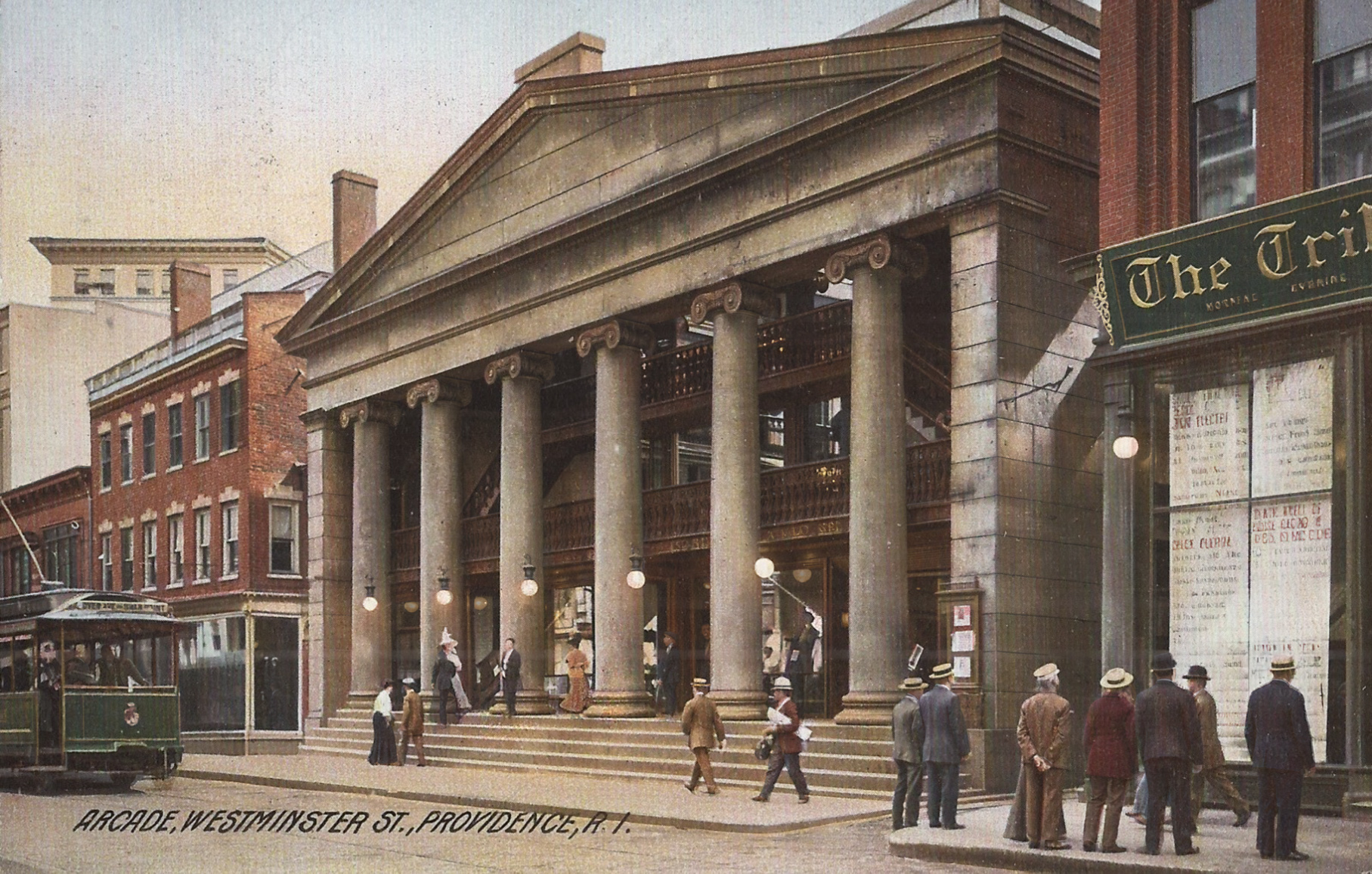
* Another eBay pick, a nicely-angled ground-level view of the Market Place in Providence, looking up College St. in the distance. Possibly the early 1900s?

* And finally, authors and publishers may be interested to know that PDF Index Generator is now at version 3.6. This adds AI divination of topic categories. The worthy one-man $70 desktop software auto-generates a back-of-the-book index for your book(s).


— End-quotes —

Tobacco smoke and smoking were very common in Lovecraft’s time.

“Philandering and Nicotinical Sir:- I’ve never smoked since donning long trousers; since the fragrant weed is to me no more than a choking nuisance. When I was small, I smoked because it was the grown-up, masculine, and forbidden thing to do; but as soon as I could present a reasonably grown-up appearance without it, I relievedly suffered it to become a none-too-cherished memory. I naturally have to tolerate clouds of mephitic vapour from most of my friends, and I flatter myself that I do it without complaint. But at least I don’t have to thicken the cloud of tear-gas by any voluntary exhalations of my own!” — Lovecraft to Rheinhart Kleiner, November 1919.

Really — what pleasure one can gain from puffing away at nauseating & stifling fumes is beyond me! I did it once— when 11 to 14 years old — for no boy in my vicinity was then considered manly unless he surreptitiously emulated the graceful smokestack either behind the stables or in the neighbouring sylvan retreats. I sampled cigars, cigarettes, pipe, & the like; & puffed like a veteran; but always detested the infernal stuff. Glad enough was I to fling away tobacco when long trousers & increased inches made my manliness an obvious fact which needed no nicotinical corroboration! Nor have I any literary need of tobacco. When I go in for drugs, I am no “tin-horn”, but buckle right down to opium — vide “Dagon”. Since it is not I, but my heroes, who indulge, I do not feel the ill effects. Incidentally — I think Alfredus [Galpin] has given up his cherished hasheesh!” — Lovecraft to Rheinhart Kleiner, February 1920.

“Anent the smoke nuisance — you may be correct in theory about the reason for my aversion for the weed, but I would lay a heavy wager that it would take years of practice for me to cultivate a taste which after all is not worth cultivating! I am a conservative soul, & am not as radically different in tastes from the 14-year-old Theobaldus as one might fancy from a mere reading of the numerals which proclaim my proximity to thirty. All I know is that smoke is smoke, & just as choking when from a pipe as when from a leaky stove! Of course, connoisseurs make fine distinctions — but I prefer to breathe pure air than to inhale malodorous fumes. To me the ultimate horror of earth is a smoking car [train carriage set aside for smokers]. As a rule, I avoid taking drugs to stimulate literary endeavour; but when I try to describe hell — if ever I do — I fancy I shall take a ride in a smoker to work up atmosphere! Of course, the quality of the tobacco doubtless means something — but I find I acquire just as severe headaches when calling on a friend of mine who smokes quarter cigars.” — Lovecraft to Rheinhart Kleiner, March 1920.

Lovecraft’s New York City poem “On the Double-R Coffee House” (1st February 1925), on the bohemian hang-out, has… “Mids’t them I sit with smoke-try’d eyes”. He also talks in one of his letters of the… “nicotined atmosphere” there. The mid-1920s Kalem Club meetings also appear to have been rather smoky at times, and what with that and the strong coffee, Lovecraft must have come away with quite a ‘buzz’.

“While I am peculiarly repelled by unpleasant odours, I have no vast hankering after perfumes, & always urge barbers not to smell up my old bean [his head] with patent citified lotions. I like the fresh scent of springtide on the hills, & the August aura of new-mown hay, but I’d never go to the trouble of building an organ of olfactory notes — with perfume-phials for pipes — as did des Esseintes in the tenth chapter of A Rebours!” — Lovecraft to Fritz Leiber, December 1936.

HPLinks #85 – Innsmouth sells, lost fantasists, tall ships, sinister coastlines, new movies and more…

16 Saturday May 2026

Posted by asdjfdlkf in HPLinks, Lovecraftian arts, Picture postals

≈ Leave a comment

HPLinks #85.

* Antiques & Arts reports that the lacklustre and error-riddled amateur Innsmouth book produced in Lovecraft’s lifetime has fetched $11,875 at auction. I’d guess, from the price, that it’s probably not the same as the signed Heritage Auctions copy I featured last week in HPLinks. The Antiques & Arts report also gives the prices for other Lovecraft books sold at the same PBA Galleries auction.

* Wormwoodiana discovers a trove of unknown fantasy books from Lovecraft’s era, in “Reading Fantasy in 1928-29: Part One”. They appear to have been well outside the orbit of Weird Tales.

* DMR surveys Weird Architecture Part I: Our World and Time and Weird Architecture Part II: Other Worlds and Times.

* Taskerland this week has considered remarks On “Through the Gates of the Silver Key”.

* In Spanish from Chile, the survey article La Antartica en la Literatura Fantastica (2017) (‘The Antarctic in Fantastic Literature’). Freely, and seemingly newly, available online.

* Deep Cuts this week considers and reprints the short 1936 local memoir “Robert E. Howard as a Boy”.

* Useful for Mythos writers and others, a new Howard / Conan Comics / Lovecraft / CAS mega-combo in-world timeline as a free spreadsheet, Titan/Heroic Signatures Howardverse Timeline V1.

* Possibly also of use as reference for Mythos writers, The Online Review of Rhode Island History has faithfully transcribed the local guide A Survey of Rhode Island in 1789 as a HTML page.

* The worthy local Windows freeware Everything is so useful for scholars and picture archivists that it has to be mentioned here. Now in a new 1.5 beta (May 2026). The beta adds drag-and-drop from search-results to other software, tagging, Boolean search, and more. It’s also incredibly fast. Very useful for local search on your PC, in combination with the free AnyTXT Searcher. To enable Boolean: Top menu | Tools | Options | Search | ‘Allow Literal Operators’. NOT is then a search operator, as well as AND, OR.

* New and sinister Lovecraftian goings on along England’s sedate Somerset coastline…

“The Apocalypse Players’ […] latest full adventure, As The Waters Cover The Sea, begins with a walking trip in the Quantock Hills and soon spirals into a strange and terrifying tale involving cricket, crustaceans, cults and Alfoxton House. […] the county and its people somehow feel more authentically in touch with the past than other parts of England […] feels like a place where ghosts could walk, cults gather, and fae creatures dance by moonlight”.

Their performance of As The Waters Cover The Sea has 23(!) podcast parts and has just concluded. All the parts are now on YouTube.

* Ages of Madness is a forthcoming ‘Lovecraft animated’ anthology of animated shorts. According to the trade journal Animation Magazine the European project is a serious venture now attracting big names in auteur animation, and it will… “serve as a prelude to the feature-film Ages of Madness: The Howling of the Jinn”. Which, at a guess from the title and also the prelude anthology’s format, may weave a episodic tale around the history of The Necronomicon?

* A big-screen indie reboot of Lovecraft’s Herbert West: Reanimator is apparently moving ahead. Starburst magazine has Malcolm McDowell (Clockwork Orange) signing on to appear, with… “cameras expected to begin rolling next month [June 2026] in the river town of Alton.” Not Bolton.

* And finally, newly on Archive.org is the short 2:30 minutes film The Life of H.P. Lovecraft which showcases the current (horrific to some) state-of-the-art of AI video generation. Sadly not under Creative Commons, or else stills from it might be re-styled/re-drawn to make a comic-book version.


— End-quotes —

New on eBay, I found a 1907 low view of the industrial side of the Providence river-front, with a working tug. A card made by someone who knew the tug’s pilot, seen at the wheelhouse. Plus my Photoshopped Nano Banana makeover, giving the picture a slightly more Lovecraftian feel. Note the old sailing-ship masts on the far-right, which Lovecraft knew and which he would have glimpsed while coming down the lanes onto the other river-front.

[Lovecraft returns home to Providence after a long trip…] “A fresh salt wind came up from the harbour, over the roofs of the centuried warehouses and the Old Market House of 1773; and down the narrow, curving line of the old town street by the shoar I glimpsed the chimneys and gambrel roofs of mouldering houses known to ancient captains and tarry West Indian seamen. I was home again — in the old New-England seaport that is not quite like any other New-England seaport; in the old maritime New-England that is so different in its soul from [the inland towns …] green-leaved, hill-crowning Providence — Providence, of the old brick sidewalks and the Georgian spires and the curving lanes of the hill, and the salt winds from over mouldering wharves where strange-cargoed ships of eld have swung at anchor.” — Lovecraft in Observations on Several Parts of America (1928).

“Southward you will glimpse the harbour, once a forest of masts, & even now a port of prominence. In September 1815, Market Square was temporarily transformed to a raging sea — the terrible gale of that month driving large full-rigged ships high over the bridge. A good-sized brig was left stranded on Westminster Street when the mad waters subsided.” — Lovecraft to Kleiner, June 1918.

“Into this bay used to come the shipping of all the world, and about a century ago it was a veritable forest of masts.” — Lovecraft to Galpin, September 1919.

“I can see clearly that the French have a profounder culture than we have — that their intellectual perspective is infinitely clearer than ours, & that their tastes are infinitely farther removed from animal simplicity. [Yet still] I shout at every French prize [captured ship] that Capt. Abraham Whipple (my collateral ancestor) brings to Providence harbour & delivers to His Majesty’s prize court of Admiralty at Newport” — Lovecraft to Woodburn Harris, November 1929.

[Lovecraft explores the industrial side of the Providence river-front in 1928, finding behind it…] “a squalid colonial labyrinth in which I moved as an utter stranger, each moment wondering whether I were indeed in my native town or in some leprous, distorted witch-Salem […] there was a fog, & out of it & into it again mov’d dark monstrous diseas’d shapes […] narrow exotick streets and alleys […] grotesque lines of gambrel roofs with drunken eaves and idiotick tottering chimneys […] and toward the southeast, a stark silhouette of hoary, unhallowed black chimneys and bleak ridgepoles against a mist that is white and blank and saline — the venerable, the immemorial sea”. — Lovecraft to Morton, December 1923.

“The effect of night, of any flowing water, of the peep of day, of ships, of the open ocean, calls up in the mind an army of anonymous desires and pleasures. Something, we feel, should happen; we know not what, yet we proceed in quest of it.” — R.L. Stevenson, noted by Lovecraft as entry No. 222 in his Commonplace Book of story ideas. He had found it quoted in John Buchan’s The Runagates Club (1928). It was to be his last entry in his Commonplace Book.

HPLinks #84 – HPL’s Innsmouth, Cosmic Humour, Lovecraft’s guns, and more…

10 Sunday May 2026

Posted by asdjfdlkf in HPLinks

≈ Leave a comment

HPLinks #84.

* Up for auction in three days, what might be Lovecraft’s copy of the ill-fated Innsmouth book, or at least one of the copies he was shipped and then sent around to friends…

* S.T. Joshi’s latest blog post lists the anthology Lovers of Darkness: New Stories Inspired by Lovecraft’s Commonplace Book as one of his new books… “likely to appear this year”.

* Japan Cthulhu is a 780-page table-trembler, filled with Japanese tales in Italian translation. This May 2026 book… “collects three novels and seven short stories [as a bumper anthology] that explores the golden age of the Japanese Lovecraftian tale”. A quick search suggests it’s not also available in English. Though I guess the novels and stories may be found separately in English.

* There’s a chapter that touches on Lovecraft in the new Concerning Dust and Ashes: Affects of Horror in the Hebrew Bible (Oxford University Press, 2026), “The Wonder and the Terror of the Divine” …

The chapter argues for the sublime as a temporary point of hesitation, which must resolve itself into either wonder or terror. […] This experience of terror as a result of an encounter with the divine is termed ‘transcendent terror’, a category which shares many characteristics with Lovecraftian cosmic horror. […] While Lovecraft’s idea of cosmic horror is situated within an atheistic worldview, transcendent terror can serve as a theistically framed model of a similar type.

* Also apparently touching on Lovecraft, a new Bloomsbury book coming in June 2026, titled Cosmic Humour and Philosophical Pessimism in Contemporary Culture. It looks at a specific form of humour that articulates a ‘cosmic’ pessimistic outlook. The author traces it from Britain in 1969, then a nation undergoing a rapid loss of faith in established religious and political institutions amidst an unprecedented wave of de-censorship (and also, incidentally discovering Lovecraft). From there the book progresses through later examples of such humour. The gloomy Marvin the Paranoid Android, in Hitchhiker’s Guide to the Galaxy, is apparently one such example.

* Somewhat of a shelf-companion to Cosmic Humour perhaps, is Weird Mysticism: Philosophical Horror And The Mystical Text (2020) from Lehigh University Press. An old one, but it’s the first time I’ve noticed it here. One of the three areas of focus is on…

philosophical pessimism [via the] pessimal paradise of E.M. Cioran. [What] emerges is a quiet friendly imperative to laugh in the face of the void…” (review)

* It looks like I missed noting Lovecraftian Proceedings No. 5 here. This was the 2024 issue, collecting the 2022 conference papers. Among others, it has the definitive article on “Firearms in the Life and Work of H.P. Lovecraft”, co-written by two deep researchers of the topic. I see that one co-author also has a Investigator Weapons handbook for the Call of Cthulhu tabletop RPG, though I couldn’t get past the DriveThruRPG captcha to see it.

* Curtis Weyant seeks a connection between De Casseres and Lovecraft.

* The Silver Key has a new Arcane Arts: Dispatches from the Silver Key newsletter. 12 issues so far. The email newsletter is free and “covers things the blog doesn’t” such as heavy metal music.

* GhostvilleHero has a brief review of In the Mad Mountains: Stories Inspired by H.P. Lovecraft (2024).

* MPorcius is reading through the first issues of Weird Tales, from 1923, summarizing the tales and commenting.

* Super Stuff in the Bronze Age has a lengthy Windy City Pulp and Paper Con 2026 report…

the annual convention book issued by Moon Dog press, was this year focused on Argosy magazine […] Incredibly there was a copy of Weird Tales #2 (April 1923) for sale [at the dealer tables], unslabbed. That is the rarest issue, rarer than Weird Tales #1. I’m told it is unthinkable for something like that to be for sale at a UK event. I understand that another copy of Weird Tales #2 (graded by CGC at 8.0) is shortly to go up for auction at Heritage [Auctions].

* Super Stuff also tips me off to the fact that there is… “an Overstreet price-guide equivalent for pulps called Bookery’s Guide To Pulps, with the latest 4th edition just published”. The 3rd edition, in 410 pages, is here and this seems the official site.

* A complete 1936-1971 run of the pulp Astounding, up for auction in Australia in seven days.

* A free online article from The Pulpster’s 2021 issue, “A million words a year for 10 straight years”. In which Walter B. Gibson recalls how he wrote The Shadow…

Complete certainty of the plot, before beginning, allows spontaneous writing. Therefore, I write an elaborate synopsis, which covers definitely, even in acute detail, each point that promises real difficulty during the writing of the story.

* New on Archive.org, scans of a run of 19 issues of the Rohmer Review, a fanzine dedicated to Sax Rohmer (Fu Manchu) and his macabre tales. Lovecraft knew Rohmer via his publication in Weird Tales in the 1920s, had read his novel Brood of the Witch Queen, and read his popular history of sorcery The Romance of Sorcery (1924).

* I don’t track the weekly tidal wave of ‘Lovecraftian’ videogames, but a dating-sim sounds unusual enough to worth noting. Sucker for Love is…. “comedic in tone, but nevertheless remaining reverential to the themes and sensibilities of Lovecraft.” Newsweek magazine is sufficiently smitten to interview the guy who made it (freely available online, seemingly no region-block or paywall).

* And finally, it appears that the UK’s Free Speech Union can now accept PayPal, at long last. Members get options for experienced legal help, if they are attacked for exercising their legal right to free speech in the UK. The Union has won many free speech cases.


— End-quotes —

“I, too, was a detective in youth — being a member of the Providence Detective Agency at an age as late as 13! Our force [of local boys] had very rigid regulations and carried in its pockets a standard working equipment consisting of police whistle, magnifying-glass, electric flashlight, handcuffs, (sometimes plain twine, but ‘handcuffs’ for all that!), tin badge, (I have mine still!!), tape measure, (for footprints), revolver, (mine was the real thing, but Inspector Munro (age 12) had a water squirt-pistol while Inspector Upham (age 10) worried along with a cap-pistol). […] We shadowed many desperate-looking customers, and diligently compared their physiognomies with the “mugs” in The Detective [magazine], yet never made a full-fledged arrest. Ah, me — the good old days!” — Lovecraft to Derleth, February 1933.

“[As a boy] I used to be a great hand at rigging up [in disguise] having a whole makeup kit of bushy beards, fierce moustaches, slouch hats, daggers, pistols, and other appurtenances of the desperate characters toward which my youthful fancy inclined me.” — Lovecraft to Robert Bloch, June 1933.

“[As a boy] I loved the woods and their traditional associations. The lore of hunting allured me, and the feel of a rifle was balm to my soul; but after killing a squirrel I formed a dislike for killing things which could not fight back, hence turned to [card] targets until such a time as chance might give me a war. […] Around 1906 [age 16] I was a good rifle shot, but by 1910 my skill had declined [due to eyesight].” — Lovecraft to Moe, April 1933.

* [As a youth] “I loved firearms & could scarcely count the endless succession of guns & pistols I’ve owned. I wish even now that I hadn’t given away my last Remington [rifle]. As it is, [today] I possess only an ancestral & unshootable flintlock musket.” — Lovecraft to J. Vernon Shea, March 1933.

HPLinks #83 – Names in Lovecraft, Lovecraft and antiquity, Russian Lovecraft, Lovecraft on the Moon, and more…

02 Saturday May 2026

Posted by asdjfdlkf in HPLinks, Lovecraftian arts, New books, Scholarly works

≈ Leave a comment

HPLinks #83.

* New to me and now open-access, “Teratonymy: the weird and monstrous names of H.P. Lovecraft”, from the academic journal Names (September 2010). Freely available online.

* A long abstract for an advanced undergraduate presentation at Oberlin, “Letters from the Abyss: Epistolary Form and the Unknowable in Lovecraft’s Cosmic Horror” (2025). A rare focus on the influence of letter-writing on the structuring of Lovecraft’s fiction…

“Nineteenth-century Gothic texts such as Dracula and Frankenstein use written correspondence to create realism, build trust, and establish clear lines of communication between narrator and reader. This study argues that Lovecraft reworks these same forms to produce the opposite effect: confusion, fragmentation, and uncertainty.”

* A recent virtual conference on Mediterranean Antiquity in the Work of H.P. Lovecraft (April 2026). This included papers, not yet available online, such as…

    — H.P. Lovecraft and the Dark Side of Antiquity.
    — Cthulhu and Polyphemus.
    — Civilization, Decline, and Hybridizations: Trajectories of ‘Decadence’ in Greco-Roman Cultures and Lovecraft’s Fiction.
    — Roman History Through the Lens of Lovecraft?

* A reminder to readers that the deadline for the Armitage Symposium is fast approaching. Submit by 24th May 2026.

* The Journal of Dracula Studies once again rises from the dead, and has a new Call for Papers.

* Deep Cuts considers the 1970s booklet Winifred Virginia Jackson — Lovecraft’s Lost Romance (1976) by R. Alain Everts & George T. Wetzel. And also Lovecraft’s Daughter (1983) by R. Alain Everts. The latter being Sonia’s teenage ‘flapper’ daughter.

* The boy Lovecraft’s attention was turned towards Greek/Roman myth by reading Hawthorne’s Wonder Book and Tanglewood Tales. Now there’s a sumptuous new $100 illustrated Wonder Book Illuminated Edition, complete with essays by Guillermo del Toro and others.

* Dark Worlds Quarterly has a new post surveying The Cthulhu Mythos in the pulp magazine Strange Tales.

* From France, the audio ‘Lovecraft Integrale’ series of podcasts, which appear to be straightforward free high-quality human readings of Lovecraft in French, with music. My guess is that they’re meant to showcase the abilities of the maker’s Audio360 studio in Paris? Freely available online, no region-blocking.

* From Moscow, a Russian book whose English title might be The mythology of Lovecraft: From Cthulhu and cosmic horror to the Necronomicon and forbidden cults (2026). Appears to be a mix of biography, criticism and mythos-systematizing, with dashes of philosophy? The reviewer states… “it seems that this is the first time his mythology has been analysed in such detail in Russian”

* SpraguedeCampFan reviews Weird Tales: 100 Years of Weird, 1923-2023 (2023).

I see that this table-trembling 500-page hardback can now be had as a rather more lightweight Kindle ebook. Speaking of which, I read that Amazon is ceasing all re-install support and book-sales to its previous Kindle ereader devices… so watch out for that.

* A horrid front-cover that doesn’t inspire confidence, but I see there’s a new short book on Amazon titled Lovecraft on Civilization: Selected Writings.

It might be something quickly copy-pasted from the Selected Letters and banged together with some online essays? Or perhaps it’s something more considered and curated, and only marred by that cover? Who knows, as there’s no Kindle ebook free sample. Buyer beware.

* Seemingly from Germany (it’s in German, anyway) on the ARTE channel and online, the short 14 minute on-location documentary Providence, die dunkle Stadt von H.P. Lovecraft. The ARTE video plays for me, with no region-blocking, captchas or sign-in.

* An unusual new book, Lovecraft in India. A little digging reveals it to be a graphic novel, rather than a scholarly look at the publication history, reception and local adaptations. Available now from Gosh comics in London.

* Regard Critique reviews the new Metal Hurlant (the French edition of ‘Heavy Metal’) Lovecraft special-issue. The reviewer finds that Druillet has his…

extracts from his delirious illustrated Necronomicon [reprinted from the old Lovecraft special, but this time] accompanied by a complete analytical text on the links between the graphic designer and the author of Providence by Alex Nikolavitch.” And there is also… “a fascinating interview with the mangaka Gou Tanabe”.

* In Japan, the famous horror-manga creator Gou Tanabe has launched his long-form graphic novel adaptation of The Case of Charles Dexter Ward. The first instalment has now appeared in Japanese.

* Talking of comics, in case you hadn’t noticed, a vast and seemingly completist collection of vintage ‘fanzines and magazines about comics’ are flooding onto Archive.org as good scans.

* On DeviantArt, Peru’s GeniusXX is having fun depicting the Great Race and other Lovecraft monsters. He appears to be taking requests.

* A small fact about Lovecraft’s environs that I had not previously fully appreciated. It was male Brown University students who would have thronged up and down College Street (confined to the south sidewalk, the northerly one being traditionally reserved for residents) during term-time. Brown was then segregated by gender, it appears. Here is Lovecraft on the point…

I fear your colleague’s Providentian geography is all wet. Cushing St. is a full quarter-mile north of here; & instead of going up the great hill, slopes gradually downward from near its summit over the eastward plateau on top. (Like Barnes St. — which is not far away). It is around this street that Pembroke College, the female department of Brown University, clusters — whereas College St. (commonly called ‘College Hill’) tops the main & exclusively masculine part of the institution.” — Lovecraft to Galpin, November 1933.

* And finally, talking of hearty young lads, new at the HPLHS Store is the RPG book Campfire Tales: Scouts Against Cthulhu.


— End-quotes —

Slightly late (the astronauts are back and being received at the White House), but this week here are some quotes from Lovecraft on travel to the Moon. Lovecraft was aware, as early as 1920, of a plan to send a rocket-ship to the Moon…

“Speaking of astronomical things — is either of youse guys interested in (a) the supposed new trans-Neptunian planet [Pluto], (b) the talk of telegraphic communication with Venus or Mars, and (c) the Goddard plan for sending a rocket to the moon? If so, just speak up! Grandpa has heaps to say about all these things!” — Lovecraft to Galpin, April 1920.

He refers to space pioneer Robert Goddard’s paper A Method for Reaching Extreme Altitude (March 1920), which saw Goddard mercilessly mocked by the usual suspects.

“‘Space ships’ of the traditional scientifictional sort are perhaps a little beyond probability (the obstacles to their operation being really much greater than popular science indicates), but I certainly think that some rocket voyage to the moon (whose extreme nearness puts it in a separate category) will be attempted — first with an untenanted projectile, & later perhaps with a human cargo. Whether any living being could survive such a voyage & return is another matter.” — Lovecraft to Natalie H. Wooley, November 1933.

[In sending an editor] “an account of my vivid and active career I did not think it necessary to mention […] my voyage up the Oxus, nor my visit to Samarcand, […] but I did hint of certain travels through the aether in the dark of the moon, and give broad suggestions regarding certain queerly-dimensioned cities of windowless onyx towers on a planet circling about Antares …” — Lovecraft to Frank Belknap Long, December 1927.

HPLinks #82 – review of the Smith letters, Derleth re-written, German Lovecraft comics, Lovecraft’s birds, and more…

24 Friday Apr 2026

Posted by asdjfdlkf in HPLinks, Lovecraftian arts

≈ Leave a comment

HPLinks #82.

* Sprague de Camp Fan reviews the two-volume Dawnward Spire, Lonely Hill: The Letters of H.P. Lovecraft and Clark Ashton Smith.

* The latest Mythlore: A Journal of J.R.R. Tolkien, C.S. Lewis, Charles Williams, and Mythopoeic Literature is now freely available online. Mostly Tolkien and his circle/era, but note also the book reviews for…

   – William Hope Hodgson and the Rise of the Weird: Possibilities of the Dark.
   – Icons of the Fantastic: Illustrations of Imaginative Literature.
   – Raven and Crow: The Mythology, Art and Science of Our Favorite Black Birds.

* In Space: A Student Journal for Public Audiences (University of Alabama), “On Lovecraft and The End”. The idea of cosmic indifference, it is suggested…

frees us to define our own values of what is important and what is not. It examines suffering, not as some divine trial, but as a shared human experience that connects us.

* New on Amazon, Tales of the Derleth Mythos (April 2026), seemingly an anthology newly collected by Robert M. Price. A collection of writers responding to, and in two cases freely re-writing, Derleth’s post-Lovecraft Mythos tales…

Two stories presume to improve on a pair of Derleth’s own tales. “The Round Tower” is both a compliment on and a criticism of “The Lurker at the Threshold”. The trouble is that the third part of Lurker ‘jumps the tracks’ laid down by the preceding two. “The Round Tower” attempt to set things right with a new substitute part three. “Footsteps Far Below” reproduces most of Derleth’s “The Return of Hastur”, but incorporates revisions which were suggested by Clark Ashton Smith but ignored by Derleth.

* Dark Worlds digs up “More Early Plant Monsters” from Victorian and Edwardian fiction.

* New at LibriVox, a public domain reading of “Marooned in Andromeda” by Clark Ashton Smith.

* Due in September 2026, a third edition of Wiley’s table-trembling survey volume American Gothic: From Salem Witchcraft to H.P. Lovecraft.

* The new Eurocomics BD Die Katzen von Ulthar und weitere Geschichten offers four Lovecraft tales, adapted for comics by Giuseppe Congendo and Antonio Montano.

The tales adapted are “The Terrible Old Man”, “The Cats of Ulthar”, “The Hound” and “The Outsider”. The cover appeals, but the German review at Warp Core (here translated) is not encouraging…

It becomes clear from the very beginning that this book is anything but easy to read and digest. The artwork, is anything but standard and indeed the illustrations are extreme. Extremely minimalist, extremely stylized, and extremely abstract. The drawings are limited to two colours per page, with speech bubbles adding a third. At times, it’s hard to know what to make of what you’re looking at. The narratives themselves are advanced almost exclusively through dialogue.

* New on Archive.org, the fanzine Infinity #2 (1973). A Berni Wrightson special-issue, but it also has a Frazetta interview.

* Also new on Archive.org, Xero #10 (1963). Has a useful long survey of Sax Rhomer’s output, followed by a Rhomer bibliography to circa 1962.

* The latest Journal of Inklings Studies has a book review of Phantastes: A Graphic Novel Adapted from George MacDonald’s Classic. The issue’s reviews are freely available online.

* Talking of comics, the UK’s 2000 A.D. comics magazine has a new comic-book take on Lovecraft’s pigeons (you’ll recall his Yuggoth sonnet on “The Pigeon-Flyers” of Hell’s Kitchen, NYC)… Lovecraftian pigeon monster.

* The quality of book covers matter to half of your potential Generation Z readers, it appears. A new UK survey from the reputable YouGov survey agency, using a somewhat reliable methodology which surveyed 2,097 UK book-buying adults, in March 2026. They… “found that 49% of 18-24 year-olds consider a book’s cover an important factor when buying, compared to just 27% of over-55s.” At a time when many people’s disposable income is being very significantly reduced, I’d suggest that having a quality cover may tip the balance towards success. There are many options for the self-publisher: a young designer/typographer who wants to burnish their portfolio; a small commission via DeviantArt; public domain images; and even AI generation if one knows what one’s doing with it and can combine it with Photoshop skills.

* Possibly of use for writers, the unique free offline utility Paragraph Tripler / Paragraph Expander. Paste in your text, and get all paragraphs tripled. So you can potentially see three somewhat different versions at a time, and then pick the best. Or keep track of first / second / final draft, at the paragraph level.

* And finally, an amusing guide to installing H.P. Lovecraft Air Conditioning. One of the nicest combinations of AI writing and niche marketing I’ve yet come across…

Color Palette: Deep blues, charcoal grays, and muted emeralds mirror the night ocean and shadowed chapters of Lovecraft’s fiction. Neutral walls allow accents to pop and prevent the space from feeling oppressive.

Textural Layers: Stone veneer, weathered wood, and aged metals resemble ancient structures like the fictional R’lyeh or the forgotten libraries described by Lovecraft. Textures influence perceived room temperature and comfort.

Ambient Lighting: Low-intensity LEDs, programmable strips, and candles with flicker can mimic the eerie glow of otherworldly luminance. Lighting should be controllable to maintain comfort while preserving mood.

Scent And Sound: Subtle sea-air aromas or resinous scents and a curated soundscape of distant surf, creaking timbers, and whispered chorales enhance immersion without overwhelming the senses.

Furnishings And Symbolism: Classic leather seating, vintage shelving, and arcane-looking artifacts evoke Lovecraft’s era while keeping seating comfort and airflow top priorities.


— End-quotes —

“I recall how he [Everett McNeil] shewed Sonny and me Hell’s Kitchen — the first time either the Child or I ever saw it. Chasms of Hogarthian nightmare and odorous abomination — Baudelairian Satanism and cosmic terror-twisted, fantastic Nordic faces leering and grimacing beside night-lapping beacon-fires set to signal unholy planets — death brooding and gibbering in crypts and oozing out of the windows and cracks of unending bulging brick walls — sinister pigeon-breeders on filth-choked roofs sending birds of space out into black unknown gulfs with unrepeatable messages to the obscene, amorphous serpent-gods thereof.” — Lovecraft to Morton, December 1929, recalling visiting Hell’s Kitchen in New York City. Unlike Red Hook, the roofs in Hell’s Kitchen were accessible and thus used as youth-gang headquarters, where pigeon breeding in rooftop coops was rife. The birds aided in gambling, crime communications, and stealing.

“Carter did not enter the temple, because none but the Veiled King is permitted to do that. But before he left the garden the hour of the bell came, and he heard the shivering clang deafeningly above him, and the wailing of the horns and viols and voices loud from the lodges by the gates. And down the seven great walks stalked the long files of bowl-bearing priests in their singular way, giving to the traveller a fear which human priests do not often give. […] Then [he] turned and descended again the onyx alley of steps, for the palace itself no visitor may enter; and it is not well to look too long and steadily at the great central dome, since it is said to house the archaic father of all the rumoured shantak-birds, and to send out queer dreams to the curious. […] the rumoured shantak-birds are no wholesome things; it being indeed for the best that no man has ever truly seen one (for that fabled father of shantaks in the king’s dome is fed in the dark).” — Lovecraft, The Dream-Quest of Unknown Kadath.

“I saw the ruinous, deserted old Randolph Beebe house where the whippoorwills cluster abnormally, and learned that these birds are feared by the rustics as evil psychopomps. It is whispered that they linger and flutter around houses where death is approaching, hoping to catch the soul of the departed as it leaves. If the soul eludes them, they disperse in quiet disappointment; but sometimes they set up a chorused clamour of excited, triumphant chattering which makes the watchers turn pale and mutter — with that air of hushed, awestruck portentousness which only a backwoods Yankee can assume — “They got ’im!” […] I saw the haunted pasture bars in the spectral dusk, and one evening was thrilled and amazed by a monstrous saraband of fireflies over marsh and meadow. It was as if some strange, sinister constellation had taken on an uncanny life and descended to hang low above the lush grasses. And one day Mrs. Miniter shewed me a deep, mute ravine beyond the Randolph Beebe house, along whose far-off wooded floor an unseen stream trickles in eternal shadow. Here, I am told, the whippoorwills gather on certain nights for no good purpose.” — Lovecraft visits Wilbraham, scene of “The Dunwich Horror”, July 1928.

“Whippoorwills are odd creatures — & (as you may recall from my “Dunwich Horror”) form the subject of gruesome myths in rural New-England, being regarded as malign psychopomps. About their notes — in Florida the local whippoorwhills have an ampler call than in the North, perhaps indicating their membership in another sub-species. Instead of a cluck followed by “ree notes, the prevailing cry seems to be longer & more complexly trilled — so that the small boys of Dunedin translate the message rather quaintly as “Chuck married the widow”. These birds were especially numerous in the thickets near good old Canevin’s abode at 1159 Broadway [Dunedin, Florida].” — Lovecraft to Derleth, June 1933.

“Whippoorwills? I’ll say we have ’em down here! Exotic ones too with a liquid rolling note apparently more complex than that their northern kinsfolk … I first heard them in the mystical dawn outside my window, and half imagined that they were voices calling across the ultimate void from Beyond.” — Lovecraft to Derleth, from Dunedin, Florida, June 1931.

HPLinks #81 – Lovecraft and the posthuman, Lovecraft and geology, a century of Cthulhu, letter from Red Hook, and more…

17 Friday Apr 2026

Posted by asdjfdlkf in AI, HPLinks, Lovecraftian arts, New books, REH, Scholarly works

≈ Leave a comment

HPLinks #81.

* A new £150 academic book from Brill / Walter de Gruyter, H.P. Lovecraft and Posthumanism (2026). No sign of it yet on Amazon UK, but the ebook version is apparently published. Here are the contents…

* This week a geodynamics scientist looks closely at the geology in “At The Mountains of Madness”. Lovecraft’s…

geology is not decoration — it is the engine of the plot. The story advances through stratigraphy, fossils, field observations, and the slow realization that rocks are not simply background scenery, but records of worlds vastly older than humanity. In that sense, the horror is profoundly geological: it emerges from time, burial, preservation, and the idea that the Earth has existed far longer than we would like. From a geological perspective, one of Lovecraft’s sharpest intuitions was to present Antarctica as (geo)dynamic rather than static […] Lovecraft understood, instinctively, that the rock record is unsettling. A cliff is never just a cliff; it is a stack of vanished environments. A fossil is never just a shape in stone; it is evidence that the world used to be structured differently.

* HorrorBabble has a free six-hour audio reading of The Complete Hyperborean Cycle by Clark Ashton Smith: Audiovisual Edition on YouTube.

* The REH Foundation Press has issued a special fundraiser book for the Howard house repairs, First Passage: Early Drafts of Beloved Yarns (2026).

* Now officially free and online, the four-volume Encyclopedia of Pulp Heroes (2017).

* Forthcoming from the University of Wales Press, Coasts and the Gothic (2027), including a chapter on “Weird Tales of the China Coast”…

The weird tales of the treaty ports and coastal waters of China, written in the early years of the twentieth century, provide an evocative and understudied examination of life in the harbours and coasting vessels of […] urban port cities like Hong Kong, Shanghai, and Yangtai.

* S.T. Joshi has issued a new edited collection of lesser-known vintage horror tales, One of Cleopatra’s Nights: Tales and Poems of Egyptian Horror (2026). Available as a budget ebook, and it also includes some modern horror poems on the topic of Ancient Egypt.

* New from Italy, an Italian-language book Il secolo di Cthulhu: Omaggio misterioso a Lovecraft (‘The Century of Cthulhu: Writings in Honor of the Centennial’).

Apparently it opens with essays on the history of the famous tale, followed by stories. The lead essay… “reconstructs the birth of The Call of Cthulhu as a web of influences — from Margaret Murray to Lord Dunsany to Arthur Machen”. The fiction authors appear to have been asked to take as their departure point the real-life mysterious disappearance of an iconic early Italian fan-painting… “Karel Thole’s original painting for the cover of Monsters on the Street Corner“.

* Up for auction, The David Aronovitz Collection of Important Science Fiction and Fantasy. A two-part auction, in May and then December 2026. Including an August 1925 Lovecraft letter sent from Red Hook to Clark Ashton Smith…

* In a new interview, the manga creator Junji Ito talks Lovecraft, Osamu Dazai, and his latest vinyl-exclusive audio drama. The latter being his audio tale of…

an old melody on an unmarked vinyl record becomes an inexplicable source of terror, [and which] is now a vinyl-exclusive audio drama named In Old Records.

* An interesting Python-based attempt to make local software that automatically generates an OldTimeRadio show, which may interest some. Feed it real weird-science news, and from this it auto-writes a script, adds narration and voice-acting, then adds music and SFX. Sadly the narrator’s voice is generated via the Kokoro AI model, so… good luck getting it working on Windows. I must have tried to install/run a dozen different packages that claimed to offer Kokoro, and all failed or were stymied (each in a different way). The only working Kokoro TTS I have is included in the NovelForge 4.0 novel-writing software, which is straightforward Windows software with a no-hassle install.

* Talking of audio production tools which may interest Lovecraftian creatives, there’s now a 6Gb ‘fine-tune’ of the worthy Stable Audio sound-effects generator, called Stable Audio X and it works in ComfyUI. Stable Audio was trained on the vast Freesound.org archive of free sound-effect recordings. Apparently the X fine-tune of Stable Audio can not only do prompt-to-SFX-audio, but can also auto-create an accompanying foley soundtrack for a video (if you feed it a video).

* Talking of AI tools, yes… we can now re-style images so they more-or-less evoke Providence at night in Lovecraft’s time. Here’s ‘Lovecraft returns home up College Street at night, in the late 1920s’. Made with two Nano Banana day-to-night re-styles of a vintage public-domain image, plus my Photoshop-addition of HPL and the black bag he often carried.

Three short extracts from “Aletheia Phrikodes” (1916) by H.P. Lovecraft, seem to fit the picture…

Hard by, a yawning hillside grotto breathes
From deeps unvisited, a dull, dank air
That sears the leaves on certain stunted trees
[…]
I was afraid when through the vaulted space
Of the old tow’r, the clock-ticks died away
Into a silence so profound and chill
That my teeth chatter’d — giving yet no sound.
[…]
Methought a fire-mist drap’d with lucent fold
The well-remember’d features of the grove,
Whilst whirling ether bore in eddying streams
The hot, unfinish’d stuff of nascent worlds


— End-quotes —

“By 1901 or thereabouts I had a fair knowledge of the principles of chemistry […] Then my fickle fancy turned away to the intensive study of geography, geology” — Lovecraft to Galpin, August 1918.

[As a boy] “Much in the universe baffled me, yet I knew I could pry the answers out of books if I lived & studied longer. Geology, for example. Just how did these ancient sediments & stratifications get crystallised & upheaved into granite peaks? […] I became uncomfortably conscious of what I didn’t know. Tantalising gaps existed everywhere.” — Lovecraft to Vernon Shea, February 1934.

“an old-fashioned but not seriously misleading introduction to geology still unsurpassed for beginners is Geikie’s old Geology Primer. Another peculiarly congenial veteran is Winchell’s Walks and Talks in the Geological Field” — Lovecraft’s ghost-written Suggestions for a Reading Guide, probably indicating the key geology books he knew as a boy.

“I am not insensible of the importance of mineralogy in science; being well aware that the history of the planet and the details of many of its most vivid catastrophes lye hid in the chemical constitution and physical environment of its various sorts of rock. The science of geology, that primary branch of learning of which mineralogy is a division, is indeed something in which I might with ease become interested under the proper set of chance conditions; insomuch as it is directly concern’d with that main stream of cosmick pageantry which begins in blank aether and free electrons and ends in the perfection of Nordick man and Georgian architecture. Where mineralogy fails to get a grip on me is in the fact that it is a secondary science; an affair mainly of classification, with relatively slight direct linkage to the dramatick stream of pageantry of elemental conflict and mutation which appeals to the cosmic curiosity or interest-sense of the incurable layman.” — Lovecraft to his mineralogist friend Morton, October 1930.

“There is material for ineffable phantasy in the rocks & inner abysses of Mother Earth.” — Lovecraft to C.A. Smith, March 1933, in a letter headed as written at the “Hour of the Opening of the Under Burrows”.

HPLinks #80 – Golems, REH news, book reviews, comic adaptations, new Burleson book, librarians and more…

09 Thursday Apr 2026

Posted by asdjfdlkf in AI, HPLinks, Lovecraftian arts, REH, Scholarly works

≈ Leave a comment

HPLinks #80.

* An English abstract for a new conference paper from the city in Brno in the Czech Republic, “The Discipline of the Eye: Lovecraft’s Visual Epistemology, Atmospheric Proof, and the Horror of Display” (2026). Through “refusal and display”, Lovecraft…

disciplines the eye to treat atmosphere as evidence […] outline, surface, hue, and scene operate as atmospheric proof—signals of an alien order […] Indeterminacy, shared by narrator and reader, forces imaginative substitution, making the reader complicit in producing what cannot be stably seen.

* The latest (37.1) members-only Journal of the Fantastic in the Arts has a review of David Goudsward’s book Adventurous Liberation: H.P. Lovecraft in Florida. Not online.

* From Russia in Russian and open-access, an essay that translates as ‘The Fantastic Chronotope and the Image of the City in the works of G. Meyrink and H.P. Lovecraft’…

Meyrink’s Prague (The Golem and The Angel of the Western Window) and H.P. Lovecraft’s Innsmouth (“The Shadow over Innsmouth”) each offer a fantastic space with distinctive features [… I also suggest] that certain details of the descriptions of the fictional city of Innsmouth were most likely borrowed by H.P. Lovecraft from The Golem.

However, one can note that “Innsmouth” was written at the end of 1931 and yet Lovecraft didn’t finally read The Golem until several years later when Barlow was able to send him a copy… “I had seen the cinema version, and thought it was faithful to the original — but when I came to read the book only a year ago [i.e. April 1935]” …. Holy Yuggoth! The film had nothing of the novel save the mere title and the Prague ghetto setting — indeed, in the book the Golem-monster never appeared at all, but merely lurked in the background as a shadowy symbol.” (Lovecraft, in Selected Letters V, p.138). If there was any inspiration, it would have been from the movie. But Lovecraft was personally well acquainted with decrepit seafronts of all sorts.

* Also from Russia and in open-access, a new journal article which translates as “‘Lovecraftian Magic’ as a Form of Fictional Religion” (2026). In Russian, but easily auto-translated.

* A new philosophy article on the Medium platform on “H.P. Lovecraft’s Takedown of Islam” (a short free sample, then $ paywall).

* DMR notes the passing of “Lee Breakiron: A Gentleman and a (Howardian) Scholar”…

While Lee was all-around a gifted scholar of [R.E.] Howardiana, he was the undisputed king — by his own hand — when it came to scholarship regarding the history of Howardian fandom and literary criticism. He’d read and collected all of it during the decades before he strode into the REH scholarship arena.

* A review of Robert E. Howard: The Life and Times of a Texas Author.

* The REH Foundation podcast has a new chat surveying and discussing Robert E. Howard’s Pirate Stories.

* A new review of the Selected Letters of Clark Ashton Smith.

* On Kickstarter… Deep Space Lovecraft: 2 Cthulhu Mythos Horror Adaptations. Being… two “Mythos tales reimagined & visualized as hard science fiction” and done as comics. It’s heavily over-funded already. “The Haunter of the Dark” is imagined as a visit to a giant cathedral-like space station, and “The Hound” seemingly as a visit to another space station / museum? Despite the obviously AI-generated images, which by the looks of them were probably generated some years ago with now-primitive AI and then partly overpainted, the images have been carefully cohered into appealing pages. The pages are offered on the Kickstarter page as free samples. Looks to me like the Inverse Press / Flatline Comics could be a way to publish your AI generated comic in paper, without having to encounter the anti-AI hysteria currently being whipped up elsewhere.

* AI has moved on since then, and if you want a taster of that then have a look at this curious weird experiment. Simply feed the entire text of the seminal science-fiction novel The Time Machine into an AI, and have it make an apparently un-aided script and then generate a 17 minute movie version by itself… “this is the raw unrefined result with a single take, no cherry picking” says the experimenter.

* The new French Metal Hurlant 18 (Lovecraft special, 2026) magazine is now available.

* Amazon UK is listing Donald R. Burleson’s new book Seed of the Gods: Lovecraft-Inspired Tales and Others as published in April 2026… “his first collection of short stories in more than a decade, [in which] Burleson gathers tales written over the past fifteen years”.

* A new free ebook, “Overworked, Undernourished, and Weak in the Eyes”: The Portrayal of Librarians in Comics. An assiduous annotated and seemingly completist survey in 365 pages, offered by the author. Freely available to download as a PDF. It’s under Creative Commons Non-Commercial, so one could have an AI extract all the references which refer in some way to supernatural/horror librarians and thus make a more compact themed survey.

* Taskerland has a short essay “On “The Man of Stone” by Hazel Heald and H.P. Lovecraft”. He finds this collaboration is…

not a great story, but it is an instructive one. In its mixture of cosmic suggestion and theatrical excess, it shows how readily Lovecraft’s ideas can be broken apart and made to function elsewhere. What emerges is not simply a change in tone, but a loosening of ownership, the same anxieties set loose from their original form and already beginning to move beyond the control of their author. This process is usually dated to Lovecraft’s afterlife, to obscurity, Derlethian appropriation, copyright murkiness, and the long slide into cultural ubiquity, but its beginnings may be earlier.

* Dark Worlds surveys “The Arkham Sampler Fiction”. Scans of Derleth’s Sampler issues can now be found at the Internet Archive.

* Up for auction at Heritage Auctions, a complete run of Arkham House books.

* Browsing eBay for scans, I’d not seen this one before. A pleasing and unwatermarked map of the highway system in Rhode Island, 1925. Could be upscaled to become a good RPG game prop?

* And finally, a rare street-level view of the Market Square, Providence, as Lovecraft would have encountered it. Many other postcard views are elevated or bridge-views. The view here is north towards the State House dome. The city’s market was held around the railings on the left of the picture. One can almost imagine the fellow alighting from the tram car, holding a black bag, to be the young Lovecraft.


— End-quotes —

“My aunt is well acquainted with Mr. Champlin Burrage, an Oxford man, who is librarian of the John Carter Brown library at Brown. (I hope to meet him very soon.)” — Lovecraft to Kleiner, April 1917. Brown University in Providence.

“Like you I am absolutely devoid of actual friends outside of correspondence. Those whom I knew in youth are all active and successful now, […] one a librarian of the R.I. Historical Society” — Lovecraft to Kleiner, circa 1918.

“My other guest [in Providence], Carl Ferdinand Strauch — poet and Asst. Librarian of Muhlenberg University (a friend of Brobst’s) — was also highly interesting, and very appreciative of the local antiquities and and-wheres.” — Lovecraft to Morton, September 1932.

“Only the other day a correspondent of mine — a librarian who sees all the magazines — was remarking what a fixture of the small & select publications you [i.e. Derleth] are getting to be!” — Lovecraft to Derleth, September 1933.

“… some timid reader has torn out the pages [from the Necronomicon] where the Episode of the Vault under the Mosque comes to a climax — the deletion being curiously uniform in the copies at Harvard & at Miskatonic University. When I wrote to the University of Paris for information about the missing text, a polite sub-librarian, M. Lean de Vercheres, wrote me that be would make me a photostatic copy as soon as he could comply with the formalities attendant upon access to the dreaded volume. Unfortunately it was not long afterward that I learned of M. de Vercheres’ sudden insanity & incarceration, & of his attempt to burn the hideous book which he had just secured & consulted. Thereafter my requests met with scant notice.” — Lovecraft to C.A. Smith, November 1930.

HPLinks #79 – Lovecraft’s father, Lovecraft and urbanism, Herbert West BD, Claude Mythos, Lovecraft and machines, and more…

31 Tuesday Mar 2026

Posted by asdjfdlkf in AI, HPLinks, Lovecraftian arts, New books, Scholarly works

≈ 3 Comments

HPLinks #79.

* A new book, The Father’s Silence: H.P. Lovecraft and the Shadow of the Father (2026). Being a 100-page collection of “John L. McInnis III’s long unpublished scholarly work on Lovecraft”, newly published by his son. The book examines the long shadow that can be seen to have been cast by Lovecraft’s father, in relation to Lovecraft’s… “themes of inheritance, decay, forbidden knowledge, and unseen influence”.

* Deep Cuts considers “Howard Phillips Lovecraft and Sex” (1974) by R.A. Everts.

* New on Archive.org, to borrow, a scan of Barton Levi St. Armand’s The Roots of Horror in the Fiction of H.P. Lovecraft (1977).

* Also new on Archive.org, a scan of Zealia Bishop’s “H.P. Lovecraft: A Pupil’s Review” (1953).

* On Reddit, a long article on “Italian Cinema and Lovecraft”. In English.

* New in Italian, “Il mito di Lovecraft. H.P.L. come personaggio nel fumetto”, a journal article on Lovecraft as a character in two graphic novels (Alan Moore, Breccia). Freely available online.

* New in the latest edition of the journal Studies in the Fantastic, “Biophilia, New Urbanism, and “He”: H.P. Lovecraft’s Contribution to Environmental Thought” ($ paywall)…

Lovecraft presents readers with a compelling and original critique of twentieth-century American urbanism, one that bears little resemblance to either E.O. Wilson’s influential theory of biophilia or the environmental movement in general.

* New on YouTube, the R.E. Howard Foundation in a podcast conversation with the H.P. Lovecraft Historical Society.

* Heroic Fantasy Quarterly has news of the forthcoming Howard Days S&S Workshop for writers.

* Talking of writers, the $50 Windows desktop PC software NovelForge is now at version 4.0. At the end of last summer I made and released a free Lovecraft style module for it. In the new v4.0 this worthy script and novel-writing software adds “over 50 local neural voices” for text-to-speech, plus Word export and more. The voices are the excellent real-time Kokoro voices, in a ONNX wrapper (thus, no Python wrestling or $800 graphics-card is required). The installer size has increased accordingly, but is a reasonable 260Mb. The free-trial version doesn’t expire, has nearly all features working, and is only very lightly crippled. The third-party $20 WindowTop Pro would be required to give the software’s UI a full Dark Mode (tested and working), though NovelForge’s native ‘Distraction Free’ simple page now has a new dark option.

* ThePulp.Net has a handy new directory-page with fresh links to Doc Savage websites and more.

* Rue Morgue positively reviews the new Welsh anthology of Lovecraftian Mythos tales.

* On Archive.org, a good scan of the underground Skull Comics #4: Special Issue Lovecraft (1972), which was so popular they immediately followed it with Skull Comics #5 (1972) which was also a Lovecraft issue. #5 includes Corben and also an adaptation of the Lovecraft poem “To a Dreamer”.

* New to me, a French BD comics adaptation of Lovecraft’s “Herbert West”. 136 pages, published in April 2025. The characters become cartoon animals.

* Hokusai’s famous “Mount Fuji” series of prints gets a Lovecraftian monster-makeover, in a new 126-page artbook from Japan. Could be a quick AI makeover, I’ve not sure. Buyer beware.

* A McFarland book I missed noticing around Christmas time last year, Fantastic Adventures in the Comics: Rockets, Genies, and Bug-Eyed Monsters, 1940s-1980s (December 2025). Only covers American comics, and in just 120 pages. So it sounds like it’s aimed at newbie readers/collectors looking for an authoritative survey?

* Ghost Clinic reports that Mike Lyddon’s new screen documentary Lovecraft In Florida: DeLand and the Barlow House won ‘Best Short Documentary’ at A Night of Horror Film Festival and will be released on Blu-ray later in 2026, along with…

his 2022 documantary Haunted Thrills which had tremendous success on the film festival circuit. The film explores the pre-code science fiction and horror comic book era of the late 1940’s to mid 1950’s. It features commentary by three living pre-code comic book artists – Joe Sinnott, Everett Raymond Kinstler, and Victor Carrabotta, all of whom have sadly passed away. The Blu-ray will be a special signed and numbered limited edition release, so please bookmark this website as we near the release date, probably in October of 2026.

* And finally, the leading mega-AI Claude has its latest hottest version. It’s named ‘Claude Mythos’. Nope, the name is not an April Fool, apparently. Said by official leaked documents to be the secret next-gen Claude that is already built, and which in the words of the developers is… “by far the most powerful AI model we’ve ever developed”. The name was apparently given because it’s so scary.


— End-quotes —

“I am, I hope, now a complete machine without a disturbing and biassing volition; a machine for the reception and classification of ideas and the construction of theories.” — Lovecraft to Anne Tillery Renshaw, June 1921.

“About Brown [University students] rioting — yes, I did take a genuine pride in the virile energy and healthy antinomianism displayed [by the boys] on Memorial Day. […] It makes me sad to reflect that I’ve grown too old and grey to mix into inspiring rough-and-tumbles like this. I’d love to crack skulls in the name of free individualism, and smash office-appliance-shop windows as a symbolic nose-thumbing at the age of commerce, machines, time-tables…” — Lovecraft to Morton, July 1929.

“Anybody who thinks that men […] are able consciously to mould the effect and influences of the devices they create, is behind the times psychologically. Men can use machines for a while, but after a while the psychology of machine-habituation and machine-dependence becomes such that the machines will be using the men — modelling them to their essentially efficient and absolutely valueless precision of action and thought …… perfect functioning, without any reason or reward for functioning at all. [We will] no longer measure men as human beings, but as effective fractions of a vast mathematical machine which has no goal or purpose save to increase the precision and economy of its own useless and rewardless motions.” — Lovecraft to Morton, October 1929.

“Just read the new Astounding [pulp magazine]. Essentially mediocre & conventional — machine-made stories with no distinction in style or atmosphere.” — Lovecraft to Derleth, September 1933.

HPLinks #78 – F.B. Long letters published, new early discoveries, Providence swamps and ponds, and more…

23 Monday Mar 2026

Posted by asdjfdlkf in Historical context, HPLinks, Scholarly works

≈ Leave a comment

HPLinks #78.

* The long-awaited limited-edition hardcover of the Lovecraft-Long letters has been released. As the $85 A Sense of Proportion: The Letters of H.P. Lovecraft and Frank Belknap Long. Shipping now.

This volume brings to a conclusion the massive effort to publish the totality of Lovecraft’s extant correspondence. In each of these twenty volumes, editors David E. Schultz and S.T. Joshi have consulted original manuscripts and have exhaustively annotated the letters to provide readers with a full understanding of the biographical and literary background of every document.

Congratulations to all involved with this triumph of research, scholarship and endurance. Now all we need is the cumulative index volume. And, to save Tentaclii readers from looking, I should add that there’s no sign yet of a release of the scans of these new letters at the Brown University repository. At least, not when sorting by date. Possibly these are there, but the system dated them a few years back, when they were ingested-but-embargoed? Just a guess, for now.

* S.T. Joshi reports on a newly-found ‘first mention of Lovecraft in print’. Donovan K. Loucks has unearthed a Providence Evening News item from early April 1903, which reported that the boy Lovecraft had his $4 “small express waggon” stolen from in front of the Hope Reservoir Pumping Station. An express waggon was a basic multi-purpose toy cart with a long handle for pulling and no brakes. The one seen below is made of wood, but they were also made of sheet metal by the early 1900s.

Yes, that sloping path looks perfect for boys and waggon-rides.

* An abstract for a paper presented at the Design Research Society Conference 2026, “User centred dread: a Lovecraftian critique of design”… “The concept of ‘user-centered dread’ emerges as a central provocation, highlighting how users are led into states of incomprehension and even terror through supposedly benign design work”. The authors are from Glasgow in Scotland, a city notorious for its urban design horrors.

* A new open-access article in the journal Modern American History, “Where the Dumps that Used to Be Ponds Used to Be: Urbanization and Waste in Providence, Rhode Island” provides detailed deep historical background on the changing aqueous landscapes of Providence.

from the 1880s until the 1950s, officials encouraged the conversion of inner-city ponds and lakes into landfills, with each filling more quickly than the last. This trend continued until virtually all low, wet places had been filled, along with significant stretches of the urban coastline.

For Lovecraft, such places were Cat Swamp; along the banks of the Seekonk; York Pond and the ravines back of it. From places such as York Pond and the Seekonk arose his earliest literary combinations of landscape and nightmare.

* The Fossil: Official Publication of The Fossils has its January 2026 issue freely available. Including an item from Lovecraft’s wife… “Monica Wasserman writes about a recently discovered early piece by Sonia Green, published in 1921” and the snappily-written piece is also printed. Though it takes some decoding, as its written in the amateur convention-report style of the time.

* Back in July I noted the Argentinian philosophy book H.P. Lovecraft. La Anti-vida y el destino cosmico (2025), and now I see an “English Edition” is newly available as a Kindle ebook on Amazon. Get the 10% free sample to determine if the translation is up to the job.

* At the University of Verona, Italy, there was a campus-wide… “day of studies to explore the role of materials and resources in science-fiction worlds, between theoretical reflections and the analysis of Lovecraft”.

* In open-access, what appears to be a February 2026 special edition of Lingua Italiana magazine (?) on the topic of The New Italian Weird. In Italian. Freely available online.

* DMR considers Lovecraft’s Shout-Outs to Robert E. Howard, rather than the other way around…

Lovecraft told REH that he would name-check some of Howard’s creations in his future tales and he fulfilled that promise. The earliest mentions can be found in “The Whisperer in Darkness”, which was finished in September of 1930.

* Dark Worlds Quarterly surveys “Shoggothian Terror in Sword & Sorcery Comics”.

* The Save the Robert E. Howard Museum campaign is now more than half-way there.

* American Hero Press have a very sumptuous-looking Frazetta TERROR large-format artbook at 15″, with pull-out prints on heavy paper stock.

* Finnish publisher Jalava has long done good work in translating Lovecraft, R.E. Howard and others into Finnish. I see that in 2025 they produced a handsome edited volume of the best stories by Lovecraft in Finnish.

* Now released, the new book Ghost Signals: The Shadowlands Of British Analogue Television 1968-1995. 140 pages of essays on the otherworldly in the British landscape, as seen on British broadcast television in its prime.

* Talking of British spooks, the final ‘farewell’ issue of the scholarly M.R. James journal Ghosts & Scholars has been published.

* From Germany, a YouTube gallery of various Mythos Creatures, visualised as five-second ‘animated pictures’.

* On Kickstarter and already funded, a Dreamlands playing-card pack.

* The Gates of Imagination reads Lovecraft’s “The Haunter of the Dark”, free on YouTube.

* On Librivox and public domain, Short Science Fiction Collection 106. Includes free audio readings of Frank Belknap Long’s “Young Man With a Trumpet” and Hannes Bok’s “Return from Death”.

* And finally, on Reddit one Grandpa Theobaldus (u/GrandpaTheobaldus) is newly fascinated by Lovecraft and film-going, and is regularly digging up Lovecraft quotes in which the master talks about movies he has seen.


— End-quotes —

“My home was not far from what was then the edge of the settled residence district, so that I was just as used to the rolling fields, stone walls, giant elms, squat farmhouses, and deep woods of rural New England as to the ancient urban scene. This brooding, primitive landscape seemed to me to hold some vast but unknown significance, and certain dark wooded hollows near the Seekonk River took on an aura of strangeness not unmixed with vague horror. They figured in my dreams — especially those nightmares containing the black, winged rubbery entities which I called “night-gaunts” — Lovecraft, from “Some Notes on a Nonentity”.

“Remembering that I had no map & knew nothing of the country, [I went] trusting with chance with a very agreeable sense of adventure into the unknown; just as I used to enjoy getting “lost” on walks around Cat Swamp [as a boy]” — Letters to Family, page 421. The northern part of Cat Swamp became the Brown University Baseball Field of the 1920s/30s.

“[the old wild and farmland area of Providence is now] built up with residential streets; although a small strip of it — the high wooded bluff along the Seekonk River & an adjacent series of ravines — has been preserved in its primitive state as a park reservation.”, Selected Letters IV, p.348. The high wooded bluff is the southern one at York Pond, likely relatively pristine throughout Lovecraft’s life (although the northern bluff was ground down and graded for a road). Note however that in Lovecraft’s boyhood this strip along the Seekonk had evidently been a wild and unregulated place, as… “By 1908, Blackstone Park had fallen into almost complete disuse” (Providence Journal) and was being used as a dumping ground. One suspects the city authorities were deliberately neglecting it, in the hope of waterfront development. The city however eventually preserved the tidal Seekonk waterfront for the long term, with…

“the preservation of a splendidly rural series of river-bluffs, wooded ravines, and meadows for a space of at least two miles along the shore, and extending considerably inland. Its ownership and conditions are [legally] fixed, hence it has been the same throughout my life and is always likely to stay so. I can shed the years uncannily by getting into some of my favourite childhood haunts here. In spots where nothing has changed, there is little to remind me that the date is not still 1900 or 1901, and that I am not still a boy of 10 or 11.” — Lovecraft to Derleth, October 1930, written outdoors from “Open fields near the River”.

← Older posts


Please become my patron at www.patreon.com/davehaden to help this blog survive and thrive.

Or donate via PayPal — any amount is welcome! Donations total at Easter 2025, since 2015: $390.

Archives

  • June 2026
  • May 2026
  • April 2026
  • March 2026
  • February 2026
  • January 2026
  • December 2025
  • November 2025
  • October 2025
  • September 2025
  • August 2025
  • July 2025
  • June 2025
  • May 2025
  • April 2025
  • March 2025
  • February 2025
  • January 2025
  • December 2024
  • November 2024
  • October 2024
  • September 2024
  • August 2024
  • July 2024
  • June 2024
  • May 2024
  • April 2024
  • March 2024
  • February 2024
  • January 2024
  • December 2023
  • November 2023
  • October 2023
  • September 2023
  • August 2023
  • July 2023
  • June 2023
  • May 2023
  • April 2023
  • March 2023
  • February 2023
  • January 2023
  • December 2022
  • November 2022
  • October 2022
  • September 2022
  • August 2022
  • July 2022
  • June 2022
  • May 2022
  • April 2022
  • March 2022
  • February 2022
  • January 2022
  • December 2021
  • November 2021
  • October 2021
  • September 2021
  • August 2021
  • July 2021
  • June 2021
  • May 2021
  • April 2021
  • March 2021
  • February 2021
  • January 2021
  • December 2020
  • November 2020
  • October 2020
  • September 2020
  • August 2020
  • July 2020
  • June 2020
  • May 2020
  • April 2020
  • March 2020
  • February 2020
  • January 2020
  • December 2019
  • November 2019
  • October 2019
  • September 2019
  • August 2019
  • July 2019
  • June 2019
  • May 2019
  • April 2019
  • March 2019
  • February 2019
  • January 2019
  • December 2018
  • November 2018
  • October 2018
  • September 2018
  • August 2018
  • August 2015
  • July 2015
  • March 2015
  • February 2015
  • January 2015
  • December 2014
  • November 2014
  • October 2014
  • September 2014
  • August 2014
  • July 2014
  • June 2014
  • May 2014
  • March 2014
  • February 2014
  • January 2014
  • December 2013
  • November 2013
  • October 2013
  • September 2013
  • August 2013
  • July 2013
  • June 2013
  • May 2013
  • April 2013
  • March 2013
  • February 2013
  • January 2013
  • December 2012
  • November 2012
  • October 2012
  • September 2012
  • August 2012
  • July 2012
  • June 2012
  • May 2012
  • April 2012
  • March 2012
  • February 2012
  • January 2012
  • December 2011
  • November 2011
  • October 2011
  • September 2011
  • August 2011
  • July 2011
  • June 2011
  • May 2011
  • April 2011
  • March 2011
  • February 2011
  • January 2011
  • December 2010
  • November 2010
  • October 2010
  • September 2010
  • August 2010
  • July 2010

Categories

  • 3D (14)
  • AI (73)
  • Astronomy (70)
  • Censorship (14)
  • de Camp (7)
  • Doyle (7)
  • Films & trailers (101)
  • Fonts (9)
  • Guest posts (2)
  • Historical context (1,096)
  • Housekeeping (91)
  • HPLinks (88)
  • Kipling (11)
  • Kittee Tuesday (92)
  • Lovecraft as character (58)
  • Lovecraftian arts (1,634)
  • Lovecraftian places (19)
  • Maps (70)
  • NecronomiCon 2013 (40)
  • NecronomiCon 2015 (21)
  • New books (971)
  • New discoveries (165)
  • Night in Providence (17)
  • Odd scratchings (984)
  • Picture postals (277)
  • Podcasts etc. (431)
  • REH (186)
  • Scholarly works (1,475)
  • Summer School (31)
  • Unnamable (87)

Get this blog in your newsreader:
 
RSS Feed — Posts
RSS Feed — Comments

H.P. Lovecraft's Poster Collection - 17 retro travel posters for $18. Print ready, and available to buy — the proceeds help to support the work of Tentaclii.

Proudly powered by WordPress Theme: Chateau by Ignacio Ricci.