What goodies do we seem to have entering the public domain in January 2024?
70 years:
For nations under ‘the 70 year rule’, the author must have died in 1953. At the current Wikipedia list of such, the major names are the poet Dylan Thomas (Under Milk Wood, though not the LP recording) and Hilaire Belloc (Cautionary Tales for Children and much more). Also the screenwriter Herman J. Mankiewicz (writer on The Enchanted Cottage).
With a little digging I find, for 1953 deaths…
* Gordon MacCreagh, the horror, adventure and travel writer, real-life adventurer and U.S. navy pilot. His White Waters and Black (1926), a book on an expedition up the River Amazon is said to be… “regarded by many as one of the great travel books”. Author of at least five horror stories, a contributor of stirring tales to Adventure and Argosy, and he appears to have produced well over 150 stories in all. There seems potential for a ‘best of’ book, if such does not already exist.
* Sir Arnold Bax. Master of the King’s Musick during the Second World War. Known for the romantic Celtic tone poem “Tintagel” and others. But I find he also… “wrote poetry and short stories set in Ireland under the name of Dermot O’Byrne”. The tales were described at the time as… “studies of romantic life in the West of Ireland to-day”.
* T.F. Powys. One of the Powys brothers, he wrote Christian fantasy stories and novels. Now very obscure, even to Christians. But he attracted a healthy amount of academic and critical interest in the 20th century.
* George Manning-Sanders. British story writer, novelist and playwright. Had a widely acclaimed first novel, Drum and Monkey, but is now forgotten. Drum was “a novel about a dealer in second-hand oddments, and his ambitions for his young son.” His stories were published in the daily press, and seem likely to be human ‘real life’ stories of Britain in the 1930s.
Also of possible interest…
* Charles R. Knight, a major dinosaur artist and painter of prehistoric man in his environment. Inspired Harryhausen. “First published in 1946, Charles R. Knight’s Life Through the Ages” is apparently a major artistic study of humans in the Stone Age.
* “Gordon Jennings, who died in 1953, was a master of special effects” for the movies “who almost single-handedly elevated the art from its primitive beginnings”. The War of the Worlds, When Worlds Collide and many others. He doesn’t appear to have published anything on the craft of special effects, but some readers of Tentaclii may know different.
* H.J. Massingham. British nature writer. Died 1952, thought some say 1953. Any uncertainly on the date will be cleared by 2024.
The U.S.A.
All the films, books and other works published in 1928. Below are some of my picks. Some of these titles here may already be public domain, due to the author’s death date.
Edgar Rice Burroughs, The Master Mind of Mars (Barsoom series), and Tarzan, Lord of the Jungle (book version).
S. Fowler Wright, Deluge. His huge best-seller. Influenced John Wyndham and John Christopher.
E.E. ‘Doc’ Smith, The Skylark of Space (serial version).
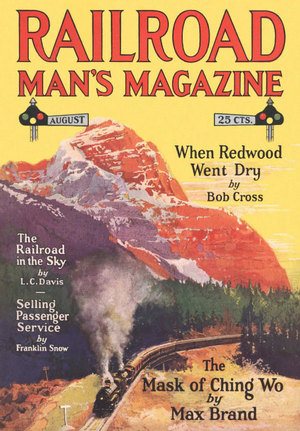
Weird Tales and other pulps for 1928. Of possible interest in WT are Wandrei’s “Sonnets of the Midnight Hours” series, re: a new illustrated edition. Munn’s tale “The Werewolf’s Daughter” also enters the public domain via WT, thus completing the release of his three linked ‘Werewolf’ novels (the first two being Werewolf of Ponkert, and Return of the Master).
Ethel Owen, Hallowe’en Tales & Games. Games to play and tales to tell, for children in middle childhood. Wife of Frank Owen (“The Wind that Tramps the World”), the Weird Tales contributor.
Wild Animal Interviews and wild opinions of us. Sounds like a potential source for a new graphic novel or children’s picture-book.
The Giraffe in History and Art. Unusual.
And finally, I noticed some 1928 books that H.P. Lovecraft might have read, or at least browsed in the public library:
H.B. Drake, The Shadowy Thing. A novel praised by Lovecraft.
Virginia Woolf, Orlando: a biography. He must have read reviews, at least.
The Polar Regions in the twentieth century.
The Book of Polar Exploration.
G.B. Harrison, England in Shakespeare’s day. By a Cambridge lecturer. Published in New York.
The Story of the Spectator 1828-1928.
Hare, London in bygone days.
Boys and Girls of Colonial Times.
The Roman World. Knoph edition, New York.
The Rise of American Civilization: Volumes One and Two.
The History of British Civilization.
Oswald Spengler, The Decline of the West: Volume Two. In English. I seem to recall he had only ever read Vol. 1, but he would have seen reviews of Vol. 2.
Vathek. John Day Co. edition, New York. With Introduction, and fine illustrations.
The Day After To-morrow: What is going to happen to the world? A good brisk survey of Lovecraft’s possible future-world, as it would have seemed at 1927-28. Published by Doubleday, so not a crank book. Note the focus on glands, suggesting Lovecraft was not alone in his interest.
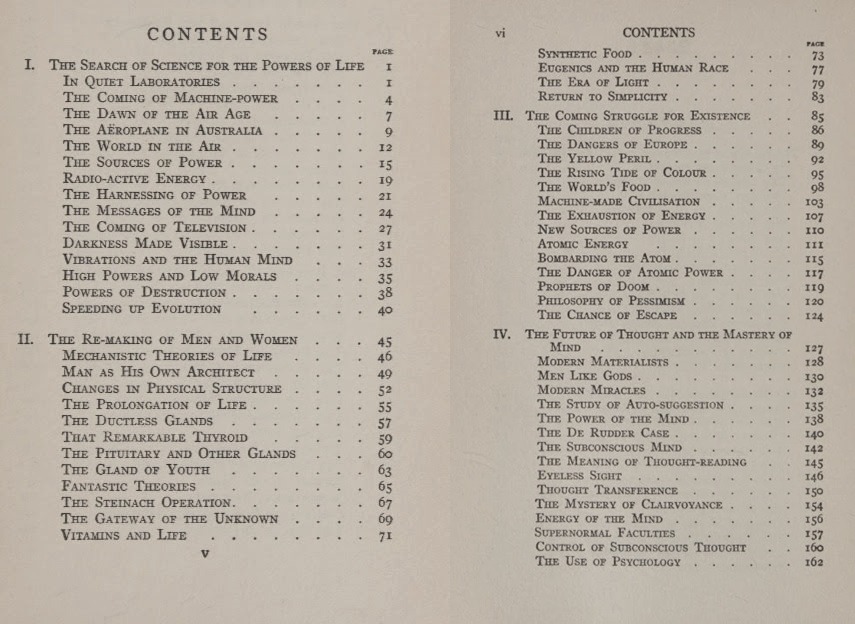
On Archive.org as The Day After Tomorrow. Note that the contents-page’s page-numbers are awry.
Ice Cream (the first manual and handbook)
50 years:
In the few nations that follow the 50 year rule, J.R.R. Tolkien. The only notable nation there is New Zealand. But it was reported a while back that NZ bureaucrats have done some shifty shifting about, inside a trade treaty, so as to make it 70 years from 2024. Thus Tolkien may well not be going into the public domain there.