• About
  • Directory
  • Free stuff
  • Lovecraft for beginners
  • My Books
  • Open Lovecraft
  • Reviews
  • Travel Posters
  • SALTES

Tentaclii

~ News & scholarship on H.P. Lovecraft

Tentaclii

Category Archives: New discoveries

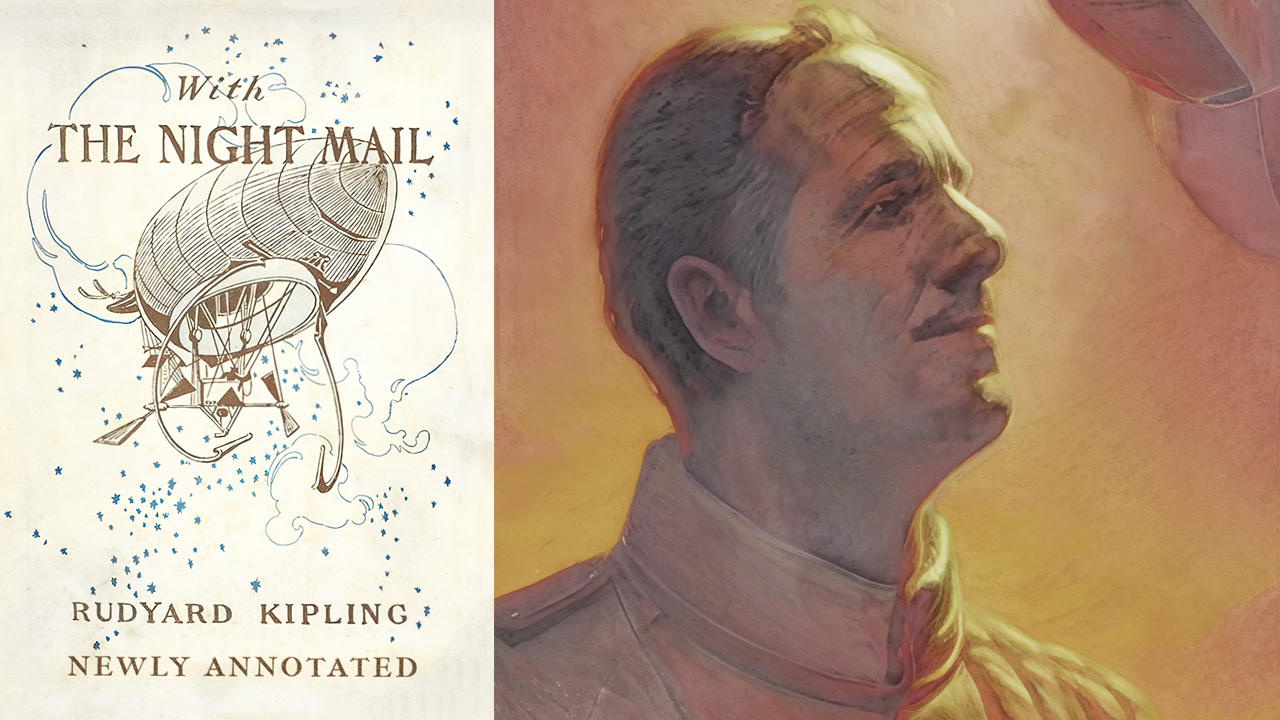
New book: Copiously annotated and corrected edition of “With The Night Mail”

28 Sunday Aug 2022

Posted by asdjfdlkf in Kipling, New books, New discoveries, Scholarly works

≈ 4 Comments

Newly published, my labour-of-love “With the Night Mail”, annotated edition. Available now as a .PDF file. $2 on Gumroad, but the first 30 Tentaclii readers can get it free by using coupon-code tentaclii at the checkout. Or if you’ve feeling generous, you can pay the $2 and skip the coupon. I’m hoping that this Gumroad ‘formula’ may eventually start to produce a much-needed bit of extra income.

Blurb:

This is the best version of Kipling’s famous “With The Night Mail” (1905), the first ‘hard’ science-fiction story. Still a fabulous steampunk read, today.

Here newly and fully annotated with 4,600 words of precise scholarly annotations. Several important new discoveries are made, including the identity of “little Ada” — she was a real pilot! All four earliest versions have been checked and cross-referenced, and the modern corrupted text has been carefully cleaned. Differences between editions are noted in the footnotes.

There are 145 footnotes, explaining the technology, lingo, and places. One footnote even discovers a long ‘new’ section of dialogue about the risk of plague, unseen since the first publications in 1905 — and never reprinted until now!

This .PDF is thus as close as we will get to a definitive version of the seminal story that launched the entire genre of hard science-fiction, and which opened the highly influential Gollancz yellow-jacket survey anthology One Hundred Years of Science Fiction (1969).

As a bonus, there are four new full-page colour illustrations including one of “George”. This labour-of-love e-book is 28 pages in total, delivered to you as a .PDF file. It may interest RPG gamers, as well as scholars and readers.

As you can tell, I’ve at last been able to see all four of the earliest editions. And my gosh… many differences! And with errors in places, in some modern editions, even including a handful in the free version on the site of The Kipling Society. Anyway, regular Tentaclii readers know my approach… copious attention to detail, deep historical research, resulting in many fascinating footnotes. Enjoy.

REVIEW: The Lovecraft Annual 2021

09 Tuesday Aug 2022

Posted by asdjfdlkf in New books, New discoveries, Scholarly works

≈ 2 Comments

REVIEW: The Lovecraft Annual 2021. Hippocampus Press. Published late summer 2021.

The curry-brown cover of the 2021 Lovecraft Annual might seem to anticipate ‘hot stuff’ inside, and Lovecraftians who see the connection will not be disappointed. My guess is that this year’s colour choice was designed to sizzle nicely on the shelf, alongside the hot new Letters to E. Hoffmann Price which has an appendix containing Price’s East India Curry recipe.


Serving up the Annual’s spicy ‘appetiser’ is Horace A. Smith, co-author of a forthcoming book on Lovecraft’s experience of astronomy, the planets and various real cosmic phenomena. Here his title and subject is “Astronomy with Lovecraft’s First Telescope”. Perhaps in response to a magazine advert, Lovecraft had mailed off 99 cents of his juvenile allowance and received back an ‘Exclesior’ astronomical telescope. Smith reports on his own purchase of a vintage eBay example of the same, followed by his tests. There are found to be some small faults in the instrument, such as the need for balance of the extended tubes and some chromatic shifts in the lenses. But on a clear night the telescope is found to be quite adequate for seeing the moons of Jupiter. The ‘Exclesior’ could also serve as a terrestrial spy glass and even as a microscope. Lovecraft seems to have obtained this first telescope sometime in the first quarter of 1903, at age 12. Smith does not take the opportunity to link this telescope with the ‘sleuthing’ which Lovecraft also undertook at around this age. Selected Letters III reveals that the young Lovecraft, at around age 12/13, always carried a gun — a real revolver — with him and also had a set of disguises and false beards. This was to do with his boyhood detective work with the unofficial ‘Providence Detective Agency’, perhaps modelled on the Baker Street Irregulars of Sherlock Holmes or some other band of boys in the juvenile literature of the time. One imagines that a folding spy-glass might have offered this roving group useful long-distance surveillance of miscreants, as well as some fine viewing of craters on the moon, Mars and Orion’s belt.


A brief note in the Annual then tells of the recent arrival of the Belknap Long letters at the John Hay Library.


Duncan Norris’s “The Detestation of Mammon in Lovecraft” is a brisk and yet thoughtful survey of the various uses to which Lovecraft put money and gold in his tales. The two items were then widely considered to be freely exchangeable, due to what was known as the ‘Gold Standard’. This meant cash could be converted to gold on demand, a useful guard for the citizenry against a corrupt money-printing government. I might add that Providence was a centre for large-scale jewellery making, to which Lovecraft appears had a family connection via his father — but admittedly that is rather tangential to the idea of gold as an incorruptible currency. A survey of the uses of poverty and needy frugality in Lovecraft’s writings would of course be a whole other essay, but also a nice companion piece for “Detestation of Mammon”. Perhaps Norris might consider surveying this topic in a future Annual.


Next there is a brief note on the remarkable discovery of another historical Howard P. Lovecraft. Living in Los Angeles, of all places, and being of working age in 1917. Make of that what you will, Mythos writers of Hollywood.


Ken Faig Jr.’s “Lovecraft and the Irish” continues his long-standing interest in the Irish in Providence and their connections with Lovecraft. He opens by recalling the Irish domestic servants who were employed in Lovecraft’s boyhood home, and then explores the close juvenile friendship with the Branigan brothers. The focus here is on their family and home, rather than the free-range activities undertaken by the boys during their middle childhood. A painting of their father is reproduced in b&w on page 35 of the Annual, but the proportions are noticeably distorted. By the time of Lovecraft’s boyhood this neighbouring family had ‘married out’ and up, and had thus become only “a quarter Irish”. But it seems they compensated for their paternal dilution by becoming all the more fervently Irish in cultural terms. Faig finds that they made frequent visits across the water to the old pre-Troubles Ireland, and took delight in collecting what were presumably genuine Celtic antiquities. Faig draws our attention, via a Lovecraft letter, to the strange and presumably ancient votive bog-carvings they carried back. These found their way into Lovecraft’s growing mantelpiece museum of arcane curios, and he cherished them for the rest of his life. These were “grotesque” and had “a greenish patina” according to a letter by Lovecraft. I then wondered if these might have formed subconscious templates for the later ‘Cthulhu idol’, which at one point in the famous tale is also seen to be located in a swamp?

I would have welcomed Faig’s opinion on the social standing of Catholics in Providence circa 1902-1916, but no mention is made. One assumes the Irish of Providence were all practising Catholics. And when Faig’s essay states that Cardinal Mercier of Belgium stayed with the Branigan family in 1919 during his visit to the USA, such a thing seems almost certain. Surely a national Cardinal would only have stayed with a Catholic family known for devout attendance at church? But what did Lovecraft think of such matters, given his later reflexive rhetorical distaste for all things ‘Popish’? Did Providence’s long tradition of religious freedom and toleration give him a more open minded approach in his middle childhood and teenage years? This matter of religion and toleration perhaps deserves further investigation, though admittedly it may be difficult to pin down Lovecraft’s early attitudes to such things — beyond his well-known pagan play-acting in the local sylvan glades, and his teenage determination to avoid class prejudice in his friendships. Such as his friendship with the Swedish working-class immigrant Arthur J. Fredlund. The Swedes being then the largest new immigrant group in Providence, and as such formative in shaping Lovecraft’s aesthetic appreciation of ‘Nordic beauty’. The Irish were also a handsome lot, judging by the Providence Amateur Press Club, predominantly young Irish amateurs. Here the Club is given a paragraph by Faig but is ably documented in full elsewhere, with photos found by myself. Lovecraft’s supernatural Irish homecoming story “The Moon Bog” is touched on. Faig concludes with some later events relating to the Branigan family, and the fate of their house. He discovers a 1916 passport photo of Lovecraft’s long-ago close playmate John Joseph Branigan which, though small and shadowed, shows a handsome ‘Jonny Appleseed’ type of American lad.


David E. Schultz then goes “Following The Ancient Track” in pursuit of the early order in which Lovecraft’s poetry might have been presented as a collection. This ancient track leads into a briar-tangled swamp of ‘tentative lists’ with crossings-out, crumbling typescripts, abandoned booklets and more. But Schultz is a most able guide to such things, and leads his reader out the other side of the swamp with nary a scratch.


A brief note then anticipates the forthcoming book which will survey Lovecraft and his interest in astronomy and the planets. Ahead of this, some recent Lovecraft Annual essays on related topics are pointed out. This reminded me that the Lovecraft Annual could benefit from a single-volume keyword index, since there are now 15 volumes on the shelf and another is due very soon. Not everyone has access to the electronic version locked in academic databases, which is presumably searchable.


Raphael Hanon offers “Lovecraft’s Presentiment: Taphonomy as a Narrative and Horrific Element in the Tales of H.P. Lovecraft”. Taphonomy is the scientific study of the decomposition of creatures, specifically the reasoning and inference that can be applied to these remains. This aids in the solving of crime or the expansion of our knowledge of history and the earth sciences. Such factual but necessarily gory matters are here ably identified and surveyed in Lovecraft’s fiction. The details are found to be accurate even though… “Taphonomy was not yet a discipline when Lovecraft published his texts”. Which positions Lovecraft as something of a pioneer. But how much of a pioneer, I wondered? Were others also doing similar things in pulp and detective fiction? Sherlock Holmes is mentioned briefly, and we know Lovecraft read his adventures up to a certain date. It might then have been useful for Hanon to briefly quote a Sherlockian authority on the matter. I know that Conan Doyle had been a former doctor’s assistant in the slums of Birmingham in the West Midlands of England. But did he then use genuine taphonomy in the Holmes tales, and if so how often?

Hanon remarks that… “For an exhaustive review of Lovecraft’s use of science, the reader should refer to Gorosuk’s recent work.” This turns out to be a 2013 masters dissertation in French, freely available online. This focuses on science in “The Call of Cthulhu”, “The Shadow Over Innsmouth”, “The Shadow Out of Time”, The Case of Charles Dexter Ward, and “At the Mountains of Madness”. I’d be interested to read an abridged version in English, if someone could translate it for a future Annual.


Dylan Henderson follows with a brilliant and well-written consideration of “The Promise of Cosmic Revelations: How the Landscape of Vermont Transforms “The Whisperer in Darkness””. I was ready for this consideration of Vermont, having very recently revisited “Whisperer” — though I had found myself a trifle disappointed by some of the tale’s clunkily over-explanatory lines and the relentlessly clueless narrator. Was “Whisperer” actually another self-parody like “The Hound”? But it seems not, judging by Lovecraft’s letters on its varied reception among ‘the gang’. It’s perhaps best thought of now as Lovecraft trying to overtly ‘please Farnsworth Wright’ at Weird Tales, which would seem to be one plausible explanation of it.

Henderson considers the densely wooded hills and still-unpaved mountain tracks of 1920s Vermont in relation to an encroaching modernity and the likely psychological impact of the ‘settled rural’ + ‘dark wilderness forest’ on an urban man of the period. Urbanites are even today often unsettled by deep countryside, and torn by the promise vs. the reality of the rustic life in a modern world. In the end I was not entirely convinced that Henderson’s claims about what Lovecraft might have been trying to do with the characterisation and landscape of the tale. His central claims, though well stated, didn’t quite seem to chime with the story I had just heard. But Henderson makes perceptive comments about the implied off-world cities of the ‘Outer Ones’ (the buzzing Mi-go from Yuggoth), and the false lure of knowledge and far-flung travel — the getting of which turns out to entail becoming a proto-Dalek ‘brain in a canister’ to be ferried around at the whim of alien entities. Many a modern inter-continental airline passenger might feel something similar. Lovecraft acutely felt the tension —in a new world of transatlantic airships, giant ocean liners, and the British flying-boat service which strung together even the furthest reaches of the Empire — between “a wish for infinite visioning and voyaging power [and] the familiar background which gives all things significance.” His modest and practical solution was to balance low-cost regional summer explorations with winter voyaging into the cosmic unknown via fiction and poetry. Along with his all-year vicarious enjoyment of travelogues in magazines, and the “infinite visioning” sometimes to be had from glimpses in the new medium of cinema newsreels or feature films set in exotic locations.


Brendan Whyte responds to the previous Lovecraft Annual with his “H.P. Lovecraft’s First Appearance in Print Reconsidered”. But — like the contributor to which he responds — somehow he has not discovered that a “psychometrical” apparatus was for weather forecasting and measurement. It has to do with measuring condensation and dew formation and is apparently used for measurements alongside bulb thermometers. This method relates also to “the colours of the thin films which the action of the weather produces upon glass” in collecting and condensing the condensation. Again, a chance has been lost to suggest a link between the young Lovecraft’s weather station apparatus and the strangely coloured “globules” in “The Colour out of Space”. Whyte does however very usefully suggest that the remote Amsterdam Evening Recorder newspaper was likely “lifting entirely and directly” its Lovecraft letter from a mid 1905 issue of The New York Herald. This seems very likely, though the Herald appearance has not yet been located. In which case we need find no connection of the young Lovecraft with a town some 100 miles NW of Providence.


Lovecraft himself appears next with his poem “New England Fallen”, a seemingly newly discovered version not in the latest The Ancient Track. There is a 1912 poem of that name in this definitive poetry collection, but it is far longer and definitely not as enjoyable to read. This short version has a verve and snap about it, and also a sentiment which reminds one of “The Street”. I would hazard a guess that it might also have been a private gift-poem, having been found handwritten on the back flyleaf of The Puritan Republic of the Massachusetts Bay in New England (1899). Perhaps a gift to Lovecraft’s then-elderly uncle and early mentor Franklin Chase Clark (1847-1915)? Incidentally, it appears that the formative Uncle still awaits a comprehensive study by Lovecraft scholars in terms of his interests, writings and publications — which went beyond the medical.

In the Annual the poem “New England Fallen” appears to have the typo fith for filth (“where fith corrupts”). It is of course possible that this is an early antiquarian touch from Lovecraft’s pen. The same can be found in All the Familiar Colloquies of Desiderius Erasmus, where the long-s word fiſh occurs in the line “where fish corrupts”, i.e. stinking and rotting fish. But the context of the “Fallen” poem is such that the word must be filth. A pity, since it would have been interesting to note Lovecraft conflating aliens and fish at so early a date.


Christopher Cuccia traverses “A Bridge through Chaos: The Miltonic in “Dagon” and Lovecraft’s Greater Cthulhu Mythos”, to examine the possible influence of Milton on the seminal tale of “Dagon”. Milton’s Bible-inspired cosmos and its monsters are found to be broadly comparable to those of Lovecraft. But I would have liked to have heard something about when and what Lovecraft read of Milton, prior to the writing of “Dagon” in the summer of 1917. Yes “Dagon” has the line in the story… “Through my terror ran curious reminiscences of [Milton’s] Paradise Lost, and of Satan’s hideous climb through the unfashioned realms of darkness.” But is Lovecraft here recalling his deep and recent reading of Milton, or just nodding distantly to the illustrations for it which struck him so forcibly as a child? These were found in…

an edition de luxe of “Paradise Lost” with illustrations by Dore, which I discovered one day in the east parlour

I can find no reference to his avidly reading Milton, other than his once recalling some oft-quoted ‘famous lines’ on the bucolic rustic life, and a passing remark in 1933 to Vernon Shea…

As for Milton — I don’t see how you … can argue away the distinctive charm of a large part of his work. He has the power of evoking unlimited images for persons of active imagination, & no amount of academic theory can explain that away

But that was in 1933, not 1916 or early 1917. And he doesn’t actually personalise it.


Marc Beherec then investigates “The Church That Inspired “The Horror at Red Hook” and the Fall of the House of Suydam”. At first glance Beherec appears to establish that Lovecraft knew the Syrians of the Red Hook were Christians, via a post-New York Dwyer letter. Beherec is correct but in a roundabout way, since he conflates the strange eastern music Lovecraft heard coming through the walls of his rented room (“A Syrian had the room next to mine”) with what is claimed to be Lovecraft’s 1927 knowledge that the Syrians of Red Hook were a variety of Orthodox Greek Christians (pages 141-142). This risks the reader misunderstanding what Lovecraft wrote at two different times. When Lovecraft wrote to Dwyer… “They belong for the most part to the Orthodox Greek Church” his comment was spurred not by Red Hook’s Syrians but rather by… “an old Turk [living at Clinton St.] under me, who used to get letters with outre stamps from the Levant. Alexander D. Messayeh.” The 1927 letter to Dwyer describes this man and then has a remark that observes that there is “a Greek strain” in the form of Christianity that then existed under the dominion of the Turks. Lovecraft was talking about the Greek influence on Christians living under Turkish dominion in the Near East, but he is not very specific and only by inference can the comment be seen to apply to Red Hook.

Most likely he did know the Red Hook Syrians were Christians, soon after arriving in Red Hook and after some initial confusion between i) the forever-unseen but oft-heard musical inhabitants of the room next to Lovecraft (“Syrian”), and ii) the seen and known “old” fellow living in the room under Lovecraft at Clinton Street (a “Turk”). The Syrians of Red Hook were indeed eastern Christians of various types and sects, fleeing the long persecution and massacres of Christians and Jews which has left the Middle East the impoverished monoculture it is today…

Renowned immigrant scholar Philip K. Hitti, himself a Maronite [i.e. an eastern Christian], observed that most Syrians designated Ottoman persecution, “the alien yoke of the Turks,” as “the chief cause of their emigration”. “Christianity overwhelmingly predominated in this immigrant group. The sources generally agree that roughly ninety percent of Syrian immigrants in the first wave to the United States were Christians” [almost entirely from the forested uplands of Mount Lebanon, and thus could also be called ‘Lebanese Christians’]. — from Gregory J. Shibley, New York’s Little Syria, 1880-1935 (2014).

The deep enmity between Christian Syrians and Turks is summed up by the old Syrian adage… “Wherever a Turk sets his foot, there the earth withers for a century”, and I imagine that even today they do not care to be confused with each other. Of course, Lovecraft may well have been confused himself. His supposed “Turk” in the room below, implied to be from “the Levant”, was possibly also a Syrian. Only an investigation of Mr. Alexander D. Messayeh will tell us more. In fact Messayeh was a Turk from Baghdad, the major and ancient city that lies far inland and to the east of the Levant coastal area and which at the time he came-of-age was then part of the fading Ottoman Empire. As a New York dealer in rare antiquities he would have had daily correspondence from across the Levant, which is what Lovecraft noted. The man can be known via various archival sources. The Daily News from New York, 4th May 1926 puts me on the right track…

Miss Kelly, 21, yesterday brought suit for $100,000 for “breach of promise against Alexander D. Messayeh, 52, internationally known art dealer.

A recent French thesis then clarifies the journalistic “art dealer” of 1926. Messayeh was actually a steady dealer in ancient antiquities, shipped by his brother from Baghdad to Britain, France and America…

he took part in the creation of the Plimpton collection [of ancient Babylonian tablets and cones], and in the enrichment of the British Museum [under the famous Budge] … [in 1912 in France] Father Scheil cites the name, referring to two people, “antique dealers, Bagdadians […] one of the brothers, Alexander D. Messayeh (more often called Alex) takes care of the American-front European business, while the second brother, Emil D. Messayeh, lives in Baghdad and manages supply [trading as ‘Messayeh & Ghanima’].” They had worked with the famous Budge to acquire Persian antiquities for the British Museum, as evidence by a letter… “In accordance with your wishes, we have made all possible inquiries against the Persian antiquities (…) we managed to obtain a statue (…)”. Letter from D. Massayeh and N. Ghamina to Dr. Budge, March 8, 1900.” — translated from La circulation des tablettes cuneiformes matheematiques, a 2017 thesis in French by Magali Dessagnes, for the University of Paris.

He entered the somewhat different trade in Babylonian tablets and cones and stamp-seals in circa 1913/1914, albeit according to a rival excavator who was talking to a big client and slighting Messayeh’s lack of expertise in such things. In 1931 a letter to Messayeh from the same rival abruptly chides Messayeh as an old-fashioned ‘object hunter’ — a trader unaware of a modern museum’s need for painstaking new scientific excavation methods and diligent documentation. Messayeh seems to have ceased trading from New York City at around that point. He made a late marriage in his old age, or perhaps brought his wife to the U.S.

Thus he was an urban Ottoman Turk from Baghdad (now Iraq), settled in New York City as a businessman rather than a Christian refugee fleeing persecution and massacre. Lovecraft was almost certainly right about his origin then, though unintentionally misleads by mentioning exotic postage stamps from the Levant (i.e. the long coastal stretch of the eastern Mediterranean from Aleppo down to the Suez Canal, and very far from inland Baghdad). Messayeh’s wide trading connections suggest he would have needed good English, and likely had fluency in various other languages. His religious background remains a mystery, and this question is not solved by the 1925 census for Clinton St. (my thanks to Ken Faig Jr. for this information). There Mr. Messayeh gave his name as a “Messeyek, Alex”, occupation as “Fireman”, born in the USA and aged “30”. All surely wrong. In the later 1940 census he seems to have told the truth… born 1875 in Baghdad. This fits with the dates for the brother who remained in Baghdad, in whose name the middle D. initial stood for “David”. If both brothers had “David” as a common middle name, that may even indicate a Jewish background. This may seem unlikely today, but at the end of the First World War “a third of the citizens of Baghdad were Jewish”.

Perhaps his 1925 census entry was because he was not keen for tax authorities to be able to readily cross-reference him. But I wonder if the seedy Clinton Street lodgings were also a way to avoid the lovely young Miss Kelly and her impending $100,000 law-suit?

“Art Man in $100,000 Love Suit”, 1926. The picture does not show the two people involved. The next day the same paper reported of him “ARABIAN KNIGHT ANGERED IN CELL IN [?]AM ARREST”.

The law-suit press-cutting confirms his age in summer 1926, 52. That age classed as “old” in those days, so Lovecraft was also correct there.

Beherec also gives some general figures for annual legal U.S. immigration of Syrians in 1924 (page 145), yet leaves unmentioned the important factor of the group’s local population growth in New York City from 1890-1924. His point about American over-reaction to this immigrant population would have been better made if he had noted the total local population — what is not stated is that around 10,000 Syrians were living in Brooklyn by 1930 (see the results of the 2017 research project Syrians in New York: Mapping Movement, 1900-1930, drawing on census data and using cutting-edge digital mapping). But Lovecraft was anyway aware of the more refined cultural and business aspects of the Syrian community in Brooklyn — for instance his tailor was a Syrian named Habib — and he took the trouble to show that the sinister newcomers in his tale were “eloquently repudiated” by settled locals. The newly arrived sect described in Red Hook are…

unclassified slant-eyed folk who used the Arabic alphabet but were eloquently repudiated by the great mass of Syrians” (The Horror at Red Hook”).

Beherec usefully spends several pages disentangling the various religious groups and sects involved in various Eastern religious presences in 1920s New York City, a matter which often utterly baffled the Catholic priests who came into contact with them and their unfamiliar ways. This aids the evaluation of various Red Hook churches as candidates for the key church described in “The Horror at Red Hook”, the church having been apparently mis-identified by earlier Lovecraftian researchers. The advice of deep experts on local churches is sought. The fact that most churches of that time and place really did have a basement dancehall is surely an interesting find, and it again confirms the documentary accuracy of ethnographic and demographic details in “Red Hook”. Also of interest is the relatively high water-table under some basements, which caused subsidence in later years, which make one think of the subterranean canals of the story and the collapsing buildings.

It is suggested by Beherec that Lovecraft at some point visited Manhattan’s ‘Little Syria’, the local source of the cross-city emigration from the late 1890s onward. Growing Syrian families had moved from the increasingly expensive Manhattan to the cheaper and more family-friendly properties of Brooklyn (Syrians in New York: Mapping Movement). I would have welcomed more evidence from the letters on this possible visit to the ‘Little Syria’ area in Manhattan, by 1925 a small area then becoming noted by guide books for tourists for its restaurants and spicy atmosphere. On the matters of the exact identification of the model for the church in the “Red Hook” story, and links with specific real people with the surname Suydam (very common in the city), I remain unconvinced by Beherec’s suggestions.

Toward the end Beherec gives a passage found in Kirk’s Diary. Kirk is talking of a Kalem meeting which frankly discussed sex… “one was a homo, one an avowed fetishist, one quite nothing were sex is concerned” wrote Kirk of the participants. (Lovecraft’s New York Circle, page 28). This sent me in search of the exact date of the meeting. It turns out that Lovecraft was away in Elizabethtown on Friday 10th October 1924 (as heard in the recent Voluminous podcast), having a break from ‘the boys’ and Sonia. Of the three attendees mentioned, we can assume that the first was Loveman (and that Kirk was thus aware of his homosexuality) but the other two are unknown. Presumably the Kalems were able to discuss sex so openly because Lovecraft was absent. The next day Lovecraft immediately returned early to Elizabethtown, Saturday 11th October, and it then seems sure that he had entirely skipped the Friday evening Kalem meeting (held at a “table” according to Kirk, so perhaps simply a cafe meet-up without McNeil).


Next in the Annual is James Goho’s “A Portrait of Charles Dexter Ward as a Haunted Young Man”. He suggests that Curwen can be understood as a ‘phantom’ — this being a specialist term currently in use among the Gothic Studies crowd in universities. Perhaps Goho’s most useful section here, for many outside the cloistered world of Gothic Studies, will be the seven pages offering a concise and straightforward plot summary of the novel. One hopes that lazy students will not use this as a crib in future, to avoid reading Dexter Ward. I recent heard the full book as the excellent vintage cassette tape reading, and can tell them that they would be missing out on quite a treat. Such a fluent and perfect reading must surely forever rebut the parroted claim that Lovecraft’s fiction is clotted and ‘unreadable’.


Duncan Norris hears “The Reverberation of Echoes: Lovecraft in Twenty-First-Century Cinema”, ably tracing Lovecraft’s themes and ideas in recent corporate and amateur screen productions. He makes the amusing point that the influence of Lovecraft is now so pervasive that even those who shun him are — unbeknown to themselves — still his followers. Norris is brisk and entertaining, and has a few sharp words for one big-name writer who professes to hate Lovecraft — yet who is on record as being proud of never having read “The Colour Out of Space” and other classic tales by the man. Norris also dips into soundtracks, and there is even some room in the capacious discussion for a quick thrash with Norwegian black metal rock bands.


Steven J. Mariconda’s annual column “How to Read Lovecraft” muses on Lovecraft’s sense of play, leading into a plausible consideration of how his sense of historical flow and juxtaposition may have been influenced by his formative study of devices such as Adams’ Synchronological Chart of Universal History (1881). Mariconda suggests this may be linked with the later ‘playing out’ of the Mythos as a linked and interpenetrated cross-story/cross-author timeline. This would also fit well with the synchronistic way Lovecraft understood time in his own self and memory.


Finally we have the book reviews. Ken Faig Jr. considers the new expanded volume of Kleiner letters. He tantalizes the reader with a remark on the Kleiner, Morton and Moe letters, stating that… “the fate of the originals is not known”. All we currently have are the transcripts. This makes me think that a future Lovecraft Annual might usefully have an overview of all possible ‘missing correspondent’ caches that are at all likely to still be lurking in someone’s attic, together with some indication of possible whereabouts (e.g. McNeil’s descendants in Wisconsin). Darrell Schweitzer then ably reviews the two-volume Letters to Family. Martin Andersson concludes with a review of the spicy new volume of Letters to E. Hoffmann Price and Richhard F. Searight. That’s the one with the curry recipe.

Postcard from Price and Lovecraft to Donald Wandrei, after the 25 and-a-half hour session of talk, curry and coffee that Lovecraft describes here as a “convocation of necromancers”. This marathon session occurred in New Orleans when Lovecraft first visited Price. Postcard dated 15th June 1932.

‘Picture postals’ from Lovecraft – Chatham

15 Friday Jul 2022

Posted by asdjfdlkf in Historical context, New discoveries, Picture postals

≈ Leave a comment

In Selected Letters Vol. V we encounter Lovecraft writing a late letter to Kleiner. Lovecraft recalls a “Chatham” as a key landmark from early in his New York City years…

the quaint familiar landmarks (Scotch Bakery – Chatham – 78 Columbia Heights, etc.)

This is not footnoted in the first edition of the Kleiner letters. No other reference to a “Chatham” occurs in Letters I have access to.

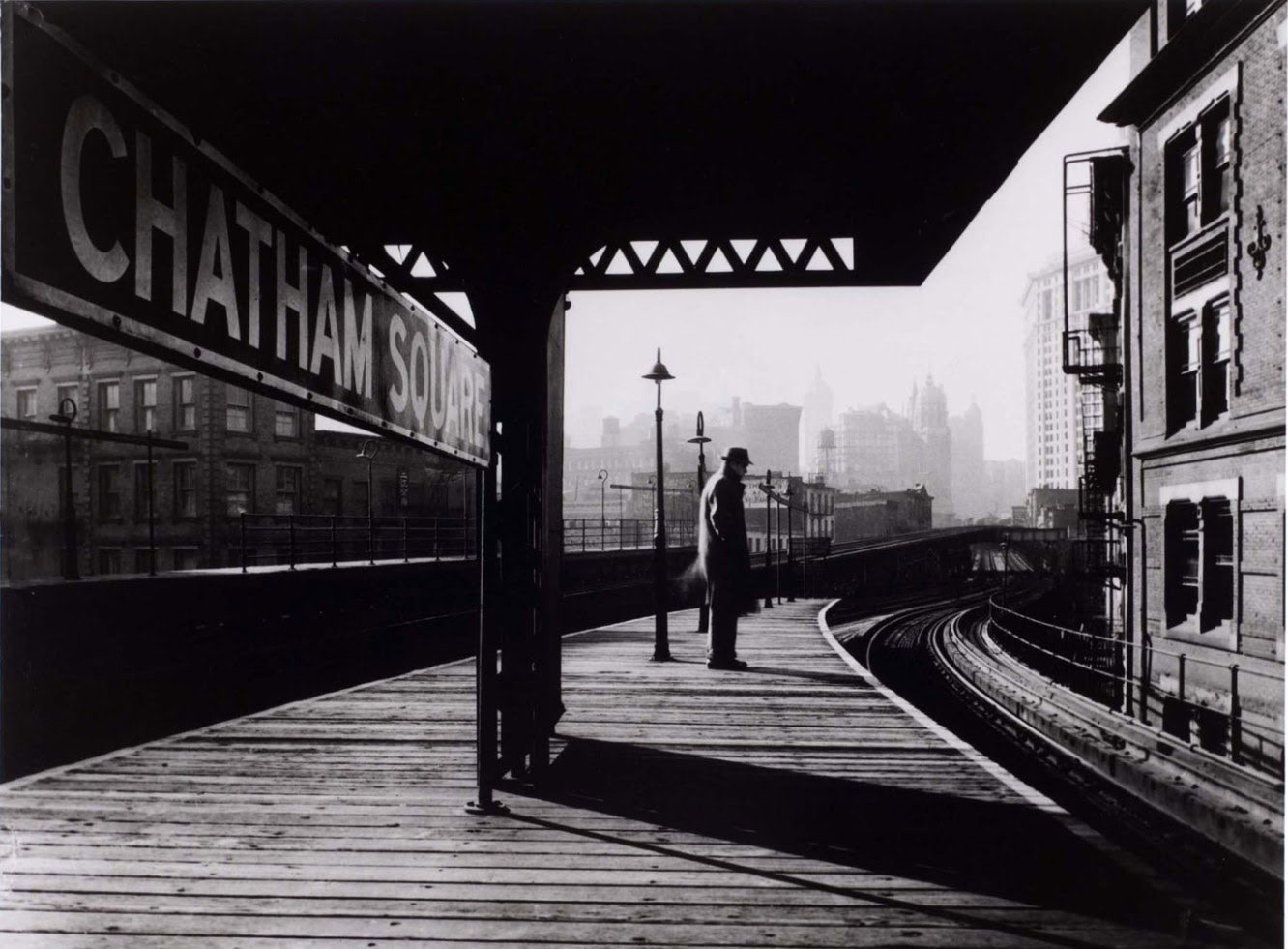
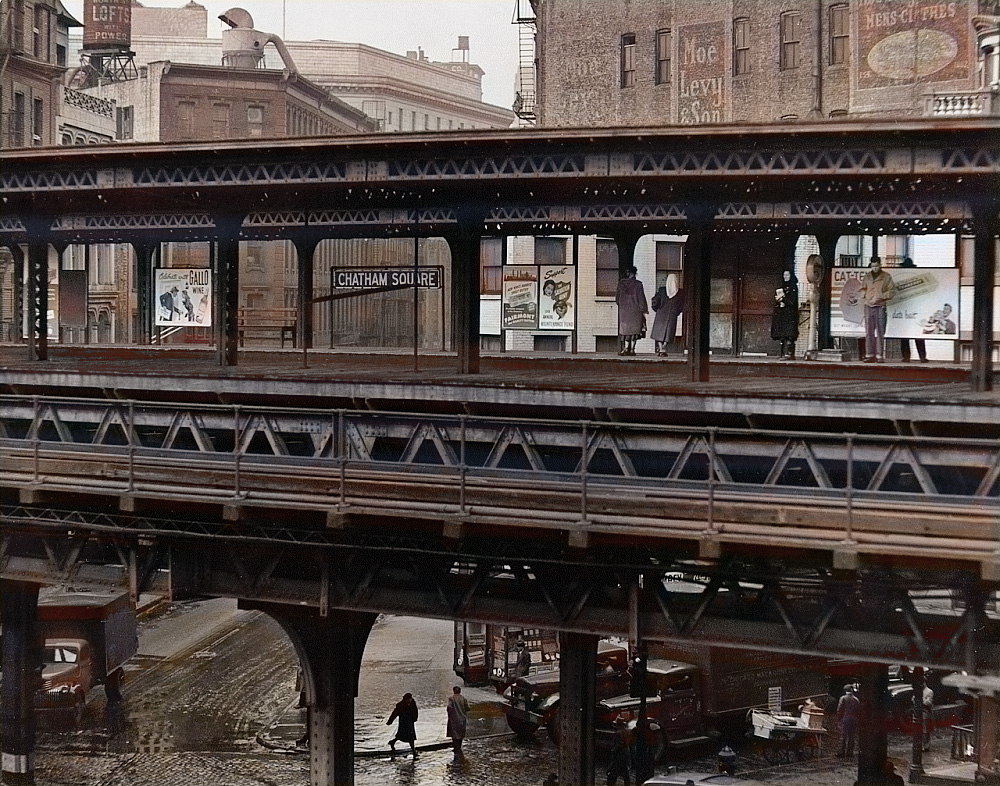
However the 1925 Diary comes to the rescue with… “Ph. Sug. Ho. Chatham Sq.” and one other mention of “Chatham”. The mention of “Sq.” led me to Chatham Square. This was a very major NYC transport intersection, with the Elevated railway there having fine views of the city skyline… along with less welcome chilly gusts.

Here we see one platform of the Chatham Square’s Elevated twin-platform station in the 1930s, as superbly photographed by Arnold Eagle. Presumably “Chatham” was where Lovecraft frequently met up with some of his Circle who were coming in on the Elevated, before they headed elsewhere.

And here we see a Chatham Square platform in the 1940s, and some of the rainy street below.

Notes on the Selected Letters of H.P. Lovecraft, Volume V

11 Monday Jul 2022

Posted by asdjfdlkf in Astronomy, Historical context, New discoveries

≈ 2 Comments

Notes on the Selected Letters of H.P. Lovecraft, Volume V.

The time is 1934-37.

* Lovecraft was using his old cleaned telescope for local observations again, in early 1935… “Last Sunday evening I was all ready to watch the occultation of the Pleiades, but clouds malignly intervened.” (Page 107). He does not give the location, but presumably somewhere open and near his home.

* He saw a large exhibition of Hokusai prints from Japan… “a splendid lecture & special exhibition pertaining to my favourite Hokusai, & the entire [Art Museum, Providence] quarterly bulletin was devoted to the subject of Japanese prints. (Page 127). The Museum had acquired a large set. “Hokusai’s Cranes on Snow-Laden Pine was one of the things I especially liked in the exhibition” (Page 127). This seems to be ‘Cranes on Branch of Snow-covered Pine’…

* He was back at Jake’s in Providence in early 1935…”we descended [College Hill] to “Jake’s” – the famous stevedore [dock-worker] restaurant at the foot of the hill which Wilfred B. Talman (then a Brown student) discover’d in 1926 and introduced to the gang. Here have gorg’d such dignitaries as W. Paul Cook, James Ferdinand Morton, Donald Wandrei … and now Robert Ellis Moe. This is the joint where good food is serv’d in such fabulous quantities. We chose sausage-meat and johnny-cakes, with stupendous bowls of short-cake (R.E.M. banana; H.P.L. peach) and whipped cream for dessert.” (Page 126).

* He was amused by a S.F. League spoof publication, Flabbergasting Stories. The… “S.F. League & its members have [a] mimeographed parody on the science fiction magazines – Flabbergasting Stories. It is really extremely clever & witty — Sterling showed me a copy.” (Page 151).

* By April 1935 he accepted the presented evidence for some form of vegetative life living on Mars… “We can no longer dispute the independent existence of protoplasm on different worlds, since vegetation on Mars has been well authenticated by direct visual & photographic evidence.” (Pages 153-54).

* Lovecraft records that… “in idly reflecting on my correspondence list the other day, I discovered that the praenomenon [Christian name] most numerously represented is none other than Robert – Barlow, Bloch, Howard, Moe, Nelson.” Who was Robert Nelson? He’s in the volume Lovecraft’s Letters to Robert Bloch, as Robert Nelson (1912-1935), since new letters were discovered in 2012. His weird poetry and other work is now collected in Sable Revery: Poems, Sketches and Letters by Robert Nelson.
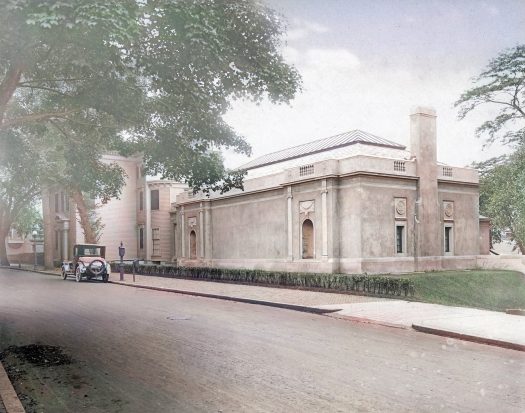
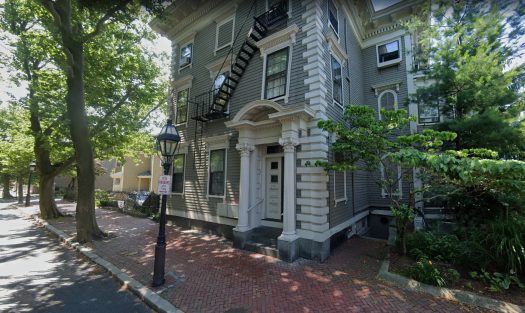
* He also recalls that… “Clarke Howard Johnson [1851-1931, 49 Westminster St.] Chief Justice of the R. I. Supreme Court was my grandfather’s best friend and executor of his will.” (Page 166). No photo can be found.

* Beyond the lake-pines around Barlow’s Florida homestead were real English oaks… “Bob’s [Barlow’s printing] cabin across the lake is virtually finished, & last week I cut a roadway from the landing to the cabinward path. This edifice is ideally located in a picturesque oak grove – not the live-oak of the [U.S.] south, but the old-fashioned, traditional oak of the north & of Old England.” (Page 182).

* Extensive reading preceded each trip to a new place… “Every time I take a trip I read up as extensively as possible on the places I’m going to see — so that when I get there, each site and object will have some meaning for me.” (Page 188).

* “I’ve felt only one earthquake in the course of my existence – the shock of Feb. 28, 1925, when I was in New York.” (Page 207). Apparently… “one of the most powerful earthquakes of the 20th century”, the Charlevoix–Kamouraska earthquake. It originated under the St. Lawrence River Valley in Canada, which may interest Mythos writers if that location has not already been used.

* The autumn/fall of 1935 was very mild and prolonged, and Lovecraft was fortunate to spend two weeks in New York City during this fine spell. He stayed with Donald Wandrei at 155 West 10th Street… “The brothers have taken a very attractive four-room flat in Greenwich Village — at 155 West 10th St., above a rather well-known ‘bohemian’ restaurant called Julius’s.” (Page 210). Donald’s brother was away during the stay, and so Lovecraft had his room. Thus Lovecraft was for two weeks in a flat above one of the most famous gay bars in history. A bar still going today and now numbered as 159.

The bar on 1940s.nyc, here cleaned and colorised.

* In 1935 the John Hay Library has “frequent exhibitions there (books & reliques of literary or historic interest) which I usually see.” (Page 216). Such as one on the poet Horace along with a lecture (Page 218).

* His Christmas tree was delivered, rather than netted and then personally slung over a shoulder before being manfully hefted up the hill from the Market Place… “Our Christmas tree arrived yesterday, but will be kept in a cool closet to prevent deterioration”. (Page 218).

* Lovecraft had once been a regular reader of the magazine The Black Cat, which folded just before Weird Tales appeared on the stands. Morton was seeking to collect a complete run in 1936, and Lovecraft remarked… “Hope ya kin get your Black Cat file. I used to buy that reg’lar-like, and recall the swell weird stuff it had.” (Page 227). Which means he would have seen Arthur Leeds stories in it, before he encountered any members of the Circle including Leeds. That assumes though that he read the magazine past early summer 1914. Leeds was hailed as “new to our readers” in the May 1914 issue. We know Lovecraft began to “notice” the magazine in 1904, but seemingly not the cessation date for his interest in it.

* In his final years he was writing to a “Frederic Jay Pabody” about Atlantis. Ten such letters came up for sale in 2016 and are now found complete in Letters to C.L. Moore and Others.

* His Uncle had translated Virgil… “Some day I wish I could get his Virgil published — a blank verse translation of everything but the Eclogues which (together with other mss. of his) I have always carefully treasured.”. (Page 329). Sadly it appears that these works have been lost?

* In his younger days he saw the stage actor Robert Mantell play… “Horatio, Iago, Mercutio, Bassanio, Edmund, and Faulconbridge” in Providence. (Pages 340 and 350). This means he saw performed Hamlet, Romeo and Juliet, The Merchant of Venice, King Lear, and King John. He elsewhere implies that he saw Richard III with the players using the 18th century Cibber version.

* His Remington typewriter gave “non-visible writing”, i.e. as the typist he could not see what was being typed onto the page. (Page 267).

* “The first comet I ever observed was Borelli’s — in Aug. 1903. I saw Halley’s in 1910 — but missed the bright one earlier in that year by being flat in bed with a hellish case of measles!” (Page 282).

* “The especial glamour of spangles [i.e. small sparkles of light] probably comes from a synthesis of different pleasant associations — the stars, the rising sparks of a comfortable fire, precious stones, &c.” (Page 328). Sunlight on clear purling water, too.

* October/November 1936. “I haven’t had a new suit of clothes since 1928.” (Page 337). “I have reduced nourishment to $2 and $3 per week” to economise. (Page 364).

* Talking of the future… “I would advocate the improvement of backward groups through education, hygiene, & eugenics.” (Page 323). What does he mean here? Not what modern leftists mean, who have since sought to conflate 1930s eugenic practices and ideas with mass murder in Nazi death-camps. But Lovecraft explicitly told his correspondent that he did not mean death. He was speculating about a possible future “within the next half-century”, and stating that he would not wish some future state to “starve & kill off the weak”. Though he was highly doubtfully about the chances of any human “improvement” happening via scientific breeding, what he envisioned was evidently more a ‘eugenics for health’ programme of sterilisation and contraception. Such ideas were relatively common at the time, not least on the left, and in Lovecraft’s words were widely “agreed” on… “It is, for example, agreed that hereditary physical disease & mental inferiority ought not to be transmitted — hence within the next half-century the sterilisation of certain biologically defective types will probably become universal throughout the western world, thus cutting down the prevalence of idiocy, epilepsy, haemophilia, & kindred inherited plagues.” Similarly his use of the word “hygiene” has a different meaning than today, being a 1920s and 30s euphemism for various forms of birth-control and venereal disease prevention (e.g. condoms) under the control of the users. At that point in time, mass routine abortion of babies appears to have been unthinkable as a eugenic method.

* He indicates what a possible 1940s ‘Romans in Africa’ tale or novel might have looked like, with Ancient Romans… “penetrating south into Africa beyond the mark set by Maternus, skirting the [River] Niger, threading through steaming jungles … and finally coming upon that Kingdom of Elder Horror whereof there survives today only the ruined masonry of the Great Zimbabwe.” (Page 375).

* He gives a useful starter reading list for Dunsany… “When I think of Dunsany, it is in terms of The Gods of the Mountain [a play], Bethmoora, Poltanees Beholder of Ocean, The City of Never, The Fall of Babblekund, In the Land of Time, and Idle Days on the Yann.” (Page 354).

* “My dream of the black cat city was very fragmentary. The place was built of stone and clung to the side of a cliff like some of the towns drawn by Sime for Dunsany’s stories. There are towns more or less like it in Spain. The place seemed to have been built by and for human beings aeons ago, but its present feline inhabitants had evidently lived there for ages. Nothing actually happened in this dream — it was just an isolated picture of the place, with the cats moving about in a rational and orderly manner, evidently in the performance of definite duties.”

* In his Mythos, cats are (probably) tentacle-tailed aliens from outer space… “the mysteries of those black outer gulfs whence surely the first terrestrial felines lithely sprang long ago when Mu and Hyperborea were young.” (Page 377).

* Shortly before he became ill and died, he at last saw a movie of which he could approve. (Pages 435-36). “A Midsummer Night’s Dream [released 1935] — and it was certainly no disappointment. The delivery of the lines was in nearly every case excellent; and though there were some cuts in the [Shakespeare] text which I lamented, these did not amount to more than the excisions common to all acting versions from the Restoration down. The music blended effectively with setting and dialogue, and the pageantry was excellently managed. Some of the elusively weird photographic effects connected with the haunted wood were incomparably fine. As the animating spirit of the grove, that little elf who played Puck certainly scored a triumph. In aspect and voice and demeanour he represented with utter perfection the bland, mischievous indifferentism of the traditional sylvan deity, while that shrill, eery, alienly-motivated mirth of his was the most convincing thing of its kind that I’ve ever seen.”

The movie seems to have had many sniffy reviews at the time, from critics who thought it too low-brow. But it won two Oscars due to a “grass-roots write-in campaign” from fans. For initial general release in October 1935 the movie was cut from 132 minutes to 117, but I don’t know what running-time Lovecraft saw more than a year later in Providence in early 1937. Could it have had a more fulsome public release, post-Oscars? Perhaps movie historians can answer that one. The movie finally had a good home release as a DVD in 2007, but it does not appear to have been otherwise restored. It appears to have been ignored by writings about Lovecraft and cinema, presumably because it was seen so late in his life. Nevertheless, it should be included in any future survey of his appreciation of the cinematic arts. I have to say that it certainly feels overlong when seen at its full length. The visual are indeed very fine, but the music and delivery are both far too strident. The music is written for the concert hall, not a movie, and the vocal delivery has that very fast and shrill (shrieked, at times) ‘screwball’ pace that is all to common in 1930s movies.


Well, that’s it for the Selected Letters. All five volumes are now done. I’ll now be catching up on my saved bundles of blog posts, tutorials, reviews and newspaper and magazine articles. After that I’ll be reading the Lovecraft Annual 2021, for an in-depth review before the 2022 Annual is released.

‘Picture postals’ from Lovecraft: a mixed bag from Brookyn

24 Friday Jun 2022

Posted by asdjfdlkf in Maps, New discoveries, Picture postals

≈ Leave a comment

This week in my ‘Picture Postals’ series of posts, more follow-on from my recent successful search for Lovecraft’s “John’s” in Brooklyn.

1) Here are two Photoshop-combined sections of Sanborn’s 1904 Brooklyn Atlas, showing 7 Willoughby Street (John’s) in plan and context.

We can see here that No. 7 (“John’s”) had a large isolated yard and sheds out back. This is possibly of relevance re: it being a suitable-looking site for prohibition hooch-brewing in the back yard, something which we know went on regularly at the main branch of John’s. Note the adjacent cigar making, carpet cleaning and gas-fitting. Alcohol fumes from the stills might have been well cloaked by the neighbouring pongs. Possibly there was also a back-entrance to the yard, for small trucks using the insalubrious Union Lane. Looks to me like a perfect site for prohibition brewers in 1925.


2) In my recent search for Lovecraft’s Clinton St. grocery, I can now discount the store on the ‘bank’ corner of Atlantic Avenue – Clinton Street. You’ll recall there was a savings bank on one of the four possible corners, a bank that had departed the area in 1922. A 1927 picture shows that a corner store there, visible on that corner in the early 1940s, was not yet in existence at 1927. This discovery further confirms that Lovecraft’s grocery store was at 156 Atlantic Avenue, on the corner with Clinton.

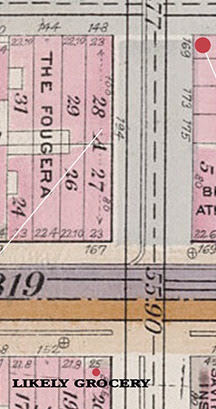
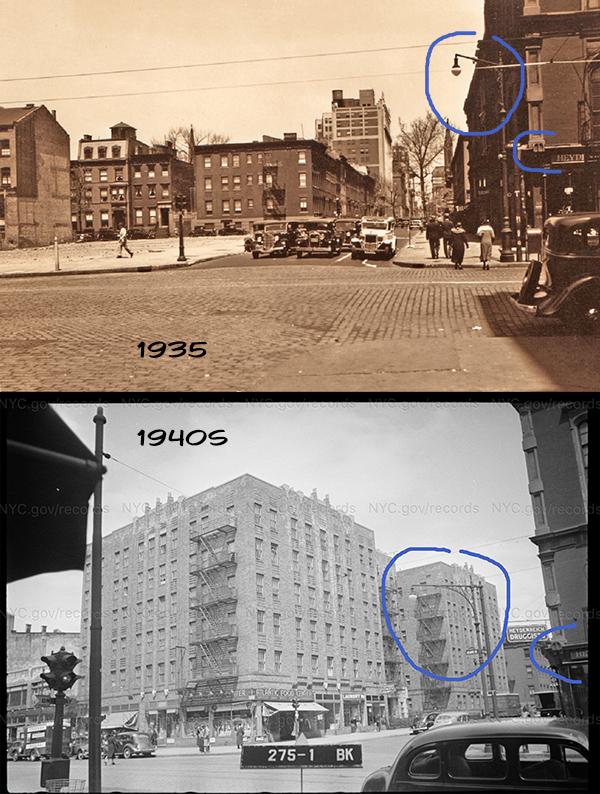
In the same set of pictures there is a 1935 picture of 156 Atlantic Avenue. This is in one of the same set of Sperr pictures, Brooklyn: Clinton Street – State Street. But this picture has been confusingly titled. Its title implies that it shows State Street but it does not, as the label on the back indicates. It is merely “south from State Street”, i.e. made at a point south ‘on the map’, but with State St. behind the cameraman. To someone who knows what they’re looking at, this April 1935 picture shows Lovecraft’s Clinton – Atlantic Avenue corner, as seen from the waste-ground of the demolished Fougera apartments. Thus Lovecraft’s grocery is partly visible behind parked cars, on the very far right of the picture…

Regrettably this is one of the Sperr pictures that the NYPL hold hostage for their expensive “fine art prints” racket.


3) Also in the Sperr pictures, I found a better angle in a picture that looks down Clinton Street. Brooklyn: Clinton Street – Atlantic Avenue, early June 1927. A date which was little more than a year after Lovecraft had returned to Providence. The druggist (chemist) is on the corner with its awnings up against the sun, and Lovecraft’s Clinton St. is falling away at the left of the picture, as seen below. Lovecraft’s room at No. 169 is on the far corner, slightly obscured by a nearer lamp-post. Sperr’s label on the back has a description and the “June 1927” date. I think this may be the first time this particular picture has been identified with No. 169, and it’s very close in time.

Sadly it’s another of the Sperr pictures that the NYPL hold hostage for their “fine art prints”. Online it is very low-res, but apparently the NYPL do have larger as a very expensive “art print” — and seemingly with no actual guarantee that the image quality will be any better. You might end up with a $150 blur.

However, discovering that the corner building had once been the “Brooklyn Atheneum” aka “Athenaeum” opened doors to new data, and I found more or less the same view on a Brooklyn Eagle postcard…

Late 1890s. The Brooklyn Historical Society hold the plate.

We can see “Heyder[eich?]” the druggist was there on the corner in the late 1890s, as he was in the 1935 and 1940 pictures of the same corner. He appears to have been there all the way through, circa 1890s-1940.

What of the Atheneum? The Atheneum had once been a large concert hall, assembly rooms and then a private mercantile subscription library, and there was indeed a druggist on the corner (a chemist shop, as I had suspected). Its heyday as a modern venue was the 1850s-70s, and later as a theatre and lantern-projectionist forum in the 1880s. Nothing is heard of it after that as a regular cultural venue. But there was an attempted mass-meeting of East Coast anarchists there in 1901, as a result of which… “police closed down the Athenaeum”. The building was then swiftly leased by the New York Court of Special Sessions (of the Second Division, meaning Brooklyn, Queens and Richmond). “The Second Division the Court of Special Sessions is now held at the corner of Atlantic avenue and Clinton street” at “171 Atlantic Avenue”. Rather too swiftly occupied, since the officers complained for several years about the badly leaking roof, until the place was eventually refurbished. The Court’s lease was renewed in 1922, the year when the building was sold to a new owner by what a real-estate trade-paper called the “old” Athenaeum. The new owner appears to have been making a long-term investment on the corner site rather than the creaky old building — it was listed for demolition as part of “slum clearance” and abruptly demolished in 1942.

When Lovecraft was living at No. 169 this corner of Clinton and Atlantic was thus a court for the trying of petty crimes. Crime that merited either a fine, or some days in jail or a youth reformatory. It may not have sat as a court every day, but its presence would often have ‘flavoured’ the surrounding sidewalks with a seedy and anxious atmosphere.

The Athenaeum’s final days are seen here, photographed circa 1941-42 by Irving Kaufman, with the demolition placard on the front…

Old Brooklyn Athenaeum / Second Division of the Court of Special Sessions, before demolition. Also Clinton Street and No. 169. Photo by Irving Kaufman (1910–1982). Kaufman’s son Phil Kaufman was until a few years ago able to provide prints. But Phil Kaufman’s website has now gone, and at the time he posted these prints he did not know where they had been photographed. Just that they showed large Brooklyn buildings that were declared for demolition.

Here the old corner druggist has gone at last and the store has become an opportunistic grocer, “American **st Grocers(?)”, for a year or so before demolition. But this is long after Lovecraft’s time there. Still, it gives us another new picture looking down toward No. 169 Clinton St. and we get a feel for Lovecraft’s walk up to his Syrian tailor’s and to the corner, before crossing Atlantic to reach his usual grocery store.

In a further Irving Kaufman picture we can also see the immense ‘Fouguera’ apartments building that loomed opposite Lovecraft in Clinton St. This picture shows the other side of the street, and a distinctive corner of the druggist’s frontage can be seen in the bottom-right (it has a ‘pig snout’ moulding that can’t be mistaken). Comparing the styling of this frontage, just visible enough, with the 1935 and circa 1940 pictures to show that it it not yet the grocer’s seen in the circa 1941 picture. In that latter picture the grocer has re-tooled the signage boards somewhat. This ‘Fouguera’ photo must be earlier than circa 1941. Indeed, it must be circa 1934-35 because 1934 was when the ‘slum clearance’ demolition boards went up on the building, as noted by the Brooklyn Eagle. These boards can be clearly seen on the building.

We can also more clearly see the nature of the corner shop at the ‘Fouguera’. It was a furniture store with what seems to be an antique bric-a-brac wing with a show-window on the corner.

To summarise, my search for Lovecraft’s grocery has found the store, and has also established several other useful facts along the way. Lovecraft would have walked toward the grocers on Clinton/Atlantic through a ‘canyon’ like street, with the immense ‘Fouguera’ on one side, and the old Brooklyn Athenaeum on the other. If he walked from his room into this canyon during the day he might have encountered many people going to or from the Second Division the Court of Special Sessions, Brooklyn’s court for petty crime that was held in that building. Such anxious or hard faces cannot have raised his general assessment of the immediate area. Culture and thrift was fading away. The old Athenaeum had gone, the Saving Bank on its opposite corner across Atlantic had departed in 1922 (and seemingly also the artists who had some sort of informal studio colony above it). The once proud ‘Fouguera’ was (in the eyes of the city) now becoming the slum that would condemn it in 1934 and with a seedy-looking furniture store and a seedy cafe below. The old druggist on the Athenaeum corner, “Heyder[eich?]”, kept up the tone. The grocery at No. 156 Atlantic Avenue was worth patronising and affordable, and presumably friendly. But the area was obviously going downhill despite a superficial aura of fading quality, as Lovecraft’s letters also evidence.

Map showing Lovecraft’s room at 169 and the four corners of Clinton/Atlantic. Clockwise: ‘Fouguera’ and bric-a-brac shop; Athenaeum (now the petty-crimes court for Brooklyn) and Druggist; the old Savings Bank (lower part not a store until after 1927); and then the grocery at 156 Atlantic.

‘Picture Postals’ from Lovecraft: Looking down Clinton Street

10 Friday Jun 2022

Posted by asdjfdlkf in Historical context, New discoveries, Picture postals

≈ 1 Comment

Following on from yesterday’s notes, the final post for Selected Letters II.

Page 259: Here Lovecraft is giving advice to young Talman, who by January 1929 had moved to Red Hook. Lovecraft recalls that when living at Clinton Street he had patronised… “the grocer on the corner of Atlantic” as he put it. Thus Clinton Street and Atlantic Avenue, very near his room. He seems to imply there was only one such possible corner with a grocer on it.

Now it can’t be the “Atlantic Food Centre” seen on 1940s.nyc, because that corner was gone by 1934 and the “Food Center” only appeared there after Lovecraft’s time. Before that it was the Fougera apartments. They had stores beneath the apartments, but the larger of these appears to have been a liquor store.

Although on 1940s.nyc the lower picture may be earlier, as the “Druggist” corner on the right of the picture was also demolished in 1942.

We know what the Fougera corner looked like in 1922, before demolition and the later “Atlantic Food Centre”, thanks to pictures in an article on The Fougera by New York historian Brownstoner. It does not look like a grocery store…

The picture of the demolished Fougera site does however give us a peep down the street to Lovecraft’s famous No. 169 Clinton address, albeit in 1935 and thus ten years after his time there…

Lovecraft says elsewhere that he patronised the Syrian “tailor in the same block”, and here we can indeed see a large sign for “Tailor”. Also a glimpse of the corner store on the right (“Heyd…” something). We know from Lovecraft’s “Red Hook” story that there were relic Norwegians in the area, so my guess on the name would be Scandinavian. There are plenty of Heyde and Heyder surnames in Norway. A later picture shows a drugstore/chemists there, and this earlier incarnation does have the visual feel of a chemists’ shop. Not a grocery then.


But what of Lovecraft’s grocer? It’s not the Fougera corner and it’s not the drugstore corner. So it should be one of two possibilities that are behind the above-seen cameraman.

Ok, the 1940s.nyc site now lets me ‘turn the camera around’ and give readers a look at those two possible grocery stores.

The bottom and slicker-looking one was built as a savings bank, which moved out in 1922. Google Street View has the building’s Clinton side as “191 Clinton” and the shorter Atlantic side of the same building is “160 Atlantic Avenue”. The same numbering applied in the 1920s. In 1922 American Art News announces…

Nicolas Macsoud [a painter of the Orient and miniaturist, 1884-1972] has returned to his studio, 191 Clinton Street, Brooklyn.

Although that may indicate the rooms above. The large apartments above the bank were home to several artists circa 1890s-1910s, and circa the 1900s-1910s the address pops up frequently on art show catalogues now on Archive.org. In 1921 it was still the address of the Brooklyn Society of Miniature Painters, though that may be because of the miniaturist Nicolas Macsoud. Nothing much is heard of art there after 1922. That may be due to the copyright cut-off. Or it could be that the artists departed with the bank in 1922, as the area went rapidly downhill.

But my feeling is that a lush marble-lined savings bank of 1922 would not suddenly become home to a cheap grocers the very next year. This reinforces my feeling that 160 Atlantic Avenue / 191 Clinton Street was not Lovecraft’s corner grocery, if it even was a grocery circa 1923-27. To me it feels, peering through the fuzz, like a fancy bread and cakes shop. Or perhaps a fruitier.

Update: I can now discount the store on this ‘bank’ corner of Atlantic Avenue – Clinton Street. A 1927 picture shows that a corner store was not yet there at that time.

That leaves one option. The top of the two pictures is the final possible corner, at 156 Atlantic Avenue. In this circa 1940 picture the address feels the cheaper of the two possible stores. It has what might be ‘delicatessen’ sign-writing on the windows. On the balance of probabilities, I’d say that Lovecraft’s Red Hook grocery store was at No. 156.

Today the area has obviously gentrified and 156 is the affluent hipster’s ‘Swallow Cafe’, though its facade still keeps the old name ‘Tripoli’ (the well-reviewed middle-eastern and “seafood specialities” restaurant that was there 1982-2010s). Pictures of the side of the building today show it goes quite far back, far enough to allow for a large grocery store in the 1920s, and this is confirmed by a similar early 1940s view of the place…

Mythos writers may then be interested to learn that No. 156 also goes down quite deep…

156 Atlantic Avenue: this particular building has three sub-basements, the lowest of which lines up with track level inside the [subway] tunnel. (The World’s Oldest Subway, 2015, page 22)

Thus Lovecraft’s Red Hook corner grocery had deep basements that went down and down until they reached the level of the city’s oldest subway. And was later home to a “seafood specialities” restaurant. Hmmm….

SFFaudio Podcast #684

05 Sunday Jun 2022

Posted by asdjfdlkf in Historical context, New discoveries, Podcasts etc.

≈ Leave a comment

As some people’s thoughts turn toward the usual beach-front summer vacation, the new SFFaudio Podcast #684 has an unabridged Gordon Gould reading for “The Strange High House In The Mist” by H.P. Lovecraft followed by discussion.

Lovecraft claimed the story was inspired by the “titan cliffs of Magnolia” (Mass.). Yet I find that the postcard and glass-plate makers have singularly failed to capture any “titan” cliffs, and the candidates of “Rafe’s Chasm” and “Mother Ann” seem to lack the necessary attributes.

Yet it appears he was not being ironic…

I ended up with the titan cliffs of Magnolia — memories of which prompted “The Strange High House in the Mist” — and found their charm undiminished. [He had seen them in 1923]. You can’t imagine their majesty unless you’ve seen them — primal rock and sea and sky …. and the bells of the buoys tolling free in the aether of faery!

In 1933 he recalls…

the striking sea-cliffs of Magnolia — with the yawning abyss of Rafe’s Chasm.

Well then… maybe they just never had the right photographer? Perhaps at low tide one could walk around below them on the beach, and that way they looked more impressive?

However, the search of Magnolia does yield me the required Father Neptune…

‘Picture postals’ from Lovecraft: Bickford’s, Brooklyn

27 Friday May 2022

Posted by asdjfdlkf in Historical context, New discoveries, Picture postals

≈ 1 Comment

This week, another try at finding H.P. Lovecraft’s New York City cafes and eateries. Today Bickford’s, tomorrow… John’s.

H.P. Lovecraft mentions that a favoured eatery in Brooklyn was “Bickford’s” near Borough Hall. The place was found early during his New York City sojourn. He had abandoned the Tiffany, whose wood-panelled decor he favoured, after he discovered that the clients just could not be ignored in favour of the decor…

the clientele was past enduring … young toughs and gangsters … I got all my stomach could stand after three or four months and thereafter switched to Bickford’s – near Borough Hall.” (Selected Letters II, page 259).

The early switch is confirmed by his 1925 Diary, which notes “Bickford’s”.

In the early 1920s Bickford’s was part of a small but growing chain, with the owner Samuel L. Bickford known for his work with and fund-raising for the Boys Club in Brooklyn. He had also run the New England Waldorf’s Lunch chain in the 1910s, and since these were one of Lovecraft’s favourites he could have been familiar with Bickford’s name in that way. In New York Mr. Bickford offered the unbeatable combination of good cheap food, fast service, and long hours. His chain was a success and in the 1920s branched out into even faster service with self-service automats, it seems, if the New York City branches listed in directories as ‘Bickford’s Lunch System’ are anything to go by. He ended up with a large successful chain.

The Chain Store Age trade magazine tells us that a Bickford’s branch wasn’t located at 425 Fulton Street until 1927. Thus the 58 Court Street branch must have been Lovecraft’s haunt in the Red Hook years, and it is indeed very “near Borough Hall” being just a few steps away down Court St. He calls this branch of Bickford’s a “one-arm”, meaning both cheap and that it had ‘side-arm’ tables just wide enough to hold your plate of food.

In its better days 58 Court Street had been the home to Mr. Edward Greaf, first-class dealer and importer of wines and also the Curator of Entomology at the Brooklyn Institute. But by the 1940s it was the Concord Cafeteria, with a Chop Suey hall above…

As can be seen here in the late 1930s. The former Bickford’s is now the Concord cafeteria and is partly seen on the left. The 25-cent Chop Suey restaurant is above…

Today Street View shows the site as a seedy “Dunkin’ Donuts” hole-in-the-wall next to a failed “General Nutrition” health-food store. However, most of the pleasing stonework and a classic Brooklyn metal fire-escape remain above, evoking a touch of the past.

The above 1940s picture is the nearest in time and place to the 1920s I can get. Not quite as Lovecraft would have known it some 15 years earlier, but I note that since 1917 Bickford’s branches all had the same classy architect and designer, one F. Russell Stuckert. Thus the Court Street branch would probably not be too different from the following frontage in design and logo and perhaps also the use of stained glass. Here we see his design work in the post-1927 frontage for the nearby 425 Fulton Street branch, located a little to the west of Borough Hall…

“Hot Turkey” on the menu. The frontage is deceptive as to the size, since inside it was vast and went back and back and back again — as I’ll explain in another post. The smartness of this 1927 branch, seen here in the late 1930s, may not quite reflect that of the earlier and more worn Court Street branch circa 1925.

David W. Dunlap wrote about the cultural aura of the Bickford’s chain in 2000 in The New York Times, then a reputable newspaper of record. He noted that in the 1950s Ginsberg’s Howl beat generation… “sank all night in submarine light of Bickford’s” (Howl, Ginsberg), and that the great Woody Allen later revered the chain… “I got no money. I’ll go sit in Bickford’s.” (Getting Even, 1971, his breakthrough book collection). Other New York creatives also mentioned it over the years. But Dunlap didn’t pick up on the fact that one H.P. Lovecraft had, as usual, got there first.

Notes on Selected Letters II – part one

23 Monday May 2022

Posted by asdjfdlkf in Astronomy, Historical context, Lovecraft as character, New discoveries

≈ 4 Comments

Over the summer I’m re-reading H.P. Lovecraft’s five volumes of Selected Letters and this time I’m making notes. Here is part one of my notes on Selected Letters Vol. II.


* Lovecraft mentions Chase’s Drug Store located at the central “bridge” area of Pawtuxet, stating that this store offered all the best available postcards of local scenes (page 58). The Providence Public Library has a picture of Chase’s frontage, with a chap appearing to carry away a packet of drugs that could equally be a set of postcards. I’ve here rectified and faintly colourised it (this kind of picture doesn’t take colour very well). The picture was made by Mr. Chase, so it is his store.

* Lovecraft states that he had his cuttings on Rhode Island and antiquarian matters well-sorted and assembled into scrapbooks by October 1926. These having been in mounded up in piles on his desk, when living in one room at Red Hook (page 77). His scrapbooks, antiquarian or otherwise, do not appear to have survived.

* In April 1926 he was back in Providence and exploring his own city. Though obviously inspired by Eddy’s recent introduction to the reality of an ‘unexplored Providence’, he appears to be alone in the following exploration. He was also presumably using the secrets he had learned about the layout of colonial Providence during the fateful visit to the Shepley Library. He thus begins to visit on foot parts of Providence he had not previously visited…

I discovered one of the most hellish slums ever imagined by mankind. it was a place whose existence I had not before realised — the end of Chalkstone Ave. near Randall Sq. and the railway — and its dark hilly courts approach the very ultimates of blasphemous horror.” (page 43)

It appears to be a dangerous area even today, just to warn any local Lovecraftians who might be thinking of photographing there. The 2022 news reports two shootings in Chalkstone Ave.

* In May 1926, Lovecraft was still exploring previously unexplored “seedy” by-ways, but this time perhaps less squalid ones. As he was in the company of his aunt…

Mrs. Gamwell and I took a walk thro’ a section of the town in which I had never set foot before — an antient and now seedy district east of the river and just south of the good residential area. Colonial houses abounded, and I was astonisht at some of the gorgeously antique effects obtainable here and there. […] It is call’d Dove Street, and has neither pavement nor sidewalk, but consists of irregular rows of simple Colonial cottages with rough stone doorsteps, and here and there a flagstone or two.” (page 54)

Dove Street is one of the parallel side streets that run alongside the main Hope Street at Fox Point, and head down toward the waterfront rail-yards at India Point. Dove Street still exists, though the map hints it may have been truncated in modern times. Today the Rhode Island Historical Society’s Mary Elizabeth Robinson Research Center is located about 160 yards to the north, which means that researchers might also fit a visit to nearby Dove Street in when visiting. The top part of Dove Street appears, from Street View, to be on its way to being gentrified.

* In February 1927 he writes of the Providence waterfront and names four “dark alleys” there…

the vivid, glamorous waterfront with its rotting wharves & colonial warehouses & archaic lines of gambrel roofs & dark alleys with romantic names (Doubloon, Sovereign, Guilder, Bullion, etc) & wondrous ship-chandleries & mysterious marine boarding houses in ancient, lamplit, cobblestoned courts”.

Today “Doubloon Street” etc. One of which might have partly inspired “The Call of Cthulhu” setting…

one of the queer dark courts on the precipitous hillside [of Providence] which formed a short cut from the [dock used by the Newport boat on the] waterfront to the deceased’s home in Williams Street.

* In October 1926 he travelled, seemingly by motor-coach, from Providence and…

the Eddy Street coach terminal over the antient Plainfield Pike […] and later on the region devastated to create the new Scituate reservoir” (page 81)

In March 1927, five months later, he wrote “The Colour Out of Space” with its soon-to-be reservoir setting.

* He cleaned his old telescope in October 1926…

I cleaned the brass of my telescope yesterday for the first time in twenty years. Gehenna, what a green mess! And I couldn’t get it very brilliant even in the end. That’s what neglect does!

So this tells us two things. That he still had his old telescope, but that he had not used it for a long time.

“Gehenna” is a word used in the King James Bible in the final parts of Isiah, and refers to a beautiful garden place, a garden-grove for refined dancing and singing that was near to Jerusalem. An insidious and intractable Moloch worship [i.e. ritual sacrifice of young children by burning alive] came to replace the dancing and song. Lovecraft thus alludes to the later form of the valley when, after being utterly despoiled by the Moloch worship and sacrifice, the later and more respectable kings of the city sought to blot out the memory of the despoliation with further despoliation of their own — they buried Gehenna under a giant tip used for the fire-ashes and waste and unwanted dead bodies of Jerusalem. Thus “Gehenna” became a byword for ashes and filth.

In April 1927 (page 126) Lovecraft gives the vaguest hint that he may have made some winter or early spring 1927 observations through the newly-cleaned telescope…

As in your case, the skies exert the utmost fascination upon me; nor is the weaving of wild dreams about their unplumbed deeps & suns & worlds in the least hampered by the precise astronomical data which my scientific side demands.

* By June 1927 (page 140) Lovecraft had noticed how at least one critic had made the connection of the more fanatical aspects of the Puritan era with “the horror-element in American literature”…

It is easy to see how the critic Paul Elmer More traces the horror-element in American literature to the remote New England countryside with its solitude-warped religious fanaticism.

* Eddy Jr. pops up again in July 1927 (page 156) when he is “hunted up” to join a gathering of visitors at Barnes Street of Morton, the Longs and others. The implication of the wording is that Lovecraft has not seen Eddy Jr. for a while, had not invited him to the gathering, and was not quite sure how to get in touch with him when someone (likely Morton) suggested Eddy Jr. should join them at Barnes Street.

* His birthplace and childhood home at 454 had an “ebony and gold” decorative scheme for the “front hall”, and then a rich “old gold and rose” for the “front parlour”, in which he used to read The Arabian Nights.

* A letter offers us some implied details of Long’s proposed “novelette”, which would have made characters out of Lovecraft and others in the New York City ‘gang’. He chides Long (page 172)…

As for your new novelette — look here, young man, you’d better be mighty careful how you treat your aged and dignified Grandpa as here! You mustn’t make me do anything cheerful or wholesome, and remember that only the direst of damnations can befit so inveterate a daemon of the cosmick abysses. And, young man, don’t forget that I am prodigiously lean. I am lean — LEAN, I tell you! Lean! And if you’re afraid that my leanness will make the horror get you instead, why just reduce [diet] like your Grandpa and escape as well! And be sure to depict me in my new Puritan frock coat. I think I shall adopt an umbrella also.

Evidently the proposed novel had by September 1927 become a “novelette” and was in the planning stage. Lovecraft by then expected it to be in the weird monster-horror vein and likely to feature mysterious demise or else “damnation” for the gang. Presumably it was to be set in the mid 1920s in New York City. That’s about all that can be gleaned here. His use of “LEAN” refers to Long’s humorously ribbing of Lovecraft about the early part of his New York sojourn, during which the master had grown distinctly plump under the influence of Sonia’s cooking and also her largesse in paying cake-shop and restaurant-bills.

* In late September 1927 Lovecraft lists his recent notable reading likely to be of interest to Ashton Smith (page 174)…

– Goat Song by Werfel. (a printed play)

– Atlantideer by Beniot.

– New Lands by Charles Fort (only “skimmed”)

– The World’s Desire by Rider Haggard and Long (a mis-transcription for Lang) (planning to read)

The latter was not a new book, and had first appeared in 1889. Lang was the famous late Victorian scholar and folklorist, compiler of numerous useful popular anthologies of fairy and Northern epic stories, and translator of ancient classical texts. Haggard was the florid and fantastical adventure writer, famous for She. Their novel apparently… “continues the story of Odysseus, who returns to Ithaca to find his home destroyed”. He then leaves for a new quest, seeking his former love Helen of Troy. Lovecraft likely did read the still-rather-readable novel, since it spurred entry #141 in his Commonplace Book. Incidentally, the novel’s Wikipedia page has obviously had a severe and politically rebarbative mauling by leftists.

New Lands was a 1923 book by the modern confabulator Charles Fort, in which he focused on apparent “astronomical anomalies” that fall or float down from the sky. Fort used the book to loosely… “pull together examples of falls of stones, gelatinous substances, anomalous earthquakes, fireballs … bright stars, luminescent gas, mirages, ball lightning”, in pursuit of his barmy notion of ‘sky islands’ — actual land floating all unseen in our upper atmosphere. This theme of sky-falls has obvious relevance to Lovecraft’s “The Colour Out of Space”, written March 1927. Since I assume that Fort’s book was “skimmed” before and not after the writing of the famous story. I’ve not seen any other suggestions that New Lands inspired “Colour”, or rebuttals of the notion. Thus this may be my new discovery — if the dates align.

“Atlantideer” is a mis-transcription for Atlantida. This 1919 novel appeared in English in 1920 and was serialised in Adventure. It appears to be a romantic Sahara desert ‘lost race’ adventure with strong similarity to Haggard’s famous She. Indeed so strong that there was a legal case over it.

Goat Song appears to be a romantic coming-of-age tragedy-adventure involving a Spartan boy-warrior and his beloved.

It’s interesting that The World’s Desire, Atlantida and Goat Song could all be construed as having strong female themes which would have allowed Lovecraft to ‘think through’ his relations with the departed Sonia.

* With the visiting Talman’s help he discovered apparent Welsh elements in his family ancestry. Although striking an amused pose, he appears rather peeved and not a little un-nerved by this (page 180). Several slightly later letters see him diving headlong into Ancient Roman history and imagining (and indeed dreaming) himself as a Roman. I intuited that this may have been in reaction to the Celtic discoveries, or as he phrased it “this shocking revelation of hybridism”. This discovery has obvious implications for the development of the later “Innsmouth” and its idea of tainted heredity. The Welsh discovery was not the only shock from his family tree. Later, as Ken Faig Jr. has recently discovered, Lovecraft found an American side of the family line who had been rather lowly fish dealers. Thus offering us another possible inspiration for “Innsmouth”.

Actually the Welsh link in his core line of descent, as I’ve pointed out, may not have been really Welsh by lineage and blood. It may have simply been by residence. Although admittedly his letters do report him discovering one seemingly true-blooded Welsh lady had married into the family. Sadly his Northumbrian / Welsh(?) family line never seem to have been followed by a modern genealogist, and indeed I’m not sure if the relevant data now exists.

* He notes with some pleasure the first appearance of his fiction in hardback, when “The Horror at Red Hook” was re-printed as the concluding story in “Not at Night”. This was actually titled You’ll Need a Night Light, the third of what had only just become the ‘Not at Night’ series. These books contained Weird Tales reprints, selected for the British market by the magazine’s London agent Charles Lovell and then passed to Selwyn & Blount’s anthologist Christine Campbell Thomson for final choice and arrangement.

Despite this being a “third edition” cover the publisher apparently went bust shortly after publication, and the book’s UK rights were promptly purchased by Hutchinson. Which led to a legal tangle with Weird Tales, as a later Lovecraft letter recounts.

* And finally, a line written while joshing with Long (page 202) sounds like an entry in the Commonplace Book, but wasn’t…

… certain queerly-dimensioned cities of windowless onxy towers on a planet circling around Antares

‘Picture Postals’ from Lovecraft, 9 Canal St., Providence

13 Friday May 2022

Posted by asdjfdlkf in Historical context, New discoveries, Picture postals

≈ 1 Comment

Hurrah, persistence pays off. Friday the 13th might be unlucky for some, but it’s lucky for Lovecraftians. Because here at last is a picture of Lovecraft’s favourite Jacques Lunch, and at the 9 Canal Street address too. Aka “Jake’s”.

From the budget bundle-o’-local-photos book Rhode Island: Unforgettable Vintage Images of the Ocean State, published 2000 and now long out of print. Here cleaned, rectified and colorised.

The date is uncertain. The caption has it that Hugues Jacques and Pierre ‘Leo’ Jacques are seen behind the counter, and we know from Ken Faig Jr. that they took over the former bar in 1923. So it is probably at about that date or a little later. One can see a docks-worker and probably at least one docks foreman or truck-driver eating at the counter. As well as several old gents who might be of limited means, perhaps the “Salvation Army derelicts” as Lovecraft once referred to them in a letter. A certain ‘Domingo’, not seen, also regularly served behind the counter…

Toward Domingo, an olive-skinned, behind-the-counter servitor at Jacques’, his favorite eating place in Providence, he was as affable as a courtier in a drawing room.” (Talman, on Lovecraft)

Lovecraft had discovered this cheap and abundantly sustaining eatery via Talman in 1926, and from then on he regularly enjoyed its man-sized portions of cheap food. He does not appear to have been a daily or even a weekly customer, but he dropped in and was well known to the place and its people — especially in the summer “visiting season”. The place seems to have slowly slid downmarket over the years. From late summer 1933, and as the Great Depression deepened, Jake’s began to tolerate what Lovecraft called “extremes in the matter of clientele”. He sought out other nearby options, and came to patronise a nearby Al’s Lunch. However, perhaps the “clientele” situation eased. Since Ken Faig Jr. has established he was still eating at Jake’s in August 1934 and March 1935. One day in mid September 1935 Lovecraft found Jacques abruptly closed, the business having failed at last. Lovecraft looked forlornly in the windows again at various times, but found it always “still vacant”.

Also newly discovered, as seen in my earlier post, the opening times as they stood in April 1933…

‘Picture Postals’ from Lovecraft: Cleveland, August 1922

22 Friday Apr 2022

Posted by asdjfdlkf in Historical context, New discoveries, Picture postals

≈ 1 Comment

This week’s ‘Picture Postals’ is part four of four, of a few notes on the new expanded edition of the Galpin letters. On page 293 Lovecraft usefully recalls the exact locations enjoyed during his 1922 visit to Cleveland. This was a very happy time for him as he was effectively released from his long hermitage. The addresses are…

1537 E. 93rd St. [Loveman’s family home], 9231 Birchdale [Avenue, Galpin’s family home, quite near to Loveman], Wade Park, Clark’s Lunch [north side of Euclid Av.], Taylor’s Arcade [south side of Euclid Av.], Eglin’s [bookshop]


I found a good picture of a Clark’s Lunch on the central street called Euclid Avenue, and dated 1922…

Galpin met Lovecraft at the railway station and immediately took him to eat at a Clark’s Lunch, before they then went back to Galpin’s family home. This same Lunch was where he and the boys mostly ate their ‘meals out’ after that, as Lovecraft told his aunt in a letter.

It’s pleasing to get a photo of the exact date, although the heavy coats and hats in the picture suggests a bright-but-chill springtime rather than the early August heat of Lovecraft’s extended and fatefully cheering visit. However, is this the Clark’s Lunch? The people look rather too upmarket and the hole-in-the-wall too small. Were there other branches? There were. The 1920 American Legion Convention booklet usefully yields the list of the city’s branches…

So, there were two Lunch’s on Euclid. And we now know that the branches were open 24 hours.

But which Lunch is shown? The one at 1325 Euclid or at 5410 Euclid? Enough of the surrounding architecture of one remains to be seen today on Google Street View, and thus the above picture can be confirmed as the central Lunch at 1325 Euclid.

However I’m still not entirely certain, as there were evidently other branches. Indeed there were 15 branches in the city by the 1950s. So let’s look more closely at the place of arrival and see if that helps. Lovecraft was on the Lake Shore overnight sleeper train from New York to Cleveland, seeing the Catskills in the distance as he travelled along the Hudson Valley (he would later that year set “The Lurking Fear” in the same mountains). In 1922 the Lake Shore sleeper drew in to Cleveland at the old and decrepit New Union Depot. This had been renovated in earlier decades, but was still then blighted by “years of accumulated soot and ash which had made the building into a dirty eyesore” according to the railway historians. In 1922 it was all-but defunct. The city’s long-planned gleaming station was still just bare cleared-ground at that time, and would only open in 1930. Thus we can be sure that Lovecraft arrived in the city at the old and decrepit New Union Depot. The question is then, which was the nearest Clark’s Lunch branch for the station?

Sadly, it’s not the one seen above at 1325 Euclid. Pity, but the situation did look rather too posh. The nearest to this station would have been the branch at 228 West Superior, on the west side of Cleveland Public Square and about a quarter mile walk from the New Union Depot. There was a large business college at 236 West Superior, and an athletics store at 226, with together suggest a student-ish atmosphere for the Lunch. The food appears to confirm this student-y supposition. The food there was found to be “humble” and “inexpensive”, as Lovecraft told his aunt (Selected Letters Vol. 1., p. 191).

Unfortunately there don’t appear to be vintage pictures of that stretch of West Superior, and this row has since been cleared. It has long been a parking lot called Jacob’s Lot…

But the local press report that by 2024 the car park will be gone. From the site of Lovecraft’s Lunch will soar a new Sherwin-Williams Corp. mega-tower skyscraper. Suitably enough, for a place where artists and writers such as H.P. Lovecraft and Hart Crane once met, the company is ‘America’s Paint Company’ and makes paints.


What of Taylor’s Arcade? This was on the south side of Euclid Avenue in its central run, and is here seen perhaps circa 1912-ish? A decade before. Not to be confused with another and far grander wrought-iron arcade in the same city, which still exists.


What of Wade Park? This had a large zoo with lions and polar bears and suchlike, and an art museum, as well as fine and expansive parkland with lakes. Lovecraft tells his aunt that he toured the “Cleveland Art Museum” there. Aka the Cleveland Museum of Art. This was housed in a long low classical building.

The museum displayed fine art and crafts from all eras and Lovecraft would have seen full armoured and mounted medieval knights, “Carthage” by the famous British artist Turner, Japanese porcelain, French paintings, and far more. Also the following approximate emulation of a Moorish-style courtyard garden, which appears (from another companion card) to have had a further small garden in a more eastern style with a central Buddha.

The heat of early-mid August 1922 was very heavy, and thus no doubt much to the liking of both the garden and Lovecraft. Strong heat always pepped him up. He also found that he needed to blend in more with the boys and thus he divested himself of his usual hat and stiff collar…

Can you picture me vestless [i.e. without a waistcoat], hatless, soft-collared, and belted, ambling about with a boy of twenty, as if I were no older? … One can be free and easy in a provincial city … What I need in order to be cheerful is the constant company of youthful and congenial literary persons. (Selected Letters Vol. 1, p. 293)


As for the bookshop, “Eglin’s” is the form elsewhere in Selected Letters which confirms the spelling. Also confirmed is that some of the shop’s after-hours reading events were quietly rather gay at that time (as the confirming spelling occurs in the context of Lovecraft’s comments on Gordon Hatfield and Loveman). The journal Phantasmus for 1924 then gives the address “Eglin’s Book Store, 824 Superior Ave.” and the 1925 American Book Trade Directory confirms. By March 1930 the sales-outlets list of The Rosicrucian mystical magazine shows it had moved down the Avenue to 806. Today its old site at No. 824 is a 4,000 sq. ft. modern art gallery, seemingly shelled from the original building and with some of the old frontage still intact.

No. 824 is about a quarter-mile west of the Clark’s Lunch branch at 228 West Superior (see above). This helps to very strongly confirm the likely branch at which Lovecraft, Loveman, Galpin and the Eglin’s crowd ate in 1922. Given the “humble” and “inexpensive” fare, from the branch of a growing and reliable 24-hour chain, it would have been the natural choice as a local eatery.

Loveman would later work at Eglin’s as a bookshop assistant, but when he lost the position he followed the poet and his sometime-lover Hart Crane to New York City. Lovecraft later followed Loveman to New York, and the rest is history.

‘Picture Postals’ from Lovecraft: the Shepley Library

25 Friday Mar 2022

Posted by asdjfdlkf in Historical context, New discoveries, Picture postals

≈ 3 Comments

This week, the Shepley Library in Providence. This place appears in passing in Lovecraft’s novel Charles Dexter Ward, when Ward is described as having belonged in his city…

as much to the past as the antiquities he loved so keenly. […] His social activities were few; and his hours were spent mainly at home, in rambling walks, [in various learned institutions or at] the newly opened Shepley Library in Benefit Street” Later, in his investigations into Curwen…

Charles Ward examined a set of his accounts and invoices in the Shepley Library

The place also has a passing mention in “The Shunned House”…

I was forced to ransack both the Rhode Island Historical Society and Shepley Library before I could find a local door which the name Etienne Roulet would unlock. In the end I did find something; something of such vague but monstrous import that I set about at once to examine the cellar of the shunned house itself with a new and excited minuteness.

Shepley was Colonel George Leander Shepley (1854-1924). His personally-designed private library / museum opened at 292 Benefit Street in late 1921, as seen here in my newly colourised picture via the Providence Public Library and the Historical Society…

Lovecraft was able to visit in 1923. He appears to have had access because his aunt Annie Gamwell was working there at the time. A magazine of the period shows the Library had been open to the public on afternoons, when first opened in late summer 1921. But I’m uncertain if that opening offer was then continued into 1922 and 1923.

The American Antiquary Society has a short outline biography, revealing the owner to have run and made his fortune in the largest insurance business in the world. One source mentions his ingenuity at developing new insurance services and policy types to serve new markets. Another talks of his absolute integrity. He was a leading Mason who had ascended very high, a member of various clubs and sat on a number of local company boards. In his retirement he built and stocked his large library relating to Rhode Island and Providence history, rivalling that of several other well-endowed local institutions. That Lovecraft’s narrators are able to either frequent or “ransack” the Shepley Library thus implies they knew the old fellow personally, or at least his curator. Lovecraft himself had a friendly reception from the curator, to the extent of apparently being offered the loan of a certain key view of Providence… if only a duplicate could be found to replace it on display. Lovecraft evidently made a long and close inspection of the place and he discovered much, as detailed in the Voluminous podcast letter of 6th March 2022 and also in a letter to Moe (Letters to Maurice W. Moe, page 133-34). It was this visit that revealed to him a previously unknown colonial section at the back of Weybosset, between Weybosset and the waterfront. This quickly led to his foggy expedition into the squalid rookery around ‘Gould’s Court’ (Ghouls Court) at the back of Uncle Eddy’s book shop on Weybosset. Nephew Eddy already knew this area at the back of his uncle’s book shop well, as it happened, and he acted as guide. Ken Faig Jr.’s Some of the Descendants of Asaph Phillips and Esther Whipple also has the museum as being Shepley’s home (“housed in his home on Benefit Street”), and it does appear from the photograph to have been a house with a large museum / library wing seamlessly attached.

Lovecraft was distinctly peeved when the the old fellow died in 1924 without making arrangements for his magnificent collection, other than (seemingly) for it to remain where it was and private. His reaction is revealed by the new Letters to Family (Vol. 1, p. 500), when Lovecraft writes…

the closing of the Shepley museum is utterly barbarous — upon my soul, I don’t think much of the old boy if he didn’t provide for the permanent exhibition of his collection. He aught to have deeded it to the Historical Society, or to Brown University, or to some other institution founded in his name. Egad! But it’s a publick crime to keep a treasure-house like that closed!!

The death of a daughter shortly before her father meant the old man’s planned inheritance was fumbled. The other daughter who did inherit the fortune allowed the museum to languish in a private state for academics only (“opened only to research students on request”), since we hear of no more visits by Lovecraft. If it had been open then he would surely have visited it again and taken friends there, and remarked on this in letters. In 1938, as war loomed, the collection was finally sold (not given) to the Rhode Island Historical Society. The building was for a time used by theatrical players and used to stage puppet-theatre shows for children.

How history might have been different. Imagine… old Colonel Shepley takes a shine to Lovecraft’s aunt, woos and marries her, then adopts Lovecraft as heir-apparent and the ideal antiquarian son he had always wanted. Lovecraft inherits the enormous fortune. He spends the next twenty years championing architectural preservation throughout America and Britain, and on the side issues some modest and slim books of polished philosophy. He barely writes any fiction.

So I guess we should be grateful that such events never happened. But Lovecraft’s extended and generous 1923 visit had done enough. He felt it had been a key turning point in his life, as he told Moe in 1923…

I am now become definitely an antiquarian, rather than a general student of letters

Shepley’s house still exists today as “295”, as can be seen by comparing Street View with the archival view. Today the observant scrutineer will also notice a down-steps side-entrance which goes through through to a shabby apartment and peeling porch on the back of the house. Perhaps this was once the back apartment of the on-site curator? Street View also reveals that the library at the side is now a sunken car-parking area, with crude graffiti and strewn trash… “where once had been only strength and honour, taste and learning” (“The Street”).

The depth and level of this car-park suggest that the 1921 view of the museum from Benefit Street may well be deceptive. I suspect that we see there the back of the building and that the museum actually had two floors, with the lower one being set down into the slope. The 1921 view thus only shows the back of the top floor as it was visible from the street. In fact, we can see it has a top atrium which even might even suggest two floors and perhaps a sky-room. The Federal Writers’ Project (1937) did briefly itemise the building as “one-storey” in a book, something which has since been parroted by others, but those books were often hasty make-work projects for communist cliques — as Lovecraft’s friend Arthur Leeds found to his detriment. I suspect the compilers of the book were not local, and were just working from quick snapshots of street views.

After writing the above I found a back view photograph of the Library, from the Historical Society via the book Providence’s Benefit Street. I’ve here repaired and colorised it. Yes, at the back the building was obviously deeper but also a bit more complex than a straightforward and mundane two-storey building. It may even have had a cellar strongroom (note the bars on the windows) that went down further into the ground. Apparently Shipley’s alarm and burglar-proofing system was state-of-the-art for the time. The modern-day shabby back-porch, as seen on Google Street View, can here be glimpsed in the distance.

← Older posts
Newer posts →


Please become my patron at www.patreon.com/davehaden to help this blog survive and thrive.

Or donate via PayPal — any amount is welcome! Donations total at Easter 2025, since 2015: $390.

Archives

  • February 2026
  • January 2026
  • December 2025
  • November 2025
  • October 2025
  • September 2025
  • August 2025
  • July 2025
  • June 2025
  • May 2025
  • April 2025
  • March 2025
  • February 2025
  • January 2025
  • December 2024
  • November 2024
  • October 2024
  • September 2024
  • August 2024
  • July 2024
  • June 2024
  • May 2024
  • April 2024
  • March 2024
  • February 2024
  • January 2024
  • December 2023
  • November 2023
  • October 2023
  • September 2023
  • August 2023
  • July 2023
  • June 2023
  • May 2023
  • April 2023
  • March 2023
  • February 2023
  • January 2023
  • December 2022
  • November 2022
  • October 2022
  • September 2022
  • August 2022
  • July 2022
  • June 2022
  • May 2022
  • April 2022
  • March 2022
  • February 2022
  • January 2022
  • December 2021
  • November 2021
  • October 2021
  • September 2021
  • August 2021
  • July 2021
  • June 2021
  • May 2021
  • April 2021
  • March 2021
  • February 2021
  • January 2021
  • December 2020
  • November 2020
  • October 2020
  • September 2020
  • August 2020
  • July 2020
  • June 2020
  • May 2020
  • April 2020
  • March 2020
  • February 2020
  • January 2020
  • December 2019
  • November 2019
  • October 2019
  • September 2019
  • August 2019
  • July 2019
  • June 2019
  • May 2019
  • April 2019
  • March 2019
  • February 2019
  • January 2019
  • December 2018
  • November 2018
  • October 2018
  • September 2018
  • August 2018
  • August 2015
  • July 2015
  • April 2015
  • March 2015
  • February 2015
  • January 2015
  • December 2014
  • November 2014
  • October 2014
  • September 2014
  • August 2014
  • July 2014
  • June 2014
  • May 2014
  • March 2014
  • February 2014
  • January 2014
  • December 2013
  • November 2013
  • October 2013
  • September 2013
  • August 2013
  • July 2013
  • June 2013
  • May 2013
  • April 2013
  • March 2013
  • February 2013
  • January 2013
  • December 2012
  • November 2012
  • October 2012
  • September 2012
  • August 2012
  • July 2012
  • June 2012
  • May 2012
  • April 2012
  • March 2012
  • February 2012
  • January 2012
  • December 2011
  • November 2011
  • October 2011
  • September 2011
  • August 2011
  • July 2011
  • June 2011
  • May 2011
  • April 2011
  • March 2011
  • February 2011
  • January 2011
  • December 2010
  • November 2010
  • October 2010
  • September 2010
  • August 2010
  • July 2010

Categories

  • 3D (14)
  • AI (70)
  • Astronomy (70)
  • Censorship (14)
  • de Camp (7)
  • Doyle (7)
  • Films & trailers (101)
  • Fonts (9)
  • Guest posts (2)
  • Historical context (1,095)
  • Housekeeping (91)
  • HPLinks (72)
  • Kipling (11)
  • Kittee Tuesday (92)
  • Lovecraft as character (58)
  • Lovecraftian arts (1,624)
  • Lovecraftian places (19)
  • Maps (70)
  • NecronomiCon 2013 (40)
  • NecronomiCon 2015 (22)
  • New books (966)
  • New discoveries (165)
  • Night in Providence (17)
  • Odd scratchings (984)
  • Picture postals (276)
  • Podcasts etc. (430)
  • REH (184)
  • Scholarly works (1,467)
  • Summer School (31)
  • Unnamable (87)

Get this blog in your newsreader:
 
RSS Feed — Posts
RSS Feed — Comments

H.P. Lovecraft's Poster Collection - 17 retro travel posters for $18. Print ready, and available to buy — the proceeds help to support the work of Tentaclii.

Proudly powered by WordPress Theme: Chateau by Ignacio Ricci.