‘Picture Postals’ from Lovecraft: Brooklyn Botanical Gardens – part one

This week on ‘Picture Postals’, part one of a look at the Brooklyn Botanical Gardens. The Japanese Gardens alongside the Brooklyn Museum became one of H.P. Lovecraft’s favourite places in New York City, his…

favourite Japanese garden beside the Brooklyn Museum

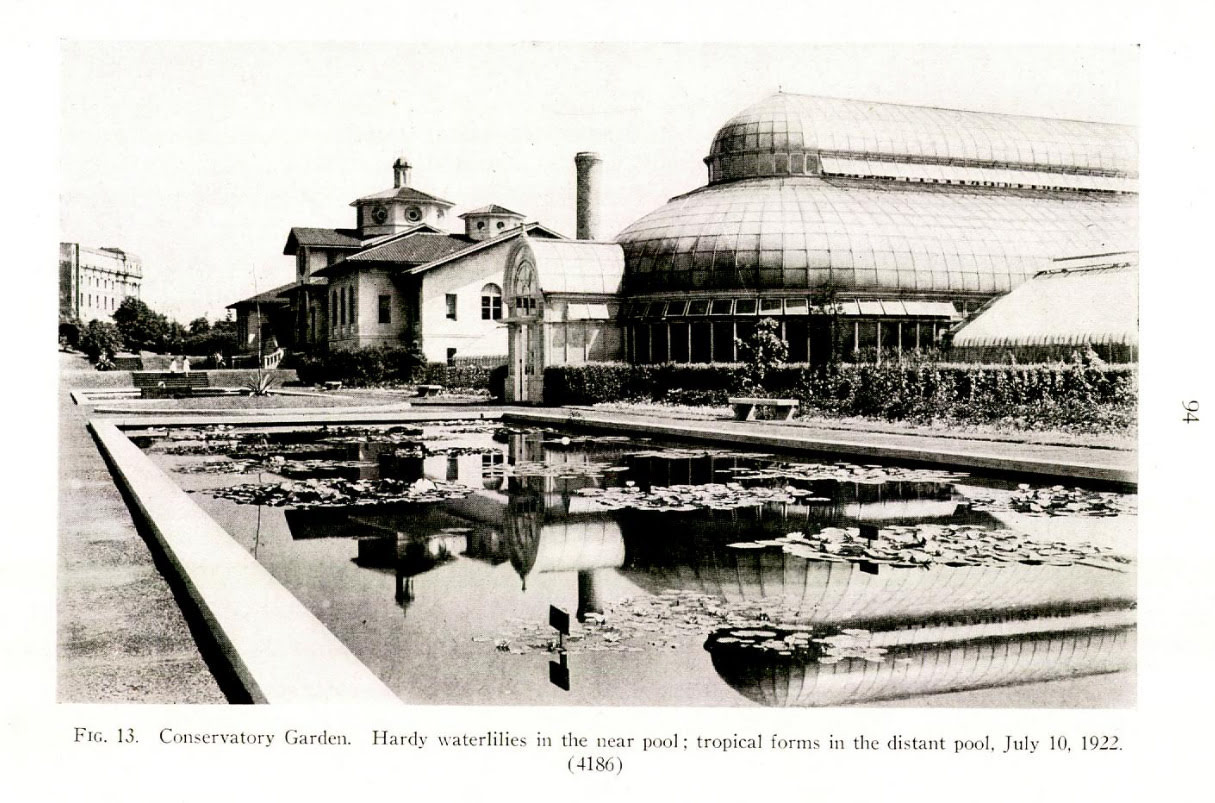
One can see the arrangement here. The Museum building is seen at the top of the picture, the run of conservatories are below, and the Japanese ‘hill and pond’ garden sits between them.

Sadly, as you can see, the quality of these pictures is not great. The Museum does have some of its public domain glass-plate pictures online (at rather pointless sizes), but those are only some of the pictures to be seen in old books and journals. But you get the idea from the pictures below.

Inside would be exotic steam-heat, which Lovecraft enjoyed, and which he might have especially welcomed if he had visited on a chilly Christmas / New Year visit. Also to be seen would be strange plants and sinister pods.

Interestingly in the mid 1920s there were film shows there that might have entertained him. This example is from 1923…

So far as I’m aware, however, he does not mention visiting the hothouse after the Japanese Gardens. But it would seem unusual if he had never set foot in the place, when he made many visits to its next-door neighbours. It’s also known that he enjoyed other hothouses on his various antiquarian trips. I’d welcome any references to where he might mention the Brooklyn hothouses.

If they didn’t influence Lovecraft, it seems difficult to imagine them not influencing his good friend and Brooklyn native Frank Belknap Long. In the war years of the 1940s Long produced a series of pulp stories of exotic alien plants which go under the general title of John Carstairs, Curator of the Interplanetary Botanical Gardens.

“I felt obliged to drop a line to the mighty Conan…”

Tentaclii has gone a bit quiet on Robert E. Howard and Conan et al. It’s not because I’ve lost interested, but because the material isn’t there to note. There seems to have been a lack of suitable items recently, other than the new cash-in comics and foreign translations and suchlike so ably tracked by Messages from Crom.

But now the Robert E. Howard Days (aka Howard Days) in Cross Plains, Texas, are just over six weeks away. It may be that various scholarly and thoughtful publications are being timed to appear for that.

In the meantime I see that Exploring the Worlds of REH Omnibus collects Fred Blosser’s themed ebooks (Howard’s Weird Texas, etc) into a single paperback. Along with eight new articles. I see he also has the survey ebooks Sons of Ringo: The Great Spaghetti Western Heroes and More Sons of Ringo.

One item I thought might be of note was Conan the Barbarian Epic Collection: The Original Marvel Years – Queen of the Black Coast. This was a chunky Marvel 1970s Buscema/Thomas reprint volume released last Christmas. But be warned that the cover and title is misleading. On reading the details you find this is only the run-up to his meeting Belit the ‘Queen of the Black Coast’ (issues #43-59). Conan meets her in #58 and then #59-to-#100 or thereabouts is the rest of the Belit run, as ably collected in Dark Horse’s earlier reprint book Chronicles of Conan, Volumes 8-12. So, be warned that you’re not getting the run that the new ‘Original Marvel Years’ cover seems to promise.

I took a look to see if I had missed anything else in the last year or so, and noted “Der Barbar aus dem Norden: Nordenbilder in Robert E. Howards Conan-Erzahlungen”, in the journal NORDEUROPAforum, 2020. On ‘images of the ancient North as they appear in R.E. Howard’s Conan’. It may interest some readers here, especially because it’s under full Creative Commons Attribution and is thus available to be translated from the German.

Also there’s now a new and mighty-thewed blog-post category here at Tentaclii, REH. I’ve gone back and retrospectively tagged as many posts as I can find.

Dipping into the tidal-wave…

Eurogamer magazine has a new interview with the maker of one of the best games of 2020, the acclaimed and strongly Lovecraftian Call of the Sea, “Lovecraft, new studios, and the legacy of Myst”

“It was one of my favourite games of last year. And you’ve just been nominated for a BAFTA…” [British version of the Oscars, which includes games and TV]

There is of course a constant weekly tidal-wave of Lovecraftian games, comics, metal albums, table-top RPGs and suchlike, and Tentaclii can only briefly note the best here. Of which…

* The Sinking City (2019), the big Lovecraftian Innsmouth-alike videogame of 2019, is now said to be back on the retail shelves after a legal dispute.

* Gou Tanabe’s eagerly awaited manga graphic-novel of “The Dunwich Horror” is taking a break from serial publication in Japanese and will be back in July, which will likely put the English edition back by four months or so.

“a mighty slab of stone rests on the forest floor”

This faint similarity may interest some…

The vast oaks grew thicker as he pushed on beyond the village, and he looked sharply for a certain spot where they would thin somewhat, standing quite dead or dying among the unnaturally dense fungi and the rotting mould and mushy logs of their fallen brothers. There he would turn sharply aside, for at that spot a mighty slab of stone rests on the forest floor; and those who have dared approach it say that it bears an iron ring three feet wide.

Some anniversaries for 2023

Advance notice on some anniversaries for 2023…


50 years (1973):

(The year Lovecraft broke through to a mass audience)

“Over a million paperback [Ballantine] editions of Lovecraft’s work had apparently been sold in the USA by June 1973” (Joshi, Time magazine).

In the UK, the Panther paperbacks of Lovecraft (Dagon, The Lurking Fear, Lurker at the Threshold).

Lovecraft’s Supernatural Horror in Literature (as a popular cheap paperback Dover edition, 1973).

First hoax Necronomicon.

Esoteric Order of Dagon… “an amateur press organization formed by a group of Lovecraft devotees in 1973”.

Dirk W. Mosig begins writing on Lovecraft.

Wilfred B. Talman, “The Normal Lovecraft” (1973).

The Revised H.P. Lovecraft Bibliography (1973).


80 years (1943):

The Dream-Quest of Unknown Kadath published (1943, Arkham House, in Beyond the Wall of Sleep).

The Commonplace Book published (1943, Arkham House, in Beyond the Wall of Sleep).

Publication of “the first bibliography of HPL, by Francis T. Laney and William H. Evans (1943)” (Joshi).


100 years (1923):

Lovecraft completes his run of his amateur journal The Conservative.

Publishes “The Lurking Fear” shocker serial in Home Brew.

Weird Tales founded.

Lovecraft’s first appearance in a pulp magazine (Weird Tales).

“The Rats in the Walls”, “The Festival”.


120 years (1903):

The Rhode Island Journal of Astronomy.

Vaudeville at Keith’s, March 1908

A sample of the vaudeville programme at Keith’s theatre, March 1908.

Lovecraft fondly recalled, in a letter to Moe, “Keith’s Continuous Vaudeville” and the “new biograph travel films to chase the audiences out of Keith’s at six-o’clock”. He was recalling the years 1900-02 when he was ten to twelve years old. He is known to have visited “the old Keith’s Theatre” c. 1905 to see Houdini. The 1908 date of the above programme may be a bit late, as he would then have been around 17 years old, but the sort of vaudeville programme at Keith’s would not have changed much.

More link fixing after the move

More link-fixing this evening.

For some reason, after the fresh WordPress as first installed, this was fine for getting the PDFs…

/tentaclii/index.php/pdfs/

Now it’s not and it’s just…

/tentaclii/pdfs/

Yet the /index.php/ is needed for the links to the HTML blog post pages. ‘Go figure’, as Americans say.

The other problem is that a direct link to a PDF respects capitalisation. A free WordPress blog forces the filename down to the_cats_of_ulthar_annotated_2019_fontsembedded.pdf in the link and on the server. But a paid hosting server will have it as the original filename of The_Cats_of_Ulthar_annotated_2019_fontsembedded.pdf (note the uppercase) and will thus refuse to serve the PDF. The filenames of all my .PDFs are now lower-cased to match the links.

Anyway, PDFs and freebies links have all been check by hand, again. They should now all be working.

Also, I’ve been able to restore the pictures on my little RPG adventure A pictorial RPG scenario: The Assemblage of Dr. Arnold Astrall.

The sidebar now looks nicer and neater.

I’ve spent a further hour with a regex plugin (search/replace) rooting out any remaining jurn .org links, and as far as I can see they are now fixed and gone.

The PayPal donations link has been restored to the blog’s sidebar.

Added to Open Lovecraft:

Added to Open Lovecraft:

2022:

* E.S. Nilsson, Between the Eldritch and the Deep Blue Sea: A Study of Ecosystemic Configurations and the Ocean in Stories by H.P. Lovecraft. (Undergraduate final dissertation for Karlstads University).

* C. Agostini and E. Baggio, “A construcao de narrativas e os estudos de cultura material”, Revista Arqueologia Publica, Vol. 17, 2022. (How Lovecraft entices the reader to think about the formal ‘study of things of the past’).

* L. Mastropierro and M. Mahlberg, “Key words and translated cohesion in Lovecraft’s ‘At the Mountains of Madness’ and one of its Italian translations”, 2022. (“A comparison of Lovecraft’s original and a translation into Italian provides us with a nuanced understanding of the complex nature of cohesive networks [within such texts]”).

2021:

* Special issue of Studies in Gothic Fiction, Volume 7, 2021. (Five texts on adapting Lovecraft for games).

* J. Hunter, “Mysterium Horrendum: Exploring Otto’s Concept of the Numinous in Stoker, Machen, and Lovecraft”, book chapter IN: Theology and Horror: Explorations of the Dark Religious Imagination, 2021. (Appears to be an open access deposit via Academia.edu? Note that their PDFs can only be freely accessed by non-members via a title search on Google Scholar).

* A. Lubon, “Scalanie uniwersum: krytyka translatorska posrod kontekstow recepcji przekladowej poezji H.P. Lovecrafta w Polsce, Przekladaniec, No. 42, 2021. (“Consolidating the Universe: Translation Criticism among Contexts of Translational Reception of H.P. Lovecraft’s Poetry in Poland”. Close study of sematic shifts over time, in Polish translations).

* L.K. da Rocha, “A Tradicao, A Critica E As Representacoes Da Modernidade Em Howard Phillips Lovecraft: Uma Analise Triangular Entre Literatura E Documentos De Intimidade.”, Revista Cadernos de Clio, Vol. 12, No. 1, 2021. (Short article in what appears to be a graduate journal in Portuguese. “Tradition, criticism and representations of modernity in Howard Phillips Lovecraft: a triangular analysis between literature and documents of intimacy”. Lovecraft’s responses to modernity and the ongoing modernizing processes. Lovecraft is an anti-modern agent, an individual who idealised a utopian society via pure values. This is reflected in his fiction.)

* O. Glain, “H.P. Lovecraft’s Zadok Allen: a rebirth of the New England backwoods dialect?”, Etudes de Stylistique Anglaise, Vol. 16, 2021. (In English with French abstract).


Also some interesting items without full-text, noted here only:

“‘Awed listening’: H. P. Lovecraft in classic and contemporary audio horror” (Broad survey, touches on Bloch: “In the radio work of Lovecraft acolyte Robert Bloch as well as shows such as Quiet, Please (1947-49) the ‘Lovecraftesque’ is strongly evident. Indeed, various dimensions to Lovecraft’s fiction make his oeuvre ideally suited to audio adaptation.”).

“Those who predicted the darkness: writing the end in Lovecraft and Houellebecq”. (“Surprisingly, very few critics have discussed Lovecraft’s considerable contribution to Houellebecq’s thinking. […] This first study devoted exclusively to the links between these two authors will examine the thematic and stylistic aspects of their respective eschatological visions.”).

“The Protoplasmic Imagination: Ernst Haeckel and H.P. Lovecraft”. (“For Haeckel, [protoplasm] was the missing piece in the puzzle that Darwin had almost completed, and with it the whole mystery and wonder of life was within explanatory reach. For Lovecraft, on the other hand, it was the very essence of the shapeless, primitive, and fundamentally menacing quality of life that civilization had to keep at bay.”).

Notes on Selected Letters – part one

Notes on the Selected Letters – part one:

I’ve decided to re-read Lovecraft’s Selected Letters over the summer. Here are my ‘Note on Selected Letters‘ for Volume 1, which I was lucky enough to get in a cheap ex-library copy some years ago. Thanks to my Patreon patrons who made that purchase possible. One of the nice things about such a hardback, compared to the paperback volumes of letters, is that the binding is such that they can lay flat when you open them and lay them on a table or book-stand.

Note that I skimmed and sometimes skipped a few letters from people I already have in their dedicated volumes, such as Moe and Kleiner.

* The planet Venus is noted, along with Develan’s Comet. Page 5.

* Lovecraft is hailed by key members of the audience as a “born public speaker”, after laying aside his script and giving his talk impromptu at the Hub Club. Page 124.

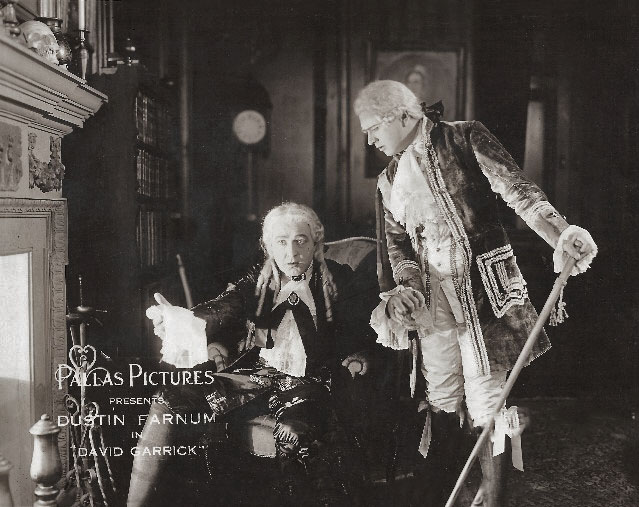
* He saw the movie David Garrick. He mentions the name of the leading man, so we know this was the 1916 version, seen below. Page 127.

* His amateur colleague Jackson kept scrap books of the best of amateur publications, in which Lovecraft found he featured heavily when he was shown them in Boston. I’m not sure if these scrap-books have survived. Page 126.

* In 1921 Lovecraft anticipates “the next war”. Page 160.

* “Don’t complain of the youth’s high-powered motor-car unless you can give him an horse and armour and send him to conquer the domains of the neighbouring kings!” Page 209.

* With his youthful telescope he… “gazed upon the moon’s frightful abysses where no diffusing air softens the nighted blackness of distorted shadows.” and “It has always been my intention to write a set of tales involving other planets”. The latter said in 1923. Page 214.

* He reveals why he ceased publishing his astronomy articles in the local newspaper… “The paper was sold to the Democrats”. Page 214.

* There is a magnificent extended description of a Portsmouth garden, which is almost a prose-poem in itself…

When it is twilight in the worlds, there are heard in that garden the invisible steps of MĀNA-YOOD-SUSHĀI, who is weary of Sardathrion’s gleaming walls and onyx lions, and would gaze softly and gently on that loveliness he hath created in his dreams.

MĀNA-YOOD-SUSHĀI is Dunsany’s ‘Dreamer of All Things’ god. Page 245-46. Lovecraft is writing fan-fiction, in 1923.

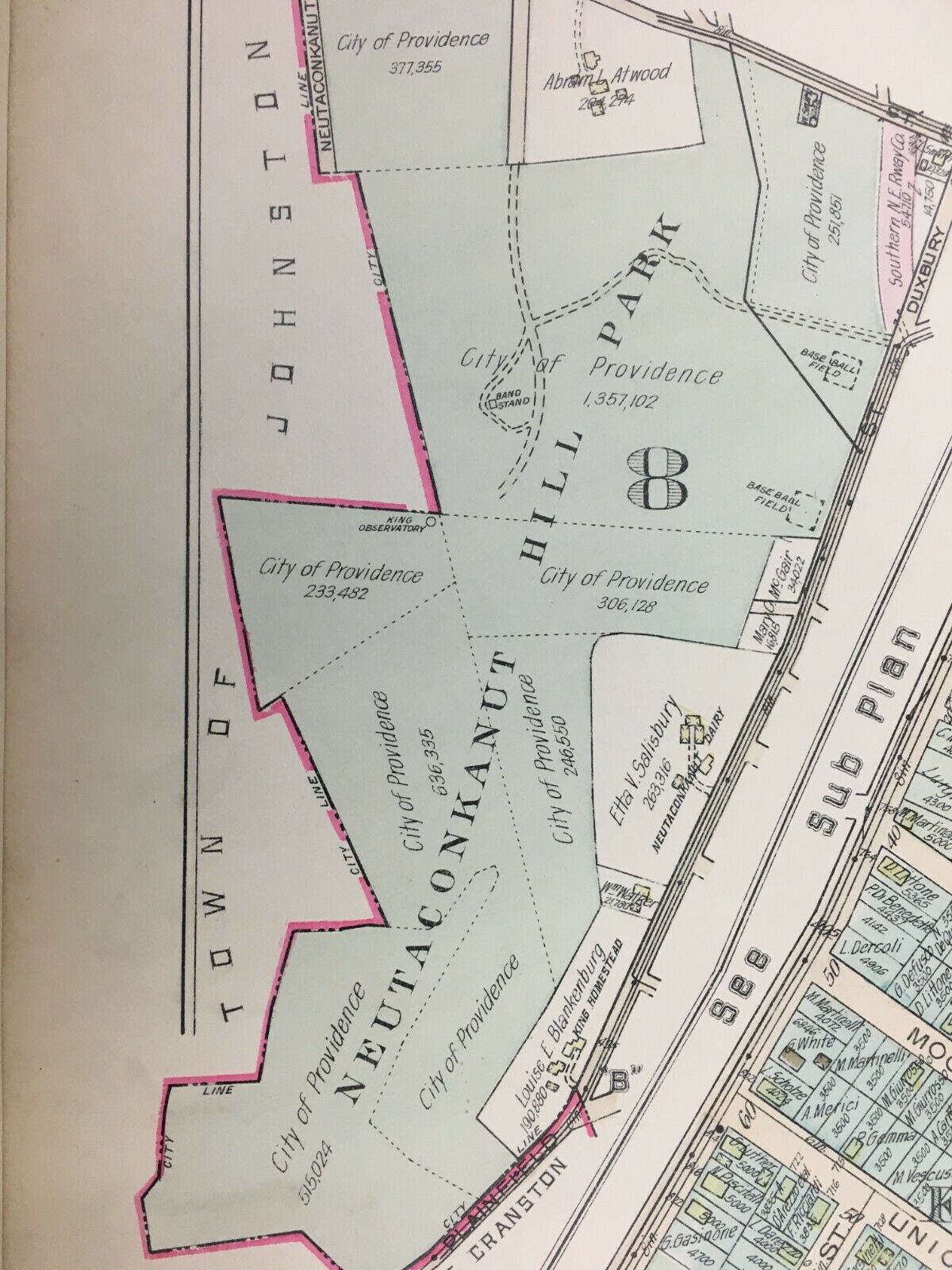
* In a 1923 exploration of the front part of Nentaconhant Hill [Neutaconkanut] he notes that at the summit an… “observatory in the Gothick manner, somewhat in disrepair, crowns this majestick acclivity”. Although the lack of any further description of his climbing this tower suggests there may have been no public access. The Rhode Island Historical Preservation 1976 survey listing for Johnson makes no mention of this tower, but this 1926 map shows the “King Observatory” and its location on the hill…

This was Abby A. King’s ‘The King Observatory’, a 60-foot tower “topped by an observation cupola”, though if for night-time astronomy rather than daytime sight-seeing is now uncertain. Perhaps the intent was to allow both. But Rhode Island Historical Notes for 1977 has a footnote, to an article on an early Boy Scouts trip to the hill, that reveals the above map was out of date. Since the tower, it states… “was burned to rubble by vandals in 1925”. This probably suggests that local youths had a clandestine way into the tower, and also suggests a heavy timber frame inside stone facing. Given this the setting thus presumably inspired ‘the tower scene’ in the excellent recent biographical graphic-novel Une nuit avec Lovecraft, although the tower is there imagined as having survived into the 1930s.

Only much later in his life did he discover the little-visited faun-haunted meads and twilit glades at the back of the same hill, then just outside the city boundaries…

* In early 1924 Lovecraft recalls of his earlier self..

In those middle years [after leaving High School I was] practically out of the world until three years ago [i.e. 1921]” … “the poor devil was such a nervous wreck that he hated to speak to any human being, or even to see or be seen by one; and every trip to town was an ordeal.

By “trip to town” he must mean for daytime or evening shopping and suchlike in the central market and business district, or for the Public Library / bookstores, rather than any hypothetical night-walks (he appears to have been largely nocturnal during this period).

* In early 1924 his planned “big novel” Azathoth will be “exotic and highbrow” and “wholly unsuited” to Weird Tales. While his lesser novel for the Weird Tales masses will be a “hideous thing … The House of the Worm“. Neither were written, of course. Page 295.

* There is a useful plain explanation, to a puzzled Frank Belknap Long, of what the submarine city in his “The Temple” is meant to be…

My submarine city is a work of man – a templed and glittering metropolis that once reared its copper domes and colonnades of chrysolite to glowing Atlantean suns. Fair Nordick bearded men dwelt in my city, and spoke a polish’d tongue akin to Greek; and the flame that the Graf von Altberg-Ehrenstein beheld was a witch-fire lit by spirits many millennia old.

There are only oblique hints of this in the tale…

1). The reader in the year 1921 is presumably expected to parse several mid-Atlantic locations. The submarine is preying on the “Liverpool-New York” civilian shipping lanes at “N. Latitude 45° 16′, W. Longitude 28° 34′”, something most schoolboys would then be familiar with via their school Atlas, which showed the shipping lanes. Later the submarine drifts well “south” of these shipping lanes, so… she is somewhere north of the Azores and thus outside the well-trafficked routes.

2). As for the underwater city, it is clearly prior to even the earliest Greek art… “impression of terrible antiquity, as though it were the remotest rather than the immediate ancestor of Greek art”. The reader, informed elsewhere by the historical-ethnographic categories known to the early 1920s, must thus deduce that due to its stated age the city was built by a primal unknown ‘Nordic’ culture which only later informed the known historical ‘Mediterranean’ type culture. There was in the 1910s a simplistic ‘Nordic vs. Mediterranean’ argument relating to the wider questions of Indo-European cultural origins and diffusion. Lovecraft is probably assuming that everyone is familiar with these divisions.

3). As for the “witch-light”, the story does offer a… “rhythmic, melodic sound as of some wild yet beautiful chant or choral hymn … vividly aglow with a flickering radiance, as from a mighty altar-flame far within”. Which seems clear enough. But by “witch-light” Lovecraft presumably means ‘a large but somewhat faint flickering radiance’, rather than ‘a light lit by witches’.

4). But that the flickering light (implied flame) has been lit by “spirits” is only meant to be deduced from the general ghostly underwater setting + the immense age of the place. Perhaps also by the carvings on the temple doors “exquisite carvings like the figures of Bacchanals in relief”, which indicates the spirited scene that awaits beyond. I can find no details on ancient temple Bacchanals which indicate that some sort of special large flickering flame was present at the interior aspect of these (the processions are better attested) but perhaps Lovecraft knew differently and expected others to know it too.