Vaudeville at Keith’s, March 1908

A sample of the vaudeville programme at Keith’s theatre, March 1908.

Lovecraft fondly recalled, in a letter to Moe, “Keith’s Continuous Vaudeville” and the “new biograph travel films to chase the audiences out of Keith’s at six-o’clock”. He was recalling the years 1900-02 when he was ten to twelve years old. He is known to have visited “the old Keith’s Theatre” c. 1905 to see Houdini. The 1908 date of the above programme may be a bit late, as he would then have been around 17 years old, but the sort of vaudeville programme at Keith’s would not have changed much.

More link fixing after the move

More link-fixing this evening.

For some reason, after the fresh WordPress as first installed, this was fine for getting the PDFs…

/tentaclii/index.php/pdfs/

Now it’s not and it’s just…

/tentaclii/pdfs/

Yet the /index.php/ is needed for the links to the HTML blog post pages. ‘Go figure’, as Americans say.

The other problem is that a direct link to a PDF respects capitalisation. A free WordPress blog forces the filename down to the_cats_of_ulthar_annotated_2019_fontsembedded.pdf in the link and on the server. But a paid hosting server will have it as the original filename of The_Cats_of_Ulthar_annotated_2019_fontsembedded.pdf (note the uppercase) and will thus refuse to serve the PDF. The filenames of all my .PDFs are now lower-cased to match the links.

Anyway, PDFs and freebies links have all been check by hand, again. They should now all be working.

Also, I’ve been able to restore the pictures on my little RPG adventure A pictorial RPG scenario: The Assemblage of Dr. Arnold Astrall.

The sidebar now looks nicer and neater.

I’ve spent a further hour with a regex plugin (search/replace) rooting out any remaining jurn .org links, and as far as I can see they are now fixed and gone.

The PayPal donations link has been restored to the blog’s sidebar.

Added to Open Lovecraft:

Added to Open Lovecraft:

2022:

* E.S. Nilsson, Between the Eldritch and the Deep Blue Sea: A Study of Ecosystemic Configurations and the Ocean in Stories by H.P. Lovecraft. (Undergraduate final dissertation for Karlstads University).

* C. Agostini and E. Baggio, “A construcao de narrativas e os estudos de cultura material”, Revista Arqueologia Publica, Vol. 17, 2022. (How Lovecraft entices the reader to think about the formal ‘study of things of the past’).

* L. Mastropierro and M. Mahlberg, “Key words and translated cohesion in Lovecraft’s ‘At the Mountains of Madness’ and one of its Italian translations”, 2022. (“A comparison of Lovecraft’s original and a translation into Italian provides us with a nuanced understanding of the complex nature of cohesive networks [within such texts]”).

2021:

* Special issue of Studies in Gothic Fiction, Volume 7, 2021. (Five texts on adapting Lovecraft for games).

* J. Hunter, “Mysterium Horrendum: Exploring Otto’s Concept of the Numinous in Stoker, Machen, and Lovecraft”, book chapter IN: Theology and Horror: Explorations of the Dark Religious Imagination, 2021. (Appears to be an open access deposit via Academia.edu? Note that their PDFs can only be freely accessed by non-members via a title search on Google Scholar).

* A. Lubon, “Scalanie uniwersum: krytyka translatorska posrod kontekstow recepcji przekladowej poezji H.P. Lovecrafta w Polsce, Przekladaniec, No. 42, 2021. (“Consolidating the Universe: Translation Criticism among Contexts of Translational Reception of H.P. Lovecraft’s Poetry in Poland”. Close study of sematic shifts over time, in Polish translations).

* L.K. da Rocha, “A Tradicao, A Critica E As Representacoes Da Modernidade Em Howard Phillips Lovecraft: Uma Analise Triangular Entre Literatura E Documentos De Intimidade.”, Revista Cadernos de Clio, Vol. 12, No. 1, 2021. (Short article in what appears to be a graduate journal in Portuguese. “Tradition, criticism and representations of modernity in Howard Phillips Lovecraft: a triangular analysis between literature and documents of intimacy”. Lovecraft’s responses to modernity and the ongoing modernizing processes. Lovecraft is an anti-modern agent, an individual who idealised a utopian society via pure values. This is reflected in his fiction.)

* O. Glain, “H.P. Lovecraft’s Zadok Allen: a rebirth of the New England backwoods dialect?”, Etudes de Stylistique Anglaise, Vol. 16, 2021. (In English with French abstract).


Also some interesting items without full-text, noted here only:

“‘Awed listening’: H. P. Lovecraft in classic and contemporary audio horror” (Broad survey, touches on Bloch: “In the radio work of Lovecraft acolyte Robert Bloch as well as shows such as Quiet, Please (1947-49) the ‘Lovecraftesque’ is strongly evident. Indeed, various dimensions to Lovecraft’s fiction make his oeuvre ideally suited to audio adaptation.”).

“Those who predicted the darkness: writing the end in Lovecraft and Houellebecq”. (“Surprisingly, very few critics have discussed Lovecraft’s considerable contribution to Houellebecq’s thinking. […] This first study devoted exclusively to the links between these two authors will examine the thematic and stylistic aspects of their respective eschatological visions.”).

“The Protoplasmic Imagination: Ernst Haeckel and H.P. Lovecraft”. (“For Haeckel, [protoplasm] was the missing piece in the puzzle that Darwin had almost completed, and with it the whole mystery and wonder of life was within explanatory reach. For Lovecraft, on the other hand, it was the very essence of the shapeless, primitive, and fundamentally menacing quality of life that civilization had to keep at bay.”).

Notes on Selected Letters – part one

Notes on the Selected Letters – part one:

I’ve decided to re-read Lovecraft’s Selected Letters over the summer. Here are my ‘Note on Selected Letters‘ for Volume 1, which I was lucky enough to get in a cheap ex-library copy some years ago. Thanks to my Patreon patrons who made that purchase possible. One of the nice things about such a hardback, compared to the paperback volumes of letters, is that the binding is such that they can lay flat when you open them and lay them on a table or book-stand.

Note that I skimmed and sometimes skipped a few letters from people I already have in their dedicated volumes, such as Moe and Kleiner.

* The planet Venus is noted, along with Develan’s Comet. Page 5.

* Lovecraft is hailed by key members of the audience as a “born public speaker”, after laying aside his script and giving his talk impromptu at the Hub Club. Page 124.

* He saw the movie David Garrick. He mentions the name of the leading man, so we know this was the 1916 version, seen below. Page 127.

* His amateur colleague Jackson kept scrap books of the best of amateur publications, in which Lovecraft found he featured heavily when he was shown them in Boston. I’m not sure if these scrap-books have survived. Page 126.

* In 1921 Lovecraft anticipates “the next war”. Page 160.

* “Don’t complain of the youth’s high-powered motor-car unless you can give him an horse and armour and send him to conquer the domains of the neighbouring kings!” Page 209.

* With his youthful telescope he… “gazed upon the moon’s frightful abysses where no diffusing air softens the nighted blackness of distorted shadows.” and “It has always been my intention to write a set of tales involving other planets”. The latter said in 1923. Page 214.

* He reveals why he ceased publishing his astronomy articles in the local newspaper… “The paper was sold to the Democrats”. Page 214.

* There is a magnificent extended description of a Portsmouth garden, which is almost a prose-poem in itself…

When it is twilight in the worlds, there are heard in that garden the invisible steps of MĀNA-YOOD-SUSHĀI, who is weary of Sardathrion’s gleaming walls and onyx lions, and would gaze softly and gently on that loveliness he hath created in his dreams.

MĀNA-YOOD-SUSHĀI is Dunsany’s ‘Dreamer of All Things’ god. Page 245-46. Lovecraft is writing fan-fiction, in 1923.

* In a 1923 exploration of the front part of Nentaconhant Hill [Neutaconkanut] he notes that at the summit an… “observatory in the Gothick manner, somewhat in disrepair, crowns this majestick acclivity”. Although the lack of any further description of his climbing this tower suggests there may have been no public access. The Rhode Island Historical Preservation 1976 survey listing for Johnson makes no mention of this tower, but this 1926 map shows the “King Observatory” and its location on the hill…

This was Abby A. King’s ‘The King Observatory’, a 60-foot tower “topped by an observation cupola”, though if for night-time astronomy rather than daytime sight-seeing is now uncertain. Perhaps the intent was to allow both. But Rhode Island Historical Notes for 1977 has a footnote, to an article on an early Boy Scouts trip to the hill, that reveals the above map was out of date. Since the tower, it states… “was burned to rubble by vandals in 1925”. This probably suggests that local youths had a clandestine way into the tower, and also suggests a heavy timber frame inside stone facing. Given this the setting thus presumably inspired ‘the tower scene’ in the excellent recent biographical graphic-novel Une nuit avec Lovecraft, although the tower is there imagined as having survived into the 1930s.

Only much later in his life did he discover the little-visited faun-haunted meads and twilit glades at the back of the same hill, then just outside the city boundaries…

* In early 1924 Lovecraft recalls of his earlier self..

In those middle years [after leaving High School I was] practically out of the world until three years ago [i.e. 1921]” … “the poor devil was such a nervous wreck that he hated to speak to any human being, or even to see or be seen by one; and every trip to town was an ordeal.

By “trip to town” he must mean for daytime or evening shopping and suchlike in the central market and business district, or for the Public Library / bookstores, rather than any hypothetical night-walks (he appears to have been largely nocturnal during this period).

* In early 1924 his planned “big novel” Azathoth will be “exotic and highbrow” and “wholly unsuited” to Weird Tales. While his lesser novel for the Weird Tales masses will be a “hideous thing … The House of the Worm“. Neither were written, of course. Page 295.

* There is a useful plain explanation, to a puzzled Frank Belknap Long, of what the submarine city in his “The Temple” is meant to be…

My submarine city is a work of man – a templed and glittering metropolis that once reared its copper domes and colonnades of chrysolite to glowing Atlantean suns. Fair Nordick bearded men dwelt in my city, and spoke a polish’d tongue akin to Greek; and the flame that the Graf von Altberg-Ehrenstein beheld was a witch-fire lit by spirits many millennia old.

There are only oblique hints of this in the tale…

1). The reader in the year 1921 is presumably expected to parse several mid-Atlantic locations. The submarine is preying on the “Liverpool-New York” civilian shipping lanes at “N. Latitude 45° 16′, W. Longitude 28° 34′”, something most schoolboys would then be familiar with via their school Atlas, which showed the shipping lanes. Later the submarine drifts well “south” of these shipping lanes, so… she is somewhere north of the Azores and thus outside the well-trafficked routes.

2). As for the underwater city, it is clearly prior to even the earliest Greek art… “impression of terrible antiquity, as though it were the remotest rather than the immediate ancestor of Greek art”. The reader, informed elsewhere by the historical-ethnographic categories known to the early 1920s, must thus deduce that due to its stated age the city was built by a primal unknown ‘Nordic’ culture which only later informed the known historical ‘Mediterranean’ type culture. There was in the 1910s a simplistic ‘Nordic vs. Mediterranean’ argument relating to the wider questions of Indo-European cultural origins and diffusion. Lovecraft is probably assuming that everyone is familiar with these divisions.

3). As for the “witch-light”, the story does offer a… “rhythmic, melodic sound as of some wild yet beautiful chant or choral hymn … vividly aglow with a flickering radiance, as from a mighty altar-flame far within”. Which seems clear enough. But by “witch-light” Lovecraft presumably means ‘a large but somewhat faint flickering radiance’, rather than ‘a light lit by witches’.

4). But that the flickering light (implied flame) has been lit by “spirits” is only meant to be deduced from the general ghostly underwater setting + the immense age of the place. Perhaps also by the carvings on the temple doors “exquisite carvings like the figures of Bacchanals in relief”, which indicates the spirited scene that awaits beyond. I can find no details on ancient temple Bacchanals which indicate that some sort of special large flickering flame was present at the interior aspect of these (the processions are better attested) but perhaps Lovecraft knew differently and expected others to know it too.

‘Picture Postals’ from Lovecraft: Cleveland, August 1922

This week’s ‘Picture Postals’ is part four of four, of a few notes on the new expanded edition of the Galpin letters. On page 293 Lovecraft usefully recalls the exact locations enjoyed during his 1922 visit to Cleveland. This was a very happy time for him as he was effectively released from his long hermitage. The addresses are…

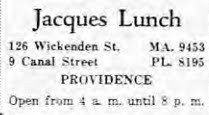
1537 E. 93rd St. [Loveman’s family home], 9231 Birchdale [Avenue, Galpin’s family home, quite near to Loveman], Wade Park, Clark’s Lunch [north side of Euclid Av.], Taylor’s Arcade [south side of Euclid Av.], Eglin’s [bookshop]


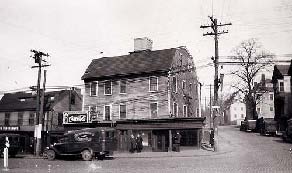
I found a good picture of a Clark’s Lunch on the central street called Euclid Avenue, and dated 1922…

Galpin met Lovecraft at the railway station and immediately took him to eat at a Clark’s Lunch, before they then went back to Galpin’s family home. This same Lunch was where he and the boys mostly ate their ‘meals out’ after that, as Lovecraft told his aunt in a letter.

It’s pleasing to get a photo of the exact date, although the heavy coats and hats in the picture suggests a bright-but-chill springtime rather than the early August heat of Lovecraft’s extended and fatefully cheering visit. However, is this the Clark’s Lunch? The people look rather too upmarket and the hole-in-the-wall too small. Were there other branches? There were. The 1920 American Legion Convention booklet usefully yields the list of the city’s branches…

So, there were two Lunch’s on Euclid. And we now know that the branches were open 24 hours.

But which Lunch is shown? The one at 1325 Euclid or at 5410 Euclid? Enough of the surrounding architecture of one remains to be seen today on Google Street View, and thus the above picture can be confirmed as the central Lunch at 1325 Euclid.

However I’m still not entirely certain, as there were evidently other branches. Indeed there were 15 branches in the city by the 1950s. So let’s look more closely at the place of arrival and see if that helps. Lovecraft was on the Lake Shore overnight sleeper train from New York to Cleveland, seeing the Catskills in the distance as he travelled along the Hudson Valley (he would later that year set “The Lurking Fear” in the same mountains). In 1922 the Lake Shore sleeper drew in to Cleveland at the old and decrepit New Union Depot. This had been renovated in earlier decades, but was still then blighted by “years of accumulated soot and ash which had made the building into a dirty eyesore” according to the railway historians. In 1922 it was all-but defunct. The city’s long-planned gleaming station was still just bare cleared-ground at that time, and would only open in 1930. Thus we can be sure that Lovecraft arrived in the city at the old and decrepit New Union Depot. The question is then, which was the nearest Clark’s Lunch branch for the station?

Sadly, it’s not the one seen above at 1325 Euclid. Pity, but the situation did look rather too posh. The nearest to this station would have been the branch at 228 West Superior, on the west side of Cleveland Public Square and about a quarter mile walk from the New Union Depot. There was a large business college at 236 West Superior, and an athletics store at 226, with together suggest a student-ish atmosphere for the Lunch. The food appears to confirm this student-y supposition. The food there was found to be “humble” and “inexpensive”, as Lovecraft told his aunt (Selected Letters Vol. 1., p. 191).

Unfortunately there don’t appear to be vintage pictures of that stretch of West Superior, and this row has since been cleared. It has long been a parking lot called Jacob’s Lot…

But the local press report that by 2024 the car park will be gone. From the site of Lovecraft’s Lunch will soar a new Sherwin-Williams Corp. mega-tower skyscraper. Suitably enough, for a place where artists and writers such as H.P. Lovecraft and Hart Crane once met, the company is ‘America’s Paint Company’ and makes paints.


What of Taylor’s Arcade? This was on the south side of Euclid Avenue in its central run, and is here seen perhaps circa 1912-ish? A decade before. Not to be confused with another and far grander wrought-iron arcade in the same city, which still exists.


What of Wade Park? This had a large zoo with lions and polar bears and suchlike, and an art museum, as well as fine and expansive parkland with lakes. Lovecraft tells his aunt that he toured the “Cleveland Art Museum” there. Aka the Cleveland Museum of Art. This was housed in a long low classical building.

The museum displayed fine art and crafts from all eras and Lovecraft would have seen full armoured and mounted medieval knights, “Carthage” by the famous British artist Turner, Japanese porcelain, French paintings, and far more. Also the following approximate emulation of a Moorish-style courtyard garden, which appears (from another companion card) to have had a further small garden in a more eastern style with a central Buddha.

The heat of early-mid August 1922 was very heavy, and thus no doubt much to the liking of both the garden and Lovecraft. Strong heat always pepped him up. He also found that he needed to blend in more with the boys and thus he divested himself of his usual hat and stiff collar…

Can you picture me vestless [i.e. without a waistcoat], hatless, soft-collared, and belted, ambling about with a boy of twenty, as if I were no older? … One can be free and easy in a provincial city … What I need in order to be cheerful is the constant company of youthful and congenial literary persons. (Selected Letters Vol. 1, p. 293)


As for the bookshop, “Eglin’s” is the form elsewhere in Selected Letters which confirms the spelling. Also confirmed is that some of the shop’s after-hours reading events were quietly rather gay at that time (as the confirming spelling occurs in the context of Lovecraft’s comments on Gordon Hatfield and Loveman). The journal Phantasmus for 1924 then gives the address “Eglin’s Book Store, 824 Superior Ave.” and the 1925 American Book Trade Directory confirms. By March 1930 the sales-outlets list of The Rosicrucian mystical magazine shows it had moved down the Avenue to 806. Today its old site at No. 824 is a 4,000 sq. ft. modern art gallery, seemingly shelled from the original building and with some of the old frontage still intact.

No. 824 is about a quarter-mile west of the Clark’s Lunch branch at 228 West Superior (see above). This helps to very strongly confirm the likely branch at which Lovecraft, Loveman, Galpin and the Eglin’s crowd ate in 1922. Given the “humble” and “inexpensive” fare, from the branch of a growing and reliable 24-hour chain, it would have been the natural choice as a local eatery.

Loveman would later work at Eglin’s as a bookshop assistant, but when he lost the position he followed the poet and his sometime-lover Hart Crane to New York City. Lovecraft later followed Loveman to New York, and the rest is history.

Industrial Trust revived

The Providence Architecture Here and There blog reports on the possibility of “New life for Industrial Trust building?”. This iconic central building having been vacant for a while now. Sadly it now looks set to become apartments, rather than the towering multi-floor H.P. Lovecraft & Mythos Madness Museum that the city should have enjoyed for the last thirty years.

The article includes much local insight into the political machinations (of the sort that always seem to have dogged Providence), but also a very nice tip-off on an old Providence Journal photo of the building under construction in 1927 as seen from the foot of College Street. This inset picture quickly led me to the full picture, another ‘foot of Lovecraft’s College Street’ picture I had never seen before. I’ve here colourised it…

Compare with the same scene some 20 years earlier, as seen in another newly-found picture.

Final Reckonings with Bloch

On SF Crows Nest, Eamonn Murphy has a new long review of Final Reckonings: The Complete Stories Of Robert Bloch (Volume 1)

This first volume of ‘The Complete Stories’ is widely available for about £10 or less on various sites and that’s a bargain. For some reason, the next two volumes are rarer and much more expensive.

Also, over at The Silver Key a new review of the new Robert E. Howard Changed My Life.

‘Lovecraftian People and Places’ now on Amazon UK

I’m pleased to see that Ken Faig Jr.’s new book Lovecraftian People and Places is now listed on Amazon UK and dated there “12th April 2022”. Over at Hippocampus the page for the book usefully notes that… “All essays have been revised for publication in this collection.”

Incidentally I see that Lovecraft Annual No. 15 (2021) is currently half-price at Amazon UK. It’s still waiting for my review here. I read ‘a few essays in’ last autumn and then put it down. My interest in Lovecraft tends to be somewhat seasonal, strongest in May-September. I’ll have to re-start the 2021 Annual reading sometime before the summer of 2022 comes to an end. I’m pleased to say that editor Joshi has accepted an item by me for a future Annual, and another for his Penumbra journal.

Shots Around Providence

With thanks to Ken Faig Jr., a link to the new Shots Around Providence (1930s-1940) on YouTube. Via the Historical Society, which has kindly placed the amateur film online.

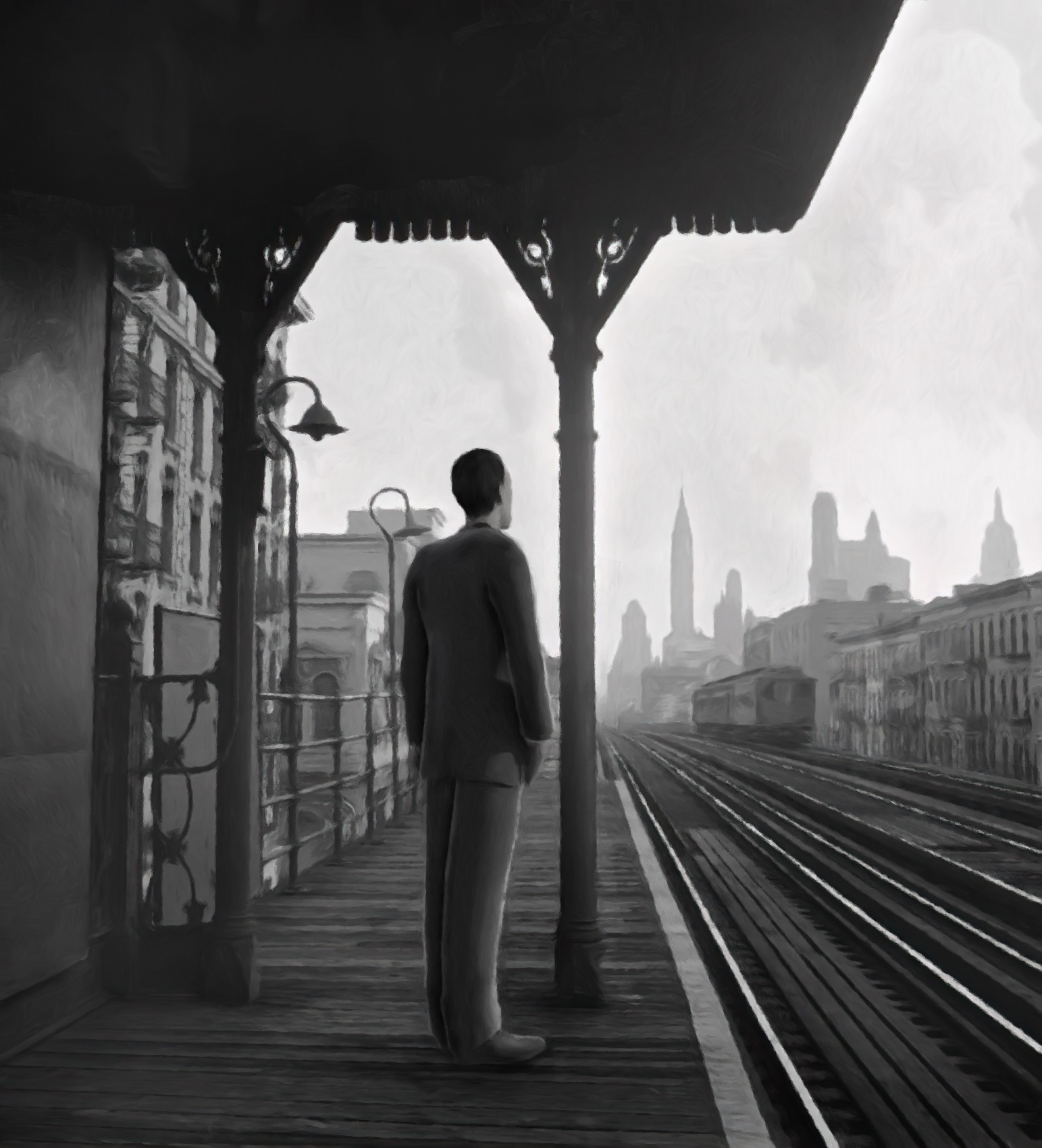
In one scene we see a Lovecraft-alike man shopping for a Christmas tree. These being stacked around the city’s Market Place fruit-market site on the waterfront in November/December 1934. I’ve lifted the shadows in Photoshop, which are always too dark on such things. I’ve also added a basic colourisation. Contact the Society if you want to give the film a thorough work-over and stabilisation.

I seem to recall that 1934 was the year that Lovecraft — having moved into 66 College St. — surprised his aunt by installing a Christmas tree and then merrily decking it and the halls. A family tradition that had long been in abeyance if I recall rightly. If it wasn’t that year, it was likely the next.

Notes on the Galpin letters – part three

Part three of four, of a few notes on the new expanded edition of the Galpin letters:

* Lovecraft’s childhood barn was “razed” in 1931 (p. 272) having become rotten and fungus ridden. He puts an age-date on the period in which it formed his playhouse, age 10. Which puts the disposal of the carriage-horses at or before 1900. (p. 272).

* The 1932 eclipse of the sun is described in detail on page 274, with some comparative reference to the eclipse of 1925.

* He cogently summarises his attitude to emotions and his ‘what the heck’ approach, in paragraphs at the foot of pages 278 and 279.

* He notes the “mild winters” in 1932/32 (p. 283), 1932/33 (p. 288), at a time when he had not yet moved into 66 College Street. The move to the new house may well have saved his life, since 1933/34 was a very cold winter and was sometimes at “seventeen below” zero (p. 305). But by then he thankfully had the 24-hour steam-heat from the neighbouring Library boiler. At No. 66 he also enjoyed the “symphony of chimes” from the various nearby clock and church towers (p. 291).

* Lovecraft found a “surprisingly vast audience” attendant on a public visit to Brown by the T.S. Eliot to Providence. He notes that Eliot was newly British Royalist / Anglo-Catholic.

* At the end of March 1933 he was about to launch into the revision of an 88,000 word novel, which it appears he completed and for which he was paid $100. “This novel has not been identified” says a footnote.

* He notes various Cleveland locations in August 1922. More on those, with new pictures, in a near-future ‘Picture Postals’ post at Tentaclii.

* He tells Galpin in 1933 that he had twice been mistaken by Canadian strangers as a British man (p. 296). The non-French Canadians presumably being, at that time, more familiar with the British upper-class accent than today.

* He talks of a booklet issued by the city “school department” circa 1933, which presumably formed a guide to College Hill. Since he was pleased that the bird’s eye view on the cover showed #66 and its garden court. (p. 300) Elsewhere he talks of the magnifying glass he used to closely scrutinise such things, and also picture postcards and photographs.

* He gives a long synopsis of a never-written story of his, in a lengthy paragraph (p. 303, also footnote on p. 305 which references Commonplace Book #157). This would have been about the animated ‘Kirby krackle’ that happens behind the eyes when they are tightly scrunched shut.

“It would amuse me if some writer were to build upon my work & achieve a fabric infinitely surpassing the original!” (p. 301). Indeed.

* He did extensive research on the topography and sights of Paris in early 1933, as he had earlier done for olde London (p. 304).

* Belknap Long was a strongly doctrinaire communist by June 1934, but by October had learned to tone it down a bit when writing to Lovecraft (p. 312, p. 322).

* “Had an interesting view of Peltier’s Comet…” late in his life at Ladd. He then still had his own “small glass” [i.e. his telescope], but evidently he has not set it up on the monitor roof at No. 66. He had a fine westward view, and even a door onto the roof. But the general view of the northern sky had an “obstructed nature” as he put it (p. 336).

* Galpin’s lost novel is named, being Murder in Monparnasse (p. 336).

* The de Castro letters are at the end of the book of Galpin letters. Spurred by de Castro’s wayward pursuit of various New Testament figures via ancient Gaul, Lovecraft engages in discussion about the historicity of Christ and the value of Christianity in the modern world (pp. 366-367).

* He recalls he read a biography of Baudelaire circa 1922. The book’s notes suggest there were then two good choices for such (p. 375).

* His phone number at No. 66 was Providence 2044. Which is the title of a future Lovecraftian sci-fi graphic novel, if ever I heard one (p. 375).

* Despite Lovecraft’s reputation for being supposedly unreadable, a Galpin review hails his style in “Arthur Jermyn” story and the Dreamlands tales… “He certainly excels Lord Dunsany in the directness of narration” and has a “beauty of style” (p. 426).