Ph.D. in Music and Multimedia Composition at Brown

This seems relevant to Lovecraft, re: the creation of Lovecraftian music, perhaps relating to the topography/hydrology and hauntology of Providence…

Applications are invited for a Ph.D. in Music and Multimedia Composition (MMC) at Brown University. Fully-funded with a generous stipend and benefits.

MMC will host an online Open House event on 18th November 2022, from noon to 2pm EST. MMC faculty and current students will be available to answer questions.

Application deadline: 15th December 2022.

They appear to encompass a wide variety of musical styles and approaches, and seem to favour someone capable of a similar range. It’s not mentioned, but I assume that similarly advanced multimedia/coding skills will be needed.

Off the top of my head I’d propose Brown’s monstrous Art History block, being the site of Lovecraft’s house, as an instrument to be ‘played’ in a Lovecraftian manner. Possibly by being linked in some generative way to the city’s relic underground tunnels and the Twin Islands (Lovecraft used to land on these in his boat, probable inspiration for “Dagon”) in the Seekonk, such that subtle and uncanny noises are generated via sensors in the tunnels and in the tidal flows of the Seekonk. To lighten the mood in places, also mingling with a brighter sonic evocation of Lovecraft’s lost Cat Swamp in summer. One might further use cosmic rays above Providence as data inputs to generate occasional symphonic washes of sound.

New on Archive.org

Archive.org had a new influx of books to borrow. New or newly-spotted…

So many lovely days : the Greenwich Village years. Family history of Lovecraft’s friend George Kirk, including a picture of the Chelsea Bookshop in summer 1930. Appears to be very much out-of-print today.

Cross Plains universe : Texans celebrate Robert E. Howard (2006)

Robert Silverberg’s many trapdoors : critical essays on his science fiction (1992)

Affinity Publisher v2, now with footnotes

Serif’s Affinity has launched its version 2.0 suite of Adobe-killers. Of interest to scholars and writers is that there are now footnotes, as a new feature in its Publisher DTP software for desktop. Seemingly this feature is also in the iPad app version of Publisher. I assume the footnotes work as they do in Word.

Affinity Publisher v2 on its own can currently be had on an introductory discount for £35.99 UK ($40.99 US), if you don’t need the other Affinity software (equivalents of Photoshop and Illustrator). That’s an excellent one-off price for such a polished DTP software, though note that…

* the InDesign-like UI is going to be a bit scary for the first week for some users

* it’s very eye-straining, since on Windows you can’t scale the UI with its tiny fonts and labels. Mac users can at least scale up the UI font size.

* Windows 7 users should note that Publisher 1.9.2 was apparently the last that could run on Windows 7.

What you don’t get is, compared to the competitors…

* The user-friendliness and Word-like UI of Microsoft Publisher.

* Adobe InDesign’s plugin ecosystem.

* QuarkXpress’s integrated HTML5 output.


Also, I see that at long last Scrivener 3.x is out for Windows, after years and years of waiting.

Notes on ‘Letters with Donald and Howard Wandrei’, part four

The final part of my notes on Letters with Donald and Howard Wandrei.

We open in late summer 1935, among the letters sent to Petaja.


Various pages. Both 1935 and 1936 appear to have had cold and late spring-times, which did not help to bolster Lovecraft’s failing health.

p. 450. Lovecraft sees a rare “lunar rainbow” in Florida, cast by the full moon, and describes it as “faint but perfect”.

p. 451. He recalls that he had seen Indians (i.e. native Americans) once “in their native habitat” in 1931. These were Seminoles “who still maintain their tribal organisation”. They had a large camp at Musa Isle in the Florida everglades, and did their best to maintain traditional dress and customs under tribal leadership. The forthcoming book Lovecraft in Florida will likely have more details on such visits.

p. 458. Shows evidence that he is aware of the gay movement in Germany, by October 1935. In a brief discussion of Burton’s 1885 musings on a geographical “Sodatic Zone”, he notes… “at present Germany is said to suffer from such perverted attitudes”. Although by that time Lovecraft was increasingly out-of-date re: the Nazi Party under Hitler (who had seized control of the Party in June 1934).

p. 463. He did not actually own a copy of The Witch Cult in Western Europe (1921), and it appears he never had… “I wish I could get hold of it, but it is infernally hard to find”. p. 466 has him stating “I’d give a lot to own a copy”.

p. 468. He would also like to have read the great Finnish epic The Kalevala.. “which I have for years been meaning to read”. Also p. 483, “my long-standing wish to read the Kalevala“.

p. 469. “Choreography [i.e. the dance] is an art I can appreciate even less than music”.

p. 474. Reports that he undertook a “titanic file cleaning” over many days in June 1936, and as a result he has “thrown away a couple of tons of junk”. And among it probably papers and letters that today would fetch substantial sums, and would be of much interest to scholars.

p. 486. Following the letters, a reprint of an article on Howard Wandrei. Wandrei tells the interviewers that he once owned a complete run of the pre-Weird Tales magazine The Black Cat, and Wandrei retails the story that it folded (shortly before Weird Tales appeared on the stands) because it ran one especially gruesome story involving pain experiments on cats and dogs, then a man. The magazine’s circulation vanished as a result, apparently, and it folded. However, the story of that title was actually in The Black Mask in early 1924, and cannot be found in the old The Black Cat. I suspect that a crackly telephone interview allowed the confusion of the two titles. The Black Mask (est. 1920) may well have dipped in circulation as a result, but appears to have run on until July 1951.

p. 488. A dealer-listing of letters from Lovecraft to Wandrei is given. These letters either no longer exist, or else are salted away in a private collection. But the listing does quote a few lines here and there. A 7th November 1935 postcard was sent by Lovecraft from the rooms above the “Julius” bar in New York City, where Lovecraft was staying. Later a long-time and famous gay bar, although its 1935 status is unknown other than it was then the “Julius” bar.

‘Julius’ bar, 155 West 10th St., now No. 159.

Lovecraft assures the recipient of the card that he is “NOT patronising the barroom beneath” his room, although Donald Wandrei is. He had earlier noted Wandrei was living above a “well-known ‘bohemian’ restaurant” in one letter, but that was presumably before his actual arrival. On arrival, and seeing the place, he is obviously more inclined to call it simply a “barroom”. He spent two weeks living there with Howard Wandrei. The address was 155 West 10th St., now numbered as 159 and it has since become one of the most famous bars in gay history.

Innsmouth in Italy

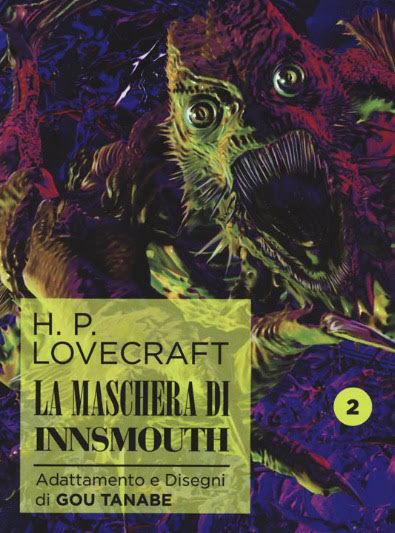
Gou Tanabe’s 2020 “Innsmouth” graphic novel is now available in Italian translation, in a two-volume set. In terms of size it’s a real graphic-novel, being presented as two slabs totalling 480 pages…

Despite the size it’s rather amazingly listed at only 15 euros for the box-set, by the Italian blurbs. I’m not sure how they can produce it at that price, unless perhaps the Italians have a different sort of euro. Perhaps there’s a huge market for such things in Italy and/or it’s very cheaply manga-style printed in Japan and then shipped to Italy on a very slow tramp freighter? Or perhaps the market has over-corrected, and the fabled paper shortage has now turned into a glut?

Anyway, no sign of it in English. Dark Horse have the English translation rights, and I had guessed at a Halloween 2022 release date for that. But no sign of it yet on the Dark Horse site.

A history and critical analysis of Blake’s 7

Possibly useful for my future reference, once I get around to finishing my stop-start Doctor Who re-watch, is the 1990 MacFarland book A history and critical analysis of Blake’s 7, the 1978-1981 British television space adventure. Newly found on Archive.org, to borrow. It appears to have just about everything you might want to know about the much-loved Blake’s 7 TV series, including episode synopses.

I also spotted the more fannish guide-book Maximum power! : the complete unauthorised guide to all 64 episodes of Blake’s 7 (2nd edition). Which has details of some of the more obscure spin-off items…

Warning of wobbly cardboard stage-sets and rubber-suit monsters: 1970s British sci-fi TV series are not for everyone, and are something of an acquired taste.

Literary Catcast

The Literary Catcast, a podcast about cats in literature.

Also a Rhode Island PBS Weekly programme which featured a short H.P. Lovecraft slot for Halloween 2022, and apparently it was their second such look. Online, at present. Only a couple of minutes, in a ten-minute programme rather more interested in witches and gory axe-murders.

Of the two, I think the Literary Catcast might be the better choice.

Call: The Lovecrafter requires assistants and contributors

Assistants are wanted for the German magazine The Lovecrafter. This is produced by and for the German Lovecraft Society, and their annual double-issue has just appeared. They are now gearing up for 2023. Obviously, good German would be required…

The Lovecrafter has been the official club magazine of the German Lovecraft Society since 2016. It provides the club members with information on the topics of weird fiction, cosmic horror, fantastic literature with a cthulhoid focus and other literary Yog-Sothothery. A double edition is currently published once a year. In addition, the Lovecrafter regularly publishes scenarios and NPC profiles for the role-playing game FHTAGN, and keeps an eye on any developments and releases that might interest RPG gamers. We are looking for backup!

No pay, but there are “expense allowances” available. Especially wanted are…

committed authors, proofreaders and editors … In addition, we are looking for layout artists, and people in general who are or would like to be familiar with the craft of journalism (including testing for readability, print and paper quality, etc).

It also looks like now would be about the right time to offer a German-language item as a contributor for the 2023 issue. The magazine’s 2023 double-issue themes are “Lovecraft as a poet” and “Robert E. Howard”.

Spellbound and Vuzz reprints

British readers of a certain age may be interested in a new digital reprint of Spellbound, which in the mid 1970s was a popular spooky supernatural-mystery weekly comic for girls. Spellbound Volume One is available now. This collects the vintage serial “I Don’t Want to be a Witch”, and pairs it with selected vintage one-off strips. There are also four modern one-off takes on the Spellbound formula, bundled in a 116-page volume. But note that back then a page of a British weekly could contain the equivalent in panels of three pages in a modern padded-out comic.

Also from the 1970s, Philippe Druillet’s Vuzz collected as a new oversized hardback, albeit of 72 pages.

Lovecraft on a Comet

A post title like ‘Lovecraft on a Comet’ might seem a nice co-incidence for Bonfire/Fireworks Night. Though here the Comet in question is a train, and not a blazing hunk of ice hurtling through the cosmos.

Many will recall that Lovecraft had a lifelong love of railway trains. This was not only confined to his youth, when he appears to have read the entire run of Railroad man’s Magazine, made scale-model tracks in the old carriage-house, then taken solo journeys in middle-childhood, and even published his own The Railroad Review ‘zine for family and friends (1901, one issue known) — complete with long humorous verse, perhaps his first really successful original narrative for an audience.

Some of his most enjoyable travels were had by train carriage and railway station, especially when fine landscape views were streaming past his window. Sometimes, an alternative view of a place gave him a completely different and more favourable impression, as when an unfamiliar rail route once took him into his friend Morton’s mundane New Jersey town. He also enjoyed the arrivals and departures, such as riding into New York City above the sidewalks on the famous ‘Elevated’, or departing the city for his honeymoon from the mighty gothic/classical Pennsylvania Station.

But what of Providence? We have a few wide pictures of the city station frontage, but what about behind the frontage in the last years of the great Age of Steam? I’ve found this vintage 1932 picture which gives a feel for the sort of mighty steam trains to be found there, on which Lovecraft would have departed and entered his city. Here the train is about to head westward and so presumably reach New York City. With thanks to the Providence Public Library. I’ve here colourised their scan of the picture.

[the pronunciation of ‘Cthulhu’] “is more like the sound a man makes when he tries to imitate a steam-whistle…” (Lovecraft).

Late in his life Lovecraft also managed to get aboard a new Providence ‘super-train’ for a guided tour, when the train first arrived in his city. This was a new super-streamlined tubular-aluminium and air-conditioned diesel train named The Comet

Early artist’s impression of what the new train might look like.

The service in operation.

Sadly I can’t re-find Lovecraft’s account of the tour he was given, but I recall it filled at least a long paragraph or so. It’s in the published Letters somewhere, probably given to one of his younger correspondents. April/May 1935 appears to be the target date, judging by press photos and news coverage at that time. But I can find nothing in the Bloch or Rimel letters.

Apparently the design was a one-off and it was the only train ever designed by Zeppelin in Germany. Some in the press billed it as a “rail-Zeppelin”. In those pre-war days the Germans and Americans could work on such joint projects. Lovecraft no doubt approved of the Teutonic styling, with the train-ends rather resembling Wagnerian helmets. The Comet went into service in June 1935 on the Providence to Boston (South Station) run, making the run in 44 minutes including a stop at Back Bay in Boston. The train was double-ended for a quick turnaround at its destinations. The livery was “blue, silver, and white”, and was very plush inside for its 160 passengers. It was a great success, and proved itself totally reliable during the following 1935/36 New England winter.

Such a ‘new’ train must have seemed a remarkable change from the grimy and older steam-trains Lovecraft was used to, and quite a harbinger of the future. Steam-trains may have their charms. You could slide down the carriage windows for fresh air, for one, and passengers were not sealed in a “pre-paid suffocation chamber” (as Lovecraft once termed air-sealed public-transport). But they were also heavy and noisy, and one might encounter soots and smoke as one boarded.

I don’t know if he ever actually travelled to Boston on The Comet. He preferred a more leisurely landscape view from his train windows, and even a one-way ticket may have been deemed an expensive extravagance. He did visit the Boston area to see Cole and his family, from 3rd-5th May 1935, as he notes for several correspondents (e.g. Rimel letters, p. 273), and did so again some time later. But he would surely have mentioned it to them if he had ridden on the new Comet to reach Boston.