A side view of College St.

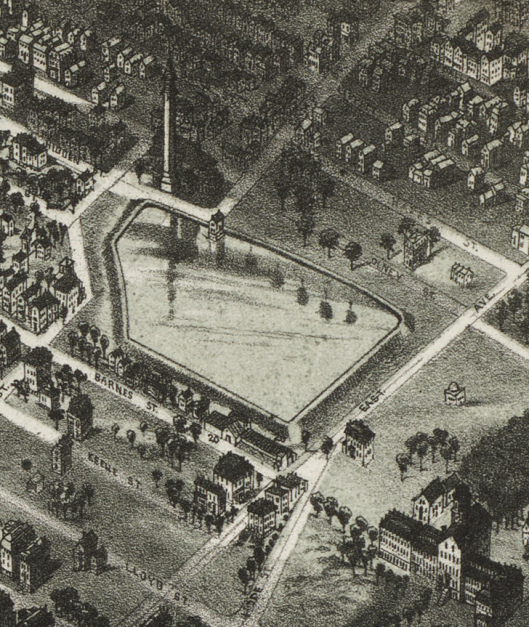
A side view of College St. Seen as part of a rare wide view of the Providence Athenaeum building, which offers an evocative side-glimpse of a spot half-way up the College Street Lovecraft knew so well. The perhaps c. 1900 card is here newly rectified, shadow-lifted and re-colourised.

Here we see the spot marked on the 1918 Plat Book map, with Lovecraft’s last home as the other highlighted spot.

A 1958 record-picture made on a glass plate shows much more detail, though is of course more than two decades after Lovecraft’s time and there’s been some overgrowth of the view. Still, one can see the John Hay Library behind the trees. Again, newly colorised.

Lovecraftian Mythos writers might wish to note the mysterious side-tunnel that this large image reveals…

The Athenaeum claims a connection with Poe dating to 1848, when he “is said” to have met many times with Mrs. Whitman in such alcoves and nooks as the library could provide. Lovecraft adds that Poe “wrote his name at the bottom of one of his unsigned poems in a magazine” there. Thus Lovecraft sometimes included it on his whistle-stop tour of Providence for visitors, though I’m uncertain if that would have involved entrance and browsing or just exterior architectural appreciation. I know of nothing to suggest Lovecraft ever had a subscription or ticket to this private library, though some in the circle of his aunts did (e.g. the lady who catalogued Lovecraft’s library at his death). He used the city’s main Public Library all his life, for free, and also had a stacks card there. Though, late in his life, a letter reveals that he went to The Athenaeum to consult some scarce books on the history of the defunct Nantucket whaling industry.

The Twentieth Century British Supernatural Novel (1958)

New on Archive.org to borrow, The Twentieth Century British Supernatural Novel (1958). Includes an early positive appreciation of Tolkien as a supernatural writer. And by someone who had actually read The Lord of the Rings (most critics of the time didn’t, something which is obvious from their reviews and comments). The text also has some discussion of Lovecraft.

Time Machine

Another day, another image-gen AI. MyHeritage’s existing Deep Nostalgia (subtly animates your vintage faces) has been joined by a new AI at MyHeritage. Reportedly based on a blend of Stable Diffusion & Google’s as yet unreleased DreamBooth.

AI Time Machine appears to be available now, and can blend your ancestor picture (or even you) into a historical figure. Thus taking your ‘family snapshots’ even further back in time, albeit with the risk of polluting existing memories.

I’m not a MyHeritage subscriber so can’t try it. But there’s a video demo here. No doubt we’ll soon be seeing Lovecraft as a Roman senator, Nordic warrior or an 18th century London coffee-house patron.

Black Friday

A few Black Friday sale items I’ve noticed, of possible interest to Tentaclii readers. All rather modest savings so far. No ‘80% off’ door-busters, as yet.

Blambot has 30% off of their comic-book lettering fonts, by using coupon-code CYBERWEEK at the checkout. Expires 4th December 2022. Some horror fonts and vintage 1950s EC comics type fonts. They also have vintage ad fonts, suitable for recreating old ads and poster for RPGs.

25% off a one-time perpetual licence for the QuarkXpress DTP desktop software. Don’t judge it by the bad reputation it had back in 2002. It’s now worth considering if you need a full DTP desktop software, and (unlike Adobe’s InDesign) it doesn’t require an expensive plugin to export to HTML5.

A modest 25% off Gigapixel AI, the best desktop image up-scaler. Apparently still available as a standalone, for now. They had announced that it would only be available in a bundle with their other AI software.

Modest discounts on DxO ViewPoint 4. If you visit places and make or have a lot of pictures of buildings or rooms, this ‘partly automatic’ desktop software straightens the curved/wonky verticals and horizontals. Used to be very cheap, a couple of years ago. Now more expensive.

No discounts yet on PDF Index Generator, DocFetcher Pro, JitBit Macro Recorder, Scrivener 3, Booksorber. CQuill Writer is 30% off all year round, so doesn’t really count.

As with all software, try before you buy, to check your OS can run it and if you like the user interface. Some software, such as Serif’s Affinity Publisher DTP software, have squinty deal-breaker UIs. Others won’t run on old OSs. AI software may require a certain grade of graphics card.

Caerdroia

Wormwoodiana looks at ‘Mazes and Labyrinths’…

There may well still be lost turf maze sites still to be discovered, using detailed place-name evidence or possibly local traditions: I came across one by chance a while ago in a church guide.

… and there’s the potential for newly-created ones, I imagine. One can of course make a temporary ‘summer maze’ of simple mown grass, which may better suit the hand-wringing nay-sayers on the Parish Council. But a more permanent turf-sod maze can’t be too difficult to make once you have a few tons of thick sods delivered to the land. Some drainage pipes too. Since, as Shakespeare pointed out, anything built as channels-in-turf is liable to gather muddy water in our British climate…

The nine-men’s-morris is filled up with mud,
And the quaint mazes in the wanton green,
For lack of tread, are undistinguishable.

The Wormwoodiana article usefully makes me aware of the Caerdroia journal, a long-running scholarly journal dedicated to the topic of mazes and their cultural uses. Possibly a home for your prospective article discussing notable pulp / early-SF mazes, such as the Lovecraft/Sterling story “In the Walls of Eryx”?

The Caerdroia Archive has a range of free public PDFs. Such as “Arthur Machen and the Maze Theme” (1991), which may interest some Tentaclii readers. Also out-of-print 2003-17 back-issues as free .PDFs. I’ve added the indexing URL to JURN and the .PDFs can now be found via my JURN search-engine.

Twitty fun

Surprisingly true. All-but useless for news / opportunities gathering, but fun to scroll really fast through for 30 minutes a day on a desktop PC, with images blocked. That assumes, of course, you know how to ‘follow’ someone while also blocking their daily tidal-wave of re-tweets. And that your feed has settled down, discarding the stupid mini-feeds ‘suggested topic’ (Soccer, Wrestling, Boxing and other manly grunt-fests). Why are suggestion-bots so dumb? All of them, all the time. Fix that, Elon and you’ll be a rich man. Oh, wait…

Brooklyn and the world (1983)

Here’s a curiosity, newly on Archive.org, Brooklyn and the world (1983). An anthology with literary autobiography and memoirs about Brooklyn, and at the back a comprehensive annotated bibliography including film. Though the short stories set in Brooklyn are not annotated, and nor do we get a list of them by first date of publication. Lovecraft is thus consigned to “1965” via an Arkham House edition, though I’m fairly sure that Lovecraft was the first to enshrine Red Hook in memorable fiction.

Lovecraft in Estonian

Lovecraft now available in Estonian

The Viking publishing house published the “The Call of Cthulhu” and other stories in Estonian five years ago, in an award-winning translation. This newest [Nov 2022] translated collection builds on that and continues readers’ journeys through Lovecraft’s landscapes, principally in and around the fictional Massachusetts town of Arkham and the Miskatonic river. Though also taking the reader on trips to other worlds, alien dimensions and distant planets.

Lovecraft was right, part 459

There’s a small error on a point of economic history, found in the most recent episode of the podcast Voluminous. This is re: Lovecraft’s 1930 forecast that…

The workman’s place in this ultimate order [i.e. he seems to imply the emerging form of advanced technological capitalism] will not be at all bad, and may conceivably be so good — with so much leisure — that it will help to solve the problem of the impecunious man of cultivation.”

In the podcast this is said to be wrong. Based on the assumption, presumably, that nothing much has changed for a “workman” since Marx first peered through the grimy windows of an early Lancastrian cotton-mill.

Yet, as usual, Lovecraft was right. In the year he was born, the average U.S. adult worked a week of 61 hours. For a factory worker or farm-hand it could often be 100 hours. By 2021 the average U.S. full-time working week was down to 38.7 hours. The well-documented post-war boom in leisure-time happened, just as Lovecraft predicted. For adults the reduced hours were largely the result of employers competing for skilled labour, allied with their capital investment in machines and better productivity.

Lovecraft’s “problem of the impecunious man of cultivation” has also been somewhat solved, at least for cheese-paring bachelors, by another relatively new phenomenon. The rise of part-time but regular jobs — giving earnings on which it is possible to live something of a writer’s life. Many labour-saving devices (fast-boil kettles, etc) services (food delivery, fast-food etc) and tools (word-processors, Internet research etc) make such a life more viable by freeing up a few more hours. Not only do we have more leisure hours to spare, but we can do more with them (so long as we choose not to waste 24 hours a week being zombified by TV). We also have far more choice.

Such 20th century change looks even better if you work out the ‘disposable percentage of a lifetime’ spent at work, given that our lifespans have greatly increased since the time of Lovecraft’s parents. We now spend only around 10-20 percent of our entire waking lives at work, depending on how you calculate such things (amount of time spent in education, % of each day spent in the workplace, actual life-span, age of retirement etc). One can also add that for most people the age 67-82 (15 years) period of retirement is now a far more healthy and active part of one’s life than it was in Lovecraft’s time. 75% of those aged 65-74 in the U.S. have no disabilities at all.

“Industry, highly mechanised, demanded but little time from each citizen; and the abundant leisure was filled with intellectual and aesthetic activities of various sorts” (The Shadow out of Time)

Lovecraft may yet be proved right twice over. Once we get through the current bumpiness then the world will be at least 350-450% richer by 2099, according to the best U.N. forecasts. With a consequent rise in leisure time and opportunities. That may even entail the rise of a sort of ‘aristocracy of the cultured’ that Lovecraft envisaged for a future leisure society.