“… the flickering of the monstrous lights”

Entry dates and full rules for the H.P. Lovecraft Film Festival, now available.

No “romantic comedies”, I see. They’re banned. Aww. Lovecraft wrote at least one of those (“Sweet Ermengarde”). But it seems the gore-loving masses must be forever deprived of a hilarious makeover for his “Ermengarde”. Imagine a tentacle-filled moustache-twirling Perils of Pauline silent-movie -style big-screen romp.

Anyway, the deadlines are now available:

August 2023 (Providence): 30th May 2023.

October 2023 (Portland): 1st August 2023.

Rodell D. Sanford Jr.

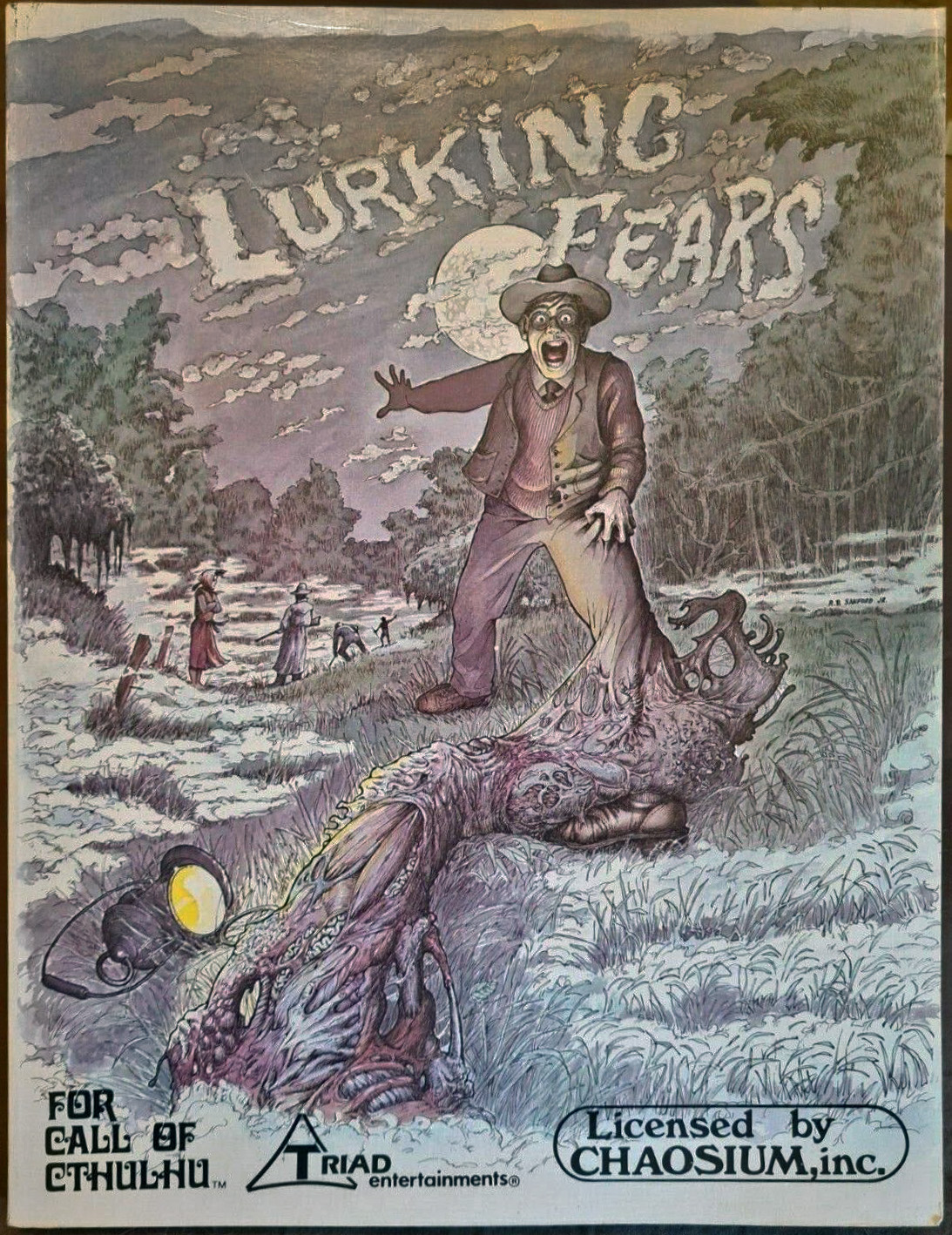
Via eBay, some real non-AI illustration. Here de-curved and colour-cast corrected (to the extent that’s possible without damaging the picture’s night-time mood). Not also up-scaled. Artwork by Rodell D. Sanford Jr., for what appears to be the first edition of Chaosium’s Lurking Fears RPG adventure anthology (inc. a Florida adventure, which it’s possible the cover depicts).

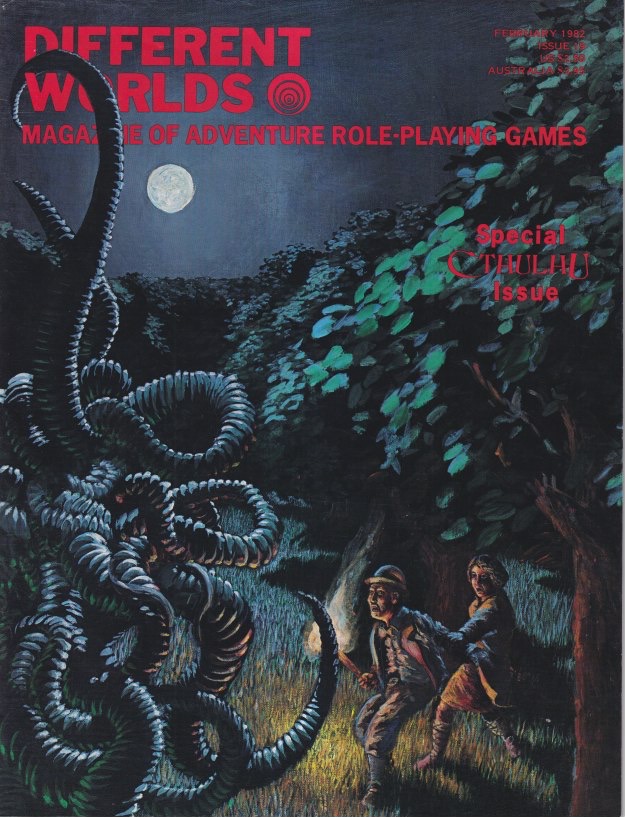
And another, from 1982, a painting but looking like it’s from the same artist…

Inked

I had another play with AI image generation, this time tempted by the new “Ink v2” style-module at the mostly-free Dream by Wombo…

A bit closer to Lovecraft this time, rather than Nick Cage or 1920 silent movie-star Buster Keaton. Although a bit stiff and too much of a ‘the butler bid it’ feel, perhaps. That’s the problem with AI, the faces and heads often have a touch of the showroom dummy about them. But feel free to use this for your Lovecraftian projects, fanzines, blog posts debating AI, etc.

Howard Days 2023

The Silver Key has posted a long recap of the 2023 Robert E. Howard Days which have just successfully finished for this year. Also a “Howard Days Wrap Up” at the Rogues in the House podcast.

SpraguedeCampFan ran day-by-day posts, and his final one “Time to Come Home” has links to all the previous posts. There are abundant clear photographs.

Plus Savage journal entry #41 reports on a trip to Howard Days 2023, with photos.

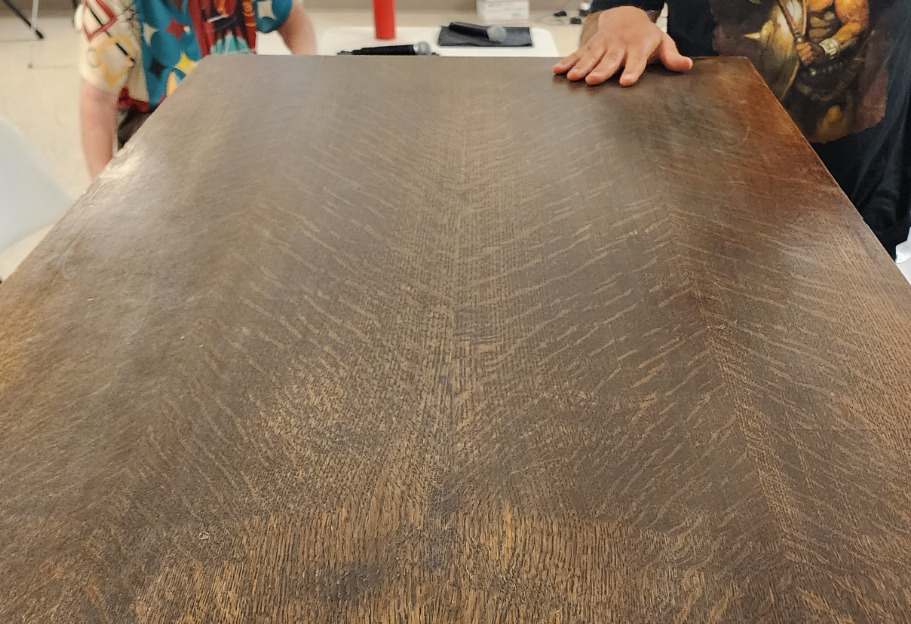
The R.E. Howard Foundation has a post on “The journey of REH’s writing table: a piece of literary history”, on Howard’s lovingly restored writing table. This was a feature of this year’s Howard Days.

Wild Stars also has a set of pictures.

There was coverage in the local Brookhaven Courier, “Museum celebrates author Robert E. Howard”.

The Robert E. Howard Days: 2023 Events Schedule. No YouTube, podcast or audio files as yet, that I can find. I seem to recall that in previous years, the panel recordings surfaced online in due course.

Also in REH, and available along with the new affordable Collected Letters at Howard Days, I see we have a new edition of The Dark Man scholarly journal. ‘New’ since I last noticed it. Issue 13.1, January 2023 includes what appears to be a substantial survey of Conan’s predecessors. The issue is also interesting re: the editors being open to an essay on Tolkien.

I would assume that we’re moving toward the time of year when potential contributors for January 2024 should be thinking about what they might submit in the late summer?


Coming next, PulpFest 2023.

Forthcoming: Midnight Rambles: H.P. Lovecraft in Gotham

David J. Goodwin’s ‘Lovecraft in New York’ book has a title and a date. According to Amazon UK, Midnight Rambles: H.P. Lovecraft in Gotham will appear in Kindle and hardback on 7th November 2023, and is billed as a 272-page…

chronological micro-biography of Lovecraft’s New York years emphasizing Lovecraft’s exploration of the city environment, the greater metropolitan region, and other locales and how they molded him as a writer and as an individual.

I’ll no doubt be reviewing it when I get a copy, probably in the company of the other 2023-expected book on Lovecraft in Florida.

Also of possible interest, and to be published in the same month, A Lovecraftian Biography of H.P. Lovecraft by Osvaldo Felipe Amorarte. Billed as biography of “Lovecraft’s private life and, using his own writing style and atmosphere” to convey his “relationships, illnesses, disillusions and his own fear of the unknown”. Although it looks like it might be a work assisted by a ChatGTP-type AI re-writer, judging by the descriptions of the author’s previous books.

Still, it’s an interesting idea. Tell of Lovecraft’s life, with factual accuracy, but in a series of linked stories written in his own style. Writing convincingly with Lovecraft’s style and language is easier said than done, of course. But who knows what style-morphing wonders AIs may yet unfold?

Tentaclii in May

Well it’s 1st May, and our Great and Glorious Charlie III has still unaccountably failed to send me an invite to his Coronation bash in London. Oh well. I’m just glad to say that Tentaclii has survived another bout with Covid and another Stoke-on-Trent winter, and that with the heater off for all but a few days of the coldest weather. I always knew there was a good use for that tin-foil hat. It keeps the heat in, as well as warding off the emanations from R’lyeh.

This month my ‘Pictures Postal’ posts looked at: the Moses Brown School in Providence which briefly features in Lovecraft’s Dexter Ward; Lovecraft’s own gravestone (and along the way I found a new vintage view of his bit of the Seekonk River); then a sale listing for a 1975 “MinnConn” paper flyer led me to the sea-cliffs of Magnolia and a newly-expanded picture of Lovecraft; and to the John Carter Brown Library, where I was rather pleased to find Cthulhu lurking on the doorstep. There you are, you see… even the most apparently mundane ‘Picture Postals’ posts can sometimes discover monsters.

Talking of monsters, in an out-of-band ‘picture post’ I was also pleased to find that Lovecraft’s dad’s Gorham Co. silver factory produced stylised silver toads. Indeed, an item which would not look out of place in an Innsmouth museum. Really. This find was due to my perusing the online holdings of the Smithsonian, a rich resource now standing at 4.5 million images. More such Smithsonian finds are coming next week on Tentaclii.

Adding to my own scholarly musings, I posted another of my occasional “Notes on The Conservative” series. In which I combed through Lovecraft’s issue for October 1915. It was interesting to note how closely the world of a 1915 Conservative issue maps onto today’s world. So far as I know I’m the first to translate the heading quotations used in The Conservative. In other scholarly work, I’m about to start reading the Lovecraft Annual 2022 for a summer 2023 review.

I was pleased to find that Lovecraft was correct in surmising there were giant above-ground fungi in the Palaeozoic (“The Shadow out of Time”), as has now been proven by the latest science. The ‘Vikings in North America’ debate, which stretches back to Lovecraft’s time, has also finally been put to rest with an apparently incontrovertible new wood-source analysis. The Vikings were there, and the ‘cranks’ were right. Although, probably not right about Vikings being present so far south as Lovecraft’s own coastal stomping grounds. The climate was a lot warmer back then, and there was no need for them to venture that far south for timber.

Talking of dead trees, it was a ‘no show’ month for new Lovecraft books or journals this month. But a new hardback edition of The Spirit of Revision: Lovecraft’s Letters to Zealia Brown Reed Bishop is due later in May. In new book formats, I spotted that Ken Faig’s Lovecraftian People and Places (April 2022) now has a Kindle ebook edition. In journal articles I noted an interesting new French study of the various posthumous diagnoses Lovecraft had received from armchair psychoanalysts. Sadly it’s behind a paywall.

Another book Lovecraft enjoyed has turned up on Archive.org, The Story of Saxon and Norman Britain Told in Pictures (1935). Intellectual Vagabondage (1925) is also a fascinating and brisk layman’s survey of Lovecraft’s intellectual hinterland, sans Lovecraft himself. It’s also new and free on Archive.org.

Talking of bargain books, I see all the great Amazon Warehouse sub-£10 deals have dried up for books of Lovecraft’s letters. I’m guessing that Lightning Source, the POD printer for these books, has switched to a new post-Covid printer. One that is more efficient, and thus makes no ‘slightly damaged’ books. The volumes of Letters I want are all up around £30+ these days. There’s still no sign of the new Long letters arriving on the public-facing Brown University repository.

In crowdfunders, congratulations to both the Lovecraft Arts & Sciences and to the team for the new REH / HPL letters translation into French. They both struck gold this month with their funding calls.

Nothing much in audio this month, but I was pleased to find a 70-minute public-domain audio reading of “The Call from Beyond” by Clifford D. Simak. This being Simak’s SF sort-of tribute to Lovecraft. Not a great tale, but interesting to see one master creatively responding to the ideas of another.

In music, there was just the release of Music from the H.P. Lovecraft Literary Podcast – Volume Three (2023).

On the big screen, news of a new Lovecraft movie A Suitable Flesh seems to be getting horror-movie fans excited. This will premiere at the Tribeca Film Festival in June 2023. Based on Lovecraft’s “The Thing on The Doorstep”, according to the up-and-coming director. Over on the theatre stage, the stage-play “Lovecraft, mon amour” had another three new performances in France.

Nothing in comics, but the concluding issue of the big Kadath adaptation is imminent if not already released. The collected trade-paperback volume lands in a few weeks, as Unknown Kadath. Ignore the “Volume One” label on this. It’s just an annoying comics-trade naming convention, one that is very off-putting to readers who just want a competed tale in one volume.

In the visual arts, I’ve been playing around with AI art and text generators. Only the free ones, since I can’t afford monthly subscriptions. And I’m not showing too many of the results here, as I know it annoys some people. But it’s important to keep up with such things, as they’re here to stay now and AI will only get better and faster. We may even resurrect Lovecraft via AI, in a few years. I’ve suggested a panel discussion on that for the next NecronomiCon convention…

Should we resurrect Lovecraft? H.P. Lovecraft as the ideal candidate for a near-complete AI-powered personality and memory resurrection.

On the back of this new interest Tentaclii had a new “AI” post tag, to collect any AI-related posts in one place. This even includes my own ‘AI Lovecraft’ story from way back in 2011. If you want more on accessible and free AI image-making, go here. Yes, all the artists in the new-on-Archive.org Science Fiction And Fantasy Artists Of The Twentieth Century: A Biographical Dictionary would surely frown and tut, I know. But like I said, it’s in the wild and here to stay — whatever the EU says. We may as well roll with it.

I still hope to release a new voluntary-work issue of Digital Art Live for the community by the high summer, though it will necessarily have a new name. It will probably be somewhat AI focused. Suggestions for email interviews are welcomed, as are books and other products you’d like to see blurbed in the ‘Imaginarium’ section.

Over in the land of the Tolkien scholars, I released the third issue of my free Tolkien Gleanings PDF ‘zine. The fourth is now well underway and it’s looking like another 48-pages. The reviews slot is currently empty. Surprisingly I don’t actually have a lot left that I want to read and haven’t yet read. Tolkien Dogmatics; The Road Goes Ever On and On; and The Gallant Edith Bratt (still languishing in a £10 paperback) and that’s about it… other than various ‘unobtainable’ old journal articles and the last two paywalled “The Year’s Work in Tolkien” articles in the journal Tolkien Studies. The nice things about Tolkien studies is there are no swathes of expensively out-of-reach volumes, and only one volume of the Letters.

That’s it for this month. As always, Patreon donations, Amazon vouchers, and offers of regular paid work are always welcome please.

“The Face in the Abyss”

New on Librivox, a free reading of “The Face in the Abyss” by Abraham Merritt.

The work was listed as in Lovecraft’s library. An article in the first issue of the Lovecraft Annual made a comparison with Lovecraft’s “The Mound”. This was “They Have Conquered Dream”: A. Merritt’s “The Face in the Abyss” and H.P. Lovecraft’s “The Mound”.

A 1934 reader’s letter explains some of the story’s convoluted history…

Project Gutenberg also has… “First published in Argosy All-Story Magazine, September 8, 1923. A sequel (“The Snake Mother”) was serialized in Argosy, October 25 ff, 1930. Science-fiction, the Early Years remarks “considerably abridged and rewritten for the book version”, before summarising from the magazine version. Encyclopedia of Fantasy and Horror Fiction adds that the magazine version was itself “based on earlier, shorter pieces”. So obviously it has a very complex textual and publication history. Which makes it unfortunate that Librivox doesn’t list at least the date of the source-text being used for its audio readings.

Intellectual Vagabondage (1925)

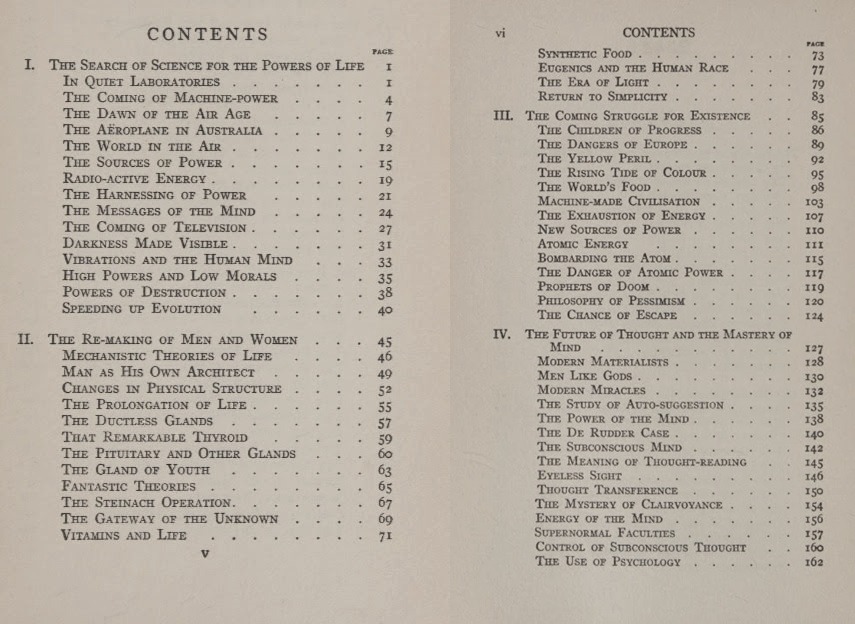
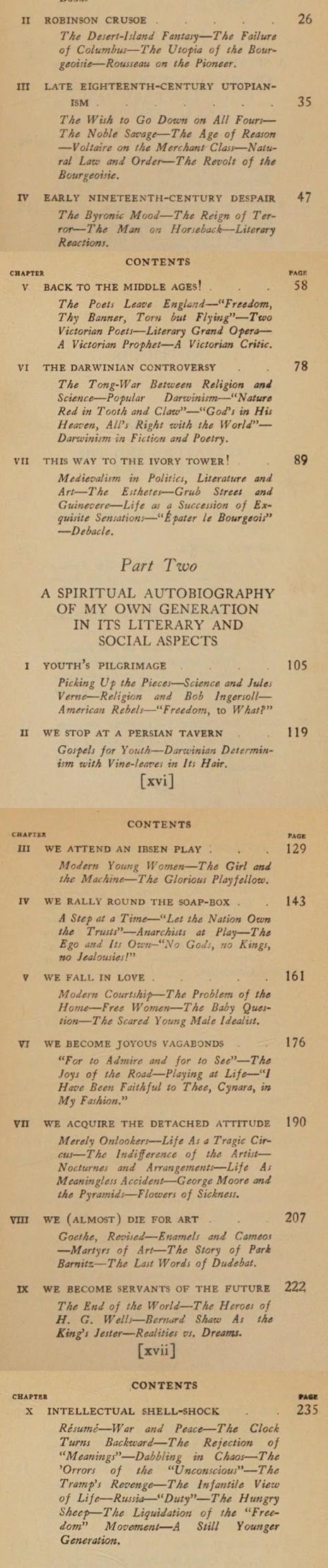
New on Archive.org, a useful layman’s survey of the intellectual landscape in which Lovecraft has steeped himself and was living through until the mid 1920s, with particular focus on American reception (or not) of such ideas and trends. Intellectual Vagabondage: an apology for the intelligentsia (1925) has an off-putting title, sounding now like some dour treatise against Marxism. But instead we find a crisp and accessible survey, written by one with ‘boots on the ground’ at the time, as can be seen here by the contents list…

Lovecraft was right, part 583

“Mystery prehistoric fossil verified as giant fungus”. 18 to 26 foot high, possibly higher when ‘flowering’ to shed spores. So far as we know Prototaxites did not have the ‘mushroom caps’ that they have today. Just the ‘stalks’.

Picture: “Pioneers of the land” by Plioart on DeviantArt.

I also note… “A new Palaeozoic plant closely allied to Prototaxites”, identified in Nature Geoscience in 2012… “It differs from Prototaxites only in its possession of internally differentially thickened tubes.” One must now assume that these were also fungi.

Therefore, Lovecraft’s depiction of towering and gigantic fungi in the “Palaeozoic” period of Earth’s prehistory now seems somewhat prescient…

The omnipresent gardens were almost terrifying in their strangeness, with bizarre and unfamiliar forms of vegetation nodding over broad paths lined with curiously carven monoliths. Abnormally vast fern-like growths predominated; some green, and some of a ghastly, fungoid pallor. […] Fungi of inconceivable size, outlines, and colours speckled the scene in patterns bespeaking some unknown but well-established horticultural tradition.” (“The Shadow out of Time”)

He doesn’t pin down what these inconceivably giant fungi looked like and, in his focus on giant fern forests later in the tale, he stays within the then-consensus of science until 1906. After 1906 the consensus rapidly breaks down as seed-bearing fossil plants are discovered. There were still giant fern forests, but they are no longer thought to have dominated the land.

But we do get the clear idea, early on in Lovecraft’s tale, that this is a Palaeozoic world where there are also gigantic fungi. Also that some of what he thinks of as distant ferns (“fern-like”) may in fact be fungi (“some of a ghastly, fungoid pallor”).

Gigantic fungi were sometimes known in 1930s science fiction, though also known far earlier in time by the Lovecraft Circle. A remark by Lovecraft shows that many in the Circle knew the illustrated fantasy book Etidorhpa (1895) by John Uri Lloyd…

that strange old novel “Etidorhpa” once pass’d around our Kleicomolo circle and perus’d with such varying reactions

Illustrations for ‘Etidorhpa’ (1895).

They would also have known Verne’s Journey to the Centre of the Earth (1864), in which the shores of the Central Sea harbour a forest of giant mushrooms. Also the fungi landscapes of the H.G. Wells novel The First Men in the Moon (1901).

But was Lovecraft ahead of science on placing giant fungi both in the distant prehistoric past and living above-ground? It seems so. The 1911 Britannica passage on Palaeozoic | Fungi give the strong impression they were small or microscopic, and elsewhere has… “The few and incomplete data which we at present possess as to Palaeozoic Fungi do not as yet justify any inferences as to the evolution of these plants”. So far as I can tell from some searches, nothing much changes in the science for many decades thereafter.

John Carter Brown Library

This week on ‘Picture Postals from Lovecraft’, a very fine glass-plate view of the John Carter Brown Library at Brown. This is an “other gate” on the university, the better known one being the Van Wickle Gates near Lovecraft’s last home at No. 66 and at which Lovecraft posed for photos.

No, it’s not a Library of Congress picture. This one came from spotting a stray eBay listing of a discarded print from some picture library. There was no watermark and it was a good scan at 1600px. I’ve here colourised, cleaned and enlarged x2.

I’d previously spotted that an ironwork Cthulhu-a-like was recorded in a 1965 book of b&w art-photographs of the Brown campus. This was located outside the John Carter Brown Library, but is not clearly seen on the above picture.

It formed part of the moulding at the foot of the lamp-posts outside the Library, and above we see one of what appears to have been three faces surrounding the base. The new colour picture now adds further context to this discovery. The lamp-posts can be seen, and these face(s) were not right down on the sidewalk/floor where they might be overlooked. Rather, they terminated in the elevated marble stair-posts and would thus have been visible to all who ascended the steps and then passed by. Including one Mr. H.P. Lovecraft.

Their elevation and original situation can also be seen here. That they were topped with ‘Moon’ globes might also have tickled Lovecraft’s fancy…

Book: Science Fiction And Fantasy Artists Of The Twentieth Century

New on Archive.org, with a public PDF download, McFarland’s Science Fiction And Fantasy Artists Of The Twentieth Century: A Biographical Dictionary (2009). This is no longer discoverable on the McFarland catalogue site, and Amazon UK and USA both have it as “out of print, unavailable”. There are no used copies or copies on eBay either. Thus, I think it can justifiably be linked here without harming anyone’s wallet in these difficult times.

It’s a scholarly two-column reference work that was aimed at academic libraries, judging by the original retail price of $135 (probably about $220 in today’s money). There are two introductory survey essays, one to 1975 and another from the 1970s through to the year 2000. The author then crisply details the biographies of nearly 400 selected artists in 500 or so pages, nearly all North American but with some 70 British artists manning the tail-guns. The book doesn’t cover the field of children’s science-fiction, work for the screen, or comics work (Corben is in, Moebius isn’t), and as far as I can tell it has little to say about the art of books native to Russia, Germany or Japan.

The book will also serve as a handy reference guide to collectors of the various artbooks issued by these artists, though there are surely more to be discovered. One hopes that somewhere in the world is a collector with the whole 20th century caboodle of these artbooks in mint condition, and that he’ll leave them all to the Smithsonian National Air and Space Museum or suchlike.

I wonder if this PDF freebie book has been released on Archive.org in order to drum up interest for a new updated edition circa 2025? One imagines there would be a market for a greatly expanded two-volume $500 set.