Various new books

Newly listed at the Hippocampus website, the forthcoming books Implications of Infinity: Collected Essays by George Sterling and A Splendid Poison: The Letters of Ambrose Bierce and George Sterling. Both edited by S.T. Joshi and David E. Schultz, and at a pre-publication discount via the publisher.

This reminds me that it’s about the time of year when thoughts might be turning to the key Lovecraft journal, The Lovecraft Annual. In terms of potential contributors starting to polish their submissions, ready to send off to S.T. Joshi.

In other forthcoming books, I see that The Spirit of Revision: Lovecraft’s Letters to Zealia Brown Reed Bishop is being newly listed in hardcover on Amazon UK. This will be an “enhanced second edition” from Helios House Press, having previously been available from the HPLHS (and, at a much higher price, from Amazon). The new edition is set for release on 31st May 2023.

Note that these letters are apparently also in the new Letters to Woodburn Harris and Others volume from Hippocampus.

French translation of the letters of Robert E. Howard and H.P. Lovecraft

In France, the translator of their new Lovecraft editions is interviewed in interview with La Petit Journal. This is free and in HTML, so can be easily translated. The chat brings news of the next project…

Q: Today, a subscription is launched, until 4th May 2023, for the French translation of the correspondence between Robert E. Howard and H.P. Lovecraft. How important is this exchange between the two authors, in terms of a better understand Lovecraft’s work?

A: We see the man at work, and in his exchanges with a friend and fellow author. They talk about literature, publishing, history and politics. It is, in a way, the “behind the scenes” of Lovecraft at work.

Q: What will this new French translation of the letters offer, compared to the original?

A: We have some original documents, but above all we intend to enrich this correspondence with our own critical apparatus. Along with several iconic documents: photos of the authors, of their friends, of the places where they lived, reproductions of their letters, covers of the magazines where they published, etc.

The crowdfunder is at a site I’d not known about, fr.ulule.com, as La correspondance de Robert E. Howard et Howard P. Lovecraft. It’s already been nearly 400%+ funded.

“Lovecraft, mon amour” – three shows for 2023

Three performances of the stage play “Lovecraft, mon amour”, in the French city of Lyon. 28th – 29th April 2023.

A fantastic theatrical and musical biopic, which immerses us musically in America from the 1920s to 1947. The play begins in 1947, Sonia has just learned of the death of Lovecraft, ten years after his death. This news upsets her and provokes a torrent of memories. But she begins to have the strange impression that Howard is actually there with her. As they move from confidence to confidence, these two characters reconstruct the course of their thwarted, extraordinary, overwhelming love… Will Sonia recognise Howard? Is love stronger than death?

The Mould Shade Speaks

Deep Cuts has dug up the horror poem “The Mould Shade Speaks” (1919) by early Lovecraft collaborator Winifred Virginia Jackson.

… very little of Jackson’s poetry has been reprinted, and much of it is uncollected or largely inaccessible for those without access to newspaper archives and obscure and expensive amateur journals, although a selection of poems have been republished in the appendix to Letters to Rheinhart Kleiner and Others.

H.P. Lovecraft Motion Comic

Saturday-morning cartoons? Tentaclii has ’em! Newly uploaded to Archive.org, but made some years ago, a H.P. Lovecraft Motion Comic: The Rats In The Walls (2017). Excellent, even if we don’t get to see comic-book frames. 30 minutes, good narration. Also, it has Spanish subtitles here. Well worth watching.

The same maker also made H.P. Lovecraft Motion Comic: The Call Of Cthulhu (2015), which is on YouTube only.

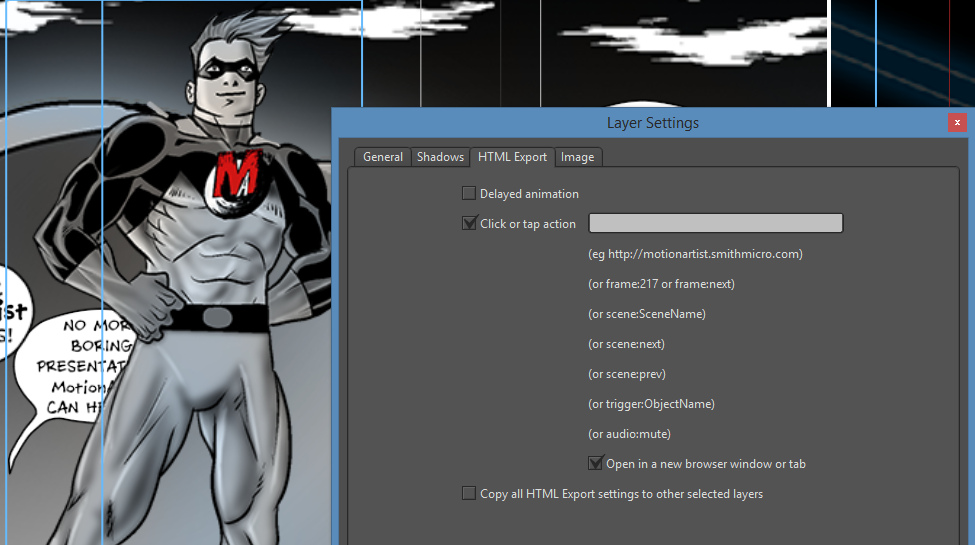
Motion comics? They were partially animated comic-book-like animations made on the desktop PC with Adobe After Effects (not ideal) or (if you do a bit more research on software) with dedicated motion-comics software such as MotionArtist. Sadly they died off, despite portable HTML5 output, partly due to the additional labour needed to make them and partly due to the intensely conventional stance of the bulk of comic-book buyers. Maybe they’ll be revived, now that AI will be able to do some of the heavy lifting re: artwork, and now that comics buyers (different than readers) are a little less averse to ‘digital’.

MotionArtist 1.3, on which development stopped 2017. But it still works and can still be had if you look hard enough. It’s also well-documented and has abundant video tutorials.

A ‘postal’ snap of Lovecraft himself

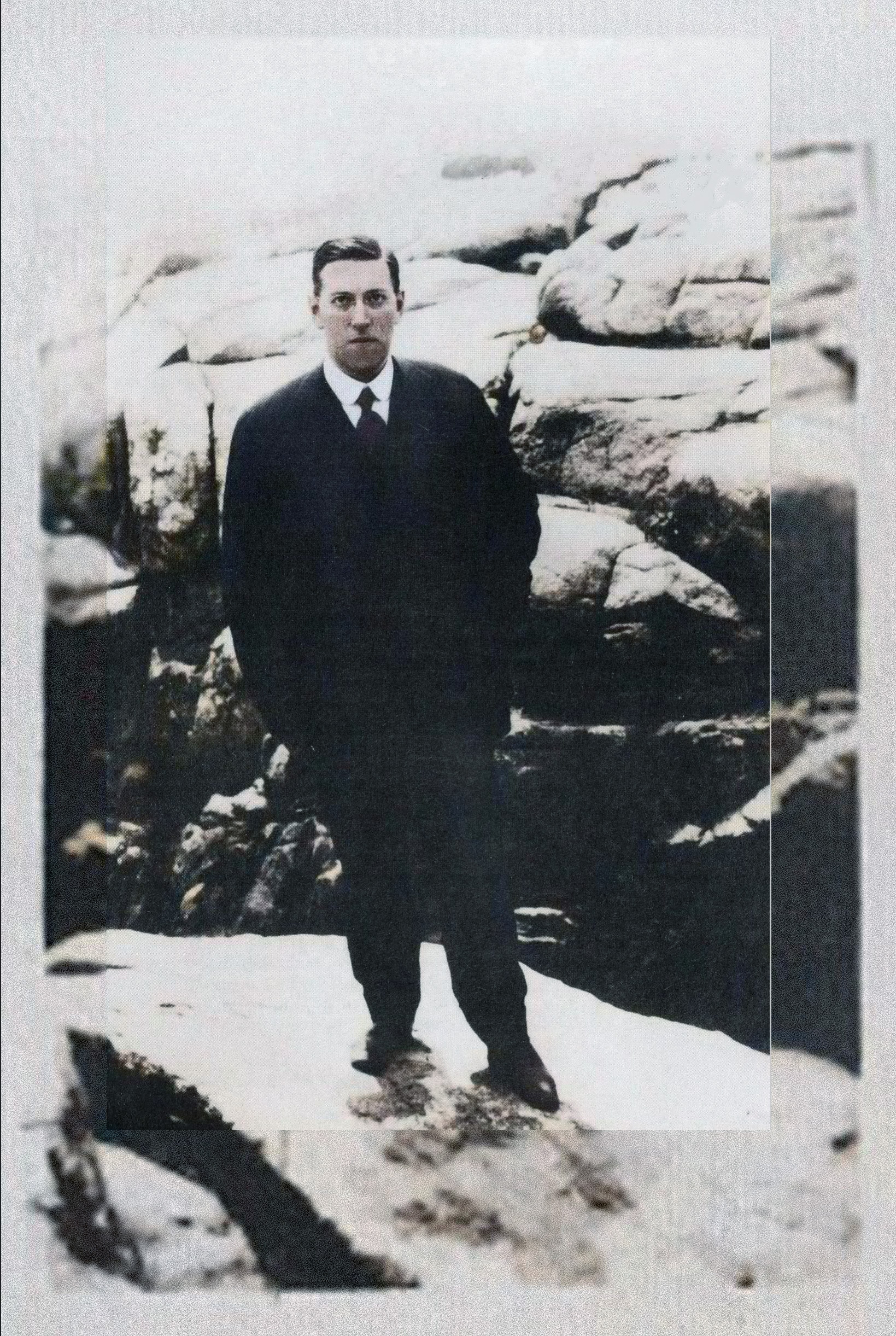
Many thanks to Martin A. for letting me know that Tuesday’s ‘mystery picture’ of Lovecraft was printed in a higher-res form in the anthology Eternal Lovecraft (1998). I’ve here combined this with the thumbnail of the 1975 MiniCon flyer version that was up for sale, to show what was cropped. Mostly the eerie footprints on the rock. It may also indicate that highlights were blown out on later cropped prints. If you view at 100% and look closely at the face, on the left side there may be indication of the facial scarring caused by his ingrowing facial hairs and ‘tweezers trouble’.

H.P. Lovecraft in August 1922, standing on a promontory rock ledge in an ocean cleft at Magnolia, Mass. Most likely to be in “Rafe’s Chasm”.

A ‘picture postal’ that Lovecraft sent, 1927.

“explored the cliffs of Magnolia, overlooking Norman’s Woe, and containing the celebrated Rafe’s Chasm.”

“the striking sea-cliffs of Magnolia — with the yawning abyss of Rafe’s Chasm”

He later compares it very favourably with “The chasm on M’head Neck”, near Marblehead, which might give Mythos fiction writer an interesting lead on a suitable setting for a tale. If it hasn’t been used already.

Here is the back of a postcard from Lovecraft, dated 29th June 1922 and postmarked “Magnolia Station” for the 30th.

Spent this morning on the rocks while pearl-grey mists surged out of the sky to mix with the sea. Over the cliffs one might see only the abyss of milky vapour, as if it were the void beyond the Edge of the World. Will not return …

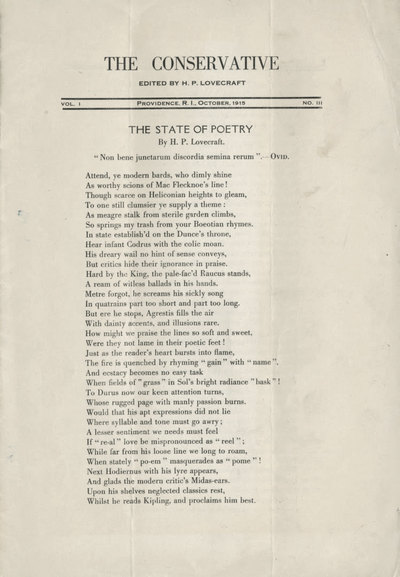
Notes on The Conservative – October 1915

Notes on The Conservative, the amateur journalism paper issued by H.P. Lovecraft from 1915-1923.

Part Three: the October 1915 issue.

Lovecraft has now issued his third issue of his own amateur paper The Conservative. Is it a Halloween ‘horror’ issue? Let’s find out.

He opens with his poem on “The State of Poetry”, headed by a line from Ovid which translates for sense as “Ill-mated things have discordant offspring”. This might seem to some to hint at key themes in his future fiction. The poem ushers forward a series of would-be bards to perform for a king, each bard offering his own form of poetic ineptitude or gross error of topic. One suspects the readers of The Conservative would have been well be able to identify each amateur journalist thus given their turn on the stage. These are sometimes well masked, with names such as “Mundanus”, or even left un-named as mere Whitman-esque “degen’rate swine”.

Note the line of poetry “Ablest is he who in rhyming can reach / The Lofty coarseness of a Cockney speech”, something that Lovecraft had experienced in his own city of Providence at the astronomical Ladd Observatory, in the company of the “affable little cockney from England” John Edwards. Lovecraft ends his verse by suggesting the true poet will do best in chaste seclusion (such as his own, hem hem), restoring ancient times with his imaginative ‘fancy’ and learning much from the lost Golden Ages of creativity such as the England of Shakespeare or Johnson.

His essay “The Allowable Line” naturally follows from the poem. It is headed by another untranslated line from the Roman poet Horace. A line which translates for sense as “On discovering dazzling brilliance, disregard the flaws”. In the essay he continues his debate with Kleiner, begun in the previous issues and continued in correspondence, on the “allowable rhyme”. He tracks this through history, giving a basic outline of its once-common use in English poetry, and then the later emergence of stricter rhyming. In this we also have the sense that Lovecraft has read the work of all those he names, and with due attention. Not that he liked all of them, and for instance he calls Erasmus Darwin’s poetry “pompous”. Though if all he recalled, and hazily so (“Darwin’s ‘Botanick Garden’ … my early reading”) was The Economy of Vegetation, then he may not have realised that the slump in the middle of this book is likely the result of Darwin’s collaborator slotting in her own unheralded verses.

His “Editorial” bites back against the “insulting insects” that have begun to infest his mail-box, and he threatens to publish their letters with “original style, spelling, grammar” in future. The short article “The Conservative and His Critics” naturally follows, headed by more lines from Horace, which can be translated as “It is better, I warn you, not to make me touchy”. Then some short poetic ripostes to politically pro-German lines of wartime verse which had attracted Lovecraft’s special ire.

We then come to the meat of the issue, with the long essay “The Renaissance of Manhood”. Here Lovecraft forensically identifies the types of pacifists who oppose a just and necessary war, and suggests their motivations. One feels he will have more to say on the topic in future. Though as S.T. Joshi has observed, his own attempts at patriotic poetry will fail to rise above mediocrity.

The essay “Liquor and its Friends” reveals that he broadly subscribes at this time to the ‘trickle-down theory’. Those at the top of society must first set an example, “which will then work downwards, as if through gravity”.

His thoughts on “The Youth of Today” follow. He welcomes the postal approach of “schoolboys of today [who] fear not to speak as they think”, and here we learn of how he first encountered his new young protege David H. Whittier.

“Symphony and Stress” appears at first sight to examine another side of amateurdom, in which amateur papers were “the product of a small circle of cultivated ladies”. Yet mid-way he compares this to Lockhart’s anti-rum paper Chain Lightning which vividly recounts “unspeakable evil” among the alcoholics and “horrors utterly beyond the realization” of the sheltered ladies. All drawn from Lockhart’s experiences in his own town. Lovecraft ends by asking the ladies to forbear in their mild criticism of negative-minded “buzzards” in amateurdom. Each has their place, and may do good in their own way.

He briefly lauds some improving amateur papers from youths, and especially notes Basinet’s paper The Rebel. Lovecraft states he knows Basinet personally, but what goes unsaid is that the lad was one of the largely Irish group of Providence amateurs — later to be so ably documented by Ken Faig Jr. Here Lovecraft notes that Basinet has recently switched his leftist beliefs from socialism to anarchism. Dunn, of the same local group, is also noted in the context of discussions of the ever-vexed Irish question. Lovecraft seems to be of the opinion that “Ireland is now an equal and integral part of the British Empire” and thus (presumably) nothing more need be said.

A back-page poem by John Russell titled “Socialism” marks the end of the issue. Russell was a long-distance Lovecraft correspondent (West Tampa, Florida) from 1913 through 1925, encountered via a vehement debate in the pages of The Argosy. This 1915 poem foresees the “stagnant pool” that society would become if a wise man and a fool were to receive the same treatment and income in a vain attempt to enforce a socialist economy. Also the way that socialist leaders, inevitably authoritarian, would start to find underhand ways to “grab the most they could” from the masses.

The Halloween horrors that some Lovecraftians might have been expecting of an October issue are thus… not here. Yet in a way, it is a horror issue of a sort. There are “insulting insects” in Lovecraft’s mail-box; he details some of the very real “unspeakable evil” which emerges from alcoholism; and finally anticipates the looming horrors of socialism — horrors which were to become manifest soon after Trotsky’s Moscow coup in 1917.

Overall one has a strange sense of familiarity with the present day. An ugly mix of high-flying philosophical debate and pro-enemy sympathies during wartime; a hazy vision of socialism which seduces a vocal minority among the young; a mass of hide-bound reactionaries unwilling to adapt to the new modernity; while lone grassroots voices battle for the truth about ruined lives and families in their own town. Also a tendency among creatives toward a complacent withdrawal from it all, into a rose-tinted myopia in which beautiful and well-formed poetry is everything.

Open Assistant.io

Another day, another open source chat AI. We’re up to three now. The new Open Assistant.io is a fully and properly open-source ‘chat’ AI, and only requires a Google login to use for free. At present there’s a Llama 30B model for the public, based on Facebook’s escaped Llama. So perhaps not so good for writing Python code. My initial try timed out… I had no response after ten minutes. But that may be due to heavy initial use. I reloaded and found a message about being in a long queue. Still, it’s a serious and worthy/big attempt to begin a fully open chat AI. As the group’s leader says “we’ll soon have them running on toasters”, rather than closed subscription-only corporate servers in Whereizitagin.

The two other open AIs OpenChatKit (not great) and the FastChat portal to open models (can be very good) had no such problems with the question, which was…

Q:

Explain the possible future uses of AI for the analysis of the letters of H.P. Lovecraft. Do not refer to fiction or stories by Lovecraft.

FastChat using Vicuna 13b had the best response, which I edit and bullet-point here…

A:

* to extract relevant information such as themes, topics, and sentiments;

* to categorize the letters based on their content;

* to identify any recurring motifs;

* to analyze the writing style and evolution over time;

* to analyze the historical context, e.g. references or allusions to historical events, people, or places;

* to develop a model of the cultural and historical context in which Lovecraft was writing;

* to analyze the letters in terms of their literary merit;

* to identify any stylistic or technical elements that are particularly effective or innovative;

So it’s unaware of the concept of a writer’s ‘circle’ and the importance of mapping that. It’s more like a reply by an English Literature student rather than a historian. It’s also unaware of the outlines of Lovecraft’s life, and but it’s aware he was an author who wrote letters and can thus given very generic advice common to any prolific letter writer.

Eventually I reloaded the recalcitrant Open Assistant.io and had an answer to the above question in a reasonable time. It was not as good as FastChat but did offer three items, among a whole lot of blather and boilerplate text about AIs in general…

* to offer deeper insights into Lovecraft’s personality traits, beliefs, moods, interests, etc;

* to establish named entity recognition, for specific details about individuals, locations, events, dates, organizations, products, etc;

* to create entirely new pieces of correspondence.

So here there may be a hint of some awareness of the interaction between the man and his circle, and even that there will be interest in the products he used (the new-fangled invention called ‘ice-cream’ and so on). There’s also what might seem a rather naughty awareness of AI’s future ability to confect new Lovecraft-alike letters. Which implies extraction from the letters of a workable and convincing ‘style model’ and ‘topic web’. And Lovecraft is the ideal candidate, now that the letters are nearly all published. Yes, there are others who are comparable. But what modern kid wants to chat with Voltaire or Cicero?

A few other items which might have been mentioned are (off the top of my head)…

* analysis of letter length and seasonality of contact, re: determining his ‘favourite’ correspondents;

* the identification of common abbreviations or nicknames, and the amalgamation of these with reference to the same person when properly named. Thus “Sonny” would = Long;

* extraction of weather and season data, matched to location;

* extraction of suitable passages or names which could then be woven into new stories;

* identification of his childhood memories across the entirety of the letters;

* identification of ‘shop talk’ regarding rates of pay, markets, editors etc;

* to add guidance annotations for audio reading;

* generating AI images from his descriptions;

* to establish and offer translations of slang and archaic words.

* to power a videogame in which Lovecraft is a character and you can talk at length with him.

AI tag added

A new AI category / tag for Tentaclii, to group such posts. I’ve gone back and retrospectively tagged some of the more recent posts, even back to 2011’s “H.P. Lovecraft gets turned on”. Wobbly though current AIs are (they’re definitely not shoggoths, quite yet), they’re going to be coming for everything including Lovecraft. Also relevant as assistants for the many writers, editors and small publishers who read Tentaclii.

Rocking in Minneapolis

A “MinnConn” paper flyer, said to be from Minneapolis in 1975. The picture is from a new Abe sale listing (now sold). “MinnConn” was presumably fannish, but nothing can be discovered about it under that name. Possibly a mis-typing for Minicon (Minneapolis)?

Ah yes, here we go… it must have been for the Minicon 10 (Minneapolis) fan convention held in April 1975. There was no autumn fall-con in Minneapolis in 1975, so that must be it. Sadly Archive.org only has the convention booklet and not the initial PR flyers.

The photo is of Lovecraft somewhere out in the wilds, standing on a spur of rock. Possibly a coastal rock-cleft. He looks to be a chunky young fellow (no ‘reducing’ diet, yet), and may be wearing glasses. Honeymoon?

Do any Tentaclii readers know, offhand, where a larger version of this picture might be found?

Update: It’s August 1922 at Magnolia, Mass., though the online version that gives the date/location is still small and also cropped. Is there a bigger print version somewhere?

PDF chatters

I’ve learned of an interesting new type of text extraction and query AI. They seem to have become public during March / Easter and I’d not previously been aware of them. You upload a single PDF, have an AI auto-tag, segment, summarise the segments, and cross-page links built for its various topics and facts, etc. Probably more, ‘under the hood’.

All this is done in order to make the PDF more searchable in the form of “chat”. After upload and analysis you can “chat” with the uploaded PDF, by asking it natural-language questions. Results have natural language answers, and links to the relevant page-numbers. Which means you can check that the AI isn’t getting it wrong (as they often do) due to dodgy ‘facts’ in the model inputs and/or confabulation when forming the reply.

Such things are exemplified by the likes of ChatPDF, Humata, Unriddle, Docu-Talk and Docalysis. Doubtless Microsoft Office is also ‘on the case’ with this sort of thing, if they don’t already have it in Office 365. I no longer have access to 365, and it’s difficult to discover a good overview explaining their vast range of new AI assistants.

Anyway, the new assistants are perhaps useful for those who want to plump up a traditional back-of-the-book index, and be sure they’ve not missed anything. Doubtless you’ll think of other uses.

As usual with such services, you don’t know where the PDFs or the questions are going after they hit the remote servers in Whereizitagin. So sending PDFs or asking questions that could reveal business or research secrets is not advisable. But I imagine that this sort of ‘one-book analysis’ is not too processor-intensive, so doubtless there will be local non-cloud versions soon enough. If there aren’t already.

But I also wonder what would happen if one uploaded a single-file PDF of the collected fiction (or even letters or essays) of H.P. Lovecraft. To what extent would it be like ‘talking’ with Lovecraft, and how original would it seem? In other words, would it be doing a minimum of comparing statements across disparate pages, then bringing them together in a way that offers a more powerful insight into the topic in question? And could a further ‘style model’ be built from the PDF, which would mean that the replies are given in a Lovecraftian manner?


Meanwhile, a second fully and properly ‘open source’ chat AI is released, OpenAssistant. The first was OpenChatKit a month ago.