Christmas with Lovecraft

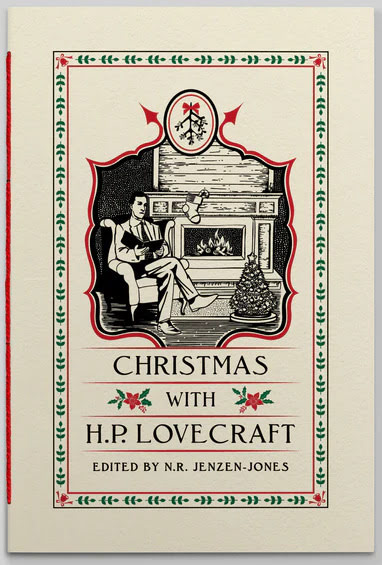
New at the HPLHS Store, the gift book Christmas with H.P. Lovecraft. Sadly not a themed selection from the letters. Rather it… “primarily comprises Lovecraft’s published and unpublished poems which deal with Christmas, winter, the solstice, and related themes.” Plus “The Festival”. A 48-page limited edition of 500 copies.

Here, however, is one of the ‘Christmas’ letters…

[December 1934] “My aunt & I had an exceptionally pleasant Christmas, & I hope the same is true of yourself. We had a tree for the first time in over a quarter of a century. All our old-time tree ornaments were long ago dispersed; but I laid in a new & inexpensive stock at Woolworth’s & Kresge’s [1] — tinsel star & rope, globular baubles, set of lights, stand, & abundant shreds of tinsel to hang from the branches like the Spanish moss of the far south. The result was really delightful & impressive, & I’ve spent considerable time admiring & gloating. We had numerous though inexpensive presents — my best one from my aunt being a picture of the oldest house in Providence (the Stephen Hopkins house — 1742 only a block & a half from our door), drawn by a local artist & simply framed. We began the day most auspiciously by listening to the great British Empire broadcast — which I hope you did not miss. Etheric conversations between London & the uttermost reaches of our [Empire’s] Dominions — Australia, Tasmania, Canada, India, South Africa, & so on — with other area sages from Scotland, Ireland, Liverpool, & a country place in the Cotswolds … & finally an address by the King. I don’t know when I’ve ever had a greater imaginative stimulus. [2] After it was over I turned face down the dollar bill that was tied on top of one of my gifts …… I couldn’t bear to see the features of one who was instrumental in the cruel tearing of these colonies from the Empire in whose fabrick they rightly belong!

Later in the day came a turkey feast at the boarding-house across the back garden (home of the late [cat] Sam Perkins), a general unveiling of gifts, & a session of conversation & contemplation by candlelight & tree-light. At the boarding-house Mrs. Spotty (little Sam Perkins’s mother) received a catnip mouse as a Christmas gift, & seemed very well pleased with that traditional feline delicacy. I couldn’t locate any of the members of the Kappa Alpha Tau [his local shed-top cat ‘club’] — the weather being inauspicious for sessions atop fence & clubhouse — but trust they all partook of ample Yuletide cheer. Well — unless something goes wrong, the New York convention season will open Monday morning — the last day of 1934. Barlow hit the metropolis Christmas Day, & is staying at a rather luxurious hotel in 102nd St. which Long found for him. His tastes in lodging are so sumptuous & sybaritical that he couldn’t get about the country as cheaply as I do!”

[1] “Kresge’s”:

“S.S. KRESGE’s 10c STORE”, Westminster Street, Providence. Note what might be an “American Cheese” sign.
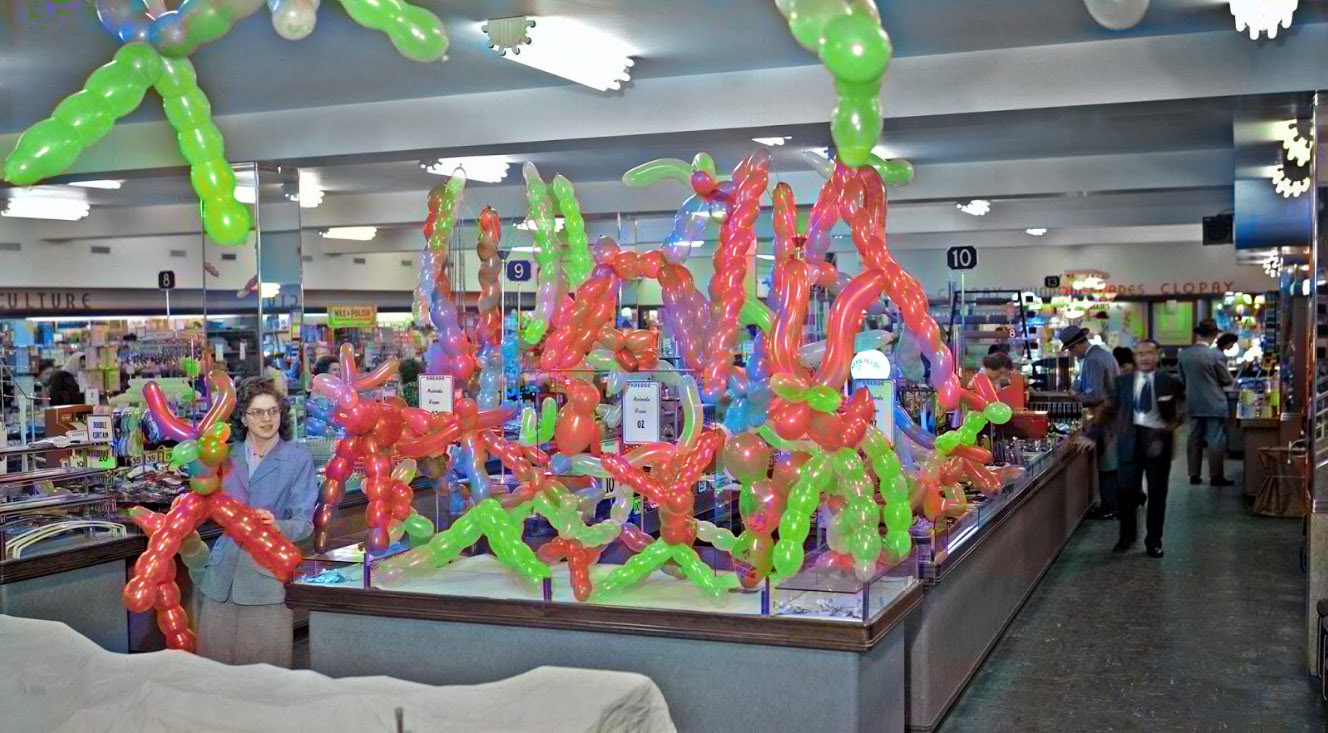
Typical Kresge’s interior, with tentacular balloons, 1948. Later became KMart.

[2] The Empire broadcast:

Live, the hour was an intricately coordinated triumph of radio engineering and clear evidence of the new medium’s global reach. The British Empire then still ruled a quarter of the world’s people, thus Lovecraft’s fond cry of “God Save the King!” was no vapid archaism.


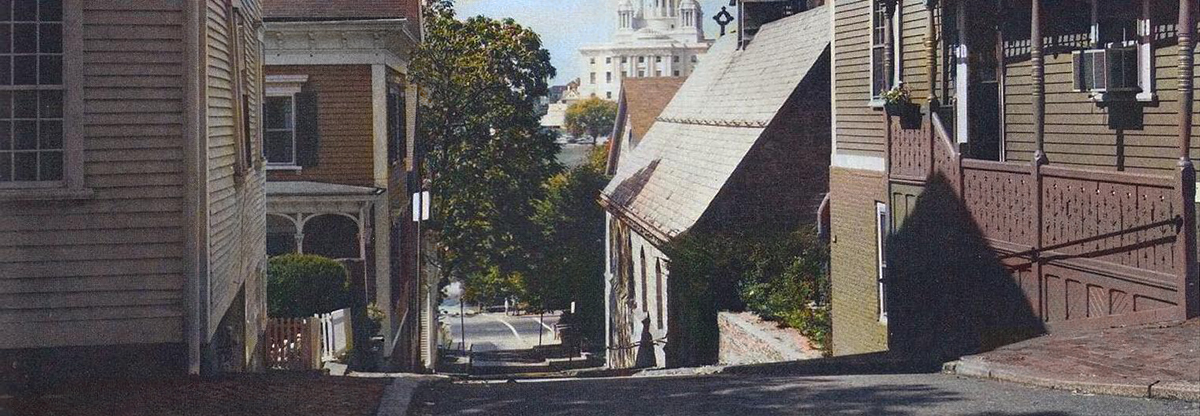
College Hill, looking toward the Capitol

This week in ‘Picture Postals from Lovecraft’, a glimpse of Lovecraft’s beloved College Hill looking toward the Capitol building (aka State House). Said to be Benefit Street, possibly early 1960s.

The picture appeared in a magazine and the seller of the pages cropped the preview picture. Thus the top part is missing. But we can still see the down-slope view that Lovecraft would have known. I’ve here colourised and contrast-adjusted it.

The article reveals that… “in the 1950s urban renewal threatened the whole area [of College Hill] with demolition and redevelopment”.

Monstrously big in Japan

New in the Japanese Journal of Analog Role-Playing Game Studies, an academic article offering “An Exploration of the Appeal of the Cosmic Horror Series of Gamebooks for Call of Cthulhu TRPG | RPG”. This considers, partly via online surveys, some of the reasons for the sustained popularity of the Call of Cthulhu RPGs in Japan.

The Call of Cthulhu series is said to be bigger than D&D in Japan, and synonymous with ‘tabletop RPG’. The success is apparently aided by the relatively simple rules, adaptability to different time-frames and sub-genres, and a strong player base among female fans (meaning male fans can ‘play with my waifu’).

More AI freebies

More looking through CivitAI, which is the main repository for free generative AI image models and plugins. There’s a lot there, and it can take a lot of digging to find stuff.

There’s some obvious Cthulhu / Giger / pulp etc stuff. But here are some other interesting non-obvious items, which seem to have Lovecraftian and RPG potential, and which you would never find via search.

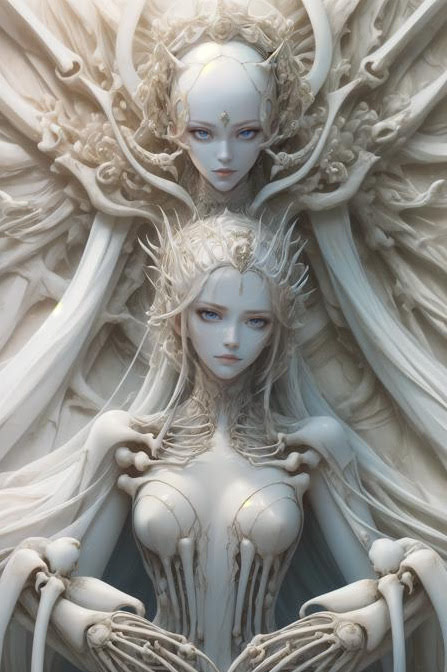
These two might be combined in interesting ways… SAMO bones carving (intricate ivory carving) and Occult Geometry.

You would be able to use negative prompting to steer the Bone Carving away from an Anime / Chinese look, and more toward Giger / Lovecraft.

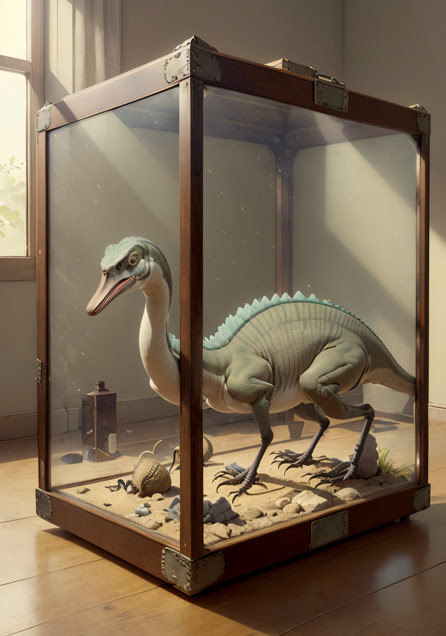
And for RPGs and illustrations involving museums, explorers etc…

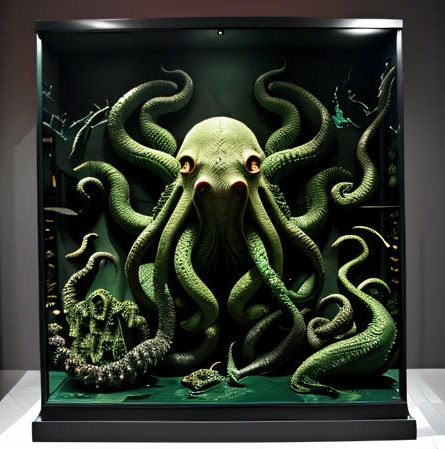
KnollingCase (puts X inside an old fashioned specimen case for museums).

Antixdisplay (puts X inside a modern museum display case).

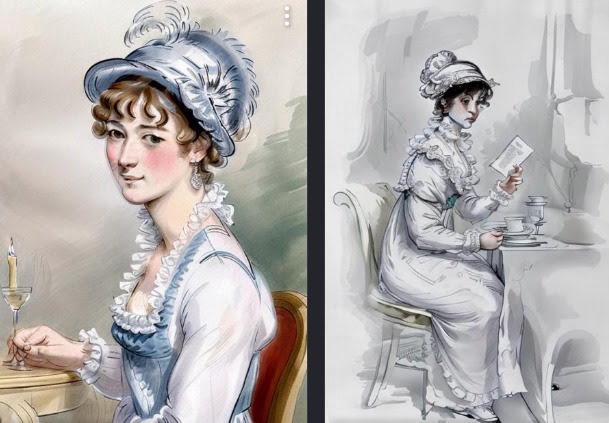
And for Victorian / Edwardian explorers, Muttonchops / Sideburns (Realistic) (for men) and DrawingSD1.5 (19th century pen and wash pictures) for the explorer’s old books of field-notes.

How far AI image generation has come, in just a year. What will another year bring?

The Cthulthu Palimpsest

The venerable British writer and ‘early SF’ scholar Brian Stableford has a new book due early in the new year. The Cthulthu Palimpsest is set for release on 5th January 2024, and its 300+ pages complete a series…

Written to complete and conclude a series of metaphysical fantasies featuring Auguste Dupin, a character invented by Edgar Poe, which involve him with characters and entities invented by H.P. Lovecraft, as well as actual historical figures and occasional devices appropriated from other works of weird fiction.

Also noted, looking back through his recent books, his Weird Fiction in France: A Showcase Anthology of its Origins and Development (December 2020).

A Dream of 1955

This is what The Dream-Quest of Unknown Kadath would have looked like, had it arrived on your shelves in 1955. Up for sale at Honest Abe’s site, “Published by Shroud, 1955” in an edition of 1,500 copies.

Though a little research elsewhere reveals this picture to be of the boards, minus the dustjacket.

The door to the cellar…

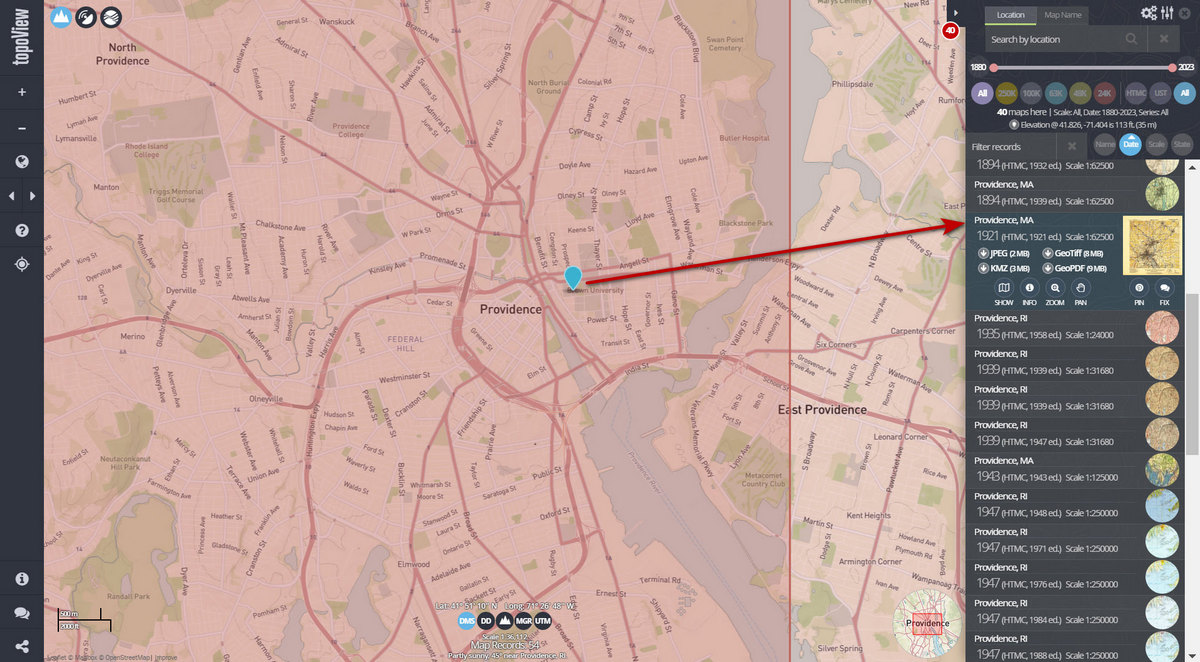
I’ve found an old postcard of Weybosset Street, showing what must be the entrance door for Lovecraft’s favourite Providence second-hand bookseller (see my long article on ‘Uncle Eddy’ in the Lovecraft Annual). Sadly it’s only a small 600px CardCow picture, with no larger available unless one buys the physical card.

The distinctive dome-roof building on the corner gives the orientation. It can still be seen on Google StreetView.

However, even a basic AI-powered enlargement (Topaz GigaPixel AI) makes it clear the entrance door that would have led down to the cellar bookshop, said to have been the largest ‘open shelves’ store in Providence. The Dana’s store was perhaps larger in stock by the time of Lovecraft’s death, but their two-floor storerooms were not open to public browsers.

Here I’ve subtly highlighted the entrance door…

Moebius emulation via Stable Diffusion 1.5: a survey

More delving into the options for ‘add-ons’ that can steer the Stable Diffusion 1.5 AI image generator toward certain styles or objects in its images. The community’s work on SD 1.5 add-ons now has an excellent range and depth (things move fast in AI-land), and also a healthy dash of ‘quirky’. The ethos is ‘free’, and there’s no payment involved so long as you run the image generation on your own PC. Image generation can be helped along by ‘guide poses’ created from 3D-figure desktop software such as DAZ Studio and Poser.

For the style of the French comics artist Moebius with SD 1.5 I found the following, after a thorough search:

* Moebius Color Style – v1.0 is a LORA that tries to emulate the later ‘colour Moebius’ style. Said to work best as an add-on for the large Xenogasm checkpoint model for SD 1.5, which seems to have been specially trained for the sort of subject matter you might find in old 1980s copies of comics magazines such as Heavy Metal, 1984, Epic, etc and similar. Perhaps also Zona 84, Ere Comprimee etc, at a guess. The 1970s-style Xenogasm model is NSWF in the eyes of the 2020s, as you might expect. Apparently Xenogasm 2.1 is the last before it started being heavily re-worked for more realism, so you may want to try that first.

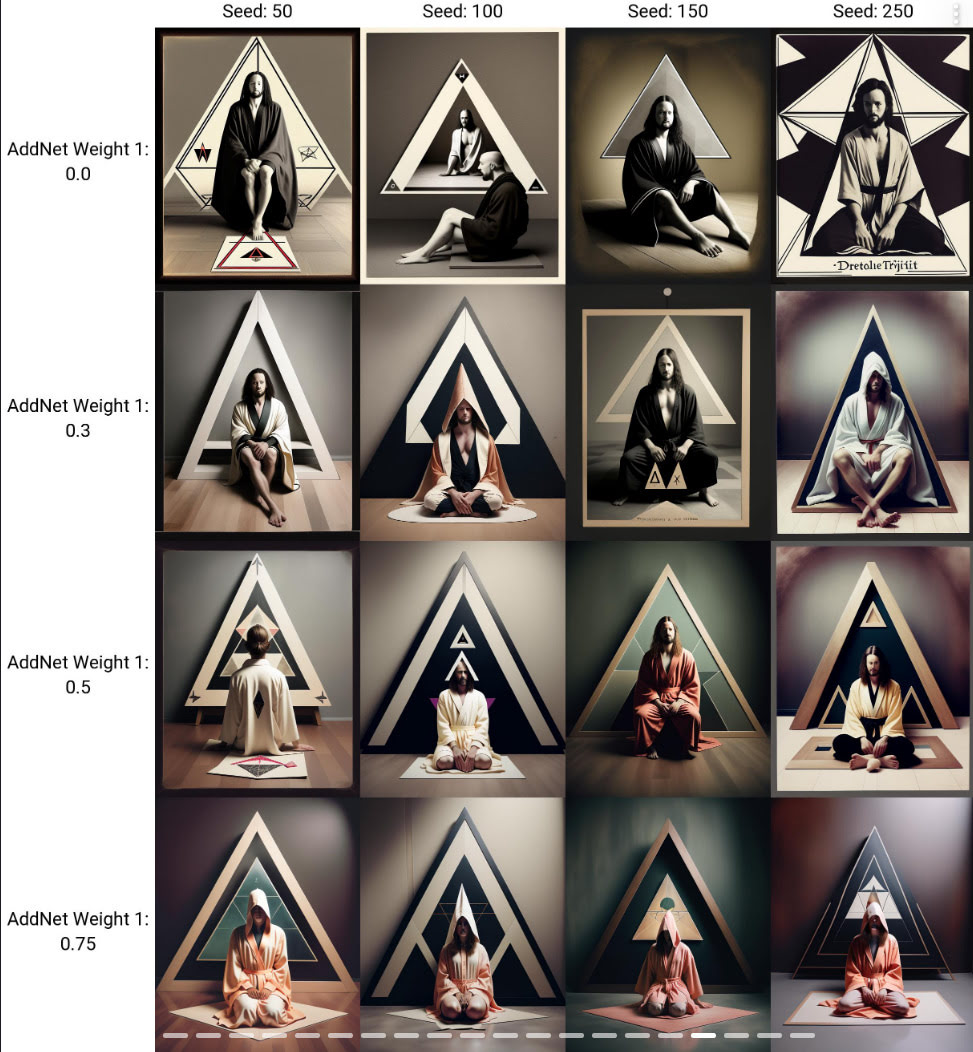
* WASMoebius V1, which is an Textual Inversion ‘Embedding’ add-on for SD 1.5 rather than a LORA add-on.

* For a more old-school ‘B&W Moebius’ one might try the Centerflex – v2.8 checkpoint model. Its main promo images are photoreal and it is a “photorealistic-first” model. But delve into the description and note that this is a dual model. Switch it to its illustration mode and it is said to specialise in the ‘clear ligne’ line-art of the French and Belgian BD comics and Moebius in particular.

Artist styles that this model was explicitly trained to on include Roy Krenkel, Jean-Pierre Gibrat, Milo Manara, Willy Vendersteen, Francois Schuiten, Edgar P Jacobs, Herge, Jacques Tardi, and Moebius. […] This model contains a general activation keyword phrase to evoke a certain hybrid comic book style and composition. This phrase is “ligne claire” meaning “clear line” after the Franco-Belgian comic book [line-art] tradition.

* Possibly also worth a look, in complete SD checkpoint models, is the Protogen Infinity checkpoint model. Trained on comics, isometric art, science-fiction. As well as Protogen, ReV Animated (aka ReVAnimated) is a model name that pops up for use with the more comics-oriented LORAs. There are also SD 1.5 models trained on modern western superhero art, such as iCoMix.

* Metal Hurlant Comics – Moebius, Bilal, Druillet is a LORA trained on a range of the classic 1970s/80s French comics artists. Though it appears to work best with the more grungy Druillet style. An ‘alpha release’, and not likely to be updated to a 1.0 release.

Another Damn Art Model (ADAM) was partly trained on Moebius, along with other Heavy Metal and 1970s artists.

* There’s also a relatively refined attempt at Enki Billal – v3.0, a Bilal style which might combine well with one or two of the above. Update: And another attempt, Enki Bilal Style – v1.0.

Some people combine checkpoint models and LORAs and ’embeddings’. So for instance one might combine the big Centerflex model with the smaller Moebius Color Style LORA as an add-on.

I don’t see anything that can do the distinctive ‘dash shading’ of Moebius. Although I’m not sure an AI could do this, unless it could be trained to follow the shading on a depth-map from a 3D figure / scene…

Ok, that’s what I found. Now all I need is the 12Gb graphics card for the PC, to be able to try them out. 🙂

Recognition reviewed

At the SFRA, a new review of S.T. Joshi’s book The Recognition of H.P. Lovecraft

Joshi does not hesitate in calling out cynical personalities who profited from Lovecraft’s legacy only to trample on his reputation later. [But] controversy has had little effect on the sales of his fiction around the world. The Recognition of H.P. Lovecraft is ultimately a testament to the power of the stories, which have proved resistant to many different crises, and will certainly survive many more.