Scribus 1.6 adds footnotes

Footnote fans may be interested in a new release of the free open-source DTP software Scribus 1.6. Now has “foot and end notes (experimental feature)” along with a new dark mode, a “new PDF-based output preview”, and even (it’s claimed) import of Microsoft Publisher .PUB and Quark files. Still works on Windows 7 too.

The download is here. I’m downloading now, and I’ll believe the .PUB import when I see it. But the footnotes and other changes make it a must-install.


Update: I knew it was too good to be true. The 64-bit installs, launches and then… completely and utterly freezes. Rebooting the PC made no difference. I then tried the 32-bit, but the same problem there. Scribus also then managed to make my old Microsoft Publisher un-launchable, due to the new C++ runtime installers Scribus needed to install.

Public Domain Day 2024 Remix Contest

Archive.org has the usual Public Domain Day 2024 Remix Contest

“Make a 2–3 minute movie using at least one work published in 1928 that will become Public Domain on 1st January 2024.”

With one of 2024’s possible themes being “Weird Tales of 1928″ and another being somewhat detective-ish, “Sleuthing the Public Domain”.

A quick look at my Public domain in 2024 post suggests a film-maker could choose from Wandrei’s “Sonnets of the Midnight Hours” series in Weird Tales. In books, small parts of Wild Animal Interviews and wild opinions of us and the prescient The Day After To-morrow: What is going to happen to the world? might make amusing cartoons.

Talking of cartoons, Mickey Mouse’s first appearance finally enters the public domain, so a makeover for the malodorous mouse is not impossible. Imagine…

‘It is 1928. Mickey the Rat is piloting the sinister river steamer Whippoorwill to Providence, with a malign black cat as the skipper. They sail up through the mists to Providence to relieve Mr. Lovecraft of some Lovecraftian creatures which have escaped his imagination and entered reality. A sign indicates the creatures are to be imprisoned on the Isles of Shoals. Mickey also smuggles aboard H.P. Lovecraft himself, who as usual is seeking a cheap ticket to his beloved Newport. But the master’s presence excites the massed weird creatures to a chaotic cacophony of sinister cosmic music, as each one strives to emit its unique sounds. As they set sail again Mickey the Rat then conducts them all in a wild and somewhat co-ordinated sonic worship of their creator. The short ends with Lovecraft ignominiously put off on a lonely lighthouse rock near Providence, while Mickey the Rat is stuck on kitchen duty boiling tentacles… the fun has been foiled by the skipper.’

Whippoorwill was indeed the name of Mickey’s steamboat, captained by a cat. The above makeover closely follows the plot.

Baring-Gould Centenary

Wild Yorkshire notes that 2024 is the Baring-Gould Centenary year…

In 2024, the Baring-Gould Centenary year, we’re celebrating – in artwork and animation – his work inspired by the time he spent as a young curate in Horbury: the hymn ‘Onward Christian Soldiers’, his folklore study ‘The Book of Were-Wolves’ and his semi-autobiographical novel, set in a thinly disguised version of Horbury, ‘Through Flood and Flame’. Cue thwarted love, dramatic disasters and the villainous Richard Grover, man-monkey and firebrand preacher.

Philosophy’s tentacles

Brazilian journal Das Questoes has an ‘After Speculative Realism’ special as its latest issue. Leads with “The Cthulhu Ascendancy: H.P. Lovecraft and the Tentacles of Speculative Realism” in English. The later article “Is the Future of Speculative Realism in the Study of Literature?” may also interest.

The latest edition of Brumal also has “Hijos de Cthulhutl: deidades prehispanicas y horror cosmico en H.P. Lovecraft” (‘Sons of Cthulhu: Prehispanic Deities and Cosmic Horror in H.P. Lovecraft’. Though the choices don’t quite seem to suit the grand title. The author examines two lesser collaborative works “The Transition of Juan Romero” (1919, a quick demo for the Circle of how to revamp a “dull” story by amateur Philip B. McDonald) and “The Electric Executioner” (1929, a revision of an earlier story by de Castro).

See you after Christmas…

Right, I think that’s all until after Christmas. I hope you’ve enjoyed your daily Tentaclii during 2023. My blog will return perhaps on Tuesday the 2nd of January or thereabouts, though there may perhaps be a ‘2023 in Lovecraft’ annual post before that. Have a merry Christmas and a happy New Year.

Lovecraft at Coney Island

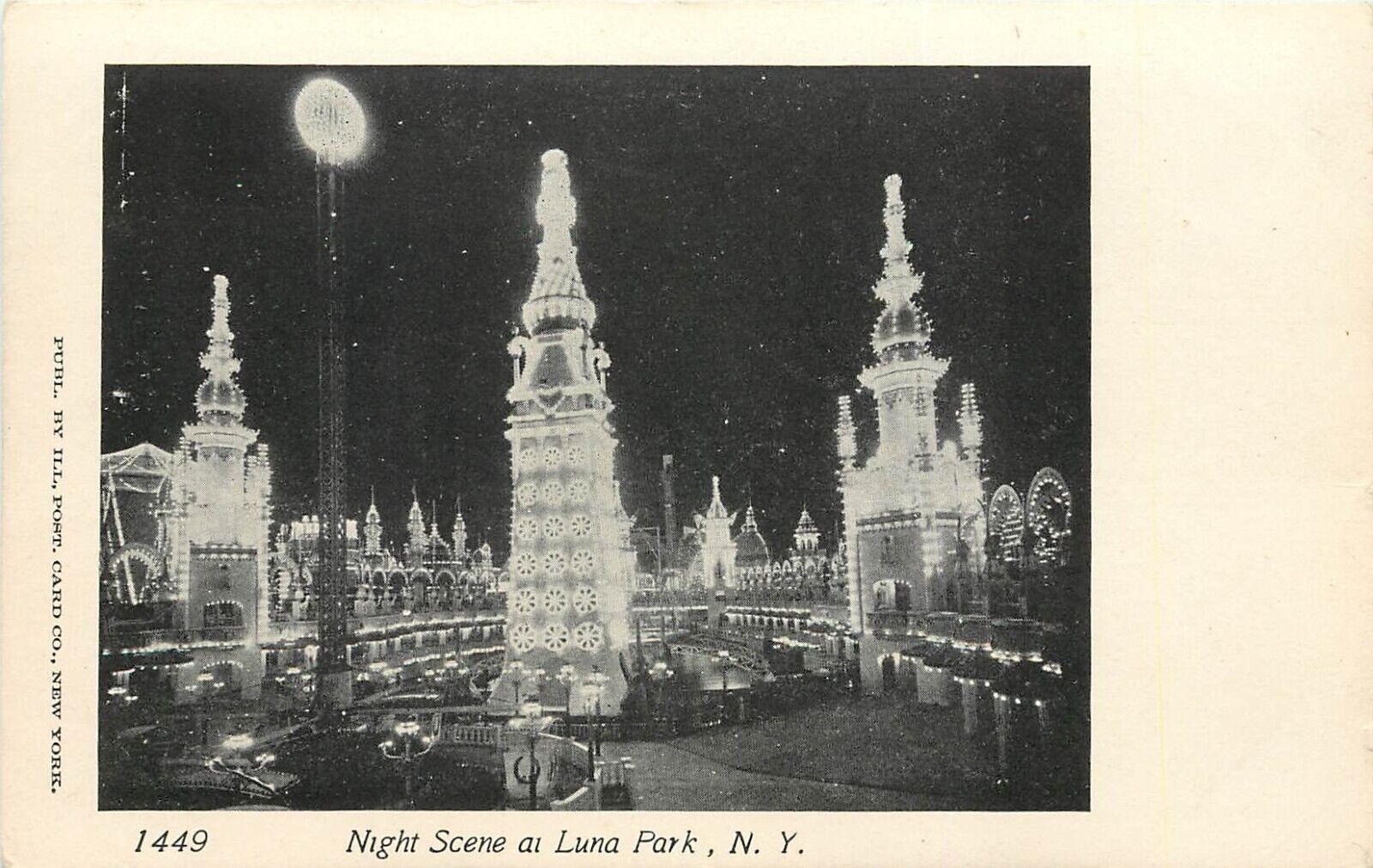
As we head toward Christmas, the closest I can think of to a ‘Christmas decorations / lights’ edition of my regular ‘Picture Postals from Lovecraft’ post is Lovecraft strolling through the illuminations at New York City’s famous Coney Island amusement ground and parks. Not only idly strolling the boardwalks. He visited a number of times, both at night and in daytime, and partook of the fun palaces. The place was not exactly his ideal of the realm enchanted by “the bells of faery” or the more alluring cities of his Dreamlands, admittedly. But it was a sort of enchanted realm, by the standards of Brooklyn.

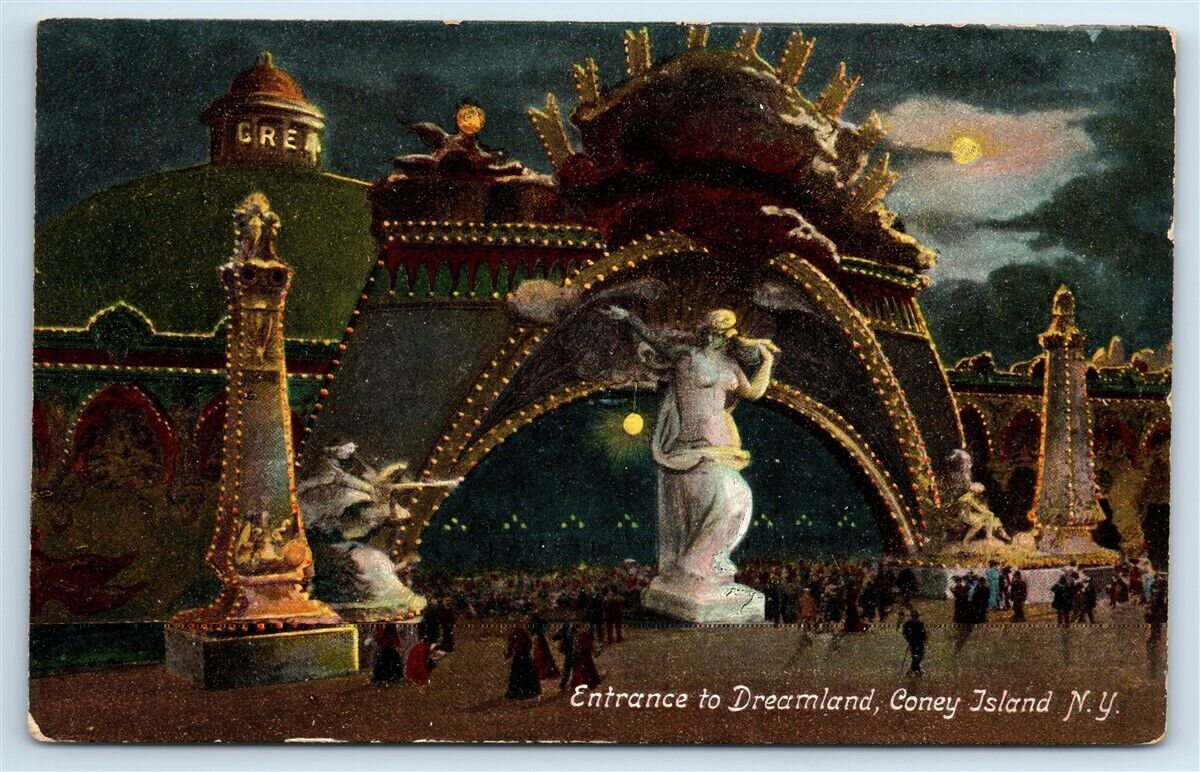
There was once even a large “Dreamland” section, the entrance of which is seen here. But it had burned down in 1911, and so far as I can tell was not rebuilt. In which case it can’t have been an influence on Lovecraft’s naming of the Dreamlands.
Coney Island was a large spur of land hooking into the ocean, as seen by the map below. Lovecraft was however not impressed by its view of the ocean, from what he called “the detestably squalid strand of Coney Island”. This was perhaps not only a reference to the litter/trash, but also to the amorous adventures known to be going on there under the cover of darkness.
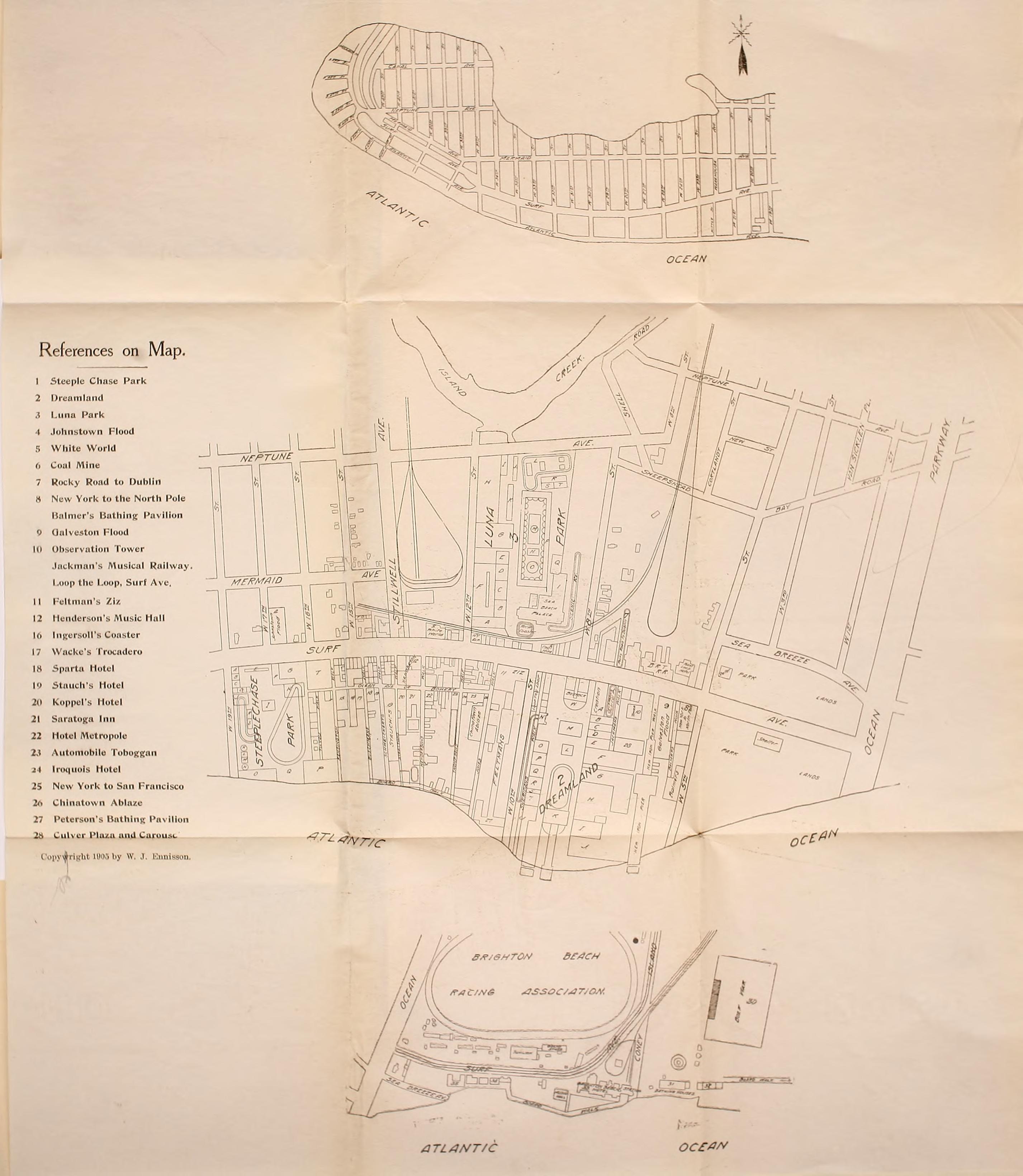
But the frontage parks and their hinterland had many attractions and plazas, as shown on the map from 1905. He would have seen the central attraction of Luna Park, the huge new Boardwalk (opened 1923) and other sections of the area. We know for instance he was at the Luna Park section in 1925 because that was where Lovecraft’s Coney Island silhouette was crafted by the silhouettist E.J. Perry, and where he first tasted candy-floss. He visited several times.
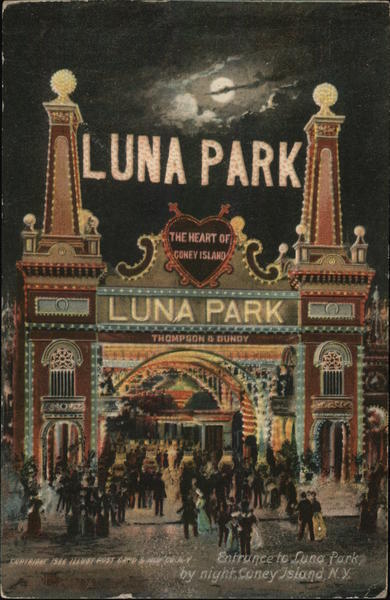
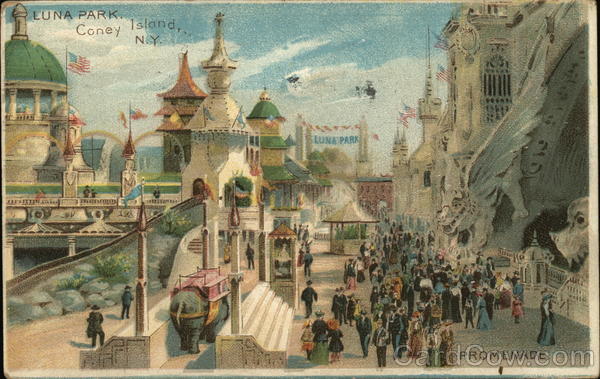
In later years his friend Arthur Leeds was at or near Coney Island. If Lovecraft ever saw Leeds ‘at work’, as the ‘front man’ barker who lured the paying punters into a freak show, appears to be unknown. Lovecraft probably would have met some of the performers if he had, and thus would have mentioned the encounter(s) somewhere. So perhaps he didn’t see Leeds at work.

It’s interesting to note how some of the cards show scenes that almost resemble science-fiction magazine cover-paintings of the period. One wonders about the possible influence of Coney Island’s spectacle on the visual imagination of early New York City science-fiction writers.
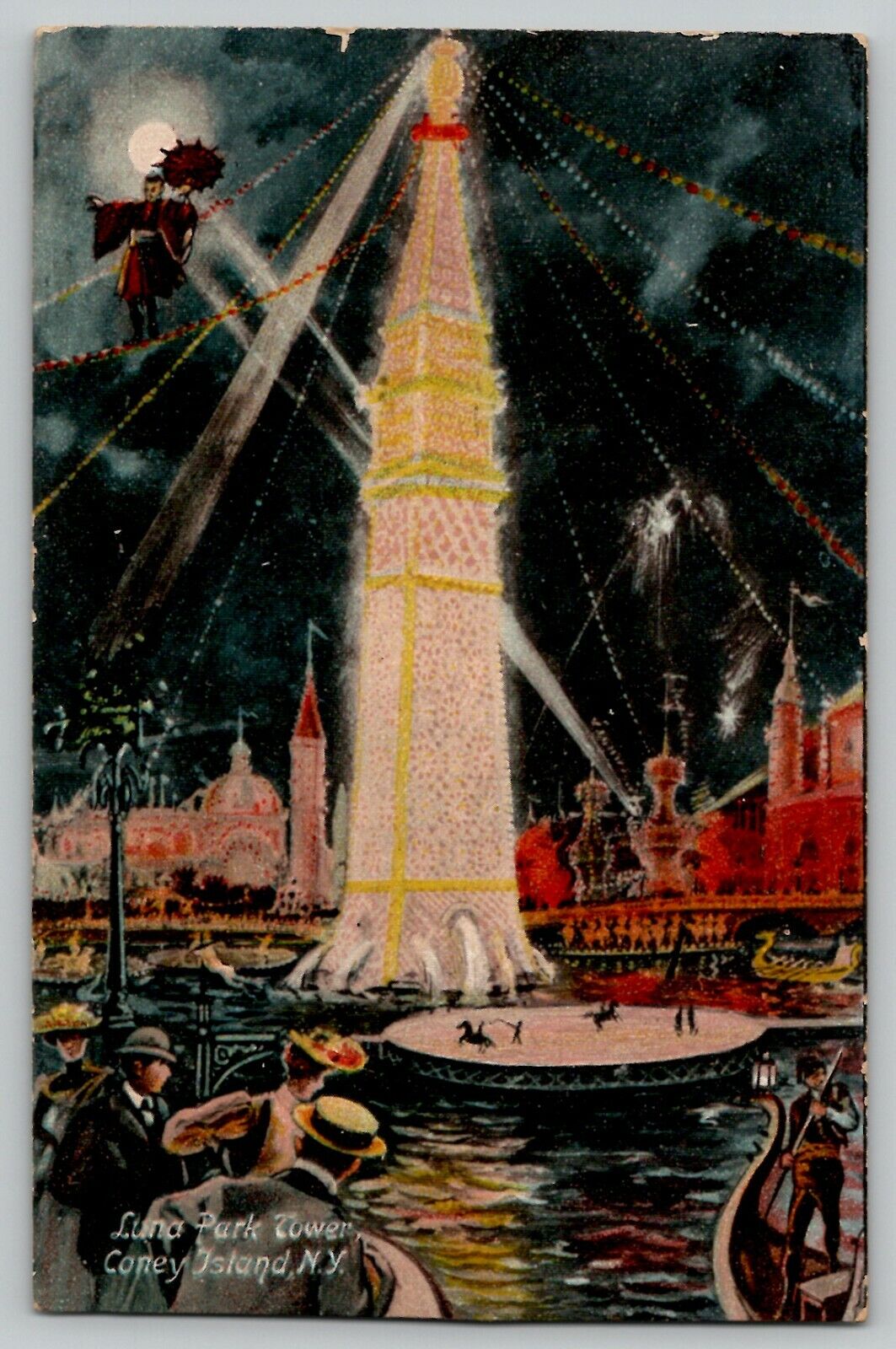
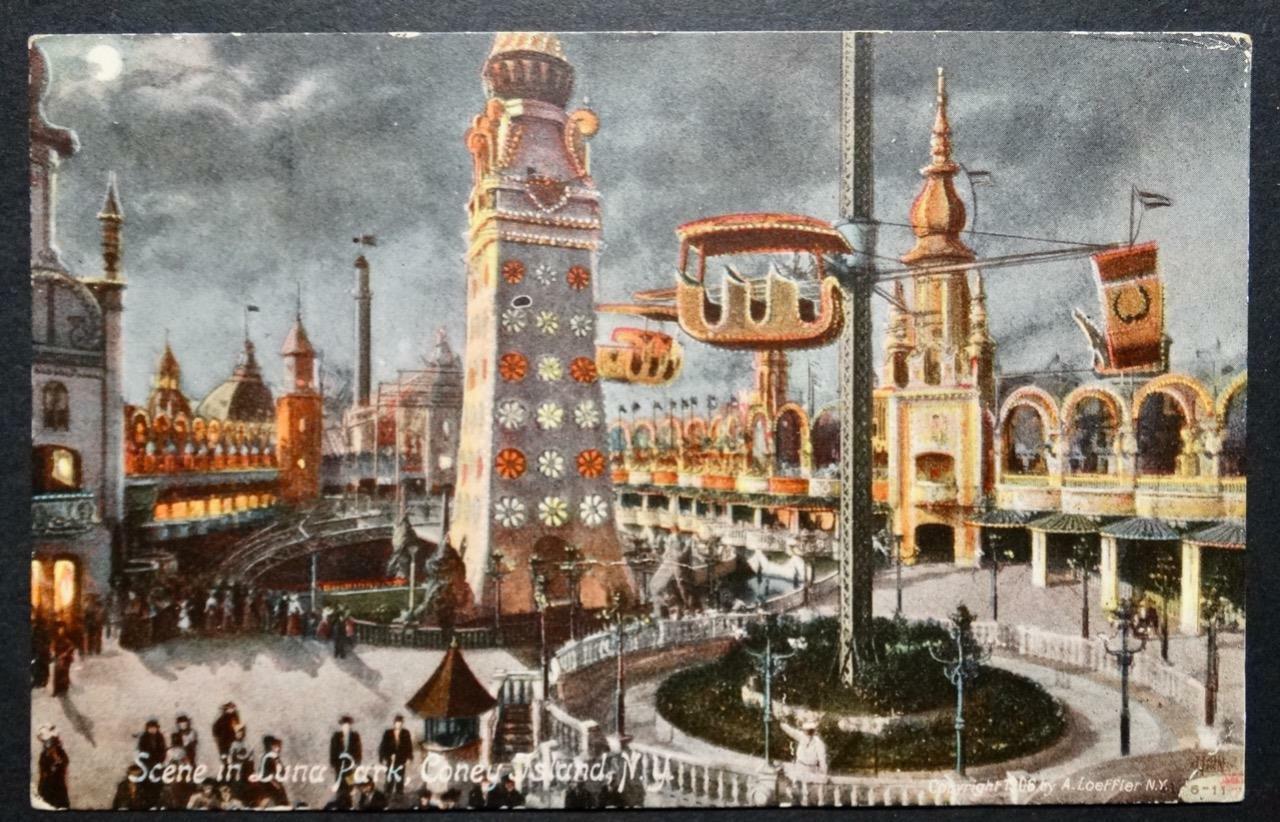
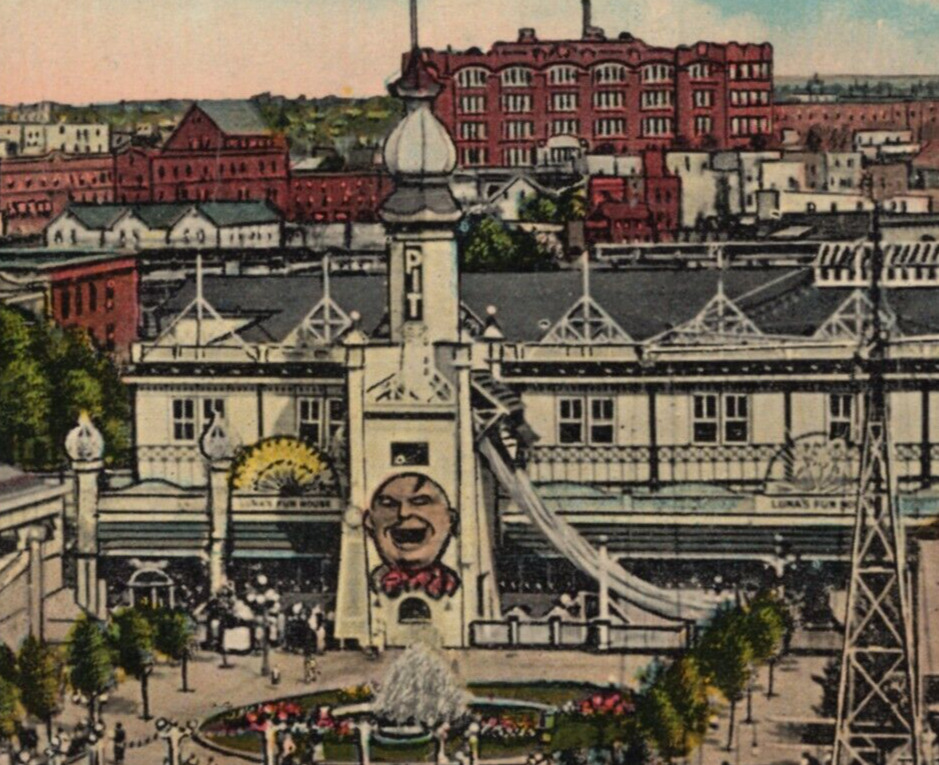
I also found a not-great picture of the $100,000 Fun House called “The Pit” which had re-opened in 1923 after complete refurbishment. It was a ‘crazy house’ inside its apparently normal exterior. I recall it’s been suggested that this was where “The Room of Wonder” was located, which Lovecraft enjoyed in late July 1925.
Here’s his detailed account of solving the puzzle of how “The Room of Wonder” was done, on the spot, with jotted diagrams of explanation. It’s from the Letters from New York volume.
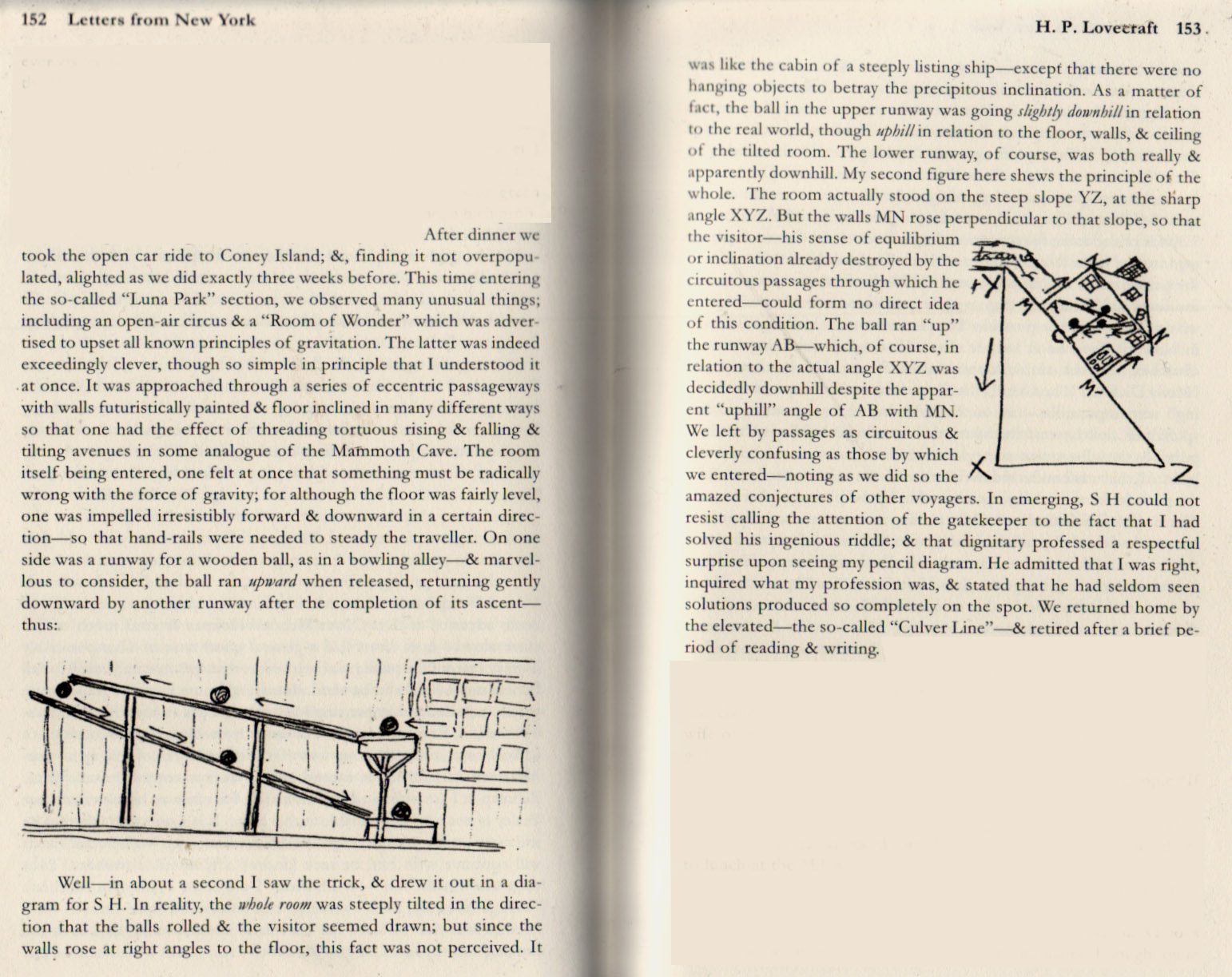
I can’t locate any further information about “The Room of Wonder”, but it seems plausible to think it would have been one of three or four such rooms in ‘The Pit’. And Lovecraft’s encounter recalls the scene in “The Call of Cthulhu” in which the sailors are before the door on the island…

they could not decide whether it [the door] lay flat like a trap-door or slantwise like an outside cellar-door. As Wilcox would have said, the geometry of the place was all wrong. One could not be sure that the sea and the ground were horizontal, hence the relative position of everything else seemed phantasmally variable. Briden pushed at the stone in several places without result. […] In this phantasy of prismatic distortion it [the door] moved anomalously in a diagonal way, so that all the rules of matter and perspective seemed upset.

Such are the ways of writers. Non-writer academics often assume they take key points of inspiration from the great classics of their time (Moby Dick etc). They don’t, and it would be stupid to do so because the borrowing would be recognised immediately. Instead they often ‘take it where they find it’, which means the researcher might usefully start looking where they were on the map and then try to discover what they would have encountered there at that exact point in time.

More LORAs

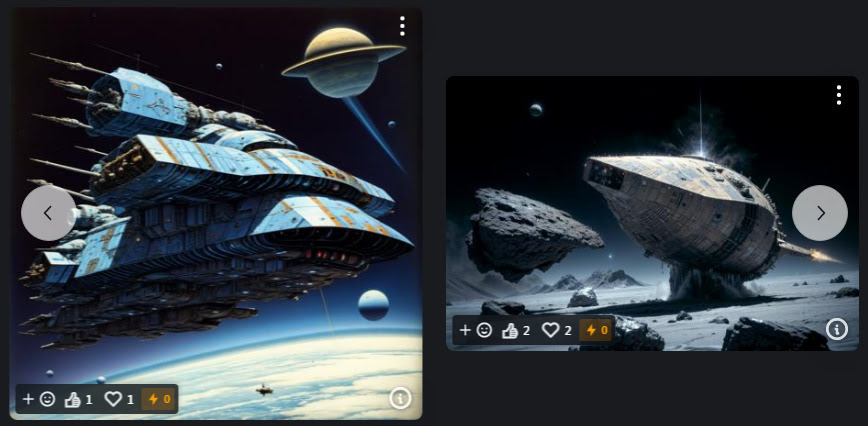
More new free LORA plugins for Stable Diffusion 1.5, noted since my last such post and likely to interest some Tentaclii readers. Running these requires free software such as InvokeAI or ComfyUI, a Stable Diffusion model, and a newer graphics-card in your PC.

The new Overgrowth Style which could be used with the also-new Moss Beasts.

Proto. This might be used with the also-new Glass Sculptural LORA, to make new ‘Blaschka glass animals’ as if from the deep sea.

The new R-Fantasy LORA Edition – v1.0. Get the R-Fantasy model’s generic fantasy-art look in combination with any model, potentially. May have problems with the anatomy on fantasy beasts, by the look of it.

New, a LORA for the Alessandro Biffignandi comic style – v1.0. A 1980s Italian comics artist, who a book on his work describes as… “One of the most accomplished and prolific fumetti cover artists was Alessandro Biffignandi, whose artworks featured horror, fantasy and sci-fi elements.” And plenty of big-breasted ladies, by the look of it.

And finally, from summer 2023 but newly discovered, Doomer Boomer – v1.0. Not a LORA but a model. Specifically trained with SD 1.5 at 768px and with quality inputs, to output the styles of the more painterly late 1970s / early 1980s Heavy Metal magazine and similar vintage fantasy paperback-cover / album-cover artists. Can be guided by prompts to make images as if “by Frank Frazetta”, “by Brom” etc.