Lovecraft at Coney Island

As we head toward Christmas, the closest I can think of to a ‘Christmas decorations / lights’ edition of my regular ‘Picture Postals from Lovecraft’ post is Lovecraft strolling through the illuminations at New York City’s famous Coney Island amusement ground and parks. Not only idly strolling the boardwalks. He visited a number of times, both at night and in daytime, and partook of the fun palaces. The place was not exactly his ideal of the realm enchanted by “the bells of faery” or the more alluring cities of his Dreamlands, admittedly. But it was a sort of enchanted realm, by the standards of Brooklyn.

There was once even a large “Dreamland” section, the entrance of which is seen here. But it had burned down in 1911, and so far as I can tell was not rebuilt. In which case it can’t have been an influence on Lovecraft’s naming of the Dreamlands.

Coney Island was a large spur of land hooking into the ocean, as seen by the map below. Lovecraft was however not impressed by its view of the ocean, from what he called “the detestably squalid strand of Coney Island”. This was perhaps not only a reference to the litter/trash, but also to the amorous adventures known to be going on there under the cover of darkness.

But the frontage parks and their hinterland had many attractions and plazas, as shown on the map from 1905. He would have seen the central attraction of Luna Park, the huge new Boardwalk (opened 1923) and other sections of the area. We know for instance he was at the Luna Park section in 1925 because that was where Lovecraft’s Coney Island silhouette was crafted by the silhouettist E.J. Perry, and where he first tasted candy-floss. He visited several times.

In later years his friend Arthur Leeds was at or near Coney Island. If Lovecraft ever saw Leeds ‘at work’, as the ‘front man’ barker who lured the paying punters into a freak show, appears to be unknown. Lovecraft probably would have met some of the performers if he had, and thus would have mentioned the encounter(s) somewhere. So perhaps he didn’t see Leeds at work.

It’s interesting to note how some of the cards show scenes that almost resemble science-fiction magazine cover-paintings of the period. One wonders about the possible influence of Coney Island’s spectacle on the visual imagination of early New York City science-fiction writers.

I also found a not-great picture of the $100,000 Fun House called “The Pit” which had re-opened in 1923 after complete refurbishment. It was a ‘crazy house’ inside its apparently normal exterior. I recall it’s been suggested that this was where “The Room of Wonder” was located, which Lovecraft enjoyed in late July 1925.

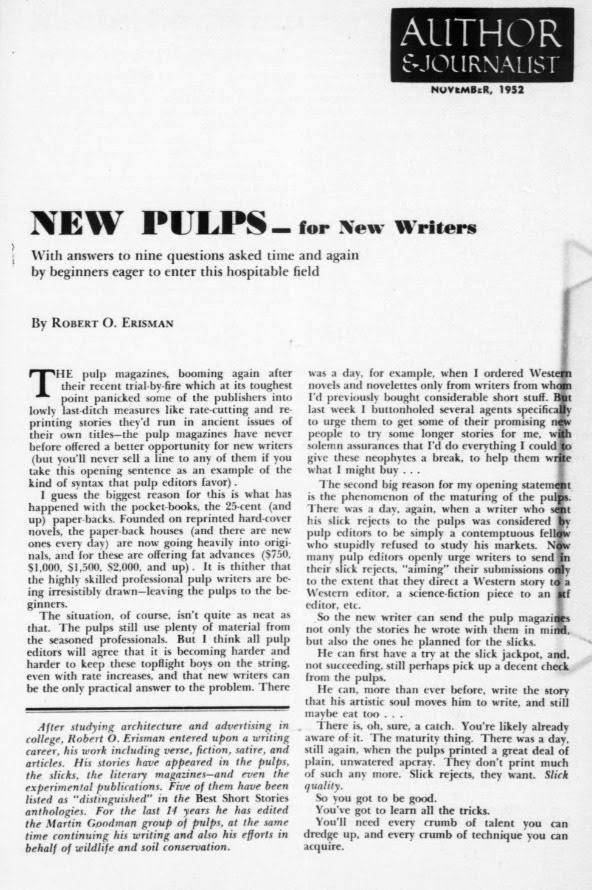
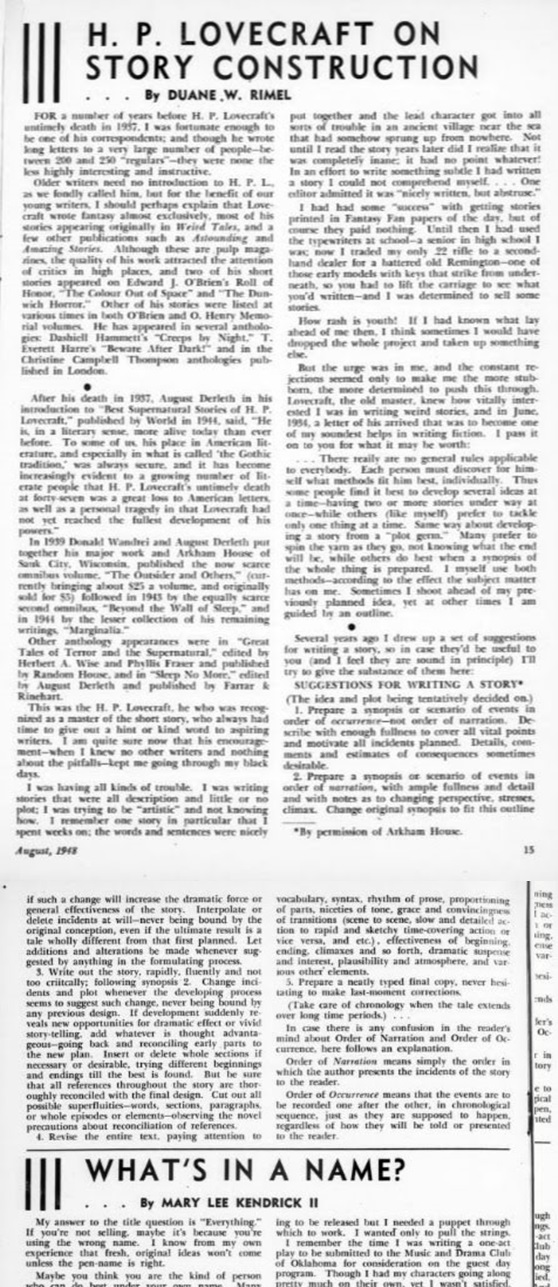
Here’s his detailed account of solving the puzzle of how “The Room of Wonder” was done, on the spot, with jotted diagrams of explanation. It’s from the Letters from New York volume.

I can’t locate any further information about “The Room of Wonder”, but it seems plausible to think it would have been one of three or four such rooms in ‘The Pit’. And Lovecraft’s encounter recalls the scene in “The Call of Cthulhu” in which the sailors are before the door on the island…

they could not decide whether it [the door] lay flat like a trap-door or slantwise like an outside cellar-door. As Wilcox would have said, the geometry of the place was all wrong. One could not be sure that the sea and the ground were horizontal, hence the relative position of everything else seemed phantasmally variable. Briden pushed at the stone in several places without result. […] In this phantasy of prismatic distortion it [the door] moved anomalously in a diagonal way, so that all the rules of matter and perspective seemed upset.

Such are the ways of writers. Non-writer academics often assume they take key points of inspiration from the great classics of their time (Moby Dick etc). They don’t, and it would be stupid to do so because the borrowing would be recognised immediately. Instead they often ‘take it where they find it’, which means the researcher might usefully start looking where they were on the map and then try to discover what they would have encountered there at that exact point in time.

More LORAs

More new free LORA plugins for Stable Diffusion 1.5, noted since my last such post and likely to interest some Tentaclii readers. Running these requires free software such as InvokeAI or ComfyUI, a Stable Diffusion model, and a newer graphics-card in your PC.

The new Overgrowth Style which could be used with the also-new Moss Beasts.

Proto. This might be used with the also-new Glass Sculptural LORA, to make new ‘Blaschka glass animals’ as if from the deep sea.

The new R-Fantasy LORA Edition – v1.0. Get the R-Fantasy model’s generic fantasy-art look in combination with any model, potentially. May have problems with the anatomy on fantasy beasts, by the look of it.

New, a LORA for the Alessandro Biffignandi comic style – v1.0. A 1980s Italian comics artist, who a book on his work describes as… “One of the most accomplished and prolific fumetti cover artists was Alessandro Biffignandi, whose artworks featured horror, fantasy and sci-fi elements.” And plenty of big-breasted ladies, by the look of it.

And finally, from summer 2023 but newly discovered, Doomer Boomer – v1.0. Not a LORA but a model. Specifically trained with SD 1.5 at 768px and with quality inputs, to output the styles of the more painterly late 1970s / early 1980s Heavy Metal magazine and similar vintage fantasy paperback-cover / album-cover artists. Can be guided by prompts to make images as if “by Frank Frazetta”, “by Brom” etc.

Sea-creatures in cinema

France has a new National Maritime Museum and its opening blockbuster exhibition examines…

“the representation of the seas and sea-creatures in cinema”

The show is open now in Paris, and runs until 5th May 2024. It covers the entire history of film from the first silents to the latest SFX. There’s also a 320 page catalogue.


Also of interest, the Korshak Collection visits Florida, for a gallery exhibition running 8th March – 28th April 2024…

The Korshak Collection features works by pioneering artists from over a century of published science fiction, horror, and fantasy. These original adventure and fantasy illustrations appeared on the covers and pages of timeless novels, and in classic pulp magazines from the 1930s through 1960s such as Amazing Stories, Weird Tales, Fantastic Adventures, and Wonder Stories.

HPL photoreal – a quick test

Lovecraft in 3D + Stable Diffusion. Made by taking the Meshbox 3D Lovecraft poseable figure (purchase | free face expression presets) for the Poser software, improving the skin a bit by tinkering with materials, and then doing a quick simple render in Poser with a 50mm virtual camera (a 50mm lens is best for portraits).

Then I used this quickie render from Poser in a ControlNet (simple ‘canny’ and ‘depth’) for AI image generation. Which in InvokeAI 3.0 and Stable Diffusion 1.5 produced a photoreal mugshot…

Then slight Photoshopping to fix the hair (little duck-tail quiff: ‘AI say no’), desaturate the skin a little, and vignette. And… the proof-of-concept portrait was done. It’s a bit ‘waxworks figure from del Toro’s basement’ if you look at it for too long. Fish-eyes too (he’s going to Innsmouth soon). But it’s reasonable for a first test without any work on the expression or pose.

LORA links

More ‘style LORAs’, plugins for AI models, new in the last ten days or so. Plucked from among the daily tidal-wave of LORAs for individual game and anime characters. These are for use with a suitable AI model, plugged into desktop software such as InvokeAI or ComfyUI.

SyFyEye1 – v2.0. Big sci-fi landscapes, with large planets / moons in the sky, veering towards ‘wallpaper’ rather than old-school space-art.

The above might be used in combination with the also-new Grand Scale LORA.

The Shadow v1.0. The pulp character.

Aliens from “Mars Attacks”.

Horror Manga in the modern b&w manga style. Looks a bit toony, but you might be able to push it more towards a Junji Ito look. Perhaps in combo with the new Junji Ito LORA, even.

Book cover with face. Possibly of special interest to RPG makers needing artwork.

Alfred Bestall Style, creator of the British comics character Rupert the Bear. Also looks useful for a ‘1930s vintage artwork’ look with suitably muted printed colours, rather than the garish colours of modern reprints. However, to ‘de-age’ faded paper prints and old paintings a bit, you might look at the White Papper LORA.

By the way, the latest power-metric for AI image-making speedsters is… “cats per second” (CPS). Several new tweaks / modules have recently enabled near real-time AI generation of images. At the same time the power-draw is going down. These things will be running in a display panel on the side of your breakfast toaster before long. Or perhaps first in a nude-y camera, given the interests of most AI users.

In the Japanese Gardens

Given the dreary weather, for this week’s ‘Picture Postals from Lovecraft’ post it seems suitable to revisit one of Lovecraft’s favourite places. The Japanese Gardens at the Brooklyn Botanical Gardens, if only in b&w. These had opened in 1915…

… and were thus barely a decade old when Lovecraft encountered them in the mid 1920s.

Here we see a Lovecraft-alike writing near the bridge of the Japanese pond, with its bronze storks.

These are apparently from circa 1925, and are thus as Lovecraft would have seen it.

The place was also open in winter, when the hot-houses would have been the main draw. But after a fresh fall of snow the Japanese Gardens would also have had a certain allure. New York had several record-breaking snow-storms during Lovecraft’s time there. Again these pictures are from near to the time that Lovecraft was in New York City.