Friday ‘picture postals’ from Lovecraft: the Long ‘strip’

This week, a set of hand-drawn postcards sent to Lovecraft. My thanks to the Brown University repository.

From 16th November 1926 Frank Belknap Long began to send a ‘comic-strip by postcards’ to his good friend H.P. Lovecraft. Having recently escaped the ‘pest zone’ of New York City, and recovered his wits, the master thus found one ‘episode’ per day being slipped through his letter-box in Providence from New York. While Long’s art is crude, the biographical and professional insights are of some interest. The final card is not addressed or stamped, so may have been delivered in person or enclosed inside a letter.

1. Randolph Carter and the Priests of Baal-Naplong. While attempting to escape Baal-Naplong (New York?), HPL is caught up on the city’s wall and hangs there ‘invert’ and upside down. He utters vital sentences which are cut in the sword battle between Frank Belknap Long (wielding the Scimitar of Sophistication) in battle against Weird Tales / Farnsworth Wright (wielding, curiously, the Sword of Modernism. Perhaps the irony was intended?).

2. Randolph Carter defies the daemons of Baal-Naplong. Having escaped the city of Baal-Naplong, HPL is perused by daemons from that city. He wields the sword of Puritan Ethics against various monsters, which represent literary, critical and artistic tendencies. He appears to wear a Puritan-style hat.
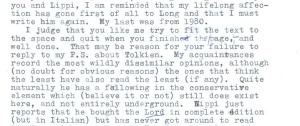
3. Randolph Carter pursued by an Octopus — that is more shoggoth than octopus. HPL had become rather plump during his early stay in New York, but later took to a ‘reducing’ diet and often this veered near to starvation.

4. Randolph Carter goes in for Genealogy. This may suggest family history as an activity that HPL found solace in when he first returned home from New York City, as he had in the mystery years after 1908. It may also hint that Long was aware that HPL’s family tree was not as blue-blooded as he might have wished for.

5. Randolph Carter indulges in a slight altercation. In Providence Cemetery he battles a “Dr. Calef” for possession of a manifesting spirit. The reference is to Robert Calef, author of More Wonders of the Invisible World (1700).

6. Top: The spirit of Ivan Lampisz, deemed a long-dead medieval poet by the gravestone inscription seen in the previous card, seems to engage in some sort of personality transference with Randolph Carter, which thus enables Lampisz to be released from the spirit world. Lampisz ascends and is welcomed by the higher poetic spirits of Baudelaire, Shelley and Swinburne.

Bottom: Randolph Carter defends the 18th Century. Revivified and rid of the spirit, Carter arises and defends himself and his ugly Georgian Cyclops (i.e. Georgian poetry) against another risen spirit of the graveyard, the Spirit of Eternal Loveliness.

7. Finally, Randolph Carter is seized by three ghouls (Flaming Youth / Victorianism / the 20th Century) and taken by them to the top of a church tower to be dismembered. Lesser horrors (ghost, winged hound or ‘The Hound’ or perhaps a gargoyle, large snake) appear to be circling the church.

A quote from Poe, “The Bells” concludes: “They that dwell up in the steeple, all alone … They are neither man nor woman”. This seems a rather curious choice of emphasis, from the original…

And the people -ah, the people –
They that dwell up in the steeple,
All alone,
And who tolling, tolling, tolling,
In that muffled monotone,
Feel a glory in so rolling
On the human heart a stone –
They are neither man nor woman –
They are neither brute nor human –
They are Ghouls

In Long’s choice is there a subtle inference that HPL risks becoming such a ‘third sex’ or ‘intersex’ type, “neither man nor woman”? Which was how homosexuality was vaguely understood and framed, in 1926, following the reception of the new Hirschfeldian sexology from Berlin. A few months earlier Lovecraft had referred to his close friend Samuel Loveman, a gay man, “if Samuelus isn’t a flaming youth still, for all his barren pole and uncertain equator”. The “pole” and “equator” here are presumably allusions to Loveman’s balding head and slightly expanding paunch. This was said in a June 1926 letter to Long. Had Long looked up the discreet allusion apparently being proffered (in a discussion on poetry) then he could only have found it in Shakespeare…

To flaming youth let virtue be as wax
And melt in her own fire. Proclaim no shame
When the compulsive ardour gives the charge

Perhaps then the apparent not-so-subtle warning offered by Long’s last card was the whole point of the comic strip? Did Long somehow fear that if Lovecraft remained “all alone” and yet also under the sway of the “flaming youth” (Loveman) by correspondence and poetry, then there was a risk that certain latent platonic tendencies might somehow be encouraged to flower in the master? And with “no shame”, too? That the final card had to be delivered in person or inside a letter, rather than risk one of the aunts seeing it in the morning mail, does seem to enhance the likelihood of “neither man nor woman” being intended to have a personal as well as poetic meaning.

Note that Lovecraft did refer to Long as a “flaming youth” a couple of times. But that was four years later, in 1930, and the context shifted the meaning much more toward ‘flaming young fool’. Lovecraft was at that point chiding Long for not having written a ‘dinosaur egg hatches’ story, back when Lovecraft had suggested it to him and no-one else had yet written one.

New on DeviantArt

New on DeviantArt…

The Great Old One by icoppens of Belgium, in poster style.

Neo Cthulhu by DerMalerinGelb of Germany.

Yog-Sothoth by AstShera of Russia. In stipple, if you look at it in full-res.

Lovecraft’s laptop by SelineToolate of Russia.

The Dunwich Horror by Mediocre-Grimm of the USA.

Mythos by juniorWoodchuck of Switzerland. (Including hypothetical relic populations of reptilian animals that might inhabit the Nameless City).

Mi-Go, soldier caste by Reinhard-Gutzat of the USA. (Part of his “Bizarre Biology” currently on display at the Brooklyn Art Library).

Mountains of Madness storyboards from Paraberio in Spain. (Partly online, and also as a wordless story-sequenced ebook)

Rise of the anti-fans

A useful new definition from Rise Again Comics, this week… “an anti-fan is someone who claims to be a fan of something while advocating for everything that destroys it and the fandom surrounding it”. And, I’d add, while often also lining their own pockets — via side-tracking clueless newbies toward their own ersatz products.

News from S.T. Joshi

S.T. Joshi’s blog has updated.

* News of a Joshi-penned… “little detective novel featuring Lovecraft and Sonia as detectives, Honeymoon in Jail”, which sounds fun. Perhaps an opportunity there for an aspiring comics artist to do a graphic novel adaptation of this item, I’d suggest?

* There’s to be a Japanese documentary on Lovecraft, Dark Side Mystery which will screen in Japan in November. For which the Japanese makers took the trouble to jet to the USA and also to fly S.T. Joshi to the John Hay Library in Providence and interview him there carefully for several hours. It sounds promising, and one presumes it will eventually be released online with English subtitles.

* There’s also a documentary film being made with the “Canadian documentarian Qais Pasha”, which sounds like it could be on ‘Lovecraft and his places’. Update: the core of it is “Lovecraft’s visits to Quebec”.

New non-fiction book: Midwestern Strange

Due in a month’s time, on 1st September 2019, Midwestern Strange: Hunting Monsters, Martians, and the Weird in Flyover Country from the University of Nebraska Press. The book appears to be a sort of travel book in which a bigfoot-hunting academic takes a year’s sabbatical from the University of Wisconsin. He spends a year visiting Gravity Falls-ish places known for their midwestern monster-mysteries, strange sightings and terrific tall-tales, while recording interviews. Each place gets a chapter, and also some musings on the lures of mystery and the traps of truth.

It follows the somewhat similar but rather more dry book American Cosmic: UFOs, Religion, Technology (2019), which interviewed both U.S. UFO-logists and the ‘extraterrestrial intelligence’ probablists (as in “they’re probably out there”), from the perspective of an ethnographer.

July 2019 on Tentaclii

It’s the end of the month again. Here in the English West Midlands the month of July did its usual dance of sun and rain. Large pools now creep ominously across the wasteland toward Tentaclii Towers. The air-conditioning unit was ceremonially wheeled out of the darkness and dusted down for its usual three-day stint, in what passes for a British summer. Much ginger beer was sipped, with the aid of $59 from 19 kind Patreon patrons.

As for Tentaclii, daily posting continued and the usual haul of new items was hauled.

Forthcoming ‘collected’ books noted included Lovecraft’s best poems and best essays in new Joshi-tastic editions. In ebooks I noted the imminent affordable ebook of the stories of the late Wilum Pugmire, An Imp of Aether; and discovered that the older A Look Behind the Derleth Mythos: Origins of the Cthulhu Mythos is now available as an equally affordable third-edition ebook.

In survey books, noted were the new Encyclopedia of Weird Detectives; the new Weird Tales of Modernity; the free Worlds Imagined: the Maps of Imaginary Places in PDF; and a new edition of S.T. Joshi’s critical survey Weird Fiction in the Later 20th Century.

As for non-fiction Lovecraft or related journals, noted were: The Fossil #380 (free); Brumal’s huge Lovecraft special issue (free); the forthcoming Crypt of Cthulhu #113; and the Italian Providence Tales #4. Also two recent issues on the Russian Gothic / Magic & Magicians from the paywalled academic journal Russian Literature.

Various free scholarly items were linked up from my own Open Lovecraft page. The free Howard Days videos at YouTube, several scholarly, were also linked here in a couple of structured posts.

Scholarly ‘calls’ included S.T. Joshi’s new project Penumbra, a journal for criticism and scholarship of weird fiction, and The Dark Man journal (Robert E. Howard, and now also other pulpsters of his era), for which I made the suggestion that ‘The Small Town’ would make a good themed issue. Also noted here was the S. T. Joshi Endowed Research Fellowship.

In comics I was pleased to find the genuinely experimental Secuencia Grafica 1 from Spain, adapting “At The Mountains of Madness” in lively wordless storyboard form. I hope to have an interview with the maker in the next issue of Digital Art Live magazine, which will be themed around comics.

Outside print, a number of musical items were noted, including a CD and symphony performance, and a notable heavy rock album in place of fireworks for the 4th of July. Also news of several art shows, a theatre show, a new radio theatre CD, and a podcast or two. A couple of mildly promising indie games, Gibbous and Moons of Madness, seemed deserving of note.

For historical context there was a deep dive into “Around Brattleboro” which wrestled with the exact geography of the place and which may have found some new pictures of the 1927 floods that inspired Lovecraft. The Guest Post: “Lovecraft, alive in Paris!” gave an insight into Paris in 1970, its politics and its response to Lovecraft.

Feeling deprived of either a seaside holiday or a RPG jaunt into the Sahara, my Friday “Picture Postals” took a stroll down to the beach shacks of Marblehead and along the Newburyport shoreline, though nothing very remarkable was discovered there.

Some suggestions were made in “Toward an ‘Open Cthulhu’” and “Lovecraft’s Diary: a project proposal”.

As for my new discoveries, I’m pleased to say that several were made this month…

i) “On Buzrael” solved a small source problem in “The Dunwich Horror”.

ii) A possible new discovery was that Commonplace Book item #11 links with “The Cats of Ulthar” — though I’ve never been able to see Shultz’s Annotated Commonplace Book (1987), so perhaps he notes it there. (Is he going to get a new edition of that out, at some point soon?)

iii) “A letter from Marblehead” was a more substantial discovery, offering a very strong and previously unrecognised source for “The Strange High House in the Mist”. Possibly it’s now un-provable as a source, although someone with boots-on-the-ground in Marblehead, full access to the Lovecraft letters, and access to the Ward family records might be able to do something more with adding context to the discovery.

In the background, I’ve done a comprehensively annotated “The Cats of Ulthar” which will be released on Lovecraft’s Birthday (20th August) and which runs to 6,000 words. Also a fully annotated Lovecraft poem, which will be released for the 100th anniversary of the Mythos later this year and which is set to run to 10,000 words of annotations.

Coming in August here at Tentaclii, among other items: ‘HPL in an aquarium’ with many pictures; and a comic-strip drawn by Frank Belknap Long and featuring Lovecraft.


For my Patreon patrons, as protected posts here in July 2019…

* Lovecraft’s Unused Monsters, Cultists and Story-Settings: No.2 — the Ignis Phaunos.

* Cosmology and Harmony from the 1980s.

* Wayne June’s “The Shadow Out of Time” (for free)

Just $1 a month (or more, ideally more) gets you access to these posts and other occasional goodies.

‘Shellfish processing’ at Newburyport

A small addition to my “Friday ‘picture postals’ from Lovecraft: Newburyport” posts. Here’s a possible prop for gamers seeking an additional plot-prompt. While not huge or 300dpi it should be printable if making a small card at perhaps 4½”.

Is the apparently mundane new ‘shellfish treatment plant’ at Plum Island what it seems? Why are the cars of two marine biologists seen to visit it? What of the new rumours among the older fishermen of monstrously tentacular things being seen in the tidal pools…? Why does the place emit a faint phosphorescent glow at night? Etc.

Audiobook: Arabian Nights: Volume 10 released

Burton’s Arabian Nights Volume 10 as an unabridged audiobook, including the Terminal Essay. Free from Librivox. I’d previously blogged on the earlier nine audiobooked volumes here, and had also linked to a means to lookup Librivox’s cryptic titling of the stories (such “Night 998”) and translate them into proper story titles.

If you don’t take to a reader’s voice, don’t forget that excellent free media players such as AIMP let you pitch-shift and speed-shift audio during real-time playback. Though that tends to work best on a desktop PC rather than an Android tablet.

Free book: Worlds imagined: the Maps of Imaginary Places

The catalogue for 2017’s Texas exhibition Worlds imagined: the Maps of Imaginary Places is now available as a 70Mb free-and-public PDF download.

I expected to open a 600-page book with Tiny Footnotes. It’s actually only 92-pages of content with Big Pictures. Still, even at a relatively short-and-sweet length, the book is obviously a quality survey and a fine-starting-point for the fantasy map beginner. Or for those refreshing their memories and catching up with the best of the newer maps.

The recent 2014 map of Lovecraft’s Dreamlands features, and the book closes with a bit of one of Robert E. Howard’s maps of Conan’s world.

Sadly it can’t be OCR’d for use with local search, as the PDF’s security is tightly locked down. Also, if you wanted to quote the text you’d have to screenshot with Microsoft Office’s OneNote and then “Copy text from Picture”.

There’s also a 25 minute video tour of the exhibition, usefully SteadyCam-ed to prevent sea-sickness in viewers.