Call for articles on ‘Fantasy flora / Flore imaginaire’, for a special issue of the journal Fantasy Art and Studies. Deadline: 10th June 2024.
Call: Fantasy flora
31 Sunday Mar 2024
Posted in Scholarly works
31 Sunday Mar 2024
Posted in Scholarly works
Call for articles on ‘Fantasy flora / Flore imaginaire’, for a special issue of the journal Fantasy Art and Studies. Deadline: 10th June 2024.
30 Saturday Mar 2024
Posted in New books, Scholarly works
Fabula reports the publication of Selection de lettres (1927-1929) in France. 86 Lovecraft letters newly translated into French for the first time, in a volume of over 400 pages. The Amazon UK listing has it as published with 600 pages and a hundred letters. So I’m guessing there may have been a truncation of the volume, so as to meet publishing schedules? Anyway, a vital chunk of Lovecraft’s letters, now available in French.
AI cover illustration, by the look of it, with no-one bothering to Photoshop it a little to remove the tall-tale signs. I’ve nothing against well-done AI images, but part of the process really should be a final pass by a human with Photoshop.
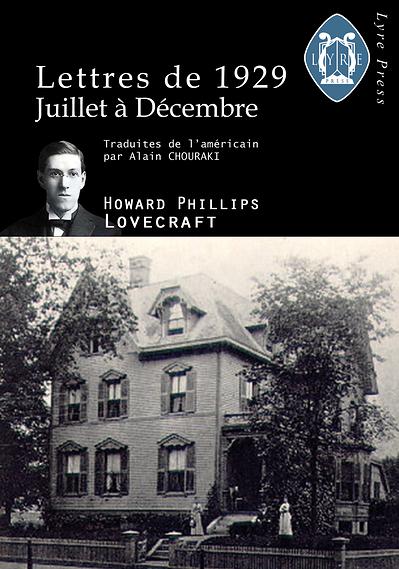
I assume these 82 letters don’t overlap with those in a book by another translator, Lettres de 1929: Juillet a Decembre published in 2021…
This collection offers us, in a quality translation, a selection of thirty letters written between July and December 1929, absolutely unpublished in French. Together with a very useful “glossary” of almost 50 pages, to help the French reader understand the numerous references found in these letters.
Incidentally, I believe Lovecraft’s translated tales first appeared in French in 1954? Which would make 2024 the 70th anniversary of the French discovery of Lovecraft.
25 Monday Mar 2024
Posted in Scholarly works
Voegelin has a new review of the relatively new book Theology and Lovecraft (2022)…
to say that Lovecraft was a man of his times is an understatement and deflection. He was more a man out of time, living firmly in a romanticized past and fantasizing about a dangerous future. This was a religious endeavor – which is to say, a mission of devotion and worship – even for a staunch atheist like Lovecraft.
See also the 2020 open-access article Altar Call of Cthulhu: Religion and Millennialism in H.P. Lovecraft’s Cthulhu Mythos. Which, incidentally, is under full Creative Commons Attribution.
This article offers a close analysis of millennialism within Lovecraft’s thought” as seen in three tales.
And in the latest Aeon magazine, H.P. Lovecraft, philosopher.
23 Saturday Mar 2024
Posted in Scholarly works
New in Dissections: Journal of Contemporary Horror, a long review of What Is Anything: Memoirs of a Life in Lovecraft and also of Joshi’s Journals: 1974–1987.
16 Saturday Mar 2024
Posted in New books, Scholarly works
Jan B. W. Pedersen, author of various articles in the Lovecraft Annual, announces a new book for June 2024. His H.P. Lovecraft: Midnight Studies is to be published by the academic publisher Peter Lang.
Also spotted, in the Spring 2024 edition of Exacting Clam… “Henry Wessells on Melville and Lovecraft”.
09 Saturday Mar 2024
Posted in Scholarly works
NecronomiCon Providence has issued the call for the Dr. Henry Armitage Memorial Scholarship Symposium, to be held at the impressive Omni Hotel, Providence – 15th-18th August 2024. Among the most interesting suggestions for possible topics are…
* Lovecraft’s correspondence as pre-blogging/travelog
* [Publisher] “Arkham House” and its heritage: further discoveries in its archival history
“Pre-blogging” is a new one to me. Never heard of it before. Seems that it may mean ‘a blog post you write before you actually do something, which you then also blog about afterwards’. Or they may just mean historically, that Lovecraft was ‘using letters as a form of blogging, before blogging was invented’? If the latter, it raises the question of his often phenomenal memory. Did he, like a modern blogger today, have substantial ‘search access’ in his mind to much of importance that he had written in his correspondence? “Lovecraft’s memory” might make an interesting topic for a short talk, showing just how good it was, how it worked, pointing to where and why it might have failed over time, and all the while drawing examples from the correspondence.
Anyway, submission deadline for the 2024 Symposium is 24th May 2024 and “early submissions are encouraged”.
2024 Call Flyer and contact details.
Omni Hotel
06 Wednesday Mar 2024
Posted in Scholarly works
Another quick scamper around the tunnels of academia…
* “Science and Madness: Echoes of Freudian Psychoanalysis in the Works of H.P. Lovecraft”, an M.A. dissertation. “Available for download on Thursday, April 25, 2024”.
* H.P. Lovecraft’s monsters of modernity read through J. J. Cohen’s ‘Seven Monster Theses’. Another Masters dissertation, from 2022 and also embargoed, but with a substantial abstract. As well as the oft-cited racial fears…
“The study finds that Lovecraft’s monsters are in part influenced by religious uncertainty following the First World War, the scientific advancements of Einstein’s theories of relativity, and the economic uncertainty of the American Great Depression” and at a deeper level “laissez-faire capitalism and Judeo-Christian thought”.
* In Indiana, the 2023-2024 IDAH HASTAC Scholars include a reseacher looking at… “the role of magic in weird fiction, particularly that influenced by H.P. Lovecraft. As part of this work, Sam utilizes computational text analysis methods such as topic modelling and document classification.”
01 Friday Mar 2024
Posted in Picture postals, Scholarly works
A new project at Brown University, the Archaeology of College Hill. Taught, appropriately enough, more or less right alongside Lovecraft’s old garden, by the sound of it and by what can be seen in the photos.
The students have…
began an archaeological excavation of a green space next to Brown’s List Art Building … [the old] 58 College St. … In the late 1930s, it housed the now-inactive Alpha Tau Omega fraternity.
This was the closely adjacent building, close enough for Lovecraft to observe students from his windows, as his sunsets lowered into dusk and one might see into other houses before the curtains were drawn. The place featured in “The Haunter of the Dark”…
Students in the Psi Delta house, whose upper rear windows looked into Blake’s study, noticed the blurred white face at the westward window on the morning of the 9th, and wondered what was wrong with the expression.
Close enough for students to also see Lovecraft’s (Blake’s) expression while at his desk. There was no “Psi Delta” chapter in Providence, according to Annotated Lovecraft. It was thus Lovecraft’s polite gloss on the real Alpha Tau Omega. Presumably he had no wish to antagonise his direct neighbours, should they come to read the tale. As well they might. Yet the Tau Omega is referenced a little later in the story…
A youth in the Tau Omega fraternity house thought he saw a grotesque and hideous mass of smoke in the air just as the preliminary flash burst, but his observation has not been verified.
One hopes the current Brown students may move just a few yards back toward the List building in the future, and thus begin to excavate the site of Lovecraft’s garden. Now there’s an idea for a Mythos story.
Also relating to the List building, here’s one which may interest pychogeographers more than archaeologists. Just over 40 years after Lovecraft’s death, a 1978 meditation by Debra Shore on the top floor of the cramped and apparently rather spooky List Art Building. This is the modernist building the edge of which is seen in the above photo, and which stands on the site of Lovecraft’s home at 66 College Street. The peice for the Brown Alumni Monthly seems oblivious to the shade of Lovecraft, although obliquely evokes The Rats In the Walls, Pickman’s Model, Hypnos and others, for those who know their Lovecraft…
Located at the top of the building, where the stegosauric [i.e. dinosaur] ribs soar over the Providence skyline, rising massively from the Hill, is the painting Studio. [In which …] A sextet of crabs (blue, purple, green, gold, maroon, burnt orange) scrabble on a canvas, covering letters — which spell underneath, WE DREAM. […] A plaster head labeled “Phrenology” sits on a table. The skull is quartered, then divided further: the sections numbered. […]
The place is a mess, the floor lined with paper towels, cigarette packs, stretcher strips, empty turpentine cans, paper, cups – the debris of doing art. The floor is spattered with paint, scarred and splotched, scratched and marred. The walls have become a canvas, too, a backboard for design ideas to be batted against, an easel for a canvas to be stretched across, a sketchpad. Even the windows have become stained.
The sky, through one long slit window, is a subtle gradation of pastel hues, a value-study called sunset, a pale wash. Through this window, smeared with paint, the city glows, bustles, empties, rests. My reflection mirrors me; behind, the easels wait, the colors deepen in hue. The light flows in, and out. A new piece of cut canvas is draped over a new wooden frame, ready to be stretched and primed. Long strips of wood, like tallest reeds, lean against a wall. In the studio at dusk, a single painter paints. The others have packed up and gone home. The easels stretch toward the sky. A saxophone wails on the radio. Night comes.
29 Thursday Feb 2024
Posted in Scholarly works
The venerable British SF author Brian Stableford has passed away. I can’t speak to his fiction, though I recall reading his SF books in the early 1980s and I know his range later included Lovecraftian Mythos tales (The Innsmouth Heritage and Other Sequels, etc al), fantasy tales (collected in Fables & Fantasies from Necronomicon Press) and acclaimed genre pastiche and mash-ups (Sherlock Holmes and others). Here I try to piece together a very basic overview of his scholarly works. Others will doubtless do a far better job in time, for one of the most prolific British writers. One hopes they’ll also say a word or two about the fine cover-artists he must have enjoyed having from time to time…
In 1979 he made his name as a critic with a study of the works of fellow SF author James Blish, A Clash of Symbols: The Triumph of James Blish. So far as I can tell, he never wrote on Lovecraft but a taste of his wide range of interest can be found in the contents list for his Slaves of the Death Spiders and Other Essays on Fantastic Literature (2017). With essays on H.G Wells and Dracula, SF of the 1980s, and also the infamous British 1990s censorship case of Lord Horror, plus his musings on the modern profession of science-fiction writing as a profession. He wrote at length on the latter topic in Writing Fantasy and Science Fiction. Several other essay collections on the craft, and DIY guides to writing SF, can also be found.
He was most interested in the deep roots of science-fiction, and became the authority of seminal but forgotten figures in the early ‘scientific romance’ such as Birmingham’s Sydney Fowler Wright (Deluge, The World Below and others), writing introductions to new editions, collecting and publishing S. Fowler Wright’s Short Stories, and editing books with a wider scope such as Scientific Romance: An International Anthology of Pioneering Science Fiction, the multi-volume scholarly book-series Scientific Romance in Britain 1890-1950; plus the later New Atlantis: a narrative history of the scientific romance.
He was also interested in the intersections with decadence, with historical collections such as Decadence and Symbolism: A Showcase Anthology, and at least two volumes of the Dedalus Book of Decadence. Exemplary early drug literature he collected in Snuggly Tales of Hashish and Opium. Recently he produced the representative collection Weird Fiction in France, and The Dedalus Book of British Fantasy (19th century).
He collected sea tales of alluring sirens in The Snuggly Sirenicon and Fays of the Sea, made an anthology of early femme-fatalle stories, and in Tales of Enchantment and Disenchantment wrote a history of faerie as a lead-in to “exemplary anthology” of such early tales and with a focus on the female ‘fay’.
In his later years he produced anthologies of proto-science fiction such as News from the Moon, and volumes of translations of early French science fiction such as Nemoville. His translations of early French imaginative authors would fill a small library, and his The Plurality of Imaginary Worlds: The Evolution of French Roman Scientifique provides the guide-book. Side-interests included early proto-robots, evidenced by the book Automata which collected stories from the 19th century featuring such ‘automata’ devices.
I see he had bibliographic articles published in the Book & Magazine Collector, introducing collectors to the likes of R.E. Howard and M.P. Shiel.
One can also find his name as editor (and probably also writer) on volumes such as The A to Z of Fantasy Literature; Science Fact and Science Fiction: An Encyclopedia; the Historical Dictionary of Science Fiction Literature; Dictionary of Science Fiction Places, and others.
Being British he was also interested in our own SF history, as seen in pieces such as “A Brief Economic History of British SF magazines” (in Space, Time, and Infinity: Essays on Fantastic Literature, 2007). Possibly there are more such out there.
That’s it for a brief survey. Doubtless I’ve missed a lot, but hopefully I’ve also given others some clusters to build on. Or just titles to read. He wrote a lot, but was not publicised a lot — and so you may well find titles above that you had no idea existed.
29 Thursday Feb 2024
Posted in Odd scratchings, Scholarly works
A paywalled chapter in the new book Hydrology and Its Discontents, “A Psychoanalysis of Wet Dreams”. Academia is still peddling Freud, Jung and Lacan into the 21st century, I see. But what’s this…
To chart a course through these hydrologic horrors, we invoke the spirit of H.P. Lovecraft, master of cosmic horror.
Well that’s a start, I suppose. I wonder if the author is aware of a Lovecraft ditty on the topic?
“(Wet) Dream Song”, a parody of a poet of amateur journalism called E.A. Edkins and “signed” by him in inverted commas, though definitely by Lovecraft…
“Oyster stew” here presumably being a euphemism for male masturbation. Which perhaps reveals an underlying reason for Lovecraft’s detestation of sea-food?
The “clamour of flowers / drove one quite frantic” on the beach is probably also a euphemism for bathing youth. One recalls Camus, evoking the beach of Oran in Algeria…
Oran also has its deserts of sand: its beaches. [ covered with flowers in winter, and girls in summer…] the sharp blue of the sky, everything makes one fancy summer — the golden youth then covering the beach, the long hours on the sand and the sudden softness of evening. Each year on these shores there is a new harvest of girls in flower. Apparently they have but one season. The following year, other cordial blossoms take their place […] (Personal Writings)
On the reverse of the card, presumably included with a letter and thus the correspondent is lost, Lovecraft writes… “I will illustrate the kind of [amateur pseudo-decadent] bilge I have in mind by by composing a parody here and now, currente Corona (*) and without apologies to any possible original or originals.” Which seems to imply that he was familar enough with Edkins’ work to parody it impromptu. The various dates, however, indicate that Lovecraft would not have gained his familiarity with Edkins’ work by revising it.
* meaning, with the current of ink still flowing from his Corona pen nib?
1920s Corona nib.
Lovecraft’s correspondent would likely have been attuned enough to see the subtle wit is his picking the word currente for a poem on the topic, in relation to a flowing pen-nib.
28 Wednesday Feb 2024
Posted in Scholarly works
Bookstore Chronicles. Being an oral history of bookselling in America, as told by the nation’s own booksellers. The call for participants is still active and they appear to want audio only. One option there is to… “record a self-interview and upload your audio file”. Or if you know an old bookseller you think should be interviewed, pop over with an audio recorder for an afternoon’s chat.
25 Sunday Feb 2024
Posted in Scholarly works
MarzAat reviews The Annotated Tales of Edgar Allan Poe (1981). I never knew it existed. Currently available ‘to borrow’ from Archive.org, or I see there are a few hardback copies from used booksellers at reasonable prices. The detailed review by MarzAat usefully notes the many Lovecraft connections.