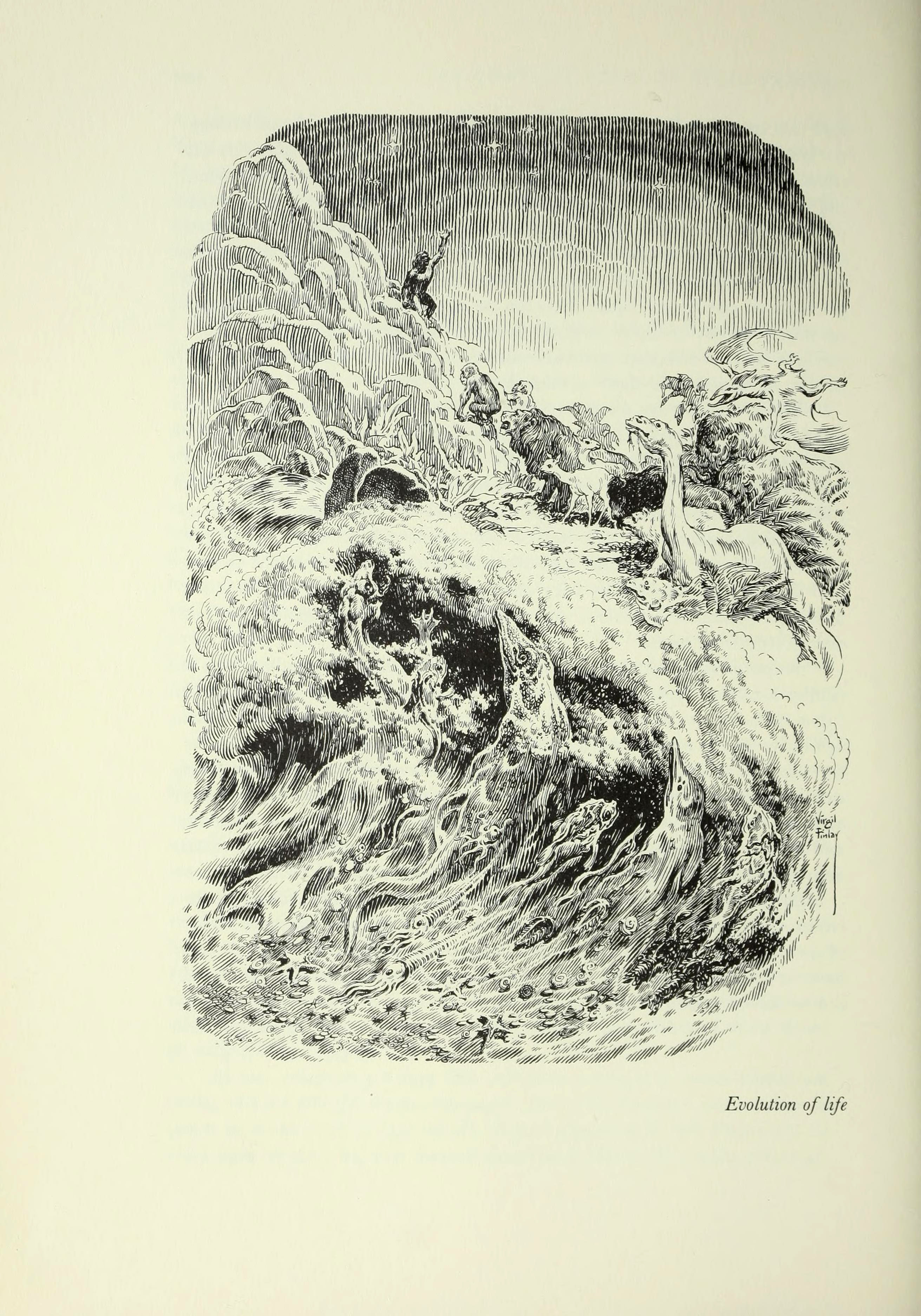
“Evolution of life” by Virgil Finlay, one of a series of illustrations he made for The Complete Book of Space Travel (1956).

01 Thursday Nov 2018
Posted in Lovecraftian arts
“Evolution of life” by Virgil Finlay, one of a series of illustrations he made for The Complete Book of Space Travel (1956).
30 Tuesday Oct 2018
Posted in Lovecraftian arts
I’m not taking much notice of videogames here, but the new Call of Cthulhu, released today, is so big it merits an exception to the rule.

The first reviews are out, for the major new videogame Call of Cthulhu (Cyanide Studios, 2018), which makes a serious attempt attempts to embody and package Chaosium’s Cthulhu table-top RPG game into a single-player narrative-driven mystery-horror videogame.
Big ambitious games such as this are best played on the PC desktop about 18 months after release, when multiple bug-fixing patches and mods have fixed their inevitable release-day problems. At that point there are often DLC expansion chapters to be had, and the overall price is cheaper.
But, on initial release today, the fan-boy and magazine reviewer sentiment seems to be broadly favourable. Though many of the (often spoiler-packed) reviews chafe at the usual Big Game gremlins…
* Unconvincing and stiff character animations, on characters that have to be low-poly so they can run on consoles.
* Characters are generic, and sometimes tell you about stuff that hasn’t yet happened in the game.
* Decent voice-acting, but some East Coast Americans may notice inconsistent dialogue accents.
* The stealth mechanics could benefit from a buff up.
* Some tiresome ‘key collecting’, a couple of annoyingly obtuse puzzles.
* Lacks ‘action’, for gamers who expect machine-guns and monsters every 30 seconds.
* The muted and gloomy colour palette and environments of the New England coast (Darkwater Island in 1924, standing in for Innsmouth) also spur some gripes, from those who might have preferred a more vividly-hued game.
But gamers are used to such things, and for a big RPG none of the gripes are really specific to this title. Generally the game looks like it’s made a fairly good landing on its first day, and is getting healthy amounts of praise. If the PC Windows version can be modded, and/or gets heavily patched (Cyanide Studios are good on that, I hear), infrequent game-players may well find that it’s worth a look this time next year. It’s probably likely to be more impressive to those who only play three games a year, than to the jaded seen-it-all-before types who play three games a week.
30 Tuesday Oct 2018
Posted in Lovecraftian arts, New books
A new illustrated artbook edition of “The Call of Cthulhu”, in French translation.

This one is, according to one translated review…
a fully illustrated edition of grand paintings by French artist François Baranger, concept illustrator of movies such as Harry Potter, Beauty and the Beast, and videogames like Heavy Rain and Beyond: Two Souls. […] Instead of blood, sharp fangs, mutilated bodies and other things we associate with terror today, Baranger emphasizes the suppressed, hidden horror that Lovecraft slowly escalates in such a masterly manner. It is not entirely unreasonable to claim that Lovecraft would give his ‘thumbs up’. […] The bound book is of a monstrous size (20 x 28 inches) [and] the quality of the edition is high for its price, with thick, shiny pages and a hard cover that should survive many readings.
Some of the illustrations are also available as movie-like print posters in limited editions of 120. I’m not sure if there are other painted illustrations and/or b&w pen-and-line illustrations inserted in the text, but “fully illustrated” implies that there might be.


30 Tuesday Oct 2018
Posted in Lovecraft as character, Lovecraftian arts, New books, Odd scratchings
Do we have enough “Lovecraft as character” appearances to do The Encyclopaedia of H. P. Lovecraft as Character, focussed only on the appearance of H.P. Lovecraft and his close circle as characters in stories, graphic novels, rock songs, games and more? I think we do. By now there must be at least a hundred such depictions of Lovecraft himself.
For instance, my recent Good Old Mac biographical book on Everett McNeil, the keystone Lovecraft Circle member, found ten such instances of him alone. And I haven’t even read the various books which treat the Lovecraft circle to a detective novel outing (such as the recent novel by Joshi), in which he likely also appears as a character. Nor the various table-top RPGs. McNeil had another depiction in one of the new graphic novels of Lovecraft’s life, He Who Wrote in the Darkness, and I would suspect he may also appears in the other new graphic novel Some Notes on a Nonentity: The Life of H. P. Lovecraft (though I haven’t yet seen that). That’s just one often-overlooked member of the Circle, and yet there’s already material enough for an Encyclopaedia chapter.
It might be organised by date and by cultural milieu:
Lovecraft as ‘living character’; pre-1937.
The War Years: 1938-1949.
The Depths of the Cold War: 1950-1964.
The Counter-culture: 1965-1975.
The De-censorship Decades: 1976-1996.
Gone Global: 1997-2007.
Haunting the New Puritans: 2008-2018.
Lovecraft’s Circle as Characters.
Due to the estimated cost of making it I won’t be the one to do such an Encyclopaedia, but if the idea tickles both your fancy and wallet then please feel free to give it a go. Bear in mind that acquiring all the works needed to comprehensively make such a book will require either a vast collection and/or a very plump wallet.
30 Tuesday Oct 2018
Posted in Lovecraftian arts

“The Innsmouth Look”.
29 Monday Oct 2018
Posted in Lovecraftian arts
Tags
Each October, inkers all over the world do a ‘drawing a day’ challenge which goes under the title Inktober, and post with a (this year) #INKTOBER2018 tag.

Here are a few Lovecraft ‘Inktober 2018’ drawings that caught my eye on DeviantArt.

By trapperkeeper, really capturing that old-time pulp feeling, with the help of some ‘Kirby krackle’…

Guarded by CAdamsIllustration…


There’s still time to do the last few challenges, Double | Jolt | Slice, which all offer possibilities for pulpy Lovecraft fun.

If you’re new to digital drawing, on a desktop have a look at the free open source Krita 4, its Inking 101 starter guide and Wolthera’s free Inking Brush pack for Krita 4. The brushes in Krita can have real-time smoothing applied, so as to smooth the freehand strokes made by shaky hands. It helps to have a ‘draw on the screen’ pen monitor, which are expensive but Ugee makes good budget models (I have a £300 1910B). As an alternative you can probably pick up a used large Wacom digitizer pad for about £50, but make sure the pen is still with it and fully working.
There are of course many Android drawing apps for tablets, the best of which used to be Autodesk Sketchbook. That’s no longer on the Amazon Kindle App Store, so (unless you want to do a fiddly sideload of it) the translated Japanese app called Tayasui Sketches + is a good alternative choice for inking on a Kindle HD 10″ tablet.
27 Saturday Oct 2018
Posted in Lovecraftian arts
Illustrator Ysemay Dercon visits Lovecraft’s former home at 10 Barnes St, for Halloween. I like the ‘collected leaves’ idea.


Perhaps one could draw on the actual leaves, incising them with the tiny tip of a fine scratch-board pick? And then record their drying out and changing colours and crumbling into weirdness. Or how about shaping them subtly into tiny dreamland-ish face masks?
27 Saturday Oct 2018
Posted in Lovecraftian arts, New books, Podcasts etc., REH
S.T. Joshi’s latest blog post notes an interesting audiobook, The Gods of Easter Island and Other Poems by Robert E. Howard.

27 poems expertly read and with some musical accompaniment. Available as a physical CD by mail-order from Fedogan and Bremer Books.
23 Tuesday Oct 2018
Posted in Lovecraftian arts
I’ve extracted the best Eddie Jones interior art from the run of Vision of Tomorrow, a short-lived 1969/70 British attempt at a high-quality science fiction magazine which featured occasional cosmic horror.


That’s how you do spreads when you only have black-and-white to work with. Very nice work.
There’s a fine in-progress biography of Eddie Jones, which is so comprehensive that it even tells me that I have a slight tangential connection — he did the covers of the Novacon convention programme booklet a couple of years before I did. Though the biography lacks the wider economic context. He produced a huge amount of painted covers for the German sci-fi paperbacks, a few for Sphere in the UK, and later some covers for the Star Trek paperbacks. But, like many in the UK, he was hit very hard by the 1978-1983 period of economic chaos, collapse and grinding recovery. He never had a book collection.
There was one fairly brief interview with him, in the short-lived British magazine Vortex (#5, 1977).
22 Monday Oct 2018
Posted in Lovecraftian arts, New books, Scholarly works
The original has been found for John W. Campbell’s famous story “Who Goes There?”, a 1938 Lovecraft-alike tale about a team of scientists in Antarctica and their horrifying encounter with a shape-shifting alien entity. Campbell’s unpublished draft for that, known as “Frozen Hell”, had 45 pages of unused material. The original is now set to be published in 2019 by Wildside.

Science Fantasy Review for Spring 1950 lists “Frozen Hell” as part of a forthcoming Campbell collection, but it seems that book never made it to print. The work was recently discovered by Alec Nevala-Lee, just sitting un-regarded in an archive box, while he was doing research for his new book on the history of the famous Astounding magazine.
22 Monday Oct 2018
Posted in Lovecraftian arts, Podcasts etc.
For the 500th episode of Pseudopod, a complete audio reading of Fritz Leiber’s story “A Bit Of The Dark World” (Fantastic, February 1962). He had written some early stories that drew somewhat on Lovecraft, back in the 1930s and 40s, but without pastiching the master. Today I think of him as a sword & sorcery author linked with the post-Howard Conan series, but here the mature Leiber attempts a tale of cosmic horror fit for the know-it-all world of the early 1960s.


Leiber had been musing about the nature of writing in changing times for some years, such as in his rip-roaring sci-fi comedy-satire “The Silver Eggheads” (1959, expanded as a novel in 1962). This features an A.I. science fiction setting in which ‘novel writers’ are machines with names such as the ‘Fiction House Fantasizer’ with Fingertip Credibility Control!). It’s also a little Lovecrafty, as it riffs on the idea of still-living “genetically-enhanced brains taken from the skulls of once-living writers”.

Sadly there’s no audiobook version of what appears to be a sci-fi comedy classic, and the OCR on the 1959 novelette version at Archive.org isn’t good enough for text-to-speech. Though the novel is, at least, newly available for the Kindle.
21 Sunday Oct 2018
Posted in Lovecraftian arts, Maps, Odd scratchings, Scholarly works
Here’s an elegant map, which might make a useful folded bookmark or paste-in for Lovecraft scholars. Especially those reading through the ever-increasing number of shelf-strainers that contain Lovecraft’s Letters and Essays, and who are trying to follow the old gent as he zig-zags through the coastal summerlands and backwaters of New England to alight on the doorsteps of fellow amateurs, correspondents and antiquarian museums. The map is from the 1922 edition of The geography of New England.

300dpi, in a 3Mb .jpg file. It’s not a fold-out, so there’s not much I could do about the gutter when aligning the two pages in Photoshop.
Also useful, for following Lovecraft’s more local walks into the city-centre, is a 1907 street-map of central Providence. Hand-drawn by a local, it was intended for use as part of a city-wide ‘open day’. As such it shows the hopping off points for the tram lines that Lovecraft would have used to get out and about, and it usefully highlights and has a fine-grained local awareness of which stores and buildings are worthy of notice. Again, there was not much I could do about the map’s gutter, as it wasn’t a fold-out map.
