• About
  • Directory
  • Free stuff
  • Lovecraft for beginners
  • My Books
  • Open Lovecraft
  • Reviews
  • Travel Posters
  • SALTES

Tentaclii

~ News & scholarship on H.P. Lovecraft

Tentaclii

Category Archives: Historical context

“The House and the Shadows”

14 Saturday May 2022

Posted by asdjfdlkf in Historical context

≈ Leave a comment

I find that J. Vernon Shea’s late memoir of Lovecraft is online, as printed in Fantasy & Science Fiction (May 1966). It can thus be seen in context. The magazine’s editor thinks, for instance, Lovecraft’s entire work to be “entirely unwholesome” and has “great reservations”. Elsewhere in the issue Fritz Leiber reviews the first book of the Selected Letters.

In I Am Providence Joshi much later remarked…

Some of his essays on Lovecraft — especially “H. P. Lovecraft: The House and the Shadows” (1966) — are quite notable.

Shea’s memoir runs to 7,700 words and seems more of an early attempt at a short biography than a memoir, and as such has largely been overtaken. It appeared six years after Moskowitz’s article-biography on Lovecraft (Fantastic, May 1960). But in context it’s an interesting snapshot of Lovecraft ‘as known’ among the science-fiction crowd in the summer of 1966. At that time the counter-culture was incipient but also still somewhat ahead in time. There was great disdain among the science-fiction gate-keepers for genre-mixing (fantasy/sci-fi, sci-fi/horror), allied to a huge concern for ‘respectability’ amid the ever-present thought of ‘what will the mainstream culture think of us?’.

‘Picture Postals’ from Lovecraft, 9 Canal St., Providence

13 Friday May 2022

Posted by asdjfdlkf in Historical context, New discoveries, Picture postals

≈ 1 Comment

Hurrah, persistence pays off. Friday the 13th might be unlucky for some, but it’s lucky for Lovecraftians. Because here at last is a picture of Lovecraft’s favourite Jacques Lunch, and at the 9 Canal Street address too. Aka “Jake’s”.

From the budget bundle-o’-local-photos book Rhode Island: Unforgettable Vintage Images of the Ocean State, published 2000 and now long out of print. Here cleaned, rectified and colorised.

The date is uncertain. The caption has it that Hugues Jacques and Pierre ‘Leo’ Jacques are seen behind the counter, and we know from Ken Faig Jr. that they took over the former bar in 1923. So it is probably at about that date or a little later. One can see a docks-worker and probably at least one docks foreman or truck-driver eating at the counter. As well as several old gents who might be of limited means, perhaps the “Salvation Army derelicts” as Lovecraft once referred to them in a letter. A certain ‘Domingo’, not seen, also regularly served behind the counter…

Toward Domingo, an olive-skinned, behind-the-counter servitor at Jacques’, his favorite eating place in Providence, he was as affable as a courtier in a drawing room.” (Talman, on Lovecraft)

Lovecraft had discovered this cheap and abundantly sustaining eatery via Talman in 1926, and from then on he regularly enjoyed its man-sized portions of cheap food. He does not appear to have been a daily or even a weekly customer, but he dropped in and was well known to the place and its people — especially in the summer “visiting season”. The place seems to have slowly slid downmarket over the years. From late summer 1933, and as the Great Depression deepened, Jake’s began to tolerate what Lovecraft called “extremes in the matter of clientele”. He sought out other nearby options, and came to patronise a nearby Al’s Lunch. However, perhaps the “clientele” situation eased. Since Ken Faig Jr. has established he was still eating at Jake’s in August 1934 and March 1935. One day in mid September 1935 Lovecraft found Jacques abruptly closed, the business having failed at last. Lovecraft looked forlornly in the windows again at various times, but found it always “still vacant”.

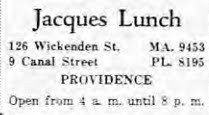
Also newly discovered, as seen in my earlier post, the opening times as they stood in April 1933…

It’s a gas…

11 Wednesday May 2022

Posted by asdjfdlkf in Historical context

≈ Leave a comment

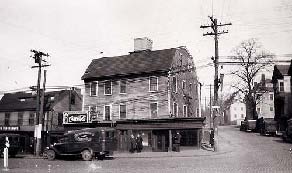
I’ve updated Monday’s 132 Wickenden Street post. I had mis-typed “Jack’s” instead of “Jake’s” a couple of times. Corrected now. I’ve also re-thought what Faig’s “one door east” means in the context of this new-found picture. It now looks to me like “Jake’s” had been on the opposite corner (i.e. the open forecourt seen here), and had moved across to the other corner at 132 when the Shell gas-station forecourt was built on the site of 126.

In which case this is it before the Shell station, albeit as a small picture…

* Opening times, April 1933 ad…

Both are closed from 8pm to 4am.

* March 1934 ad…

126 was now only in open in the afternoon and early evenings, perhaps a sign of staff problems. Canal St. was still only closed from midnight to 4am, with the expanded opening hours possibly a sign of needing the income.

* Late September 1935 ad…

The ad has No. 126 open 24 hours a day except Sundays, and no mention of Canal St. Which had closed down that same month.

132 Wickenden Street, Providence

09 Monday May 2022

Posted by asdjfdlkf in Historical context

≈ 1 Comment

Fox Point Photo History has placed online a post-1938 photo of “Jacques Lunch” courtesy of Lou Costa. To Lovecraft this was “Jake’s”. The date looks to be the early-mid 1950s, though I’m no expert on American cars and it might be later.

Jacques Lunch, [1]32 Wickenden Street. Looking north on Wickenden Street.

The photo has the “1” in 132 Wickenden Street cut off by the scanner. It had formerly been at No. 126, and moved to No. 132 in 1938. So this is the later site that Lovecraft would not have known, but it indicates the situation. Since Ken Faig Jr.’s Moshassuck Monograph Series No. 18 (2019) has scrutinised the maps and puts the move from 126 to 132 as only “one door east”. In which case, as the picture looks north, the old location known to Lovecraft was very near if not adjacent to the above cafe. I wonder if it had perhaps been where the Shell garage forecourt is, as seen on the picture?

“Jake’s” as Lovecraft called it was a key local haunt of Lovecraft’s from 1926. There were however two branches for Lovecraft’s fave Providence eatery, a cheap “stevedore restaurant” which he had discovered in 1926 via Talman. “Stevedores” being burly dockworkers. In October 1929, in a letter to Wandrei (p. 171) he give a tantalising flavour of the place. Lovecraft records that he had recently enjoyed a visit to Jake’s with Talman. But he also recalls that the nervous Cook, visiting Lovecraft in Providence a short while later…

somehow harboured the least bit of reluctance toward lining up to the counter [at Jake’s, Canal St.] betwixt [black] stevedores and Salvation Army derelicts

This more central Canal St. Jake’s (formally “Jacques”) closed during the Great Depression, in September 1935. But a little later Lovecraft was pleased to discover that the other Wickenden Street branch of his favourite cafe was still open down on the even rougher waterfront at Fox Point…

I have discovered the slum branch of Jake’s is still open, so that if the call of old times is sufficiently strong, we can plunge down South Main St. & tank up with the familiar overdoses in a hardy waterfront section where the sparrows chirp in bass & the policemen go in carbine-bearing squads.” (November 1935, the volume of Wandrei letters, page 345). [carbine-bearing = bearing rifles].

However in July 1936 he told Talman in a letter that he had not recently visited the Wickenden Street branch on Fox Point, to confirm that the surviving waterfront branch was still open. It is of course possible he did visit Wickenden Street with Wandrei in November 1935, but his comment to Talman shows he was not sure if it had survived into the late summer of 1936. My thanks to Ken Faig Jr. for the 1936 letter data.

Here we see Fox Point and the docks in the distance, looking across to it from the Market Place district. The New York passenger boats arrived and departed there (see the pair of far white boats), and Morton and Loveman and possibly others used this method rather than the railway. I seem to recall that Sonia also travelled by boat. Thus Lovecraft would have walked up to the Point to meet them or see them off.

Wickenden Street was on the edge of the Fox Point ‘wedge’, and it does not seem impossible that this cafe would have been a natural destination with a friend fresh-off-the-boat and hungry for hot cheap food. The anarchist Morton being the most likely candidate to eat in a cheap “slum” cafe catering to stevedores and merchant sailors. As evidence of his venturesome-ness one can point to the time that he and Lovecraft clandestinely snuck into the adjacent rail-freight yards, then puzzled their way through a maze of sinister box-cars to reach a good shore view.

Here we look down on Fox Point, and the cafe appear to be more or less in the centre of the picture. Though I think it must be obscured by other buildings. The New York Boat docks are off camera on the right. The rail-freight yards are too low down along the shoreline to be seen.

The river Seekonk can however be seen in the distance, and perhaps a line that indicates one of the Twin Islands. The young Lovecraft used to land on these with his rowing boat, when he was a sturdy lad.

‘Picture Postals’ from Lovecraft: Brooklyn Botanical Gardens – part two

06 Friday May 2022

Posted by asdjfdlkf in Historical context, Picture postals

≈ 1 Comment

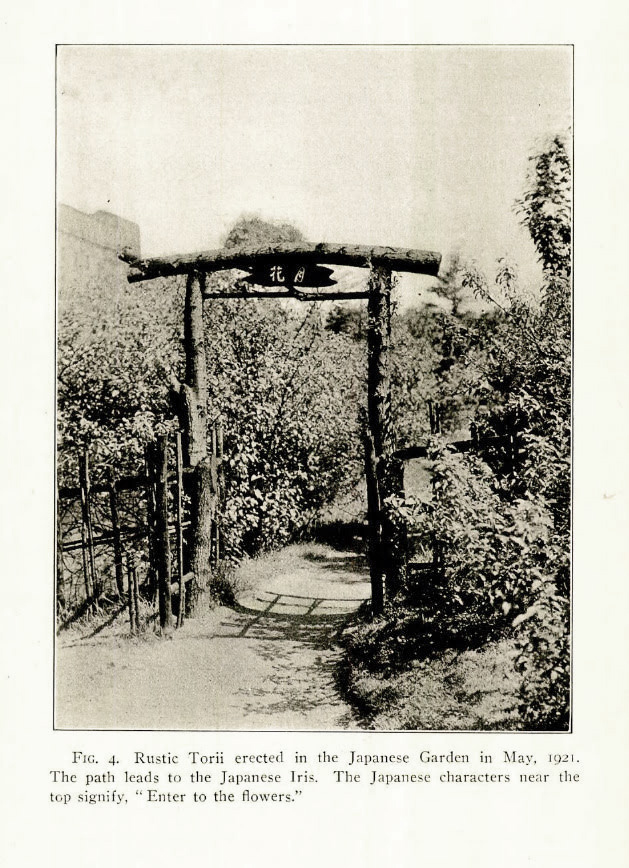
This post follows on from ‘Picture Postals’ from Lovecraft: Brooklyn Botanical Gardens – part one. This week I take a look at the Japanese Gardens, a favourite of Lovecraft when in New York City.

Reading Lovecraft’s letters, one might imagine these gardens were perhaps something rather small and oblong. Picturesque but, in a busy city, rather ‘crammed in’ alongside the overshadowing museum. In reality they were effectively a large and highly landscaped park, some way from the museum building and maturing nicely by the mid 1920s. They formed just the corner of an even larger park. This larger park had many features, including a run of gigantic tropical conservatories that in the 1920s were said to be some of the most extensive and well-stocked in the world. In the view seen below the Museum is located in the top right, with the Japanese ‘hill and pond’ garden park below it.

Here we see one of the Japanese garden’s small shrines in the Lovecraft period, newly colourised by me. The artist seen painting was actually one of the staff, and thus was very lucky. Because the institution’s journal for the period shows that artists and photographers were strictly forbidden from bringing any kind of tripod, stand, easel, seat or sitting device. Thankfully dogs were also banned, which must have pleased Lovecraft.

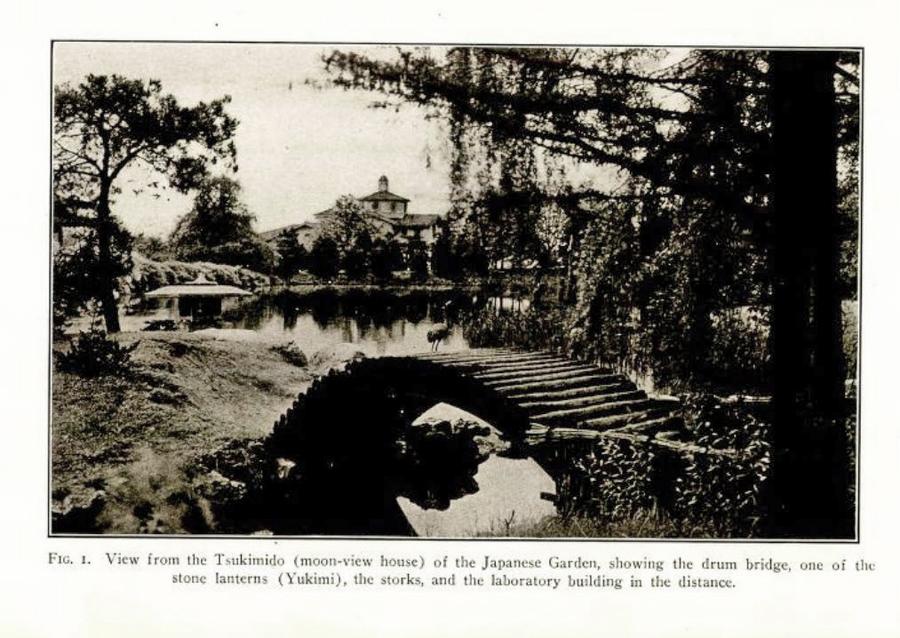
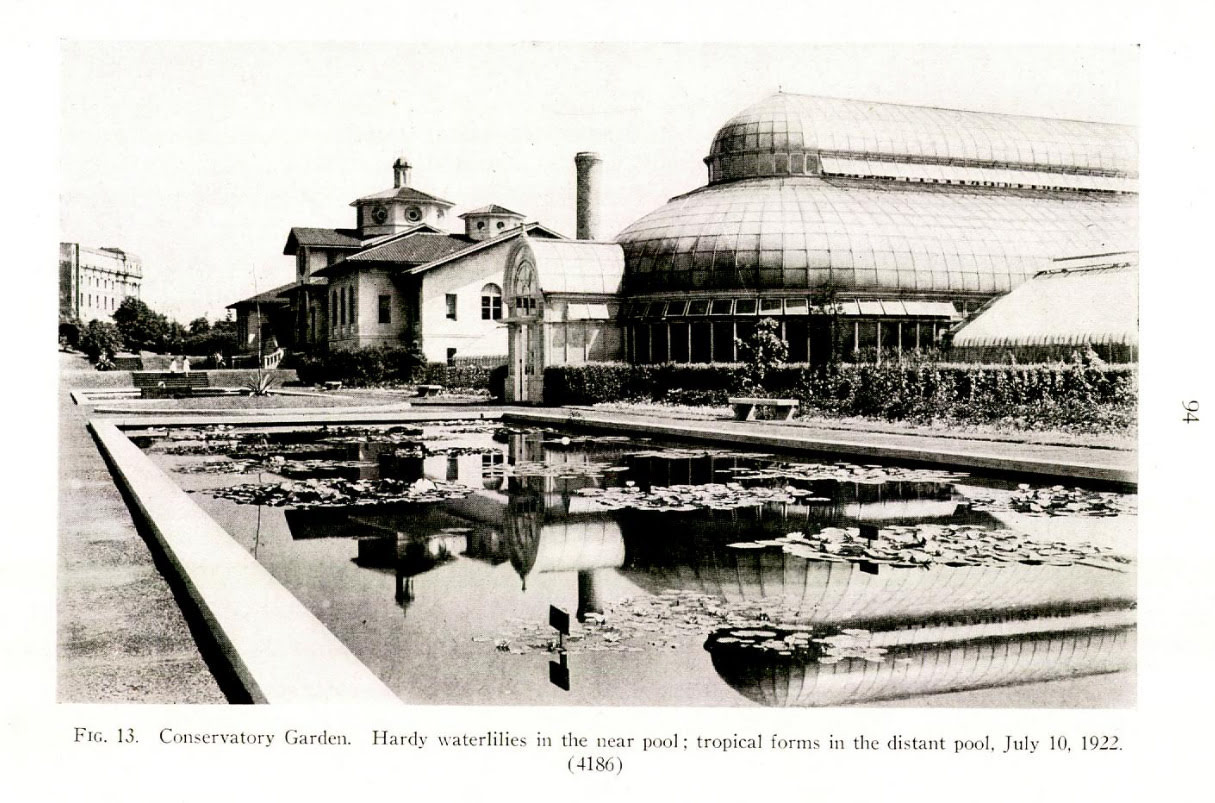
The rest of the pictures are rather poor quality, but are from the Lovecraft period. As such they indicate what he would have enjoyed in one of his favourite places.

The White memorial, for the philanthropist — importer by trade — who made the vast gardens possible. He died shortly before Lovecraft came to New York.

The Japanese rock garden seen in 1917, with the planting around the boulders still maturing.

The Lily Pools outside the Conservatories were obviously meant to ease the landscapes of the Japanese Garden into the long terraces that ran alongside the Conservatories.

One of the Conservatories seen in 1936.

The omnipresent gardens were almost terrifying in their strangeness, with bizarre and unfamiliar forms of vegetation nodding over broad paths lined with curiously carven monoliths. Abnormally vast fern-like growths predominated; some green, and some of a ghastly, fungoid pallor. Among them rose great spectral things resembling calamites, whose bamboo-like trunks towered to fabulous heights. Then there were tufted forms like fabulous cycads, and grotesque dark-green shrubs and trees of coniferous aspect. Flowers were small, colourless, and unrecognisable, blooming in geometrical beds and at large among the greenery. … Fungi of inconceivable size, outlines, and colours speckled the scene in patterns bespeaking some unknown but well-established horticultural tradition.”

— from The Shadow out of Time.

‘Picture Postals’ from Lovecraft: Brooklyn Botanical Gardens – part one

29 Friday Apr 2022

Posted by asdjfdlkf in Historical context, Picture postals

≈ 2 Comments

This week on ‘Picture Postals’, part one of a look at the Brooklyn Botanical Gardens. The Japanese Gardens alongside the Brooklyn Museum became one of H.P. Lovecraft’s favourite places in New York City, his…

favourite Japanese garden beside the Brooklyn Museum

One can see the arrangement here. The Museum building is seen at the top of the picture, the run of conservatories are below, and the Japanese ‘hill and pond’ garden sits between them.

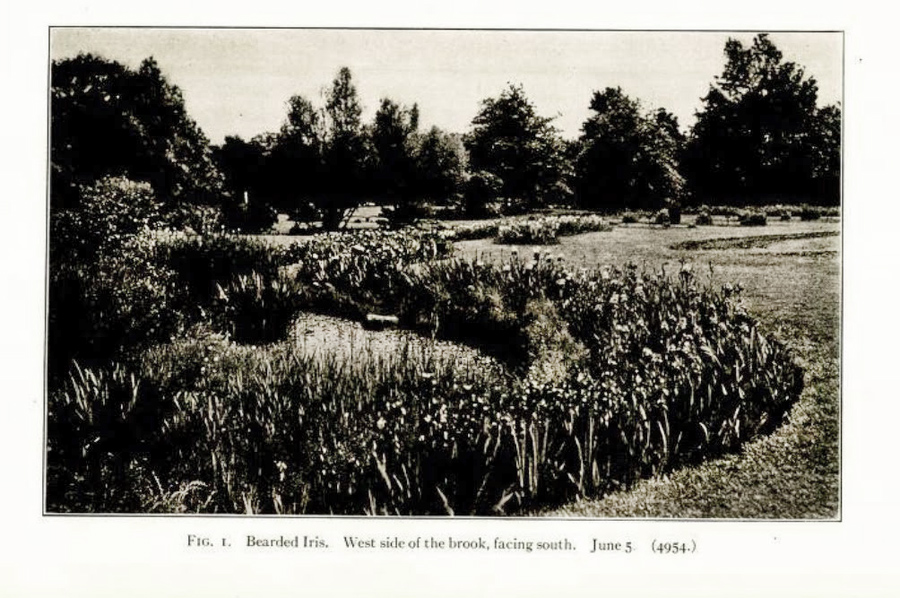
Sadly, as you can see, the quality of these pictures is not great. The Museum does have some of its public domain glass-plate pictures online (at rather pointless sizes), but those are only some of the pictures to be seen in old books and journals. But you get the idea from the pictures below.

Inside would be exotic steam-heat, which Lovecraft enjoyed, and which he might have especially welcomed if he had visited on a chilly Christmas / New Year visit. Also to be seen would be strange plants and sinister pods.

Interestingly in the mid 1920s there were film shows there that might have entertained him. This example is from 1923…

So far as I’m aware, however, he does not mention visiting the hothouse after the Japanese Gardens. But it would seem unusual if he had never set foot in the place, when he made many visits to its next-door neighbours. It’s also known that he enjoyed other hothouses on his various antiquarian trips. I’d welcome any references to where he might mention the Brooklyn hothouses.

If they didn’t influence Lovecraft, it seems difficult to imagine them not influencing his good friend and Brooklyn native Frank Belknap Long. In the war years of the 1940s Long produced a series of pulp stories of exotic alien plants which go under the general title of John Carstairs, Curator of the Interplanetary Botanical Gardens.

Some anniversaries for 2023

25 Monday Apr 2022

Posted by asdjfdlkf in Historical context

≈ 2 Comments

Advance notice on some anniversaries for 2023…


50 years (1973):

(The year Lovecraft broke through to a mass audience)

“Over a million paperback [Ballantine] editions of Lovecraft’s work had apparently been sold in the USA by June 1973” (Joshi, Time magazine).

In the UK, the Panther paperbacks of Lovecraft (Dagon, The Lurking Fear, Lurker at the Threshold).

Lovecraft’s Supernatural Horror in Literature (as a popular cheap paperback Dover edition, 1973).

First hoax Necronomicon.

Esoteric Order of Dagon… “an amateur press organization formed by a group of Lovecraft devotees in 1973”.

Dirk W. Mosig begins writing on Lovecraft.

Wilfred B. Talman, “The Normal Lovecraft” (1973).

The Revised H.P. Lovecraft Bibliography (1973).


80 years (1943):

The Dream-Quest of Unknown Kadath published (1943, Arkham House, in Beyond the Wall of Sleep).

The Commonplace Book published (1943, Arkham House, in Beyond the Wall of Sleep).

Publication of “the first bibliography of HPL, by Francis T. Laney and William H. Evans (1943)” (Joshi).


100 years (1923):

Lovecraft completes his run of his amateur journal The Conservative.

Publishes “The Lurking Fear” shocker serial in Home Brew.

Weird Tales founded.

Lovecraft’s first appearance in a pulp magazine (Weird Tales).

“The Rats in the Walls”, “The Festival”.


120 years (1903):

The Rhode Island Journal of Astronomy.

Vaudeville at Keith’s, March 1908

25 Monday Apr 2022

Posted by asdjfdlkf in Historical context

≈ Leave a comment

A sample of the vaudeville programme at Keith’s theatre, March 1908.

Lovecraft fondly recalled, in a letter to Moe, “Keith’s Continuous Vaudeville” and the “new biograph travel films to chase the audiences out of Keith’s at six-o’clock”. He was recalling the years 1900-02 when he was ten to twelve years old. He is known to have visited “the old Keith’s Theatre” c. 1905 to see Houdini. The 1908 date of the above programme may be a bit late, as he would then have been around 17 years old, but the sort of vaudeville programme at Keith’s would not have changed much.

Notes on Selected Letters – part one

24 Sunday Apr 2022

Posted by asdjfdlkf in Astronomy, Historical context

≈ Leave a comment

Notes on the Selected Letters – part one:

I’ve decided to re-read Lovecraft’s Selected Letters over the summer. Here are my ‘Note on Selected Letters‘ for Volume 1, which I was lucky enough to get in a cheap ex-library copy some years ago. Thanks to my Patreon patrons who made that purchase possible. One of the nice things about such a hardback, compared to the paperback volumes of letters, is that the binding is such that they can lay flat when you open them and lay them on a table or book-stand.

Note that I skimmed and sometimes skipped a few letters from people I already have in their dedicated volumes, such as Moe and Kleiner.

* The planet Venus is noted, along with Develan’s Comet. Page 5.

* Lovecraft is hailed by key members of the audience as a “born public speaker”, after laying aside his script and giving his talk impromptu at the Hub Club. Page 124.

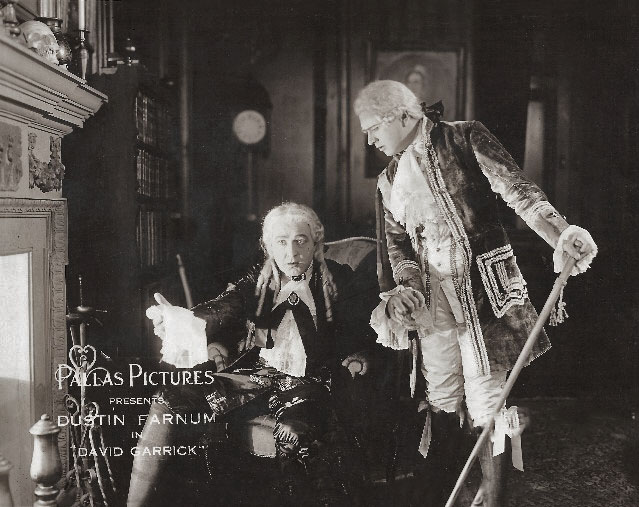
* He saw the movie David Garrick. He mentions the name of the leading man, so we know this was the 1916 version, seen below. Page 127.
* His amateur colleague Jackson kept scrap books of the best of amateur publications, in which Lovecraft found he featured heavily when he was shown them in Boston. I’m not sure if these scrap-books have survived. Page 126.

* In 1921 Lovecraft anticipates “the next war”. Page 160.

* “Don’t complain of the youth’s high-powered motor-car unless you can give him an horse and armour and send him to conquer the domains of the neighbouring kings!” Page 209.

* With his youthful telescope he… “gazed upon the moon’s frightful abysses where no diffusing air softens the nighted blackness of distorted shadows.” and “It has always been my intention to write a set of tales involving other planets”. The latter said in 1923. Page 214.

* He reveals why he ceased publishing his astronomy articles in the local newspaper… “The paper was sold to the Democrats”. Page 214.

* There is a magnificent extended description of a Portsmouth garden, which is almost a prose-poem in itself…

When it is twilight in the worlds, there are heard in that garden the invisible steps of MĀNA-YOOD-SUSHĀI, who is weary of Sardathrion’s gleaming walls and onyx lions, and would gaze softly and gently on that loveliness he hath created in his dreams.

MĀNA-YOOD-SUSHĀI is Dunsany’s ‘Dreamer of All Things’ god. Page 245-46. Lovecraft is writing fan-fiction, in 1923.

* In a 1923 exploration of the front part of Nentaconhant Hill [Neutaconkanut] he notes that at the summit an… “observatory in the Gothick manner, somewhat in disrepair, crowns this majestick acclivity”. Although the lack of any further description of his climbing this tower suggests there may have been no public access. The Rhode Island Historical Preservation 1976 survey listing for Johnson makes no mention of this tower, but this 1926 map shows the “King Observatory” and its location on the hill…
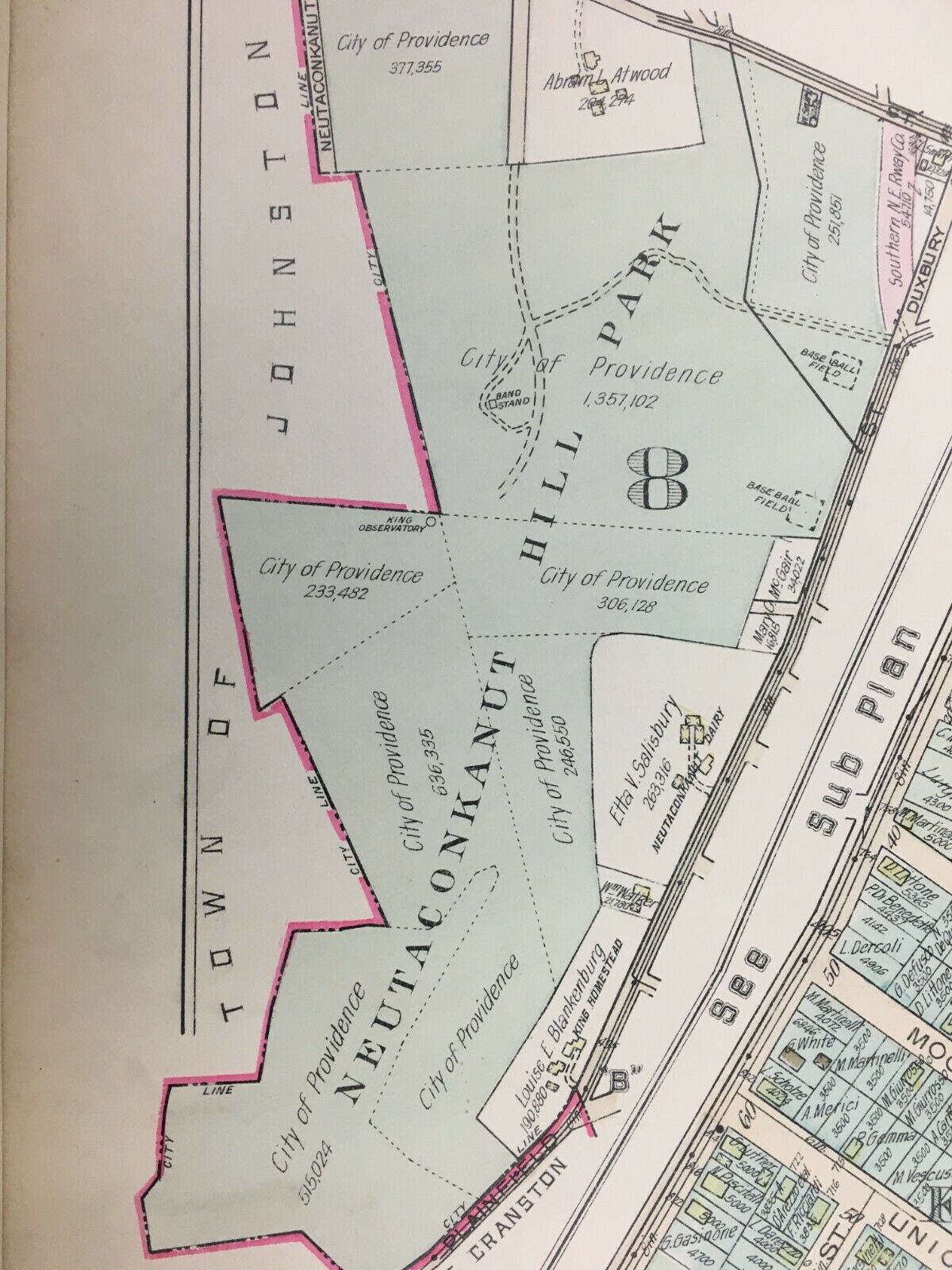
This was Abby A. King’s ‘The King Observatory’, a 60-foot tower “topped by an observation cupola”, though if for night-time astronomy rather than daytime sight-seeing is now uncertain. Perhaps the intent was to allow both. But Rhode Island Historical Notes for 1977 has a footnote, to an article on an early Boy Scouts trip to the hill, that reveals the above map was out of date. Since the tower, it states… “was burned to rubble by vandals in 1925”. This probably suggests that local youths had a clandestine way into the tower, and also suggests a heavy timber frame inside stone facing. Given this the setting thus presumably inspired ‘the tower scene’ in the excellent recent biographical graphic-novel Une nuit avec Lovecraft, although the tower is there imagined as having survived into the 1930s.

Only much later in his life did he discover the little-visited faun-haunted meads and twilit glades at the back of the same hill, then just outside the city boundaries…

* In early 1924 Lovecraft recalls of his earlier self..

In those middle years [after leaving High School I was] practically out of the world until three years ago [i.e. 1921]” … “the poor devil was such a nervous wreck that he hated to speak to any human being, or even to see or be seen by one; and every trip to town was an ordeal.

By “trip to town” he must mean for daytime or evening shopping and suchlike in the central market and business district, or for the Public Library / bookstores, rather than any hypothetical night-walks (he appears to have been largely nocturnal during this period).

* In early 1924 his planned “big novel” Azathoth will be “exotic and highbrow” and “wholly unsuited” to Weird Tales. While his lesser novel for the Weird Tales masses will be a “hideous thing … The House of the Worm“. Neither were written, of course. Page 295.

* There is a useful plain explanation, to a puzzled Frank Belknap Long, of what the submarine city in his “The Temple” is meant to be…

My submarine city is a work of man – a templed and glittering metropolis that once reared its copper domes and colonnades of chrysolite to glowing Atlantean suns. Fair Nordick bearded men dwelt in my city, and spoke a polish’d tongue akin to Greek; and the flame that the Graf von Altberg-Ehrenstein beheld was a witch-fire lit by spirits many millennia old.

There are only oblique hints of this in the tale…

1). The reader in the year 1921 is presumably expected to parse several mid-Atlantic locations. The submarine is preying on the “Liverpool-New York” civilian shipping lanes at “N. Latitude 45° 16′, W. Longitude 28° 34′”, something most schoolboys would then be familiar with via their school Atlas, which showed the shipping lanes. Later the submarine drifts well “south” of these shipping lanes, so… she is somewhere north of the Azores and thus outside the well-trafficked routes.

2). As for the underwater city, it is clearly prior to even the earliest Greek art… “impression of terrible antiquity, as though it were the remotest rather than the immediate ancestor of Greek art”. The reader, informed elsewhere by the historical-ethnographic categories known to the early 1920s, must thus deduce that due to its stated age the city was built by a primal unknown ‘Nordic’ culture which only later informed the known historical ‘Mediterranean’ type culture. There was in the 1910s a simplistic ‘Nordic vs. Mediterranean’ argument relating to the wider questions of Indo-European cultural origins and diffusion. Lovecraft is probably assuming that everyone is familiar with these divisions.

3). As for the “witch-light”, the story does offer a… “rhythmic, melodic sound as of some wild yet beautiful chant or choral hymn … vividly aglow with a flickering radiance, as from a mighty altar-flame far within”. Which seems clear enough. But by “witch-light” Lovecraft presumably means ‘a large but somewhat faint flickering radiance’, rather than ‘a light lit by witches’.

4). But that the flickering light (implied flame) has been lit by “spirits” is only meant to be deduced from the general ghostly underwater setting + the immense age of the place. Perhaps also by the carvings on the temple doors “exquisite carvings like the figures of Bacchanals in relief”, which indicates the spirited scene that awaits beyond. I can find no details on ancient temple Bacchanals which indicate that some sort of special large flickering flame was present at the interior aspect of these (the processions are better attested) but perhaps Lovecraft knew differently and expected others to know it too.

‘Picture Postals’ from Lovecraft: Cleveland, August 1922

22 Friday Apr 2022

Posted by asdjfdlkf in Historical context, New discoveries, Picture postals

≈ 1 Comment

This week’s ‘Picture Postals’ is part four of four, of a few notes on the new expanded edition of the Galpin letters. On page 293 Lovecraft usefully recalls the exact locations enjoyed during his 1922 visit to Cleveland. This was a very happy time for him as he was effectively released from his long hermitage. The addresses are…

1537 E. 93rd St. [Loveman’s family home], 9231 Birchdale [Avenue, Galpin’s family home, quite near to Loveman], Wade Park, Clark’s Lunch [north side of Euclid Av.], Taylor’s Arcade [south side of Euclid Av.], Eglin’s [bookshop]


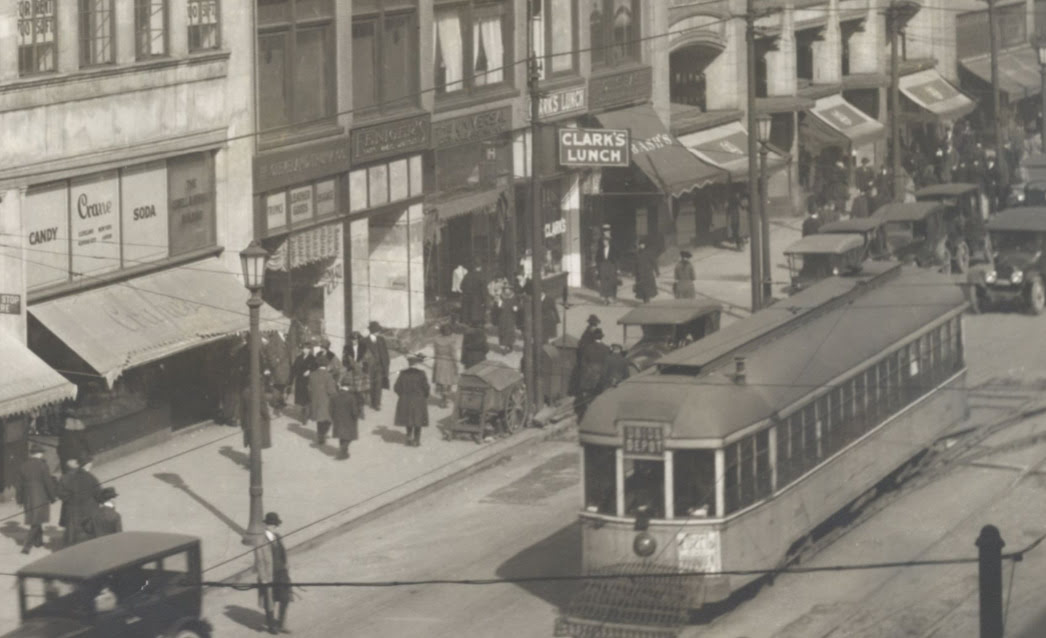
I found a good picture of a Clark’s Lunch on the central street called Euclid Avenue, and dated 1922…

Galpin met Lovecraft at the railway station and immediately took him to eat at a Clark’s Lunch, before they then went back to Galpin’s family home. This same Lunch was where he and the boys mostly ate their ‘meals out’ after that, as Lovecraft told his aunt in a letter.

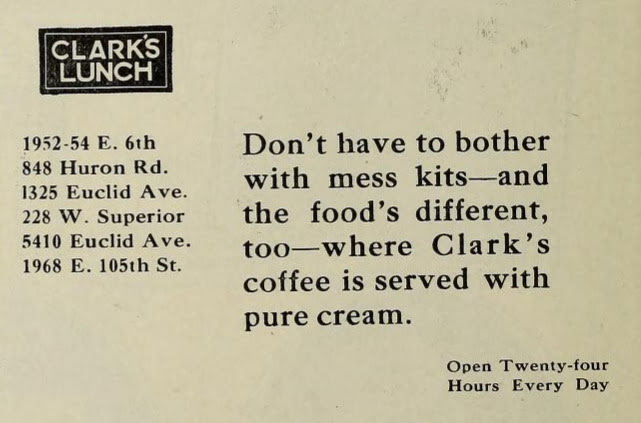
It’s pleasing to get a photo of the exact date, although the heavy coats and hats in the picture suggests a bright-but-chill springtime rather than the early August heat of Lovecraft’s extended and fatefully cheering visit. However, is this the Clark’s Lunch? The people look rather too upmarket and the hole-in-the-wall too small. Were there other branches? There were. The 1920 American Legion Convention booklet usefully yields the list of the city’s branches…

So, there were two Lunch’s on Euclid. And we now know that the branches were open 24 hours.

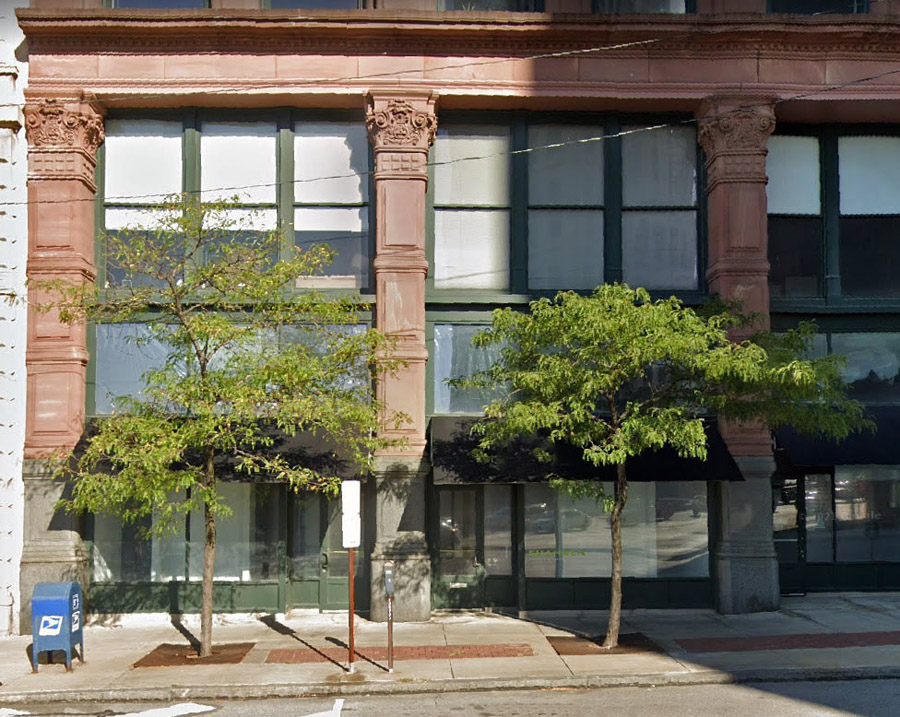
But which Lunch is shown? The one at 1325 Euclid or at 5410 Euclid? Enough of the surrounding architecture of one remains to be seen today on Google Street View, and thus the above picture can be confirmed as the central Lunch at 1325 Euclid.

However I’m still not entirely certain, as there were evidently other branches. Indeed there were 15 branches in the city by the 1950s. So let’s look more closely at the place of arrival and see if that helps. Lovecraft was on the Lake Shore overnight sleeper train from New York to Cleveland, seeing the Catskills in the distance as he travelled along the Hudson Valley (he would later that year set “The Lurking Fear” in the same mountains). In 1922 the Lake Shore sleeper drew in to Cleveland at the old and decrepit New Union Depot. This had been renovated in earlier decades, but was still then blighted by “years of accumulated soot and ash which had made the building into a dirty eyesore” according to the railway historians. In 1922 it was all-but defunct. The city’s long-planned gleaming station was still just bare cleared-ground at that time, and would only open in 1930. Thus we can be sure that Lovecraft arrived in the city at the old and decrepit New Union Depot. The question is then, which was the nearest Clark’s Lunch branch for the station?

Sadly, it’s not the one seen above at 1325 Euclid. Pity, but the situation did look rather too posh. The nearest to this station would have been the branch at 228 West Superior, on the west side of Cleveland Public Square and about a quarter mile walk from the New Union Depot. There was a large business college at 236 West Superior, and an athletics store at 226, with together suggest a student-ish atmosphere for the Lunch. The food appears to confirm this student-y supposition. The food there was found to be “humble” and “inexpensive”, as Lovecraft told his aunt (Selected Letters Vol. 1., p. 191).

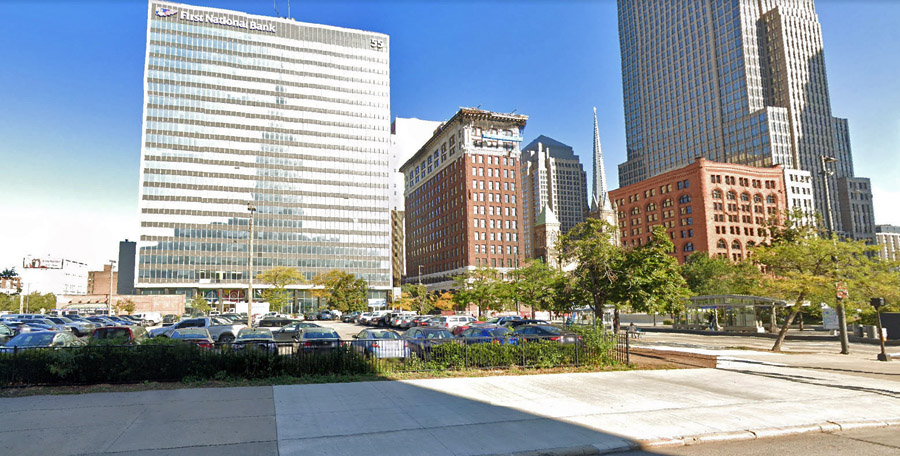
Unfortunately there don’t appear to be vintage pictures of that stretch of West Superior, and this row has since been cleared. It has long been a parking lot called Jacob’s Lot…

But the local press report that by 2024 the car park will be gone. From the site of Lovecraft’s Lunch will soar a new Sherwin-Williams Corp. mega-tower skyscraper. Suitably enough, for a place where artists and writers such as H.P. Lovecraft and Hart Crane once met, the company is ‘America’s Paint Company’ and makes paints.


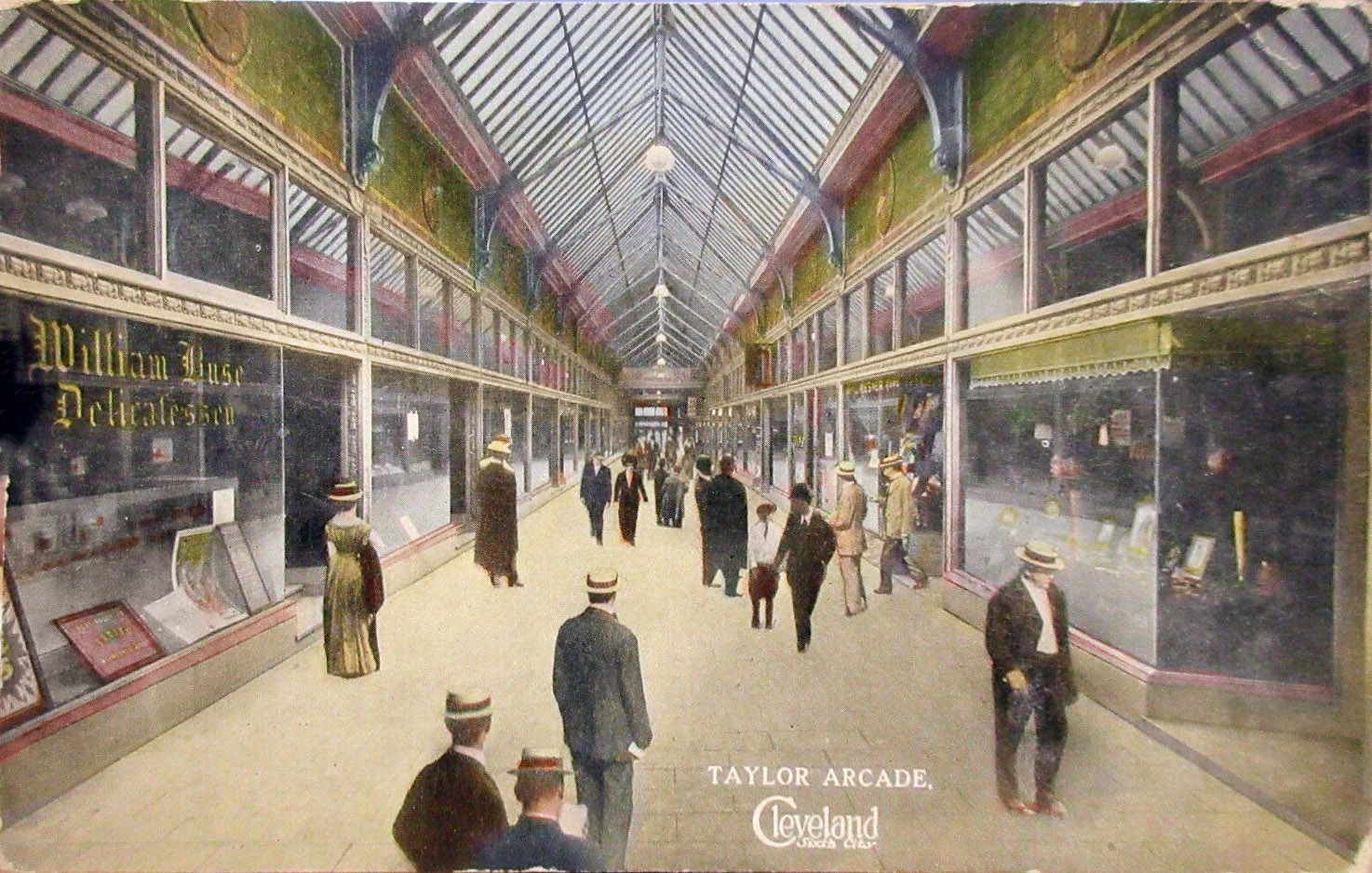
What of Taylor’s Arcade? This was on the south side of Euclid Avenue in its central run, and is here seen perhaps circa 1912-ish? A decade before. Not to be confused with another and far grander wrought-iron arcade in the same city, which still exists.


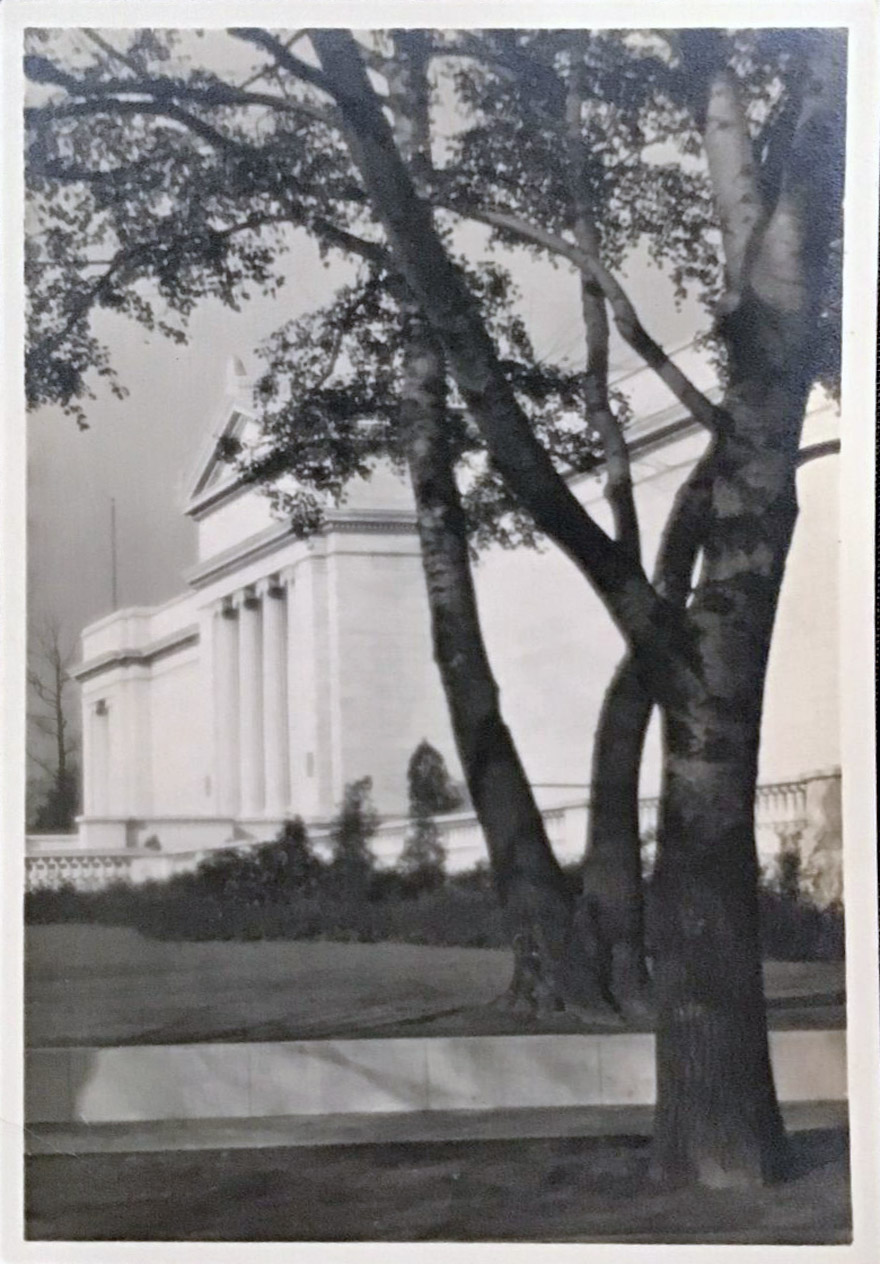
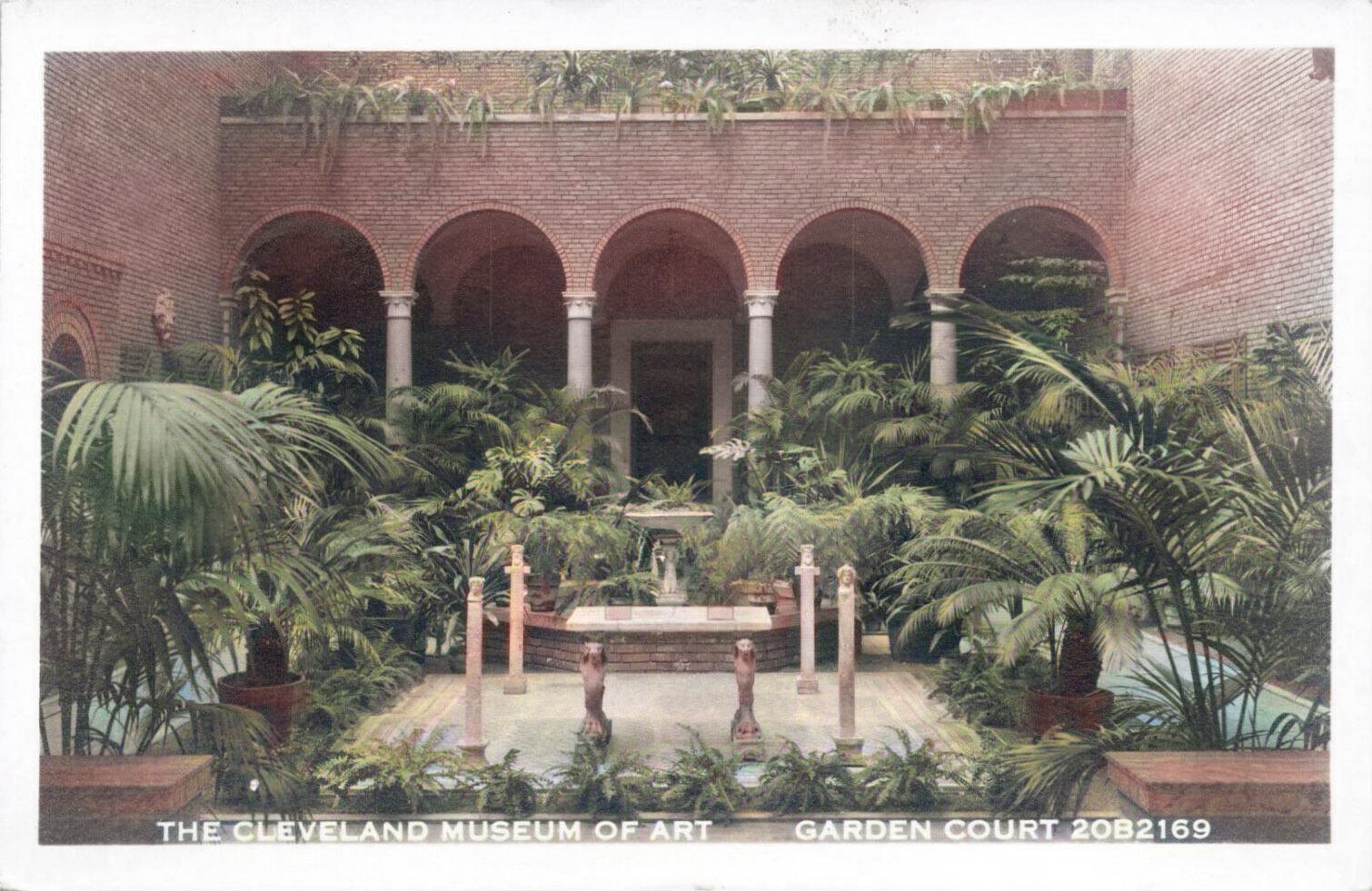
What of Wade Park? This had a large zoo with lions and polar bears and suchlike, and an art museum, as well as fine and expansive parkland with lakes. Lovecraft tells his aunt that he toured the “Cleveland Art Museum” there. Aka the Cleveland Museum of Art. This was housed in a long low classical building.

The museum displayed fine art and crafts from all eras and Lovecraft would have seen full armoured and mounted medieval knights, “Carthage” by the famous British artist Turner, Japanese porcelain, French paintings, and far more. Also the following approximate emulation of a Moorish-style courtyard garden, which appears (from another companion card) to have had a further small garden in a more eastern style with a central Buddha.

The heat of early-mid August 1922 was very heavy, and thus no doubt much to the liking of both the garden and Lovecraft. Strong heat always pepped him up. He also found that he needed to blend in more with the boys and thus he divested himself of his usual hat and stiff collar…

Can you picture me vestless [i.e. without a waistcoat], hatless, soft-collared, and belted, ambling about with a boy of twenty, as if I were no older? … One can be free and easy in a provincial city … What I need in order to be cheerful is the constant company of youthful and congenial literary persons. (Selected Letters Vol. 1, p. 293)


As for the bookshop, “Eglin’s” is the form elsewhere in Selected Letters which confirms the spelling. Also confirmed is that some of the shop’s after-hours reading events were quietly rather gay at that time (as the confirming spelling occurs in the context of Lovecraft’s comments on Gordon Hatfield and Loveman). The journal Phantasmus for 1924 then gives the address “Eglin’s Book Store, 824 Superior Ave.” and the 1925 American Book Trade Directory confirms. By March 1930 the sales-outlets list of The Rosicrucian mystical magazine shows it had moved down the Avenue to 806. Today its old site at No. 824 is a 4,000 sq. ft. modern art gallery, seemingly shelled from the original building and with some of the old frontage still intact.
No. 824 is about a quarter-mile west of the Clark’s Lunch branch at 228 West Superior (see above). This helps to very strongly confirm the likely branch at which Lovecraft, Loveman, Galpin and the Eglin’s crowd ate in 1922. Given the “humble” and “inexpensive” fare, from the branch of a growing and reliable 24-hour chain, it would have been the natural choice as a local eatery.

Loveman would later work at Eglin’s as a bookshop assistant, but when he lost the position he followed the poet and his sometime-lover Hart Crane to New York City. Lovecraft later followed Loveman to New York, and the rest is history.

Industrial Trust revived

21 Thursday Apr 2022

Posted by asdjfdlkf in Historical context

≈ Leave a comment

The Providence Architecture Here and There blog reports on the possibility of “New life for Industrial Trust building?”. This iconic central building having been vacant for a while now. Sadly it now looks set to become apartments, rather than the towering multi-floor H.P. Lovecraft & Mythos Madness Museum that the city should have enjoyed for the last thirty years.

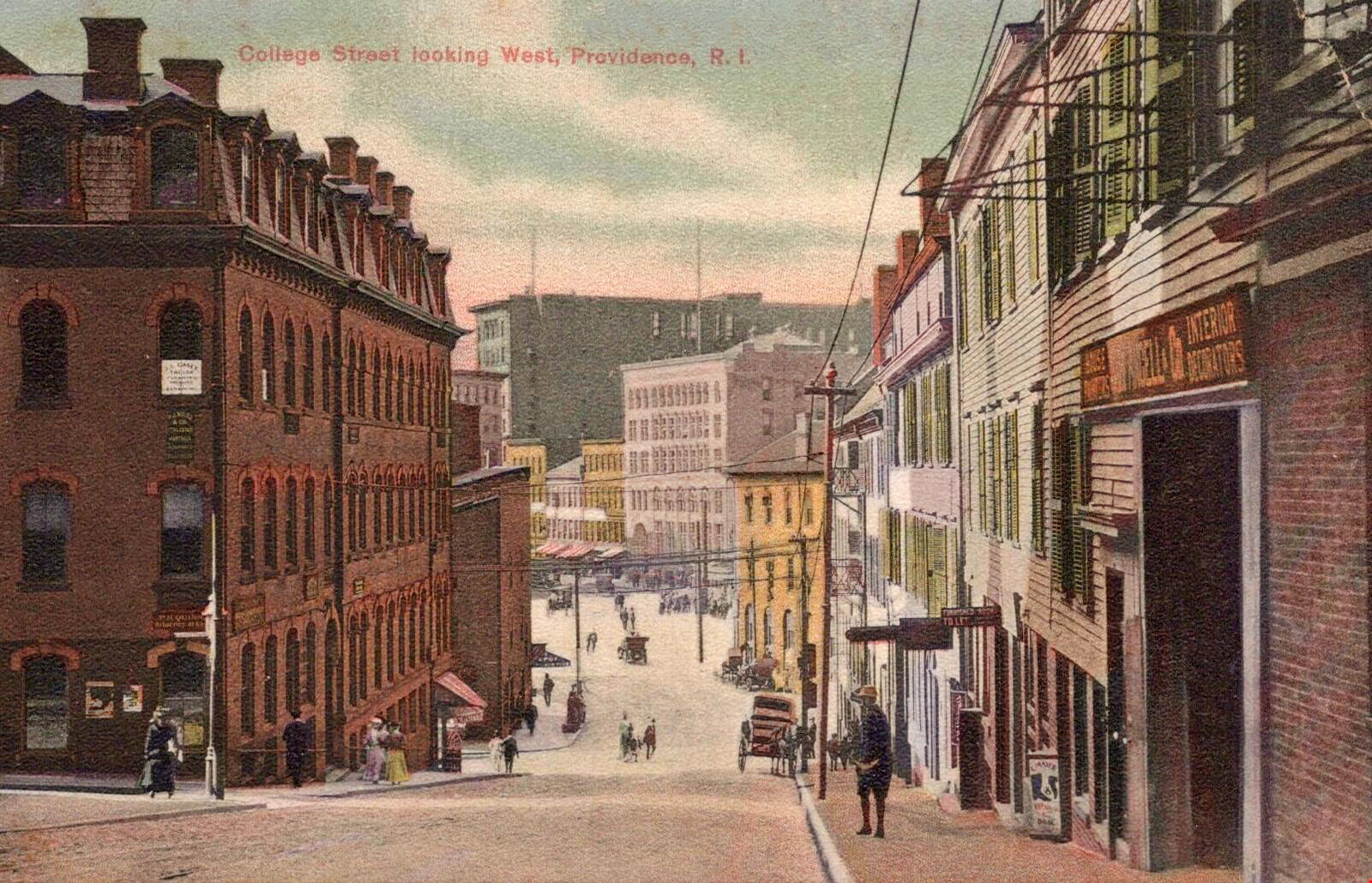
The article includes much local insight into the political machinations (of the sort that always seem to have dogged Providence), but also a very nice tip-off on an old Providence Journal photo of the building under construction in 1927 as seen from the foot of College Street. This inset picture quickly led me to the full picture, another ‘foot of Lovecraft’s College Street’ picture I had never seen before. I’ve here colourised it…

Compare with the same scene some 20 years earlier, as seen in another newly-found picture.

Shots Around Providence

18 Monday Apr 2022

Posted by asdjfdlkf in Films & trailers, Historical context

≈ Leave a comment

With thanks to Ken Faig Jr., a link to the new Shots Around Providence (1930s-1940) on YouTube. Via the Historical Society, which has kindly placed the amateur film online.

In one scene we see a Lovecraft-alike man shopping for a Christmas tree. These being stacked around the city’s Market Place fruit-market site on the waterfront in November/December 1934. I’ve lifted the shadows in Photoshop, which are always too dark on such things. I’ve also added a basic colourisation. Contact the Society if you want to give the film a thorough work-over and stabilisation.

I seem to recall that 1934 was the year that Lovecraft — having moved into 66 College St. — surprised his aunt by installing a Christmas tree and then merrily decking it and the halls. A family tradition that had long been in abeyance if I recall rightly. If it wasn’t that year, it was likely the next.

← Older posts
Newer posts →


Please become my patron at www.patreon.com/davehaden to help this blog survive and thrive.

Or donate via PayPal — any amount is welcome! Donations total at Easter 2025, since 2015: $390.

Archives

  • March 2026
  • February 2026
  • January 2026
  • December 2025
  • November 2025
  • October 2025
  • September 2025
  • August 2025
  • July 2025
  • June 2025
  • May 2025
  • April 2025
  • March 2025
  • February 2025
  • January 2025
  • December 2024
  • November 2024
  • October 2024
  • September 2024
  • August 2024
  • July 2024
  • June 2024
  • May 2024
  • April 2024
  • March 2024
  • February 2024
  • January 2024
  • December 2023
  • November 2023
  • October 2023
  • September 2023
  • August 2023
  • July 2023
  • June 2023
  • May 2023
  • April 2023
  • March 2023
  • February 2023
  • January 2023
  • December 2022
  • November 2022
  • October 2022
  • September 2022
  • August 2022
  • July 2022
  • June 2022
  • May 2022
  • April 2022
  • March 2022
  • February 2022
  • January 2022
  • December 2021
  • November 2021
  • October 2021
  • September 2021
  • August 2021
  • July 2021
  • June 2021
  • May 2021
  • April 2021
  • March 2021
  • February 2021
  • January 2021
  • December 2020
  • November 2020
  • October 2020
  • September 2020
  • August 2020
  • July 2020
  • June 2020
  • May 2020
  • April 2020
  • March 2020
  • February 2020
  • January 2020
  • December 2019
  • November 2019
  • October 2019
  • September 2019
  • August 2019
  • July 2019
  • June 2019
  • May 2019
  • April 2019
  • March 2019
  • February 2019
  • January 2019
  • December 2018
  • November 2018
  • October 2018
  • September 2018
  • August 2018
  • August 2015
  • July 2015
  • April 2015
  • March 2015
  • February 2015
  • January 2015
  • December 2014
  • November 2014
  • October 2014
  • September 2014
  • August 2014
  • July 2014
  • June 2014
  • May 2014
  • March 2014
  • February 2014
  • January 2014
  • December 2013
  • November 2013
  • October 2013
  • September 2013
  • August 2013
  • July 2013
  • June 2013
  • May 2013
  • April 2013
  • March 2013
  • February 2013
  • January 2013
  • December 2012
  • November 2012
  • October 2012
  • September 2012
  • August 2012
  • July 2012
  • June 2012
  • May 2012
  • April 2012
  • March 2012
  • February 2012
  • January 2012
  • December 2011
  • November 2011
  • October 2011
  • September 2011
  • August 2011
  • July 2011
  • June 2011
  • May 2011
  • April 2011
  • March 2011
  • February 2011
  • January 2011
  • December 2010
  • November 2010
  • October 2010
  • September 2010
  • August 2010
  • July 2010

Categories

  • 3D (14)
  • AI (70)
  • Astronomy (70)
  • Censorship (14)
  • de Camp (7)
  • Doyle (7)
  • Films & trailers (101)
  • Fonts (9)
  • Guest posts (2)
  • Historical context (1,095)
  • Housekeeping (91)
  • HPLinks (76)
  • Kipling (11)
  • Kittee Tuesday (92)
  • Lovecraft as character (58)
  • Lovecraftian arts (1,628)
  • Lovecraftian places (19)
  • Maps (70)
  • NecronomiCon 2013 (40)
  • NecronomiCon 2015 (22)
  • New books (966)
  • New discoveries (165)
  • Night in Providence (17)
  • Odd scratchings (984)
  • Picture postals (276)
  • Podcasts etc. (431)
  • REH (184)
  • Scholarly works (1,469)
  • Summer School (31)
  • Unnamable (87)

Get this blog in your newsreader:
 
RSS Feed — Posts
RSS Feed — Comments

H.P. Lovecraft's Poster Collection - 17 retro travel posters for $18. Print ready, and available to buy — the proceeds help to support the work of Tentaclii.

Proudly powered by WordPress Theme: Chateau by Ignacio Ricci.