• About
  • Directory
  • Free stuff
  • Lovecraft for beginners
  • My Books
  • Open Lovecraft
  • Reviews
  • Travel Posters
  • SALTES

Tentaclii

~ News & scholarship on H.P. Lovecraft

Tentaclii

Category Archives: Films & trailers

Terry Gilliam’s Don Quixote – released

20 Saturday Apr 2019

Posted by asdjfdlkf in Films & trailers

≈ Leave a comment

I’m pleased to see that Terry Gilliam (Monty Python, Time Bandits, Brazil) has released his major new movie Don Quixote, and that it’s getting positive reviews. Good acting, with a central actor able to grounds the flights of fancy. Lively and fun, inventive cinematography, fantastical. Given that it’s been 25 years in the making, it has a few rough edges but I’ve looked at eight reviews from the New York Times to Hey U Guys and it looks good. It’s great that such a film can make it to a cinema release in 2019, and with a full 2 hour running time. You should be able to catch it at U.S. cinemas now. Official Website.

New Book: Double-bill Terrors

30 Saturday Mar 2019

Posted by asdjfdlkf in Films & trailers, New books, Scholarly works

≈ Leave a comment

A new book from McFarland, just published, is “Twice the Thrills! Twice the Chills!” Horror and Science Fiction Double Features, 1955–1974. The cover is too violent for a free blog on WordPress.com, but the Contents show that it’s a comprehensive survey that steps through the double-bills in chronological order. A sample from 1967…

1967

Prehistoric Women & The Devil’s Own
The Projected Man & Island of Terror
Frankenstein Created Woman & The Mummy’s Shroud
Bloody Pit of Horror & Terror-Creatures from the Grave
They Came from Beyond Space & The Terrornauts
It! & The Frozen Dead

$60 takes you on the guided tour through the schlock. I’m guessing that after the 1940s about six or seven of them have to be worth seeing.

Lovecraft and Fritz Lang’s Siegfried

27 Wednesday Mar 2019

Posted by asdjfdlkf in Films & trailers, Historical context

≈ 1 Comment

On Archive.org, the Lovecraft rave-fave movie Fritz Lang’s Siegfried (1924 Germany, 1925 USA), released in America in New York on 23rd August 1925. Kirk’s Diary confirms it was playing at the Century.

Lovecraft wrote in a letter dated 12th September 1925 that he had seen this epic new movie and that it was for him…

“a stupendous spectacle [of] the scattered myths of the Nibelung ring from the early Volsung Saga to the Wagnerian […] it was an ecstasy & a delight to be remembered forever!”

Though far from being any great appreciator of the type of music involved, Lovecraft felt emotionally and creatively stirred by the bass, writing that…

“The musick, too, was of ineffable inspiration. […] Nothing had so inspired me in weeks, & I believe a masterful daemon-tale[1] could be founded upon the sinister bass musick from “Reingold” (played when Siegfried overpowers the King of the Niebelungs & seizes their treasure) alone.”

According to the historians the main (perhaps only) New York cinema showing Siegfried had apparently specially equipped itself with advanced audio equipment, so as to project the fine subtleties of the music. Thus Lovecraft may have been physically as well as emotionally stirred by the bass notes.

Curiously, Siegfried does not appear to be mentioned in the Letters from New York volume during the letters for the fall/autumn of 1925. Nor is it in the index. Instead we only learn there that Lovecraft saw the new movie of The Phantom of the Opera during that month. This rather significant omission is interesting in itself, as it seems to confirm that Letters from New York is not to be understood to be the definitive autobiographical account from Lovecraft of his New York years.

The de Camp Lovecraft biography has it that… “Arthur Leeds treated Lovecraft to a showing of the silent German motion picture Siegfried”. This doesn’t necessarily mean that the impoverished Leeds was flush with cash at this point, as his long-standing movie industry connections (12 years before he had been Editor of Scripts at the major Edison studio, located in the Bronx) may have gained him free tickets in exchange for a trade press review. He was also a great appreciator of recorded music and had been a columnist on The Music Trades magazine in the early 1920s, and may have continued in this line into the mid 1920s.

Or perhaps Leeds had just cashed the payment from Farnsworth Wright for his story “Return of the Undead” (Weird Tales, November 1925). The letter writers of ‘The Eyrie’ later stated… “I nominate it as the weirdest of weird tales” and it was “closely pressed for first honors” [in that issue], so he might have been feeling quite pleased at his future prospects. Thus Leeds might have felt he was ‘in’ with Weird Tales, and that income might soon be flowing from there.

Thus, either way, the tickets. Lucky Lovecraft.

de Camp also offers a quote from Lovecraft’s 12th September 1925 letter on Siegfried, in which Lovecraft does seem to imply that Wagner’s music gave him some genuine inkling of the emotional texture of the ancient Northern spirit…

“It was the very inmost soul of the immortal & unconquerable blond Nordic, embodied in the shining warrior of light, great Siegfried, slayer of monsters and enslaver of kings…. The musick, too, was of ineffable inspiration. Insensible as I am to musick in general, I cannot escape the magic of Wagner, whose genius caught the deepest spirit of those ancestral yellow-bearded gods of war & dominion before whom my own soul bows as before no others — Wooden, Thor, Freyr, & the vast Alfadur — frosty blue-eyed giants worthy of the adoration of a conquering people!”

Piecing together fragments of movie history available on Google Books, one can determine that the 1925 USA version of the movie was “shortened for export”[2] at “about 9,000 feet” from 10,500 feet.[3]. Which might equate to perhaps 12 to 15 minutes of cuts, assuming a highly professional New York hand-cranking projectionist who didn’t just ‘crank it through’ at 1.5x speed. One assumes the requirements of the music speed restrained his hand from fast-cranking. Some “scenes unflattering to the hero” were apparently cut. Possibly of drunkenness, re: prohibition in the USA. There’s no mention that the German inter-titles were translated to English for the USA version, or that some sort of voice-over or live stage speaker read out the inter-titles in English.

There were two movies, the first being Siegfried. The later one doesn’t seem to have had any substantial release in the USA in the 1920s or 30s. It had one gala screening in New York, it seems, and then it went onto what the history books vaguely call the ‘Art House’ circuit for a limited run. Lovecraft was back in Providence at that point, and so far as I know there was no ‘Art House’ cinema in Providence in the 1930s. Perhaps there was one in rarefied Boston? Or possibly he might have seen it on one of his summer travels to other cities, but at that time he most likely lacked the cash to see such a long and niche movie. And if he had seen ‘part two’, then he would surely have mentioned it in a letter.

An HD restoration of Siegfried was released as Die Nibelungen on Blu-ray and DVD in 2012, presumably with the footage missing from the American release that Lovecraft saw. It has the first and second movie and also includes a 70 minute “The Legacy of Die Nibelungen” documentary on the restoration work, and English subtitles for the German inter-titles. I don’t like the digitally-applied heavy gold tinting throughout, and you may want to use a video player that can apply a greyscale or partial-desaturation filter in real-time.


Siegfried is also of interest because J.R.R. Tolkien is somewhat likely to have seen it. While his imagination was already well infused with such Northern materials in their most potent linguistic forms, in the early years of his professional career he might have taken the time to travel from Leeds to view a major work such as Siegfried. Perhaps even taken his students to see it. It appears to have played the UK in the spring and summer of 1924.


Footnotes

1. [↑] A possible inspiration ‘seed’ for the penetrating dream-sonics in the first part of “The Call of Cthulhu”? Although Lovecraft had written out the basic plot for “The Call of Cthulhu” a month earlier (“a new story plot — perhaps a short novel”). But we don’t know when the idea of the dream-sonics arose, which in the published story appear in passages such as… “from some undetermined point below had come a voice that was not a voice; a chaotic sensation which only fancy could transmute into sound … a subterrene voice or intelligence shouting monotonously in enigmatical sense-impacts”. That reads kind of like what opera sounds like, to me.

2. [↑] A Companion to Fritz Lang.

3. [↑] Distributing Silent Film Serials: Local Practices, Changing Forms.

In full Colour

24 Thursday Jan 2019

Posted by asdjfdlkf in Films & trailers, Lovecraftian arts

≈ Leave a comment

It’s official. SpectreVision has announced the leading actor Nicolas Cage will be starring in a big budget movie adaptation of Lovecraft’s “The Colour out of Space”. The film’s director will be Richard Stanley. He hasn’t directed a feature film since the early 90s (Dust Devil) after becoming entangled in a studio-doomed Island of Doctor Moreau reboot and falling out of features. But he has done documentaries, such as The Secret Glory (Nazi Grail hunting) and The White Darkness (Haitian voodoo) and The Otherworld (modern-day paranormal investigators in Cathar France). Principal photography on Colour is said to be starting next month, and the press-release lists a large phalanx of Producers who’ll keep the production on track. I don’t recognise any of the other actor names, apart from Cage, but it’s obviously going to be a quality production.

Miskatonic 1927

15 Tuesday Jan 2019

Posted by asdjfdlkf in Films & trailers, Lovecraftian arts

≈ Leave a comment

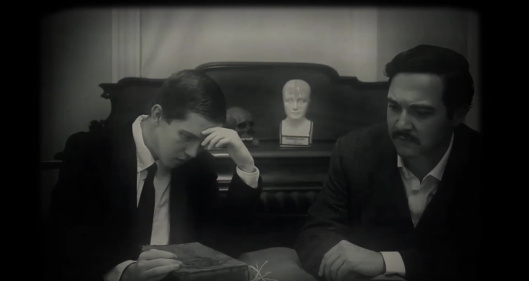
The short film “Miskatonic 1927” in full, a selection for the H.P. Lovecraft Film Festival 2018. “H.P. Lovecraft & Clark Ashton Smith begin an English translation of the dreaded tome The Necronomicon.”

Review: Aquaman (2018)

26 Wednesday Dec 2018

Posted by asdjfdlkf in Films & trailers, Lovecraftian arts

≈ Leave a comment

WARNING: SPOILERS!

Aquaman (2018).

So… there’s this story that starts at an old lighthouse. One stormy night the lighthouse keeper gets to mate with a sea-visitor. They produce a hybrid child, then there’s a submarine attack on a sunken alien city… and there’s a devolved race of monstrously fishy trench-dwellers, a giant trapped sea-monster under the ocean that’s a octopus-dragon-squid hybrid… then a mysterious stone codex with ancient lettering on it, and to decode this our heroes need to discover a hidden ancient city under the Sahara. It’s Lovecraft, right?

Nope. It’s the big-budget Aquaman. Having been told the new Aquaman movie is “surprisingly Lovecraftian”, I’ve now seen it. While it certainly has broadly Lovecraftian moments and elements, at its core it’s the stock-formula pulp that Lovecraft was writing against: those 1920s pulp tales which tiresomely re-worked well-worn themes of politicking medieval kingdoms, over-proud war-hungry princes, treacherous councillors, beautiful princesses who fall for the flawed and banished hero-prince, and a hidden ancient Sword That Will Unite the Kingdom. The pulp authors merely placing these stock elements in some hidden underground realm, on Venus, at the poles, or in this case underwater. Read a half-dozen good ones, and you’ve basically read them all.

That said, Aquaman is generally very enjoyable for what it is, and is full of very well-made visual spectacle. The amount and duration of high-end CG is amazing, and there is a ton of money on the screen. After recent disasters DC must have ‘bet the farm’ on this one, and it’s paid off. Despite the CG it’s all very believable and coherent, and in terms of the physical acting involved in doing ‘underwater’ I saw no flaws. The design values are very high in terms of how things look, and the costumes, vehicles and creatures are all well integrated into a tight example of movie world-building.

Is it Lovecraftian? Not really, certainly not as much as some have claimed. Though it has its moments:

* the opening of the movie echoes the opening of “Innsmouth”, in terms of the submarine attack on the underwater reef. This attack is, of course, a ‘false flag’ attack in a hijacked submarine. Aimed at helping the wicked power-hungry prince to stir up a war against the hated surface-dwellers.

* almost nobody will notice, but we see that Aquaman’s dad has been reading “The Dunwich Horror” before he mated with the Fishy One From The Sea (who after some initial puking very quickly turns from bedraggled mermaid to primped Glamour Queen). The book is under the snow-globe that emotionally grounds the movie’s opening scenes. The book should probably have been “The Shadow over Innsmouth” for thematic congruence, but I guess Hollywood felt that might be a little too politically incorrect.

* then there’s an undecipherable carved stone with a hidden message in it, and it needs to be taken to an ancient ruined city of the forgotten ones under the Saharan desert. But Aquaman and his companion princess have an Atlantean GPS to reach its hidden entrance, which is kind of lame. They could at least have used some kind of mystic ‘water-sense’ to follow the vast amount of water that’s said to be sunk beneath the desert.

* the secondary baddie starts quoting Lovecraft directly (“Loathsomeness waits and dreams in the deep, and decay spreads over the tottering cities of men”), when he surfaces for his big second-act battle with Aquaman. However, his costume looks so utterly ridiculous and camp that you just can’t take him seriously. He’s obviously disposable and just there for Aquaman to beat up, half way through the movie. The need to fit with the DC universe meant that the movie’s makers lost a huge opportunity to make him a deluded Cthulhu-worshipping cultist, whose secret double-crossing aim is to release the…

* giant Cthulhu-like mountain-sized Kraken-y sea monster that has been trapped below the sea for aeons. This monster is, of course, released… though no cultists are involved in making this happen.

* we get the briefest mention of a crucial bit of back-story involving Atlanteans who survived the famous deluge of Atlantis and remained pure-bloods and the Trench dwellers who did not remain pure and fell into a “savage regression” biologically. While the visual look of this devolved race is Lovecraftian, when it’s eventually revealed, the cultural nod is actually more to H.G. Wells and his famous devolved Morlocks. This is confirmed when we learn that the Trench dwellers hate light, and can be driven back merely with lighted distress flares.

* there’s ten minutes of a nightmare encounter at sea with this devolved deep ocean race. These are definitely Derleth-Lovecraftian in appearance, and we’re told they were once Atlanteans but that they devolved in a “savage regression” to fishy bestiality over the millennia. This scene has its moments, but the monsters are again only really there for Aquaman to battle past… so that he can reach a tropical Thunderball-like Paradise Island… where the Magic Trident of All Power power-up thing is resting.

* the Magic Trident of All Power power-up thing is in a cave behind the Glowing Waterfall, where it’s guarded by a giant tentacular being. But Mrs Squiddy talks, in a manner more akin to Tolkien’s Smaug the dragon than to anything in Lovecraft. Anyway… there’s little time for a chat, as War Is Brewing.

Except for about 30 seconds in the dark Trench, the ocean conveys no sense of a vast and eerie darkness, and there’s no unfathomable ‘cosmic awe’ akin to outer space. So, it’s not Lovecraftian in that sense.

Is it DC, then? I have no clue at all about that, not being a DC fan. I know absolutely nothing about the DC comics version of Aquaman, other than that he’s DC’s equivalent of Marvel’s Sub-Mariner character. I thus probably missed many DC-tastic Easter Eggs, but I guess they’re in there. I only noticed how Aquaman positioned itself to dovetail with other blockbuster properties. Disney’s Tron: Legacy is probably the biggest debt it owes, and that debt is massive. But this viewer didn’t mind in the slightest, since the movie re-works the best bits of the Tron sequel so beautifully, at such duration and on such a vast scale. In terms of the hero’s own personality and style it’s very obviously pitched as a rival to Marvel’s Thor. As ‘screen fun with a coherent story’, Aquaman even manages to hold its own against the excellence of the latest Thor: Ragnarok movie. Those who know the Lord of the Rings movies will also spot visual nods in Aquaman, such as the distant shot where a tiny Gandalf falls silently into the inky depths of Moria.

Overall Aquaman is entertaining fun, and if you have a strong bladder it’s worth seeing at the cinema purely for the visuals. It deserves its “top movie of Christmas 2018” box-office cash take. I’d be surprised if there wasn’t an Oscar in the offing for the costume designers and/or the action scene story-boarders. Although in terms of ‘action Oscars’ they’ll have tough competition from the latest Mission Impossible.

The story and dialogue is… still messy, but it’s an enjoyable mess. It veers wildly between jaw-dropping fanboy ridiculousness, over-the-top camp homage, and a surprisingly sugary moms-iness. But this isn’t meant to be a movie that one thinks about deeply. It’s just a good adventure romp and zips through at a fast pace. The Thor-like hero is engaging and of the ‘clever guy who hides it under goofy-and-dumb’ type, and his Atlantean princess is winsome-but-tough. Their dialogue might have popped and surprised just a little more. But on the other hand the script editors have kept the talkiness and jokes under control. There are some three-minute “let’s talk about our feelings” family reunions, but there’s no turgid lecture-mode that slows things down every ten minutes (as in the interminable second movie of The Guardians of the Galaxy series). The usual worthy ‘messages’ from the Hollywood elite are in there, but only briefly and at a very basic level:

* don’t put plastic and effluent in the sea;
* ‘place all humanity above the needs of one nation’;
* modern pirates are bad people;
* human/Atlantean half-breeds can become King, if they prove themselves worthy by their actions.

The latter point raising the question of what, exactly, some of the surviving Atlanteans were mating with in order to devolve into Trench dwellers — thus raising in the remaining pure Atlanteans such an abject horror of hybridity that they never once pause to make the obvious distinction between humans and lobsters. By the look of it, the rogue Atlanteans were sneaking off to snuggle up to the primitive Giant Crab People on dark nights. Which, in a way, is very Lovecraftian.

Foxx’s London Overgrown

22 Saturday Dec 2018

Posted by asdjfdlkf in Films & trailers, Odd scratchings, Podcasts etc.

≈ Leave a comment

Here’s a calming electronic-orchestral neo-romantic album which some readers may care to explore in the hectic run-up to Christmas and the New Year, London Overgrown by John Foxx (2015, 52 mins). It’s one of his best ambients, and is free in full and ad-free via an ordered YouTube playlist.

Foxx is solo and purely instrumental here and he revisits the mood — though not the rapid electro-pulses and singing — of his early classic post-Ultravox album The Garden. Those who know Eno’s best ambient and the instrumentals on early albums — such as Before and After Science and Another Green World — may hear small homages and nods to the master on several tracks in the first half of the album. In the second half it becomes even more eerily becalmed and frankly almost dull in places, but in a rather British ‘sublimely beautifully decay’ way. The album has a rather downbeat trailing-off ending, and some listeners may like to segway the final track into something similar but a bit more upbeat from Foxx, perhaps suggesting a return or awakening from dreamland wanderings.

* Foxx’s sleevenotes for London Overgrown.

* Some booklet pictures for London Overgrown.

* My anthology London Reimagined: an anthology of visions of the future city, which you may care to dip into while listening.

* Amazon download for London Overgrown, with better quality audio than on YouTube.

The album’s cover suggest the post-apocalyptic, something I’m not a great fan of. Though this isn’t part of the tiresomely relentless wave of post-apocalyptic science-fiction. In which an old-school genre wild west story gets retooled with a thin sci-fi veneer, punky haircuts and some sub-Riddley Walker slang, and an uber-violent gang of Bad Men who menace a peaceful enclave of tofu-knitting eco-hippies. Similarly I have little time for the escapist neo-primitivist future-fantasies of ‘total re-wilding’, to be found among both the anarchist eco-left and in certain theoretical grouplets of the continental far-right, and which sometimes also feed into science-fiction.

But in the case of Foxx’s London Overgrown album we have something different, I think, and with different intellectual roots. His is a poetic idea of wandering, walking in an abandoned and partially overgrown empty city, taking in the sublime sunset vistas and pondering the garden-clad architecture of a lost civilisation. Psychogeography, if you like, but without the tired old leftist politics it’s often been freighted with by the London school.

Such exploration was of course a theme that Lovecraft explored in both his night-walks and his fiction, and he did so on the back of the many very real archaeological discoveries of ruined cities in the 1870s-1930s — think, for instance, of his Nameless City, Mountains of Madness, Kadath, and other works. Lovecraft would have made a fine pith-helmeted archaeological explorer, I think, had his constitution been more robust. He would have revelled in the heat involved in somewhere like Mexico, then the ‘hot ticket’ to career success for Americans such as his friend Barlow. Still, at least he paced the ancient cities in his imagination and dreams, to our great benefit.

Thus, though Foxx’s album cover montage of St. Paul’s dome implies that the album is a projection into ‘a future ruined’, it seems to me more of a nostalgic recovery in music of a Richard Jefferies (Wild England) / H.G. Wells (Time Machine) vision of an overgrown London. Foxx’s album arises from the poetic response to the real ruined cities that were encountered in the days of Empire. In which explorers entered the silent empty ruins of great cities unseen for great ages, and there pondered and wove poetry on the inevitable fading away of all Empires. As such the album seems an echo of a real lived moment in cultural time, rather than a future-fantasy.

As Foxx states in his sleeve-notes, his music also evokes another more recent reality — the way he’s lived through something comparable, namely the 1974-2014 de-industrialisation and restoration of those parts of our English landscapes that had been made primarily by the industries of steel, coal, and heavy manufacturing. Restoration sometimes by heroic but unsung human reclamation works, sometimes by natural over-growing aided by the carbon-fertilisation effect, often a bit of both. Again, this has been a lived reality, as cities such as Stoke-on-Trent — once the most polluted in Europe — really have changed over 40 years from industrial wasteland to relative verdancy. And done so at such a slow pace that the mental preconceptions of their car-driving residents (who usually only see the place from a few routinely-travelled grotty main roads) have yet to catch up with the changed realities and newly verdant terrains which lie behind the houses and the tawdry store-fronts. To coin a psychogeographic phrase: “Behind the storefront, the forest!”

Lovecraft and The Raven

07 Wednesday Nov 2018

Posted by asdjfdlkf in Films & trailers, Historical context, New discoveries

≈ Leave a comment

In a late September 1919 letter H.P. Lovecraft singled out “Henry B. Walthall” as a silent cinema star he held to be “above the rest”, the only other being the young Japanese star Sessue Hayakawa.

Walthall possess tragic potentialities all too seldom utilised on the screen. His part in the “Birth of a Nation”, though a leading one, failed to do him justice. He could create a sensation if some of Poe’s tales were dramatised — I can imagine him as Roderick Usher or the central character in “Berenice”. No one else in filmland can duplicate his delineation of stark, hideous terror or fiendish malignancy. — Lovecraft.

What movies would Lovecraft likely have seen Walthall in? The annotations in the volume of Galpin letters suggests only… “Judith of Betthulia [1914, Biblical melodrama], Avenging Conscience [1914, horror-drama, Poe], and Birth of a Nation [1915, family drama, war-epic].”

Avenging Conscience was based on Edgar Allan Poe stories, and featured Walthall playing Poe himself.

But a quick look at Walthall’s filmography suggests that Lovecraft might also have been thinking of “The Raven” (1915, Essanay), a remake of a lost 1912 D.W. Griffith short. The expanded 1915 version was a major ‘melodramatic bio-pic’ movie of Edgar Allan Poe, and Walthall again played Poe.

Lovecraft may have been impressed by what were reported (in the 1915 movie press) to be uncanny double-exposure FX scenes such as Poe fighting a duel with himself, dream-levitating, and by the general visual inventiveness of the sets. Also with the fact that it been filmed in an exact life-sized reproduction of the interior of Poe’s home in Fordham, built on a stage-set after Essanay sent an architect to take the exact measurements. Lovecraft would likely have been less impressed by what is said to be a curt re-write of Poe’s life history, including giving him a thirty-five year old Virginia.

Apparently the movie was immensely popular, and Lovecraft would almost certainly have seen it despite its biographical shortcomings. Perhaps it was too popular, as movie buffs note that there was no screen representation of Poe for many decades afterwards. Originally running as much as 80 minutes (six reels, lost), there’s an approx. 40 minute survival which appears to have been crudely butchered for length and which is now on a 2007 DVD. It’s not currently on Archive.org or YouTube.

The Emperor of Dreams – streaming

04 Sunday Nov 2018

Posted by asdjfdlkf in Films & trailers

≈ Leave a comment

The new feature-length documentary Clark Ashton Smith: The Emperor of Dreams is now on Amazon for digital download ‘rental’ at £4.99 / or $4.99 in the USA. The 1:1 exchange £-$ rate is a bit annoying, as £4.99 = $6.50. But it’s still cheaper for Brits than shipping the $15 DVD from the USA.

Emperor of Dreams DVD available

29 Monday Oct 2018

Posted by asdjfdlkf in Films & trailers, Podcasts etc.

≈ 1 Comment

Newly listed at Hippocampus is Clark Ashton Smith: The Emperor of Dreams DVD, the disc for the feature-length documentary…

Apparently also streaming via Amazon, though I can find no trace of that on either Amazon USA or UK or on Vimeo.

(The trailer).

“Bring me the next Game of Thrones. Oh, wait…”

30 Sunday Sep 2018

Posted by asdjfdlkf in Films & trailers

≈ Leave a comment

Amazon has reportedly cancelled its vaguely-planned and probably politically-impossible Conan TV series, announced back in February 2018. Some sources claimed it would be “literary” and faithful to Howard, while other claimed a “wholly new story”, so there was obviously some confusion among the team from the start. Game of Thrones director Miguel Sapochnik would apparently have told the life-story of Conan, from being bewitched and lured into the frozen wilderness as a youth in “The Frost-Giant’s Daughter”, to becoming the brooding and battle-scarred King of Aquilonia. And now, Messages from Crom brings news of the cancellation of the series, seemingly before they’ve even cut the pilot episode.

Oh well, there are always the audiobooks. And radio always did have the best pictures.

“Ah, ze French…”

19 Wednesday Sep 2018

Posted by asdjfdlkf in Films & trailers

≈ Leave a comment

Fantastique: The Dream Worlds of French Cinema, a film season at the BFI in London, 24th October to 22nd November 2018. Opening with the talk “Le Fantastique: A Curious Tour of the French Weird”.

← Older posts
Newer posts →


Please become my patron at www.patreon.com/davehaden to help this blog survive and thrive.

Or donate via PayPal — any amount is welcome! Donations total at Easter 2025, since 2015: $390.

Archives

  • January 2026
  • December 2025
  • November 2025
  • October 2025
  • September 2025
  • August 2025
  • July 2025
  • June 2025
  • May 2025
  • April 2025
  • March 2025
  • February 2025
  • January 2025
  • December 2024
  • November 2024
  • October 2024
  • September 2024
  • August 2024
  • July 2024
  • June 2024
  • May 2024
  • April 2024
  • March 2024
  • February 2024
  • January 2024
  • December 2023
  • November 2023
  • October 2023
  • September 2023
  • August 2023
  • July 2023
  • June 2023
  • May 2023
  • April 2023
  • March 2023
  • February 2023
  • January 2023
  • December 2022
  • November 2022
  • October 2022
  • September 2022
  • August 2022
  • July 2022
  • June 2022
  • May 2022
  • April 2022
  • March 2022
  • February 2022
  • January 2022
  • December 2021
  • November 2021
  • October 2021
  • September 2021
  • August 2021
  • July 2021
  • June 2021
  • May 2021
  • April 2021
  • March 2021
  • February 2021
  • January 2021
  • December 2020
  • November 2020
  • October 2020
  • September 2020
  • August 2020
  • July 2020
  • June 2020
  • May 2020
  • April 2020
  • March 2020
  • February 2020
  • January 2020
  • December 2019
  • November 2019
  • October 2019
  • September 2019
  • August 2019
  • July 2019
  • June 2019
  • May 2019
  • April 2019
  • March 2019
  • February 2019
  • January 2019
  • December 2018
  • November 2018
  • October 2018
  • September 2018
  • August 2018
  • August 2015
  • July 2015
  • April 2015
  • March 2015
  • February 2015
  • January 2015
  • December 2014
  • November 2014
  • October 2014
  • September 2014
  • August 2014
  • July 2014
  • June 2014
  • May 2014
  • March 2014
  • February 2014
  • January 2014
  • December 2013
  • November 2013
  • October 2013
  • September 2013
  • August 2013
  • July 2013
  • June 2013
  • May 2013
  • April 2013
  • March 2013
  • February 2013
  • January 2013
  • December 2012
  • November 2012
  • October 2012
  • September 2012
  • August 2012
  • July 2012
  • June 2012
  • May 2012
  • April 2012
  • March 2012
  • February 2012
  • January 2012
  • December 2011
  • November 2011
  • October 2011
  • September 2011
  • August 2011
  • July 2011
  • June 2011
  • May 2011
  • April 2011
  • March 2011
  • February 2011
  • January 2011
  • December 2010
  • November 2010
  • October 2010
  • September 2010
  • August 2010
  • July 2010

Categories

  • 3D (14)
  • AI (70)
  • Astronomy (70)
  • Censorship (14)
  • de Camp (7)
  • Doyle (7)
  • Films & trailers (101)
  • Fonts (9)
  • Guest posts (2)
  • Historical context (1,095)
  • Housekeeping (91)
  • HPLinks (70)
  • Kipling (11)
  • Kittee Tuesday (92)
  • Lovecraft as character (57)
  • Lovecraftian arts (1,623)
  • Lovecraftian places (19)
  • Maps (70)
  • NecronomiCon 2013 (40)
  • NecronomiCon 2015 (22)
  • New books (966)
  • New discoveries (165)
  • Night in Providence (17)
  • Odd scratchings (984)
  • Picture postals (276)
  • Podcasts etc. (430)
  • REH (183)
  • Scholarly works (1,466)
  • Summer School (31)
  • Unnamable (87)

Get this blog in your newsreader:
 
RSS Feed — Posts
RSS Feed — Comments

H.P. Lovecraft's Poster Collection - 17 retro travel posters for $18. Print ready, and available to buy — the proceeds help to support the work of Tentaclii.

Proudly powered by WordPress Theme: Chateau by Ignacio Ricci.