HPLinks #109.
* The Hippocampus Press website has details of the forthcoming hardcover edition of David E. Schultz’s H.P. Lovecraft’s Commonplace Book and Other Notes: An Annotated Edition. Due at the end of December 2026.
This exhaustively annotated edition, based upon decades of study of both the text and sources of the commonplace book, illuminates the origins of many entries—from events in Lovecraft’s life, books or stories he read, and other sources—while also indicating their use in his fiction, even in cases where the use of the entries is by no means obvious.
* The U.S. Library of Congress ‘Headlines & Heroes’ series this week interviews “David Cercone, Researcher for the H.P. Lovecraft Historical Society”.
* In the latest open-access Journal for Religion, Film and Media, the lead article is “A Virtual Fanfiction Universe: Lovecraftian Religion in the Online Game The Secret World / Secret World Legend”.
* From Thailand, the open-access student journal article “Applying H.P. Lovecraft’s Narrative Style to the Development of Horror Animation Screenplays”. In Thai, with an English abstract. Attempts to distil applicable principles from Lovecraft’s…
literary devices [which might inform] visual, aural, and rhythmic mechanisms at the scene level: the restriction of narrative perception; the gradual disclosure of information; the use of setting and atmosphere as instruments of estrangement; and the reinforcement of human insignificance.
* Boundary2 has a long review of Mark Fisher’s The Weird and the Eerie.
* The R.E. Howard Foundation has another try at a livestream, the last one having been plagued by cable-chewing demons from the nethermost pits.
* New in the open-access journal Medievalia, La impronta vikinga en ‘Conan el Barbaro’ (John Milius, 1982): Construccion cinematografica e iconografica de la barbarie”. Examines the “broader range of historical, archaeological, artistic, and iconographic references” that the movie director drew on to form this early-1980s screen version of Conan.
* The Lost Kind, possibly the first full AI cinema-length movie. Certainly the first such ‘dark fantasy’ movie. How far we’ve come from the 512px gloopiness of just a few years ago. Free on YouTube.
* Also on YouTube, the new student short film Arthur Machen’s “The Inmost Light”.
* Talking of Machen, there’s a newly attributed Arthur Machen publication, the play “The Hidden Sacrament of the Holy Graal”.
* On eBay, Dark Messenger Reader #1 (1975), a Lovecraft/Mythos stories fanzine. Looks a bit scarce to me, so I guess someone may want it.
* The Good Friends of Jackson Elias podcast discusses ‘Occult Detectives’ with Lovecraft scholar Heather Miller.
* The Internet Archive has unveiled the 2027 Public Domain Film Contest. Make a short movie, up to 4 minutes max., using at least one work published in 1931 that will become Public Domain on 1st January 2027. Two big 1931 horror movies will enter the public domain: Dracula, and Frankenstein. Note that the rules say all “AI tools” used must be declared and “explained” — implying a possible unspecified penalty for AI entries.
* Artbook publisher Thames & Hudson is set to do Syd Mead justice in print, with the forthcoming Syd Mead Ultimo artbook. Edited by Mead experts and billed as “a major retrospective”, the book is due in early March 2027. Tentaclii readers in San Francisco can pop down to the city’s Transamerica Pyramid gallery for a sneak-preview, via the gallery exhibition “Syd Mead: Future Pastime” (until 17th December 2026).
* ImagineFX magazine has published its last issue in either print or digital, for Christmas 2026. The loss removes a major fantasy/sci-fi and sometimes-horror title from the public news-stands here in the UK and possibly elsewhere, and means there are no more digital creative magazines (Digital Art Live and 3D World went some years ago). There is some good news though, re: British magazines. “Every Back Issue of Starlog Is Back on the Internet Archive”. Officially, thanks to the title’s new owners.
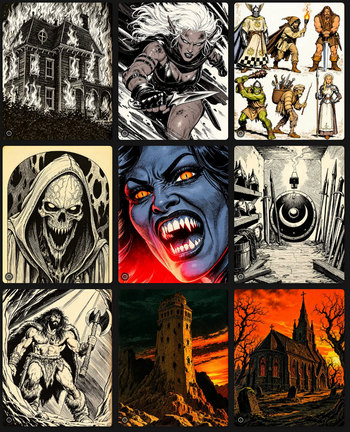
* A new MOSS-Image LoRA dedicated to emulating Gamebook illustration.
* In Spanish, but auto-dubbed by YouTube, Lovecraft’s Crypto-Botany is a survey which digs deep and plucks seven plant monsters from Lovecraft’s work.
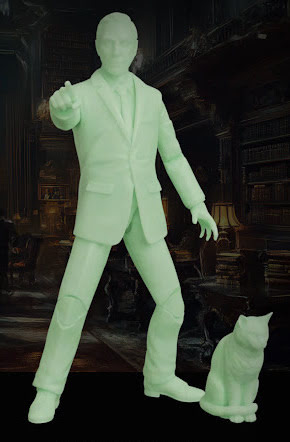
* Propnomicon spots the new Glow in the dark H.P. Lovecraft figure. I had also spotted it in search today, but then I couldn’t get past the Big Bad Toy Store’s robot-blocker. I suppose if one painted very thin translucent paint on him (coloured varnish?), then he’d still glow?
— End-quote —
Luminous Lovecraft…
“… gravity can act as a deflecting agent like refracting and reflecting media. Now the significance is this: if gravity can affect the course of a luminous ray, then light does not consist of ether waves! Think of the significance of this fact, if fact it be: All our basic theories of optics must be revised, and perhaps all our conceptions of radiant energy revolutionised.” — Lovecraft to Galpin, April 1920.
“Another ocular idea which has long fascinated me pertains to the luminous shapes — geometrical & otherwise — seen against a background of blackness when the eyes are closed.” — Lovecraft to Galpin, November 1933.
“I took Loveman there at midnight, & when we got separated among the tombs he couldn’t be quite be sure whether a faint luminosity bobbing above a distant nameless grave was my electric turch or a corpse-light of less describable origin!” — Lovecraft to Helen Sully, October 1933, re: St. John’s churchyard.
“… absolutely marvellous firefly display […] All agree that it was unprecedented, even for Wilbraham. Level fields & woodland aisles were alive with dancing lights, till all the night seemed one restless constellation of nervous witch-fire. They leaped in the meadows, & under the spectral old oaks at the bend of the road. They danced tumultuously in the swampy hollow, & held witches’ sabbaths beneath the gnarled, ancient trees of the orchard”. [Lovecraft went to bed afterwards, intending to dream the fireflies into…] “spectral torches, & about the lean brown marsh-things (invisible to mortal eyes) who wave & brandish them in the gloaming when the unseen nether world awakes”. — Lovecraft’s aunt Lillian, July 1928. Wilbraham was the inspiration for “The Dunwich Horror”.