HPLinks #108.
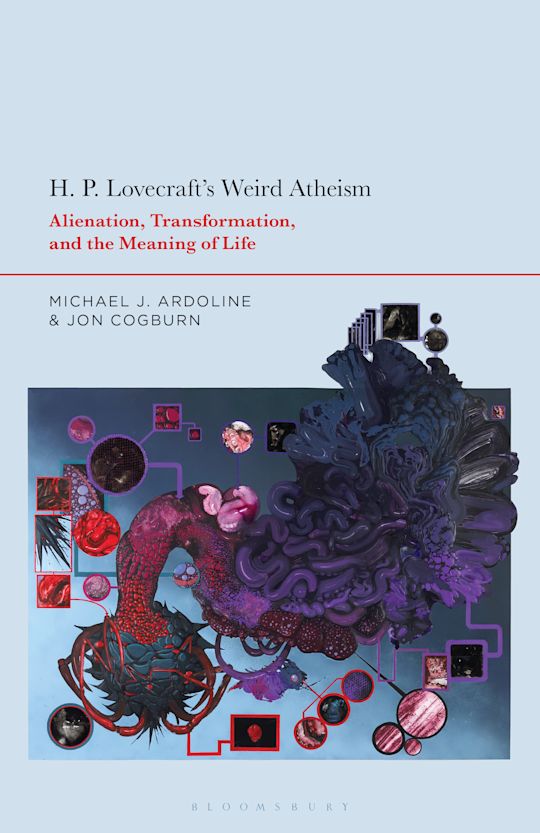
* The publisher Bloomsbury now has a cover and date for the forthcoming book H.P. Lovecraft’s Weird Atheism: Alienation, Transformation, and the Meaning of Life (2027). Due at the end of April 2027, 256 pages in hardback and ebook.
Michael J. Ardoline and Jon Cogburn puts Lovecraft’s work into conversation with both contemporary and central historical philosophical issues […] including the meaning and value of humanity in a hostile cosmos, the role of aesthetics in the good life, and the fear and allure of monstrosity [and conclude by discussing] how one might live a meaningful life in a cosmos hostile to the very possibility.
* A Masters dissertation is now available as the budget ebook The Specificity of Lovecraftian Gothic Poetics (2026).
* New on YouTube, a new S.T. Joshi interview, via the public library at Bridgeport in the USA.
* Wisconsin Public Radio (WPR) on “How Wisconsin shaped a horror legend” in the shape of Robert Bloch. Via a new interview with his biographer, the author of Psycho Century: Robert Bloch, American Horror Master.
* The House of Shadows & Ink podcast has an Interview with Sean Branney of the Lovecraft Historical Society.
* New on YouTube, Gates of Imagination reads “The Empire of the Necromancers” by Clark Ashton Smith.
* The REH Foundation has good news. “Project PRIDE Awarded $50,000 Preservation Grant for the Robert E. Howard House”.
* The two most recent issues of The Fossil: Official Publication of The Fossils are freely available. July has Ken Faig, Jr. on “The EOD and I” (‘Esoteric Order of Dagon’, a paper/mail-based APA, 1973-), and David Goudsward on “Sea Serpents and Lovecraft Letters”. The latest October 2026 issue surveys existing “Fannish APAs” in the field of pulp, and has a short review of the book The Complete Acolyte (collection of a famous early Lovecraft/Howard fanzine)…
The Complete Acolyte republishes the entire series, and adds additional historical and biographical material on the creators and the history of the ‘zine.
* Adam Alonzi on “H.P. Lovecraft, Weird Tales Magazine, and the World’s First Message Board”, discussing…
… in this condition of perpetual insolvency, the magazine [Weird Tales] invented, or at least midwifed, cosmic horror, sword-and-sorcery, and a substantial fraction of American genre fiction. Although the enterprise was an unbroken commercial disaster, its cultural yield is almost incalculable: thirty years of penury laid the foundations for blockbuster after blockbuster. But how it did this is rarely discussed.
The opening states that Lovecraft… “was terrified of the Slavs and Italians immigrating to Brooklyn” while in NYC. It’s news to me. I can find no mention of Slavs on searching my large personal Lovecraft archives, beyond a passing mention of distant Slavs in connection with Dracula, Germany and the Russian revolution. As for Italians, when in NYC he happily supped in Italian cafes and ate regularly in Italian-owned spaghetti joints.
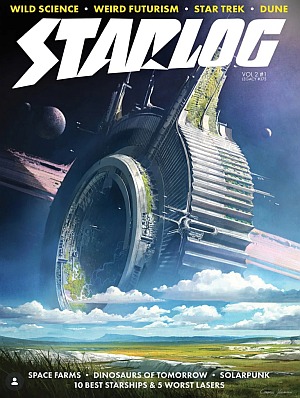
* It’s always good to see a worthy British magazine resurrected. STARLOG: The Magazine, Vol. 2 #1 (Pre-order). “The sci-fi magazine that ran from 1976 to 2009, back in print”. Albeit as a print annual initially, rather than a quarterly.
* Taskerland traces the history of weird underground zine Yuggothic Delusions Ogdo…
I was drawn to this magazine by the promise of a piece on Lovecraft and Lloigor Selavy’s piece is definitely substantial. Selavy argues that those who see Lovecraft’s work as the] quasi-existentialism of the alienated materialist [are] dependent upon a willingness to focus on a very narrow range of stories at the expense of many others. He proposes pushing a different and broader range of works to the foreground of Lovecraft’s literary reputation in an effort to re-position him as an author who was less concerned with the horrors of ‘cosmicism’ than madness and the desire for ontological escape. I’m not sure that I agree with this reading of Lovecraft, but I certainly salute the ambition of wanting to develop an understanding of Lovecraft that foregrounds “Through the Gates of the Silver Key” rather than At the Mountains of Madness.
* Taskerland also considers the Lovecraft fragment “The Book”.
* Lovecraft’s Gats i Gossos (2023) a Catalan translation of his “Cats and Dogs”.
* In Cagliari, Italy, Unica Radio profiles a forthcoming interactive promenade theatre show “Lovecraft: Cultists of Cthulhu”. Set in Providence, the show’s… “plot has its roots in ‘The Call of Cthulhu'”. The show will have a run of… “six days and five reruns a day”, so they’re obviously expecting a hit.
* The H.P. Lovecraft Film Festival Streaming Edition (2026), set for 4th – 11th December 2026. Tickets now available.
* Some Internet Archive backups saved from the now-defunct Tapas webcomics site: The Innsmouth Girl, Across the Dreamlands in 31 Days, At the Mountains of Madness: The Second Expedition, Dagon (adaptation) and What the Moon Brings (adaptation). Useful tip: it appears that The Internet Archive can only be accessed via a VPN if the chosen VPN node is in the USA.
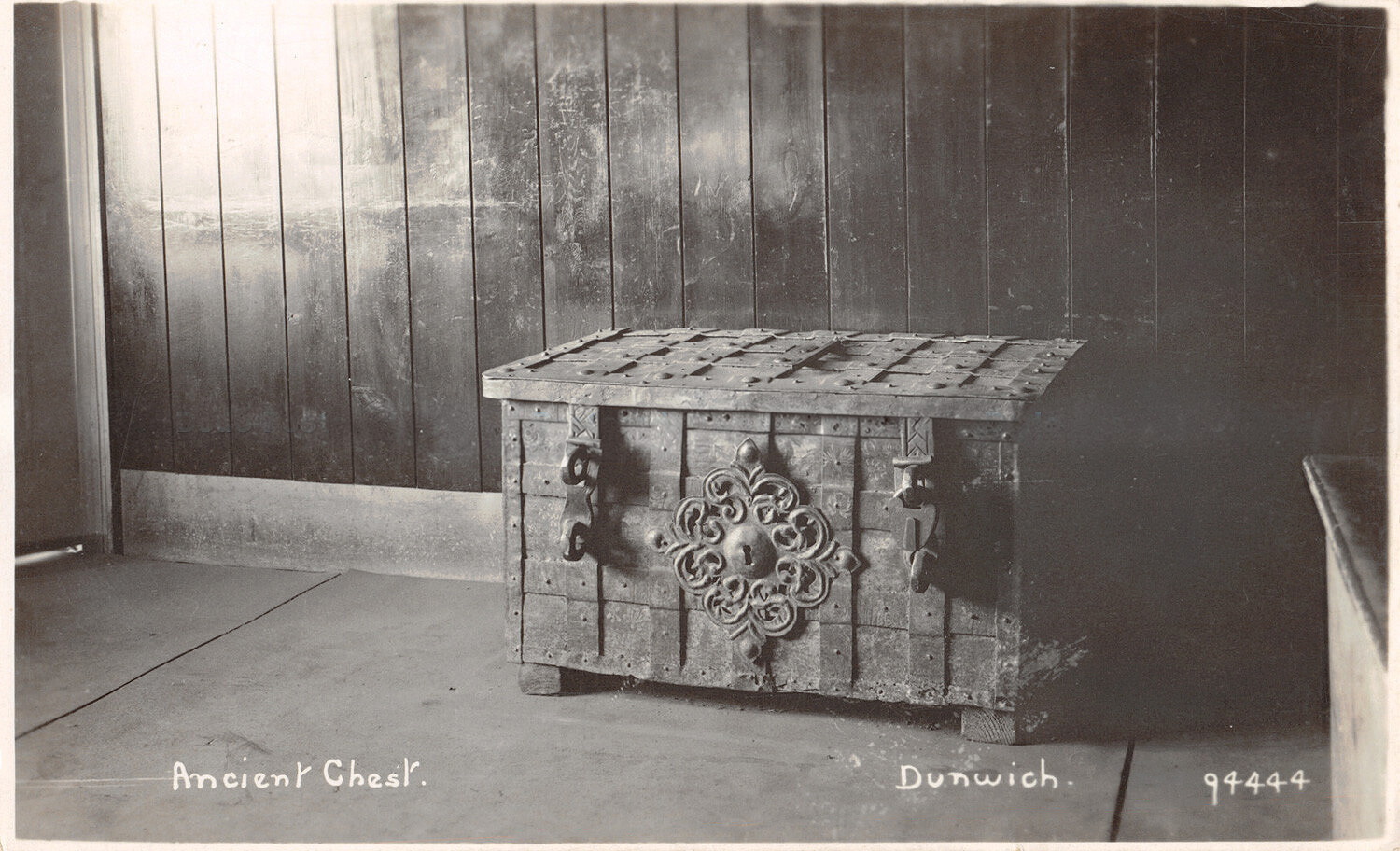
* And finally, a card from eBay that may interest some readers and perhaps especially to those in need of visual props for an RPG. It shows an olde chest from ye towne of Dunwich. I assume from the other Dunwich, the large English town that sank beneath the waves of the North Sea.
And here’s a link to a 1912 survey of “Dunwich in Literature”, as published in The English Illustrated Magazine, which may yield ideas / texts for an ‘other Dunwich’ Lovecraftian RPG (has anyone ever done one, yet?).
— End-quotes —
“My ancestry was immediately rural on the maternal side — with the spacious valleys & antient ways of western Rhode Island behind it, & with the country echoed & reechoed in the tales of my grandfather & mother — & on the paternal side, behind two generations of New York State urbanism, there was the immemorial tradition of the Old English countryside.” — Lovecraft to Frank Belknap Long, February 1933.
“I have never seen Old England, & I do not know whether it will ever be financially possible for me to do so. […] I long to see the great-boled oaks I dream about, & the grassy ridges that were once Roman roads stretching through the twilight of deep forests.” — Lovecraft to Jonquil Leiber, November 1936.
[I am a man who has…] “a healthy appreciation of his native soil-things [as will also] to be found in three-quarters of the rural squires of Old England” — To Frank Belknap Long, May 1926.
[Lovecraft had hacked and cut a new path to Barlow’s cabin in Florida, which…] “is ideally located in a picturesque oak grove – not the live-oak of the south, but the old-fashioned, traditional oak of the north & of Old England. On this account I am tentatively calling the place Druid Grove” — Lovecraft to Miss Toldridge, July 1935.
“As a boy I twisted all reality to conform to what I had been reading – often making Old England’s gnarled oaks out of New England’s maples, and so on.” — Lovecraft to Hoffman Price, February 1933.
[Today, 1915] “…the East Side child [in Providence], might as well be in the heart of Old England” ‐ Lovecraft to Kleiner, December 1915.
“This oldest of all New-England houses, made familiar to the public by many popular pictures, wood-carvings, and clay bas-reliefs, is built of massive timbers from Old England; probably parts of a ship dismantled in Boston Harbour. Stout British oak, destined to endure thro’ uncounted millennia, and typifying the staunch fibre of the peerless race that made New-England what it is. GOD SAVE THE KING!” — Lovecraft, “An Account of a Trip …”, August 1929.
“OLD ENGLAND! Honestly, if I once saw its venerable oaks and abbeys, manor-houses and rose gardens, lanes and hedges, meadows and mediaeval villages, I could never return to America. The only reason that I don’t save like hell to get in on Dench’s tour is that I simply couldn’t come back, once I saw the ancient glories and monuments of my race. I would jump in the Thames, the Cam, or the Isis; the Usk, the Ouse, or the Severn, first. When I see Old England at last, it must be as a son returning to his fathers, and I must be in a position to settle there for ever in peace and archaic dignity.” — Lovecraft to Morton, 1923.