
HPLinks #100.
* It’s sad to learn that Will Murray has passed away, and at the too-young age of 70. There’s an obituary at the Keohane funeral service website, presumably online with the family’s blessing. Also memories and appreciations from Murania Press, Super Stuff in the Bronze Age, and Comics Beat magazine.
* The son of the pioneering 1970s Lovecraft researcher John L. McInnis III now has a new Web page detailing his father’s scholarship and on-the-ground research. There are also photographs and primary-source documentation where available.
* The German Lovecraftians have issued issue No. 15 of their paper annual magazine The Lovecrafter. This issue focuses on Clark Ashton Smith.

* Deep Cuts digs deep and reprints the Weird Tales tale “Medusa” (1928) by Royal W. Jimerson, noting it has some elements in common with “Medusa’s Coil” (1930). The latter being the tale ghost-written by H.P. Lovecraft (a re-writing and re-ordering of what was likely a lost original tale or outline by Zealia Bishop).
* In English in a Hungarian academic journal, “Cthulhu’s Resurgence As An Event: Mediation And Performativity In Chinese Online Novels” (2026). Freely available online.
* A Shiver in the Archives makes me aware of the bibliography Bibliomysteries: An Annotated Bibliography of First Editions of Mystery Fiction Set in the World of Books, 1849-2000 (2014) (second revised edition, with the first apparently being a limited edition of 200 copies). I see the same author has also published the 440-page American Mystery Classics: Golden Age Bibliomysteries (July 2026) and… “This volume collects the finest of such stories” form American fiction, says the blurb. Currently it’s a 99-pence Kindle ebook on Amazon, but be warned that once purchased there’s no “Download available in additional formats” and Amazon has stopped sending ebooks to their older ereader devices. Also be warned that the first story in the collection is very skippable and curiously has nothing to do with books. Start with the second story.
* New to me, Sentinel Hill Press has “New England’s Creatures, Creepers, and Cryptids – A Bibliography” (2024) as an online post.
* Librivox has their new Coffee Break Collection 041 – Witchcraft online, including items from Lovecraft Circle members Wilfred Blanch Talman and Clark Ashton Smith. All Librivox audio readings are public domain.
* An academic paper, “AI-assisted literary-to-song adaptation: a practice-based study of literary interpretation in a text-to-audio workflow” (2026). Freely available online.
The corpus comprises 32 songs developed by a single creator, largely based on H.P. Lovecraft and produced in a post-punk/indie-rock idiom through close reading, researcher-written lyrics, ChatGPT-supported revision, Udio text-to-audio generation and human-directed assembly. Two cases are analysed: ‘The Viol Screams’ adapts “The Music of Erich Zann” and ‘Whispers from Yuggoth’ brings together selected sonnets from Lovecraft’s ‘Fungi from Yuggoth’ sequence.
* A concept album, Providence by SomeWhereOut (2026)…
Providence is the third album from Raul Lupianez under the name SomewhereOut, written over the course of two years and built as a collection of stories, each one drawing [musical inspiration] from the pages of Lovecraft and Poe.
* The production of the German open Lovecraft RPG is ceasing operations, according to the latest newsletter of the German Lovecraftians… “The entire FHTAGN editorial team is ceasing operations. We intend to complete all planned publications for this year.” The game and its offshoots remain open and freely re-usable. As I recall, it’s fairly well finished and also has a number of expansions. Open to take, adapt, translate.
* Spanish newspaper El Pais reviews what appears to be a new translated anthology which collects Lovecraft’s various Necronomicon tales.
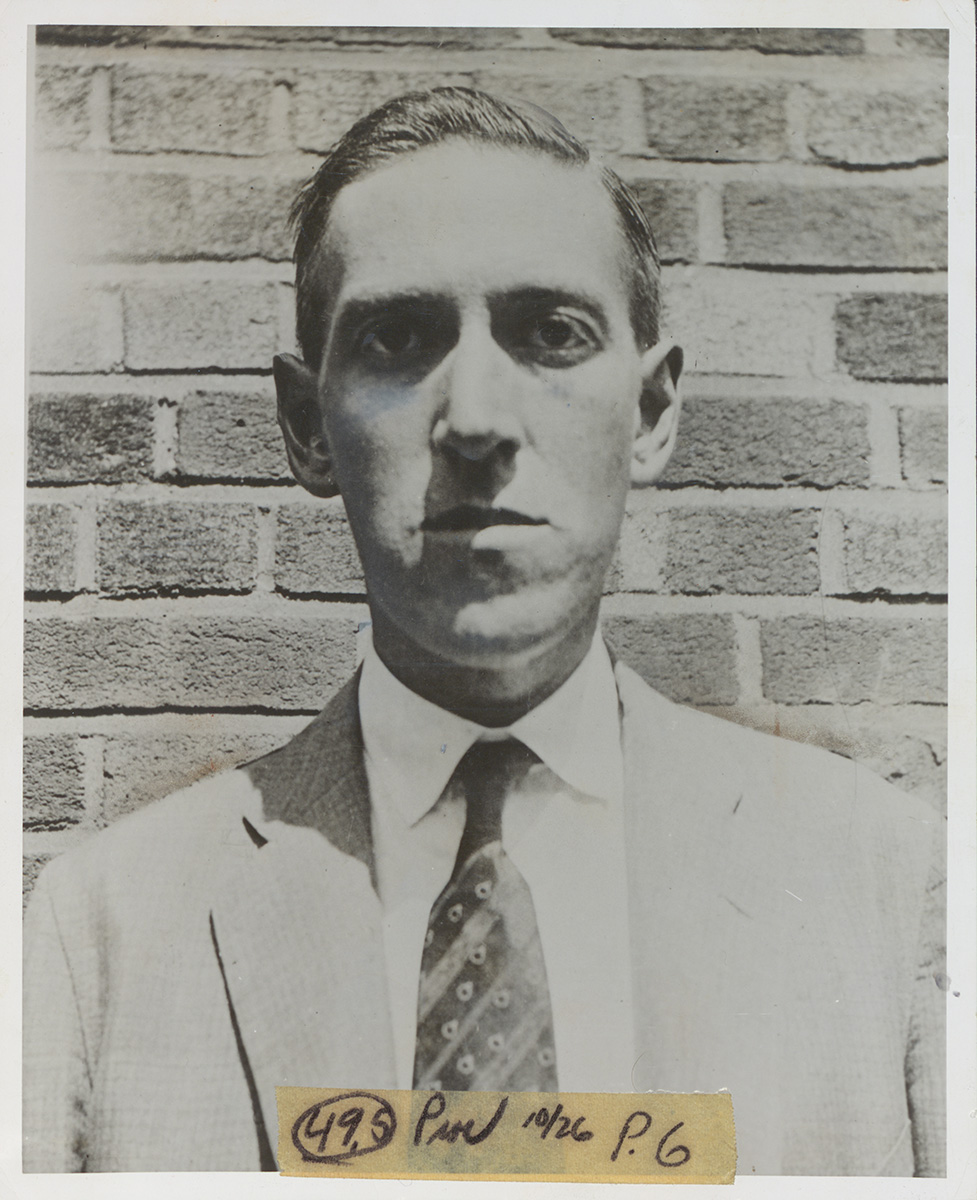
* And finally, I see that Brown University Library News published an online “The Evolution of Cthulhu” article, ahead of NeconomiCon 2026 in Providence. On the same page is news that the Hay Library (which holds the Lovecraft collections and related) will re-open in September 2026, after being closed for the summer due to exterior renovation work. Looking at the Brown Repository page, I see the new F.B. Long letters are still not online as scans. But new there are high-res scans of two portraits of Lovecraft, one from 1931 by Wilfred Blanch Talman, and the other early from his The Conservative years. The .JP2 files are around 40Mb each. Here I’ve restored the 1931 portrait as much as possible, given the high constrast of the bright summer day…

— End-quote —
Lovecraft, photographer…
“Sunday morning Loveman and I explored Prospect Park, fed the squirrels, and talked literature. At noon I did some Kodak shooting during which process there dawned upon us the new infant celebrity who was to form our principal focus of interest [thereafter, Frank Belknap] Long, whose phantasies you have doubtless read (I believe you mistook one for Theobaldian stuff!) is an exquisite boy of twenty who hardly looks fifteen.” — Lovecraft to Maurice Moe, May 1922.
[Lovecraft photographs Sonia on her arrival in Providence]. “Arriving at the Crown about 3:15 p.m., I paused only to snap the fair [Sonia] with my V.P. [Vest Pocket] Kodak, (the [Kodak Box] Brownie is still at 20 Webster!) & proceeded at once to show the quiet sights of Providence with the assurance born of practice on you & Daas.” — Lovecraft letter from September 1921.
In 1933 Lovecraft was still using his Kodak camera… “#2 Brownie which I bought 26 years ago – in far-off 1907. A sturdy two dollars’ worth!”. It had broken or run out of film in 1930, but he dug it out and used it again in 1933 to photograph his new home at 66 College Street. He also owned a portable “vest-pocket Kodak”, though it only made what he called “microscopic views”.
Lovecraft’s Commonplace Book entry, of story idea-germs, No. 184. “Expedition lost in Antarctic or other weird place. Skeletons and effects found years later. Camera films used but undeveloped. Finders develop — and find strange horror.”
[Lovecraft sends Galpin some snaps, 1933] “The please-help-the-blind effect is caused by the sun in Grandpa’s eyes — which were closed when the camera was prematurely snapped. The blurring is due either to the perturbation of the ancient Brownie at its repulsive subject, or to a lack of steadiness in the grip of the photographer. These cheap Brownies have such slow shutter action that they have to be held very still even for allegedly instantaneous exposures.” — Lovecraft to Galpin, November 1933.