
HPLinks #99.
* Catharsis Publishing has released new Hebrew translations of “The Call of Cthulhu” and Robert E. Howard’s “The Black Stone”, in one volume. Another companion volume has translations of Lovecraft’s “Pickman’s Model”, “The Music of Erich Zann”, paired with R.E. Howard’s “The Hoofed Creature” and “Doves from Hell”. The Israeli Institute for Hebrew Literature has a 2026 Frankfurt Book Fair interview with the publisher, in English, though sadly it’s trapped in a horrible Instagram format.

* 334digital on “The Shape Outside the Frame: Lovecraft, Identity and the Haunting of Contemporary Culture”. 334 also has musings on the Lovecraft that might-have-been in lost and unwritten tales.
* Jeffery Pintabona on “Why You Should Read Pulp In 2026”. Among other reasons he suggests the relatively brevity will appeal to many…
It’s often a lot shorter than literary fiction. Pulp magazines were dominated by short stories, novelettes, and novellas. Rarely would you find something longer than 40,000 words. [Plus, very little padding but lots of pace]. Pulp writing emphasizes story, action, and keeping things moving. [Modern readers] might be intimidated by the thought of attempting to read a 500 page book, but they might feel comfortable braving a 200 pager.
* MPorcius revisits Weird Tales magazine for July 1925…
All three of the stories [Hoffman Price, Lovecraft, R.E. Howard] present a philosophy and/or try to make arguments about groups of people instead of just offering simple entertainment, and the philosophies and arguments are striking (if not necessarily convincing) and so contribute to the value of the stories, to their ability to maintain the reader’s interest.
* Deep Cuts digs up a never-reprinted 1942 tale “Hell in the Village” (1942) by Hugh Raymond, noting that…
the name of the villain, Von Junzt, was likely inspired by the author of Nameless Cults in the Cthulhu Mythos fiction of Robert E. Howard. Michel also tipped in references to Lovecraft and Aleister Crowley, which suggests the whole might be a nod to Weird Tales — with tongue firmly in cheek.
* A new German translation, Die Weiden Neue deutsche Ubersetzung . Mit Einfuhrung, Anmerkungen, Chronologie und Bibliographie (‘The Willows: A New German Translation. With Introduction, Notes, Chronology and Bibliography’).
* In the new Edinburgh Companion to Irish Literature and Periodical Culture (2026), the chapter “A Lord Abroad: Tracing the Fiction of Lord Dunsany in British and American Periodicals”.
* Previously unseen 1980s Providence photos from Steven J. Mariconda. The real and later-demolished Federal Hill church in “Haunter of the Dark”, and the actual Shunned House with interiors. Also the Patterson Museum in New Jersey, established by Lovecraft’s good friend Morton.
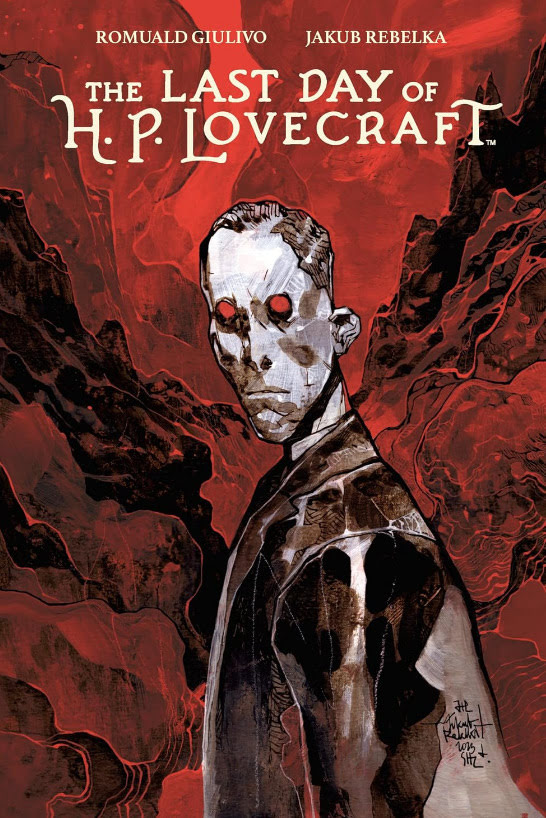
* Released as a Kindle ebook a week ago, The Last Day of H.P. Lovecraft graphic novel. Given the price and the download-size, I assume it’s the trade edition which collects all the floppy single-issues in one volume. I seem to recall it’s been a collected graphic novel before now, from a small indie publisher, but I assume this new trade edition from a bigger publisher will also include new extras?
* IGN‘s The Sinking City 2 Video Review…
Nobody really gets a happy ending in the Cthulhu mythos. But I was pretty satisfied with this latest, harrowing peek into its writhing innards.
* Now crowdfunding, the abandoned documentary Lovecraft: When the Stars are Right. Currently 20% funded with 33 days to go…
This is the first film ever made about H.P. Lovecraft — and almost no one has seen it. Shot in 1989–90, it features unique interviews with Lovecraft’s friends and colleagues. It has sat unfinished for more than thirty-five years. We need your help to complete it and release it for the first time.
* And finally, the very worthy HPLHS audiobook The Complete Fiction of H.P. Lovecraft, currently free for a “limited time” on Amazon UK when you get an Audible subscription. And seemingly free even if you just get the Trial…

— End-quote —
Talking of lost tales…
“I am still obsessed by the notion that one of the most extremely powerful of all tales would be an utterly realistic thing dealing with the sensations of a man deposited without a great amount of warning on another world. The one fatal weakness of nearly all interplanetary tales is that they almost completely ignore this factor of the situation. To my mind, the stupendous wave of emotion-incredulity, lostness, wonder, stark terror-incident to this supreme dislocation from mans immemorially fixed background would be so colossal a thing as almost to dwarf any events which might happen to a celestial traveller. I yet mean to write a tale whose one supreme climax shall be the hero’s discovery, after many torturing & ambiguous doubts, that he is on another world.” “… it would begin as a dream-phenomenon creeping on the victim in the form of recurrent nightmares, as a result of his concentration of mind on some dim trans-galactic world. Eventually it would enmesh him totally — leaving his body to vegetate in a coma in some madhouse whilst his mind roamed desolate & unbodied for ever above the half-litten stones of an aeon-dead civilisation of alien Things on a world that was in decay before the solar system evolved from its primal nebula. I doubt if I’d handle it as phantasy so much as a stark, macabre bit of quasi-realism. [..] In cold realistic fact any man with half an imagination would undergo a frightful mental shock at the mere idea of any contact with a planet other than this. This feeling would be the central element of any interplanetary story of mine; indeed, the whole thing would be more of a psychological study than an adventurous narrative…” — Lovecraft to C.A. Smith, letters of December 1929 and November 1930. Some basic components of the idea would appear to have been later woven into “The Shadow Out of Time” (written 1934-35).