An archival screenshot of the April Fools Day post for 2022.


01 Friday Apr 2022
Posted in Historical context, Housekeeping
An archival screenshot of the April Fools Day post for 2022.
31 Thursday Mar 2022
Posted in Odd scratchings
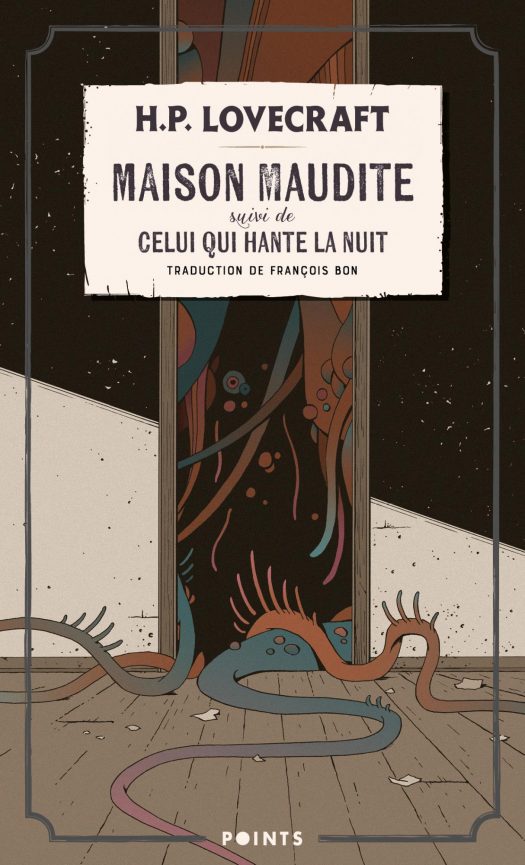
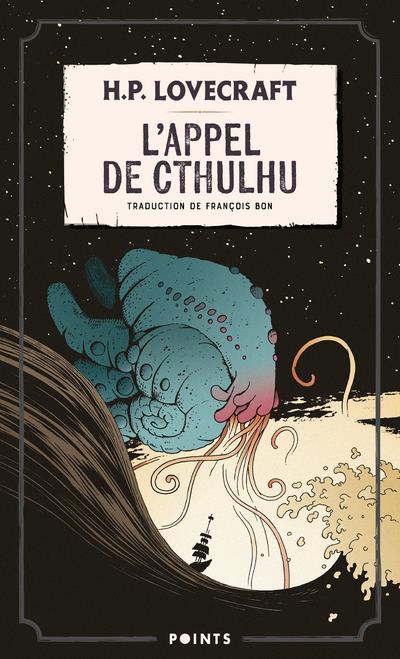
I now know the name of the cover artist for the new set of Lovecraft editions from Points in France. Thanks to two kind people who posted comments on my earlier post. He’s Borja Gonzalez of Spain. He has a graphic novel in French titled Nuit Couleur Larme, which he seems to have both written and illustrated. This ‘teen witch, teen friendships’ book was published in English in 2021 by Hoopla Digital as Night Cry (144-page ebook) and seems to have been well-reviewed.


30 Wednesday Mar 2022
Posted in Odd scratchings
S. T. Joshi’s blog has updated, and he has a number of choice books for sale including…
Frank Belknap Long’s A Man from Genoa (Recluse Press, 1926) [signed by the author]
29 Tuesday Mar 2022
Posted in Lovecraftian arts
Beautiful new Moebius-like covers for the Fracoise Bon translations of Lovecraft, these being issued by the publisher Points. These seem to have been paperbacks re-issued with new covers in 2020-21. Try as I might I can’t get the illustrator’s name. [ Update: Borja Gonzalez ] The covers of the earlier mid 2010s edition were rather vague ‘tentacles in the background / big typography’ shovelware-looking stuff. But these are more like French BD comics.



28 Monday Mar 2022
Posted in Historical context
I’m now further into reading the Gaplin letters, in the new expanded volume. Here is my second batch of notes.
* In early 1917 Lovecraft states that he likes the travel films of Burton Holmes (p. 176), seen at the Strand in Providence. Homes shot artful travel documentaries on 35mm, and appears to have made about thirty shorts a year. Here is a small selection of his travel films which could have been seen around this time, fronting the main movie…
1916:
The Cliff Dwellers Of America.
Among the Head Hunters.
Picturesque Prague.
Motoring In England.
British Egypt.
The Real Streets Of Cairo.
The Lower Nile.
Thee Upper Nile.1917:
Quaint Quebec.
On the Great Glacier.
Fruitful Florida.
Kyoto, the Ancient Capital.1918:
Fire Walkers Of Bega.
Some readers may also be interested in his 1947 “Historic New England” colour documentary, 21 minutes, if it survives.
* When Lovecraft registered for military duty he gave his occupation as “writer”. He tells Galpin that he was reassured that he might therefore still be of use… even if he failed the physical. (p. 182)
* He assumed he had read all of Sherlock Holmes by 1918, but a footnote itemises what he had read by 1927: three collections (Adventures, Memoirs, Return), three novels (Scarlet, Four, Hound) and two unnamed “mediocre” stories appearing circa 1908. I assume these were the 1908 tales “The Adventure of Wisteria Lodge” and “The Adventure of the Bruce-Partington Plans”. This shows he would have been up-to-date to summer 1908, but after that lost touch. He would have missed the rest of the tales included in the book collections His Last Bow (1917) and all of the tales in The Case-Book of Sherlock Holmes (1927). Thus it would be a mistake for scholars to assume Lovecraft had read… “The Adventure of the Devil’s Foot”; “The Valley of Fear”; “The Adventure of the Sussex Vampire” or any other of the Case-Book tales. A pity, as if he’d have stuck with Holmes just a bit longer he would likely have enjoyed “The Adventure of the Devil’s Foot” with its macabre plot and Cornwall/Africa combination.
* He owned all of Prof. Appleton’s chemistry instruction books (p. 211) as a boy. Relevant to his later work because of how the pictures line up so nicely with the themes of his later stories.
* “I tried to write a comic opera when about ten years old” (p. 214).
* He mentions the “Spanish Influenza” explicitly (p. 216). He realises around 18th November 1918, that… “This influenza is nothing light”, which seems a bit of an understatement and perhaps suggest he was behind with his reading of the newspapers. Statistics show that peak deaths in Providence occurred 13th- 14th October, and Boston had seen 3,700 deaths by the 16th October 1918.
* He had seen and strongly approved of the movie Hearts of the World (p. 219). This was a big-budget D.W. Griffith / Lillian Gish movie, partly filmed on location and depicting German brutality and atrocities against civilians during the invasions early in the First World War. Gish and Griffith later thought the movie was too anti-German, though that was at a time when the atrocities had been very assiduously ‘written out of history’ — seemingly by those who instead preferred to show the Allies (British and Americans) in a negative light. But the very widespread atrocities did happen and they were later unearthed by post- 1990 historians and are now copiously documented. If anything, the movie now appears to have underplayed the matter.
* Lovecraft lists three humorous spoofs he wrote in early summer 1923, “The Wonderful Hills”, “A Day in the Country”, and “Uncle John’s Legacy”. (p. 225). These may have been published in an amateur journal, but are now lost. They “convulsed” Lovecraft’s future wife with “mirth”.
* Lovecraft states that his uncle Dr. Clark had made a deep study of “‘descent of fire’ and legends pertaining thereto”. (p. 226). This is the idea of ‘the descent of fire from the heavens’ and its study appears to have involved examining various legends and lore for traces of early attempts to explain storm lightning, ball- lightning, ‘St. Elmo’s Fire’ and suchlike. I would guess probably also the apparent ‘trapping’ of sparks (rubbed amber, flints, static electricity, etc). Such things were seen, circa the middle of the 19th century, to be an ancient current in human belief that was different from ancient sun worship and sun-lore. This stems from Muller and others in Germany who saw the philosophy of the ancients as centred around the Dawn-time, and thus the coming Sun. But by the 1870 the scatter-gun followers of his idea were seeing ‘sun-gods’ in every fairy-tale and local old-wives tale, and a basically sensible theory was made to seem ridiculous. Being someone more interested in ‘descent of fire’ would by the 1880s have made one something of a heretic against ‘the consensus’. Lovecraft does not state that he had read his uncle’s work or the notes for it, but it might be assumed that he had at least talked with his uncle on the topic.
* Lovecraft talks of the sinister odour of old Puritan houses (p. 232), a significant factor in their macabre allure for him.
27 Sunday Mar 2022
Posted in Podcasts etc.
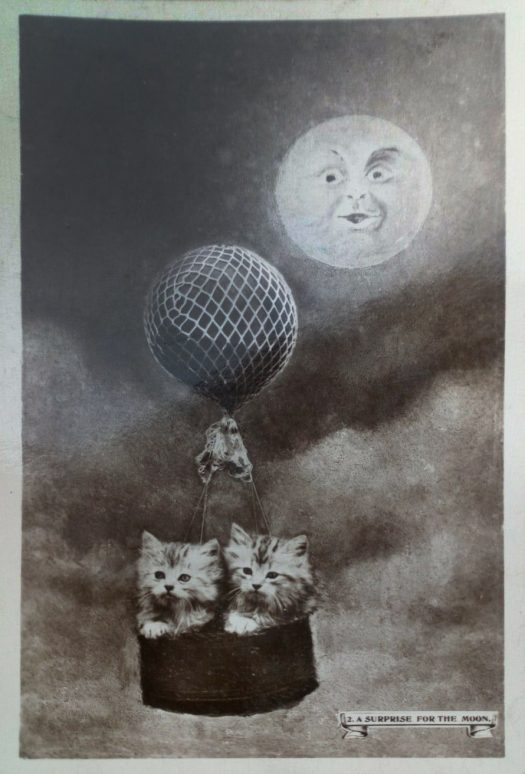
Last week the SSFAudio podcast pampered “The Cats Of Ulthar” by H.P. Lovecraft with a full reading and discussion, and graphic novelist Jason Thompson was in on the subsequent discussion. No imitations of Lovecraft meowing or yeowling or purring, but judging by the show-notes the discussion does get pretty wild.
26 Saturday Mar 2022
Posted in Scholarly works
Leftist Spanish newspaper El Pais has the article “H.P. Lovecraft’s thirst for scientific darkness”. The Spanish-language article muses on the new book in titled El Astronomicon Y Otros Textes En Defense De La Ciencia (‘The Astronomicon and Other Texts in Defence of Science’).
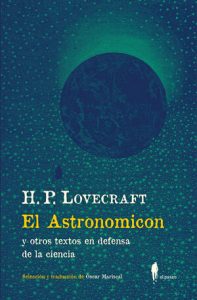
This translates Lovecraft’s various writing on astronomy and the Moon and also his public tussles with a local astrologer. I’m uncertain if it also has relevant extracts from the private letters.
This volume has an introduction by its translator, Oscar Mariscal. He introduces us to a Lovecraft who has been little-known, until now. This is Lovecraft the popularizer and defender of the science of astronomy. In these texts the world first sees this introverted young man’s hunger and thirst for a world of scientific knowledge, and glimpses a tormented inner life that will in time give rise to a cosmos of viscous monsters and star headed terrors … terrors capable of reaching across the cosmos and into the depths of our unconscious souls.
This commercial book was aided by an arts grant from the Ministry of Culture, something almost impossible to imagine happening in the UK.
25 Friday Mar 2022
Posted in Historical context, New discoveries, Picture postals
This week, the Shepley Library in Providence. This place appears in passing in Lovecraft’s novel Charles Dexter Ward, when Ward is described as having belonged in his city…
as much to the past as the antiquities he loved so keenly. […] His social activities were few; and his hours were spent mainly at home, in rambling walks, [in various learned institutions or at] the newly opened Shepley Library in Benefit Street” Later, in his investigations into Curwen…
Charles Ward examined a set of his accounts and invoices in the Shepley Library
The place also has a passing mention in “The Shunned House”…
I was forced to ransack both the Rhode Island Historical Society and Shepley Library before I could find a local door which the name Etienne Roulet would unlock. In the end I did find something; something of such vague but monstrous import that I set about at once to examine the cellar of the shunned house itself with a new and excited minuteness.
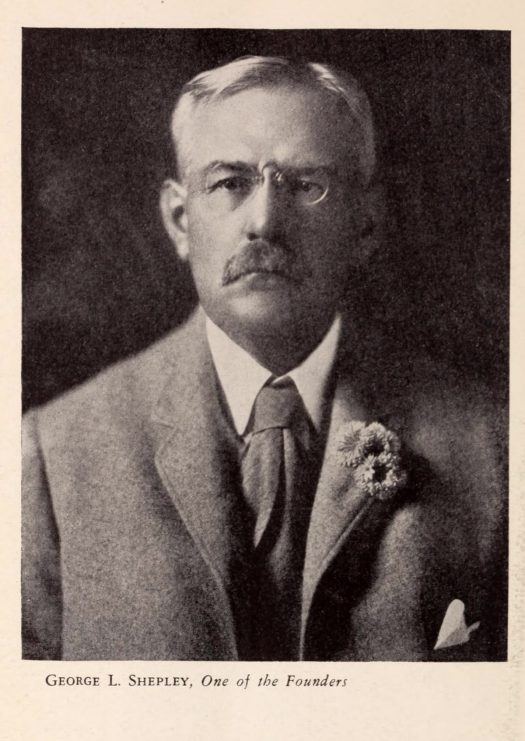
Shepley was Colonel George Leander Shepley (1854-1924). His personally-designed private library / museum opened at 292 Benefit Street in late 1921, as seen here in my newly colourised picture via the Providence Public Library and the Historical Society…
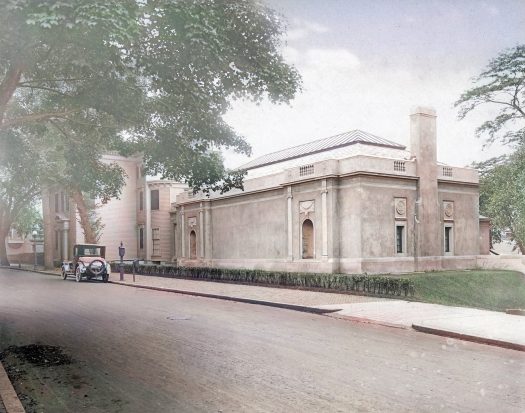
Lovecraft was able to visit in 1923. He appears to have had access because his aunt Annie Gamwell was working there at the time. A magazine of the period shows the Library had been open to the public on afternoons, when first opened in late summer 1921. But I’m uncertain if that opening offer was then continued into 1922 and 1923.
The American Antiquary Society has a short outline biography, revealing the owner to have run and made his fortune in the largest insurance business in the world. One source mentions his ingenuity at developing new insurance services and policy types to serve new markets. Another talks of his absolute integrity. He was a leading Mason who had ascended very high, a member of various clubs and sat on a number of local company boards. In his retirement he built and stocked his large library relating to Rhode Island and Providence history, rivalling that of several other well-endowed local institutions. That Lovecraft’s narrators are able to either frequent or “ransack” the Shepley Library thus implies they knew the old fellow personally, or at least his curator. Lovecraft himself had a friendly reception from the curator, to the extent of apparently being offered the loan of a certain key view of Providence… if only a duplicate could be found to replace it on display. Lovecraft evidently made a long and close inspection of the place and he discovered much, as detailed in the Voluminous podcast letter of 6th March 2022 and also in a letter to Moe (Letters to Maurice W. Moe, page 133-34). It was this visit that revealed to him a previously unknown colonial section at the back of Weybosset, between Weybosset and the waterfront. This quickly led to his foggy expedition into the squalid rookery around ‘Gould’s Court’ (Ghouls Court) at the back of Uncle Eddy’s book shop on Weybosset. Nephew Eddy already knew this area at the back of his uncle’s book shop well, as it happened, and he acted as guide. Ken Faig Jr.’s Some of the Descendants of Asaph Phillips and Esther Whipple also has the museum as being Shepley’s home (“housed in his home on Benefit Street”), and it does appear from the photograph to have been a house with a large museum / library wing seamlessly attached.
Lovecraft was distinctly peeved when the the old fellow died in 1924 without making arrangements for his magnificent collection, other than (seemingly) for it to remain where it was and private. His reaction is revealed by the new Letters to Family (Vol. 1, p. 500), when Lovecraft writes…
the closing of the Shepley museum is utterly barbarous — upon my soul, I don’t think much of the old boy if he didn’t provide for the permanent exhibition of his collection. He aught to have deeded it to the Historical Society, or to Brown University, or to some other institution founded in his name. Egad! But it’s a publick crime to keep a treasure-house like that closed!!
The death of a daughter shortly before her father meant the old man’s planned inheritance was fumbled. The other daughter who did inherit the fortune allowed the museum to languish in a private state for academics only (“opened only to research students on request”), since we hear of no more visits by Lovecraft. If it had been open then he would surely have visited it again and taken friends there, and remarked on this in letters. In 1938, as war loomed, the collection was finally sold (not given) to the Rhode Island Historical Society. The building was for a time used by theatrical players and used to stage puppet-theatre shows for children.
How history might have been different. Imagine… old Colonel Shepley takes a shine to Lovecraft’s aunt, woos and marries her, then adopts Lovecraft as heir-apparent and the ideal antiquarian son he had always wanted. Lovecraft inherits the enormous fortune. He spends the next twenty years championing architectural preservation throughout America and Britain, and on the side issues some modest and slim books of polished philosophy. He barely writes any fiction.
So I guess we should be grateful that such events never happened. But Lovecraft’s extended and generous 1923 visit had done enough. He felt it had been a key turning point in his life, as he told Moe in 1923…
I am now become definitely an antiquarian, rather than a general student of letters
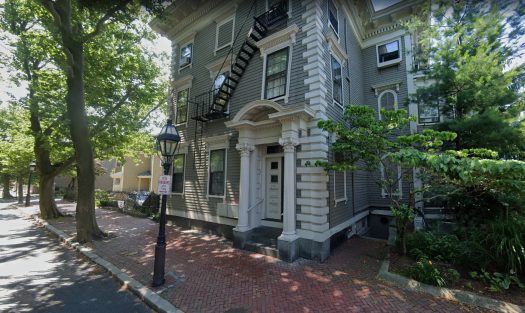
Shepley’s house still exists today as “295”, as can be seen by comparing Street View with the archival view. Today the observant scrutineer will also notice a down-steps side-entrance which goes through through to a shabby apartment and peeling porch on the back of the house. Perhaps this was once the back apartment of the on-site curator? Street View also reveals that the library at the side is now a sunken car-parking area, with crude graffiti and strewn trash… “where once had been only strength and honour, taste and learning” (“The Street”).
The depth and level of this car-park suggest that the 1921 view of the museum from Benefit Street may well be deceptive. I suspect that we see there the back of the building and that the museum actually had two floors, with the lower one being set down into the slope. The 1921 view thus only shows the back of the top floor as it was visible from the street. In fact, we can see it has a top atrium which even might even suggest two floors and perhaps a sky-room. The Federal Writers’ Project (1937) did briefly itemise the building as “one-storey” in a book, something which has since been parroted by others, but those books were often hasty make-work projects for communist cliques — as Lovecraft’s friend Arthur Leeds found to his detriment. I suspect the compilers of the book were not local, and were just working from quick snapshots of street views.
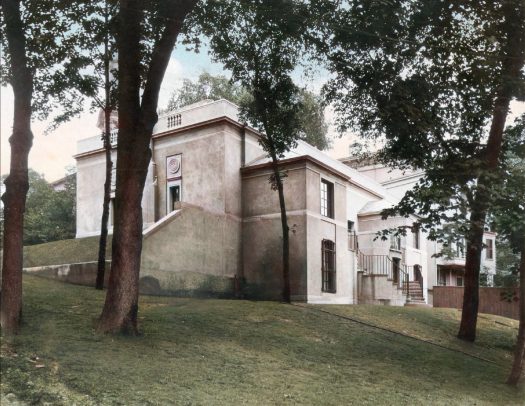
After writing the above I found a back view photograph of the Library, from the Historical Society via the book Providence’s Benefit Street. I’ve here repaired and colorised it. Yes, at the back the building was obviously deeper but also a bit more complex than a straightforward and mundane two-storey building. It may even have had a cellar strongroom (note the bars on the windows) that went down further into the ground. Apparently Shipley’s alarm and burglar-proofing system was state-of-the-art for the time. The modern-day shabby back-porch, as seen on Google Street View, can here be glimpsed in the distance.
24 Thursday Mar 2022
Posted in Odd scratchings
Dave Langford reports that…
In my copious free time I am also assembling the collected genre essays and reviews of SF Encylopedia founder Peter Nicholls, using his title for a planned (in the 1970s) but never completed history of SF: Infinity, Eternity, and the Pulp Magazines.
23 Wednesday Mar 2022
Posted in New books, Scholarly works
Neale Monks has a new long review of the book A Monster For Many: Talking With H.P. Lovecraft by Robert H. Waugh, on SFcrowsnest.
Lovecraft, Waugh argues, might be consciously patterning the structure of ‘The Dream-Quest’ on [James Joyce’s modernist] Ulysses, both being subdivided into parts thematically connected to different parts of the human body. Given that the entire story happens within a single night’s dream, the internalised quality of such a structure is plausible, at least.
Lovecraft flatly told White in May 1935… “I have not read “Ulysses””. But I suppose he may have read of it and its structure in press reviews, or heard about it in letters. It was hard to get hold of, but I seem to vaguely recall that Galpin got hold of various ‘naughty’ books when living in Paris? Galpin also had the interest and intellect to plough through some of such a difficult and rather boring text, if encountered. Thus Galpin could have related or known something of it first-hand, more so than other members of ‘the gang’?
Unfortunately for the notion of a modernist influence on Lovecraft though, I believe that old fashioned occultists patterned their spiritual ‘development’ on parts of the body. Called “chakras” or somesuch, which were deemed to be given spiritual ‘power-ups’ and in a certain order? In which case my initial guess would be that Lovecraft’s “Dream-Quest” and Joyce’s Ulysses were drawing on the same occult sources? Occultists will no doubt know more on the topic than I do.
22 Tuesday Mar 2022
Posted in Historical context
A peep inside the 1945 Armed Services overseas paperback edition of The Dunwich Horror and Other Weird Tales. This could have been what the soldiers and airmen were reading as they waited for D-Day. It was incredibly damp in England (more so than usual in a British summer) in the run-up to the invasion of Europe, and indoor pursuits such as reading were thus highly likely. After that, the men were probably rather too busy for reading.

I wonder if the thinking was that such reading would prepare the men for the horrors of battle with the Nazis? Wells’s The Island of Dr Moreau was also on the slate, in the list in the back.
Is there a publication history of this item that can reveal the facts? Perhaps in one of the Derleth biographies?
“The Dunwich Horror” was also on the radio in 1945.
21 Monday Mar 2022
Posted in New books, REH, Scholarly works
Since I last looked, the Italian Lovecraftian scholars have released several new journals.
Zothique #9 appeared at the end of September 2021.
* “an article on “The Weird and Sword & Sorcery”, which highlights the ‘Celtic substratum’.”
* “a small but succulent special section dedicated to the theme of music in weird literature, introduced by an essay by Davide Arecco, researcher and professor of History of science and technology at the University of Genoa, and with rare or unpublished stories ( by L.A. Lewis, Clark Ashton Smith, Emil Petaja, A.W. Calder, Jessie Adelaide Middleton), poems (by Jo. Dart and Robert Chambers) and also a comic that, signed by the master Gino Carosini (author of the text and drawings) presents a meeting as strange as it is unexpected: the one between the tales of Lovecraft and the music of Chet Baker!”
* “the fourth part of Mariano D’Anza’s long study on Robert E. Howard’s poetry”
Zothique #10 which apparently appeared a few weeks later as an “Autumn 2021” edition. This is the second Robert E. Howard special, of a planned three.
* “another substantial selection of articles and essays dedicated to the Bard of Cross Plains, together with a choice of unpublished works that expand the Italian bibliography of the writer.”
* “Giovanni Valenzano offers a very detailed excursus on werewolves and other shape-shifting beasts in Howard’s fiction”
* “Andrea Gualchierotti with brilliant erudition speaks to us of magic and witchcraft in the cycle of Conan the Barbarian, finding surprising parallels with the real magicians of the classical world.”
* “Mariano D’Anza’s work on the sources of Howardian poetry continues, this being his fifth section.”
Studi Lovecraftiani #20 with the announcement post being dated 12th January 2022.

* “a thorough examination of HPL’s cultural heritage in modern literature and media”
* “an in-depth study of cursed grimoires and impossible books that sprang from its pen and that of other authors”
* “a piece on Lovecraft’s monsters seen as a psychological metaphor, the first part of a learned study on the abstraction of corporeality in HPL’s fiction”
* “an original article that discloses a source never before identified for the short story “The Nameless City”.”
* “three unpublished [in Italian] writings by HPL himself, starting with a memory of his school days, where the writer also tells a funny episode that occurred during the graduation ceremony; then one of his essays where he criticizes the famous poem “The Waste Land” by Thomas Eliot, and, translated here for the first time, there are also his extraordinary notes that he needed to write the famous short story “The Shadow over Innsmouth”.”
The Italian Horror Magazine also notes that #20 has…
* “”Lovecraft’s Call: A Few Considerations on the Cultural Heritage of the Providence Dreamer.” The last part of which talks… “about Lovecraft the philosopher and conservative, a man flanked by authors apparently very distant from him such as Cesare Pavese, William Butler Yeats, Yukio Mishima and Pierre Drieu La Rochelle, Ezra Pound and even the late-stage Pasolini.”
* “Lovecraft and the Bible, examining the influence of the King James Bible on Lovecraft’s tales.”
* “an interview with Richard Stanley, director of The Colour Out Of Space movie.”