William Dean Howells

Here’s an interesting bit of historical back-story, relating to the literary atmosphere into which the younger Lovecraft would have emerged. He might have felt “The Dead Hand of William Dean Howells”, as a new article at DMR puts it. In this and a follow-on post, DMR looks at this William Dean Howell…

the “Dean of American Letters [and] literary tastemaker for the entire nation […] and his twisted jihad against any fiction containing a hint of adventurous fun or overt heroism

His main influence appears to have been from roughly circa 1887 when the Haymarket anarchist bombings led him to become a strident leftist, until the tumultuous events of 1919 and the counter-reaction they caused among the public. Howell died a year later in 1920. It is suggested by DMR that his influence after 1888 helped to bifurcate narrative literature. As well as breeding an academic cadre of gloomy leftists… “who hate the very concept of the individually competent and heroic” and who also strive to paint history as an un-heroic parade of horrors.

The division of literature being suggested, as I would phrase it, is into…

accessible imaginative adventure tales + (increasingly) science and technology

vs.

a rather dull and class-ridden realism + (increasingly) leftist politics

Sounds plausible, though admittedly I’m no expert on the emergence and reception of the proto-pulps before about 1922. Nor of literary realism. And I’d imagine that historians of early pulp might well suggest other cultural and economic forces at work in the emergence of early pulp forms. Nevertheless it does appear from what I read that Howells would have been a potent part of the mix. I’d then surmise that, as with many things, having something frowned on or censored can give it a potent allure for rebellious youth. As with so many cultural zealots, it sounds to me like Howells and his ilk may have been effectively publicising and making more exciting the very thing he wanted to stamp out. This probably worked in an inter-generational way, rather than directly. In that a copy of Black Cat or Adventure was made more exciting because Grandma and the Sunday School teacher would confiscate it if found. Neither young Billy or the news-stand vendor would have been reading William Dean Howell directly. At the editorial level, Howell and his ilk would be causing self-censorship, true. But this would just mean that some of the crudity was refined out… and thus the thing they hated was more likely to be tolerated on the news-stands and to reach young Billy.

Incidentally, talking of derided tales of heroism, this month I interviewed someone who had a big hand in the underlying CG for Emmerich’s recent war-movie Midway. And so I took a look at the movie, along the way, ignoring its bad reviews. I’m glad I did. It’s great. What did those reviewers see? It doesn’t seem to have been the same movie I saw.

Anyway, ignore the slathering of bad reviews it had on release. I found Midway to be a very fine movie on the small screen + headphones, and a straightforward celebration of American heroism of a type I didn’t think was being made today. Don’t be put off by thinking that it might be as convoluted and stop-start as the first half of his latest and somewhat clunky disaster-epic Moonfall.

But back to Howells. Did Lovecraft ever pass an option on Howells? Just once and obliquely, when he noted in passing a house as having once been lived in by the…

correct old lady William Dean Howells of Boston

That appears, so far as I have access to the materials, to be the limit of Lovecraft’s opinion of the famous critic. To Lovecraft he was, it seems, to be considered a ‘fussing old maid’ of the prim and censorious Bostonian type.1 I even checked the Morton letters ebook, which can only be searched on a Kindle 3. No mention of Howells there either.

  1. See books such as Banned in Boston: The Watch and Ward Society’s Crusade Against Books and The New England Watch and Ward Society

Providence in 1920

As automobiles became more common, the modern type of general outline map of a city became needed. Here’s an early one for Providence in 1920, which also now has its uses for orienting Lovecraftians. The dotted line in the harbour also indicates the sailing route of the ocean-going passenger ships from Fox Point.

A bit of a pickle…

New to me, the book Weird Chicago (2008), now on Archive.org.

My text searches, and a skim of the table-of-contents, suggest that the book somehow completely overlooked the fact that Chicago once housed Weird Tales magazine. But it does note in passing that 1930s/40s Weird Tales cover-artist Margaret Bundage’s husband worked as a bartender at the Dil Pickle bar.

Vamps in Whitby

The 13th century gothic Whitby Abbey in northern England plans to break… “the world record for the largest gathering of people dressed as a vampire”. Shoes are apparently vital. Past attempts in America have failed, due to too many turning up in training-shoes rather than black winkle-pickers. It’s hoped that some 1,200 vampires will be flitting around on the evening of 26th May 2022.

“The House and the Shadows”

I find that J. Vernon Shea’s late memoir of Lovecraft is online, as printed in Fantasy & Science Fiction (May 1966). It can thus be seen in context. The magazine’s editor thinks, for instance, Lovecraft’s entire work to be “entirely unwholesome” and has “great reservations”. Elsewhere in the issue Fritz Leiber reviews the first book of the Selected Letters.

In I Am Providence Joshi much later remarked…

Some of his essays on Lovecraft — especially “H. P. Lovecraft: The House and the Shadows” (1966) — are quite notable.

Shea’s memoir runs to 7,700 words and seems more of an early attempt at a short biography than a memoir, and as such has largely been overtaken. It appeared six years after Moskowitz’s article-biography on Lovecraft (Fantastic, May 1960). But in context it’s an interesting snapshot of Lovecraft ‘as known’ among the science-fiction crowd in the summer of 1966. At that time the counter-culture was incipient but also still somewhat ahead in time. There was great disdain among the science-fiction gate-keepers for genre-mixing (fantasy/sci-fi, sci-fi/horror), allied to a huge concern for ‘respectability’ amid the ever-present thought of ‘what will the mainstream culture think of us?’.

‘Picture Postals’ from Lovecraft, 9 Canal St., Providence

Hurrah, persistence pays off. Friday the 13th might be unlucky for some, but it’s lucky for Lovecraftians. Because here at last is a picture of Lovecraft’s favourite Jacques Lunch, and at the 9 Canal Street address too. Aka “Jake’s”.

From the budget bundle-o’-local-photos book Rhode Island: Unforgettable Vintage Images of the Ocean State, published 2000 and now long out of print. Here cleaned, rectified and colorised.

The date is uncertain. The caption has it that Hugues Jacques and Pierre ‘Leo’ Jacques are seen behind the counter, and we know from Ken Faig Jr. that they took over the former bar in 1923. So it is probably at about that date or a little later. One can see a docks-worker and probably at least one docks foreman or truck-driver eating at the counter. As well as several old gents who might be of limited means, perhaps the “Salvation Army derelicts” as Lovecraft once referred to them in a letter. A certain ‘Domingo’, not seen, also regularly served behind the counter…

Toward Domingo, an olive-skinned, behind-the-counter servitor at Jacques’, his favorite eating place in Providence, he was as affable as a courtier in a drawing room.” (Talman, on Lovecraft)

Lovecraft had discovered this cheap and abundantly sustaining eatery via Talman in 1926, and from then on he regularly enjoyed its man-sized portions of cheap food. He does not appear to have been a daily or even a weekly customer, but he dropped in and was well known to the place and its people — especially in the summer “visiting season”. The place seems to have slowly slid downmarket over the years. From late summer 1933, and as the Great Depression deepened, Jake’s began to tolerate what Lovecraft called “extremes in the matter of clientele”. He sought out other nearby options, and came to patronise a nearby Al’s Lunch. However, perhaps the “clientele” situation eased. Since Ken Faig Jr. has established he was still eating at Jake’s in August 1934 and March 1935. One day in mid September 1935 Lovecraft found Jacques abruptly closed, the business having failed at last. Lovecraft looked forlornly in the windows again at various times, but found it always “still vacant”.

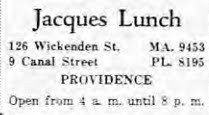
Also newly discovered, as seen in my earlier post, the opening times as they stood in April 1933…

It’s a gas…

I’ve updated Monday’s 132 Wickenden Street post. I had mis-typed “Jack’s” instead of “Jake’s” a couple of times. Corrected now. I’ve also re-thought what Faig’s “one door east” means in the context of this new-found picture. It now looks to me like “Jake’s” had been on the opposite corner (i.e. the open forecourt seen here), and had moved across to the other corner at 132 when the Shell gas-station forecourt was built on the site of 126.

In which case this is it before the Shell station, albeit as a small picture…

* Opening times, April 1933 ad…

Both are closed from 8pm to 4am.

* March 1934 ad…

126 was now only in open in the afternoon and early evenings, perhaps a sign of staff problems. Canal St. was still only closed from midnight to 4am, with the expanded opening hours possibly a sign of needing the income.

* Late September 1935 ad…

The ad has No. 126 open 24 hours a day except Sundays, and no mention of Canal St. Which had closed down that same month.

The Lovecraft Geek returns

I’m pleased to see that Lovecraft scholar Robert Price has re-animated his The Lovecraft Geek podcast, now the pandemic is effectively over. To the extent that there are three new episodes available. Before this, the last episode had been 31st March 2020. Then there was a long hiatus.

The new episodes can download to .MP3 from the show’s Podbay listing. Episode 22-001 is a 56-minute regular Lovecraft Geek, and one of the best I’ve heard. This is followed by two with Price’s new readings of Lovecraft’s “Dagon” and “The Temple” respectively.

It thus looks like there’s a good chance of another The Lovecraft Geek or two during 2022, so send in your questions to help encourage the next one.

I also took a look to see if more Lovecraft-related episodes had popped up over on the Christian MythVision YouTube channel, but no… they still only have his short 18 minute-one on “Lovecraft and the Origins of Religion” (June 2020). The rest of his podcasts over there appear to be about Biblical historicity and suchlike, and are thus not likely to be of interest to Lovecraftians. But there’s plenty to dig into in the back-catalogue of The Lovecraft Geek, linked above.

There’s also his The Bible Geek Show, and he mentioned on the new Lovecraft Geek that he recently did a complete Clark Ashton Smith reading there. Though he doesn’t say which episode.

Also mentioned in the new Lovecraft Geek are Lovecraft’s Dreamlands tales and two of the best emulators of these are named… Myers for his The House of the Worm / Country of the Worm, but also the “early Kuttner”. And Price should know on that point, since he was the editor for Kuttner’s The Book of Iod: The Eater of Souls and other Tales (1995, Chaosium) collection. A quick perusal of Price’s Introduction in that book reveals the two stories he must be thinking of…

Kuttner penned a pair of pastiches of Lovecraft’s Dunsanian tales. These are “The Jest of Droom Avista” and “The Eater of Souls”.

Both short tales were in Weird Tales in 1937 and can thus now be found online as originally printed…

“The Eater of Souls”. (Plain text).

“The Jest of Droom Avista”. (Plain text).