Audio: the Strange World of Harry Houdini, and more

New on LibriVox, audio readings of the complete Strange World of Harry Houdini texts as they appeared in Weird Tales. All read by Ben Tucker, including Lovecraft’s ghost-written pyramids adventure for Houdini.

Also on Librivox, a new 27 minute reading of “Poisoned” by Weird Tales editor Farnsworth Wright, and SFFAudio this week has Lovecraft’s “The Wood” and discussion.

New book: The Parameters of the Weird Tale

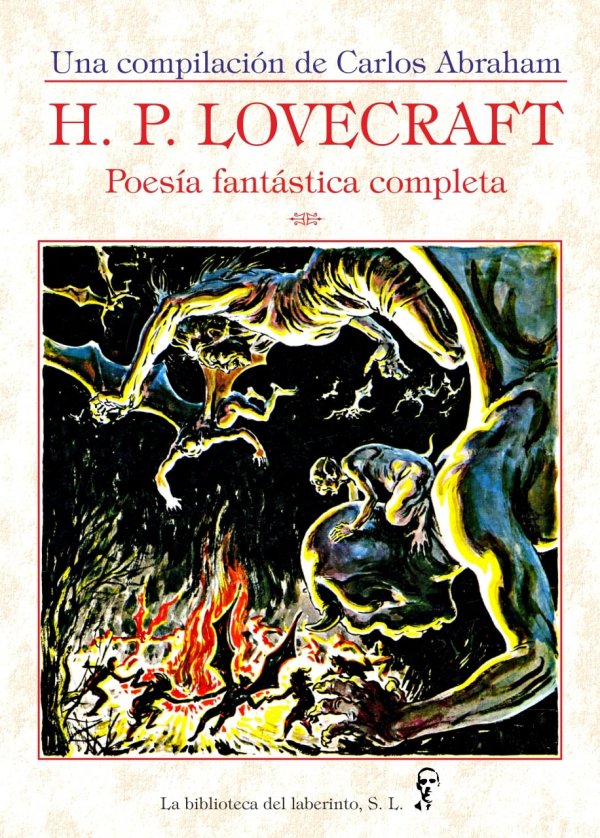
S.T. Joshi’s blog announces his new book The Parameters of the Weird Tale, which includes “old bibliographical articles from the New Lovecraft Collector (1993–99)” among other items. I don’t see the Lovecraft items in his World in Transition collection, and the old Lovecraft Collector is not on Archive.org.

The contents include, among others…

* An Annotated List of Lovecraft’s Juvenile Manuscripts in the John Hay Library.

* Lovecraft’s Earliest Writings.

* Lovecraft’s Amateur Pamphlets.

* The Sense of Place in Lovecraft’s Early Tales.

Parameters can be had on the Kindle as an ebook, or in paper.

‘Picture Postals’ from Lovecraft: Looking down Clinton Street

Following on from yesterday’s notes, the final post for Selected Letters II.

Page 259: Here Lovecraft is giving advice to young Talman, who by January 1929 had moved to Red Hook. Lovecraft recalls that when living at Clinton Street he had patronised… “the grocer on the corner of Atlantic” as he put it. Thus Clinton Street and Atlantic Avenue, very near his room. He seems to imply there was only one such possible corner with a grocer on it.

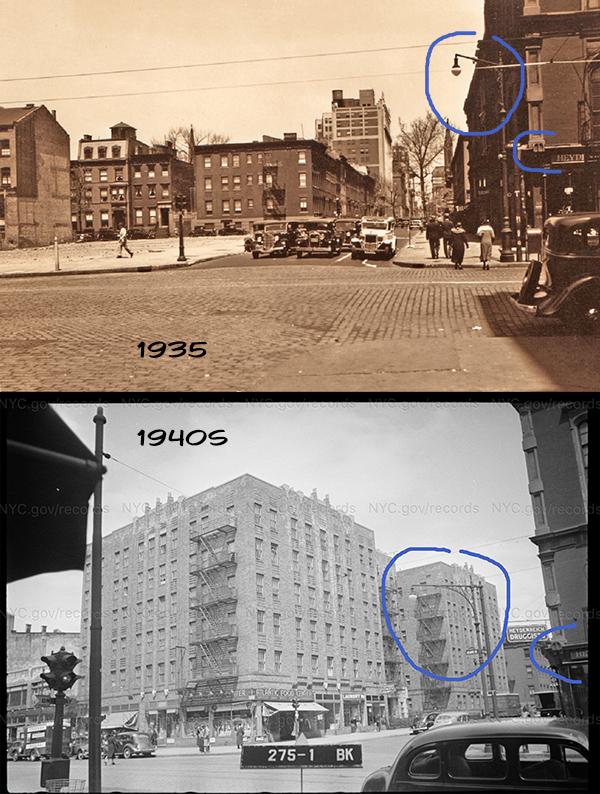
Now it can’t be the “Atlantic Food Centre” seen on 1940s.nyc, because that corner was gone by 1934 and the “Food Center” only appeared there after Lovecraft’s time. Before that it was the Fougera apartments. They had stores beneath the apartments, but the larger of these appears to have been a liquor store.

Although on 1940s.nyc the lower picture may be earlier, as the “Druggist” corner on the right of the picture was also demolished in 1942.

We know what the Fougera corner looked like in 1922, before demolition and the later “Atlantic Food Centre”, thanks to pictures in an article on The Fougera by New York historian Brownstoner. It does not look like a grocery store…

The picture of the demolished Fougera site does however give us a peep down the street to Lovecraft’s famous No. 169 Clinton address, albeit in 1935 and thus ten years after his time there…

Lovecraft says elsewhere that he patronised the Syrian “tailor in the same block”, and here we can indeed see a large sign for “Tailor”. Also a glimpse of the corner store on the right (“Heyd…” something). We know from Lovecraft’s “Red Hook” story that there were relic Norwegians in the area, so my guess on the name would be Scandinavian. There are plenty of Heyde and Heyder surnames in Norway. A later picture shows a drugstore/chemists there, and this earlier incarnation does have the visual feel of a chemists’ shop. Not a grocery then.


But what of Lovecraft’s grocer? It’s not the Fougera corner and it’s not the drugstore corner. So it should be one of two possibilities that are behind the above-seen cameraman.

Ok, the 1940s.nyc site now lets me ‘turn the camera around’ and give readers a look at those two possible grocery stores.

The bottom and slicker-looking one was built as a savings bank, which moved out in 1922. Google Street View has the building’s Clinton side as “191 Clinton” and the shorter Atlantic side of the same building is “160 Atlantic Avenue”. The same numbering applied in the 1920s. In 1922 American Art News announces…

Nicolas Macsoud [a painter of the Orient and miniaturist, 1884-1972] has returned to his studio, 191 Clinton Street, Brooklyn.

Although that may indicate the rooms above. The large apartments above the bank were home to several artists circa 1890s-1910s, and circa the 1900s-1910s the address pops up frequently on art show catalogues now on Archive.org. In 1921 it was still the address of the Brooklyn Society of Miniature Painters, though that may be because of the miniaturist Nicolas Macsoud. Nothing much is heard of art there after 1922. That may be due to the copyright cut-off. Or it could be that the artists departed with the bank in 1922, as the area went rapidly downhill.

But my feeling is that a lush marble-lined savings bank of 1922 would not suddenly become home to a cheap grocers the very next year. This reinforces my feeling that 160 Atlantic Avenue / 191 Clinton Street was not Lovecraft’s corner grocery, if it even was a grocery circa 1923-27. To me it feels, peering through the fuzz, like a fancy bread and cakes shop. Or perhaps a fruitier.

Update: I can now discount the store on this ‘bank’ corner of Atlantic Avenue – Clinton Street. A 1927 picture shows that a corner store was not yet there at that time.

That leaves one option. The top of the two pictures is the final possible corner, at 156 Atlantic Avenue. In this circa 1940 picture the address feels the cheaper of the two possible stores. It has what might be ‘delicatessen’ sign-writing on the windows. On the balance of probabilities, I’d say that Lovecraft’s Red Hook grocery store was at No. 156.

Today the area has obviously gentrified and 156 is the affluent hipster’s ‘Swallow Cafe’, though its facade still keeps the old name ‘Tripoli’ (the well-reviewed middle-eastern and “seafood specialities” restaurant that was there 1982-2010s). Pictures of the side of the building today show it goes quite far back, far enough to allow for a large grocery store in the 1920s, and this is confirmed by a similar early 1940s view of the place…

Mythos writers may then be interested to learn that No. 156 also goes down quite deep

156 Atlantic Avenue: this particular building has three sub-basements, the lowest of which lines up with track level inside the [subway] tunnel. (The World’s Oldest Subway, 2015, page 22)

Thus Lovecraft’s Red Hook corner grocery had deep basements that went down and down until they reached the level of the city’s oldest subway. And was later home to a “seafood specialities” restaurant. Hmmm….

Notes on Selected Letters II – part two

Over the summer I’m reading through Lovecraft’s Selected Letters. Here are my notes for Selected Letters II. With just one more post on Vol. II tomorrow, re: new discoveries about Lovecraft’s room at 169 Clinton Street on the edge of Red Hook.


* Page 221. Lovecraft’s family Bible, purchased 1889 by his parents, had in it a clumsy… “imitative engraving of Belshazzar’s Feast” by the Northumberland-born visionary artist John Martin (1789-1854). Lovecraft later recognized the picture “upon seeing a proper plate of the subject for the first time.”

* Page 222. 10th January 1928. Beirce’s translation of The Monk & the Hangman’s Daughter as a possible precursor to, or primer for, some of the feel of “The Dunwich Horror” (written August 1928)…

it is scarce two weeks since I read, for the first time … I shall not soon forget the general picture afforded of the wild Bavarian mountains, the sombre, ancient life of the salt mines, & the whispered, fearsome lore of the crag-fringed tarns & black hanging woods….

Around the spring of 1928 (page 331) Lovecraft also heard a public lecture — presumably at Brown — on modern Greek folklore… “I heard a highly illuminating lecture on the subject a year ago by Sir Rennell Rodd, a lifelong student of neo-Hellenic folklore.” This may also have fed into his fateful trip to Wilbraham and the birth of “The Dunwich Horror”. Rodd’s 1890s book on the topic is online, and he had presumably added to his knowledge since then.

* Page 296. By early 1929 he was weekly taking “the N.Y. Sunday Times and the sanely balanced and disillusioned news-weekly Time.” But a few years later he intimates to Long that he has limited his intake of national and international current affairs.

* Page 298. “I’d say that good art means the ability of any one man to pin down in some permanent and intelligible medium a sort of idea of what he sees in Nature, that nobody else sees. In other words, to make the other fellow grasp, through skilled selective care in interpretive reproduction or symbolism, some inkling of what only the artist himself could possibly see in the actual objective scene itself. … The picture can, if it be good art, give you something in the real scene which you couldn’t have gathered for yourself — which only the particular artist who painted the picture could ever have gathered preserved for other people to see. … We derive from this process a feeling of magnification in the cosmos — of having approached the universal a trifle more closely, and banished a little of our inevitable insignificance. Instead of being merely one person, we have become two persons — and as we assimilate more and more of art we become, in effect, more and more people all in one; till at length we have the sensation of a sort of identification with our whole civilisation.”

* Page 323. He reads The Silversmiths of Little Rest, by William Davis Miller. Because it related to his family-tree and “the Casey side av me” believed by his family research to be originally “the English Caseys of Gloucester”, England. The 50-page 18-plate book was produced in a limited edition of 150, seemingly for antiquarians in New England. Little Rest was a place, rather than a description of the work-habits of the smiths. “Full biographical and occupational information (markings, inscriptions) on the following key Little Rest (i.e., Kingston, RI) silversmiths: Samuel Casey, John Waite, Joseph Perkins, Nathaniel Helme, Gideon Casey and William Waite.”

* Page 324. March 1929. He alludes to something Talman is writing or has recently written. “By the way — it’s a good idea of yours to square us criminal Caseys with society by making an Howard Phillips a reg’lar deteckatiff” [regular detective]. Which hints that Talman had recently penned or planned to pen a crime-detective story featuring a “Howard Phillips”. I don’t yet have the volume of Talman letters, and I imagine I may find there some detail about this apparent ‘Lovecraft as character’ story. By January 1929 Talman had moved to Red Hook, and I would guess he was enamoured of “The Horror at Red Hook” with Detective Malone, and thus probably wanted to write something similar himself — perhaps a clever sequel featuring Lovecraft himself. But I shall have to wait for the book of Talman letters to find out if there are more details on this.

* Page 329-30. April 1929. He observes that the… “Famous ‘London Terrace’ in West 23d St. [New York City] — where a friend of mine has lived all his life — is to come down shortly to make room for a wretched apartment skyscraper.” Who was this friend? He may be footnoted in the Toldridge letters, but I don’t yet have that volume. But something can be gleaned from the building data. Historians now refer to the row as a… “development from the 1840s known as London Terrace, built to look like typical London [British] apartments at that time”. A local report of 1929 gives an alternative name, mourning the loss of… “a row of private dwellings of considerable age and great local interest, identified as London Row or London Terrace”. The book The City in Slang (1995) gives a folk-name and the location… “One of the earliest so-named Millionaires’ Rows in New York was a block on West 23rd Street, a development formally called London Terrace, between Ninth and Tenth Avenues.” So these data may help someone to pinpoint Lovecraft’s mysterious friend, who still lived there in 1929 and was likely either i) affluent and elderly or ii) a young lad of an affluent family.

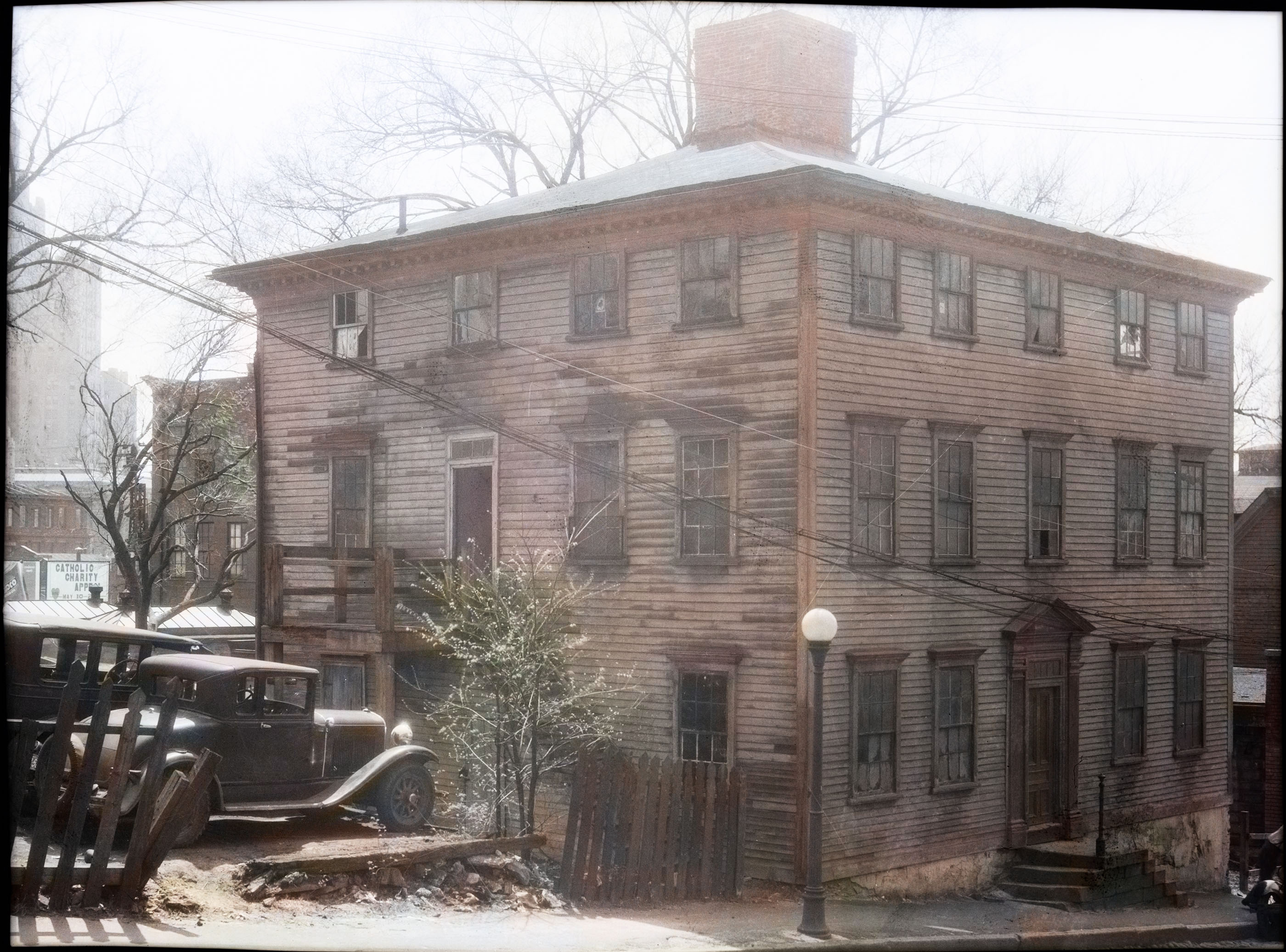
* Page 353. Lovecraft tells Mrs Toldridge… “I pass in sight of the ancient Carter house every time I walk down town — & the neighbourhood is still much as he knew it in 1770 & thereabouts. Across the street an old brick schoolhouse built in 1769 is still serving its original purpose, whilst at the foot of the hill the old Quaker Meeting House ( 1745) still broods beside its deserted wagon­sheds. … John Carter, Providence’s colonial printer, & publisher of the Providence Gazette & Country-Journal before, during, & after the revolution. His old shop & office, the Sign of Shakespeare’s Head, in Gaol-Lane, is still standing in good condition notwithstanding the sinking of the neighbourhood to slumdom. It is a large square house on a steep hill, with fanlighted doorway & the double flight of railed steps so typical of colonial Providence.”

The John Carter house is at “21 Meeting Street”, an address which unlocks the Library of Congress. Here is the house as Lovecraft would have known it circa 1933-35. The Industrial Trust building can be seen behind on the left. Modern photos show a currently ‘restored’ colour that can range from neon-red to coconut-shell brown, so I’m not sure how to colour it. Here it’s sort of ‘faded creosote’, in keeping with its decrepit slum state.

Collected works in Japanese

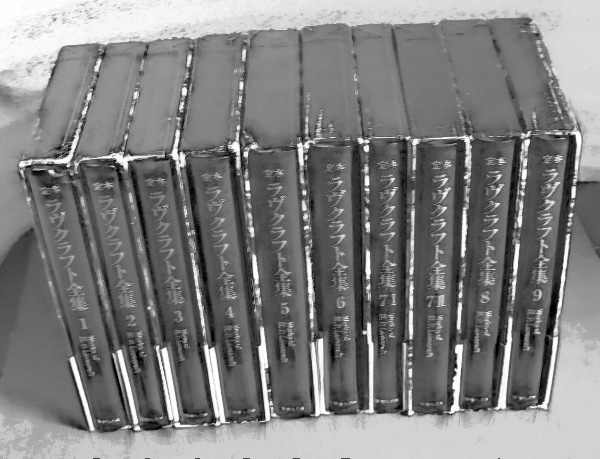
Lovecraft would surely have been chuffed to have his collected works in Japanese. This is what the set looks like, though apparently there was one further uniform volume produced after the boxed set. A bad blurred Abe picture, and the set anyway looks it’s spent some years in the hold of a Kushiro squid-jigger, so I’ve here filtered it a bit.

Peter Lamborn Wilson

I hear that Peter Lamborn Wilson is now with the angels.

Doubtless some thumping great 650-page biography will, one day, proffer a paragraph that draws strange parallels between P.L. Wilson and H.P. Lovecraft. For instance, living as-if back in 1911, quitting New York City for the rural Hudson Valley, engaging playfully with the weird Fourier-ist backwoods of American history, dreaming of wandering mad Arab visionaries and Sufi dream-voyagers, seeking traces of lost Egyptian desert utopias, musing on the hermetic ‘will to power as disappearance’ in the service of eventual re-emergence and re-discovery in other places and at other times.

But for now I plant a few quick signposts-in-the-sand, following a quick catch-up survey of where his post-2001 work might be found.

His latest book appears to be Peacock Angel: The Esoteric Tradition of the Yezidis (2022). Which should help clear up any misconceptions gained about them in Lovecraft’s “Red Hook”. This follows on from his Cauda Pavonis: Esoteric Antinomianism in the Yezidi Tradition (2019).

His The Temple of Perseus at Panopolis is a 400-page table-trembler which imaginatively and poetically… “aims to give a thick impression of a single Egyptian city, Akhmim, called by the Greeks Panopolis or ‘city of Pan’. As a time-machine, this book will take the reader back to the 5th century AD, when the last champions of Paganism were battling against the coming triumph of Christianity.” Sounds interesting. A little later on his heavier book False Messiah: Crypto-Xtian Tracts and Fragments (2022) is said to prod at the various esoteric encrustations that have attached themselves to Christianity.

His fantastical fiction is to be found in Night Market Noodles & Other Tales (2017) and his collection of Borgesian and Nabokovian hoax-fictions False Documents (2015). I can’t find any other such collections. I’ve never read any of it, but it’s on the list now.

Riverpeople (2014) is his “epic” mixed poetry and prose text, which appears to be akin to Moon’s PrairyErth but shorter. It’s on the landscapes and people of his adopted home-place in the Hudson Valley, above New York City. The Esopus River, to be exact, which it appears Lovecraft knew in the form of his cherished “Esopus grist mills”. Riverpeople is flanked by a book of essays arising from his interest in early American weird-history, The American Revolution as a Gigantic Real Estate Scam: And Other Essays in Lost/Found History (2019). Another sentiment with which Lovecraft might have nodded in agreement, if not quite agreeing with the romantic anarchist politics (the ponderous and un-readable fellow anarchist Murray Bookchin frowned on Wilson too, which I consider to be a Good Sign). Wilson’s related essays, such as “Back to 1911: Temporal Autonomous Zones” and “Caliban’s Masque: Spiritual Anarchy and the Wild Man in Colonial America”, are to be found in the miscellaneous clear-out collection Anarchist Ephemera (2016). Which, since it’s Creative Commons, is on Archive.org as a PDF.

Like Lovecraft he was also a poet. I can find three chunky volumes of selected poems published in 2018, Lucky Shadows and Vanished Signs and Thibault or the Secrets of the Sea. Said by Autonomedia to have all been selected from his “1999–2014” poetry, and then split into books distributed among three different publishers. A note on Vanished Signs suggests a chunk of that volume is from his earlier Ec(o)logues (2011), which was apparently an evocation of “anarcho-surrealist” bucolic ruralism. Sounds like News from Nowhere for the Terrance McKenna generation. After that the poetry seems to swing a little darker with the final(?) School of Nite (2015) which was a 60-page photobook with sombre photos and poems.

His essay collection New Nihilism (2018) collected essays on comics-and-freedom (said to be excellent), evading the corporate media, and his enduring love of Celtic culture and history (not the cringe New Age gift-shoppe variety) among other topics. Sadly he does not appear to have ever engaged with Lovecraft in essay form. That would have been an interesting long essay. But it’s one that we shall now never have.

New book: Cosmicism and Neocosmicism in H.P. Lovecraft

Newly listed on Hippocampus, Ellen J. Greenham’s book Cosmicism and Neocosmicism in H. P. Lovecraft, Philip K. Dick, Robert A. Heinlein, and Frank Herbert

In Greenham’s analysis, Lovecraft’s cosmicism offers human beings limited options in madness or death as responses to the inescapable revelation of their own insignificance and ephemerality in the universe. The neocosmicism of Dick, Heinlein, and Herbert offers another pathway in the framework for how humans might respond when facing engulfment. Rather than yielding to despair, neocosmicism offers an experience that leads to the revitalisation of the human’s relationship with the universe it inhabits.

SFFaudio Podcast #684

As some people’s thoughts turn toward the usual beach-front summer vacation, the new SFFaudio Podcast #684 has an unabridged Gordon Gould reading for “The Strange High House In The Mist” by H.P. Lovecraft followed by discussion.

Lovecraft claimed the story was inspired by the “titan cliffs of Magnolia” (Mass.). Yet I find that the postcard and glass-plate makers have singularly failed to capture any “titan” cliffs, and the candidates of “Rafe’s Chasm” and “Mother Ann” seem to lack the necessary attributes.

Yet it appears he was not being ironic…

I ended up with the titan cliffs of Magnolia — memories of which prompted “The Strange High House in the Mist” — and found their charm undiminished. [He had seen them in 1923]. You can’t imagine their majesty unless you’ve seen them — primal rock and sea and sky …. and the bells of the buoys tolling free in the aether of faery!

In 1933 he recalls…

the striking sea-cliffs of Magnolia — with the yawning abyss of Rafe’s Chasm.

Well then… maybe they just never had the right photographer? Perhaps at low tide one could walk around below them on the beach, and that way they looked more impressive?

However, the search of Magnolia does yield me the required Father Neptune…

Lovecraft’s maps

Along with the forthcoming mega-index to the completed volumes of Letters, it struck me that we could also use a companion volume containing maps. ‘Orienting’ maps, in outline but still somewhat detailed. Map that quickly tell readers where one place was in relation to another. I’d suggest the following:

1. Lovecraft’s Providence (the topography and places known as a boy)

2. Lovecraft’s Providence (post-1914).

3. Lovecraft’s College Hill and Marketplace (including tunnels).

4.   ”  Places near Providence (Dark Swamp etc).

5.   ”  Brooklyn.

6.   ”  New York City.

7.   ”  New England coastline.

8.   ”  Dots-on-the-map. A general ‘dot-map’ of Lovecraft’s excursion and trip destinations east of the Mississippi and up into Canada.

9.   ”  Florida and his southern excursions.

10.   ”  Circle locations (their origins, places).

11.   ”  Far-flung Empire (his interest in particular far-flung places, places used in fiction etc).

Appendix: Map and mapping sources known to have been owned, used, consulted by Lovecraft.

Appendix: Bibliography of maps known to exist, relating to the original Lovecraft material (i.e. not the wider and later Mythos).

Appendix: List of important addresses in Lovecraft’s life.

Might be done in a suitable period style…