An Arthur Leeds crime one-pager from The Black Cat, March 1920. Newly on Archive.org.

And a longer railway tale in the May issue, “Over the Great Divide”.


28 Tuesday Jun 2022
Posted in Historical context, Kittee Tuesday
An Arthur Leeds crime one-pager from The Black Cat, March 1920. Newly on Archive.org.
And a longer railway tale in the May issue, “Over the Great Divide”.
27 Monday Jun 2022
Posted in Historical context, Scholarly works
Online for free, The Letters of Edgar Allan Poe in the revised two volume Gordian Press edition: Vol. 1 and Vol. 2 (both 1966).
Also, from the same worthy press and site, Poe’s collected Imaginary Voyages (1994). This is also on Archive.org “to borrow”, but here it’s free in full-text.
26 Sunday Jun 2022
Posted in Podcasts etc.
Phil Chenevert has two new public-domain readings on Librivox, “The Call of Cthulhu” and “The Colour Out of Space”. These are also on torrents at archive.org: Call and Colour.
Also Frank Belknap Long’s “The Timeless Ones”, newly online at Librivox as part of a story collection. It appeared in Planet Stories in July 1951.
25 Saturday Jun 2022
Posted in Historical context
A newly discovered item from Everett McNeil, “oldster” of the Lovecraft Circle. Published in Comfort magazine, September 1923, a short syndicated item titled “The Feast of the Dead”.

In 1913 the same paper ran his long biography of Kit Carson. He had previously published the historical novel With Kit Carson in the Rockies; a tale of the beaver country (1909).
24 Friday Jun 2022
Posted in Maps, New discoveries, Picture postals
This week in my ‘Picture Postals’ series of posts, more follow-on from my recent successful search for Lovecraft’s “John’s” in Brooklyn.
1) Here are two Photoshop-combined sections of Sanborn’s 1904 Brooklyn Atlas, showing 7 Willoughby Street (John’s) in plan and context.

We can see here that No. 7 (“John’s”) had a large isolated yard and sheds out back. This is possibly of relevance re: it being a suitable-looking site for prohibition hooch-brewing in the back yard, something which we know went on regularly at the main branch of John’s. Note the adjacent cigar making, carpet cleaning and gas-fitting. Alcohol fumes from the stills might have been well cloaked by the neighbouring pongs. Possibly there was also a back-entrance to the yard, for small trucks using the insalubrious Union Lane. Looks to me like a perfect site for prohibition brewers in 1925.

2) In my recent search for Lovecraft’s Clinton St. grocery, I can now discount the store on the ‘bank’ corner of Atlantic Avenue – Clinton Street. You’ll recall there was a savings bank on one of the four possible corners, a bank that had departed the area in 1922. A 1927 picture shows that a corner store there, visible on that corner in the early 1940s, was not yet in existence at 1927. This discovery further confirms that Lovecraft’s grocery store was at 156 Atlantic Avenue, on the corner with Clinton.
In the same set of pictures there is a 1935 picture of 156 Atlantic Avenue. This is in one of the same set of Sperr pictures, Brooklyn: Clinton Street – State Street. But this picture has been confusingly titled. Its title implies that it shows State Street but it does not, as the label on the back indicates. It is merely “south from State Street”, i.e. made at a point south ‘on the map’, but with State St. behind the cameraman. To someone who knows what they’re looking at, this April 1935 picture shows Lovecraft’s Clinton – Atlantic Avenue corner, as seen from the waste-ground of the demolished Fougera apartments. Thus Lovecraft’s grocery is partly visible behind parked cars, on the very far right of the picture…

Regrettably this is one of the Sperr pictures that the NYPL hold hostage for their expensive “fine art prints” racket.
3) Also in the Sperr pictures, I found a better angle in a picture that looks down Clinton Street. Brooklyn: Clinton Street – Atlantic Avenue, early June 1927. A date which was little more than a year after Lovecraft had returned to Providence. The druggist (chemist) is on the corner with its awnings up against the sun, and Lovecraft’s Clinton St. is falling away at the left of the picture, as seen below. Lovecraft’s room at No. 169 is on the far corner, slightly obscured by a nearer lamp-post. Sperr’s label on the back has a description and the “June 1927” date. I think this may be the first time this particular picture has been identified with No. 169, and it’s very close in time.
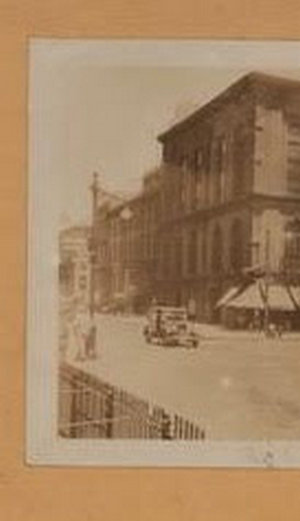
Sadly it’s another of the Sperr pictures that the NYPL hold hostage for their “fine art prints”. Online it is very low-res, but apparently the NYPL do have larger as a very expensive “art print” — and seemingly with no actual guarantee that the image quality will be any better. You might end up with a $150 blur.
However, discovering that the corner building had once been the “Brooklyn Atheneum” aka “Athenaeum” opened doors to new data, and I found more or less the same view on a Brooklyn Eagle postcard…

Late 1890s. The Brooklyn Historical Society hold the plate.
We can see “Heyder[eich?]” the druggist was there on the corner in the late 1890s, as he was in the 1935 and 1940 pictures of the same corner. He appears to have been there all the way through, circa 1890s-1940.
What of the Atheneum? The Atheneum had once been a large concert hall, assembly rooms and then a private mercantile subscription library, and there was indeed a druggist on the corner (a chemist shop, as I had suspected). Its heyday as a modern venue was the 1850s-70s, and later as a theatre and lantern-projectionist forum in the 1880s. Nothing is heard of it after that as a regular cultural venue. But there was an attempted mass-meeting of East Coast anarchists there in 1901, as a result of which… “police closed down the Athenaeum”. The building was then swiftly leased by the New York Court of Special Sessions (of the Second Division, meaning Brooklyn, Queens and Richmond). “The Second Division the Court of Special Sessions is now held at the corner of Atlantic avenue and Clinton street” at “171 Atlantic Avenue”. Rather too swiftly occupied, since the officers complained for several years about the badly leaking roof, until the place was eventually refurbished. The Court’s lease was renewed in 1922, the year when the building was sold to a new owner by what a real-estate trade-paper called the “old” Athenaeum. The new owner appears to have been making a long-term investment on the corner site rather than the creaky old building — it was listed for demolition as part of “slum clearance” and abruptly demolished in 1942.
When Lovecraft was living at No. 169 this corner of Clinton and Atlantic was thus a court for the trying of petty crimes. Crime that merited either a fine, or some days in jail or a youth reformatory. It may not have sat as a court every day, but its presence would often have ‘flavoured’ the surrounding sidewalks with a seedy and anxious atmosphere.
The Athenaeum’s final days are seen here, photographed circa 1941-42 by Irving Kaufman, with the demolition placard on the front…
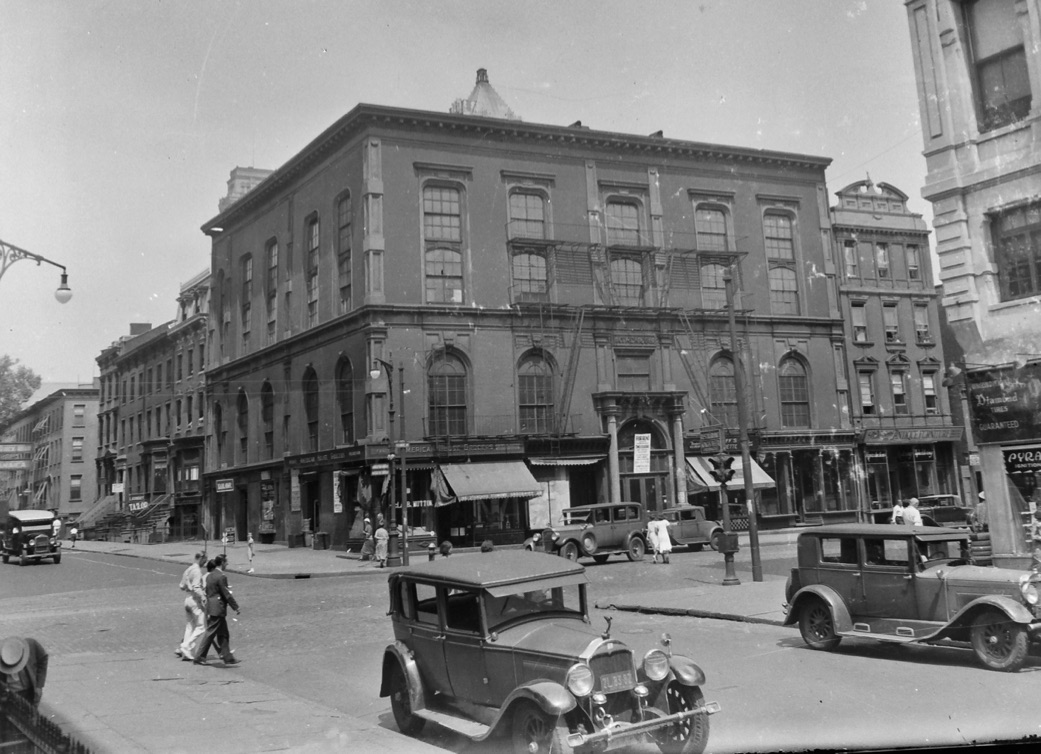
Old Brooklyn Athenaeum / Second Division of the Court of Special Sessions, before demolition. Also Clinton Street and No. 169. Photo by Irving Kaufman (1910–1982). Kaufman’s son Phil Kaufman was until a few years ago able to provide prints. But Phil Kaufman’s website has now gone, and at the time he posted these prints he did not know where they had been photographed. Just that they showed large Brooklyn buildings that were declared for demolition.
Here the old corner druggist has gone at last and the store has become an opportunistic grocer, “American **st Grocers(?)”, for a year or so before demolition. But this is long after Lovecraft’s time there. Still, it gives us another new picture looking down toward No. 169 Clinton St. and we get a feel for Lovecraft’s walk up to his Syrian tailor’s and to the corner, before crossing Atlantic to reach his usual grocery store.
In a further Irving Kaufman picture we can also see the immense ‘Fouguera’ apartments building that loomed opposite Lovecraft in Clinton St. This picture shows the other side of the street, and a distinctive corner of the druggist’s frontage can be seen in the bottom-right (it has a ‘pig snout’ moulding that can’t be mistaken). Comparing the styling of this frontage, just visible enough, with the 1935 and circa 1940 pictures to show that it it not yet the grocer’s seen in the circa 1941 picture. In that latter picture the grocer has re-tooled the signage boards somewhat. This ‘Fouguera’ photo must be earlier than circa 1941. Indeed, it must be circa 1934-35 because 1934 was when the ‘slum clearance’ demolition boards went up on the building, as noted by the Brooklyn Eagle. These boards can be clearly seen on the building.

We can also more clearly see the nature of the corner shop at the ‘Fouguera’. It was a furniture store with what seems to be an antique bric-a-brac wing with a show-window on the corner.
To summarise, my search for Lovecraft’s grocery has found the store, and has also established several other useful facts along the way. Lovecraft would have walked toward the grocers on Clinton/Atlantic through a ‘canyon’ like street, with the immense ‘Fouguera’ on one side, and the old Brooklyn Athenaeum on the other. If he walked from his room into this canyon during the day he might have encountered many people going to or from the Second Division the Court of Special Sessions, Brooklyn’s court for petty crime that was held in that building. Such anxious or hard faces cannot have raised his general assessment of the immediate area. Culture and thrift was fading away. The old Athenaeum had gone, the Saving Bank on its opposite corner across Atlantic had departed in 1922 (and seemingly also the artists who had some sort of informal studio colony above it). The once proud ‘Fouguera’ was (in the eyes of the city) now becoming the slum that would condemn it in 1934 and with a seedy-looking furniture store and a seedy cafe below. The old druggist on the Athenaeum corner, “Heyder[eich?]”, kept up the tone. The grocery at No. 156 Atlantic Avenue was worth patronising and affordable, and presumably friendly. But the area was obviously going downhill despite a superficial aura of fading quality, as Lovecraft’s letters also evidence.
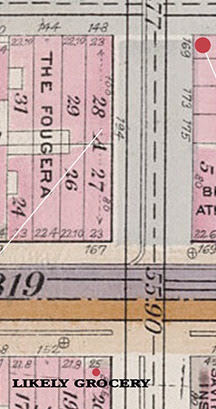
Map showing Lovecraft’s room at 169 and the four corners of Clinton/Atlantic. Clockwise: ‘Fouguera’ and bric-a-brac shop; Athenaeum (now the petty-crimes court for Brooklyn) and Druggist; the old Savings Bank (lower part not a store until after 1927); and then the grocery at 156 Atlantic.
23 Thursday Jun 2022
Posted in de Camp, Historical context
A large collection of science-fiction convention programmes have recently arrived on Archive.org. Among these is the Tricon 1966 (a Worldcon, Ohio) convention booklet. This features a cover by Kelly Freas depicting Lovecraft’s first full-length biographer L. Sprague de Camp.

And another inside, an ink drawing by Joseph Wehrle.

And Progress Report 1 has a good photo, which I’ve enhanced a bit.

Incidentally, there’s a new blog dedicated to de Camp and his fiction, at Sprague de Camp Fan.
22 Wednesday Jun 2022
Posted in Astronomy, Historical context
Notes on Lovecraft’s Selected Letters Vol. III.
* “I am very fond of gardens – in fact they are among the most potent of all imaginative stimuli with me.” (page 29). Later he implies they formed his “earliest dreams”… I have actually found the garden of my earliest dreams – and in no other city than Richmond, home of my beloved Poe! Maymont!” (page 151). He also refers to an early, lost tale or long poem… “In childhood I used to haunt such places [florists’ shops] about February, when the strain of hated winter became unbearable. I liked to walk through the long greenhouses & imbibe the atmosphere of warm earth & plant-life, & see the vivid masses of green & floral colour. One of my early doggerel attempts was a description of an hypothetical glass-covered, furnace-heated world of groves & gardens …” (page 138). He had early read Erasmus “Darwin’s ‘Botanick Garden’ … my early reading” (page 419), a likely influence on such early writing.
* He was taking night-walks in Providence in the Autumn / Fall of 1929… “the Hunter’s Moon last week was exceptionally fine. I took several walks to get the benefit of the mystic moonbeams on particular bits of landscape & architecture-river reflections” (page 38). Later he explores the far south of the city on foot, and later still (Vol. IV) parts of the north of the city.
* On everyday Christianity vs. its often pagan material trappings: “We have mouthed lying tributes to meekness and brotherhood under Gothic roofs whose very pinnacled audacity bespeaks our detestation of lowliness and our love for power and strength and beauty.” (page 45).
* On his Zimbabwe poem “The Outpost”, set in Rhodesia, he gives a linkage with Ophir which is not in the poem… “smart Arab and Phoenician Kings reign’d within the walls of the great Zimbabwe … and work’d the illimitable mines of Ophir”. The poem’s protagonist “K’nath-Hothar the Great King … [born of] great King Zothar-Nin [who] was born in Sidon of pure Phoenician stock” (page 55).
* He reads “The Netopian, house organ of Providence’s most influential bank”, which has some antiquarian articles. (Page 56). This is not online, but Brown holds the 1920-31 run at its Rockefeller Library.
* Ashton Smith’s “The Tale of Satampra Zeiros” features Commorium, which Lovecraft deems buried under the ice of Lothar. “It is this crux of elder horror, I am certain, that the mad Arab Abdul Alhazred was thinking when he – even he – left something unrnention’d & signdfy’d by a row of stars in the surviving codex of his accursed & forbidden Necronomicon!” (page 87). Lovecraft later refers to… “the mildew’d palimpsets of Commoriom” (page 242).
* Lovecraft hints at a “Cthulhu” sequel, having elsewhere suggested the possibility of a sequel story set on Cthulhu’s “home planet”. The following seems the match with that idea… “I shall sooner or later get around to the interplanetary field myself … I doubt if I shall have any living race upon the orb whereto I shall – either spiritually or corporeally – precipitate my hero. But there will be Cyclopean ruins – god! what ruins! – & certain presences that haunt the nether vaults.” (page 88) “It would begin as a dream-phenomenon creeping on the victim in the form of recurrent nightmares, as a result of his concentration of mind on some dim transgalactic world. Eventually it would enmesh him totally — leaving his body to vegetate in a coma in some madhouse whilst his mind roamed desolate & unbodied for ever above the half-litten stones of an aeon-dead civilisation of alien Things on a world that was in decay before the solar system evolved from its primal nebula. I doubt if I’d handle it as, phantasy so much as a stark, macabre bit of quasi-realism.” (pages 95-96).
* “The cuttings you enclosed are of extreme interest – that about the “star jelly” being absorbingly & superlatively so. … It is really improbable that any matter in the condition we recognise as “organic” could manage to get from one orb to another under the strenuous conditions of meteoric flight, though these occasional reports certainly do have their puzzling aspects. I have used the idea once – in “The Colour Out of Space” – & may yet use it again in a different way.” (page 136).
* In 1930 “the covers as well as the contents of rags like Snappy Stories represent true pornography” (page 108).
* “I’d damn well like to come out with a book [of philosophy] some day, even though I might never win a place beside Schopenhauer, Nietzsche, or Bertrand Russell.” (page 110). On learning philosophy he suggests to Toldridge… “You ought most emphatically to read The Story of Philosophy by Dr. Will Durant” (page 146).
* The “Fungi from Yuggoth” sonnet “series” was actually a modest and immediate financial success at a difficult time, netting him “$52.50 to date” (page 129).
* The writing of “The Whisperer in Darkness” was interrupted… “I am still stall’d on p.26 of my new Vermont horror, since revision (which I can’t refuse if I expect to make my trip!) has overwhelm’d me.” (page 130).
* In June 1930 he gives the place of a recent meeting with Dwyer… “the genial and fantastic Bernard Dwyer, whom I visited in antient Dutch Wiltwyck, up the placid Hudson” (page 159).
* In October 1930 he really does believe in witches… “the traditional features of witch-practice and Sabbat-orgies were by no means mythical. … Something actual was going on under the surface … scholars now recognise that all through history a secret cult of degenerate orgiastic nature-worshippers, furtively recruited from the peasantry and sometimes from decadent characters of more select origin, has existed throughout northwestern Europe; practicing fixed rites of immemorial antiquity for malign objects, having a governing system and hierarchy as well·defined and elaborate as that of any established religion, and meeting secretly by night in deserted rustic places. … the first mediaeval opposers of witchcraft were not mere fanatics fighting a shadow. They were deluded in that they thought themselves to be fighting something supernatural, but they were most certainly right in believing that they were fighting a genuine menace. … The witch-cult itself is probably now extinct, but no one can say just when it perished.” (pages 179-181) He later borrows many books on the topic from Keonig… “H. C. Koenig who has for some time been lending me books on witchcraft from his remarkably extensive library.” (Vol IV).
* There is a joking incantation on page 185, not in The Ancient Track…
N’ggah-kthn-y’hhu! Cthua t’lh gup r’lhob-g’th’gg Igh thok! G’llh-ya, Tsathoggua! Y’kn’nh, Tsathoggua!
It hath come!
Homage, Lord Tsathoggua, Father of Night!
Glory, Elder One, First-Born of Outer Entity!
Hail, Thou Who wast Ancient beyond Memory
Ere the Stars Spawned Great Cthulhu !
Power, Hoary Crawler over Mu’s fungoid places!
Ia! Ia! G’noth-ykagga-ha!
Ia! Ia! Tsathoggua!!!
* He is chided by Morton on his disregard of mineralogy in science… “No, Sir, I am not insensible of the importance of mineralogy in science… The fact is, I am perhaps less anti-mineralogical than the rest of the herd; insomuch as I realise that the trouble is with myself rather than with mineralogy.” (pages 200-201). One wonders if this chiding contributed to the mineralogy aspects of “At The Mountains of Madness”?
* In 1930 he recalls a past era when normal magazines would take weird fiction… “it often amuses me to note how the sedate & established magazines used to take horror-tales & phantasies without hesitation. Those were free & unstandardised days; & the prevailing view of the cosmos was one of awe & wonder, amidst which a bit of weird fiction was not at all incongruous. But all is changed now.” (page 203).
* He itemises the personal libraries of the circle… “The really big libraries owned by our crowd – beside which mine sinks into insignificance – are those of James F. Morton (general belles-lettres, specialising in Elizabethan literature), Loveman, (poetry, rare bibliophilic items), Orton (modern first editions – for which I wouldn’t give a plugged nickel), Cook (weird material), Munn (popular weird material), & young Derleth (everything under the sun — weird & modern fiction predominating).” (page 211). Curious, since I thought that Loveman was the Elizabethan specialist? Nor does he mention political works as an aspect of Morton’s library.
* On the prospects of his once again writing like Dunsany, in 1930… “In my hands, the result tends to resemble “The Land of Lur” more than it resembles the products” of Dunsany. What was “The Land of Lur”? He refers to a story in the May 1930 Weird Tales.

* “I am as geographic-minded as a cat” (page 214).
* He is still thinking in terms of ether-waves in 1930, albeit poetically… “after the destruction, the ether waves resulting therefrom might roll still farther out into some other realm of entity, where they – or part of them-might curiously reintegrate.” (page 217). In science he is also thinking of a ‘circular time’ in a similar way… “a curved time corresponding to Einsteinian curved space, you might have the voyager make a complete circuit of the chronological dimension-reaching the ultimate future by going beyond the ultimate past, or vice versa” (page 218) In relativistic terms, in space… “Straight lines do not exist, nor does theoretical infinity. What seems infinite extension is simply part of an inevitable returning curve, so that the effect of proceeding directly away from any given point in space is to return at length to that same point from the opposite direction. What lies ultimately beyond the deepest gulf of infinity is the very spot on which we stand.” (page 388). See also “Through the Gates of the Silver Key” (1934), though note that the maths in that were from his collaborator Price.
* In late 1931 he hears a lecture on the “expanding universe” theory, re:… “all spiral nebulae – external galaxies – are retreating rapidly into outer space” (page 438). But then he has second thoughts in early 1932… “Probably the expansive effect now perceived is in part illusory & in part due to one phase of a general pulsation of alternate expansions & contractions.” (Vol. IV, page 6).
* “As for Irem, the City of Pillars … The mad Arab Abdul Alhazred is said to have dwelt therein for a time in the 8th century A.D., prior to the writing of the abhorred & unmentionable Necronomicon. … some timid reader has torn out the pages where the Episode of the Vault under the Mosque [i.e. a CAS story] comes to a climax – the deletion being curiously uniform in the copies at Harvard & at Miskatonic University. When I wrote to the University of Paris for information about the missing text, a polite sub-librarian, M. Lean de Vercheres, wrote me that be would make me a photostatic copy as soon as he could comply With the formalities attendant upon access to the dreaded volume. Unfortunately it was not long afterward that I learned of M. de Vercheres’ sudden insanity incarceration, & of his attempt to burn the hideous book which he had just secured & consulted. Thereafter my requests met with scant notice.”
* On what would today be called jet-set ‘globalists’… “We cannot judge cultures, and their deep instinctive attitudes toward one another, by the unctuous amenities of the few internationally-minded aristocrats, intellectuals, and aesthetes who form a cosmopolitan and friendly group because of the common pull of surface manners or special interests. Of course these exotic specimens get on well enough together…” (page 272)
* His… “dream-self has come to represent me so perfectly that in waking hours I sometimes feel odd for lack of my three-cornered hat, powdered periwig, satin small-clothes, silver sword, and buckled shoes.” (page 283). Although elsewhere he remarks that the bulk of his dreams involve his childhood.
* “I first read up on the Hellenistic [ancient Greek] period back in ’04 and ’05.” (page 288). He reckons just 2,400 years since the height of Periclean Athens. Which makes 2022 around 2,500 years.
* The young Lovecraft, at around age 12, always carried a real revolver with him (page 290). He also had a set of disguises and false beards. This was presumably to do with his boyhood detective work. He later had “an endless succession of guns and pistols” (Vol IV, page 158) and became a crack shot until his eyesight gave out.
* He alludes to the British scientist Sir Oliver Lodge without naming him, re: spiritualism… “the nostalgic & unmotivated ‘overbeliefs’ of elderly & childhood-crippled physicists” (page 295) and “the side-line tripe cooked up by bullhead-brained physicists on their mental vacations!” (page 302). Alongside Conan Doyle, Lodge was a leading public champion of spiritualist nonsense.
* He recalls that… “from the age of three my mother always took me walking in the fields & ravines, & along the high wooded riverbank, (the latter still unchanged, thanks to the Met. Park System.).” … “the old countryside is almost gone; though one farm still remains as a farm with a few acres of antient field & orchard & garden around the antient (1735) house, & forms the goal of many a walk of mine.” The “Met. Park System” means the park formed along the banks of the Seekonk. (Pages 317 and 318).
* Early 1931. “All winter, as I told you, I have been studying Quebec; & all this spring I have been studying the Dutch Hudson Valley” (page 327).
* Lovecraft and Middle-earth, 1931… “a cold winter twilight calls up all sorts of images of shadowy shapes marching imperiously in some Northerly middle region just beyond the Earth” (page 394)
* The out-of-Africa theory was not then know. “That the human race started on some plateau in central Asia is almost certain” he writes (page 412). This out-of-Asia theory would have been a supported scientific position as late as the 1950s. Only in the 1970s and 80s did the ‘out-of-Africa’ theory become the new consensus.
* On sister-marriage and consanguinity, pre-genetics, he writes… “science long ago exploded the myth that there is necessarily anything unhealthy about the offspring of close kin.” (page 424). I’m not sure where he was getting that from, but it might argue that he had radically departed from the accepted eugenic science of the time re: the dangers of in-breeding.
* Writing to young Shea, he foresees a future time of at least partial erotic liberation… “At present, the [active] following of an alternative course [to normal sexuality] involves so much commonness & ignominious furtiveness that it can hardly be recommended for a person of delicate sensibilities except in extreme cases. It remains to be seen what sort of middle course the future will work out.” (page 425).
* Loveman was riding out the worst of the Great Depression quite well, at least in summer 1931… “Loveman gets $60.00 per week as an expert cataloguer for the well-known N.Y. firm of Dauber & Pine”. (page 416)
* Lovecraft’s younger aunt spoke with a Boston accent. (page 420).
* A revision job… “this week I have received impressions from the book-revision job which slightly alter my picture of 18th century life in the Connecticut Valley”. I can’t immediately find which book this might have been. (Page 426). The letter was October 1931, so if the work was published as a book then it might have been anywhere from Christmas 1931 to around 1935.
* “Deeps of Gba-Ktan, beyond Devil’s Reef off the coast of Innsmouth.” (page 435). Appears not to have found its way into Mythos encyclopedias.
* And finally, an item that might have made an entry in his Commonplace Book, but didn’t. “Wind in hollow walls mistaken for spectral music. Actual case in Halsey Mansion around the corner from 10 Barnes St. … actually feared by the ignorant” (pages 444-445).
21 Tuesday Jun 2022
Posted in New books, Scholarly works
S.T. Joshi’s blog brings news of a new book by Ken Faig Jr, in the form of Pike’s Peak or Bust: The Life and Works of David V. Bush (Sarnath Press, June 2022). Available now in paper, or as a budget Kindle ebook.
The new book is described by the blurb as an “exhaustive biography of Bush … a dynamic salesman with boundless self-confidence who was part guru and part charlatan”, and typical of a type that emerged in the 1920s.
He had his poetry and some of his booklets revised by H.P. Lovecraft. Bush gave Lovecraft steady revision work in the 1920s, which helped Lovecraft to get through that decade. Bush was also an early promoter of ‘marital advice’ sex books as I recall, some of which Lovecraft may have perused before his marriage. So far as we know he never ghosted any of the sex material, though he is said to have done whole chapters of Bush’s homespun popular psychology booklets. No doubt Ken Faig Jr. has all the details on that.
Archive.org’s search has become as flaky and unreliable as Amazon, and is no longer trustworthy as a guide to what an author has in there. But here are the Bush-isms I could find there after some digging and round-the-houses trips.
What to Eat (1924)
Psychology of Sex : how to make love and marry (1924)
Affirmations and how to use them (1923)
Character Analysis (1923)
Applied Psychology and Scientific Living (1923)
Psycho-analysis, kinks in the mind : how to analyze yourself and others for health and prosperity (1923)
Poems of Mastery and Love Verse (1922)
Grit and Gumption (1921)
The Silence: What It Is, How To Use It (unknown date, audiobook version only)
Inspirational poems (1921)
Humorous verse on current events and other topics (1916)
Soul poems, and other verse (1916)
Peace poems and sausages (1916)
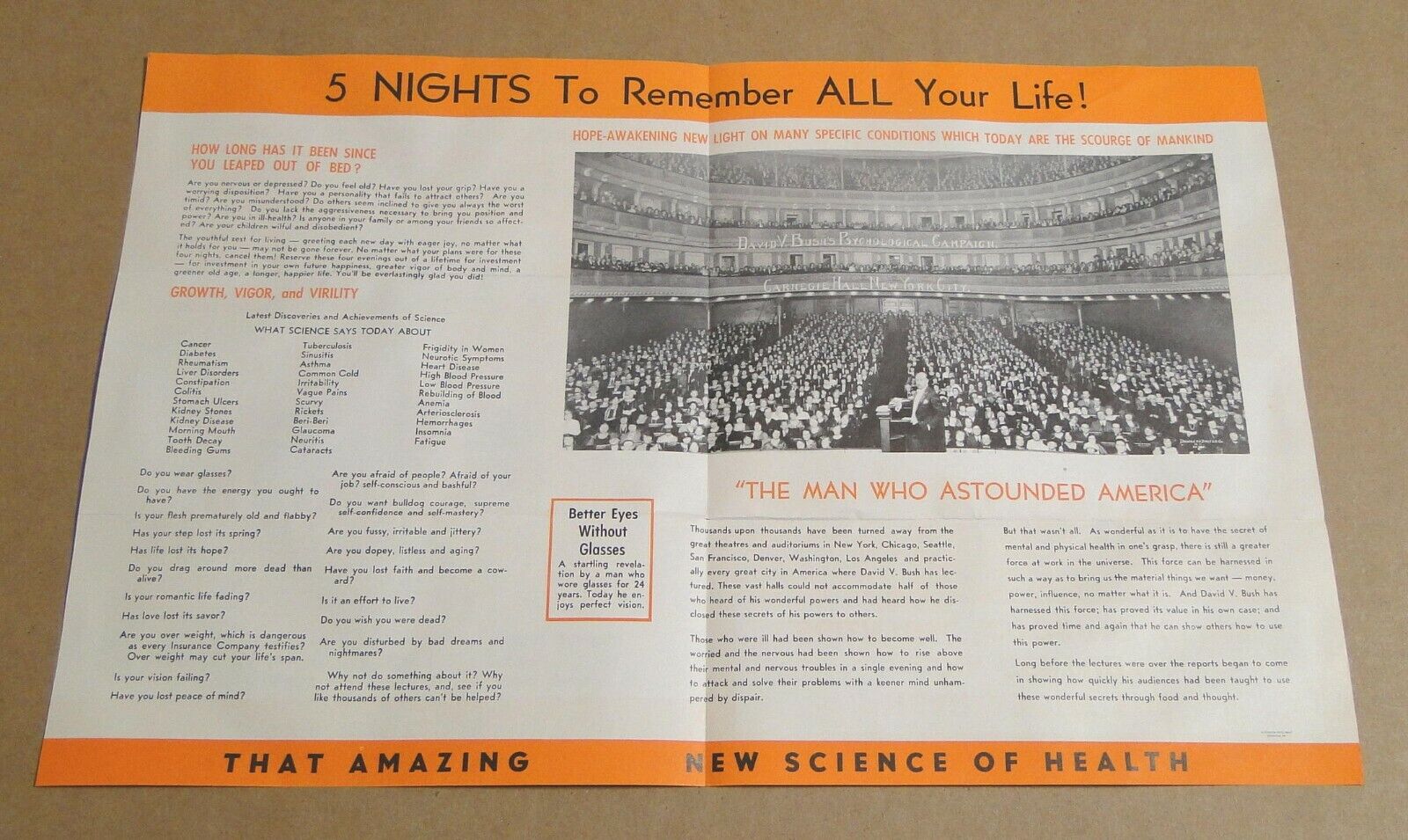
eBay shows he was still trying to pack them in to his lectures, by then for ‘health foods’, in 1950…

20 Monday Jun 2022
Posted in Lovecraftian arts
A somewhat pose-able HPL, from 52 Toys in Japan and said to be shipping August 2022.

I don’t think much of the body but the head’s not too bad, though a bit wide. Might be useful as a desk reference for someone hand-drawing a comic featuring Lovecraft?
20 Monday Jun 2022
Posted in Lovecraftian arts
Now booking, A Dream at the End of Time, a Lovecraft musical, based on Lovecraft’s “Iranon”. Los Angeles, 19th-25th June 2022. Be warned that the casting-call suggests it’s opera, not catchy show-tunes.

20 Monday Jun 2022
Posted in Historical context, Maps
Map of the NYC subways and elevated system, 1924. Useful for research orientation.

19 Sunday Jun 2022
Posted in Historical context
A little more data on Willoughby St., Brooklyn, which was looked at in depth in recent posts.
1) A 1914 ad for “Bristol’s”, which was next to “John’s” in Brooklyn.

Their office address was No. 3, but the Dining Rooms were classed as 3-5. Thus Lovecraft was aware of this double-frontage numbering when he said in a letter that John’s was “next door” to Bristol’s… at No. 7.
In 1914 Bristol’s was advertising itself as “always open”. J.E. Bristol is the owner.
2) By mid 1922 Harry E. Spilbor, Sign Writer, was listed as at No. 7 Willoughby, presumably in the sub-shop that was photographed when empty in 1916. By the mid 1930s the New York State Manufacturers directory puts him next door at No. 9. My guess is he started in the sub-shop at No. 7 at the start of the 1920s, and then later moved next-door when No. 7’s frontage was “boxed” (as seen on 1930s photos). He also writes sign cards for show-windows in stores.


The empty sub-shop in 1916.
3) Next door to “John’s” in 1923 at No. 9 was Mike’s Radio Shop (the Kranz Brothers), in either the upstairs or the sub-shop. Still in business in 1925 because they were recorded making a payment to the city, though no address is stated alongside. Barbers don’t tend to go out of business, so my guess would be the 1916 barber’s was still there in 1925 and the radio shop was in the sub-shop below it. This would be a good location for such a store because the big new Edison Electric office block was next door at the former 11-17 (subsumed circa 1923 as No. 15, still standing today).

So, that all fills in a little more mid-1920s detail on the immediate surroundings for Lovecraft’s favourite Italian eatery at John’s. The long-standing Bristol’s Dining Rooms at 3-5 with Lovecraft’s friend and fellow revisionist la Touche Hancock in an office above. Then John’s at No. 7, with Mr. Spilbor the sign-writer below in the sub-shop. Next door at No. 9 was probably a barber shop, with Mike’s Radios below.