Jaunt

The silly-season for news is here, and things are getting a bit slack while scholars are at the beach. So here’s an off-topic post that may still interest some Tentaclii readers, though I recognise that 1970s British TV sci-fi is an acquired taste. My mega-re-watch of the best of Doctor Who is ongoing, and as such I was interested to learn of a book-length guide to one of its competitor TV series called The Tomorrow People. I fondly but rather vaguely recall this from my youth, though haven’t seen it in many decades.

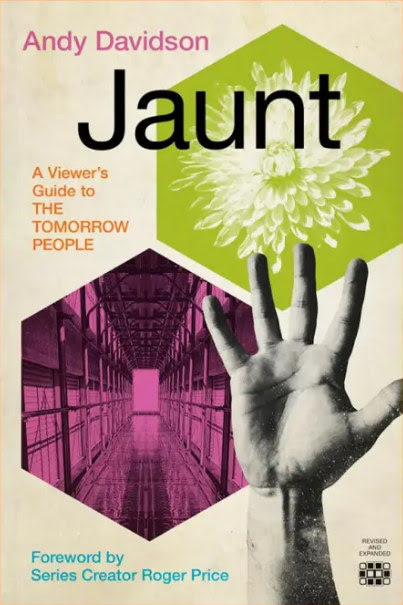
The book guide for the series is titled Jaunt: A Viewer’s Guide to The Tomorrow People. First issued in 2013, and now in July 2022 just re-issued in a new “revised and expanded edition” including detailed coverage of the original comic-strip adventures that were run in Look-In.

The cover is a faux emulation of a 1970s second-hand Penguin paperback.

I was also interested to hear of… “the return of the Tomorrow People in a lavish 1990s international co-production”, a TV reboot news of which had completely passed me by. There’s also said to be a modern third series, but it sounds both politically correct and radically changed, being set in a dystopian… “world far removed” from “the original series’ vision”.

‘Picture postals’ from Lovecraft – Chatham

In Selected Letters Vol. V we encounter Lovecraft writing a late letter to Kleiner. Lovecraft recalls a “Chatham” as a key landmark from early in his New York City years…

the quaint familiar landmarks (Scotch Bakery – Chatham – 78 Columbia Heights, etc.)

This is not footnoted in the first edition of the Kleiner letters. No other reference to a “Chatham” occurs in Letters I have access to.

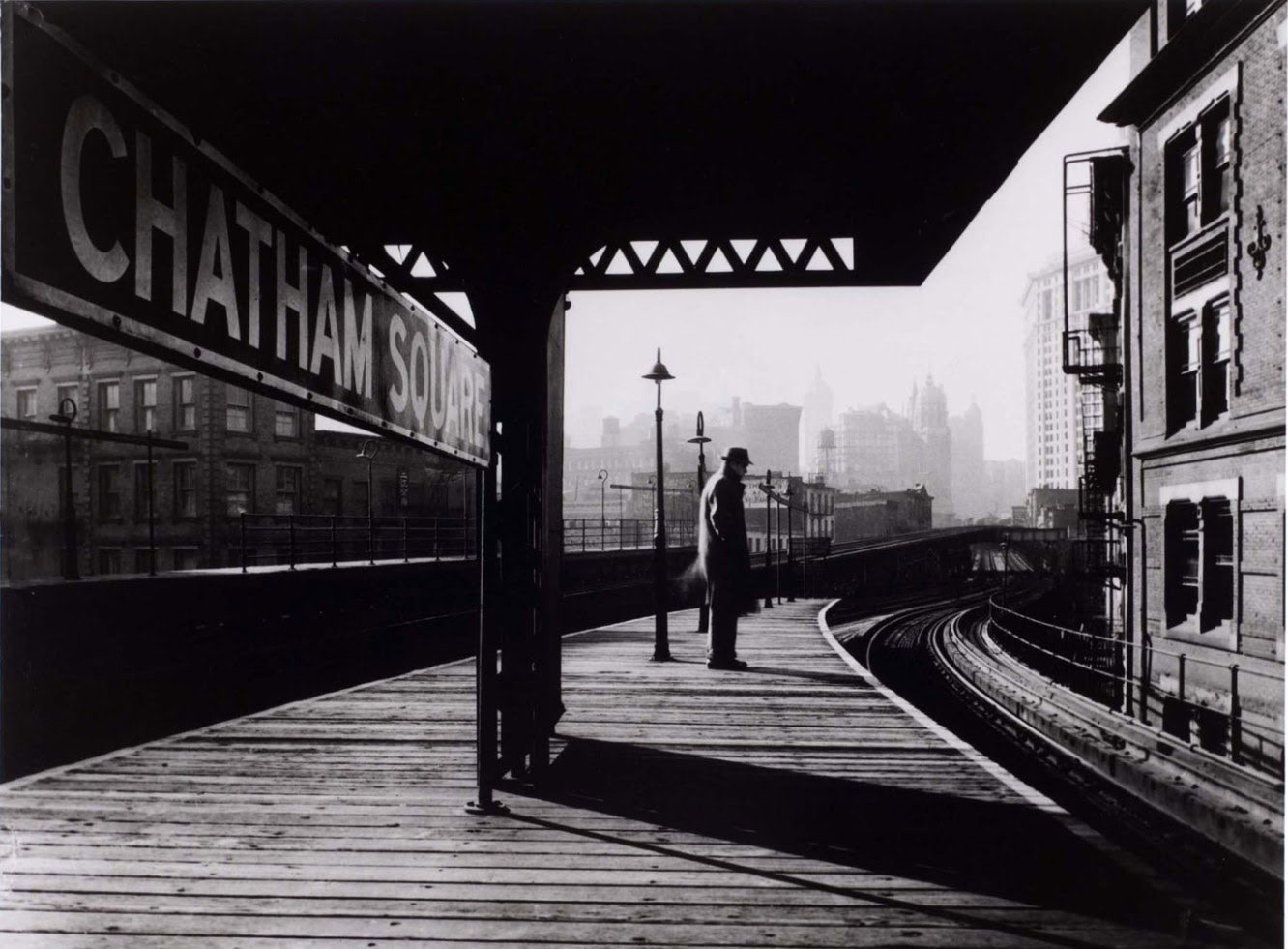
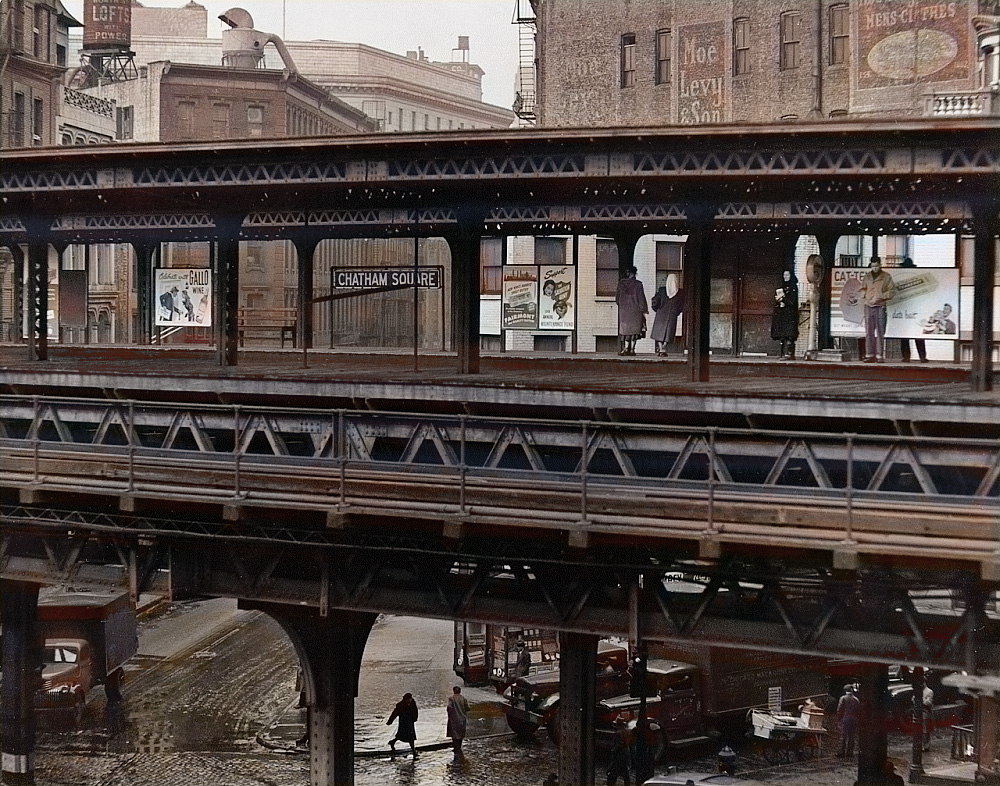
However the 1925 Diary comes to the rescue with… “Ph. Sug. Ho. Chatham Sq.” and one other mention of “Chatham”. The mention of “Sq.” led me to Chatham Square. This was a very major NYC transport intersection, with the Elevated railway there having fine views of the city skyline… along with less welcome chilly gusts.

Here we see one platform of the Chatham Square’s Elevated twin-platform station in the 1930s, as superbly photographed by Arnold Eagle. Presumably “Chatham” was where Lovecraft frequently met up with some of his Circle who were coming in on the Elevated, before they headed elsewhere.

And here we see a Chatham Square platform in the 1940s, and some of the rainy street below.

Voluminous: Elizabeth and the New York Boys

A new Voluminous podcast, ‘Elizabeth and the New York Boys’. Elizabeth referring to the two respite visits he took, via two ferries from New York City, to reach the more sedate Elizabeth. Which he called Elizabethtown…

Elizabethtown is a balm, a sedative, & a tonic to the old-fashion’d soul rackt with modernity.

Also a purgative of a sort, as due to…

the memory of weird things I had seen at twilight in Elizabethtown

… he quickly wrote his first story in a long while. He also later dreamed of the place, visiting it in a dream with Benjamin Franklin.

The rest of the letter is a whirlwind of people and places, including writing “The Shunned House”. All of which is hard not to see as effectively displacement activity which served to mask the impending collapse of his short marriage to Sonia. This circumstance and timing also helps to illuminate the final “elbow” in “The Shunned House”.

Creative Writing Machines and kittees

The latest Stuff To Blow Your Mind podcast surveys the history and current state of attempts at making viable Creative Writing Machines

educational technologist Mike Sharples discusses the book Story Machines: How Computers Have Become Creative Writers.

Don’t be put off by the faintly huckster-ish “educational technologist” label. He was at the Institute of Educational Technology at The Open University here in the UK, is “Academic Lead for online-learning service FutureLearn” (it’s a big one) and is “author of over 300 papers”.

MP3 download here. Interview starts at 2:20. Two long ad-sections.

As for the book it appears, from a long review, to be pitched mostly at the ‘history and theory of the field’ level. Rather than the level of practical $50 desktop software available now. Though that’s only the first third of the podcast, as the second and third sections are more practical. For instance, an accompanying website for the book is mentioned, titled Story Machines. This has a free public AI demo which is rather fab. I experimentally used it to expand an H.P. Lovecraft dream into a story form:

“Dream of the Black Cat City” (AI assisted demo)

Notes on the Selected Letters of H.P. Lovecraft, Volume V

Notes on the Selected Letters of H.P. Lovecraft, Volume V.

The time is 1934-37.

* Lovecraft was using his old cleaned telescope for local observations again, in early 1935… “Last Sunday evening I was all ready to watch the occultation of the Pleiades, but clouds malignly intervened.” (Page 107). He does not give the location, but presumably somewhere open and near his home.

* He saw a large exhibition of Hokusai prints from Japan… “a splendid lecture & special exhibition pertaining to my favourite Hokusai, & the entire [Art Museum, Providence] quarterly bulletin was devoted to the subject of Japanese prints. (Page 127). The Museum had acquired a large set. “Hokusai’s Cranes on Snow-Laden Pine was one of the things I especially liked in the exhibition” (Page 127). This seems to be ‘Cranes on Branch of Snow-covered Pine’…

* He was back at Jake’s in Providence in early 1935…”we descended [College Hill] to “Jake’s” – the famous stevedore [dock-worker] restaurant at the foot of the hill which Wilfred B. Talman (then a Brown student) discover’d in 1926 and introduced to the gang. Here have gorg’d such dignitaries as W. Paul Cook, James Ferdinand Morton, Donald Wandrei … and now Robert Ellis Moe. This is the joint where good food is serv’d in such fabulous quantities. We chose sausage-meat and johnny-cakes, with stupendous bowls of short-cake (R.E.M. banana; H.P.L. peach) and whipped cream for dessert.” (Page 126).

* He was amused by a S.F. League spoof publication, Flabbergasting Stories. The… “S.F. League & its members have [a] mimeographed parody on the science fiction magazines – Flabbergasting Stories. It is really extremely clever & witty — Sterling showed me a copy.” (Page 151).

* By April 1935 he accepted the presented evidence for some form of vegetative life living on Mars… “We can no longer dispute the independent existence of protoplasm on different worlds, since vegetation on Mars has been well authenticated by direct visual & photographic evidence.” (Pages 153-54).

* Lovecraft records that… “in idly reflecting on my correspondence list the other day, I discovered that the praenomenon [Christian name] most numerously represented is none other than Robert – Barlow, Bloch, Howard, Moe, Nelson.” Who was Robert Nelson? He’s in the volume Lovecraft’s Letters to Robert Bloch, as Robert Nelson (1912-1935), since new letters were discovered in 2012. His weird poetry and other work is now collected in Sable Revery: Poems, Sketches and Letters by Robert Nelson.

* He also recalls that… “Clarke Howard Johnson [1851-1931, 49 Westminster St.] Chief Justice of the R. I. Supreme Court was my grandfather’s best friend and executor of his will.” (Page 166). No photo can be found.

* Beyond the lake-pines around Barlow’s Florida homestead were real English oaks… “Bob’s [Barlow’s printing] cabin across the lake is virtually finished, & last week I cut a roadway from the landing to the cabinward path. This edifice is ideally located in a picturesque oak grove – not the live-oak of the [U.S.] south, but the old-fashioned, traditional oak of the north & of Old England.” (Page 182).

* Extensive reading preceded each trip to a new place… “Every time I take a trip I read up as extensively as possible on the places I’m going to see — so that when I get there, each site and object will have some meaning for me.” (Page 188).

* “I’ve felt only one earthquake in the course of my existence – the shock of Feb. 28, 1925, when I was in New York.” (Page 207). Apparently… “one of the most powerful earthquakes of the 20th century”, the Charlevoix–Kamouraska earthquake. It originated under the St. Lawrence River Valley in Canada, which may interest Mythos writers if that location has not already been used.

* The autumn/fall of 1935 was very mild and prolonged, and Lovecraft was fortunate to spend two weeks in New York City during this fine spell. He stayed with Donald Wandrei at 155 West 10th Street… “The brothers have taken a very attractive four-room flat in Greenwich Village — at 155 West 10th St., above a rather well-known ‘bohemian’ restaurant called Julius’s.” (Page 210). Donald’s brother was away during the stay, and so Lovecraft had his room. Thus Lovecraft was for two weeks in a flat above one of the most famous gay bars in history. A bar still going today and now numbered as 159.

The bar on 1940s.nyc, here cleaned and colorised.

* In 1935 the John Hay Library has “frequent exhibitions there (books & reliques of literary or historic interest) which I usually see.” (Page 216). Such as one on the poet Horace along with a lecture (Page 218).

* His Christmas tree was delivered, rather than netted and then personally slung over a shoulder before being manfully hefted up the hill from the Market Place… “Our Christmas tree arrived yesterday, but will be kept in a cool closet to prevent deterioration”. (Page 218).

* Lovecraft had once been a regular reader of the magazine The Black Cat, which folded just before Weird Tales appeared on the stands. Morton was seeking to collect a complete run in 1936, and Lovecraft remarked… “Hope ya kin get your Black Cat file. I used to buy that reg’lar-like, and recall the swell weird stuff it had.” (Page 227). Which means he would have seen Arthur Leeds stories in it, before he encountered any members of the Circle including Leeds. That assumes though that he read the magazine past early summer 1914. Leeds was hailed as “new to our readers” in the May 1914 issue. We know Lovecraft began to “notice” the magazine in 1904, but seemingly not the cessation date for his interest in it.

* In his final years he was writing to a “Frederic Jay Pabody” about Atlantis. Ten such letters came up for sale in 2016 and are now found complete in Letters to C.L. Moore and Others.

* His Uncle had translated Virgil… “Some day I wish I could get his Virgil published — a blank verse translation of everything but the Eclogues which (together with other mss. of his) I have always carefully treasured.”. (Page 329). Sadly it appears that these works have been lost?

* In his younger days he saw the stage actor Robert Mantell play… “Horatio, Iago, Mercutio, Bassanio, Edmund, and Faulconbridge” in Providence. (Pages 340 and 350). This means he saw performed Hamlet, Romeo and Juliet, The Merchant of Venice, King Lear, and King John. He elsewhere implies that he saw Richard III with the players using the 18th century Cibber version.

* His Remington typewriter gave “non-visible writing”, i.e. as the typist he could not see what was being typed onto the page. (Page 267).

* “The first comet I ever observed was Borelli’s — in Aug. 1903. I saw Halley’s in 1910 — but missed the bright one earlier in that year by being flat in bed with a hellish case of measles!” (Page 282).

* “The especial glamour of spangles [i.e. small sparkles of light] probably comes from a synthesis of different pleasant associations — the stars, the rising sparks of a comfortable fire, precious stones, &c.” (Page 328). Sunlight on clear purling water, too.

* October/November 1936. “I haven’t had a new suit of clothes since 1928.” (Page 337). “I have reduced nourishment to $2 and $3 per week” to economise. (Page 364).

* Talking of the future… “I would advocate the improvement of backward groups through education, hygiene, & eugenics.” (Page 323). What does he mean here? Not what modern leftists mean, who have since sought to conflate 1930s eugenic practices and ideas with mass murder in Nazi death-camps. But Lovecraft explicitly told his correspondent that he did not mean death. He was speculating about a possible future “within the next half-century”, and stating that he would not wish some future state to “starve & kill off the weak”. Though he was highly doubtfully about the chances of any human “improvement” happening via scientific breeding, what he envisioned was evidently more a ‘eugenics for health’ programme of sterilisation and contraception. Such ideas were relatively common at the time, not least on the left, and in Lovecraft’s words were widely “agreed” on… “It is, for example, agreed that hereditary physical disease & mental inferiority ought not to be transmitted — hence within the next half-century the sterilisation of certain biologically defective types will probably become universal throughout the western world, thus cutting down the prevalence of idiocy, epilepsy, haemophilia, & kindred inherited plagues.” Similarly his use of the word “hygiene” has a different meaning than today, being a 1920s and 30s euphemism for various forms of birth-control and venereal disease prevention (e.g. condoms) under the control of the users. At that point in time, mass routine abortion of babies appears to have been unthinkable as a eugenic method.

* He indicates what a possible 1940s ‘Romans in Africa’ tale or novel might have looked like, with Ancient Romans… “penetrating south into Africa beyond the mark set by Maternus, skirting the [River] Niger, threading through steaming jungles … and finally coming upon that Kingdom of Elder Horror whereof there survives today only the ruined masonry of the Great Zimbabwe.” (Page 375).

* He gives a useful starter reading list for Dunsany… “When I think of Dunsany, it is in terms of The Gods of the Mountain [a play], Bethmoora, Poltanees Beholder of Ocean, The City of Never, The Fall of Babblekund, In the Land of Time, and Idle Days on the Yann.” (Page 354).

* “My dream of the black cat city was very fragmentary. The place was built of stone and clung to the side of a cliff like some of the towns drawn by Sime for Dunsany’s stories. There are towns more or less like it in Spain. The place seemed to have been built by and for human beings aeons ago, but its present feline inhabitants had evidently lived there for ages. Nothing actually happened in this dream — it was just an isolated picture of the place, with the cats moving about in a rational and orderly manner, evidently in the performance of definite duties.”

* In his Mythos, cats are (probably) tentacle-tailed aliens from outer space… “the mysteries of those black outer gulfs whence surely the first terrestrial felines lithely sprang long ago when Mu and Hyperborea were young.” (Page 377).

* Shortly before he became ill and died, he at last saw a movie of which he could approve. (Pages 435-36). “A Midsummer Night’s Dream [released 1935] — and it was certainly no disappointment. The delivery of the lines was in nearly every case excellent; and though there were some cuts in the [Shakespeare] text which I lamented, these did not amount to more than the excisions common to all acting versions from the Restoration down. The music blended effectively with setting and dialogue, and the pageantry was excellently managed. Some of the elusively weird photographic effects connected with the haunted wood were incomparably fine. As the animating spirit of the grove, that little elf who played Puck certainly scored a triumph. In aspect and voice and demeanour he represented with utter perfection the bland, mischievous indifferentism of the traditional sylvan deity, while that shrill, eery, alienly-motivated mirth of his was the most convincing thing of its kind that I’ve ever seen.”

The movie seems to have had many sniffy reviews at the time, from critics who thought it too low-brow. But it won two Oscars due to a “grass-roots write-in campaign” from fans. For initial general release in October 1935 the movie was cut from 132 minutes to 117, but I don’t know what running-time Lovecraft saw more than a year later in Providence in early 1937. Could it have had a more fulsome public release, post-Oscars? Perhaps movie historians can answer that one. The movie finally had a good home release as a DVD in 2007, but it does not appear to have been otherwise restored. It appears to have been ignored by writings about Lovecraft and cinema, presumably because it was seen so late in his life. Nevertheless, it should be included in any future survey of his appreciation of the cinematic arts. I have to say that it certainly feels overlong when seen at its full length. The visual are indeed very fine, but the music and delivery are both far too strident. The music is written for the concert hall, not a movie, and the vocal delivery has that very fast and shrill (shrieked, at times) ‘screwball’ pace that is all to common in 1930s movies.


Well, that’s it for the Selected Letters. All five volumes are now done. I’ll now be catching up on my saved bundles of blog posts, tutorials, reviews and newspaper and magazine articles. After that I’ll be reading the Lovecraft Annual 2021, for an in-depth review before the 2022 Annual is released.

Advance notice: Lovecraft’s birthday

Just a reminder that Lovecraft’s 132nd Birthday is coming up in just over five weeks, on 20th August 2022. There’s still time to prepare a ‘birthday gift’, lecture, gig or event of some sort. If you need a theme or a ‘hook’ then note that 2022 is the 100th anniversary of Lovecraft’s first visit to New York City. It’s also been 100 years since “Hypnos”.