These are my notes of interesting points found in the first third of the book Letters with Donald and Howard Wandrei (2019).
The year is 1927. All quoted letters are from Lovecraft unless otherwise stated. This part of the book also gives letters from Wandrei.
p. 26: Among critics of the time, “Their idea of fantasy is the sophisticated snickering of James Branch Cabell”.
p. 29. He gives a short list of the “Utopian things” that he read when young. One of these is named as “Wells’ “The Time Machine””. This is interesting as, according to Letters to Family, The Time Machine was only read by Lovecraft in November 1924. We know now that this 1924 edition was a library copy, borrowed for Lovecraft by Long, and thus did not come from the Wandrei collection of early science fiction. So, did Lovecraft actually read this seminal work when young, forget it, and then re-encounter it afresh much later in 1924? It sound like it.
p. 29. Also on the list of “Utopian things” read when young is “Parry’s “The Scarlet Empire””. This was a satirical novel published 1906. A young socialist tries to commit suicide at Coney Island, but is rescued from the water by Atlantean socialists who secretly dwell offshore. He is quickly shocked into awareness that their socialist city requires a ‘dictatorship of the proletariat’, severely limiting free speech and also persecuting love as ‘reactionary individualism’. A love interest occurs. Escape from tyranny, and destruction of the underwater city by submarine torpedo. The latter point recalling the fate of the reef off Innsmouth.
p. 32. “The Black Cat used to have some excellent fragments of the macabre”. This national news-stand story magazine was the predecessor of Weird Tales, though it seems Lovecraft did not read it all the way up to the crossover date. A footnote give a line from the letters to Barlow. He “began to notice it” about 1904 [approx age 14] and then would “buy that reg’lar like”. So the period to look for such tales from The Black Cat, would be 1904 onward. The cessation date of his reading is is unknown.
p. 54. “My love of the weird dates from fairy-tale days, my curve of taste running [first] through Grimm…”
p. 63. “To my mind, the only really beautiful life which the decaying world can hope to know in the years to come is that of the small, aloof nations with primitive simplicity and strong nationalist self-consciousness; insular centres of ancient, intensively individual & tenaciously vital cultural impulses like Iceland or Ireland. These places are still alive, enjoying unbroken communion with the creative forces behind them…”
p. 65. Among a wider world ‘if only I had the funds’ travel itinerary, he notes various places in northern Europe which he would especially like to visit. “Old England [of course, but also] Nuremberg [in Bavaria], Ratsibon [old name for Regensburg, in eastern Bavaria and with a Slavic culture], Mount Saint Michel, Chartres [both big ancient religious sites in northern France].” Why Bavaria? His recently written Dexter Ward has Baron Ferenczy’s castle, of course, though the location there is “dark wooded mountains” near Klausenburg (a nod to Stoker’s Dracula). But that’s Transylvania. The likely Bavarian interest surely comes rather from the Voss book The Monk and the Hangman’s Daughter which Lovecraft found, though “not weird”, … “makes the wild Bavarian hills and deep woods and hellish lakes quiver with a malign and poignant vitality. … The man who dreamed this scene knew Bavaria from the bottom up.”
p. 67. In 1926 he had acquired the book The Haunted Homes and Family Traditions of Great Britain by John H. Ingram.
p. 77-78. “But still the little ancient lanes lead off down the precipice to the west; spectral in their many-peaked archaism, & dipping to a riot of iridescent decay where the wicked old [Providence] waterfront recalls its proud East India days […] sometimes I venture down into this maelstrom of tottering houses, broken transoms, tumbling steps, twisted balustrades, swarthy faces and nameless odours, winding from South Main to South Water, searching out the docks where the bay and sound steamers [i.e. the ‘Newport boat’ from “Call of Cthulhu” etc] still touch […] the dreaming wharves where Providence Indiamen [i.e. large sailing-ships] used to ride at anchor. Just this week there is a genuine old-time sailing ship in port — a rare occurrence now — and I love the sight of its antique masts above the centuried warehouse roofs.” See also page 98.
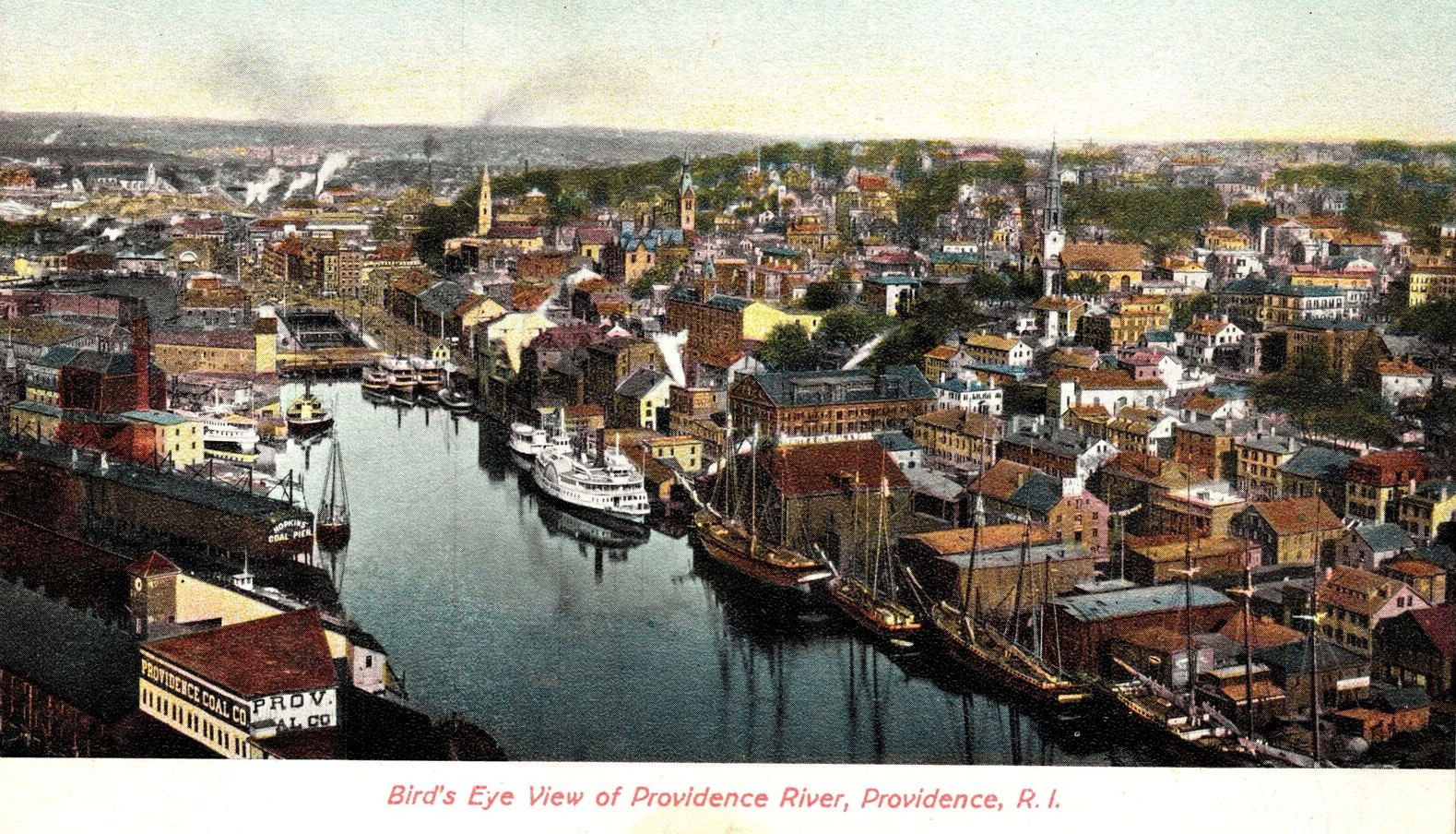
Heavy cargo, coal and oil docks on the left. Passenger docks and ‘non-messy’ freight on the right. Here we only see half the waterfront, since it ran on until it reached Fox Point which was where the New York boats docked.
p. 100. Charles “Fort is a close personal friend of Weird Tales author Edmond Hamilton, to whom he has suggested several story plots appearing in the magazine.”
p. 126. There is a marvellous extended description of his first visions of the ‘dream New York’. In Prospect Park at dusk… “the bronze lions crouch cryptic beside the marble quays of templed lakelets”. These were western-type lions, not Asian ones. He also gave Wandrei an extended two-page itinerary of things and place to see on a first visit to New York City, including Harlem. “Also walk across the High Bridge, which Poe loved”.
p. 131. He lists the used book shops then in Providence. “You will part with many a shilling at Eddy’s, The Old Corner, Gregory’s, Tyson’s, and so on.” Wandrei eventually spent $50 at such shops, then a large sum, and had to hitch-hike home. This develops into quite a hobo travelogue for Lovecraft from Wandrei, and there is a fine passage describing Wandrei’s entrance into Chicago on a powerful motorbike. Wearing goggles and mistaken for plain-clothes police, they were waved through all the city’s grids and jams.
Wandrei appears to have something of a spending problem at this point, as he later purchases two Clark Ashton Smith paintings, which apparently cleaned him out for the next year.
p. 132. At the Metropolitan Museum, Lovecraft recalled he “revelled in the new Wing K — the Roman garden with the statues. A certain austere head of a tight-lipped old Republican Roman is as much a favourite of mine as that effeminately pretty Antinous-type Hellenic head in the corridor is a favourite of Loveman’s.” Wandrei was then in New York with Loveman, and this seems a fairly clear ‘tip off’ to the lad about Loveman’s amorous inclinations.
The Met has pictures of “the Roman garden with the statues”, made in 1925…


p. 141. Confirmation by one who had visited, that Dwyer did indeed live on the lapping edge of a newly-created reservoir [re: “Colour out of Space”]. Wandrei described to Lovecraft… “a little farmhouse near the edge of the Ashokan reservoir which gives New York City its water.”
p. 147. I’ve just read [Wells’] “War of the Worlds” for the first time, in Amazing Stories. … the best thing of H.G.’s which I’ve ever seen”. This is 9th August 1927, and would be Lovecraft’s first encounter with the Wellsian idea of the ‘creeping red weed’.
p. 146, 150-51. Possible relevant to Lovecraft’s “Plan of Foxfield — for possible fictional use”, though never used. Lovecraft plans to visit “the ancient Deerfield region” with an architecture unlike that found elsewhere. He visited circa 19th-23rd August 1927, when he called it “The summit of my earthly ambition — I’ve gone broke on postcards”. Cook added a note that HPL had spent the then-handsome sum of $5 on Deerfield postcards. See: Will Murray’s “Where Was Foxfield?” in Lovecraft Studies No. 33 (1995). I’m uncertain if this suggests a link with Deerfield.


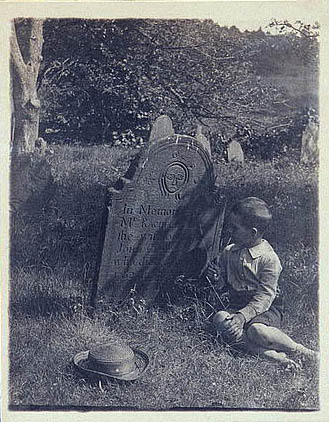
Deerfield Burying Ground, with olde style carved face on gravestone.
p. 156. Lovecraft suffered a night in the primitive YMCA at crumbling Newburyport, at the end of August 1927. This confirmed all of Wandrei’s prejudices about YMCAs, and sounds like a precursor to the overnight room in Innsmouth.
pp. 162 and 167. Lovecraft returns to Jake’s on the Providence waterfront, and discovered there was a “Jake”…
Talman enlightened me concerning the identity on “Jake”. It seems there is a real person by this name — Adam Jacques — who actually pronounces his patronymick Jakes. This is the big boss — and you may be able to recall him as the somewhat thick-set man with the moustache. … Domingo, however, is the life of the place.
Jake’s appeared in the Providence Journal, 10th September 1927. Lovecraft sent a cutting. The letter was 11th September 1927, but the letter and cutting are not in the Brown repository. But apparently the newspaper archives for this date have survived.
Incidentally, I read that Lovecraft later had some criticism of Donald Wandrei, to others. But that was surely later than 1927. In 1927 he’s obviously very pleased to have newly discovered the “new Galpin” and to have successfully introduced him to the Circle.