Up for sale, a 1960s zine I’d not heard of, Paradox #7…
Half of this issue is taken up with a bibliography of the fantasy and horror writings of David H. Keller, the [medical] doctor and Lovecraft scholar and Arkham House patron. The bibliography is extensive and is based upon the doctor’s own files, which the editor consulted on a visit to his house.
fanac.org doesn’t appear to have scans, and neither does Archive.org. Comments in other zines of the time suggest Paradox was held in high regard for its content.
His Fancyclopedia page is extensive, but makes no mention of Arkham House and (being focused on his pioneering role in science-fiction, begun at the then-startling age of 47) it makes little of his interest in the macabre and weird. Possibly “patron” is just a bookseller’s come-on, and he was really just a collector rather than an active backer of Derleth? But no, as a hard-working medical man he was well off and he had once kept Arkham afloat at a difficult time.
Keller was also an early Lovecraftian. Yes, he was the author of “Shadows Over Lovecraft” (1948), the medical man’s reply to Winfield Townley Scott’s “His Own Most Fantastic Creation” (1944). He also saved Lovecraft’s astronomy notebook for posterity (Wetzel). This latter is “Astronomical Observations Made by H. P. Lovecraft”.
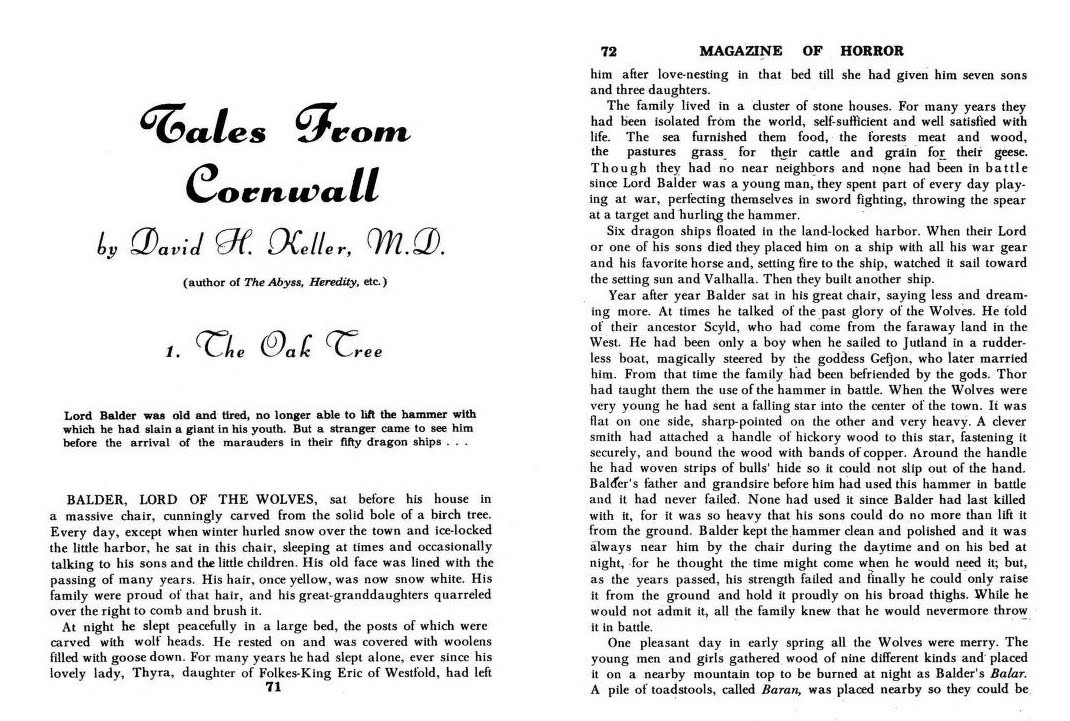
More interesting to me was that Keller also created a series of historical fantasy stories later called the “Tales of Cornwall” sequence, several of which appeared in Weird Tales in Lovecraft’s time. I’m always curious about forgotten British fantasy. Where can these tales be found? Archive.org to the rescue… it has a home-brewed Magazine of Horror PDF, a fan compilation of the stories in correct order of story-world dating and with new ones added. There are a total of ten, opening with…
The Oak Tree, dated 200 B.C, when Folkes-King Eric rules in Norway, and Olaf is Lord of the House of the Wolves at Jutland. The family name will not be changed to “Hubelaire” until 57 B.C.
… and running through to 1914.
The compiler notes on the listing page…
Lowndes managed to publish ten stories in the Cornwall series before the Magazine Of Horror folded in 1971: the six previously published tales and four of the unpublished stories. Unfortunately, the last five stories remain unpublished to this day.
His long short story “Men of Avalon”, issued in a 15 cent booklet paired with a similarly long Clark Ashton Smith story, was also partly a tale of the British Isles. Also of time-travel…
the ancient bowmen of the beautiful isle of Avalon cross the mighty abyss of Time, to pit their puny weapons against modern implement of slaughter
… though seemingly it is not one of the Cornwall tales. The only criticism of it I can find is that Derleth once called it “mawkish” when compared to the Smith story. Apparently complete in the two copies that survive, but garbled by pagination errors. Not scanned and online.
What is online is his The Last Magician: Nine Stories from Weird Tales (1978), at Archive.org and now forming a handy sampler of his other Weird Tales fantasy outside of the “Cornwall” stories. And with direct reprints of magazine pages…
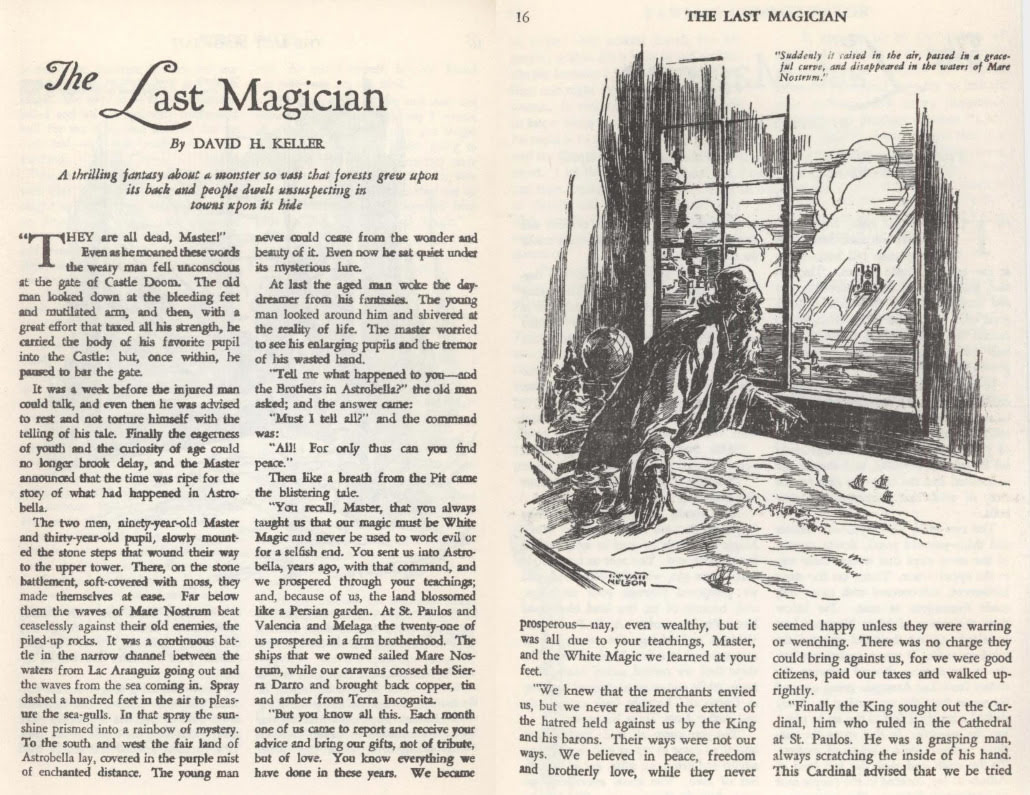
His own personal introduction to this book also reveals he had another series, a string of detective tales of “Taine of San Francisco”. Here Keller also offers this important little biographical snippet about Farnsworth Wright, editor of Weird Tales…
Our meeting was the beginning for me of a very pleasant friendship with a very remarkable editor. Much of that story is confidential, but I can reveal that I was able to attain him a wife and child in spite of his serious handicaps.
A further story collection is the collectable Arkham House volume The Folsom Flint: And Other Curious Tales (1969). A tepid review in The Arkham Sampler for Summer 1948 reveals an earlier collection…
LIFE EVERLASTING AND OTHER TALES OF SCIENCE, FANTASY, AND HORROR, by David H. Keller. Collected by Sam Moskowitz and Will Sykora. With a Critical and Biographical Introduction by Sam Moskowitz. 382 pp.
I see that this is now online to borrow in its 1974 re-printing. Here one can find in good form his horror classic “The Thing in the Cellar”, and sample a Taine of San Francisco detective-horror tale in “The Cerebral Library”. The latter can also be seen in the original in Amazing Stories for May 1931.
Further reading:
“By The Waters of Lethe: or The Forgotten Man of Science-Fiction”, Fantasy Times, December 1945. (The Evening Star was deemed his greatest greatest novel, but alongside some huge plot spoilers. Concludes that despite the lack of a critics-pleasing style… “He was consistently readable and enjoyable to a greater extent then any other writer in the history of fantastic literature.” Indeed, he topped ‘favourite’ polls in the 1930s, but was forgotten by young readers by the end of the war.)



