Studi Lovecraftiani #12 – free

If you can read Italian, the new 200-page edition of the scholarly journal Studi Lovecraftiani (#12, July 2010) is free online. For the first time, it seems…

“The move of SL from traditional paper format to an electronic version is an experiment which — it is hoped — will bring new readers. From the next issue, however, we will also return to having a paper version of SL, which will complement the electronic one.”

The PDF text allows copy and paste, so you can run it through Google Translate and/or Babelfish if you want to figure out what’s being said — sadly there are no English summaries of the articles.

And it’s easy enough to get a print-on-demand copy of your PDF edition, via an upload to lulu.com, if you really must have one for your collection.

The ‘new publications’ notes at the end of the volume refer to the essay “Sufi Motifs in the Stories of H.P Lovecraft”, but the text doesn’t provide the PDF link: it’s here.

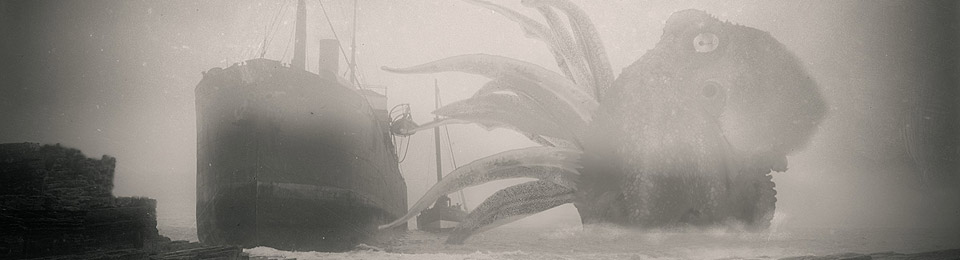
Cute Cthulhu

One of the many new unknown species being discovered this summer in the deep waters off the coast of Newfoundland…

Click for a larger version.

“Still at sea, a team of Canadian and Spanish researchers is using a remotely operated vehicle called ROPOS for dives off Newfoundland with a maximum depth of about 9,800 feet. The 20-day expedition aims to uncover relationships between cold-water coral and other bottom-dwelling creatures in a pristine yet “alien” environment, according to the researchers’ blog.”

Talking of which, Geeks are Sexy has its Summer Squidwatch report out today.

Vacation Necronomicon School – assignment five

Vacation Necronomicon School, summer 2010 reading assignment for 30th July 2010: “The Call of Cthulhu”.

“Your short assignment today […] meditate on what makes Cthulhu the truly definitive Elder God. What, exactly, is the appeal?”

TASK FIVE: 30th July 2010.

The long story “The Call of Cthulhu” famously crystallises his proto-Cthulhu mythos, details it, and introduces the Old Ones.


Possible origins and influences — the 1925 eclipse:

The detailed plot of “Cthulhu” was written in the summer of 1925, while Lovecraft was living in New York. By 1925 New York was a city of over 1,000 towering skyscrapers, and the foundations of 30 more were being laid. This great crucible of modernity was plunged Continue reading

Summer of Lovecraft Art Show – artists wanted

Sounds like someone’s having a whole lot of fun in Chicago

“Artists are being sought for the first Summer of Lovecraft Art Show. The event will be 14th August 2010 in the 5800 block of Sixth Avenue, beginning at 4 p.m. The show is similar to Dale “Dr. Destruction” Wamboldt’s annual Dorian Gray art show — “for artists who may not have found a fit at other art venues,” Wamboldt said. The Gypsy Museum of the Macabre will be there, and there will be a Twilight lookalike contest, along with appearances by Dr. Cryptocis, Dedgar Winter and Dr. Destruction. For more information, e-mail crimsontheatre@sbcglobal.net

Vacation Necronomicon School – assignment four

Vacation Necronomicon School, summer 2010 reading assignment for 29th July 2010: “Plush Cthulhi”.

“Your short assignment today […] Should Cthulhu ever be cute? What are the underlying sociological implications of the current cute Cthulhu trend?

TASK FOUR: 29th July 2010.

Ultimate spawn-baby of the home-brew cottage industry in Lovecraftiana, plush / vinyl / cut-out / knitted / resin / 3D-printed / kit-modded Cthulhi are the blogger-friendly stars of the age of the mass Internet (1995-?). They fling strangled LOLcats aside with ease, and rise to claim the topmost position of an increasingly large pile of clever and intricate and amusing re-workings of public domain / Creative Commons materials. Tethered by no grasping literary estate, no descendants of some hideously distant cousin of the author, they are free to rampage across the blogosphere. Yet there they remain. They cannot break through to ravage the outer world of Woolworths and Homes & Gardens. Are the hand-made ones profitable? Probably not. Or not very. The time put into making such crafts usual barely outweighs the profits. They make enough to pay for one’s food and drink at a Cthulhucon, perhaps. And doubtless there’s some marketing value — hang a big cute one on your convention sales table, to attract the Call of Cthulhu RPG gamer-kiddies and give the shy ones a conversational opener. But how many who approach will have read more than one or two of the original stories, and then only in RPG game books? Very few. Which perhaps begs the question: is the literary Lovecraft really popular any more? He certainly was in the 1930s, and again in the late 1960s/70s. But is he now slowly being fossilized in print?


Further open-access online reading:

Cthulhu is not cute! by Erik Davis.

Kraken Rising : how the cephalopod became our zeitgeist mascot by Mark Dery.

Arkham Tales

I’m still finding Lovecraft related links for the front-page directory of this blog. Such as Arkham Tales: the magazine of weird fiction, which has five free PDF issues online. Leucrota Press are now publishing the magazine. They have issue #6, and the just published latest issue #7, for download at a very reasonable $1.99 each. Perfect PDFs for your new Kindle or netbook.


Cover art by Mari Anne Werier.

Why are gems like this so hard to find out about (and I’m an expert web researcher and link finder)? And why are Lovecraft websites so sparsely interlinked with each other? For instance, according to a link:arkhamtales.leucrotapress.com search of Google, no-one links to Arkham Tales. No one. Which means that Google will completely bury the link in its search results.

In terms of sustainability of this sort of project, people, linking to it is almost as important as subscribing to it.

James Cameron to produce del Toro’s At the Mountains of Madness

News just in. James Cameron has reportedly stepped into the uncertainly over Guillermo del Toro’s big-budget film adaptation of At the Mountains of Madness. Presumably carrying a sack-load of profits from Avatar. At the Mountains of Madness is now apparently set to be a full-blown stereo-3D adaptation, directed by del Toro and produced by Cameron. Let’s hope Cameron doesn’t request that the story be updated to the modern day, so they can tediously wheel in teen-friendly things like helicopters firing missiles, as we saw in the mess that was Avatar. I want a beautifully restrained 1930s valve-punk adaptation, full of incredible Sky Captain-like machines.

The full exclusive story has just been broken by Deadline.

Vacation Necronomicon School – assignment three

Vacation Necronomicon School, summer 2010 reading assignment for 28th July 2010: “The Rats In The Walls”.

“Your short assignment today […] Try to make a connection […] between Lovecraft’s sense of “otherness” in other people and the intense Otherness of his unknowable horrors.”

TASK THREE: 28th July 2010.

“The Rats in the Walls” was written in August or September 1923. The short story is set in rural England, in the British Isles. The plain literary inspirations for “Rats” are suggested by S.T. Joshi’s introduction to the Penguin Classics edition of The Call of Cthulhu and Other Weird Stories (1999): Baring-Gould’s antiquarian folklore collection Curious Myths of the Middle Ages (new ed., 1881); the bare idea of ‘racial regression in an individual’ taken from Irvin S. Cobb’s story “The Unbroken Chain”; and subtler stylistic influences and the idea of decadent aristocrats from Edgar Allan Poe. Similarly decadent aristocrats appear in the context of horror in de Sade and Oscar Wilde, but it may be that Lovecraft did not have access to what were at that time ‘forbidden’ writings. He does however allude once to de Sade in “Rats”.

Although Lovecraft was a passionate Anglophile who longed to visit England — his family had roots in Devonshire, England — he was prevented from travelling by genteel poverty. So he no doubt paid special attention to English subject matter when he found it in stories, reviews, or in the writings of antiquarians and folklorists. His vision of England was thus a fantastical and rural one, yet in this he shared a genuine ‘structure of feeling’ evolved by a long line of native visionaries, a structure which had been inculcated over the millennia into the physical and emotional fabric of the nation.

A central idea in “Rats” is that important and sacred structures in the British countryside are built atop one other on the same site over the centuries and millennia. So far as I know, Continue reading

Vacation Necronomicon School – assignment two

Vacation Necronomicon School, summer 2010 reading assignment for 27th July 2010: “At The Mountains of Madness”.

“Your short assignment today […] Lovecraft’s descriptions of Antarctic terrain (both “real” and imagined) are stirring and almost poetic […] Again and again he invokes the art of Nicholas Roerich. Create your own representation of madness, using any technique you would like.”

TASK TWO: 27th July 2010.

1: A note on the visual inspirations for the novella At the Mountains of Madness (written 1931, published 1936).

At the Mountains of Madness contrasts a painterly — and perhaps even cinematic — vision of the immense Antarctic landscape, with Lovecraft’s use of a highly precise and scientific language. Written in February/March 1931, much of his technical inspiration and language could have been supplied by the book-length memoirs and reports which arose from the first Byrd Antarctic expedition (1928-1930). Byrd commanded the first of the most advanced and well-equipped of the ‘machine age‘ expeditions. Twelve straight-jackets were also supplied on the expedition, in case of madness. The success of the major expedition and its sweeping aerial photography captured the popular imagination, and illustrated books were issued very soon after their return. Byrd issued his 422-page book Little America (1930), and other team members brought out their own illustrated books.

Possibly it was this saturation of the market with Antarcticania that caused the editor of Weird Tales to reject “Mountains”? Or was it perhaps felt that the widespread atmosphere of hero-worship around Byrd would not, at that time, permit a powerful story of the horrific bloody failure and descent into madness of a major mechanised Antarctic expedition? This may be the reason why “Mountains” was only published five years later in Astounding Tales, and then in a harshly edited form.

Even if Lovecraft had not been able to afford to buy the book-length Byrd expedition memoirs, he would undoubtedly have seen many expedition photographs reproduced in popular magazines. National Geographic was in existence at that time, and Lovecraft could hardly have failed to pick up the special Antarctic expedition edition of August 1930. It is also interesting to note that the National Geographic of February 1930 had led with a 54-page photo-story titled “Seeking the Mountains of Mystery” (an expedition on the China-Tibet frontier to the unexplored Amnyi Machen range).

One must also note the Oscar-winning silent documentary film, With Byrd at the South Pole (Paramount-Publix, 1930) which had had its New York premiere on 19th June 1930. S.T. Joshi states that some of Lovecraft’s earliest stories, written as a young child, are of Antarctica and that the icy southern continent was a lifelong interest. So Lovecraft can hardly have avoided seeing this major and acclaimed film — possibly the letters, biographies and articles in the print-only journal Lovecraft Studies (which has: “On At the Mountains of Madness : A Panel Discussion” in issue 34; and “Behind the Mountains of Madness : Lovecraft and the Antarctic in 1930” in issue 14) have more to say on this matter. But I do not have access to these print-only resources, except as they sporadically appear online via Google Books.

In “Mountains” there is certainly a most strikingly cinematic account — almost a ‘montage of anticipations’ — of the final banking approach of the aeroplane as it soars over the pass to allow the first maddening views of the Leng plateau. There is also the description of the vast mirage seen from an aeroplane, which suggests the experience of watching a cinema screen. I suggest these parts of the story may have been inspired by a cinema experience, more than by the paintings of Roerich.

There are also five passing references in “Mountains” to the mystical Theosophist/Buddhist paintings of Russian exile Nicholas Roerich — S.T. Joshi states that Lovecraft had visited Roerich’s gallery when it opened in New York in 1930 for the show Shambhala. The paintings were apparently made, or started with sketches, on Roerich’s expeditions to try to locate the mythical mountain paradise of ‘Shangri La’ in the Himalayas (1923-28).


“The Last of Atlantis” (1928 or 1929), by Nicholas Roerich.

Lovecraft certainly thought these paintings by Roerich captured something…

“Better than the surrealists, though, is good old Nick Roerich, whose joint at Riverside Drive and 103rd Street is one of my shrines in the pest zone. There is something in his handling of perspective and atmosphere which to me suggests other dimensions and alien orders of being—or at least, the gateways leading to such. Those fantastic carven stones in lonely upland deserts—those ominous, almost sentient, lines of jagged pinnacles—and above all, those curious cubical edifices clinging to precipitous slopes and edging upward to forbidden needle-like peaks!” — letter to James F. Morton, March 1937.

Examples from Roerich’s acclaimed “Architectural Studies” (1904-1905), made during a visit to Russia, are also likely to have been seen by Lovecraft.

Were there more natural visual sources, closer to home? Since the story was written in February/March 1931, one might also assume that Lovecraft was mixing the usual elements of autobiography and local natural atmosphere into his fiction. We might imagine him knocking ice off his ink-well, and generally shivering in the cold of yet another bitter New England winter. Unexpectedly, this was not so — the winters of 1930-31 and 1931-32 were unusual in being among the very mildest then on record in the USA. Lovecraft is said to have detested the cold — as do all those who live in poverty in a house without central heating and who have a poor diet — but he seems to have been a lifelong devotee of Antarctic exploration, and he was no doubt both charmed and calmed by the frozen silent views of ice and snow seen from his windows in winter. Perhaps “Mountains” arose partly as a form of compensation for the loss of such cherished views, in that second unexpectedly mild winter?


2: Visual art.

“Create your own representation of madness, using any technique you would like.”


3: Further open-access reading, available online.

On ‘At the Mountains of Madness’ : Enveloping the Cosmic Horror by C.Y. Lee.

Annotated Bibliography of Antarctic Fiction.

Representations of Antarctica : a bibliography.

Vacation Necronomicon School – assignment one

Vacation Necronomicon School, summer 2010 reading assignment for 26th July 2010: “Dagon”.

“Your short assignment today is to ruminate on this ‘scientific’ aspect of his work — horrible things that remain generally unseen are unearthed.”

TASK ONE: 26th July 2010.

The short story “Dagon” was written in July 1917, partly inspired by one of Lovecraft’s dreams. There are four main elements in it that touch on science and technology: the German “sea-raider”; the unknown hieroglyphics; the volcanic or seismic activity that causes the sea-bed to rise to the surface; and the morphine. As I will show, all these in some way contain elements of ‘unearthing’ or ‘surfacing’.

Submarines: The First World War had recently engulfed America, and the story suggests Lovecraft had read many reports in the newspapers of submarine warfare. On 1st Feb 1917 Germany had declared unrestricted Atlantic submarine warfare, and America had consequently declared war on Germany on 6th April 1917.

There were navy patrols along the Atlantic-facing coastline of New England, necessary because Continue reading

Lovecraft Summer School

Want to write on Lovecraft over 13 days? There’s a free summer reading school, just started yesterday, and which is still recruiting through to 31st July 2010. Full details at the Vacation Necronomicon School

There will be short daily assignments of 300+ words. One assignment per day for 13 days, beginning 26th July 2010…

“Your long-term assignment — the end to our expedition — is to create your own Lovecraftian composition […] in 13 days.”

I’ve signed up.

[ Hat-tip to: BellMojo ]