“He spoke much of the sciences…”

The Science of H.P. Lovecraft, stufftoblowyourmind.com podcast interview with S.T. Joshi on Lovecraft and science. The podcast as a whole is well worth a listen right the way through, and would make an excellent send if you wanted to enthuse a young relative or friend about Lovecraft for the first time.

science

lovecraft-feature

The stufftoblowyourmind.com podcast has a very rich downloadle back-catalogue, but here are some of their other episodes that may especially appeal to readers of this blog:

The Science of Uncanny Music and The Sound Aquatic.

Hammer of the Witches (the science behind superstitious persecution) and Why Your Brain Likes Conspiracy.

Fiction: Reality’s Secret Master and Why Science Fiction Matters and Why We Enjoy Horror.

The Memory of Slime (the “intelligence” of slime molds and why they force us to re-think the evolution of intelligence) and The Mind of the Kraken.

The Science of Haunted Houses and Cultural Fears about Graveyards.

Why Some People Are Cat People and Cat Parasites Conquer the World.

Werewolf Principle: Adapting Humans for Space and Emotions in Outer Space and Gimme That Old Time Space Religion (how belief systems may change as a result of space exploration) and The Overview Effect: Tripping Out in Space.

Their podcast RSS feed is no longer publicised or on the browser’s URL bar (even with my put the damn RSS button back in the URL bar! add-on), and I had to hack for 20 minutes to get it: RSS.

“I found all of the openings sprung…”

Tramolines, in caves, strung across ye bottomless pits of Llechwedd caverns in the mountains of central Wales (UK). So cool. Just pipe in the sounds of “monotonous whine of blasphemous flutes from inconceivable, unlighted chambers beyond time…” via some bouncy sonic shoggoths, projection-map monstrous faces on the rock outcrops, dim the lights a little, and you’re all set for some real-life whirling Lovecraftian madness 🙂

tramp

With this kind of tech and kit on offer, can a Kickstarter for some kind of Cthulhu’s Cosmitronic Circus be far away?

“There are cases enough here, Watson,”

Your Lovecraft-meets-Holmes pastiche idea gets the green light

“Leslie S. Klinger has won his appeal against the Arthur Conan Doyle Estate, proving in the U.S. Court of Appeals that all [Holmes] material (including the characters of Sherlock Holmes and John Watson themselves) published prior to The Casebook of Sherlock Holmes [1927] is fair game for Sherlockians!”

“Fungi of inconceivable size, outlines, and colours speckled the scene in patterns…”

Brown University’s Curio, on how to avoid an ugly moiré pattern when scanning old pictures. Useful.

avoidm

Meanwhile, over at Brown’s John Hay Library the major renovation has a blog. Please let there be a post soon that says: “We have banned all staff from ever sticking their own printed paper signs on the walls and doors with blu-tack. Ever. We mean it.” Hideously naff Microsoft Word signs on tatty bits of paper are the bane of beautifully refurbished and new-build spaces.

Added to Open Lovecraft

* Cole Nelson (2014), “Devils in the Wilderness”: The Character of Wilderness in American Horror Fiction, University of Wisconsin-La Crosse Journal of Undergraduate Research XVII, 2014. “The Dunwich Horror” is one of three texts analysed. Explores the idea that description of wilderness in horror might be influenced by the manner of social deviance at the time of writing)

* Eric LaFreniere (2010), “An Awe-ful Integrity: The Science-Fiction Horror of H.P. Lovecraft” (2nd Place Winner of the long research essay category in the Madison Writing Awards 2010, James Madison University)

* Olmo Pedro Castrillo Cano (2013), “Memoria Explicativa del Trabajo de Fin de Master, “The Shadow over Innsmouth”” (In Spanish. Title roughly translates as: “An Explanatory Memorandum on The Work of The Master in “The Shadow Over Innsmouth””. For the University of Seville, Dept. of Communication. Seems to be an analysis of “Innsmouth”, possibly as part of adapating it as a film? script?)

* S.T. Joshi (trans. Alexander Pechmann), Das Ubernaturlich Grauen in der Literatur (In German. Appears to be a substantial free PDF sample of Golkonda Verlag’s German language edition of S.T. Joshi’s Annotated Supernatural Horror in Literature)

“Lonely bleak islands off N.E. coast.”

“168  Lonely bleak islands off N.E. [New England] coast. Horrors they harbour—outpost of cosmic influences. (H.P. Lovecraft, story idea #168 in the “Commonplace Book”)

“There was a lone southward-sailing ship, and far out the eye could barely discern the misty suggestion of the half-fabulous Isles of Shoals [four miles off the coast from Portsmouth]. I had not seen the ocean before for six years—the glimpses one gets in harbours are nothing.” (H.P. Lovecraft, June 1922, Selected Letters I, p.185.)

“the low, black reef lay a full mile and a half out from Innsmouth Harbour.” … “Far out beyond the breakwater was the dim, dark line of Devil Reef, and as I glimpsed it I could not help thinking of all the hideous legends I had heard in the last twenty-four hours—legends which portrayed this ragged rock as a veritable gateway to realms of unfathomed horror and inconceivable abnormality.” (H.P. Lovecraft, “The Shadow Out of Innsmouth”)

Lovecraft had visited Portsmouth just one month before writing “The Shadow over Innsmouth”.

“They are supposed to have been so called, not because the ragged reefs run out beneath the water in all directions, ready to wreck and destroy, but because of the “shoaling,” or “schooling,” of fish about them, which, in the mackerel and herring seasons, is remarkable.” (Atlantic Monthly, 1869)

“the abundance of fish was certainly almost uncanny” … “Queer how fish are always thick off Innsmouth Harbour” (H.P. Lovecraft, “The Shadow out of Innsmouth”)

“As he [‘King’ Haley] turned over a stone one day [on his Haley Island, part of the ‘Isles of Shoals’] he found three bars of solid silver [and with that mysterious treasure built a sea-wall and a wharf]” (real-life story in “The Isles of Shoals”, Harper’s Weekly)

“always been a kind of mystery where the Marshes get the gold they refine … Others thought and still think he’d found an old pirate cache out on Devil Reef” (H.P. Lovecraft, “The Shadow out of Innsmouth”)

Of course Lovecraft probably never visited those particularly barren and low-lying Isles, only spied them from the coast and read of them. A visit entailed a full day-trip on a steamer from Portsmouth in the 1920s. The steamer landed passengers at the main Star Island, where the Oceanic Hotel was a church-run establishment and any cafes likely served quite expensive refreshments to a captive audience of trippers. So it’s more likely he just read up on them, then imagined that the most bleak of the Isles — such as the barren northern Duck Island and its ragged reefs and ledges — might be transplanted elsewhere, and brought closer in so that it would be clearly visible from a hideous old town.

duck-shoals

txu-pclmaps-topo-nh-portsmouth-1917Above: ‘The Isles of Shoals’ seen in relation to Portsmouth, 1917 topographic map. The map’s marking of “Town of Kittery” and “Town of Rye” across the islands indicates legal jurisdiction, not that the islands had towns on them. The hotel on Appledore island had burned down in 1914.

Curiously, given the supposedly ‘ever-rising sea levels’ that are supposed to soon inundate the nearby New York City, global warming has left completely untouched the coastline of these lowest of low-lying islands.

Old Newburyport

[Update: I later had an additional post on the Newburyport shoreline].

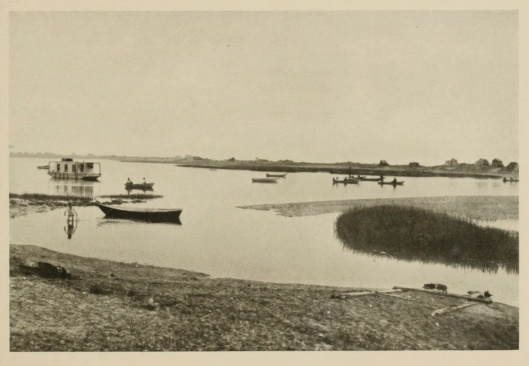
Old Newburyport, giving impressions of how H.P. Lovecraft might have seen it.

AViewofNbptfromHarbor1850_Sm
Newburyport harbour in the 1850s, painted by Richard Burke Jones with historically accurate details. Prints available.

nraland-c1920
The waterfront district circa 1920.

newburyport_waterfrontMore waterfront, from a lower elevation, view of the bridge.

newburyportpridgeBridge at Newburyport.

waternpostAs a working port.

colrun-newburyport
Coal conveyors, presumably to fuel up the steamships.

newburyportlightLight tower at Newburyport, coal conveyor to the steam ships.

1910_Newburyport_station_postcardTrain station. Lovecraft may have instead arrived by trolley in most instances (see David Goudsward, H.P. Lovecraft in the Merrimack Valley), but perhaps the train station and cross-country trolley terminus were the same place? He probably passed through on this line on his return south after visiting Portsmouth in the early 1930s. He also probably arrived here on the train from/to Boston at least once.

Looking Down State Street NewburyportCommercial centre.

neststCommercial centre.

newburyportmarket-620x413Commercial centre.

trolleymaketsquareTrolley car out of the market square.

Nbpt-JoppaLandingJoppa Landing (past the main commercial centre, Lovecraft missed the centre and went hurtling on into this area on the trolley, then walked back).

Clam shacks at Joppa Flats. The trolley car lines have been painted out, but you can see the trolley wire posts.

newburyport-clammersClam pickers on the flats.

Salt-haySalt-haying on the adjacent marshland. Seen in October from the train line that crossed the marshlands, when Lovecraft was returning south from a visit to Portsmouth, could these have looked like shoggoths-in-the-mist? 🙂

nbpt-haystacksSalt-haying on the adjacent marshland.

nra-lots-1972Newburyport waterfront partially cleared in the early 1970s, just before restoration.

nra-lots-1973Newburyport waterfront partially cleared in the early 1970s, just before restoration.

Many more excellent old photos at The Newburyport blog of Mary Baker Design.

Book Review: H. P. Lovecraft in the Merrimack Valley

Book Review:

David Goudsward, H.P. Lovecraft in the Merrimack Valley, Hippocampus Press, summer 2013. $15 print-on-demand paperback, 192 pages. Foreword by Kenneth W. Faig. Jr., with an afterword by Chris Perridas. Illustrated, basic index. The book was read completely and carefully.

lovemerr


David Goudsward is obviously a prodigious walker, just as H.P. Lovecraft was. One has to marvel at the amount of physical legwork and boot leather that went to make this new book. Goudsward has walked and ridden every one of the various routes that Lovecraft threaded through the Merrimack Valley, and he has also wandered through what remains of the antiquated foot-ways of its eastern fishing towns. At the end of the book he even provides readers with a useful short gazetteer, listing places he has visited and which are currently open to the public. For those who can’t make such visits the book offers abundant and crisply reproduced black-and-white pictures. These pictures are either Goudsward’s own, or those he has ably sourced from local archives.

The book is well organised, and the text and pictures flow well together. But much tedious and time-consuming page-flipping might have been avoided by having the footnotes placed at the bottom of each page, instead of at the back of the book. It would also have been useful to have had at least one map of the area, but there are none. This seems a pity, when there are excellent old maps in the public domain at high resolution…
newburyport Above: Newburyport in 1888, topographic map. Full version.

Of course the more digitally adept reader might juggle a digital tablet with the book, and thus ‘follow along’ via the wonderful Google Maps and Google Street View (a free tool which now allows researchers to scout out Lovecraft’s locations from the comfort of their PC). Sadly the modern Haverhill — the setting for the first half of this book — doesn’t lend itself to such Googly goodness: Goudsward informs the reader that the centre of Haverhill was effectively destroyed by the urban-planning vandals of the 1960s and 70s.

haverhill1888Above: Haverhill in 1888, topographic map.

The book opens with a short but engaging foreword by the veteran Lovecraft researcher Kenneth W. Faig, Jr. Faig immediately grabs the Lovecraftian reader by the lapels, with a stirring call to undertake the daunting task of making a complete day-by-day summary time-line of Lovecraft’s life, in the same manner as has already been done for Abraham Lincoln. That might best be done alongside an online searchable edition of the complete corpus of surviving letters (with only fragments shown, as with Google Books, in order to prevent piracy). In the meantime, books such as H.P. Lovecraft in the Merrimack Valley can help to fill some of the gaps, in terms of an almost day-to-day documentation of Lovecraft in one particular place.

Goudsward more or less strides through the events chronologically, with only a few sharp switchbacks into town histories. He opens with a succinct but detailed account of the life of Lovecraft’s fellow amateur pressman Charles W. “Tryout” Smith (1852-1948) of Haverhill. In the book’s appendices “Tryout”, along with Myrta Alice Little, is treated to a fine and painstaking listing of all solo publications.

Then the reader is stepped through the story of Lovecraft’s initial 1921 stay-over meeting with a near neighbour of “Tryout”. This person was the very tall, very beautiful and very intelligent Myrta Alice Little (1888-1967). Lovecraft was perhaps not ‘on top form’ when he met her, being only a few weeks into mourning for his dead mother. Myrta fairly soon decided to marry a local Methodist preacher, and Lovecraft was rather left in the dust. I was surprised to discover that “Tryout” Smith also swiftly departed the Haverhill scene, albeit in a very different way — he became a total recluse at a place called Plaistow between 1922 and 1926, seemingly admitting no visitors at all. Not even Lovecraft.

But Lovecraft did retain a good reason to visit Haverhill, and to explore the area’s antiquities. From March 1922 he had cultivated a friendship with a bright thirteen year old boy named Edgar J. Davis (1908-1949) of Haverhill. Lovecraft befriended Edgar’s family and was allowed to stay over at his home. Together he and Edgar were allowed to go off on trips of local exploration. They eagerly visited the shadowy crumbling estuary-mouth seaport of Newburyport, later admitted by Lovecraft to be — in part — a model for the famous story “The Shadow over Innsmouth” (written Nov-Dec 1931). Here one of Goudsward’s claims about Newburyport made me pause. It was a small claim that the old Bayley Hat (Chase Shawmut) factory was the direct model for the Marsh Refinery of “Shadow Over Innsmouth” (p.47). I felt this claim needed more evidence. On the other hand, the place does look like a plausible candidate, seen here in an elevation sketch I found from circa 1903…

RTEmagicC_PHO-Mersen-Newburyport-Facility-1903.jpg

Like many of Lovecraft’s places, Innsmouth was very probably a bit of a literary collage. He probably borrowed elements from different places: a marshy shoreline from here; a familiar town grid plan from there; add a road by which to approach in an atmospheric manner; give it human pathos by using the crumbling elegant architecture and fishing shacks of Newburyport. Then top it off with a creepy reef way offshore; a horrible hotel; a mysterious refinery; and an old abandoned railroad, some of which were perhaps simply dreamed up from his abundant imagination to suit the needs of the plot.

Goudsward’s book also looks at Lovecraft’s later (post New York) trips to Newburyport and the region, in the company of W. Paul Cook. The bright young Edgar J. Davis had by that time grown up and gone off to Harvard to study law. In this section I again paused over just one of the claims made: that a coral reef Lovecraft saw on a Miami tourist trip was the direct inspiration for Innsmouth’s Devil Reef (p.70). Yet Lovecraft’s description of the jaunt (not given in the book) seems rather incongruously bright-and-sparkly for something so dark and brooding…

   “… sailed out [from Miami] over a neighbouring coral reef in a glass-bottomed boat which allowed one to see the picturesque tropical marine fauna & flora of the ocean floor.” (Selected Letters III, p.380)

The northern third of the nearby ‘Isles of Shoals’, four miles offshore from nearby Portsmouth and ten miles NW of Newburyport, might have been a more plausible suggestion for the idea of the Reef. Although that’s not to say that Lovecraft ever visited any of the bleaker of those islands. While a couple of the larger islands had become minor tourist traps (Hawthorne wrote the junior HPL fave Tanglewood Tales there), most of ‘The Isles of Shoals’ is a sprawl of lonely low islands and tidal ledges just above the sea, where “ragged reefs run out beneath the water in all directions” (Among the Isles of Shoals, 1873). Lovecraft had visited Portsmouth just one month before writing “The Shadow over Innsmouth”.

txu-pclmaps-topo-nh-portsmouth-1917Above: ‘The Isles of Shoals’ seen in relation to Portsmouth, 1917 topographic map.

I did wonder if more might have been said in the book about the historical as well as the geographical context. By historical context I mean the sweep and impact of large implacable forces, such as the shifts in the economy and the coming of modernity to the area in the 1920s. Goudsward does have some short town histories, and some paragraphs that try to say why Newburyport was decaying. But his bibliography lacks the sort of books that might have given him some useful big spotlights, with which to illuminate small details to do with Lovecraft. While pounding the same streets as Lovecraft did can obviously be very useful, an equal pounding on digital doors — of Google Books, HathiTrust, Archive.org, Library of Congress pre-1922 online newspapers, and suchlike — might have yielded Goudsward a few useful additions to his book. For instance, the drastic overfishing at Innsmouth and the town’s keen desire for vast new shoals of fish. Is something similar to be found in the history of the Merrimack River? At Google Books I swiftly found the interesting fact that…

   “Fish were a critical link in the Merrimack valley’s food chain”, and that these fish were vastly overfished and the river over-dammed by commercial interests in the early 1800s, and the fish life of the river consequently suffered a severe ecological collapse in what had once been one of the finest salmon rivers in America. (For full details on this story see the chapter “Depleted Waters” in Nature Incorporated: Industrialization and the Waters of New England, Cambridge University Press, 2004.)

There seems an obvious parallel here with the depiction of the fictional collapse of the Innsmouth fishing economy…

   “Most of the folks araound the taown took the hard times kind o’ sheep-like an’ resigned, but they was in bad shape because the fishin’ was peterin’ aout…” (Zadok in “Shadow over Innsmouth”)

   “That fishing paid less and less as the price of the commodity fell and large-scale corporations offered competition… [but by then Innsmouth had the fish being herded in…]” (“Shadow over Innsmouth”)

I also wondered about a rhetoric around population ‘degeneration’ at the time, apparently specific to the region. I wondered how early this developed in 1921—1931, the period under discussion in the book, as evidenced by the local and regional newspapers…

   “by the 1930s […] entire regions like north-eastern Connecticut and the Merrimack Valley of New Hampshire and Massachusetts appeared to be left behind by history, and the sight of abandoned factories was as common as that of deserted farms” […] “the rural hinterlands seemed to be largely populated with inbred, degenerated retards” [and newspapers pictured] “them as a bunch of mutated dwarfs, giants, and idiots.” (Bernd Steiner, “The Decline of a Region”, H.P. Lovecraft and the Literature of the Fantastic, 2007, p.33).

Finally, there is ‘Mystery Hill’. Goudsward has long been associated with the so-called megalithic site of ‘Mystery Hill’ in New England, and so I was rather dreading reading a gusher of an essay on the topic, but find that the essay is relegated to an appendix in the book. I am no expert on the New England megaliths controversy, other than to know to be highly sceptical of North America’s ubiquitous faux prehistory. But I was pleased to find what appears to be a restrained and rather careful look at the known evidence about Lovecraft having once visited this site. I only worried that I could find nary a whit nor a sniff of the name “Pattee’s Caves” (which Goudsward states was the old local name for ‘Mystery Hill’, before its mid 1930s purchase and transformation) in any of the big pre-1926 online archives. After sifting the dubious claims of Munn and others, Goudsward finally alights on an elegant and moderately plausible way to get Lovecraft up to ‘Mystery Hill’. I won’t spoil the surprise for readers, but it’s a fun ride getting there. Even if Goudsward is right on that point, then it still doesn’t prove that the highly dubious man-sized stone slab now in pride of place at ‘Mystery Hill’ was present and visible there in 1921. Nor that Lovecraft then recalled that same slab a few years later, and fictionally hoisted it atop Sentinel Hill in “The Dunwich Horror”.

Overall the book is an engaging read, and I recommend it to those who want the fine and thought-provoking details about the inspirations for Innsmouth and how Lovecraft came to know the Merrimack River area.


Contents:

Foreword, by Kenneth W. Faig, Jr.
Preface
Acknowledgements
H.P. Lovecraft in the Merrimack Valley
Transformations
First Visits: 1921
Whittierland and Newburyport
Intermezzo: 1924–1926
Innsmouth Ascendant: 1927–1931
Dreams and Eclipses: 1932–33
Shadows out of Haverhill: 1934–36
Coda
Appendices
The Haverhill Convention, by H.P. Lovecraft
First Impressions of Newburyport, by H.P. Lovecraft
Tryout’s Return to Haverhill
Plaistow, N.H., by C.W. Smith
The Return, by H.P. Lovecraft
The Published Works of Myrta Alice Little Davies
Howard Prescott Lovecraft, by C.W. Smith
The Publications of Charles W. Smith
H.P. Lovecraft, “The Dunwich Horror,” and Mystery Hill
Sites Open to the Public
Notes
Lovecraft: A Sense of Place and High Strangeness, by Chris Perridas
Bibliography
Index


Lovecraft’s star-chart

Lovecraft’s star-chart or ‘planisphere’: “The Barritt-Serviss Star and Planet Finder”, circa 1906.

lovecrafts-star-chart

6Mb PNG, complete, printable

planisphereexhibitcradle

storagecaseandextras

sizeindication

“Thirty years ago I bought a large planisphere from Barritt — the so-called “Barritt-Serviss Star and Planet Finder”, with a graduated ecliptic and thumb-tacks for planets. An accompanying booklet gave the right ascension of each planet at short intervals for about a decade ahead, so that one could simply stick a tack on the ecliptic at the right place and all be set. Time passed, the booklet became obsolete, and I didn’t know what had become of Barritt and his firm. For a while I used the Nautical Almanack…” (Selected Letters V, p.412)

He was still using this with binoculars for casual star-gazing (not serious observation work) in the early 1920s.

Phillips Genealogies (1885)

The full text of the book Phillips Genealogies (1885). This is probably a key source from which Lovecraft constructed his family tree as he knew it: I read in the footnotes for the recent H.P. Lovecraft in the Merrimack Valley that this point has been suggested by Kenneth W. Faig Jr. Or I wonder if perhaps the book may have been used by Lovecraft’s maternal grandmother Robie (‘Rhoby’), who died in 1896 and who had apparently done much work on the family tree?

phillips

If Lovecraft had become a modernist poet…

The Call of Cthulhu

Some men found
new treasuries of data
received with suspense and astonishment
just before the stars were right
oh they worshipped
so
they
said
——

the precise words
spoken in the night
so
they
said
——
and then all dreamed
phantasies
standing evoking spirits
atop the mountains of China
—— each so so convinced
that his correspondence was corroboration
of what he imagined

Professors whooo-boy! they dun jived at those
voodoo meetings
yass sairr!
had their heads so full of waterfront rum
yass sairr!
they never questioned
them terrifying vistas
while horrors that none
of them had ever seen
——outsiders——
took advantage of the convocation
to offer blasphemous questions
for correct answerings
yass sairr!
those outsiders they bore out
the queer and the poets
when the pertinent answers
came——

So convinced
some still remained
so fascinated
and in their future years
even the Great
could not induce them to speak
for they feared sinister ears
——only mumbled in vague suggestions

Professor! —
this manuscript
places caution before audacity
the trees were thinner
these stars are wrong
the brooding voodoo —— not proven!

through the winter of the human mind
something moved sensitive among them
seeking hints
of morbid habitation
then in one nauseous rout
succeeded in tracing
the first to be approached

The man on the Newburyport boat
he knew
enough to keep away

so outer powers did not find the key
—— just found a very old man
with a dream he had never spoken
but he remembered
a morbid and long lost statue
whose origin was the sea