
Lovecraft and Howard in Africa

On the Two-Gun Raconteur blog today Keith Taylor surveys some scientific history to try to illuminate why Lovecraft and R.E. Howard might have been spurred to discuss the idea that ‘a white race or tribe had once lived in Africa’. This was a commonly accepted theory by the mid 1920s, apparently bolstered by archaeological and survey evidence and then given an added dimension by sparse Boskop archaeological skull finds from 1913 onwards — the latter being the focus of Taylor’s blog musings.

One can see this then-common idea in action in a Lovecraft letter, written after hearing a vivid and extensive first-hand account of visiting the Zimbabwe ruins in Africa. Lovecraft had had this account directly from his friend Edward Lloyd Sechrist …


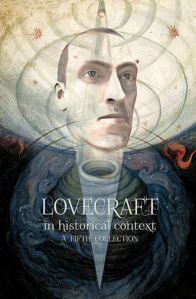
This essay has been replaced by the essay in my new book of revised, expanded, and footnoted versions of my recent Tentaclii essays, Lovecraft in Historical Context: fifth collection.
cover_front_600px

Funghi by fun guys

Ancient mushrooms meet high technology such as 3d printing.

Mushroom chair

fungus-stool

Myx Mushroom Lamp

lamp

Fungus Chair in 3D-Printed Mould

funchair

Eco-friendly mushroom fibre replacement for foam packaging

replacementforfoampackaging

“Building The World’s First Mushroom Tower”

tower

One wonders what might happen when future bio-engineering is added to the mix. Take a giant puffball (up to five feet wide) and bio-engineer it to form a dome rather than a solid ball, and make it grow four times as big. Spray the resultant 20ft high dome with a further bio-engineered organism that turns the flesh into a durable weather-proof form. Pop-up houses, literally — just take a good saw and cut out your doors and windows. When you’re finished with it for the summer, spray it with simple salt or suchlike, so the autumn rain gets through the membrane and the dome just rots down to the ground within days, leaving no trace.

herbs-giant-puffballHerb’s giant puffball.


“Mycotecture: architecture grown out of mushrooms” (90 minute video lecture) by Phil Ross…

[youtube https://www.youtube.com/watch?v=7q5i9poYc3w?rel=0&w=560&h=315]

Sex and the Cthulhu Mythos

Excellent news — Bobby Derie’s Sex and the Cthulhu Mythos is set for August publication, according to a new Hippocampus Press catalogue listing. The author had mooted to me a much later date, so I’m pleased to see it due out so soon. I’d welcome a review copy of this book.

sex-mythos

And coming in September from Hippocampus, the affordable paperback of S.T. Joshi’s two-volume Unutterable Horror: a history of supernatural fiction.

RISD completes Museum renovation

The Rhode Island School of Design’s Museum of Art has just completed extensive renovations of the Eliza G. Radeke Building, costing around $8.4m.

H.P. Lovecraft attended the grand opening in late April 1926. Probably on Sunday 25th April, the day after the official dedication ceremonies of what was then known as the Eliza G. Radeke Museum of Art. Lovecraft also found that he shared his Barnes St. house with… “an official of the School of Design Museum” (Letters from New York, p.312). This calm new museum must surely have been a Lovecraft haunt in the years after his return from New York. Lovecraft already knew well the RISD Museum’s neighbouring…


This essay has been replaced by the essay in my new book of revised, expanded, and footnoted versions of my recent Tentaclii essays, Lovecraft in Historical Context: fifth collection.

cover_front_600px

Added to Open Lovecraft

* Kevin Corstorphine (2013), “‘Colors We Cannot See’: Invisibility and The Limits of Perception in Weird Fiction”. (Paper presented at the conference “The Weird” University of London, November 2013. Compares key stories of invisible monsters, and their probable influence on Lovecraft. Previously presented as “Invisible Monsters: The Limits of Perception in Bierce, Lovecraft and Machen” at the International Gothic Association meeting, University of Surrey, August 2013)

* Catia Cristina Sanzovo Jota (2013), “Terror and shock in H. P. Lovecraft. (Possibly a class paper?)

The Scotch Bakery on Court and Schermerhorn

Rheinhart Kleiner opened his memoir of Lovecraft, “Bards and Bibliophiles”, in…

a little coffee shop at the corner of Court and Schermerhorn Streets, Brooklyn” (Lovecraft Remembered, p.188)

I may have found a picture of this cafe, titled “Schermerhorn Street looking north to Court Street, 1928” From Brooklypix

Brooklyn_Scotch_Bakery_court_schermerhorn_1928

Looking at the other available views of Schermerhorn/Court, it seems there were no other corner cafes there in the 1920s. The “Scotch Bakery and Lunch Room” can be seen on the right of the picture, and there is also a sculptural sign for it on the right-hand lamp post.

At the corner cafe Lovecraft and the gang would sup a 1 a.m. coffee and peruse the early morning editions of the New York newspapers, often before setting out for a long night walk. …


This essay has been replaced by the essay in my new book of revised, expanded, and footnoted versions of my recent Tentaclii essays, Lovecraft in Historical Context: fifth collection.

cover_front_600px