The Scotch Bakery on Court and Schermerhorn

Rheinhart Kleiner opened his memoir of Lovecraft, “Bards and Bibliophiles”, in…

a little coffee shop at the corner of Court and Schermerhorn Streets, Brooklyn” (Lovecraft Remembered, p.188)

I may have found a picture of this cafe, titled “Schermerhorn Street looking north to Court Street, 1928” From Brooklypix

Brooklyn_Scotch_Bakery_court_schermerhorn_1928

Looking at the other available views of Schermerhorn/Court, it seems there were no other corner cafes there in the 1920s. The “Scotch Bakery and Lunch Room” can be seen on the right of the picture, and there is also a sculptural sign for it on the right-hand lamp post.

At the corner cafe Lovecraft and the gang would sup a 1 a.m. coffee and peruse the early morning editions of the New York newspapers, often before setting out for a long night walk. …


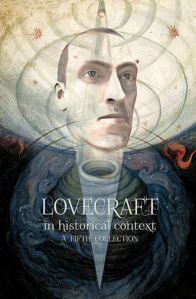
This essay has been replaced by the essay in my new book of revised, expanded, and footnoted versions of my recent Tentaclii essays, Lovecraft in Historical Context: fifth collection.

cover_front_600px

The location of “Juan Romero”: update

New ending for my short topographical note of September 2013, titled “The location of “Juan Romero”: Area 52″. Scratch the couple of sentences speculating on how Lovecraft might have learned of the area, and replace with…


How did Lovecraft come to know of the area? He appears to have been inspired in his choice of a desert setting by reading an amateur journalism author he named in a letter as ‘Phil Mac’ (Prof. Philip B. McDonald), who had apparently used a similar desert / mining setting, but for a “commonplace adventure yarn” (Lord of a Visible World, p.69). It seems Lovecraft had copied out a “dull” and “commonplace adventure yarn” sent to him by McDonald, intending to send the copy to his correspondence circle with a detailed critique of his own. But then he decided to just spend a day writing his own story based on the same or similar setting, and he then sent out both… “Youze gazinks have seen both Mac’s and my yarns.”

Philip B. McDonald graduated M.E. (Master of Engineering) from Michigan College of Mines. In Lovecraft’s The Conservative, McDonald was stated to be “Assistant Professor of Engineering English, University of Colorado” in July 1918, though he later moved to New York to become assistant professor of English, New York University. It appears he was the husband of the noted amateur journalist Edna Hyde McDonald (“Vondy”). McDonald’s desert story was not used in Lovecraft’s The Conservative and seems not to exist today, nor any of his fiction. So we don’t know how closely Lovecraft used, or not, what he called “the richly significant setting” of McDonald’s “dull yarn”.

Public domain, Jan 2015

Some of the writers who go ‘public domain’ in Europe and the UK in January 2015, under the 70 year rule…

* Max Brand (Wild West stories of the Munsey era)
* Irvin S. Cobb (prolific writer of the Munsey era, some horror)
* Arthur Quiller-Couch (English adventure novelist and poet, some ghost stories)
* John Palmer (mystery writer, biographies of Ben Johnson and Kipling)
* David Wright O’Brien (fantasy & SF writer, nephew of Farnsworth Wright the editor of Weird Tales)
* J. Storer Clouston (some science-fiction novels)
* Robert Nichols (English poet and fantasy writer)
* Margery Williams (Became a conventional children’s writer, but she first wrote the 1913 novel The Thing in the Woods, apparently a “potboiler about a werewolf and its slightly more human brother on the loose in rural Pennsylvania” Lovecraft read it, so a possible influence on “The Dunwich Horror”).
* Rene Daumal (French surrealist)
* Hulbert Footner (mystery and detective writer)
* C.J. Cutcliffe Hyne (popular adventure novels, mostly pirate tales, but also the author of the novel The Lost Continent: The Story of Atlantis)
* Greville MacDonald (son of the pioneering fantasy writer George MacDonald. Wrote the biography, George MacDonald and his Wife. Other works include The Sanity of William Blake, fairy stories, and the apparently rather fine English fantasy How Jonas Found his Enemy: a Romance of the South Downs, The latter ridiculously expensive and rare, presumably due to his Alice in Wonderland connection.)

“BY this corner of the graveyard the red dawn discovered to Jonas a little pool of clear water, with mosses and parsley-ferns all around it, and so clear and cool-looking that he must drink. The larger part of it was still shadowed by the wall. On knees and hands, he put his lips to it and drank. The refreshment was wonderful. He rose with a sense that he should find the lost sheep yet and bring her home. He looked down once more into the clear pool. It was wider than he had thought—indeed, he had been mistaken; it was a great tarn on the mountain-side! Then he saw that wonderful things were happening on the face of and all round the water. What appeared to be little glow-worms were lying motionless in groups on the mosses in a still-shadowed region by the side of the water. From beneath a low arch in the wall, where the water was slowly flowing away in a river, there came, against stream and wave and wind, a fishing-boat. Its great red sail was spread, and its pennant shone silvery blue in the sun. It came alongside a pier of mossy stones, and cast anchor. From it leapt twelve strong young fishermen, all with bright faces. They took up the little creatures with the glowing lights, and carried them aboard; then back again to other groups, until all were gathered in. For they were all sleeping human forms, close-wrapped in grave-clothes, but with their light still living, as might be seen by anyone who had suffered. When all were safe aboard, the men cast off and the boat disappeared under the arch.” — from How Jonas Found his Enemy: a Romance of the South Downs (1916).

Lovecraft in a balloon

In 1910 the 20 year-old H.P. Lovecraft visited the Brockton Fair, about midway between Boston and Providence. He later remembered… “the balloon in which I ascended at Brockton in 1910” in a postcard home, 29th August 1929.

Brockton Fair appears to have been a typical late-autumn country fair, with horse shows, athletics, agricultural produce and livestock displays, horse races, a fashion and flower show, airborne stunts with a blimp and an early airplane, and fireworks.

$_57

brocktonfair1910

The ride was presumably run by Brockton Balloon Company, owned by Professor B.S. Tirrell. Tirrell took the ballon high enough to have people perform skydiving/parachute acts from the basket, and presumably went to much the same height for his passengers. He also set off each day’s finale fireworks from the balloon while in mid-air, at evening.

brockton

One postcard shows the balloon at the Fair, c.1910…

brockbal

Lovecraft might also have seen Indians there…

The Passamaquody Indians came from Maine and set up their tepees in the woods east of the racing track. They sold baskets, jewelry and other items and put on demonstrations.” (Lois Crymble Thomas, grandaughter of one of the fair’s founders)

Two books from Lovecraft’s library

Two books from Lovecraft’s personal library…

A Book of New England Legends and Folk Lore. An excellent survey and collection of materials. Including a picture of the Pickman-esque “Old Ruin” house at Boston’s North End…

boston-north-end

See also “The Place of Noises” (p.427), on the Moodus Noises which have been suggested as one of Lovecraft’s inspirations for “The Whisperer in Darkness”.

By the same author, and also in Lovecraft’s personal library, the fine book Nooks and Corners of the New England coast.

isles

Added to Open Lovecraft

‘Henry Akeley’ (2014), “The Beast in the Cave: a Treatise on Supernatural Horror in Metal”, Heathen Harvest 2.1, July 2014. (On the use of Lovecraft stories and references, in heavy metal music)

* Randy Everts (2014), “Unknown Friends of H. P. Lovecraft: No.4, James Tobey Pyke”. (With David Haden)

* Randy Everts (2014), “Unknown Friends of H. P. Lovecraft: No.3, David Horn Whitter”. (With David Haden)

* Randy Everts (2014), “Unknown Friends of H. P. Lovecraft: No.2, Woodburn Prescott Harris”. (With David Haden)