“Scientists to the last”

Why, gosh — one could almost imagine that the folks at Brown University were channelling H.P. Lovecraft. In the news this month…

Researchers at Brown University have shattered an electron wave function, that near-mythical representation of indeterminate reality, in which an unmeasured particle is able to occupy many states simultaneously”.

A team at Brown University called BrainGate is at the forefront of the real-world movement to link human brains directly to computers”.

“Brown University is part of a team looking at the environment’s influence on human adaptation and how it changes biology… Genes can shape culture and political institutions, which in turn can shape biology and physiology, passing on certain traits to future generations.”

And becoming world experts on creatures that look like this

siphono

Fruit Hill

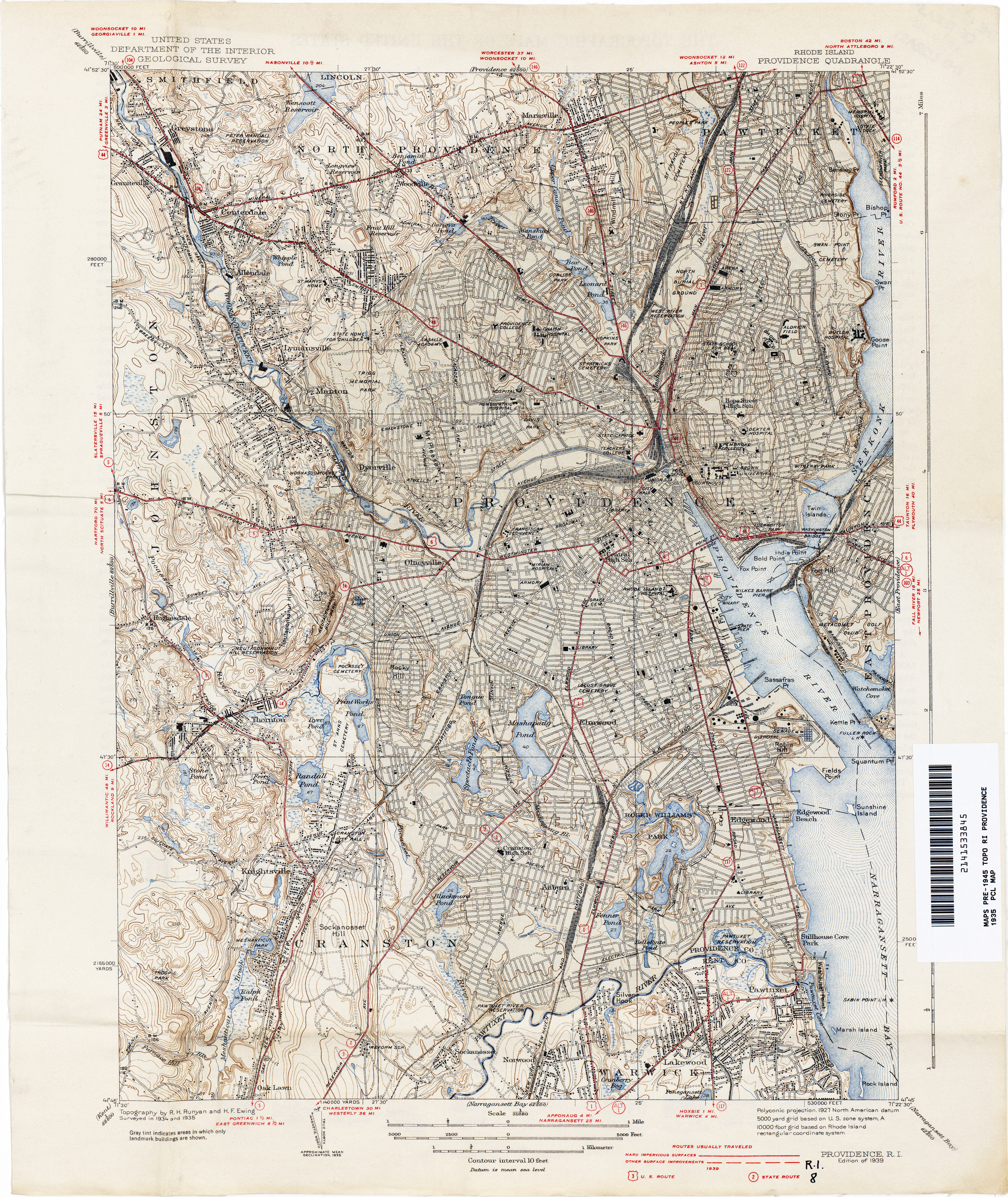
“Around the All-Hallows period I unearthed a highly picturesque district on the city’s very rim — Fruit Hill [now the Our Lady of Fatima Hospital, its grounds, and the adjacent Captain Stephen Olney Memorial Park], from one point of which I caught a view of almost incredible loveliness which included a twilight-clad descent of walled meadows (with a wood and glimpses of a sllnset-litten river at the bottom), dim violet hills against an orange-gold west, a steepled village in a northward valley, and over the rocky eastward ridge a great round Hunter’s Moon preparing to flood the scene with spectral light. Since then there has been some cold weather — even a premature touch of snow — but yesterday was warm again, and I took a walk through the same Fruit Hill region, now pretty well toned down to bare boughs and grey and brown effects. My season of hibernation looms close — but in my present ancient hilltop quarters I do not mind an indoor existence as badly as I might.” (Lovecraft to Richard Ely Morse, 14th November 1933, in Selected Letters IV, p.318)

fruithill
From: large scale topographical map of Providence, 1935.

S.T. Joshi Endowed Research Fellowship – open for applications

Applications are now open for the new S.T. Joshi Endowed Research Fellowship, for research on H.P. Lovecraft and his circle. The lucky recipient gets to spend six weeks at Brown University, with $2,500 to cover travel and expenses. Application deadline: 31st January 2015. The email address below was from the initial announcement, and I’m assuming it’s still the one for contact.

brownu1brownu2

Art Laboratory Berlin, call for work on nonhuman subjectivities

An open call:


Art Laboratory Berlin is initiating an open call for art works, texts and cooperative works with artists, scholars and scientists on non-human subjectivities.

Recent philosophical works by Graham Harman [known for his work on Lovecraft] [and others] have questioned the solely human role of subjectivity that has formed the core of ‘humanism’ over the past five centuries. [and suggested there may be] a new multiplicity of viewpoints of non-human intelligence, agency and subjectivity, that make up our planet (and beyond).

Possible topics could include:

* Perspectives under threat – non-human viewpoints during the great species die off. [which is a dubious claim]

* Bacterial viewpoints – how microbes communicate, interact and experience the world.

* Non-human perspectives – intelligence and agency in animals, plants, bacteria.

* Re-definition of intelligence, agency and sentience in ways that are not anthropomorphic.

* What do some of these perspectives make of Homo Sapiens? e.g.- 90% of the cells in our body do not have human DNA – we are a host, a topography, for billions of bacteria and fungi.

* How about agency (and even intelligence) beyond life – virii or crystals for instance.

* Are complex data systems, algorithms, artificial intelligence beginning to have points of view, and forms of agency that are beyond human comprehension?

Art Laboratory Berlin is seeking submissions and proposals predominantly for exhibitions, performances and workshops, but is also interested in cooperation with scholars and scientists for the production of a series of lectures, texts and a symposium.

The deadline for entries is 15th December, 2014. Chosen proposals will form part of our 2016-17 programme, Please submit your proposal by email to: nonhumanisms@artlaboratory-berlin.org and please title the subject-line: POST RQST.

The application should include a proposal (not longer than 5 pages), a C.V. and work portfolio (not longer than 10 pages). We ask that you keep the size of attachments altogether under 5Mb. For video or other large files we encourage the use of Web links.

Eldritch Tales in audio book form

I hadn’t realised that the Gollancz doorstopper collection of less well-known Lovecraft, titled Eldritch Tales: A Miscellany of the Macabre, now has a professional quality audio book version available.

eldritch_audio

It contains readings of a lot of the more obscure Lovecraft items, which I suspect Wayne June may never get around to recording. The items include, among others:

History of the Necronomicon
The Alchemist
A Reminiscence of Dr Samuel Johnson
Memory
Despair
Psychopompos: A Tale in Rhyme
The Nightmare Lake
Poetry and the Gods (with Anna Helen Crofts)
Ex Oblivione
The Crawling Chaos (with Winifred Virginia Jackson)
The Horror at Martin’s Beach (with Sonia H. Greene)
Hallowe’en in a Suburb
The Green Meadow (with Winifred Virginia Jackson)
Nathicana
Two Black Bottles (with Wilfred Blanch Talman)
The Last Test (with Adolphe de Castro)
The Wood
The Ancient Track
The Electric Executioner (with Adolphe de Castro)
The Trap (with Henry S. Whitehead)
In a Sequester’d Providence Churchyard Where Once Poe Walked
The Evil Clergyman

Only “‘Afterword’: Lovecraft in Britain, by Stephen Jones” seems to be omitted, though apparently it’s in the printed volume.

Maps and Mapping in Children’s Literature

Call for Papers: Maps and Mapping in Children’s Literature

Literature for children and young adults is a rich source of material for the study of literary maps, one that has been largely overlooked, despite the growth in academic interest in this area of study.

Not so relevant to Lovecraft, but this call might be interesting to those researching similar genre authors, especially those in the sword-and-sorcery genre where the addition of fan-made maps have enhanced the fiction’s appeal to later generations of young teens.

There is the surveyor mapping in “The Colour Out of Space”, and one passing moment when Lovecraft follows a rough local map… “I was steering my course by the map the grocery boy had prepared” in “The Shadow over Innsmouth”. This latter probably reflects his own practice during his numerous antiquarian visits to strange towns. There are also carved wall maps in At The Mountains of Madness which are found, copied and followed. But Lovecraft’s fiction is probably more interesting for the implied idea that certain spaces could not be found, or had not yet been placed, on maps.

Gothic Spaces / Gothic Places conference

I’ve only just found out about this one: Gothic Spaces / Gothic Places at The Manchester Centre for Gothic Studies, England, on 25th October 2014. The academic symposium has an interesting opening paper about… “John Carter, the zealous defender of the Gothic architectural style in late eighteenth and early nineteenth-century British culture” and publisher of the 18th century The Gentleman’s Magazine. Another Carter to offer up as a possible inspiration for Lovecraft’s Carter, perhaps?