John Russell, a Lovecraft correspondent during the years 1913-1925

John Russell, a Lovecraft correspondent during the years 1913-1925.

The young Lovecraft once jousted, in the pages of Argosy magazine, with one John Russell of Florida. Russell later became a correspondent at a critical time in Lovecraft’s career, but he remains something of a mystery to Lovecraftians. We don’t even know his birth and death dates, it seems. Note that he is not to be confused with John Russell Fearn (1908-1960) who was also British, an early science fiction fan, a contributor to The Futurian and later a prolific SF author.

The story of the jousting in the Argosy is well documented over several pages in S.T. Joshi’s monumental Lovecraft biography I Am Providence. The public exchange was fateful, since it brought Lovecraft to the attention of a recruiter for the amateur journalism movement. Lovecraft later recalled this consequence in a letter…

    “John Russell, the Florida Scotchman who in 1913 conducted the Argosy controversy with me which led to my discovering amateur journalism!” (Selected Letters I).

One of the Lovecraft poems from this inky jousting, “Frustra Praemuntius”, a satire on Russell, was apparently not published at the time. It can now be found in the collections of Lovecraft’s poetry titled The Ancient Track, along with the other poems from the controversy.

Russell also joined the amateur journalism movement, although a year or so after Lovecraft. Russell was born at Penicuik, near Edinburgh, and his skill was said to have been Scots dialect poems in the Robbie Burns tradition. Lovecraft wrote of him in the short “Introducing Mr. John Russell” (1915)…

    “During the winter of 1913–14 The Conservative [Lovecraft] was engaged in an extremely heated controversy concerning the merits of a certain author whose work appeared in one of the popular magazines of the day. The letters of the disputants, both in prose and in verse, were printed in the magazine, and among them appeared both the formal heroics of The Conservative, and the neat octosyllabics of one John Russell, Esq., of Tampa, Florida. Mr. Russell and The Conservative, who were arrayed against each other in the metric fray, were each separately invited by Mr. Edward Daas to join the United, but while The Conservative responded eagerly and almost immediately, his opponent deferred action. Meanwhile a peace had been sealed betwixt the contending bards, and a correspondence established, in which The Conservative continued to urge what Don Eduardo had first mentioned; the result now appearing in Mr. Russell’s advent to the association.

    John Russell, whose present address is General Delivery, West Tampa, is a true-born Scotsman, being a native of Penicuik, near Edinburgh. The patriotism of his family is attested by the presence of his two nephews at the front in Belgium, one with the Gordon Highlanders and the other with a Canadian regiment. Mr. Russell’s poetry has appeared in the public press of Scotland, Canada, and the United States, and possesses a tersely epigrammatical and at times brilliant satirical style all its own. Though proficient in classic English, it is in the quaint speech of Caledonia that Mr. Russell chiefly excels. Of this delightful dialect he is a perfect master, and his well-constructed lines are redolent of the atmosphere of North Britain. Upon joining the United, one of Mr. Russell’s first acts was to dedicate a poem to the Blue-Stocking Club of Rocky Mount, whose study of Robert Burns at once aroused his interest.”

In the United Amateur Lovecraft later gave a shorter description of the new recruit…

    “John Russell, formerly of Scotland but now of Florida, is a satirist and dialect writer of enviable talent. His favorite measure is the octosyllabic couplet, and in his skilled hands this simple metre assumes a new and sparkling lustre.” (“Department of Public Criticism”, United Amateur, August 1916).

A little later Russell secured employment on a local newspaper, as Lovecraft’s own journal The Conservative noted in October 1916 that…

    “John Russell of Florida, whose satirical and other verses have formed such a piquant feature of amateur letters, has recently accepted a position with the “Tampa Breeze” [a weekly, under the editorship of former General W.W. Averill]. He will be in complete charge of the advertising department, besides having duties of an editorial nature…” (p.114 of the book reprint of The Conservative issues).

S.T. Joshi has also noted (I Am Providence, p.276) that the 1918 Lovecraft poem “The Volunteer” was published circa 1918 in the St. Petersburg Evening Independent, a Florida newspaper. Joshi speculated that Russell might have secured this publication for Lovecraft.

Russell had nephews fighting in the First World War, so I would hazard a guess that his age might have been about age 45 in 1916. This gives a likely birth date range of circa 1868-75.

Lovecraft almost met Russell in 1922 in New York…

    “…fancy who has just written, asking me to meet him if convenient in NY at the Victor Hotel, 37th St. & 5th Ave., on Saturday, Sept. 23, (one week from today) 1922? None other than that John Russell, the Florida Scotchman who in 1913 conducted the Argosy controversy with me which led to my discovering amateur journalism! I had never thought to see him in the flesh, although I have corresponded to some extent with him; & the present chance is wholly accidental — he has been home to Scotland & is returning by way of New York. The odd thing is, that he has no idea I am in NY — his suggestion is that I make the trip from Prov. especially to see him — which would be a bit expensive & unlikely. I should like to meet the man whose verses elicited the satires from which Daas recruited me, & I have half a mind to do it — I’ll let you know. It’s so darned congenial here that I hate to break away — but I am a philosopher, & accept with stoical imperturbability every circumstance & dispensation of fate. However — what I’d advise is your coming along here & mixing in the festivities!!! You’d find Belknap a little angel — he’s second only to the immortal Alfredus.” (Lovecraft in Letters from New York)

Sadly, when the appointed hour came around, it appears that Russell missed the appointment amid the hubbub of New York.

Letters from Russell to Lovecraft are listed in the Brown University collection. The dates of these suggest that Lovecraft struck up a more regular correspondence with Russell through the late summer of 1923…

1920 Jun 30
1923 Aug 4
1923 Aug 19
1923 Sep 22
1923 Oct 13
1923 Oct 27

I could be wrong, but I suspect these have not yet been published, since the corresponding letters by Lovecraft have been lost. S.T. Joshi remarks that Lovecraft’s… “letters to Russell have not come to light” (I Am Providence, p.228). There is almost no trace of Russell in the online record, although his name is one that is very difficult to trace.

Lovecraft’s relocation to New York in 1924 probably curtailed much of his contact with his outer circle of wider correspondents, including Russell. But then Russell finally met Lovecraft face-to-face in New York in early 1925. Russell might then have been about age 55, and this a markedly ‘older’ man according to the mindset and demographics of the time. S.T. Joshi remarks in I Am Providence that Lovecraft and Russell “spent several days in April” (p.602) together in New York. There seems to be no record of the meeting or their trips, but presumably Joshi had the basic details from an aside in one of the letters. One imagines that Russell, being a ‘oldster’ and a Scot, must surely have been taken to visit the similar Everett McNeil at one point during the visit. Possibly he met the fellow staunch British patriot Ernest La Touche Hancock, who was also in New York at that time.

Russell may have been passing through New York on his way to take ship for a summer tour of the British Isles, since in August or September he sent Lovecraft three postcards of ancient Tudor houses in Ipswich, England. Lovecraft noted these in a September 1925 letter, and he went on to say that he had completed a long letter to Russell in return. If Russell had sent the cards from England, then he obviously had the funds for a lengthy trip abroad. One wonders if there was perhaps a touch of jealousy on Lovecraft’s part, since it was a trip he had long desired for himself, and his own position in New York was quite pitiful in comparison. Evidently the 1925 New York visit had been an amicable one, but there is no further evidence of correspondence after September 1925.

The amateur journalism paper The Little Gem, Jan-Feb 1938, No.2, had an article titled “AMATEUR JOURNALISM CHATS: John Russell Foos”. The Little Gem is in one of the big amateur journalism collections due to be scanned and online relatively soon. But this seems unlikely to be an interview with ‘Lovecraft’s John Russell’, and is perhaps instead with the 18 year old John Russell Foos of Ohio.

Champlin Burrage, 1874-1951

My aunt is well acquainted with Mr. Champlin Burrage [1874-1951], an Oxford man, who is librarian of the John Carter Brown library at Brown. (I hope to meet him very soon.)” — Lovecraft letter to Rheinhart Kleiner, April 1917.

Burrage was a New England man of a good family, who had graduated from Brown University in the class of 1896.

Mr. Burrage spent two years [1899-1900] at the Universities of Berlin and Marburg [and there became] familiar with the book markets and booksellers of Europe” — Annual report of the president to the Corporation of Brown University, 1915.

He later published groundbreaking work on the history of early English puritan dissenters and he became the Librarian of Manchester College, Oxford. He had married while in England, so there can be no question of a circa 1917 romantic entanglement with Lovecraft’s aunt. Though an affection or expectation between them during the 1890s is not impossible.

An account of Burrage’s arrival as Librarian at Brown, specifically his giving an inuagural lecture to senior students in December 1915, suggests that he shared with Lovecraft a certain affinity for the idea of rare books lurking in the old libraries of Europe…

Dec. 16 [1915], in the John Carter Brown Library. The Librarian, Champlin Burrage, was the host of the evening and spoke on “Historical Libraries of Europe.” … He gave several anecdotes concerning mendicant librarians and their services in collecting rare and valuable books. In closing, he explained the methods by which rare books are discovered and obtained. His talk was out of the ordinary and roused an especial interest in those students of classical literature who were present. … After the speech Mr. Burrage conducted the members … to the basement, where he showed them the photophat [photostat], a machine used for producing copies of rare manuscripts and out of-print books.” — Brown Alumni Monthly, Jan 1916.

I seem to recall that there has been some scholarly discussion about Lovecraft’s knowledge of photostats, in relation to their appearance in Dexter Ward. The fact that Lovecraft might have had photostat copies of books made for him in the basement at Brown, possibly even while researching Dexter Ward, may be of interest to some in this respect.

Lovecraft was almost a little out-of-date in his mention of Champlin Burrage’s tenure at Brown, if the Lovecraft letter has been correctly dated to April 1917. Burrage was in post from 1915 to some time in the 1916-17 term. He then “retired” (Annual report of the president to the Corporation of Brown University, 1917) as Librarian at Brown, seemingly toward the end of the academic year 1916-17. If the dating of Lovecraft’s letter is correct, however, we might then surmise that Burrage only left his post in the spring of 1917. This dating is confirmed by the Encyclopedia Brunoniana

Champlin Burrage, who had been librarian of Manchester College in Oxford was appointed to succeed Winship. Burrage remained only until 1917, and the library was under the care of Worthington C. Ford, until the appointment of Lawrence C. Wroth in 1923.”

In 1918 Burrage published the book John Pory’s Lost Description of Plymouth Colony in the Earliest Days of the Pilgrim Fathers, together with contemporary accounts of English colonization elsewhere in New England and in the Bermudas. A book which might have interested Lovecraft, as a collection of first-hand descriptions of very early New England townscapes.

There is then a gap in the historical record, in which Burrage seems to have completly switched his research track from puritans to pagans. His years after Brown appear to have been absorbed by a “complet[e] a study of the hieroglyphic inscriptions of Minoan Crete”, on which he first published in 1921. At that time the American Journal of Archaeology noted that his 1921 article, “recently appeared in Harvard Studies in Classical Philology, gives but a hint of the mass of material on old Aegean scripts which he hopes soon to publish in book form.” Sadly his decade of work resulted only in a slim 42-page book in 1928, The Ithaca of the Odyssey : a New Attempt to Show that Thiáki is the Ithaca of Homer and to Discover the Lost Sites of the Hut of Eumaeus, the Spring of Ithacus Neritus and Polyctor, the Farm & House of Laertes the City and Port of Ithaca, and the Palace of Odysseus.

1929 saw Burrage listed as “Historian, Archaeologist” in Living honorary graduates of Brown University. He described himself as “Deliberately choosing the life of historical research, discovery of lost manuscripts, author” and was living with his wife at 5 Park Vale, Brookline, which is a suburb on the outskirts of central Boston. Burrage appears to have produced no further publications, in his last two decades from 1929 to 1951.

One wonders if Lovecraft might ever have visited Burrage on the outskirts of central Boston, as he made his summer travels in the region? Perhaps on behalf of his aunt? Or did Burrage ever come to tea with his aunt while Lovecraft was there, perhaps as a parting visit in the early summer of 1917? Burrage was an expert on early Puritans, early New England townscapes, rare books in European libraries, and later on the lost scripts of then-mysterious Minoan Crete. Given this, he and Lovecraft might have had a fair bit to talk about.

NecronomiCon 2015 begins…

The NecronomiCon 2015 should be beginning to buzz about now, as people arrive on the Thursday evening.

lightsprovidencePhotograph: A Providence hillside: some lamps lit, the western windows of homes reflecting a fading sunset. By Spencer Grant (1944-), Boston Public Library.

… its ancient vanes and steeples, ridgepoles and chimney-pots, wharves and small bridges, willow-trees and graveyards; endless labyrinths of steep, narrow, crooked streets, and dizzy church-crowned central peak that time durst not touch; ceaseless mazes of colonial houses piled and scattered at all angles and levels like a child’s disordered blocks; antiquity hovering on grey wings over winter-whitened gables and gambrel roofs; fanlights and small-paned windows one by one gleaming out in the cold dusk to join Orion and the archaic stars. And against the rotting wharves the sea pounded; the secretive, immemorial sea out of which the people had come in the elder time.” — H.P. Lovecraft, “The Festival”.

Sunsets arouse in me vague feelings of pseudo-memory, mystical revelation, and adventurous expectancy, which nothing else can even begin to conjure up. They always seem to me to be about to unveil supernal vistas of other (yet half-familiar) worlds and other dimensions.” — Letter from Lovecraft to R.E. Howard, 7th May 1932.

It looks like it’s sunset for Tentaclii too. My thanks to the five people who have pledged a total of $16 to my Patreon campaign so far, which much appreciated. But I’m unsure that the Patreon call is going anywhere, sadly — I don’t see anyone even bothering to share the Patreon page on Facebook, Twitter or blogs. No comments on the Tentaclii blog, either. Just two on three likes on my various Facebook posts about it. I suspect that I will be pulling it at the end of the month.

Lovecraft’s 125th Birthday presents and parties – the big parcel

Here’s my quick round-up of the celebratory free items and events and doings in celebration of H.P. Lovecraft’s 125th birthday, on 20th August 2015…

* I’ve made a large map of some Providence locations the living Lovecraft would have been familiar with…

lovecraft_providence_final_hires_2015-thHigh resolution version here (5Mb in .JPG).

The map omits the Athenaeum — I can find very little evidence of his connection with it. It also omits the schools/YMCA and buildings/places variously said to have inspired his stories, except for “The Call of Cthulhu”‘s ‘Fleur-de-Lys’ building (hard to avoid as it’s alongside the Providence Art Club his aunt and other relatives were connected with). But the map does add cafes, of which he was so fond — one he is known to have frequented near the public library. The other is a general indication of the dock-front cafes for sailors and watermen, which he used at various times (possibly initially discovered at dawn after his early pre-NYC all-night walks?) because they were so cheap and served large portions.

* MalakiaLaGatta has a fine 125th Birthday poster

MalakiaLaGatta-deviantart

* The Trunk Space has a night of Lovecraft performance art in Phoenix, AZ, tonight.

* Cambridge, Mass. has an “In the Mouth of Madness” Lovecraft film festival from the 20th – 24th August 2015, showing Lovecraft and Lovecraft-influenced movies on the big screen.

* There’s a big costumed H.P. Lovecraft Birthday Party in the East Village, New York City, with proceeds going help the homelessness in the city. Over in the West Village, NYC, there’s a The Weird West Village walking tour: H.P. Lovecraft Birthday Edition walk. The Lovecraft Bar in NYC is also hosting a party on the 21st August.

* The public library in Jacksonville, IL is holding its own Lovecraft Festival today.

* Buffalo, NY has a Love, Light & Magick evening of Lovecraft readings.

* There’s a “Celebrate H.P. Lovecraft’s 125th birthday at the Love Fest in Second Life“, Second Life being the well-known virtual world.

* South San Francisco Main Library has a “Happy Birthday, H.P. Lovecraft!” event this evening, 20th August from 5pm to 7pm… “Join us in celebrating H.P. Lovecraft’s birthday with board games, a film screening, and treats!” Sounds like it might be aimed at young teens?

* The book launch of Satanic Panic: Pop Cultural Paranoia in the 1980s — at the Carlton Cinema, Toronto, August 20th — will happen alongside “a screening of animated shorts that celebrates H.P. Lovecraft’s 125th birthday”.

* Willits Kinetic Carnivale is a big steampunk kinetika gathering based around the Mendocino County Museum in California. They’re certainly aware that the event co-incides with HPL’s birthday, but the extent of HPL art and costume theming may be limited — their art gets prepared and planned for months in advance.

* A superbly stinky and rare giant Corpse Flower is about to blossom in Denver, just in time for HPL’s birthday…

corpse

* Pasedena’s Mountain View Mausoleum is holding an October production of Lovecraft’s “The Unnamable” in October, and they’ve having a Birthday preview reading at the Huntington on 22nd August 2015. “Wicked Lit” at the Huntington in Pasedena starts 7pm, and also includes readings from the Scottish Victorian novelist Margaret Oliphant.

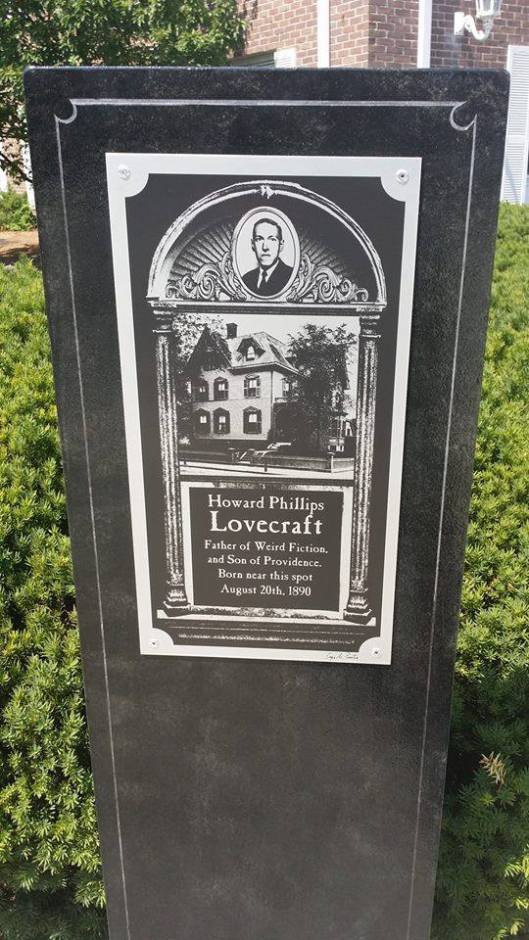
* And, of course, there are a variety of Birthday related events in Providence, based around NecronomiCon 2015. Including a new Lovecraft plaque/post sited at 454 Angell Street. Designed, created, and installed by Gage Prentiss, “with placement help by Donovan and Pam Loucks”.

plaque

There was also a Hiding Under The Covers Birthday event in Providence, but it was on the 19th. However, as this post is being published midnight on 19th/20th UK time, there might still be time to rush down there if you read this quick enough.


I guess one might also consider the cool appearance by a likeness of Lovecraft in a recent film by the great director Woody Allen (Annie Hall, Manhattan, Midnight in Paris) to be a sort of birthday present, as the movie is released about now…

“Woody Allen deployed [the Providence Athenaeum’s] bronze bust of Lovecraft while filming Irrational Man in the Athenaeum. He positioned the impossible-to-ignore, overlarge head right between the lead actors during a pivotal exchange. The goofy image did suggest irrationality of some sort.”

Although the new movie is “set in Newport” rather than Providence, it seems that a variety of New England locations were melanged into Allen’s vision of Newport. Which I suspect looks rather unlike Innsmouth when viewed through Allen’s lens (gosh, wouldn’t that be a film — “The Shadow over Innsmouth” as filmed by Woody Allen, in his Shadows and Fog mode).

Irrational Man is apparently a small-scale intimate summer story with a few Hitchcockian twists, and is premiering in cinemas/theaters about now. I don’t hold much store by movie reviewers after the dim-witted parroting reviews that destroyed Tomorrowland, but a quick glance at the Google Search snippets for Irrational Man reviews suggests the reviewers have had moderately good things to say.


Update:

* TIME magazine and the Wall Street Journal note Lovecraft’s birthday.

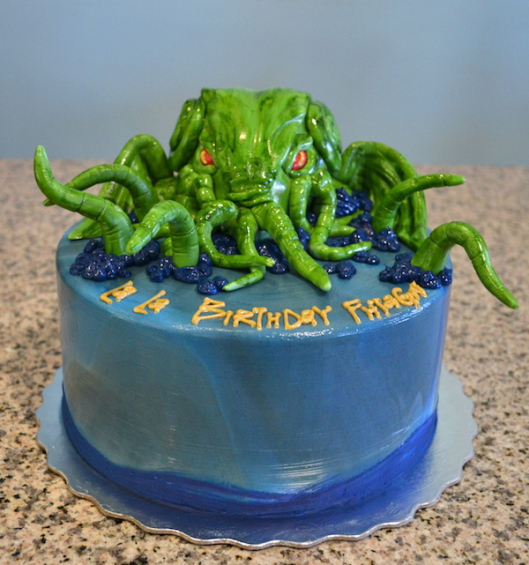
* Cake, apparently at an event at Calgary Public Library…

cake

NecronomiCon 2015: Art in Providence

The “Ars Necronomica” art show is open now at the Providence Art Club, for the very-early arrivals at NecronomiCon 2015.

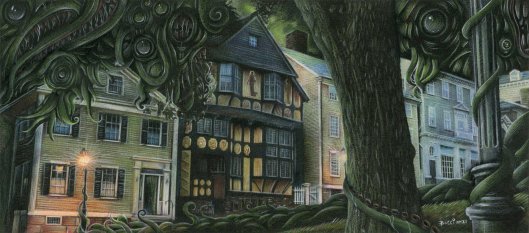
thomasst
Picture: Thomas Street at the Beginning of the End by FatherStone (Metteo Bocci). The original is on show as part of the Ars Necronomica 2015 show.

There are also some photographs of the “Ars Necronomica” exhibits online at The Art of Skinner.

The Dodge House Gallery at the Providence Art Club also has a complementary show called “Rhode Island Eerie”

“featuring Rhode Island motifs, themes, and landscapes [that were] portrayed through the lens of the life and work of H. P. Lovecraft”.

Note that the Dodge House Gallery page has a Flash-tasitic 360-degree VR tour online. Didn’t work for me, since I’ve long since uninstalled Flash (it’s a massive security risk), but it may work for you.

Also on now in Providence is a restaurant wall show of contemporary Lovecraftian prints, “The Legacy & Future of H.P. Lovecraft in the Print” at Julians on Broadway, Providence.

julians

Some original correspondence / notebook sketches by members of Lovecraft’s circle will be on show from Wednesday 19th at Brown University, in “The Influence of Anxiety: Lovecraft, Bloch, Barlow, et al.”.

bloch-shub
Picture: Robert Bloch, “IÄA. Shub-Niggurath Y’A”, circa 1933. Brown University Library.

There are no other related gallery shows nearby in New England it seems, mostly chocolate-box landscapes and seascapes for the mainstream tourist.

The Unique Legacy of Weird Tales

The Unique Legacy of Weird Tales book of essays is now slated as due in hardback in October 2015. The R.E. Howard blog Two-Gun Raconteur has an interview with co-editor Jeffrey Shanks.

untoldweirdtales

CONTENTS:

Introduction: Weird Tales — Discourse Community and Genre Nexus

PART I: THE UNIQUE MAGAZINE: WEIRD TALES, MODERNISM, AND GENRE FORMATION

Chapter 1: “Something that swayed as if in unison”: The Artistic Authenticity of Weird Tales in the Interwar Periodical Culture of Modernism – Jason Ray Carney

Chapter 2: Weird Modernism: Literary Modernism in the First Decade of Weird Tales – Jonas Prida

Chapter 3: “Against the Complacency of an Orthodox Sun-Dweller”: The Lovecraft Circle and the “Weird Class” – Daniel Nyikos

Chapter 4: Strange Collaborations: Shared Authorship and Weird Tales – Nicole Emmelhainz

Chapter 5: Gothic to Cosmic: Sword and Sorcery Fiction in Weird Tales – Morgan Holmes

II. EICH-PI-EL AND TWO-GUN BOB: LOVECRAFT AND HOWARD IN WEIRD TALES

Chapter 6: A Nameless Horror: Madness and Metamorphosis in H.P. Lovecraft and Post-modernism – Clancy Smith

Chapter 7: Great Phallic Monoliths: Lovecraft and Sexuality – Bobby Derie

Chapter 8: Evolutionary Otherness: Anthropological Anxiety in Robert E. Howard’s “Worms of the Earth” – Jeffrey Shanks

Chapter 9: Eugenic Thought in the Works of Robert E. Howard – Justin Everett

III. MASTERS OF THE WEIRD: OTHER AUTHORS OF WEIRD TALES

Chapter 10: Pegasus Unbridled: Clark Ashton Smith and the Ghettoization of the Fantastic – Scott Connors

Chapter 11: “A Round Cipher”: Word-Building and World-Building in the Weird Works of Clark Ashton Smith – Geoffrey Reiter

Chapter 12: C. L. Moore and M. Brundage: Competing Femininities in the October, 1934 Issue of Weird Tales – Jonathan Helland

Chapter 13: Psycho-ology 101: Incipient Madness in the Weird Tales of Robert Bloch – Paul Shovlin

Chapter 14: “To Hell and Gone”: Harold Lawlor’s Self-Effacing Pulp Metafiction – Sidney Sondergard

Sonia H. Davis papers now open at Brown

Brown University Library News has announced that the Sonia H. and Nathaniel A. Davis papers (MS.2012.003) are now available for research at the John Hay Library. Perhaps this is actually a re-announcement, I’m not sure, but it seems worth noting. There’s a PDF guide to the collection.

Sonia-and-NathanielSonia and Nathaniel circa 1936.

Interestingly, Sonia’s new husband (after Lovecraft)…

“Nathaniel [A. Davis] founded Planetaryan, a humanitarian organization devoted to world peace, for which Sonia was the chief administrator.”

Planetaryan was incorporated 14th June 1938, a little over a year after Lovecraft’s death, and its formal incorporated name was the “American Defense Society, of The United States”.

Co-founded with a Luther Burbank apparently. Could this be the ‘plant wizard’ Burbank, who so usefully genetically modified over 800 useful plants including our now-standard potato, and thus saved the world from hunger? Perhaps not, since he had died in 1926 shortly after being hounded by a national firestorm of hatred whipped up by evangelical Christians. Though I’d guess that it is possible that Planetaryan might have been founded a little before Burbank’s 1926 death, and only incorporated in 1938? Neither Google, Google Books nor Hathi can provide a quick answer to that question. One item that did turn up was a 1st Nov. 1937 letter from M.H. McIntyre, Secretary to the U.S. President, referring to Planetaryan as “a world-wide inter-racial organization”, which suggests it existed before its 1938 incorporation. Much later the Enciclopedia Judaica Resumida refers to it as “pacifist” organisation. The Jewish Yearbook 1945-46 calls it a “peace society”.

Researchers should note that Planetaryan appears to have been different from its namesake the American Defense Society, which had been founded in 1915. This namesake appears to have been a sort of ultra-patriotic anti-socialist organisation involved in lobbying and pamphleteering — I wouldn’t be surprised if we eventually discover the ultra-conservative Lovecraft to have once been a member of that one. So I wonder why Planetaryan was so named? Calling an organisation Planetaryan (which in the 1930s might be mis-understood as implying “Planet-Aryan”) and the American Defense Society could certainly have led to unfortunate political confusions in an era of rabid communism and socialism. Perhaps it was simply a political tactic, meant to forestall any possible re-use of the American Defense Society name for conservative purposes? Or had Nathaniel A. Davis perhaps been involved as an officer in the American Defense Society c.1915-, and then found himself in effective possession of the name at its demise — but with his political views changed? In this respect it is suggestive to find that the Brown guide to the Sonia H. and Nathaniel A. Davis papers states that he wrote unpublished patriotic poetry, poetry that was only published (by Sonia) after his death.

Update:

I’ve found out why Burbank might have been keen to promote a campaign group based around inter-racial marriage. He theoretically extended his very successful plant-breeding principles to hybridisation between races. In his child-rearing book The Training of the Human Plant (1907)…

“he argues for an extensive crossing of different races [in the hope that evolution and environment will eventually act to] combine the best traits in a single individual.” — Chris White, “Eugenics in the 20th Century”.

So we can probably assume that the group was indeed co-founded by the Luther Burbank.