Halloween Postcard Special: along the Innsmouth shoreline

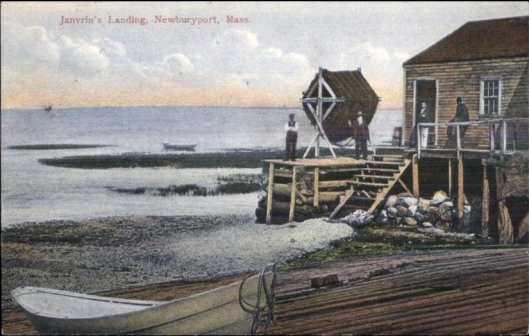
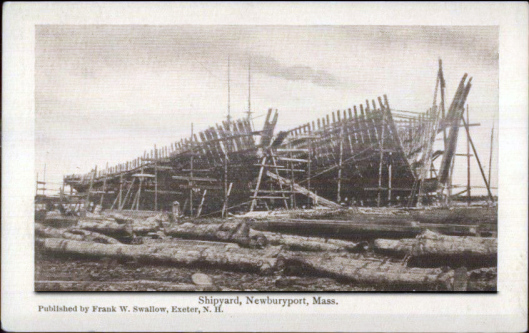
Below are a selection of Lovecraft-era postcards from the shoreline at Newburyport, Lovecraft’s base model for the town of Innsmouth in “The Shadow over Innsmouth”.

Mostly toward Joppa and Plum Island, the stretch of shortline that runs about a half-mile to a mile south-east of the main town, along the Merrimack River waterfront.

“Newburyport is one of the most hauntingly quaint towns in America [… it has a] spectral hush & semidesertion […] In Haverhill, 8 miles up the Merrimac [River], they call it ‘The City of the Living Dead’ [Among its other features, he noted] the unpaved sidewalks on pre-Revolutionary streets with rotting, half-deserted houses south of the Square. When I first saw Newburyport I mistook the central square for a mere neighbourhood shopping centre, & kept on the car (it was a trolley-car then) in the expectation of reaching some real ‘downtown’. Only when the line ended — at the ‘Joppa’ fishing hamlet — did I realise that the half-deserted square I had passed through was actually ‘downtown’!” — H.P. Lovecraft, Selected Letters IV, pages 259-260.

Lovecraft apparently got off at the end of the line, presumably toward the islands end of the Joppa stretch, and walked back to town. If he had followed the line further he would have found the route hooking around east and over to the islands resort area, such as it was, which was more to the east of the town as the crow flies. He probably didn’t step out to the Plum Island section except on postcards, or perhaps on another trip or from the train or bus. Though he did accidentally go to “the end of the line” on the tram on his first visit, that being out on the edge of Plum Island. He then walked back into town.

Also, the old railway track…

“Then I thought of the abandoned railway to Rowley, whose solid line of ballasted, weed-grown earth still stretched off to the northwest from the crumbling station on the edge of the river-gorge.” — “The Shadow over Innsmouth”.

For further details on Newburyport and Lovecraft, see Chapter 3 of David Goudsward’s book H. P. Lovecraft in the Merrimack Valley (2013). Also the book Legends and Lore of the North Shore.

Want more postcards and a map? See my earlier Old Newburyport post of 2014, which also has couple more pictures of Joppa.

Call of Cthulhu game released

I’m not taking much notice of videogames here, but the new Call of Cthulhu, released today, is so big it merits an exception to the rule.

The first reviews are out, for the major new videogame Call of Cthulhu (Cyanide Studios, 2018), which makes a serious attempt attempts to embody and package Chaosium’s Cthulhu table-top RPG game into a single-player narrative-driven mystery-horror videogame.

Big ambitious games such as this are best played on the PC desktop about 18 months after release, when multiple bug-fixing patches and mods have fixed their inevitable release-day problems. At that point there are often DLC expansion chapters to be had, and the overall price is cheaper.

But, on initial release today, the fan-boy and magazine reviewer sentiment seems to be broadly favourable. Though many of the (often spoiler-packed) reviews chafe at the usual Big Game gremlins…

* Unconvincing and stiff character animations, on characters that have to be low-poly so they can run on consoles.

* Characters are generic, and sometimes tell you about stuff that hasn’t yet happened in the game.

* Decent voice-acting, but some East Coast Americans may notice inconsistent dialogue accents.

* The stealth mechanics could benefit from a buff up.

* Some tiresome ‘key collecting’, a couple of annoyingly obtuse puzzles.

* Lacks ‘action’, for gamers who expect machine-guns and monsters every 30 seconds.

* The muted and gloomy colour palette and environments of the New England coast (Darkwater Island in 1924, standing in for Innsmouth) also spur some gripes, from those who might have preferred a more vividly-hued game.

But gamers are used to such things, and for a big RPG none of the gripes are really specific to this title. Generally the game looks like it’s made a fairly good landing on its first day, and is getting healthy amounts of praise. If the PC Windows version can be modded, and/or gets heavily patched (Cyanide Studios are good on that, I hear), infrequent game-players may well find that it’s worth a look this time next year. It’s probably likely to be more impressive to those who only play three games a year, than to the jaded seen-it-all-before types who play three games a week.

A new Cthulhu artbook

A new illustrated artbook edition of “The Call of Cthulhu”, in French translation.

This one is, according to one translated review…

a fully illustrated edition of grand paintings by French artist François Baranger, concept illustrator of movies such as Harry Potter, Beauty and the Beast, and videogames like Heavy Rain and Beyond: Two Souls. […] Instead of blood, sharp fangs, mutilated bodies and other things we associate with terror today, Baranger emphasizes the suppressed, hidden horror that Lovecraft slowly escalates in such a masterly manner. It is not entirely unreasonable to claim that Lovecraft would give his ‘thumbs up’. […] The bound book is of a monstrous size (20 x 28 inches) [and] the quality of the edition is high for its price, with thick, shiny pages and a hard cover that should survive many readings.

Some of the illustrations are also available as movie-like print posters in limited editions of 120. I’m not sure if there are other painted illustrations and/or b&w pen-and-line illustrations inserted in the text, but “fully illustrated” implies that there might be.

The Encyclopaedia of H. P. Lovecraft as Character

Do we have enough “Lovecraft as character” appearances to do The Encyclopaedia of H. P. Lovecraft as Character, focussed only on the appearance of H.P. Lovecraft and his close circle as characters in stories, graphic novels, rock songs, games and more? I think we do. By now there must be at least a hundred such depictions of Lovecraft himself.

For instance, my recent Good Old Mac biographical book on Everett McNeil, the keystone Lovecraft Circle member, found ten such instances of him alone. And I haven’t even read the various books which treat the Lovecraft circle to a detective novel outing (such as the recent novel by Joshi), in which he likely also appears as a character. Nor the various table-top RPGs. McNeil had another depiction in one of the new graphic novels of Lovecraft’s life, He Who Wrote in the Darkness, and I would suspect he may also appears in the other new graphic novel Some Notes on a Nonentity: The Life of H. P. Lovecraft (though I haven’t yet seen that). That’s just one often-overlooked member of the Circle, and yet there’s already material enough for an Encyclopaedia chapter.

It might be organised by date and by cultural milieu:

Lovecraft as ‘living character’; pre-1937.
The War Years: 1938-1949.
The Depths of the Cold War: 1950-1964.
The Counter-culture: 1965-1975.
The De-censorship Decades: 1976-1996.
Gone Global: 1997-2007.
Haunting the New Puritans: 2008-2018.
Lovecraft’s Circle as Characters.

Due to the estimated cost of making it I won’t be the one to do such an Encyclopaedia, but if the idea tickles both your fancy and wallet then please feel free to give it a go. Bear in mind that acquiring all the works needed to comprehensively make such a book will require either a vast collection and/or a very plump wallet.

Inktober 2018

Tags

Each October, inkers all over the world do a ‘drawing a day’ challenge which goes under the title Inktober, and post with a (this year) #INKTOBER2018 tag.

Here are a few Lovecraft ‘Inktober 2018’ drawings that caught my eye on DeviantArt.

By Lipatov

By trapperkeeper, really capturing that old-time pulp feeling, with the help of some ‘Kirby krackle’…

Guarded by CAdamsIllustration

Migo by Persephoneblackdove

There’s still time to do the last few challenges, Double | Jolt | Slice, which all offer possibilities for pulpy Lovecraft fun.

If you’re new to digital drawing, on a desktop have a look at the free open source Krita 4, its Inking 101 starter guide and Wolthera’s free Inking Brush pack for Krita 4. The brushes in Krita can have real-time smoothing applied, so as to smooth the freehand strokes made by shaky hands. It helps to have a ‘draw on the screen’ pen monitor, which are expensive but Ugee makes good budget models (I have a £300 1910B). As an alternative you can probably pick up a used large Wacom digitizer pad for about £50, but make sure the pen is still with it and fully working.

There are of course many Android drawing apps for tablets, the best of which used to be Autodesk Sketchbook. That’s no longer on the Amazon Kindle App Store, so (unless you want to do a fiddly sideload of it) the translated Japanese app called Tayasui Sketches + is a good alternative choice for inking on a Kindle HD 10″ tablet.

‘The Decline of the West’ on Kindle

I see that S. T. Joshi’s H. P. Lovecraft: The Decline of the West was made available as a Kindle ebook since the end of summer 2018, and now sports a very reasonable pocket-money price.

It’s the fullest account of ‘Lovecraft the philosopher’ and his wide range of influences in that field. Also the influence on him of what might be called ‘the phantasm of decline’ — that strangely popular but nebulous apparition that haunts gloomy intellectuals, and which leads them to believe that civilisational collapse is forever just around the corner. (As a corrective, see heavyweight books such as: Ridley’s The Rational Optimist; Paul Johnson’s Intellectuals; Herman’s The Idea of Decline in Western History, and my ongoing 2020 blog). Perhaps also Staring Into Chaos: Explorations in the Decline of Western Civilization; and The Perennial Apocalypse: How the End of the World Shapes History.

Joshi writes clearly and precisely as usual, and the book is usefully untainted by airy academic genuflections toward the latest idols of literary-political theory. The Decline of the West was previously available as an oversize paperback, which has a two-column layout — which some may prefer for the task of ploughing through dense philosophical triangulations. On the other hand, the ebook is keyword-searchable, which means that Lovecraft scholars may want to own both editions — though you may chuckle at such a heavyweight ebook having a toy-like ‘stop-motion Cthulhu’ on the front cover. Such are the demands of trigger-finger ebook marketing today, I suppose — ‘no monster, no sales’.

Purchasers will also want to have on their Kindle the texts available from my 2014 blog post Lovecraft as Philosopher, these being a sniffy review of Decline of the West and Joshi’s magisterial demolition of the review.

More Moe

S. T. Joshi’s latest blog post reveals that the new Lovecraft Annual #12 has reached him, together with latest door-stopper volume of Lovecraft’s annotated letters. Joshi reveals that Letters to Maurice W. Moe and Others has more than letters in it. It…

“contains numerous writings by Moe, Dwyer, and Loveman, and a letter by Starrett to Sam Loveman.”

Beyond the simple problem of wrangling a 628-page print volume thought a tiny modern letterbox by the regular postal service, I do wish that more of these Letters volumes were available as ebooks for the Kindle. Whence they would become keyword searchable, and one could make the font bigger and more readable etc. But only the Morton letters were briefly available that way, and even that volume has recently vanished from the Kindle store at both Amazon UK and USA. Thankfully the Morton ebook, purchased in 2017, is still on my Kindle.

Falling Felines

Falling Felines Research: the history book, successfully crowd-funding now.

If you can’t wait for the book, the author has a long blog post on the topic of lab research on falling cats.

It turns out that that aerodynamics, molecular physics, mathematics, mechanical control systems, and other branches of science and engineering were all strongly informed by the study of tumbling kitties which (of course) always landed on their feet. Perhaps Lovecraft was right (again), when he said that inherent in the very form of the cat lay cosmic secrets, a potent symbolisation of the universe, and that this was “just as true kinetically as statically”.

A quick search of Google Scholar and JURN shows that such research is still ongoing, and that the same science may yet inform the design of human-interacting robots, autonomous drones, space-elevator nano-ribbons, and many other sqwerky uses as yet undreamed. Robo-tentacles, perhaps.