Currently on eBay (not from me), a very pleasing small Arkham Studios Lovecraft statuette, although with the hand-held hat broken off.



02 Saturday Feb 2019
Posted in Lovecraftian arts
Currently on eBay (not from me), a very pleasing small Arkham Studios Lovecraft statuette, although with the hand-held hat broken off.
01 Friday Feb 2019
Posted in Unnamable
Jean-Paul Laurens, “A Funeral” from c. mid-1870s-early 1880s. Laurens had a macabre streak and was known as “the painter of the dead”, though his online representation today suggests colour paintings rather than shadowy etchings similar to this one. This is my 3,800-pixel rip of a picture now in the public domain under CC0, but which was also locked inside a ‘zoomify’ viewing system. So feel free to use it as a book cover or as the basis of a new paint-over using Photoshop or Krita etc.

01 Friday Feb 2019
Posted in Picture postals

Following last Friday’s Rhode Island ‘letter carrier’ postcard, this week… the Post Office itself. I don’t know that there was any sub-Post Office up on College Hill, and I’ve never heard tell of one. So I presume that Lovecraft would have been familiar with strolling down the hill to his city’s new main Post Office, after it opened circa 1908. It was replaced in 1940.
On opening, circa 1908:


Seen below about ten years later, settling in to its surroundings and greening up, though now overshadowed by new commercial buildings that have sprung up…


The interior obviously had an interestingly curvy and almost ‘gloopy’ feel to it, which offset the uprights:


I can find no explicit mention by Lovecraft of using the Providence Post Office, in the searchable material I have access to. Those were the days of strong postal censorship, and letters might be opened. So presumably it was best not to mention the building, if his local postal service was working as intended? Yet the wider postal service and its constant use loomed large in his professional and amateur life, as well as for his general correspondence. He does describe the Washington Post Office, though, and in terms that would seem to echo the building in Providence…
Now came stamps — bought at a post office next the station where a grandly cloistral air animated an interior of vast size and drowsily ornate dimness.
31 Thursday Jan 2019
Posted in Housekeeping, Odd scratchings
Well, another month has nearly gone on Tentaclii. Snow and crisp ice powders the ground below Tentaclii Towers, and the sky across the valley is an icy blue. But thankfully my typing fingers are warm, and in January 2019 the blog had 7,000 words of daily blog posts + many pictures.
Including: my new discovery of details and pictures for Lovecraft’s encounter with a bas-relief maker in Salem prior to “The Call of Cthulhu”; details of where one might (perhaps) find a published Wortman cartoon showing a good portrait of Kirk (of the Lovecraft circle) & his Chelsea Book Shop; a new pictorial survey of the Rhode Island School of Design including my newly-found picture of the Greek and Roman sculpture gallery interior as Lovecraft knew it in his boyhood; many notes and links for new books and scholarly essays and papers; details of a new free high-quality graphic novel of Lovecraft’s life; and several links to relevant online archive and in one case free audiobooks. Free research tools for independent scholars were also noted, with Paperwork being open source software for searching inside your PDF collection, and my JURN open access search-engine has returned to its former URL. There were also posts and links relating to the comics artist Moebius, to R.E. Howard, and one for Poe as a character in fiction.

If you can support Tentaclii on Patreon, please, then that would be very welcome and encouraging. The end of January saw new Patrons emerge from Norway and France, and so I now have 8 patrons giving $52 a month. All appear to be Tentaclii readers, as my hopes appear to have been unfounded that patrons might also be found among the readers of Digital Art Live magazine or users of JURN. Despite the quality of those two projects.
If you can spare just $1 a month via Patreon, please, it would be very welcome. Or you can just promote Tentaclii to your forums and groups, or do the same for one of my books. Many thanks!
31 Thursday Jan 2019
Posted in Odd scratchings, Scholarly works
I’m pleased to see Terres Lovecraftiennes, a new Facebook Group dedicated to Lovecraft’s life and times. It’s on-topic, well illustrated and moderated. All readers of Tentaclii will want to join this Group. Facebook auto-translates the Group for me, and it’s readable in English.

31 Thursday Jan 2019
Posted in Lovecraftian arts
A few Lovecraft items I noted being posted this month on DeviantArt, just in case you were looking for an active Lovecraftian illustrator.

Clothes Maketh Man by Sinkevic

Uthar kittees + Lovecraft monster mash-ups may be trending…

Azafloof (Azathoth-kittee) by ProdigyDuck

31 Thursday Jan 2019
Posted in Odd scratchings
On Archive.org to borrow, The man who called himself Poe (1969). Stories and poems with Poe as a character.


Also on Amazon, used. It appears never to have made it to a paperback, or become one of the Gollancz yellow-jacket budget ebook reprints of recent years.
30 Wednesday Jan 2019
Posted in Historical context, New books, Odd scratchings, REH, Scholarly works
Those interested in the sweeping intellectual and emotional influence of Spengler on the 1920s and 30s might be interested in a new long review of the out-of-print book The Perennial Apocalypse: How the End of the World Shapes History (1998). Spengler’s ideas and their popular interpretations touched enduring writers such as H.P. Lovecraft and R.E. Howard. In science-fiction, Asimov’s ideas about psychohistory also spring to mind. Thus this new review seems relevant to mention here. The review states that the book looked at…
Spengler alongside a long tradition of historical models that all pointed towards an “end of history.” These summaries of historical narrative modes are the best parts of the book. The project of The Perennial Apocalypse is more ambitious than to provide summaries, though. […] The central argument of The Perennial Apocalypse is that prevailing historical models of how history should go, must inevitably go, play their part in shaping events. But history almost never proceeds in the predicted fashion as a result.
A fascinating idea, re: how intellectual doom-mongering and an associated wrong-headed consensus among the gullible classes and journalists, might act as bumpers on the fast-moving pinball-table of emerging historical events. It’s something I discuss from time to time, over on my 2020 blog, and there are other books on it such as Herman’s The Idea of Decline in Western History.
Yet, while the reviewer finds in the book an interesting and well-written discussion of the structural commonalities of such predictions, he also finds few examples of their strong influence on the flow of history…
Reilly never managed to give many thorough examples of this kind of process at work. The Perennial Apocalypse ends up dwelling far more on the stuff of the great totalizing narratives of history than how they manifest in intellectual spheres and end up steering society.
Too many variables in the mix, perhaps, which in a way is kind of encouraging. Since it might lead to the supposition that no matter how much the cultural elites try to ‘put bumpers on the pinball table of history’ or tilt the table to ‘correct’ it by pounding on it with their fist, they can’t ultimately beat the inbuilt structural elements of the table. Elements which inexorably channel the probabilities of the ball’s direction across an implacable and unreachable table-base. The pinball always ends up in the hole at the bottom of the table.
The book is said to be discursive and goes beyond its main thesis, to detour into…
obscure 19th century millenarian scientific romances, H.P. Lovecraft, theosophy, Christian eschatology, and the evils of the worlds envisioned by Arthur C. Clarke.
It sounds fascinating. The original promotional blurb ran…
In every culture, history is a story, and the end of that story is the end of the world. This work describes the surprising similarities among the various forms that the ‘end of history’ has taken around the world and throughout time. Further, it explores how the image of the end has affected actual historical events, from the rise of millenarian cults to the evolution of the idea of progress.
Regrettably the book now appears to be totally unavailable, unless one pops up on eBay or Abe. There’s not even an Amazon listing for it on either Amazon UK or USA. Although the table of contents is still available along with a free bit of Chapter 2. A good example, I’d suggest, of how certain early self-published POD books are likely to become the real collectable ultra-rarities for the mid 21st century book collector.
30 Wednesday Jan 2019
Posted in New books, Odd scratchings, REH
The new Marvel comics Conan reboot opens with a defenceless Conan adrift at sea, before he goes “stumbling” into Stygia. Sounds like a rather mundane way to start, Marvel. I don’t read Conan for an approach which goes…
Hither wandered Conan the Cimmerian, black-haired, depressed, no sword, bedraggled and stumbling, to hobble over the weary dust of Stygia with his blistered feet.
The new Marvel approach is to be enlivened by “romance and comedy”, apparently. Oh dear… it doesn’t sound good. But I’m probably not their intended audience, these days.
What would R.E. Howard have done, to make the big ‘splash’ opening just a touch more gripping and forceful? Mark Kirby posted a fine guide to that, a week ago…
Robert E. Howard did not leave us much in the way of personal writing advice. The few direct comments we have by him on the topic are gleaned from his letters, or revealed by Novalyne Price Ellis in her biography … There are eight primary elements most often used by Robert E. Howard in opening narratives.
A Brief REH-Inspired Guide to Writing Great Story Openings (Part One)
A Brief REH Inspired Guide to Writing Great Story Openings (Part Two)
He also usefully points to the currently-active main forum for Howard discussion.
30 Wednesday Jan 2019
Posted in Scholarly works
* M. L. Varnieri, “Medos aquaticos: uma poetica do horror liquido em H. P. Lovecraft”, Tessera, Vol. 1 No. 1, 2018. (Water as a symbolic story element in Lovecraft’s evocation of atmosphere. The journal appears to be a new Brazilian title on imaginative literature, with the first issue themed: “An Imaginary Dossier: Forerunners, Founders and Disciples”).
* M. Simicevic, Lovecraftian Horrors: Space and Literature in Silent Hill (2018). (Possibly a Masters dissertation, for the University of Zadar in Hungary. In good English, the author discusses spatiality and the elements of space in selected Silent Hill videogames, and identifies similarities with the texts of H. P. Lovecraft).
29 Tuesday Jan 2019
Now available from the Italian Amazon site, the Italian travel guidebook for Lovecraft, I Luoghi di Lovecraft: novissima guida ad uso del viaggiatore. In English translation it’s something like, “The Places of Lovecraft, a new guide for the use of travelers”. Published by the Imaginary Travel Ltd and written by Michele Mingrone, Caterina Scardillo and Sara Vettori.
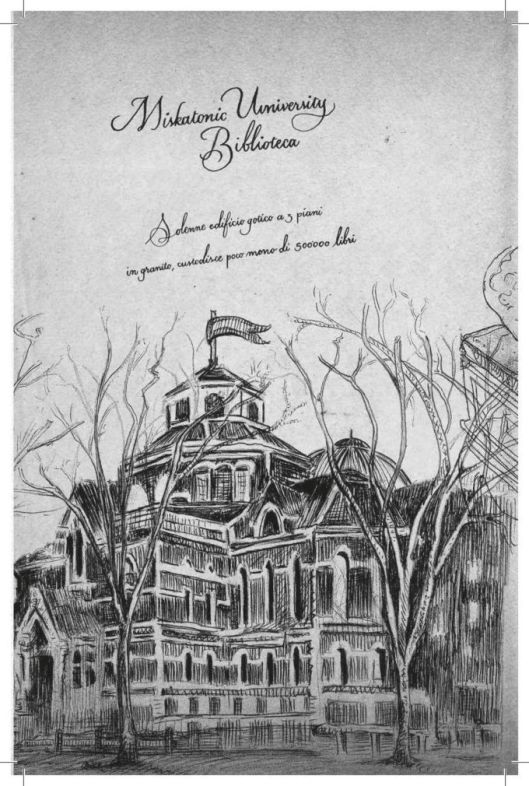

Apparently written to the Lonely Planet series style-guide, although the book is not one of their titles. Which means one gets things like history and shops, monuments to see, hotels, transport, and so on. It even ventures out of New England and has sections on Antarctica, the Nameless City, and even the Dreamlands.
28 Monday Jan 2019
Posted in Lovecraftian arts
A blog new to me, Moebius Odyssey – A space to meditate on the art of Moebius. On Moebius and his legacy. Includes French style 1970s/80s arty erotica, so it’s ‘not safe for work or school’.
