New book: Phantom Islands

Due in spring 2019, Phantom Islands in 180 pages…

“Phantom Islands tells the story of 30 such islands. Beginning with the alleged discovery of each, Dirk Liesemer recreates their fabled landscapes, the voyages attempted to verify their existence and, ultimately, the moments when that existence was at last disproved. Spanning oceans and centuries, these curious tales are a chronicle of the human lust for discovery and wealth. Beautifully illustrated with coloured maps and charts, Phantom Islands shows the cunning of imposters and frauds, the earnestness of explorers searching for knowledge, and the pleasure that can be found in our willingness to deceive and to be deceived.”

Cirsova Magazine #1

I’m pleased to hear about what amounts to a new pulp magazine, published today. The Cirsova Magazine of Thrilling Adventure and Daring Suspense, Issue #1 / Spring 2019, apparently takes an old-school approach to pulp. Or perhaps we should now call it the New Pulp. The story descriptions certainly sound alluring…

Young Tarzan and the Mysterious She, by Edgar Rice Burroughs and Michael Tierney. Based on a fragment from 1930, this previously “Lost” Tarzan adventure takes place in the Jungle Tales period.

Atop the Cleft of Ral-Gri, by Jeff Stoner – The Nazis’ never-ending quest for powerful and sorcerous relics to aid the Father-land’s conquests brings the SS to the mountains of Tibet, where a deadly and mysterious weapon is rumored to lay dormant and waiting for a new master!

The Idol in the Sewer, by Kenneth R. Gower – A reverse of fortune sends Kral Mazan fleeing through the labyrinthine sewers of Vasaros empty-handed from his audacious heist! His life may be forfeit to the rat-men who lurk in the tunnels—unless he accepts a job to retrieve their idol for them!

Born to Storm the Citadel of Mettathok, by D. M. Ritzlin – For aeons, Verrockiel the Warlord has struggled vainly to seize the stronghold of Mettathok! With infinite time and resources at Verrockiel’s disposal, what of those fated to claw, tooth and nail, inch-by-inch, progress towards their master’s goals?!

The Book Hunter’s Apprentice, by Barbara Doran – An ancient and powerfully magic book has laid a curse of death upon a sage who had spitefully defiled it! Can Zhi, a book hunter, and Qing, her apprentice with the power to “fall” into nearby closets, retrieve the volume from a haunted manse?!

How Thaddeus Quimby the Third and I Almost Took Over the World, by Gary K. Shepherd – A strange object has fallen from the sky and into the hands of one Thaddeus Quimby III! The alien artifact creates life-like facsimiles of anything imaginable, so it’s only a matter of time before everyone’s wildest dreams may be fulfilled, right?!

Deemed Unsuitable, by W. L. Emery – A beautiful young woman is at the center of a high-speed chase and shoot-out right where Morgan, a crack-shot Construct, was about to grab some lunch! Against his better judgement, Morgan enters the fray, but who is after this woman and why?!

Warrior Soul, by J. Manfred Weichsel – A strange man with a mysterious camera claims that he can capture the truth and inner beauty of a subject’s soul! Lured in by the photographer and his entrancing prints, a pair of young women find themselves imprisoned and in dire peril!

Seeds of the Dreaming Tree, by Harold R. Thompson – Its fruit are the subject of myth and legend—some hope to exploit it for knowledge and medicinal purpose while others are prepared to kill to keep its secrets! Can the bookish adventurer Anchor Brown survive the trials of the Dreaming Tree?!

The Valley of Terzol, by Jim Breyfogle – Kat and Mangos have been hired to accompany the adventurer Andorholm Wallenoop to the ruins of Terzol in search of an ancient lost delivery! A thousand-year-old receipt offers a clue to fabulous reward or certain death in the Valley of Terzol!

The Elephant Idol, by Xavier Lastra – The blind thief Auger sneaks into the opera house to steal a trinket that the lovely Trannen von Fitzburg received from a lovestruck foreigner! The gift-box’s riddle and its giver’s suicide engulf Augur — and the opera house — in a world of darkness!

Moonshot, by Michael Wiesenberg – The Government wants to put a barn on the Moon — why?! To prove that the United States is capable of landing a barn on the Moon, of course! But the question is, whose barn are they going to send and can they send it to the moon on budget?!

Friday picture postals from Lovecraft: un-tarred Brattleboro back-road to the mountain

“The kinship and hospitality of the Main Street [of Brattleboro] spread over us, and encourage us to climb higher into the charmed sea of westerly greenness to which these atavistic bricks form pylon and peristyle. The wild hills are before us […] Narrow, half-hidden roads bore their way through solid, luxuriant masses of forest, among whose primal trees whole armies of elemental spirits lurk.” — H.P. Lovecraft, “Vermont: A First Impression” (September 1927).

Lovecraft’s friend and fellow amateur pressman Arthur H. Goodenough lived near Brattleboro, hence Lovecraft came to know the place quite well on several visits. He also visited with Vrest Orton, also near Brattleboro.

The local history Brattleboro Words project also has…

“I’ve never seen no country niftier than the wild hills west of Brattleboro,” Lovecraft wrote to a friend. “The nearness and intimacy of the little domed hills become almost breathtaking. Their steepness and abruptness hold nothing in common with the hum-drum standardized world we know, and we cannot help feeling that our outlines have some strange and almost forgotten meaning.”

The full quote, uncensored by political correctness, is as follows. Lovecraft starts off in contemporary slang…

“I never seen no country niftier than the wild hills west of Brattleboro, where this guy hangs out. Brat itself is the diploduccus’ gold molar, with its works of pristine Yankee survival, but once you climb the slopes toward the setting sun you’re in another and an elder world. All allegiance to modern and decadent things is cast off — all memory of such degenerate excrescences as steel and steam, tar and concrete roads, and the vulgar civilization that bred them —”

The nearness and intimacy of the little domed hills become almost breath-taking — their steepness and abruptness hold nothing in common with the humdrum, standardized world we know, and we cannot help feeling that their outlines have some strange and almost-forgotten meaning, like vast hieroglyphs left by a rumoured titan race whose glories live on in rare, deep dreams.”

Some notes on Hugh B. Cave’s “Magazines I Remember”

Some notes made on reading Hugh B. Cave’s book Magazines I Remember: Some Pulps, Their Editors, And What it Was Like to Write For Them, newly on Archive.org and which I linked to yesterday in the post The Cave of Pulps.

* Cave lived in Pawtucket (a long trolley/tram ride from Providence), and sometimes took an apartment in Boston. While he briefly corresponded professionally with Lovecraft in the early 1930s, and Cave had at least two fulsome replies from the master, they never met or even telephoned.

* Newspapers then reprinted pulp stories. Also, Farnsworth Wright nearly interested radio in ‘putting Weird Tales on the air’, to the extent of casting the male lead for a radio adaptation of a Cave story — yet he obviously never succeeded.

* There was an informal blacklist among pulp editors of young authors known to have plagiarised the stories of others and who tried to sell the result.

* Farnsworth Wright marked unpublished manuscripts with red ink dots in the margin, in the process of assessing them, thus making them difficult to send to other editors who knew Farnsworth’s ‘ways’ and could thus spot a ‘Weird Tales reject’. This fact suggests that if a Lovecraft manuscript was rejected by Weird Tales, then he would likely have to retype it — which he hated doing.

* The “summer is a dead time in the pulps”, said of story acceptances in the early 1930s.

* Even when a pulp writer was obviously ‘working at it’ like dog, the early 1930s were a real roller-coaster for the finances of a pulp author. It seems that one could sell quite regularly, sell overseas rights, newspaper rights, and even movie options (to RKO in this instance), as well as selling to the ‘slicks’, and still find oneself living in dire poverty for long periods as magazine failed to pay or went bankrupt. I’d already known something of this re: Lovecraft and R.E. Howard, but it was interesting to see another pulp writer’s detailed perspective on the pulp market in the period.

* The ‘spicy’ pulps could be found on open sale on news-stands in Pawtucket, Rhode Island, in 1934. They were a new development in the market at that time and were rumoured among writers to be ‘under the counter’ yet Cave found it otherwise even in Pawtucket. In Cave’s professional opinion they were no more than regular pulps stories with some hackneyed sex inserted here and there.

* It seems that, to save money, writers often did not buy pulps regularly. With perhaps the exception of Weird Tales. They would only purchase if they were being published in an issue, and then they might buy a number of copies. The British reprint and anthology market would accept magazine pages instead of a typed manuscript.

* In the early 30s Cave held J. D. Newsom in very high regard for his slick funny adventure stories of the French Foreign Legion. A quick look for the name finds there’s a blog review and Pulpdom #46 (June 2006) had the article “The Men Who Made the Argosy: J. D. Newsom”.

* In the 1970s Jacobi thought that much of August Derleth’s ‘juvenile’ work (i.e. what would today be called ‘young adult’) was his strong point as a writer and that many were ‘masterpieces’. Judging by a quick search, the $7 essay collection Return to Derleth (Vol 1) has what might be the best survey of these, with one review stating that an essay by… “Marion Fuller Archer tackles the juvenile novels with rare understanding of their impact on Derleth’s own life.” Jacobi also expresses his puzzlement at the growing ‘Lovecraft cult’ of the 1970s.

The Cave of Pulps

New and free on Archive.org…

Hugh B. Cave, Magazines I Remember: Some Pulps, Their Editors, And What it Was Like to Write For Them, 1994. A 185 page book, with story-header illustrations from the pulps. Amazon and used book sellers will happily ding! your wallet for between £15 – £172 for this, in paper.

Hugh Barnett Cave (1910-2004) was a prolific pulp writer and a lifelong correspondent of Carl Jacobi. The book looks like an excellent mine of information, and the first five chapters appear to be extracts from the on-the-spot letters from one immersed in the pulp market — rather than a hazy attempt to recall matters from a distance of more than 50 years.

Definitely a book to cue up for proper reading on my Amazon Fire tablet! Sadly, I see that the PDF version has mangled the pictures, though.

Actually, this problem has usefully made me aware that Archive.org is now also offering a “COMIC BOOK ZIP” format for some types of content, which I had never noticed or tried before. This turns out to actually be the .CBZ format which can be read in any comic-book reading software. Superb quality, if 95Mb. So please forget my advice from a few days ago, about doing a manual conversion of the Archive.org .JP2s to .CBZ format. Archive.org now does it for you, if only on some types of content.

This means that you can drag-and-drop a link on a private Trello board for the relevant Archive.org page, to send a live clickable Web link from desktop to tablet. Then you can download the .CBZ directly from the tablet, rather than wrestle with a wi-fi or cable file-transfer. A simple Trello board saves having to use a mega-corp cloud service that wants to slurp up your entire bookmarks and every site URL you visit, just to send the occasional clickable URL from your desktop Web browser over to your Kindle or iPad tablet. Also works fine with YouTube videos. It’s a home-brew solution to the surprisingly difficult problem of sending a live clickable Web link from desktop to tablet, but it’s quick and it works.

On the Kindle, ComittoNxN (Comic Viewer) (paid) and Comic Time Reader (wholly free, ad-free, but needs to be sideloaded on a Kindle) are the best reader apps for free comics, in my experience, untethered from the locked-down offerings at Comixology and Marvel and similar services.

New book: Collected Essays on H.P. Lovecraft and Others

Douglas A. Anderson’s A Shiver in the Archives post made me aware of George “Wetzel’s Collected Essays on H.P. Lovecraft and Others, e-book 2015″. I missed this when it became available in October 2015. It’s a 116-page ebook with eight essays. A bit expensive for me, at present, at £3.68. But it’s definitely gone onto my ever-lengthening ‘to get’ Wish List of Lovecraft Scholarship…


CONTENTS:

“Biographic Notes on Lovecraft” (from HPL, 1971)

“The Mechanistic Supernatural of Lovecraft” (from Fresco, 1958)

“The Cthulhu Mythos: A Study” (from HPL: Memoirs, Critiques and Bibliographies, 1971)

“A Lovecraft Profile” (from Nyctalops #8, April 1973)

“The Pseudonymous Lovecraft” (from The Lovecraft Scholar, 1983)

“Lovecraft’s Literary Executor” (from The Lovecraft Scholar, 1983)

“Copyright Problems of the Lovecraft Literary Estate (from The Lovecraft Scholar, 1983)

“A Memoir of Jack Grill” (from Huitloxopetl, 1972)

“Letters of George Wetzel” (from Fan-Fare, 1951-1953)

Lovecraft’s Journal

Todd Theyer is gearing up to Kickstart a printed Lovecraftian bundle of his own letter-pressed goodness, to be named “Lovecraft’s Journal”. It will evoke and hint at the progress of a scientific expedition to the maddening wilds of Siberia, via a field journal complete with maps, field drawings, newspapers cuttings and suchlike story-props. The project is planning its launch to align with the timing of NeconomiCon 2019, but you can follow the previews on Instagram.

The Grill collection and the location of the Binkin bookshop

Douglas A. Anderson’s A Shiver in the Archives has a good new article on The H.P. Lovecraft Collection of Jack Grill and (later) Irving Binkin.

According to Wetzel, Grill “collected HPL photos, letters written to and by HPL; he interviewed HPL acquaintances, visited many of the Middle Atlantic and New England towns to which HPL had made antiquarian tours, and accumulated many other odds and ends of Lovecraftiana.” An odd, shy man, Grill wished he was “a writing fellow,” but his only writings were letters — in an execrable hand-writing, without paragraphs and mostly without dates.

The collections was purchased by Binkin in New York…

Having seen the photographs [of Lovecraft in the collection], Binkin realized that Lovecraft had been a regular customer at his bookstore, just off Red Hook in Brooklyn, over forty years earlier.

Wetzel, in his memoir of Grill, quotes a letter from Grill (circa June 1957) stating he’d acquired unpublished stories by Hazel Heald, “The Basement Room” (5 pages) and “Lair of the Fungus Death” (25 pages), from Heald herself.

Given the clunky titles, I’d expect that the Heald stories were not ones revised by Lovecraft.

But the Binkin bookshop is an interesting new point of street-level data about Lovecraft’s time in New York City in the 1920s. One wonders if an address can be pinned on it and a photo found?

54 Willoughby Street (1961 —)

A Directory of the early 1980s lists “Binkin’s Book Center, 54 Willoughby Street, Brooklyn”. The address is off Fulton St. and certainly fits the description of “just off Red Hook in Brooklyn”. A Bargain Hunter Guide of 1990 noted that “Binkin’s is the oldest bookstore [in the city]”. There is however a problem in assuming that this was always his location. For the Antiquarian Bookman for 1961 has…

“IRVING BINKIN. NEW LOCATION — ENTIRE BUILDING – FIVE FLOORS OF BOOKS. BINKIN’S. BOOK. CENTER. 54 Willoughby St., Brooklyn”

Thus it appears he only moved there circa 1961. Where Wally Dobelis remembered him in the 1960s…

Irving Binkin, in the back of Brooklyn Heights and the courthouse, on Willoughby Street, had a four-story building, the ground floor of which was devoted to making a living. Irving’s heart was really in ballroom dancing, of which he was a champion. He liked to go to Hispanic dances, and had a small Spanish book stock for his dance partners. Upstairs, he held residues of good Brooklyn estates, unpriced and unevaluated, books, paintings and ephemera. After much negotiating, Irving had decided that we were trustworthy and would not stuff our pockets, and could be permitted to make selections and bring them down for pricing. Irving was not knowledgeable, but prided himself on being able to divine, from our body language, things about the value of our selections. It did work out, since he asked for our scholarship, and we were not out to steal high value items for pennies. It was fun. I found some Elihu Vedder lithographs…

Hunting this erroneous location, however, did lead me to two evocative photos from the fringes of Red Hook…
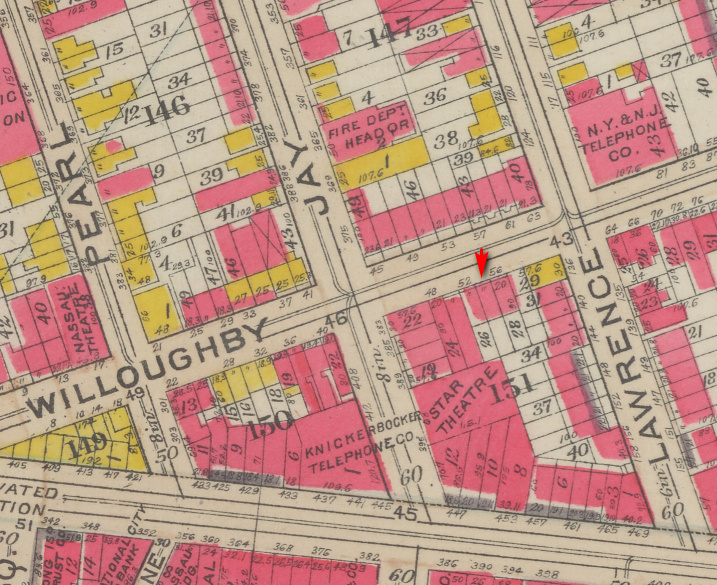
This eBay picture is from 1927, looking east along Willoughby with No. 54 ahead in the near middle-distance on the right of the street…

The sign on the far right states “Baked Beans”, a Lovecraft staple. He refers in his letters to “Red Hook’s modestly priced bean-bureaus”. A 1928 photo of Jay and Willoughby shows the same distinctive building on the corner, and the cafe and its distinctive corner-sign on the other corner…

We know that Lovecraft frequented a cafe on this street…

John’s — the Italian joint around the corner in Willoughby St.

We can also see that this picture is looking down Jay St toward the Star Theatre as seen on the map, and the theatre is advertising Burlesque girlie shows with its signage. This picture and its identification as ‘Jay’ clearly confirms the location of the other 1927 photo and that it just-about shows No. 54 in the middle distance on the right.


162 Pierrepont Street (later 1950s-1961)

However, we must step back further in time to Binkin’s earlier book store. This was on Pierrepont Street, the address given by Book Dealers in North America, 1956. Photographs of this store dated 1958 are on the Brooklyn Historical Society website. Obviously he was getting ready for his move to Willoughby Street, appearing to be a ’25-cents a book’ guy and thus generating a big low-cost stock that he could sell for higher prices at Willoughby Street in a few years’ time…

But again it’s hazardous to assume that this was the same as the store he had since the early 1930s.

We do however know that Lovecraft’s best friend Samuel Loveman knew Binkin. Also in the book trade, Loveman evidently once had a copy of Clark Ashton Smith’s poems Ebony and Crystal (1922). This is currently for sale by L.W. Currey and “a presentation inscription by Samuel Loveman, the book’s dedicatee, to bookseller Irving Binkin is present on the title page.” However, what date this book might have been gifted has to be uncertain. Perhaps the 1930s, when Binkin first set up in the book trade? Or perhaps a friendly gift in the 1970s, on rescuing the Grill collection? We shall probably never know.


252 Fulton Street.

A kind credit in Richard Morris’s scholarly book Reading Finnegans Wake (1959), and a book trade directory entry, shows that he was at 252 Fulton Street before Pierrepont Street…

The Bookshop of Isei Binkin
252 Fulton Street.

Fulton Street is of course a name well known to those who have read up on Lovecraft in New York in the 1920s, and especially his epic pursuit of a new suit at a cheap price. The dedication usefully give us Binkin’s Jewish name, which may help someone to track down where exactly he was selling books in Brooklyn, and thus where he might have been patronised by Lovecraft.

One ad Binkin placed stated that his business was “Established 1932”. So even if the 252 Fulton Street address in Brooklyn is his first such store, that would mean that Lovecraft would not have been a frequent customer there in the 1920s when he was living in New York.

And even here we can’t quite even be sure that this was where Binkin was trading from 1932 to perhaps the mid 1950s when Morris knew him. Until circa 1913 the address appears to have been a cheap and rather notorious flop-house hotel for sailors. Then after the War it appears to have been renovated into apartments and boutique shops. For instance, the American Florist for 1922 has… “S. Mastir, 256 Fulton Street, Brooklyn. We found in addition to his fine stock of cut flowers, an excellent collection of palms and other foliage plants.”

Thus a book store there from 1932 onward seems not unlikely. We know from Frank Belknap Long that the antiquarian shops along Fulton Street were not unknown to Lovecraft… “[Roman coins and] baked-clay Roman lamps, and he [Lovecraft] once helped me pick out magnificent examples of both ‘coinage and lampage’ at an old-coin shop on Fulton Street.” (Dreamer on the Nightside) Although it might be that this was the other Fulton St., to be found across the Brooklyn Bridge.


Of course, it is just possible that Binkin was ’embroidering history’ after he purchased the Grill collection, and was only claiming that he remembered having Lovecraft browsing in his shop back in the 1920s or 30s. Possibly he mis-remembered circa 1970 and another customer conveniently ‘morphed into Lovecraft’ in his memory, when hazily recalled over the distance of more than 40 years. But then there is also the possibility that Belkin had started in the book trade in the mid 1920s as a youthful assistant in someone else’s book store, and it was from that period that he genuinely remembered Lovecraft’s distinctive face.

New Derleth letters found, to be published

S. T. Joshi has a new blog post. Yet another truck-full of Joshi books is announced. Among which…

* “Eccentric, Impractical Devils [is] the whimsical title we have affixed to the collected letters of Clark Ashton Smith and August Derleth. Recently a previously unknown batch of Derleth’s letters to Smith came to light, causing us to refashion the book almost in its totality”.

* Joshi’s own “collected mystery and horror fiction” is now in one volume as The Recurring Doom: Tales of Mystery and Horror. These include his detective stories, but not the ‘Lovecraft as character’ novel The Assaults of Chaos (2013) which seems to be languishing in a limited-edition hardback.

* Also… “a complete edition of the fiction of Arthur Machen. This will appear in a three-volume trade paperback edition from Hippocampus Press very shortly”. One completely new very short story, never before published, and the excised final chapters of The Secret Glory.

Added to Open Lovecraft

Added to Open Lovecraft…

* P. J. Snyder, “Dreadful Reality: Fear And Madness In The Fiction Of H. P. Lovecraft” (2017) (Undergradate dissertation. Had a ‘Honors College Award: Excellence in Research’)

Also, though not on-topic enough to be on the Open Lovecraft page, this 2012 thesis may interest some…

* S. J. Berry, Seeking God by strange ways : cults and societies in fin de siecle literature (2012, PhD thesis).