Protected: Cosmology and Harmony from the 1980s
15 Monday Jul 2019
Posted in Scholarly works
≈ Enter your password to view comments.

15 Monday Jul 2019
Posted in Scholarly works
≈ Enter your password to view comments.
15 Monday Jul 2019
Posted in Historical context, Scholarly works
Out now, The Fossil #380 (July 2019), free in PDF.
The issue contains items of Lovecraft interest…
1) an essay by Ken Faig, looking in detail at Lovecraft’s acceptance of the NAPA silver ‘honorable mention’ medal for “The Street”. He solves a decade-long puzzle on the matter, with the aid of access to a previously inaccessible January 1922 amateur publication.
2) in a following note, Faig also briefly considers the assertion that in 1937 there was a lost ‘primary’ Lovecraft publication…
a “small booklet of poems” by Lovecraft entitled Science Fiction Bard, published by Donald Wollheim
3) a bibiographic and biographical follow-up to a Wilson Shepherd article, which appeared in the previous April 2019 issue.
14 Sunday Jul 2019
Posted in Historical context
The Miskatonic Debating Club & Literary Society blog asks of Lovecraft, “did he base the character of Old Castro on Adolphe Danziger de Castro”? And offers some interesting comparisons.
14 Sunday Jul 2019
Posted in Podcasts etc.
≈ Enter your password to view comments.
14 Sunday Jul 2019
Posted in Lovecraftian arts, Podcasts etc.
Into The Weird: A Marvel Bronze Age Comic Book Podcast is a new one to me. It’s an ongoing audio survey with ten episodes, to date. The show surveys the weird-horror elements depicted in the classic (and, often, no-so classic) Marvel Comics output of the 1970s. Their latest podcast discusses the Lovecraftian in Marvel’s Doctor Strange, specifically in two Marvel Premiere issues from 1972.

13 Saturday Jul 2019
Posted in Scholarly works
This event may interest those with deep thoughts about ‘the unreadable’, especially in relation to ‘lost’ medieval libraries and books. Note that the organisers also state they’re interested in modern imaginative evokings of such medieval things. This concern sits at the edge of wider debates about intellectual ‘dark matter’ and the transmutation of modern archives into publicly accessible forms.

13 Saturday Jul 2019
Posted in Odd scratchings
Just completed as an auction, a complete set of Selected Letters of H.P. Lovecraft on eBay UK, with 19 bids from eight bidders. As such, the final price of £180 inc. postage usefully establishes something of a 2019 baseline price for a less-than-perfect but clean and readable set with dustjackets, in the UK and without any plumping of the price by a professional bookseller.

12 Friday Jul 2019
Posted in Historical context, Maps, Picture postals

whilst conversing with natives there [in the witch-town of Salem], I had learnt of the neighbouring fishing port of Marblehead, whose antique quaintness was particularly recommended to me. Taking a stage-coach thither, I was presently borne into the most marvellous region I had ever dream’d of, & furnish’d with the most powerful single aesthetic impression I have receiv’d in years. Even now it is difficult for me to believe that Marblehead exists, save in some phantasticall dream.” — letter from H.P. Lovecraft.
Marblehead thereafter became one of Lovecraft’s favourite places as a New England antiquarian. His first visit to the town was at dusk and relatively brief, and its atmosphere permeates his story “The Festival”. He did not visit the harbour area at that time, but walked upward and onto the headland for sunset views over it, then returned down the winding streets in the gathering dusk (as in “The Festival”).
Did he ever visit the harbour and step down to the shore? I can find no evidence he did. But he returned to the ancient town again and again and must surely have, at some point, closely surveyed the shorelines and jetties, if only from a distance. His July 1923 visit for instance, ‘did’ a newly discovered built-up section which he found went right down to the harbour…
Verily, here alone survives the maritime New-England of yesterday, with the glamour of ships and the salt winds of eighteenth-century voyages.
However, at Marblehead many of the lobster shanties appear to have been over on the Little Harbour, on the east side of the town. This was termed at that time a “cove at the lower end of the settlement”. Below is a map for orientation.

It may be objected that Lovecraft would have steered clear of going too close to an actual waterfront. Since, although a ship-captain’s sea-tang in the air seems to have been not unwelcome to him, he disliked the actual smell of fish. Yet here he is at Gloucester in 1927, exploring the still-working waterfront of the “really unchanged New England fishing port”…
one may actually get a lingering taste of old New England’s maritime past, along a waterfront filled with sail-lofts, ship-chandleries, and seamen’s missions.
Again, this doesn’t quite have him tromping down rough cobbled-stone slipways and then out along a sandy strand of loose grit and crushed lobster-claws. Which he might have encountered if he had walked over to Fort Sewall and down into Little Cove (or Little Harbour) in Marblehead. From the shacks at such places the fishermen worked as they always had. Lobstermen, in particular, still worked from shoreline structures such as those shown below, with their wooden lobster pots stacked up against the sides.


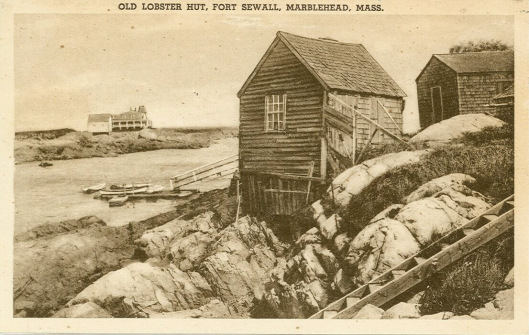

One could also see at Marblehead examples of houses which are basically fishing sheds, such as the ancient Gardner House (aka ‘Gardner Cottage’) now at 7 Gregory Street and “facing the quiet water of the tidal bay”…

A possible inspiration for Lovecraft? Well, there are many ‘Gardners’ in New England and, unless someone can dig up a “Nahum Gardner” here, there seems no reason to claim this place for “The Colour out of Space”.
What of other possible inspirations? Well, again one comes up empty. “The Lurking Fear” was written a year before Lovecraft discovered Marblehead. Thus it can’t be suggested that those particular shore shanties may have played into “Fear” settings such as…
The ground under one of the squatters’ villages had caved in after a lightning stroke, destroying several of the malodorous shanties; but upon this property damage was superimposed an organic devastation which paled it to insignificance. … The disordered earth was covered with blood and human debris bespeaking too vividly the ravages of daemon teeth and talon…
Nevertheless, there is a slim chance that there was some other shoreline encounter with “malodorous” shanties, likely surrounded by sun-bleached lobster detritus such as big claws (resembling “daemon teeth and talon”). That might be one possible real-life memory on which Lovecraft drew for this element in “Fear”, though there were doubtless others. It seems that lobstering was a craft practised pretty much all along the New England shoreline in suitable bays and coves, and that such big sun-bleached claws must have been a feature of shore-life. Such remains would have been a macabre if once-removed encounter with real-life deep ones.

What do the history books say? Well, they state that there had been a steady decline in lobster catches from the 1890s onward, probably due to over-fishing for the visitor trade. Then there were three prolonged cold snaps in a row, in the early 1920s, which soon made things quite tough for New England lobstermen by 1923. Worse times were coming, as tourist demand boomed in the hot summers of the mid 1920s and yet catches plummeted into the 1930s… just as the Great Depression really hit. Had Lovecraft actually met any old lobstermen on his travels in the 1920s and 30s, they would likely not have been very cheery people — in manner and sentiment probably much like old Zadok Allen of Innsmouth.
Thus, there seem to be no obvious aha! inspirations in the shanties at Marblehead. Oh well… one can’t expect to haul up new discoveries on every pictorial dive into Lovecraft’s places. But, those Lovecraftians looking for lobster and clam shacks in future will now at least be aware they were not only encountered by Lovecraft at the Joppa clam shanties at Newburyport (his main model for Innsmouth).
11 Thursday Jul 2019
Posted in Odd scratchings
The UK’s Met Office consults strange tomes in its weather forecasting, it seems…

The URL is now 404, but was snagged by the Google Search bot before the arcane library was deleted.
11 Thursday Jul 2019
Posted in Lovecraftian arts
New recorder music pieces from South America, with inspirations found in Lovecraft stories.

11 Thursday Jul 2019
Posted in Lovecraftian arts, Podcasts etc.
“The Horror in the Burying-Ground” by H. P. Lovecraft and Hazel Heald (c. 1933-34). Newly recorded as a free 35 minute audio story, narrated by Ian Gordon, who always does a good reading.
The Lovecraft Encyclopedia suggests that, given the dating, Lovecraft was having some fun with the story and was not taking it overly seriously…
this is evidently the last of the tales he ghostwrote for her. Much of the story is narrated in a backwoods patois [and was likely meant,] if not as an actual [self]parody, at least as an instance of graveyard humor.
Nevertheless it found its way to Weird Tales and was published May 1937 under Heald’s name.

One wonders if the illustration’s somewhat Lovecraft-like head, looking over the shoulder of and spooking a vaguely Heald-like face, was meant to convey anything to Weird Tales insiders?
10 Wednesday Jul 2019
Posted in Lovecraftian arts, New books
A 256-page Secuencia Grafica 1 (‘graphic sequence’) an ambitious and visually very stylish storyboard/storytelling exercise by Ricardo Parabere for Lovecraft’s “At The Mountains of Madness”. Not a graphic novel, not least because it’s wordless, but more a visual conceptualisation in story sequence. It’s undated by Amazon but, judging by the timing of samples pages released on DeviantArt, it was released early July 2019.


Available now for a modest price on the Kindle via Amazon, in Spain and the UK, and I assume the USA too.