H.P. Lovecraft Film Festival, 4th – 6th October 2019, USA. Now with guests and film-schedule announced.


07 Saturday Sep 2019
Posted in Films & trailers, Lovecraftian arts
H.P. Lovecraft Film Festival, 4th – 6th October 2019, USA. Now with guests and film-schedule announced.
06 Friday Sep 2019
Posted in Astronomy, Historical context, New discoveries, Picture postals
Last week’s ‘picture postal’ had a setting of quiet streets and mistiness. This week’s post continues with the same theme, evoking the ‘end of season’ shawl that many New England places would have worn by September.
I. The mist in New England.
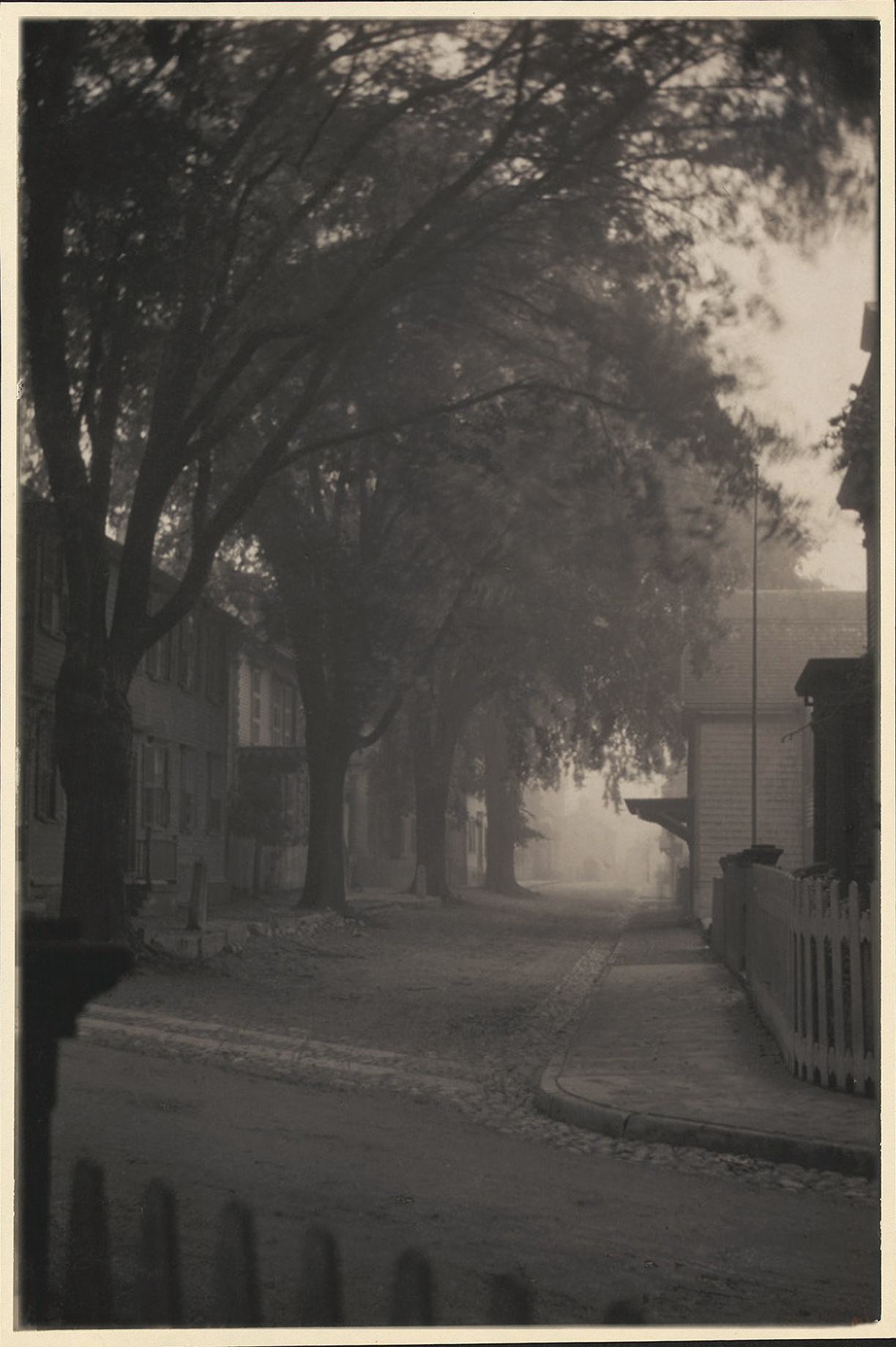
The picture also evokes the distinctly seasonal nature of Lovecraft’s own travels and visits. His annual cycle, of summer walking followed by a winter hermitage, was partly due to his extreme sensitivity to the cold. By the early 1930s he was becoming the old man he had once feigned to be, and appears to have become both more susceptible to cold and more fearful of encountering it. By the mid 1930s his ‘sitting outdoors season’ didn’t usually start until quite late, mid-May. Some historical context is relevant here. The natural state of the eastern USA during the late 1920s and 30s was somewhat different than today, being often significantly hotter in summer and colder and more icy in winter. We can also assume that mistiness was often enhanced by household coal-fires being lit as the mornings and evenings grew chill. Domestic burning of ‘soft coal’ (heavy smoke) was then permitted, for instance, and only in 1946 did Providence begin to adopt clean-air measures. Add to that the likelihood of autumnal garden bonfires being lit.
Toward the end of his annual walking season he would have started to encounter such evocative mists, fogs and mizzling rains. Such mists were almost never captured by picture postcards, which makes scenes like the one seen above all the more valuable. They remind non-residents that New England was actually somewhat akin to England, in terms of the vagaries and mistiness of its very seasonal weather. The region wasn’t all an endless parade of bright summer-scenes.
Yet sometimes it was an endless parade of such scenes, or seemingly so when the bright clement weather would run on in the year. Such was the year 1933, for about six weeks from mid September to the end of October, and Lovecraft continued to enjoy such weather by taking cheap local bus-rides and walks. During most of October 1933 he even contrived to explore parts of the inland back-country far behind Providence. Here he is in October 1933, writing to Morton…
Well, well! The old man’s still out in the open! But though it’s quite oke for brisk walking, it ain’t so good for settin’ down and writin’. Hard work guiding the muscles of my pen hand, for I doubt if the thermometer is over sixty-eight degrees. Glorious autumnal scenery. I’ve spent the last week tramping over archaick rustick landskips, searching out areas still unspoil’d by modernity…
The run of fine weather was over by around Halloween. On 2nd-3rd November 1933 he wrote to R.E. Howard…
Our autumn has been very mild … But of course this is the very end of the season. No more continuous mild weather can be expected [now], though there may be isolated days of more or less pleasantness.
How did he first become sensitised to the Providence mists? He purposefully went walking in such conditions. In a 1933 letter to E. Hoffman Price he also recalled his youthful explorations of Providence, and how he had first become…
sensitive to the mystery-fraught streets and huddled roofs of the town, and often took rambles in unfamiliar sections for the sake of bizarre atmospheric and architectural effects ancient gables and chimneys under varied conditions of light and mist, etc.
He especially favoured such misty atmospherics when blended with a quality of “spectral hush & semi desertion”, ideally accompanied by far half-glimpsed vistas in which the imagination could lightly play. Hush was of course something rather more likely to be encountered at the very end of summer, when the region’s visitors and trippers had departed and the locals were again in a more workaday mood inside their schools and workshops. Lovecraft devised a proto-psychogeographic technique to greatly increase his chances of encountering such hushed moods. In 1933 he would alight from a local cross-country bus in the middle of nowhere, then strike across country in the hope of reaching another distant bus-route where he might flag down a homeward bus. Sometimes he was forced to hitch-hike back, though another part of his practice was to never actually ask for a free ride. Presumably this was partly because he feared that if he asked, a contribution to ‘gas money’ might then be demanded at the end of the journey? By such means he semi-randomly roved down back-roads and up little lanes that he had never seen before…
I have found several alluring regions never before visited by me [that] represent a settled, continuous life of three centuries suggesting the picturesque old world rather than the
strident new.
II. The cosmic mists.
In spring 1931 H.P. Lovecraft had the idea that rain clouds and drizzling mists might be partly influenced by fluxes in incoming cosmic-rays. Although he admitted that the confounding factors on earth would make such things difficult to measure and prove…
Just how far our precipitation is affected by the recent prevalence of ether-waves is a still-open question. The unprecedentedness of any natural phenomena is always subject to dispute — for certain types of phenomena may be naturally cyclic, whilst others may attract notice more than formerly because of increased reporting facilities [and newly populated areas growing up into] dense habitation” — Lovecraft in a letter to Clark Ashton Smith, 15th April 1931.
How prescient. Here his use of “ether-waves” does not mean broadcast radio, though that was by then a secondary shadow-meaning to be found in the radio trade press and a few newspapers. Lovecraft’s new-found ability to hear a speech by the British King may indeed have caused his eyes to mist up with tears of patriotic joy. But his knowledge of science was such that he would not have imagined that mass radio ownership might be the cause of mistier mornings on Rhode Island.
Lovecraft appears rather to have been using “ether-waves” as one finds it in standard 1930s textbooks of meteorological science. There it means radiant energy, such as cosmic-rays, x-rays etc. More specifically, a usage from the June/July 1931 Bulletin of the American Meteorological Society suggests that he had the cosmic-ray end of this spectrum in mind…
First, the cosmic rays enter the earth uniformly from all portions of the sky. Second, they consist – as they enter the earth’s atmosphere – of ether waves, not of electrons. (R.A. Millikan, the Bulletin quoting a talk of his given in September 1930.)
This use of “ether waves” then must indicate that Lovecraft was thinking in April 1931 of ether-waves (cosmic-rays) as inducing “nucleation” in the air, as a mechanism by which the cosmic forces that “filtered down from the stars” could affect the formation of clouds and mists on the earth. Thus, in his mind, a “recent prevalence of ether-waves” would affect “precipitation” in the weather on earth. His only apparent concern was “just how far” this effect carried through.
But all the scientific papers and textbooks say that this idea was first proposed in 1959 by Ney in his Nature paper “Cosmic radiation and weather”. Which implies that Lovecraft’s scientific intuition was thirty years ahead of the curve. Was Lovecraft then the first to propose a direct causal link between ‘space weather’ and ‘earth weather’?
The answer to this puzzle is probably that Lovecraft partly intuited the idea from the Nobel prize-winner Robert A. Millikan. We know this eminent and questing scientist was being tracked by Lovecraft, since he mentions Millikan to Frank Belknap Long in early 1929 when Lovecraft refers to a new theory… “Millikan’s “cosmic ray””… this being mentioned in the context of a discussion of “the radio-active breakdown of matter into energy, and the possible building up of matter from free energy” (Lovecraft).
This latter point indicates that Lovecraft knew that Millikan was proposing cosmic rays that were engaged in atomic construction rather than (as we now understand it) radioactive decay. This point may seem arcane today, but from such things the fate of the universe could be determined: construction meant a constantly-renewing universe, decay an eventual infinitely diffuse heat-death of the universe. The latter theory was given a substantial boost by the publication of the Big Bang theory which occurred in Nature on 9th May 1931 (after Lovecraft’s letter), this being apparently accompanied by much journalistic befuddling of a credulous public — with feverish talk of the coming “heat-death” of the universe.
Of course we cannot be certain that Lovecraft was reading Millikan directly, in the scientific journals available at his Public Library or in the periodicals room at Brown. Because Millikan might also have been encountered in the ‘popular science’ magazines and newspaper columns of the time. He was a popular figure, as scientists go…
Dr. Millikan was the first to prove [1925] the puzzling effect was actually the work of rays bombarding the earth from cosmic depths. The story of his [independent] search is one of the epics of science. Climbing mountain peaks in the Andes, sending aloft sounding balloons on the Texas plains, making tests in a raging blizzard among the Rockies, lowering lead-lined boxes of instruments into the water of snow-fed lakes in the Sierras, he followed one clue after another. (Popular Science, November 1936).
At this time the cutting-edge of science was headline news in regular newspapers, rather than being confined to specialist magazines or to slipshod hysteria in newspapers, as it mostly is today. We also known that Lovecraft was “strongly interested” in such things…
the absorption of radiant energy & re-emission at a lower wave-length has strongly interested me” — letter to Morton on fluorescent rocks, 13th November 1933.
… and that he later attended a public lecture on cosmic rays by W.F.G. Swann in early 1935 (Morton letters).
Perhaps this interest was strong enough in 1931 to cause him to follow the contents pages of the hard science journals, and to actually read papers by Millikan and others. Thus his reading of Millikan and a few others in early 1931 might plausibly be inferred. In which case Lovecraft most likely saw, or at the least read a good summary of, a key paper by Millikan titled “On the question of the constancy of the cosmic radiation and the relation of these rays to meteorology” (Physical Review, December 1930). Since this contains the following…
These rays must therefore exert a preponderating influence upon atmospheric electrical phenomena. [followed by a discussion of] “water vapour … condensing on ions” and the conclusion that… “the cosmic rays enter the atmosphere as ether waves or photons, and hence produce their maximum ionization, not at the surface of the atmosphere, but somewhat farther down.”
The paper does not appear to have been discussed or noted elsewhere. I have looked through and keyword-searched the book-length biography of Millikan (1982), and have searched Google Scholar and Google Books and a few other sources. Note that Millikan doesn’t actually baldly state the rays—>clouds idea in his paper, and he doesn’t actually mention precipitation (i.e.: rain-clouds, rain, drizzling mist). But he gives enough leads and hints in this paper that Lovecraft the meteorologist-and-astronomer would be able to tie the pieces together into a working theory. Given this absence of commentary elsewhere, I then have to suspect this paper is the source for Lovecraft’s April 1931 understanding of levels of precipitation being “affected by the recent prevalence of ether-waves”. The timing of the paper certainly fits neatly with that of Lovecraft’s letter to Smith. We also know that Lovecraft attended a lecture on the latest developments in cosmic rays, in early 1935. In a letter to Barlow he commented on this lecture, implying that he had already had a good working knowledge of such things and that the lecture had usefully updated this.
There is a further small puzzle here. How did Lovecraft know of the recent “prevalence” of ether-waves/cosmic-rays? Because these do not appear to have been measured in time-series until 1933. The answer to the puzzle might be that the aurora borealis was then recently known to be a natural proxy for incoming cosmic-rays. An increase in the aurora would have been noted in the meteorological and polar journals, possibly even in the newspapers. The effect on shortwave radio-reception may also have been understood to be an indicator. We know that Lovecraft enjoyed ‘fishing’ on his older aunt’s radio-set for the most distant exotic radio stations he could find, and this could have sometimes meant rare distant shortwave signals bouncing off the ionosphere. His younger aunt’s radio set was apparently not so powerful. Yet regular ‘fishing’ on either might still have led him to build up a mental time-series of the disturbances in the upper-atmosphere.
“I sometimes ‘fish’ for distant stations when over there — for there is a fascination in the uncanny bridging of space” (Lovecraft in October 1932).
What then was his idea of this rays-to-clouds effect, put in modern scientific terms? At its crudest the idea of “nucleation” holds that: 1) cosmic-rays arrive and cause ionisation inside our atmosphere; 2) which introduces more tiny floating nuclei suitable for water-droplets to form on; 3) and in that way certain types of low-level cloud are more likely to arise when there are more rays. The science of this is still being actively researched, at least by those willing to brave the venomous politics of the field. Personally I remain to be convinced by scientists who suggest more sophisticated and roundabout ideas about how cosmic-ray fluxes and clouds might interact (and thus influence weather). Yet it’s not wholly impossible that Lovecraft’s 1931 hypothesis about ‘cosmic mists’ might one day be agreed to be correct, if science can see through the fog of confounding factors.
05 Thursday Sep 2019
Posted in Podcasts etc., Scholarly works
“Authors on the Road: Lovecraft’s Travels with David Goudsward”. A public-service TV show from 2013, newly on Archive.org.

Also on YouTube but there it seems to be at lower resolution than on Archive.org.
05 Thursday Sep 2019
Posted in Historical context
1) An issue of The Antiquarian Bookman from 1959 has an article called “New England Triple-play” which, judging by the snippets on Google Books, gives a fairly detailed multi-page boots-on-the-ground tour of Providence’s used book shops as they were at the end of the 1950s, including addresses. Regrettably, such a useful journal is not digitised and online.
2) A few weeks ago I wrote here about ‘uncle’ Eddy’s bookshop and Lovecraft. I see that later there was also a Dick’s Book Shop in Providence, and that the owner made a claim to Lovecraft in the 1960s. Like uncle Eddy’s Book Shop this shop also dealt in second-hand books. This other book shop was announced in Publishers Weekly as moving from 487 Westminster St. in 1939, to 70 Richmond St. It then pops up in Antiquarian Bookman and a trade directory at 102 Broad St., for a few years circa 1958-61. Then it appears back at Richmond St., at No. 44, during the 1960s.
Anyway, here are the basic details of this other shop’s claimed connection with Lovecraft, as remembered by ‘Jimserac’. He was commenting on a post on the blog “Notes From A Burning House: Remembrances of Bookstores Past” in July 2008…
In the 60’s you could walk into Dick’s Book Shop on Richmond Street and buy a copy of Davie’s Geometry, or any number of other antiquarian books, for maybe a dollar, two at the most and be treated to Dick’s first hand description of his personal acquaintance with H.P. Lovecraft.
The veracity of the owner’s remembered claim seems questionable, though. Since Dick’s appears to have been first established after Lovecraft’s death. The shop is not found by either the “Dick” or “Dick’s” name, or the Westminster St. address, in the 1920, 1934 or 1936 Directories for Providence.
Dick’s is not to be confused with the Dana bookstore. This other store appears to have been a rather more upmarket used bookstore, and judging from the brief Dana memoir of Lovecraft he almost never went in there and didn’t converse when he did.
04 Wednesday Sep 2019
Posted in Scholarly works
Call for papers for an edited volume: “Not Dead, But Dreaming: Reading Lovecraft in the 21st Century”.
Because interest in Lovecraft continues to grow, our intention is to explore some of the reasons why he has become so influential — and so indispensable — since the early 1990s. … his expanding popularity and the significance of his legacy as we entered the digital age. Consequently, we are interested in research that focuses on the significance of Lovecraft’s work from the 1990s to the present day.
An interesting topic but the list of suggested approaches is limited, and they appear to indicate that “the significance” to be considered is that of the influence exerted on university academics. This list further suggests that the editors only really want papers which use a narrow range of fashionable C.V.-ready PhD supervisor-pleasing approaches. Also, the end result seems likely to be yet another $120 ‘for academic libraries only’ dust-gatherer.
However, the call does mention “Lovecraft’s poetry” as a possible focus, surprisingly. Given the rarity of places in which to offer a close analysis of the man’s poetry in the context of its reception by modern readers, the call thus seems worth mentioning here.
The call, with a deadline for proposals of 30th November 2019.
04 Wednesday Sep 2019
Posted in Odd scratchings, REH
Where does one start when faced with the vast output of the East Texas writer Ardath Mayhar? Even the intro to her main Megapack Kindle ebook doesn’t provide a quick overview survey and guide. According to the Women SF Writers of the 1970s pages at Tor, she doesn’t even exist. But after a bit of searching and jiggling of Wikipedia I think I now have it roughly worked out…
Audiobook: Crazy Quilt: The Best Short Stories of Ardath Mayhar. I can’t get the table-of-contents for this in any format. Also in paper, but no ebook.
Rural weird/dark: Strange Doin’s in the Pine Hills: Stories of Fantasy and Mystery in East Texas, and A World of Weirdities: Tales to Shiver. The first is in Kindle ebook and is dark rather than weird, and the latter is in collectable paper with 29 stories, “many of them never before published”.
Other starter fiction:
i) As a starting point for her fantasy, How the Gods Wove in Kyrannon (1979) seems to be the best. It was her first such book, a set of tightly linked brief and delicately-Dunsanian stories followed by culminating sections. Its world-setting appears to have later been spun off as a three-volume series under the name Lords of the Triple Moon with these being aimed at a slightly younger audience than the first book? All are in Kindle ebook.
ii) The Ardath Mayhar MegaPack in two $2 Kindle books of stories. The first seeming to have the best and lighter stories in it, the second some darker material. I’m uncertain if these two collections form ‘the complete short fiction’ or are just a partial selection from her vast output. They seem to present the stories in no particular order, and include a number of westerns.
iii) Messengers in White sounds like the most interesting and successful of her science-fiction novels to start with. It’s available in Kindle ebook.
iv) Her ‘what happens when we make intelligent monkeys?’ novels sound perhaps-fun, but is probably not the science-fiction work to start with. These are found as Monkey Station: The Macaque Cycle, Book One and Trail of the Seahawks: The Macaque Cycle, Book Two, and both are in Kindle ebook. There was talk of a videogame, but I’ve found no evidence of a book three? Difficult to tell much more about it without proper reviews. It’s very difficult to find reviews for her work that are not flippant and cynical, and one gets the feeling that — like Clifford Simak — her robust rural Texan conservatism and blending of fantasy/sci-fi didn’t sit well with the sci-fi establishment of the 1980s and 1990s. (“Conservatism” doesn’t here = evangelical or religious, and a Starlog interview reveals that she was hounded locally by deluded Christians during the bizarre moral-panics over ‘Satanism’ in the 90s. Even today I encountered one prissy Christian on Amazon reviews, squeaking over discovering that Mayhar’s regionalist East Texas novels had dared to offer a tepid view of her local Church-goers).
Regionalist: So yes, there’s also a whole bundle of East Texas local rural novels and stories. Mostly ‘young adult’ tales with feisty heroines, though there’s also what is apparently her survivalist adult-novel masterpiece The World Ends in Hickory Hollow. I had my fill of that kind of post-apocalyptic novel in the 1980s, and I’m not sure I want more even now, but it’s well regarded.
Westerns: There are a great many robust pre-PC wild-western novels which might appeal to R.E. Howard fans. I’ve no idea were one might start with these.
Advice: Through a Stone Wall: Lessons from Thirty Years of Writing. Paper only. Seems to be well-regarded.
Autobiography: Strange View from a Skewed Orbit: An Oddball Memoir. Paper only. Said to be excellent.
Most of her books appear to be quite short by modern standards, many well under 200 pages. One associates the late 1980s and 90s with over-padded door-stopper books, especially in fantasy, but that doesn’t seem to be the case here.
So, that’s my somewhat hazy outline based on some online research scrabbling among scattered and sparse materials. Any advice or correction is welcome.
04 Wednesday Sep 2019
Posted in Lovecraftian arts
The making of a stop-motion animation of “The Howler” by H.P. Lovecraft.

03 Tuesday Sep 2019
Posted in Lovecraftian arts, New books
Celebrating H.P. Lovecraft’s interest in our fascinating felines.
This week, a panel of Lovecraft’s trans-lunar leaping Ulthar cat-army from “The Language of Cats” by Nicole Claveloux. The two-page strip appeared in Heavy Metal magazine’s Lovecraft special-issue in October 1979. I see the Heavy Metal online shop still appears to be shipping paper copies of that issue, though I’d guess they might perhaps be reprints rather than 1979 originals.

“The Language of Cats” is not in the fine new The Green Hand and Other Stories collection of Claveloux’s scarcer work. Hopefully the “Cats” strip can eventually be properly re-published in crisp scans, alongside the long masterpiece “Off Season” by Zha and Claveloux (which also appeared in English in Heavy Metal). And ideally without the colourisation which bedevils reprints of older b&w line-art comics these days.
02 Monday Sep 2019
Posted in Lovecraftian arts
François Baranger’s Les Montagne Hallucinees, Tome 1 is now listed on Amazon, for an October 2019 release in French from the publisher Bragelonne. The artist is also showing previews at Facebook, which have English text — so I guess an English edition may also happen too…

The format for his At The Mountains of Madness appears to be the same as his 2017 Call of Cthulhu book. Not quite an artnovel — but 14″ tall and with abundant double-page spreads of superb visuals done in his sweeping cinematic style. I assume the approved Joshi texts or the equivalent French translations are being used.

The second and concluding volume of his Mountains is set to appear before Halloween 2020. The first is being delivered on time, so we can reasonably assume the second will be too.
01 Sunday Sep 2019
Posted in Historical context
What movies might Lovecraft have seen in 1932-33? He wrote to Morton in 1933 that, over Christmas/New Year, “I was cinema’d nearly every night” by his friends in New York City.
Most likely are:
* The Sign of the Cross, a lavish epic by Cecil B. DeMille. An Ancient Roman setting under Nero, complete with vast architecture and huge crowds, and thus a natural fit for Lovecraft-the-Roman. 30th November release and almost certainly still playing a month later.

* The Mummy with Boris Karloff. Ancient Egyptian mummy-horror. He was rarely scintillated by these 1930s monster movies, but he may have appreciated some of the set design. 22nd December release.

* Island of Lost Souls with Charles Laughton and Bela Lugosi. Apparently now a bit of a cult movie. A gruesome adaptation of H.G. Wells’s early horror The Island of Dr. Moreau. This appears to have been heavily marketed as a ‘sex movie’, or what passed for such a thing in the movie-houses of December 1932. This marketing tone only got worse, as the movie passed down into the flea-pits…

Movies at this time were all ‘pre-Code’ and thus running in their full uncensored forms. The often scrappy and cut versions that appeared on TV in the 1970s and 80s were usually not accurate reflections of what had been screened at the 1930s movie palaces.
He appears to have stayed on in New York into January, but probably not for long enough to see lesser movies such as The Vampire Bat (12th January) or The Monkey’s Paw (13th January) in New York. He could not afford to see movies in Providence at this time, even if he had though the movie worth bothering with, so would have missed these.
Notable movies from earlier in 1932 were: The Old Dark House, a Boris Karloff horror by James Whale; and the modestly successful zombie movie White Zombie with Bela Lugosi. Either of these might still have been playing somewhere in New York at the end of 1932, if only in the lesser cinemas as a double-bill.
He evidently was not going to the cinema in Providence at this time, as he noted of his 1932/33 New York viewings that they were… “the first sight of such performances since last June [1932] when he had enjoyed a similar series of New York cinema treats from his friends. He would not have been so well served with horror movies in summer 1932. But Murders in the Rue Morgue (a Poe adaptation), and Tod Browning’s infamous Freaks, might have still be running somewhere in New York. They had been released in February 1932 and by the summer would make a natural double-bill for the lower end of the market.
James Whale’s Frankenstein was likely still running. This had its New York opening 4th December 1931 and was a sensational hit, said by movie history buffs to have kick-started the 1930s horror movie boom. It must surely have been playing somewhere in New York City, even six months later. The same may have been true of the high-quality Dr. Jekyll and Mr. Hyde, released 31st December 1931. These would have formed another natural double-bill of movies, this time for the classier end of the market.
Lovecraft would not have seen some flea-pit hold-over of the February 1931 Dracula, though. He eventually saw the first reels of that 1931 Dracula on a visit to Miami, but was so bored by it that he walked out on the movie and went for a night walk on the sea-front instead. When with friends he would often snooze through a dire movie rather than walk out, as being in the dark tended to induce a sleep response in him. Thus, even if he mentions that he attended a movie screening, unless he discusses the movie we can’t always be sure that he saw it rather than snoozed.
His summer 1933 letters to Barlow show a renewed zeal for the cinema, so evidently the 1932/33 New York viewings had stirred something in him.
01 Sunday Sep 2019
Posted in New books, Odd scratchings, REH
The new Tolkien’s Library is a doorstopper, and thus the free 10% sample for the Kindle has all the introductions and the first 90 items (though curiously, the table-of-contents is missing, so one has no clue what’s in the appendices). One reads in Tom Shippey’s introduction that…
Tolkien mentions not only some of the early British classics of “scientific romance” … H.G. Wells; not only familiar British writers of fantasy, such as Dunsany and Eddison; but also several [1960s-70s] writers of commercial twentieth-century science fiction or fantasy, such as John Christopher, Frank Herbert, Sterling Lanier, Lyon Sprague de Camp. He did not like all of them, but one he mentions with mild approval is Robert E. Howard, creator of the “Conan” cycle. This is something of a surprise, given that Conan is the pre-eminent example of hairy-chested macho barbarian heroism, so very un-hobbitical. Perhaps Tolkien appreciated Howard’s efforts to create a sense of age, of lost civilisations?
From my other encounters with Shippey I get the sense he is definitely not a Howard fan for some reason. And is thus probably unaware that Howard was also Tolkien’s equal — and arguably his actual superior — in setting up, setting out and then describing complex battles in epic fantasy worlds. Nor is he probably aware of the close comparisons that can be made in terms of a few central plot devices found in the longer Conan works. However, having not seen the rest of Tolkien’s Library, I’m unsure about what item Shippey is resting this remark on. Is there a new finding, or is this the same old de Camp memory? As I wrote here in March 2019, that Tolkien read Howard…
all boils down to what L. Sprague de Camp remembered in 1983 a snatch of conversation had with Tolkien in a garage in 1967, so it’s pretty slim as evidence goes.
31 Saturday Aug 2019
Posted in Odd scratchings
Well, that’s August gone. Tentaclii Towers sailed serenely on through the shimmering August blue and the increasingly chill nights of late summer, avoiding power-cuts or flash-flooding. My daily blogging continued, although my Patreon remains stubbornly stuck at $59 a month.
This month the password-protected posts for my Patreon patrons were:
* “A Century Less a Dream, new for $4”. (Effectively the ‘best of Lovecraft Studies’ as a nice hardback. I got one, but one was also left available at $4 for someone else to bag).
* “Friday ‘picture postals’ from Lovecraft: Finding Bolton”. (My new discovery on the mysterious Bolton, a place featured in several Lovecraft stories).
* “Moving Lovecraft’s House” (an eyewitness account of the event and a photo).
* “Knowing Derleth” (Derleth on the gay scene within early science-fiction fandom, and more).
Just $1 a month or more (ideally more) gives you access to protected posts at Tentaclii.
In the arts, another ‘Lovecraft as a character’ appearance was discovered in the graphic novel Atomic Robo and The Shadow from Beyond Time, and this discovery led to issue #42 of Digital Art Live magazine having a superb and long lead interview with the Atomic Robo guys. Tentaclii also featured: a brief first look at the new Colour Out of Space movie, with my musings on why it might have been time-shifted; an unearthing of a lost French Lovecraftian sculptor Henri Etienne-Martin with good pictures; an update on the Blaschka’s ocean invertebrate glass-models, including news of restorations and a new book; the Lovecraft Birthday ‘InnFest’ festival in the Second Life virtual world (now with 90 minute ‘best of’ video; and a couple of other Lovecraftian arts items.
New books were noted, such as: Lovecraft’s Letters to Wilfred B. Talman and Helen V. and Genevieve Sully; Lovecraft’s ‘autobiography in letters’ Lord of a Visible World (as a second revised edition). In fiction, new affordable and properly edited ebooks of The Averoigne Archives (Clark Ashton Smith) and the best of Wilum Pugmire; plus Arthur Machen: Collected Fiction. I noted that the French can expect a “Fully Upholstered Luxury Lovecraft” set in early 2020. I was also pleased to find the Lovecraft Lexicon encyclopedia in affordable ebook, and I read through it cover-to-cover during August.
August was a light month for new journals, but the new Lovecraft Annual #13 and Pulpster #28 were both major releases and also packed with independent scholars who Know Their Stuff. I also noted two calls for non-fiction material from future editions of the Arkham Gazette fanzine.
Useful freebies were linked to here, as usual. These included: concise synopses of Lovecraft’s revision works, totalling 13,000 words; Krazy Kat 1916-22 free online (incidentally, I also found that Lovecraft made a probable passing reference to Krazy’s mouse “Ignatz”, so maybe he did come to know this famously surreal kittee strip after all); The Fantasy Fan’s 1933-34 issues were found and linked on Gutenberg; I found 15 pages of Breccia adapting “The Whisperer in Darkness”; and a French website called Cthulhu & Co. was found, this being a fine online catalogue of Lovecraftian zines and journals. Of course August and Lovecraft’s birthday brought my own freebies: Lovecraft’s “The Cats of Ulthar” with 8,000 words of scholarly annotations; and my new revised high-res map of “Lovecraft’s Providence”.
In my biographical posts, ‘Lovecraft on a bicycle’ offered my detailed timeline of Lovecraft’s bicycling, done in order to rebut a recent tendentious (and now, proven false) claim about Lovecraft. Several of my regular “Picture Postals” posts at Tentaclii were biographical, with one of these including the full run of Frank Belknap Long’s ‘comic strip by postcards’ featuring Lovecraft as a character; “HPL in an aquarium”; and an unusual night-view photograph of College St. very near to Lovecraft’s final home.
I feel I had a breakthrough in the post “On that elbow”, by tallying story-interpretation against historical context. I similarly looked into the real Sydney Bulletin, of “Call of Cthulhu” fame — I’ve long suspected that Lovecraft had several unknown Australian correspondents, and though this post wasn’t on his correspondents it served to further confirm my hunch.
My big discovery this month came in the post “Eddy bookstore on Weybosset St”. I found a seemingly previously-unknown 1948 memoir of Lovecraft, by one who knew him well. This led me to the equally un-noticed uncle Eddy, Providence’s used bookseller. Just a few streets over from the Public Library, Lovecraft had access to a large (20,000 volumes?) used bookstore, whose friendly proprietor would open up especially for him and who was also the uncle of his best friend in the city. Who knew?
Due to the tribble-like expansion of volumes of Lovecraft’s letters, I wrote a quick post suggesting the need for a public ‘mega-index’ of these and I suggested how this might be speedily created. I also noted that Rhode Island newspapers before 1923 should be online soon, after news of a $250,000 funding grant for scanning and digitisation. One wonders if the Library might offer some sort of ‘hunt the Lovecraft’ prize, once that database is online and public. Talking of Providence, I thought I might get a blog post by rounding up all the reports from NeconomiCon Providence 2019. But after extensive searching I can only find one… and curiously that doesn’t even mention Lovecraft.
Scholarly links this month included a free detailed paper on the history of the lost Arabian desert city of Irem/Iram, plus a number of new additions (inc. one thesis) to my Open Lovecraft page. I also noted that the call for “Tolkien’s Legendarium and the Arts” included explicit openness to Lovecraft; and that there’s a call for general horror scholarship from the UK’s Ann Radcliffe Academic Conference 2020.
For my own puny shelf I bagged the book A Century Less a Dream: Selected Criticism on H.P. Lovecraft, new in hardback for a mere $4, via a fire-sale book direct from Amazon USA. It was just $11 even with shipping to the UK, which was irresistible. It was fine on arrival, the only slight mar being a bar-code sticker firmly affixed to the back cover. I’ve also been able to bag a copy of the Lovecraft Annual for 2015 at a low price, and this should be arriving here shortly.
That was August. Please help me to continue the Tentaclii blog by pledging $1 a month or more via Patreon. It would be nice to get to $100 a month by the late Autumn/Fall, a year after re-starting Tentaclii. If you made new contacts at summer conventions and conferences then please let them know about the blog and my need for patrons.

