Major Moebius retrospective

The Max Ernst Museum in Germany is to host a major retrospective of the art of Moebius. Opening 15th September and running until February 2020, with reasonably-priced tickets. The show will feature 450 works covering his whole range, plus a full catalogue.

The museum is about four miles south of the outskirts of the German city of Cologne. Cologne is about 120 miles east of Calais, or about 100 miles SE of Amsterdam, and is well connected by rail.

For a total comics-arts-o-rama visit, note that it usefully overlaps at the end of January with the huge Angouleme 2020 in France (opens 30th January 2020).

William Deminoff

One of the last to live in Lovecraft’s house at 66 College Street, before it was removed in 1959, was a Lovecraft fan writing his dissertation at Brown. William Deminoff (class of 1954) appears to have been an assistant professor at Brown in 1957 (Ken Faig Jr. found a tenancy record for that year, but not that Deminoff was a Lovecraftian) and had gone on to be active in early Lovecraft fandom. The cutting below is from March 1965. This raises the possibility that Deminoff made photographs of the house in situ in its garden court, that may still exist? The name “Deminoff” is not found in Joshi’s comprehensive bibliography, which suggests that his final dissertation was not on Lovecraft.

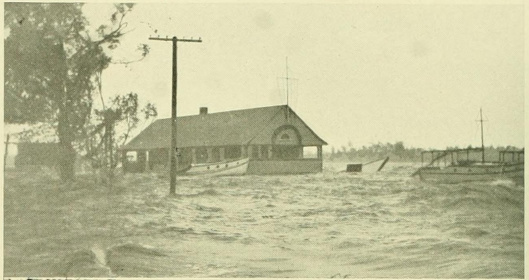
Storm on the Seekonk, 1938

I had thought that no-one had gone out to Lovecraft’s beloved Seekonk with a camera in the great storm of 1938, but here’s the university boathouse half submerged…

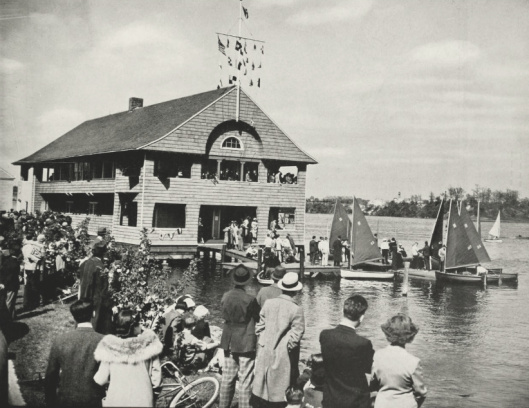
The same boathouse earlier in the same year…

The great storm also downed old elm trees on College St., which had stood in front of the fraternity house that Lovecraft could see the back of from his study window at No. 66. The reporting of this news revealed a snippet of the street’s lore that Lovecraft probably knew of. The trees on the street were thought to have been brought from England in the clipper ship era. The storm probably weakened them and they were naturally failing anyway after so long, and thus in the late 1940s the Brown alumni began a robust programme of revivification and replanting of the elms.

“Lovecraft mythos” in 1976/77

Two very early uses of the term “the Lovecraft mythos”. The first leaves it open — was Robert Anton Wilson actually talking about the Derleth mythos or the original Lovecraft Mythos? We may never know, unless someone can dig up an interview which touches on the topic. The second use is from the critic Jeffrey P. Miller, and is very clear-cut.

1977: Robert Anton Wilson, Cosmic Trigger: Final Secret of the Illuminati. “I had already incorporated into Illuminatus a variation on the Lovecraft mythos” … which he states means a Cthulhu Cult -like group helping alien entities.

1976: Jeffrey P. Miller, in a scourging review of a new Arkham Press anthology, reviewed in Science Fiction Review for May 1976. “No Arkham anthology would be complete without a few stories in August Derleth’s Cthulhu Mythos (in which the good gods and the bad gods play macrocosmic cowboys and indians, as opposed to the Lovecraft Mythos, seldom used these days, in which mankind stands alone against unknown and extra—moral forces)”.

That’s as far back as the online archives can take me, though the Masterplots annuals for 1969 and 1971 do each appear to have a bare noting of items as belonging to “Lovecraft’s mythos”. Presumably this was on their plot summaries for Derleth-approved work which had recently appeared.

Can anyone find more substantial pre-1976 uses? Uses that are not just late Derleth in letters or newsletters, trying to lay a cloaking glamour over his own ‘collaborations’?

The Beautiful Journeys of Moebius

Thanks to Moebius Odyssey for the news of a current Moebius exhibition…

At the time of writing there is an ongoing free exhibition of Moebius called “Les Beaux Voyages de Moebius” (The Beautiful Journeys of Moebius) taking place from 11th May – 24th November 2019 in Venice, Italy at the CA’ASI Architecture Studio as part of the 58th Venice Biennale. The show celebrates Moebius’ first visit to Italy and showcases part of Moebius’ oeuvre of the period.

Moebius Odyssey also has many interior pictures from the show, in the second half of a post on Moebius’s trip to Venice and the work it inspired.

Kittee Tuesday: Mark A. Nelson

Celebrating H.P. Lovecraft’s interest in our fascinating felines.

A kittee from Mark A. Nelson’s new Fantasy World-Building book, one of many such. I can very highly recommend this new book, for world-building imaginative writers as well as for makers of comics, storybooks, artnovels and games. Curiously Amazon has the paperback under a different title, Creative World Building and Creature Design. Perhaps publisher Dover found that the word “fantasy” limited the audience?

Lovecraft by Bani

From the book Vita Privata di H.P. Lovecraft, newly on archive.org this week. It’s a 300-page 1987 Italian translation of memoirs of Lovecraft by those who knew him. It appears to be firmly out-of-print, and there are not even second-hand copies listed on the Italian Amazon site. eBay gives me no results for it, either.

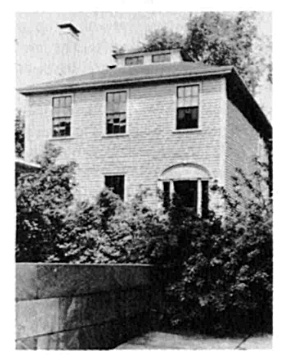
Illustrated, albeit with very fuzzy pictures. Here’s his last home, 66 College Street, seen from the elevated walkway along the side of the John Hay Library. The house rose from a lower level, having a whole lower floor below the floors and attic seen here. The lower level appears to have been lost on the move to its new and current site, unless perhaps it was buried there as a cellar.

Cthulhu outside the Library

Here’s an update on my previous post, “Cthulhu in the Library?”. A new photo has surfaced. The ironwork Cthulhu-a-like I had spotted in a 1965 book of b&w art-photographs of the Brown campus was not inside but rather outside the John Carter Brown Library.

Previous photo:

Newly found photo showing exterior context:

It’s not quite a lion, because of the dog-like teeth. The paw is also dog-like rather than cat-like. More like a supernatural hound, then? Possibly evoking Cerebrus, the multi-headed hound “that guards the gates of the Underworld”?

The Kirby Effect

The late Stan Taylor’s book-length Jack Kirby biography, now available free at The Kirby Effect: the journal of the Jack Kirby Museum & Research Center. Complete with colour scans and archival pictures. The last chapter posted was 1st June 2019, and it looks like it sees one new chapter posted every four months or so. As such the online book is currently only missing the final few chapters…

22 – Allegory Of His Life
23 – Why Did The Fourth World Fail?
24 – Once More Into The Breach
25 – Animated
26 – The Animated Artist

Picture: Jack Kirby at the board, from Kirby: King of Comics.

This spurs a fascinating historical “What If? idea” What if… Stan Lee had said to Jack Kirby one day at Timely in the mid 1950s: “Jack, forget these capes-and-tights heroes. They’re over. The kids want monsters and mystery. So I found us the secret sauce for our new Yellow Claw title, it’ll have new types of monster… and these monsters are gonna get us past this new freakin’ Comics Code and let us scoop up all the homeless readers of EC’s horror comics! Take a read of these here Lovecraft stories… yeah yeah I know, ya heard he’s supposed to be about indescribable monsters… but you’re Jack Kirby, you can draw anything…”

Of course it didn’t happen that way. In the end we got the superpowered capes-and-tights heroes vs. the superpowered monsters, and quadruple the fun. But it could have just gone toward creepy mystery monsters — before being swept away by TV and cheap paperbacks.

A ‘new’ Howard letter

A “New” R.E. Howard Letter, which had been hiding in plain sight in ‘The Eyrie’ in the Weird Tales issue for May 1926.

Howard recommends Nordic stories to the editor and readers. He singles out the Grettir the Outlaw vampire story from Iceland, presumably in the Sabine Baring-Gould translation (1890) rather than William Morris (1869) — though Howard scholars may know otherwise. But possibly younger readers of Weird Tales may equally have found it via Allen French’s popular and streamlined retelling for children The Story Of Grettir The Strong (1908) in their public library.


It would probably be useful for scholars to have a “complete Eyrie and Souk” to 1945, compiled into a single PDF with good OCR, once all the Weird Tales scans and related titles are on Archive.org. Or someone might produce an annotated and indexed ebook of such.