Starting tomorrow, little Titchfield in the south of England (UK) has a mini-Lovecraft theatre festival.


22 Sunday Sep 2019
Posted in Lovecraftian arts
Starting tomorrow, little Titchfield in the south of England (UK) has a mini-Lovecraft theatre festival.
22 Sunday Sep 2019
Posted in New books
The Vampire Stories of Robert Bloch. Limited to 100 copies, pre-ordering now.

22 Sunday Sep 2019
Posted in New books, Scholarly works
Released tomorrow (Monday 23rd September) in Kindle ebook format, Leslie Klinger’s The New Annotated H.P. Lovecraft: Beyond Arkham. This is the second and final volume of Klinger’s Annotated Lovecraft and it’s good to see that S.T. Joshi’s corrected texts have once again been used.
The 512-page paper edition has a later release date according to Amazon UK (“25th Oct 2019”). But I’m told that it’s a simultaneous print/ebook release for the USA.
I see that in the ebook and the Google Books preview the annotations are given as endnotes, rather than footnotes. Presumably that’s to allow pop-outs over the page for Kindle Fire readers, and ’round-trip’ links on the older Kindle 3 e-ink ebook ereaders. But I read somewhere that the first print volume had a “1/3 sidebar” for its annotations, so presumably that format will be repeated for the second print volume? Update: Yes, Klinger confirms the same format is used for the second volume.

It’s an amusing touch to have the front cover hint at Lovecraft’s love of spaghetti. The print edition has a different cover.
In order of presentation in the book:
The Tomb.
Polaris.
The Transition of Juan Romero.
The Doom That Came to Sarnath.
The Terrible Old Man.
The Cats of Ulthar.
Facts Concerning the Late Arthur Jermyn and His Family.
The Temple.
Celephais.
From Beyond.
Ex Oblivione.
The Quest of Iranon.
The Outsider.
The Other Gods.
The Music of Erich Zann.
The Lurking Fear.
The Rats in the Walls.
Under the Pyramids.
The Shunned House.
The Horror at Red Hook.
Cool Air.
The Strange High House in the Mist.
Pickman’s Model.
The Dream-Quest of Unknown Kadath.
At the back there is a new ‘Lovecraft Gazetteer’ of place-names, as an appendix. This includes invented places, including places in outer space.
21 Saturday Sep 2019
Posted in Odd scratchings, REH
I don’t think I ever got far into the work of Poul Anderson, and in 2019 I vaguely associate the name with 1960s space-opera science-fiction. Perhaps I encountered some of his short stories as “best sci-fi stories of…” collections, and I might have read a few of his galaxy-spanning novels in the early 1980s. But I rather suspect he was another of those libertarian science-fiction authors whose I was shoo-ed away from, in the early 1980s, by left-leaning gatekeepers.
But now I discover he also did historical fantasy / sword and sorcery novels. Some of these are even set in my native England and one has a nicely earth-mysteries dark-faerie twist, even. The mostly interesting one is partly set in the English West Midlands. Who knew? Not me, and I’m fairly well versed on such work if set in the Midlands.
I became aware of his work again thanks to some useful new survey blog posts on this side of his work. These being Poul Anderson’s “Northern Cycle”: Part One and Part Two. Part Three is still to come, but in the meanwhile the same blog has dug up two old articles from the defunct Crom Records heavy metal music website, surveying the relevant works in relation to their possible influence on metal bands… one and two.
His 1950s novel set in England under the Viking Danelaw looks somewhat interesting, The Broken Sword. Apparently best read in its rare first edition form, which launched into that curious dead-zone for public interest in fantasy (circa 1950-1964) and promptly vanished. It was hailed as a lost classic when re-discovered in the late 1960s, but even so I think it may have been one of the few to have escaped me in its 1980s paperback reprint form.
But looking most interesting to me is his A Midsummer Tempest (1974), an alternative history fantasy set in an England in which Shakespeare’s Fairy Folk are real and the English Civil Wars are partly an early-steampunk affair with airships. Super. I may have read it in the early 1980s along with the similar Keith Roberts, et al. But if I did, then I don’t recall it now. Sadly there appears to be no audiobook version, but at just 200 pages it’s not too daunting to tackle in paper or get through the letterbox — not one of those 1990s-style over-padded door-stopper fantasy slabs of 500 pages. It also skips briskly between short scenes, some with chapter headings indicating they’re set in the northern Midlands and thus near to me. It’s also said to take in another setting in which I used to live, at the other end of the West Midlands.
So, a quality pre-PC West Midlands fantasy novel that I had no idea existed. Great stuff. I’ve no idea if the author ever set foot in the English West Midlands, but it’s a nice find all the same. The formatting on the ebook is bad, so I’ve bagged a first-edition hardback for much the same price at just £4 inc. postage. It has a horribly ugly cover, compared to the painted Bob Fowke cover of the Orbit paperback and the UK popular hardback reprint by Severn, but dustjackets can be removed…


“…a titanic achievement — a delightful alternate-history fantasy that brings the fictional worlds of Shakespeare’s plays to breathtaking life with style, wit, and unparalleled imagination.” (blurb from one of the reprints).
Nominated for the World Fantasy Award for Best Novel, Nebula Award for Best Novel, and it won the Mythopoeic Award — and that was back in the 1970s when such awards meant something and hadn’t become political vehicles.
There’s a linked story of The Old Phoenix in Fantasy & Science Fiction (May 1979), which should be read alongside the book.
Unfortunately in terms of his other works he’s another one of those 1950s-1980s writers with a vast and sprawling output, and this is often loosely interconnected in confusing ways. The one reader’s guide (Poul Anderson: Myth-Master and Wonder-Weaver: A Working Bibliography) which puzzled it all out is very firmly out-of-print and unobtainable. Apparently it went to five editions. Meaning that it’s difficult to know where to begin if one were to even sample him, though there have been various reprints in-series. Still, the blog articles linked above give a starter on the more R.E. Howard-like books. I see he also did one Conan book, Conan the Rebel (1980). The plot is said to be rather too convoluted, but looking at the writing it seems a good brisk pastiche in terms of the style. There appears to be no audiobook version for it.
21 Saturday Sep 2019
Posted in Astronomy, Historical context, New discoveries, Scholarly works
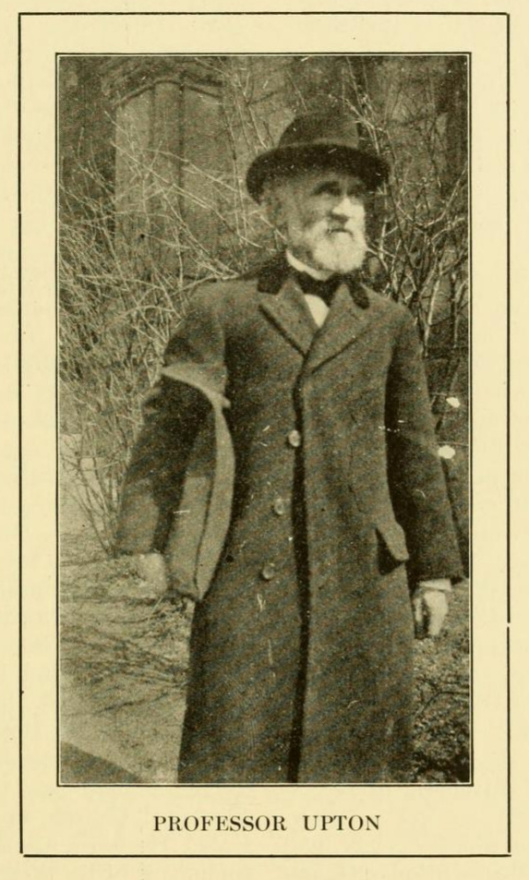
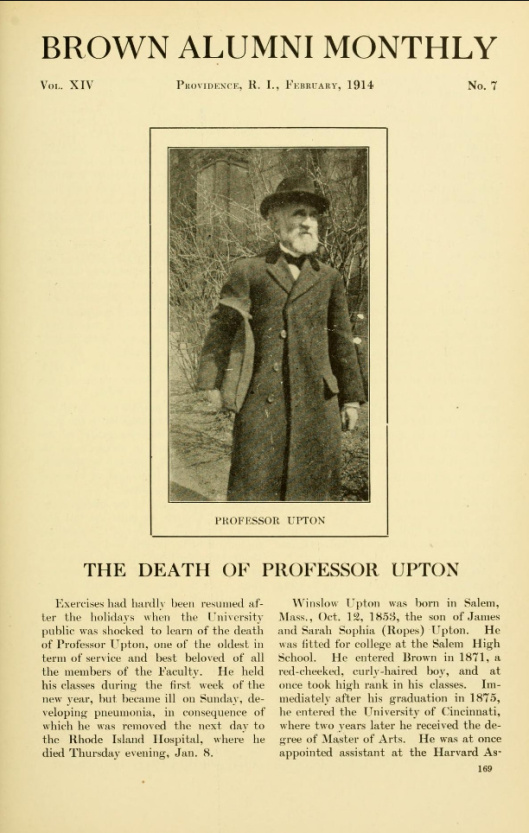
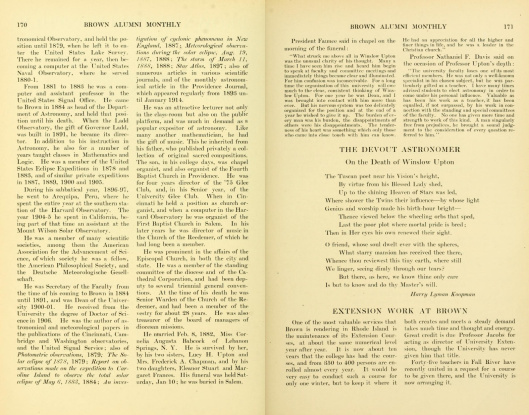
“The late Prof. Upton of Brown, a friend of the family, gave me the freedom of the college observatory, (Ladd Observatory) & I came & went there at will on my bicycle.” — H.P. Lovecraft.

Possibly this was the man who saved Lovecraft’s life. As a youth Lovecraft was contemplating throwing himself into the river in despair — just before the kind offer came from Prof. Upton.
20 Friday Sep 2019
Posted in Historical context, Picture postals
Following my recently pictorial surveys of the top of College Street, around Lovecraft’s final home, here are some nice clear views of the lower end of the street and its hill.

Here’s the same view about five years later as postcard…

And perhaps another few years on, at the dawn of the automobile-age…

Lovecraft possibly about 15 years old by that time.
And further along in the automobile-age, the same junction in 1935, in which the illustrator rather optimistically imagined that fast cars and pedestrians would mix. Two pedestrians in the picture appear to be hesitantly walking out into oncoming traffic!

This run of new frontages was just an architect’s fancy, but was built as planned and (judging by a photograph I saw) it did look like the drawings when completed.
19 Thursday Sep 2019
Posted in Historical context, Odd scratchings
Arthur Machen’s autobiography, now on Hathi and/or Archive.org in full view at last…
Far Off Things (1922) — First volume of the autobiography. On Archive.org and also Hathi.
Things Near and Far (1923) — Second volume of the autobiography. Hathi only.
The London adventure; an essay in wandering (1924) — Third and final volume of the autobiography. Also on Hathi.
Re: wandering, strange roads and early British psychogeography, see also his little travel book Strange Roads (1924). A letter to Dwyer shows that Lovecraft also knew this, and considered it a bookend to the autobiographical trilogy.
Even if you don’t care for his fiction, the autobiographical/walking work is well worth reading. So far as I’m aware, Lovecraft read all three volumes of the autobiography and it must have influenced how he practised walking. Lovecraft first discovered Machen’s work in the summer of 1923 (S.T. Joshi, I Am Providence, p.454).
19 Thursday Sep 2019
Posted in Historical context, Odd scratchings
A strange and real old booklet in the care of the John Hay Library, Providence, which might be woven into a new Lovecraftian story…

A writer might tie the booklet in with this somewhat Lovecraft-alike (it’s the chin) real ‘mystery sculpture’ at Brown…

18 Wednesday Sep 2019
Posted in Lovecraftian arts
S. T. Joshi heads out West, in his latest blog post. He also visits the Art Institute of Chicago and the Field Museum, lucky fellow. He further reports that he has now composed, in response to weird poems…
a total of twelve [choral] compositions, which may run to as much as 50 or 60 minutes. Enough for a CD!
He also has them in musical notation software, which potentially means they’re also available for translation into fully synchrotroniced cosmic synths via the likes of the Sibelius software.
18 Wednesday Sep 2019
Posted in Scholarly works
* T.A. Elfring, ‘Haunted Space’: Non-Representational Encounters in Heart of Darkness and H. P. Lovecraft. (Masters dissertation for Utrecht University, 2019).
* D. Becaj, Art as a Source of Horror in H.P. Lovecraft’s Stories (A well-illustrated Masters dissertation for Mariboru University, Slovenia, 2019. In English).
* B. Derie, “Editor Spotlight: Christine Campbell Thomson”, Deep Cuts in a Lovecraftian Vein blog, 15th August 2019. (Examines the work of the Selwyn & Blount anthologist Christine Campbell Thomson, mostly through the letters of Lovecraft and his circle and contemporaries. This successful series of British ‘grue’ anthologies is often alluded to under the general name of Not At Night, though later in the series the titles varied. Weird Tales offered their most suitable grue-some stories, these being selected by the magazine’s London agent Charles Lovell).
* M.A. Davidsen, “Do you believe in the Lord and Saviour Cthulhu?: The application of Lovecraft and his Cthulhu Mythos in Western Esotericism”, Masters dissertation in Theology and Religious Studies for Leiden University, Netherlands. (Survey and tabulation of different types of incorporation).
17 Tuesday Sep 2019
Posted in Historical context, New books, Scholarly works
Just published, Mark Valentine’s A Wild Tumultory Library is a 350-page collection of a wealth of short essays on the most obscure ‘forgotten’ writers, books, and a few bookshops — with what appears to be a strong British focus. A small sampling of the many titles…
The Palace of Isis: A Note on Elizabeth Bowen’s ‘Mysterious Kor’. [1940s, so not an influence on Tolkien’s Kor]
Pagan Mysteries in the Novels of P.M. Hubbard.
Some Books on Tea Cup Reading.
Modern Ghosts: The Macabre Fiction of L.P. Hartley.
The Ancient Art: The Tales of A.E. Coppard.
‘Great-Nephew to the Queen of Faerie’: A Note on the Grindletonians.
Zodiacs in Britain.
At the Sign of the Black Pterodactyl: George Hay and Books of ‘Some Other Dimension’.
17 Tuesday Sep 2019
Posted in Scholarly works
Super, Germany now also has a big multi-day Tolkien conference alongside the UK. I never knew that, but perhaps it’s new. Jena University will host the conference from 11th to 13th October 2019. This year’s theme is “Power and Authority in Tolkien’s Work”.

Lovecraftians in Germany may want to note that the organisers are piggy-backing the wider “First Postgraduate Forum on Research in the Fantastic” on this, with the Forum ahead of the conference on the 11th October 2019.