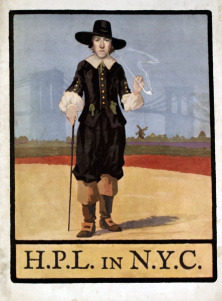
Added to Open Lovecraft

* S. Welsh, Cthulhu Waits Dreaming: A Jungian Exploration of Dreams and the Unconscious in the Works of H.P. Lovecraft. (Masters dissertation for the University of Oslo, November 2019).

* M. Jelaca, “On the Terror of Knowledge: H.P. Lovecraft and speculative realism”, Umjetnost Rijeci, LXIII, 2019. (In Croatian, with English abstract at end of PDF. Looks at the ideas of Meillassoux and Brassier, and the story under discussion is “The Call of Cthulhu”).

* B. Tandogan, “An examination of elements of cosmic horror within Adventure Time, Journal of English Language and Literature Club, Vol.2, No.1, 2020. (Journal of Sivas Cumhuriyet University, Turkey. Adventure Time is an animated fantasy TV series).

Call for papers: Weird Science and the Science of the Weird

Papers are required for ‘Weird Science and the Science of the Weird’, a special edition of Pulse: the Journal of Science and Culture. Obviously coming from a strongly leftist perspective, and as such unlikely to welcome other perspectives, but it’s a timely and interesting topic…

… the sciences are revealing strange dynamics of human-nonhuman interconnectedness [and in the resulting] conceptual transformations is a certain sense of estrangement that is often, but not necessarily, tied to feelings of unease, horror and/or fascination.

A growing tendency toward the aesthetics of the weird is visible in popular culture and contemporary art production. As a continuation of H.P. Lovecraft’s weird tradition, “the weird” is now bringing together some of the most exciting contemporary writers and filmmakers [and being] embraced by musicians [and] new media art practices, especially bioart.

In this issue of Pulse, we will aim to investigate the aesthetics, politics and ethics of the weird from various theoretical and disciplinary perspectives […] Starting from the confluence of art and science, our aim is to map diverse territories of the weird in literature, film, music, television, videogames, visual arts, comic books, dance, theatre and other media.

Deadline: 30th June 2020, for 5000-6000 articles, and 800-1000 word book reviews. All articles and related material should be submitted to: submissions.pulse@gmail.com

A revision of “The Strange High House in the Mist”?

Re-reading Barlow’s memoir of Lovecraft, in O Fortunate Floridian, I was struck by the implication of the comment by Barlow that…

Of “The Strange High House in the Mist” (1926) I have a much-interlined and revised typescript; the rhythms (he said) became too obvious in his story and had to be toned down.

Barlow’s reference to “rhythms” is ambiguous. Does it refer to the poetic play of words in lines, or to the larger structure which repeatedly pounds like ocean waves through the last part of the story?

But the clear implication here is that Lovecraft once made a heavily revised version of this typed story. Did Barlow have the early typescript of a revised version, which had then been cleanly re-typed and submitted to Weird Tales in summer 1931? It would seem a natural moment to make some changes. If so, then the further implication of Barlow’s comment is that the November 1926 original (rejected by Weird Tales and due to appear in The Recluse, but never printed there) was markedly different from the 1931 version?

The Lovecraft Encyclopedia makes no mention of any revision in either 1931 or 1934, or of a lost 1926 original which had been typed but then heavily revised. Nor, so far as I can see, is there mention of such on the survey of Lovecraft’s ‘lost’ material in “Locked Dimension Out of Reach” (Lovecraft Annual 2011), or in Joshi’s I Am Providence or his notes for Penguin Modern Classics.

But we can assume Barlow is accurate, and that there was a detailed revision. One then wonders when this was done. If in Florida in 1934 during his visit with Barlow, then the following item from Barlow’s memoir of Lovecraft may have some bearing, perhaps arising from the work in the revision…

At breakfast he told us his dreams; once of how he was a magician standing on a cliff over the ocean sending balls out into space and guiding them back, some of them returning with the scars and mosses of seas and spaces unknown.

A slightly different version of the dream is given on page 402 of O Fortunate Floridian, adding winds and wetness… a “high cliff by the ocean, where winds were blowing” and the balls “would have encrustations of odd growths, or be slimy wet.”

Readers will remember that the setting of “The Strange High House in the Mist” is a tall sea-cliff above the ocean, the original 1926 story being most likely written for a boy who lived on a sea-cliff at the ocean’s edge near Marblehead. Thus this dream, and Barlow’s comment, might hint that Lovecraft revised the story while staying with Barlow in Florida?

The Brown Repository has the story as scans, presumably deposited there by Barlow, and the notes on the record-page suggests a solution to the mystery. Although the item is…

Dated at the end: “Novr. 9, 1926.” This combination of manuscript (pages 1-7 and 10) and typescript (pages 8 and 9) was heavily revised by HPL. He apparently continued to make revisions even after the story was first published in Weird Tales, 18, No. 3 (Oct 1931).

Thus, by the look of it, it seems there was indeed some sort of composite assemblage and accretion on top of the original handwritten story of 1926, consisting of many inserted typed pages among the handwritten leaves and very heavy revision throughout. I imagine that access to Joshi’s Collected Fiction, A Variorum Edition, Volume 2: 1926–1930 would help further unlock the sequencing of this item, since the book has “High House” and it offers…

“all the textual variants in all relevant appearances of a story — manuscript, first publication in magazines, and first book publications.”

Though I’m unsure if it also pares back to what sits underneath all Lovecraft’s crossings out, and attempts a forensic reconstruction of the 1926 original. Unfortunately this book is too expensive for me, even at its current reduction from $180 to $99.

New Barlow book will be twice the size of the 2002 edition

S.T. Joshi’s blog has updated. He reports that His Own Most Fantastic Creation (stories featuring Lovecraft) is shipping, and usefully offers the contents-list.

His new blog post also reports that the forthcoming Barlow book will be a “vastly augmented edition” of Eyes of the God (2002)…

has been expanded to more than twice its size, coming to close to 550 pages and including a number of unpublished works of fiction and much other matter, including several essays on Barlow written in the 1950s and 1960s. Expect this volume later this year (I hope)!

The new podcast Wyrd Transmissions has bagged a long talk with S.T. Joshi, for episode #2.

New book: H. P. Lovecraft: El caminante de Providence

A new Spanish biography of Lovecraft, by Roberto Garcia-Alvarez, H. P. Lovecraft: El caminante de Providence. The 490-page book has an introduction by S.T. Joshi, and appears to be a substantial update of the 2016 first edition. It was due for release 19th March 2020, but publication has been postponed. The local press in Malaga, Spain, has additional details…

In 2016, the GasMask publishing house in Malaga published what is considered to be the most comprehensive and ambitious biography of this American author, The Walker of Providence, the work of Asturian writer Roberto Garcia-Alvarez. [Now comes] a new, expanded and revised edition of The Walker of Providence, with a foreword by the American writer and critic S.T. Joshi. [However, the book is now] delayed until the arrival [of printed copies] in bookshops is possible.

I’m currently working on the assumption that the end of May should see things starting to return to normal, so hopefully the Spanish won’t have too many weeks to wait.

Journal of Juvenilia Studies

An article by Ken Faig Jr. in the latest issue of The Fossil (January 2020) reveals a new journal from the International Society of Literary Juvenilia, the Journal of Juvenilia Studies. I’m pleased to see that the new journal is open-access, and has so far produced three issues and includes book reviews. It’s been added to my JURN search-engine, which enables the discovery of articles in open-access arts & humanities journals.

The journal is devoted to discussion of the works of young writers, and of the juvenilia of famous writers when they were young, rather than literature for ‘juveniles’ (as Lovecraft’s era termed them, though marketeers and librarians would today refer to them as ‘young adults’). This makes the journal relevant to The Fossil and the history of amateur journalism, and also to Lovecraft because so many of the producers of amateur publications were youngsters. The Journal of Juvenilia Studies could thus be the place to land an article on this aspect of Lovecraft’s complex network of postal ‘zines / correspondence / book-borrowing / letters-pages / boy-printers and so on.

As for The Fossil, this also offers a publication opportunity — the editor remarks in the latest issue that he’s keen to see more “articles related to amateur journalism” from new hands.

Lovecraftian Anime

The H.P. Lovecraft Literary Podcast veers off the ancient track and dives into a survey of Japanese animation, in the new “Lovecraftian Anime” episode.

Along similar lines is the new “Reading the Bible with Horror” podcast, interviewing the author of a book-length survey of all the ‘monster horror’ bits of the Bible. The blurb for this also reveals a new project, The Oxford Handbook of Biblical Monsters.

Asenath in Uniform

I’m now part of the way through reading O Fortunate Floridian, Lovecraft’s letters to Barlow. Only a few surprises so far, but I’m only up to late summer 1933 and they’re just getting warmed up.

One of the surprises was Lovecraft’s seemingly rather extensive cinema-going circa summer 1933, probably triggered by his spending Christmas 1932/33 in New York and seeing a number of the new movies there.

For instance, who knew that aspects of “The Thing on the Doorstep” were inspired by Lovecraft’s viewing at the cinema of the notorious Madchen in Uniform — just a month before the story was written?

The Marvellous A. Merritt

Who was “The Marvellous A. Merritt”? And why was he quite so popular among the cognoscenti in Lovecraft’s time? Sam Moskovitz investigated in 1960, in a detailed survey and appraisal which found its way into a British magazine…

Lovecraft met the famous author in January 1934 in New York, and proffered a copy of his “The Rats in The Walls” for consideration. In a letter to Barlow of 10th? February 1934, Lovecraft told Barlow he had found Merritt “genial and interesting … sincerely and deeply interested in the weirdness he portrays”. He later wrote to Galpin…

Among other new people I met was the fairly famous fantastic magazine writer A. Merritt, whose “Moon Pool” I have admired ever since its appearance in 1918.” — letter to Galpin, 28th April 1934.

The February letter to Barlow reveals that he had not yet read Merritt’s novel The Metal Monster (first version, 1920), since Lovecraft mentions it and implies he had not yet read it. At that point Barlow was offering to send him either The Metal Monster or the later version The Metal Emperor.

The Metal Monster had been left unread until that time, because Lovecraft had been told in 1920 that it was dull…

The Metal Monster, which I had never read before because Eddy told me it was dull. The damn’d fool! (nephew — not our late bibliophilick friend [‘Uncle’ Eddy, the Providence bookseller]). Actually, the book contains the most remarkable presentation of the utterly alien and non-human that I have ever seen. I don’t wonder that Merritt calls it his “best and worst” production. The human characters are commonplace and wooden – just pulp hokum – but the scenes and phaenomena… oh, boy!” — letter to Morton, 6th March 1934.

Incidentally, Lovecraft’s mention above of “our late bibliophilick friend” is another confirmation for Uncle Eddy of Providence, and faintly implies Uncle Eddy was not just a sour dealer in but also a lover of books.

Comparing the dating of this and the Barlow letter suggests that Lovecraft probably read the novel around the end of February 1934. Which version did Lovecraft read? He could have been sent the yellowing 1920 magazine pages by Barlow, but there was also a 1927-28 version that might have arrived instead…

“The Metal Monster” was serialized a second time in a Gernsback magazine, Science and Invention, from October 1927 to August 1928. (There were eleven parts in all.) The story was revised somewhat and re-titled “The Metal Emperor.”

This matters because “the first two chapters [are] missing in later prints”. Thus if one doesn’t have the 1920 magazine version, it’s a different beast. A very different beast, since…

“for [1927-28] Science & Invention magazine, Merritt really tore into the body of text, creating an entirely new version … This version focused on the sciency stuff, with Merritt backing-off the purple prose for which he is renowned.”

This strongly suggests that Barlow would have sent Lovecraft the original 1920 version, probably as tear-sheets. Barlow was likely savvy enough about such things to prefer The Metal Monster over The Metal Emperor. [Update: Yes, a 1934 postcard from Lovecraft reveals “The Metal Monster” was sent and read February 1934].

The original 1920 magazines containing “The Metal Monster” are not on Archive.org, but you may be pleased to learn that the original can now be had for $15 from Hippocampus Press.

Later in 1934, an August letter to Barlow reveals that Merritt had been given up as “hopeless”, in terms of a Lovecraft-Merritt correspondence. At the January meeting Lovecraft had given Merritt a copy of his “The Rats in the Walls”, but in August was still waiting for the tale to spark a letter and thus a possible correspondence between the two masters.