New book: Bottorff’s Price Guide

Bottorff’s new Price Guide & Checklist (in PDF) has been updated with a new edition.

It’s for those pocket-book comic books and spot-cartoon collections produced in a paperback books from the 1950s to the early 1980s, prior to the switch to the landscape format so as to better accommodate newspaper comic-strip reprints. The Guide appears to be free in PDF, though I could not get the download to trigger.

At the Sign of the Cat

The Lovecraftians of Hungary are seeking sponsors for their planned Spring 2021 national/regional meet-up event, and hope to launch a crowdfunding appeal in October 2020. As such they…

are open to ideas and suggestions, we welcome anyone who can share with us their experience of organizing and running such a campaign.

This also all for 2021, but they also note that…

However, all of the above [re: delay of the national event to 2021] does not apply to the graphics exhibition titled Supernatural Horror in Literature, organised jointly with the Memento Morri Association. Due to the nature of the exhibition and the venue, the opening of this exhibition will continue as planned on 8th September 2020.

The show will, appropriately enough, be at “the Cat (1084 Budapest, Berkocsis utca 23.)” and run for a month.

Entry deadline: 11th August 2020, and physical framed works need to be shipped to Hungary in good time.

The Cat, Budapest.

New book: Miskatonic Country

Coming soon, a new Call of Cthulhu RPG Keeper’s Guide book…

This book is a guide to every Miskatonic Country scenario for the Call of Cthulhu role-playing game published in a book by Chaosium or one of its licensees, and set in the 1920s.

Perhaps also useful for Lovecraft Mythos writers, if only to know what’s already been done in the region in terms of RPG storytelling in the classic Lovecraft period.

New book: Dawnward Spire, Lonely Hill – goes to paperback

Dawnward Spire, Lonely Hill: The Letters of H.P. Lovecraft and Clark Ashton Smith is now on Amazon UK in paperback with a July shipping date. 800 pages in two volumes, 1922-1931 and 1932-1937. Amazon UK has them for £30 each.

There at first seems to be no sign of them on Amazon USA, where general Web search will only land you on the page for the hardback, and with only a $150 used copy available there. Curiously, nothing then shows on Amazon USA when you search for “Dawnward Spire, Lonely Hill”, even though the hardback has a known page-listing. Further tests showed that only the search “Dawnward Spire Lonely Hill” — without the comma and in inverted commas as a phrase — meets with success. This reveals the very elusive U.S. Amazon listing pages for the paperbacks: 1922-1931 and 1932-1937.

A simple search for Dawnward Spire, Lonely Hill (comma, no quote marks) failed completely. On closer inspection this was due to the dumb AI at Amazon trying to second-guess the title. There can no such word as Dawnward, its pea-sized brain surmises. Therefore you must be searching for Downward. Durh. So much for rapid machine-learning.

Yes Amazon, you need “need help”. Help to fix stupid second-guessing by your search tools, a crude technique that should surely have no place in a billion-dollar high-tech search-based business in 2020 — not least because it fails at least 70% of the time. Google Search has also taken to annoyingly auto-removing your “quote marks”, if it thinks there won’t be enough search results for the phrase. Which reverts the search to synonymys etc. Actually, I’d rather like to know that there are no results for that exact phrase, and not be bamboozled into seeing a page of irrelevant ‘maybe, perhaps, sounds like…’ results, which are inevitably far astray from what I’m seeking.

‘Picture Postals’ from Lovecraft: Henry J. Peck

In December 1928 Lovecraft wrote to his schoolteacher friend and correspondent Moe…


   “I have come upon an altogether unsuspected country lane which winds up the ancient hill by the falls of the Moshafsuck … not a quarter of a mile from this very home [Barnes St.], yet which I never knew till this September. … line’d on one side by abandon’d gambrel-roof’d houses of the vintage of 1740 or 1750 … there is obtainable a glamourous view of Smith’s Hill — with the dome of the marble State House … which reminds one of the citadel of some fascinating Renaissance hill-town … it so overwhelm’d me with aestetick extasy when I first glimps’d it, that I was impelled to exclaim out loud, & whip forth my tatter’d note to make a crude sketch. … the [Providence] art club lately hous’d an exhibit which proves I am not alone in viewing Old Providence with an enraptur’d eye. The exhibit, of which I enclose a catalogue, was of drawings and etchings by one Henry J. Peck; and reveal’d the archaick liveliness of the ancient town [he] beholds the same cryptick overtones of brooding elder magick that I behold … huddles of ancient roofs, vistas of grass-grown colonial lanes & Georgian flights of railed steps, glimpses of tarry ghosts along the Indies-dreaming waterfront … the drawing reproduced in the catalogue is #30 of the exhibit — the antient inn-yard of the Franklin Tavern (circa 1770) on College Hill. … such arch’d yardways, when unlighted within, suggest the most spectral suggestions conceivable at night.”


Who was Peck, and where is this admired work now? Henry Jarvis Peck (1880-1964) was usually referred to by his contemporaries and editors as Henry J. Peck. He grew up and came of age in Warren, Rhode Island, attending the Rhode Island School of Design (RISD). He studied first with Eric Pape in Boston, then George L. Noyes, then from age 21 for three years with Howard Pyle.

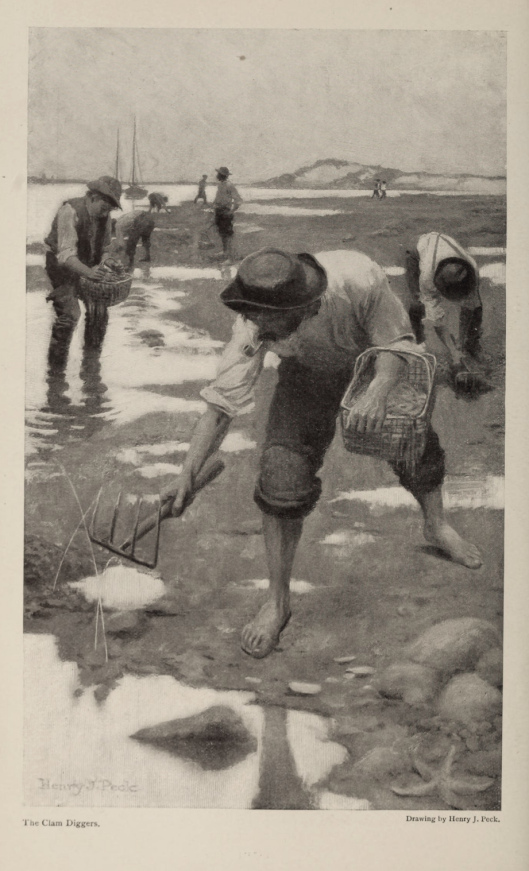
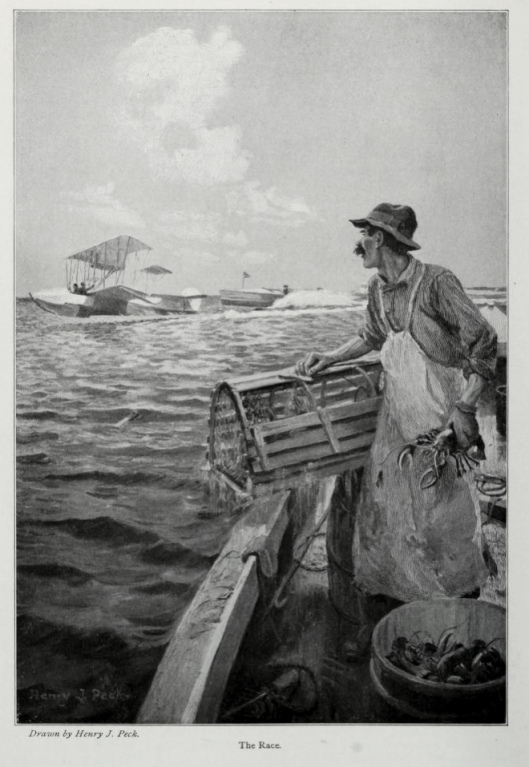
A writer as well as an illustrative artist for books and magazines, his combined articles appeared for several decades in the more upmarket magazines of America. In the summer he lived in Warren with a studio at Rodney Street, but as the snow settled he went to overwinter in New York City. Warren, you’ll recall, was a favoured haunt of H.P. Lovecraft and the scene of some remarkable ice-cream eating contests.

A favourite creative approach seems to have been to charmingly contrast the traditional and the modern, with a New England twist.
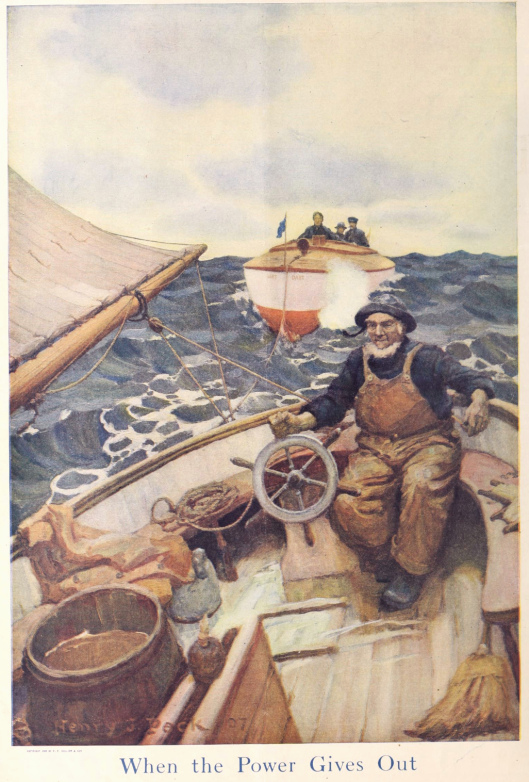
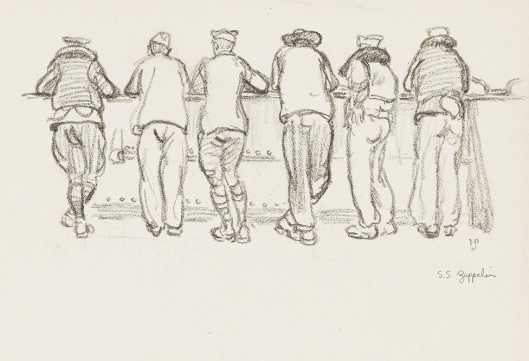
He appears to have been working in his prime from around 1906-1929. Some surviving sketch material suggests he may have served as a rapid-sketch war-artist with the Navy. Here we see officers on deck.
By the mid 1920s some of his work for Scouting journals was quite cartoonish. He also painted a string of folk-art-y radio-ham magazine covers, with the same easy and warm approach.

He also produced more refined work in this cartoonish line, for the American Country Life magazine, as seen here in December 1928. One wonders if this was a one-off swan-song, or if there was a whole series of this material.
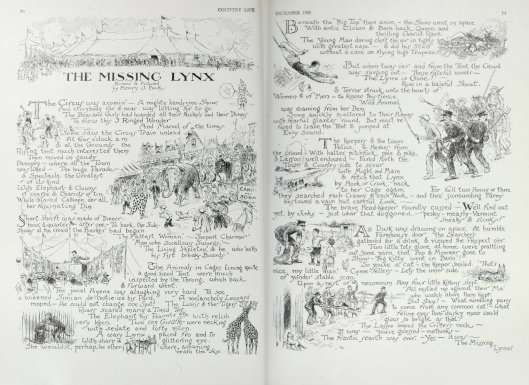
The online record suggests that Providence saw his only gallery show, and all that now remains are pictures in private hands. Lovecraft spoke to the artist at the launch of the show, and urged him to publish a book of the Providence work. But it was not to be. All that appears to survive is a catalogue for Glimpses of Providence, with a single picture, which is noted in the Moe letters. This is elsewhere noted as…

a small catalogue for an exhibition of drawings, “Glimpses of Providence and Vicinity,” by Henry J. Peck

The new Industrial Trust Building of 1928, looming over the old rooftops.

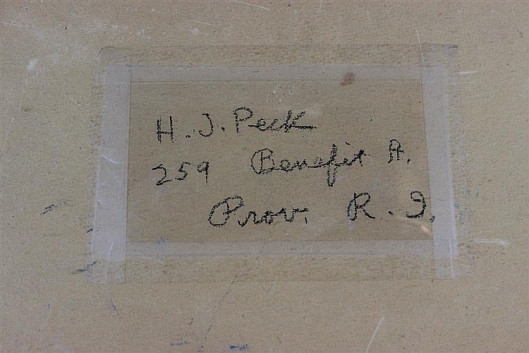
Lovecraft sent copies of the catalogue to Moe and Wandrei, and possibly to other correspondents. A label on a picture-back suggests Peck may once have had a studio in Providence in the 1920s, on Benefit Street, possibly while seeking out scenes and making the drawings for the 1928 show. But it seems he did not encounter Lovecraft before the big pre-Christmas 1928 show, and no contact was made afterwards.
Where is Peck’s body of work now, as indicated by the catalogue? Work which might be so useful now to illustrate “Lovecraft’s old Providence” of the 1920s, beyond the main well-known buildings and sights? Mostly sold and dispersed, by the look of it. One hopes that the finer etchings at least are ‘safely lost’, quietly folded away for posterity in some neglected archive. But no such online record page seems to exist for such a holding, and a search of the RISD archives database also suggests nothing. But one such recently came up for the auction, going for a pitiful $30, and the auctioneers kindly left a large scan online.
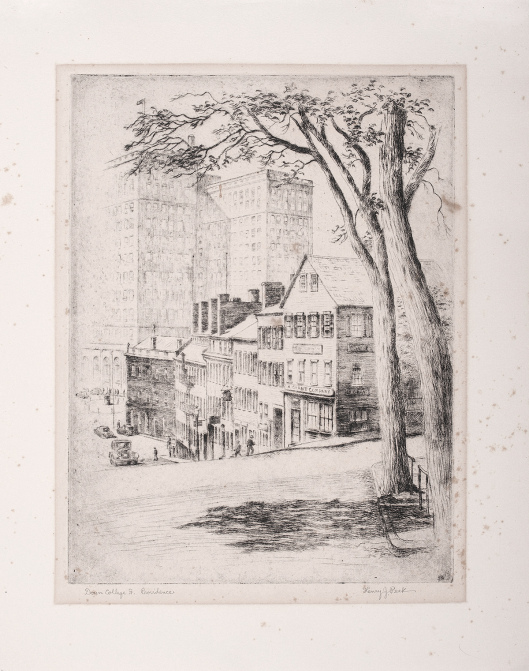
“Down College Street” (1928). A familiar-seeming man climbs the hill with a book or bundle of letters.

Toward the end of his life Peck did produce a book, a history of his home town of Warren in the form of 200th Anniversary of Warren, Rhode Island. Historical Sketch and Program 1747-1947.

Zanzala: Revista Brasileira de Estudos de Ficcao Cientifica

I’m pleased to find the new-ish Brazilian journal Zanzala: Revista Brasileira de Estudos de Ficcao Cientifica (trans. ‘Zanzala: Brazilian journal for the study of science-fiction’). Now with four issues available. They appear to be quite interested in monsters, for instance they have an article on tropical vampires in the 1950s and 60s and a couple of others in the same line.

The call for articles for the next issue has a deadline of 31st August 2020, and the theme will be: ‘The Contagious Imaginary: fantasy, horror and science fiction in the era of COVID-19’. Articles appear to be in Portuguese, though among the four issues I did spot one article in English.

Also of interest to some, in monster journals, will be the new theory-led academic Journal of Gods and Monsters from Texas.


Another recent item of note from South America is a 40 minute talk on “Lovecraft en Chile”.

Open Lovecraft updated

On the Open Lovecraft page, I’ve removed about thirty links to PDFs on Academia.edu. PDFs there can no longer be downloaded by the public, only by the service’s members or via a search at Google Scholar. The lock-down of the PDFs appears to have happened in the last couple of weeks. My thanks to Dave Higgins for letting me know about this. If scholars want PDFs to be truly open in future, I suggest using a proper public repository instead of closed services such as Academia.edu.

Added to Open Lovecraft

* K. Dimitrios, “Evolution or Degeneration? Darwin’s Influence on R.L. Stevenson’s Strange Case of Dr. Jekyll and Mr. Hyde and H.P. Lovecraft’s “The Shadow over Innsmouth”” (Masters dissertation for the Aristotle University of Thessaloniki, Greece, February 2020).

* K. Kwong, “On Xenophanes’ theology and Lovecraft’s Cthulhu Mythos”, Kerberos, Summer 2020. (Can be had via search on Google Scholar as the complete issue in PDF, where it is also known to Scholar by the title “An Alternative Site for Troy on Imbros Gokceada”, which is the title of the first article in the issue).

* D. Balodis, “Iedomu valodas: H.F. Lavkrafta gramatas ‘Kthulhu aicinajums’ un tas Latviska tulkojuma analize” (‘Fictional languages: an analysis of H.P. Lovecraft’s “The Call of Cthulhu” in its Latvian translation’. A dissertation for the University of Latvia, 2020).

The pageant of Benefit Street down through the years (1945)

Some years ago I linked to the book While Benefit Street was young (1943), and I noted that another book by the same author was not yet online. The other book has now appeared at Archive.org. The Pageant of Benefit Street down through the years (1945) was written by someone who had lived on the street as a child, being then a few years older than Lovecraft.

Lovecraft almost ended up living on that street in 1933, his choice then being between 66 College Street with his aunt or a lone room in the Seagrave Mansion on Benefit Street. An astronomy newspaper column by Lovecraft (Sept 1914) suggests a reason for the second possible choice…

Mr. Seagrave, who is connected with the astronomical department of Harvard University, and who is one of the foremost astronomers of the present time, formerly had an observatory on Benefit Street in this city.

… the implication being that there was still some connection between Seagrave and Lovecraft via astronomy. Frank Evens Seagrave (1860 – August 1934) was still alive at that point and aged 74. Although a letter from Lovecraft, considering his options, implies the old man had by then moved out…

the old Seagrave mansion where the noted astronomer F. E. Seagrave dwelt & had his private observatory until 1914

Given that Lovecraft had the offer of a room there, we might plausibly assume that Mr. Seagrave was letting rooms in his old place to suitably refined but impoverished old gents of Providence. And especially so if they had a connection with Brown or astronomy.

New book: Savage Sword of Conan reprint #3 ships, #4 dated

The third volume of the sumptuous Savage Sword of Conan reprints is now shipping in the USA, including a 160-page Conan the Buccaneer adaptation that is effectively a graphic novel. No sign of the book on the UK Amazon, though. Update: now listed in the UK. Volume 4 is announced in the USA for November 2020, adding another 900+ pages of reprints.

Not to be confused with Conan the Barbarian: The Original Marvel Years Omnibus. Savage Sword was the oversized b&w magazine edition, aimed at older readers than those browsing the spinner-racks of the monthly colour Marvel superhero comics.