H.P. Lovecraft’s “The Familiars”, and “The Pigeon-flyers”, from Weird Tales for January 1947.


31 Saturday Oct 2020
Posted in Odd scratchings
H.P. Lovecraft’s “The Familiars”, and “The Pigeon-flyers”, from Weird Tales for January 1947.
30 Friday Oct 2020
Posted in New books, Scholarly works
Now listing on both Amazon and Hippocampus for 31st Oct 2020, Eccentric, Impractical Devils: The Letters of Clark Ashton Smith and August Derleth. 602 pages from Hippocampus Press, edited and annotated by David E. Schultz and S. T. Joshi.

Additional information is found in a March 2019 blog post by S.T. Joshi…
Recently a previously unknown batch of Derleth’s letters to Smith came to light, causing us to refashion the book almost in its totality — and forcing me to re-index nearly the whole of the book. Gawd, what a nightmarish task! But the job is done at last, and I hope the book will emerge soon — along with the huge Clark Ashton Smith bibliography that Scott Connors, David E. Schultz, and I have edited.
Ouch, it sounds like he indexes by hand. Someone tell him about the automated PDF Index Generator, which would at least take care of much of the heavy-lifting of index-building.
30 Friday Oct 2020
Posted in Historical context, Picture postals
This week, yet another aspect of College Street as Lovecraft and his aunts would have known it. At the corner of Benefit and College Streets stood the headquarters of the Handicraft Club.

The artistically grown trees were apparently magnolias, and these later grew up substantially and when in leaf they obscure several later photographs of the frontage.

The Club was established there in 1905, and a rigorous approach soon attracted a healthy membership of skilled crafts workers. The place was extensive and there was a showroom and an annual exhibition of new crafts work.
It was here that one of Lovecraft’s aunts lived in 1927…
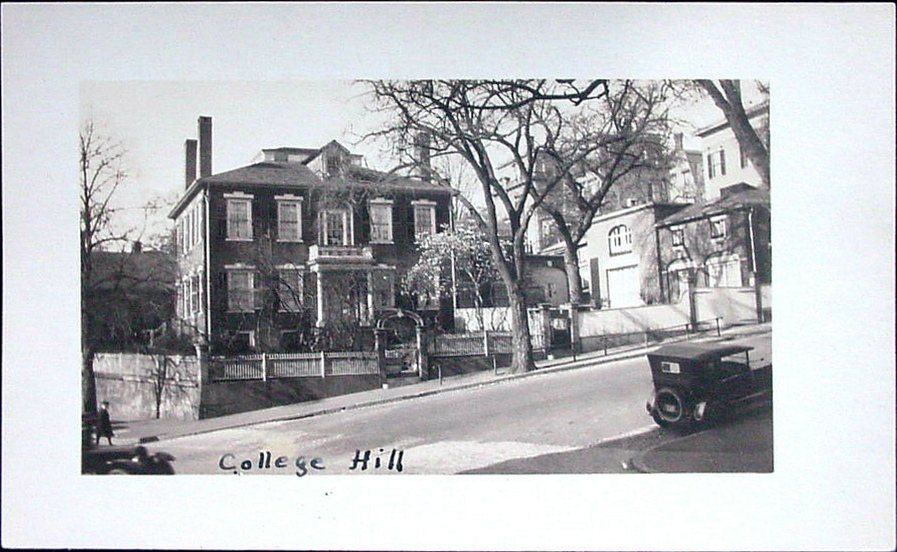
… half-way up [College Street] my aunt boarded in 1927 at the Handicraft Club in the old Truman Beckwith house. You doubtless recall that brick edifice and its old-fashion’d terraced garden.” (letter to Morton, Selected Letters IV)
S.T. Joshi writes of this period in I Am Providence…
We do not know much of what Lovecraft was doing during the first few months of his return to Providence [from New York City]. In April, May, and June [1927] he reported seeing several parts of the city he had never seen before, at least once in the company of Annie Gamwell, who at this time was residing at the Truman Beckwith house at College and Benefit Streets.
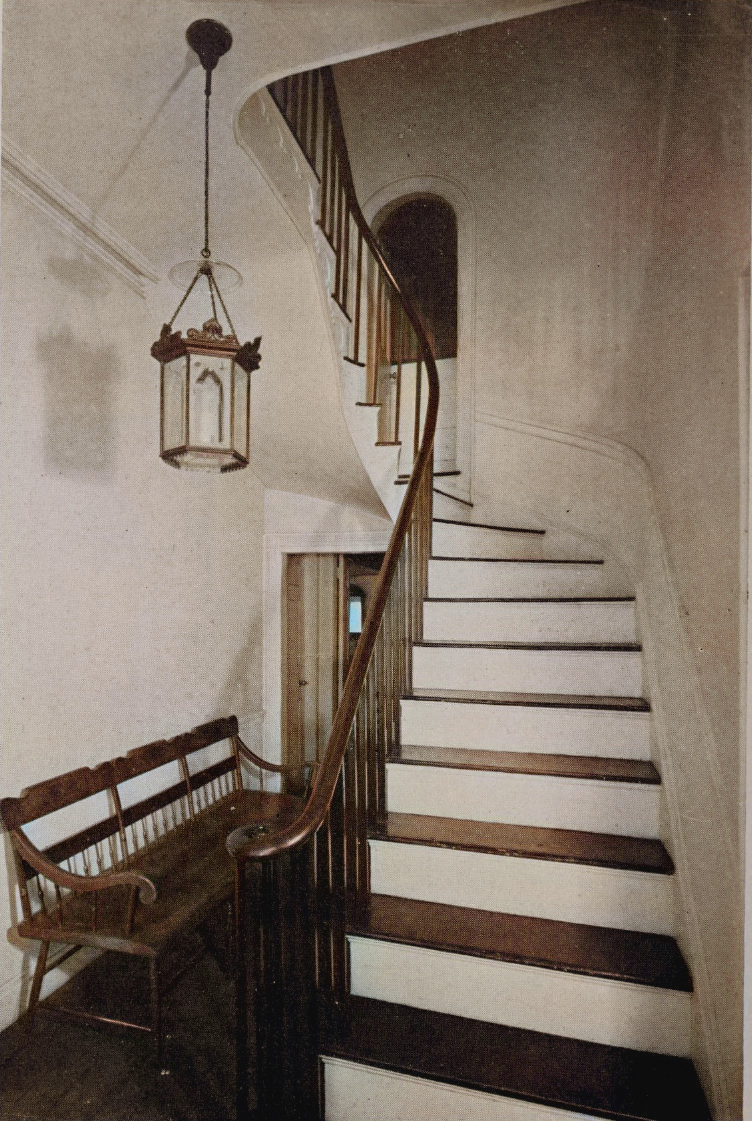
We do however know just a little of why his aunt might have been there. In 1925 the House had been purchased to serve as a “permanent home” (Handicrafts Of New England, page 321) as well as a clubhouse, and we can probably assume this was why Annie Gamwell could live there — if only for perhaps a single summer season of board and lodging. It seems plausible to assume that Lovecraft took the opportunity of his aunt’s residency to thoroughly appreciate the fine architecture. The Library of Congress has a detailed plan-book of the entire house, evoking all the details of the craftsmanship that Lovecraft would have thus admired. Though a photograph perhaps better evokes the interior that his aunt would have enjoyed at that time…
Atheist though he was, a few years later the mellowing Lovecraft was able to amiably enjoy an old traditional custom. Christmas 1933 found him listening to carols sung in the Handicraft Club courtyard…
Fixed up the sitting-room hearth with greens and surprised my aunt — and borrowed a cat for the occasion. Heard carol-singing in the early evening in the quaint cobblestoned courtyard of the Georgian Beckwith mansion (where my aunt was in 1927) halfway down the antient hill.” (letter to Morton, Selected Letters IV)
a turkey dinner at the boarding-house across the back garden & a stroll half-way down the hill to hear the carol-singing at the old Truman Beckwith mansion. I took the midnight coach & arrived in Manhattan the next morning —” (letter to Toldridge, Selected Letters IV)
29 Thursday Oct 2020
Posted in Lovecraftian arts, Scholarly works
Providence’s Brown University has a fully-funded PhD opportunity in Music and Multimedia Composition, which may be of interest to those making Lovecraftian music or sonic environments…
Students have access to the department’s Multimedia and Electronic Music Experiments (MEME) studios, and the university’s Granoff Center for the Creative Arts. These specialized research facilities house recording studios, electronics shops, project studios, exhibition and performance spaces. … faculty specialties in technoculture, sound studies, copyright, improvisation and timbre.
28 Wednesday Oct 2020
Posted in Historical context
The themes of the annual Providence Art Club Costume Party, 1913-26. A curious thing, but his aunts were in that circle and it’s not impossible that Lovecraft might have occasionally provided a few lines of verse on the year’s chosen theme. However, the 1919 date of the science-fictional “A.D. 2000” party doesn’t match with Lovecraft’s very early poem of 1912, which had imagined “Providence in 2000 A.D.”

27 Tuesday Oct 2020
Posted in Historical context, Night in Providence
Did Lovecraft ever mention Halloween as a day of pranks? Well, he knew of its prankish traditions. In his Department of Public Criticism (January 1919) column he gives a few comments on the contents of The Brooklynite for November 1918…
Mr. A. M. Adams is more successful as an essayist, and manages to infuse some real, glowing, and practical patriotism in his colloquial discourse on “Halloween Pranks”. We are glad to see so virile a piece at this particular time…
But no, he doesn’t discuss it in any volume of letters I have access to, either historically or in terms of mentioning that neighbourhood kids had come knocking on the door offering ‘trick or treat’. Though there are headers in a couple of letters. On 31st October 1931 he dated a letter to Cole as simply… “All Hallows”, and two years later he did the same with a letter to Morton.
So far as I can tell the letters hint only twice at any sort of Halloween activity on his part. To Dwyer, on being sent a drawing of Pickman’s Model, he comments (3rd March 1927) that…
At Roodmas and All-Hallows’ shall I view it, and the Objects squatting on nearby coffins or peering monstrously over my shoulder shall shudder as they gaze upon its forbidden revelations.
Remarking to Donald Wandrei (3rd November 1927) on his recent reading of The Aeneid in the 1906 James Rhoades translation, he also comments on his “spectral thoughts” at Halloween…
This Virgilian diversion, together with the spectral thoughts incident to All Hallows’ Eve with its Witch-Sabbaths on the hills, produced in me last Monday night a Roman dream of such supernal clearness & vividness, & such titanic adumbrations of hidden horror, that I verily believe I shall some day employ it in fiction.
And that’s about it so far as I can tell, apart from the use in fiction. No comments in letters on the local tradition of “Halloween pranks”, if such things were even permitted in Providence. Though admittedly I don’t yet have the two volumes of his letters to his aunts, so may be missing some mentions in letters. But I’m sure S.T. Joshi’s I Am Providence would have noted any in-person trick-or-treating in company with his aunts (“I’m H.P. Lovecraft, I don’t need to wear a mask…”). Given the evidence above he might have marked the date merely with some “spectral thoughts” and perusal of a few especially shuddersome sketches. Possibly it also often marked more or less a terminal date for his summer walks, and the onset of his usual winter hermitage.
Though he did leave us this March 1926 National Amateur poem, later reprinted in the September 1952 issue of Weird Tales…

If written for Halloween 1925, as seems likely, this would make it a poem from the Red Hook period. A time in which Lovecraft trekked out (often in vain) on what he called “exploring trips” to find relatively unspoiled suburbs of New York City. There he might find a place to walk, often at night, and enjoy for a while a lingering old-time atmosphere and the occasional company of a wide-eyed cat or two. His 1925 Diary seems to confirm my supposition: 28th Oct “Paterson” [he visits Morton in Paterson]; 29th Oct “Start poem”; 30th Oct “Finish poem”.

This doesn’t mean that the ugly suburb of the poem is Paterson, but that the trip there may have sparked the idea of the poem.
A letter adds to the Diary, and suggests why he might have been in the mood to write. Just before starting the poem he had heard that afternoon that Weird Tales had accepted his story “The Horror at Red Hook”. Also, we learn that the landlady had finally put a fire in the furnace of his until-then unheated building.
For Halloween itself the Diary shows he met Kirk and Loveman, and the Kalem Klub meeting that developed broke up at 5am the following morning. Lovecraft wandered back through the darkened streets to his room in Red Hook. The evening appears to have been marked by no special festivities, though it is quite possible his new Halloween poem was read there. So we do have, perhaps, some hints that Lovecraft marked at least one Halloween by penning a new poem.
Perhaps anticipating the acceptance of “The Horror at Red Hook”, a few weeks earlier Lovecraft had been considering how to sprinkle his writing with more convincing occult mumbo-jumbo than that he had briefly used back in the summer in “Red Hook”. In a letter to Smith on 9th October 1925 he remarked…
I have frequently thought of getting some of the junk sold at an occultists book shop in 46th St. The trouble is, that it costs too damned much for me in my present state. [and he then asks Smith for] a more or less brief list of magical books — ancient & mediaeval preferred — in English or English translations.
… presumably to see if the various New York Libraries might have free copies he could make notes from. Or perhaps the list of titles might be passed to those in the book trade, such as Kirk or Loveman, who might know of a reprint.
What of the “46th St.” occult bookstore he mentions? It can’t be the famous Weiser store, as that did not open until 1926. Possibly Lovecraft had been taken to the Gotham Book Mart, and was mis-remembering 45th as 46th? Because the famous bookseller and anti-censorship champion Frances Steloff had opened this in 1920 (a 1921 Publishers Weekly has it at “128 W. 45th St”). According to her biography her shop only sold books she liked — her tastes being almost entirely in the then-emerging modernist literature and spiritual/occultist books. One can imagine which section of the shop Lovecraft headed toward. That the books were all too expensive for him, and perhaps also too ponderous, may have been part of the impetus toward inventing his own rather more lively mythos.
He did, however, later recall seedier New York sellers of such material…
“the mystic bookstalls with their hellish bearded guardians … monstrous books from nightmare lands for sale at a song if one might chance to pick the right one from mouldering, ceiling-high piles”
26 Monday Oct 2020
Posted in New books, Scholarly works
A new Italian book, Mitologi, mitografi e mitomani (Mythologists, Mythographers and Mythomaniacs: traces of myth through the centuries). Many medieval chapters, but the book concludes with Alessandro Fambrini’s “Howard Phillips Lovecraft e Friedrich Nietzsche: sogni di dei e di superuomini”…
Lovecraft read Nietzsche and quoted him repeatedly. This article attempts to investigate the influence and consequences of the German philosopher’s thought in Lovecraftian fiction.

25 Sunday Oct 2020
Posted in Podcasts etc.
I’m pleased to find that Phil Dragash’s marvellous full-cast/full-symphonic unabridged version of The Lord of The Rings was uploaded to Archive.org in Summer 2020, in its final 2013-14 version…
* The Fellowship of the Ring. Note that the chapter “A Journey in the Dark” has a small encoding skip, also present on other online versions, which cuts a few minutes relating to the initial search for the doors of Moria and the unpacking and warding of Bill-the-pony. Also, “13. Lothlorian” and “21. The Great River” are 2013 versions, and I prefer the originals which are in the Limetorrents version.
* The Return of the King (and one of the Appendices, “Durins’s Folk”).
To legally download this you have to own the three books, the extended-cut three-DVD movie of The Lord of the Rings, and the official soundtrack album for the cinema version. To hear the full Appendices in audiobook form, you’ll want the official unabridged audiobook reading. This is commercial, and will also give you the small missing section from Phil Dragash’s Fellowship.
There’s a Digital Art Live magazine interview with Phil here, as he’s also a digital artist… as well as possibly the world’s best vocal mimic since Mike Yarwood.
25 Sunday Oct 2020
Posted in Scholarly works
New on Archive.org to borrow, Greenwood’s 1977 book The H.P. Lovecraft Companion, which I described here a while back as a first…
“‘high pass’ over Lovecraft’s work, written by a Sherlock Holmes fan and newspaper book-critic.”

With what must have then been a useful try at a map of the Dreamlands…

24 Saturday Oct 2020
Posted in Scholarly works
S. T. Joshi’s blog notes that his new journal Penumbra: A Journal of Weird Fiction and Criticism has landed on the doorstep. Now available from Hippocampus. Non-fiction items of interest include…
* The Cosmic Scale of Elfland.
* The Idea of the North in the Fiction of Simon Strantzas.
* Finding Sherlock Holmes in Weird Fiction.
* “The Weird Dominions of the Infinite”: Edgar Allan Poe and the Scientific Gothic.
23 Friday Oct 2020
Posted in Night in Providence, Picture postals
This week, more night views of Providence, this time as the young Lovecraft would have known it on night-walks. These two are early 1914 views made by the Providence artist Whitman Bailey (1884-1954). Lovecraft then aged in his early 20s.


Prospect Terrace was, of course, one of Lovecraft’s favourite places in his city. Neither picture is in my Whitman Bailey ebook collection, available here.
23 Friday Oct 2020
Posted in Historical context, REH
DMR considers a plausible alternative ‘cosmic’ influence on Robert E. Howard, Abraham Merritt.