A new species of squid has been named after Cthulhu…
“We have named it the Stoloteuthis cthulhui in honour of Cthulhu, the cosmic entity created by the writer H.P. Lovecraft”
It lurks off the east coast of Spain…



27 Tuesday Apr 2021
Posted in Odd scratchings
A new species of squid has been named after Cthulhu…
“We have named it the Stoloteuthis cthulhui in honour of Cthulhu, the cosmic entity created by the writer H.P. Lovecraft”
It lurks off the east coast of Spain…
26 Monday Apr 2021
Posted in New books, REH, Scholarly works
Well, well… an issue of The Dark Man, journal of Robert E. Howard Studies, snuck-out the door at Christmas 2020 (Vol. 11, No. 2). It’s news to me, and perhaps to you. Looking at the TOCs it seems like it’s worth my getting a copy this time around, as all items sound at least interesting. Though at present it’s not yet in ebook.
The Dark Man, Volume 11, Number 2, 102 pages.
Articles:
* “Harsh Sentences: H.P. Lovecraft vs. Ernest Hemingway” by Bobby Derie.
* “A Publication History of The Dark Man” by Luke E. Dodd.
* “Illustrated Auguries: Images Out of Time” by Phil Emery.
* “Deviations from Realism in High and Low Literature” by Jason Ray Carney.
* “Cosmic Horror: Lost in Translation” by Jacob Lindner.
* “A Brief Analysis of the Aesthetic of Weird Tales” by Mara Tharp.
Reviews:
* Book: The Howard Companion, by Richard Toogood. Reviewed by Gary Romeo.
* Book: Fantastic Paintings of Frazetta, by J. David Spurlock. Reviewed by Dierk Gunther.
25 Sunday Apr 2021
Posted in Scholarly works
S. T. Joshi’s Blog has updated, and heralds a host of forthcoming books: a new third volume of Robert H. Waugh essays on Lovecraft; Ken Faig Jr.’s Lovecraftian People; a book of essays by Matt Cardin “on weird fiction and philosophy”; Joshi’s own The Recognition of H.P. Lovecraft; and Lovecraft’s Letters to E. Hoffmann Price and Richard F. Searight. For the latter Joshi adds that this will be the “first complete publication of the letters to Price”.
25 Sunday Apr 2021
Posted in Historical context, Scholarly works
Now arriving on Archive.org from microfilm, the last of a run of the local history journal Rhode Island History 1942-2011 with indexes. They were previously only online to 2008, and only at the Historical Society website — for which the old Web link now yields only the bare warning “Forbidden”.
Lovecraft appears to be unmentionable in the journal after 1954, but one early and fair assessment is found in Randall Stewart’s survey article on “Rhode Island Literature” (January 1954)…

The journal has occasional pictures, but these have not been treated kindly by the microfilming process.
25 Sunday Apr 2021
Posted in Odd scratchings
The now very collectable book Dreams and Fancies (Arkham House, 1962) opens with the title section, consisting of Derleth’s pick of…
Fifty-nine pages of Lovecraft’s letters describing his dreams.
I was interested to learn about this. Since I have the H.P. Lovecraft Dream Book from 1994, but on flicking through it I see it only ran to 35 pages of actual dreams.
Whence came the additional pages? Was Derleth perhaps including dream-fragments such as “The Book”, which would make this Dreams and Fancies section longer? But that can’t be the case with “The Evil Clergyman”, at least, since an eBay picture shows that fragment appearing later in the book.
25 Sunday Apr 2021
Posted in New books
Wormwoodiana blog’s Mark Valentine has a new book of his writings, Sphinxes & Obelisks…
a new volume of essays on rare books and recondite subjects.
Available as a Tartarus Press limited-edition of 300.
25 Sunday Apr 2021
Posted in Historical context, Scholarly works
There’s a new issue of The Fossil freely available online.
David Goudsward tugs on a jungle creeper and swings manfully over the early Tarzan movies filmed at Silver Springs, Florida. He finds them to be mere phantasms of the river-mists, and that Lovecraft was actually wrong in his letters. None of the Tarzan films made during Lovecraft’s life were filmed along the river, though Goudsward posits that some ‘splicing in’ of old newsreel clips of underwater swimming in the pools. This would have allowed the Silver Springs promoters to make the claim and technically be correct. The article gives a taster of his new book Adventurous Liberation: H.P. Lovecraft in Florida, now said elsewhere in The Fossil to be set for a release late in 2021.
There is also an article and several reviews of recent academic work on the changing age profiles of amateur journalism, in the years before Lovecraft’s birth.
24 Saturday Apr 2021
Posted in Historical context, Odd scratchings
Newly on Archive.org, the U.S trade magazine for writers The Author and Journalist. It appears to be a complete 1916-69 run.

November 1961, a science-fiction special.
August 1948 had Lovecraft’s tips for constructing a tale, via Rimel…


The canny sub-editor has paired the then-unusual name with an article on choosing a distinctive pen-name, and a verse about love.
June 1959 also has Derleth on “The Biographer’s Goal”…
… in virtually nothing of his work save his letters did H.P. Lovecraft emerge, except by indirection, as a reclusive introvert, who lived far more in the past than in the present … it required some psychiatric knowledge to be able to put together even so short a biography as H.P.L. … The Facts — the known facts — occupied only 12 pages of the biography …
The run, as it stands on Archive.org, also includes The Student Writer.
23 Friday Apr 2021
Posted in Historical context
Lovecraft circle member Everett McNeil, giving good advice in The Student Writer for March 1923.

One can almost hear an echo of his voice at a meeting of the Kalems…
Don’t be deceived by the editorial howl for original plots. Editors don’t want original plots, and authors could not supply them if they did. The last of the strictly original plots was used centuries ago. Even Shakespeare did not create an original plot. An editor would shy violently at sight of an honest-to-goodness original plot. It would be something he had never seen before, something that no magazine, at least in his generation, had tried out.
To which we might imagine Lovecraft pushing back with a comment on new modern ways of telling the story, at least, and musing “Hmmm… The Call of Cthulhu…”.
McNeil may also give us a hint of why he was paid such low rates for a book…
The [book royalty] payments may be scattered over all the years of the copyright, fifty-six in all.
Though that still does not explain why an elderly (elderly, by the expectancy of the 1920s) professional writer would settle for terms that would outlast him by some forty years.
23 Friday Apr 2021
Posted in Historical context, Picture postals
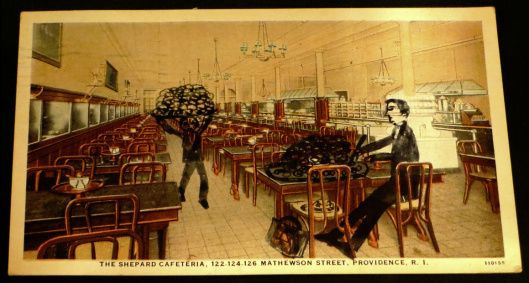
Another picture from Lovecraft’s momentous homecoming-day from New York City, which I presume I am soon to encounter again on starting the second volume of Letters to Family. I had already looked at the Art Club and the Strand cinema. Now there’s a newly found picture of the interior of “Shepard’s (neo-) Colonial Restaurant”, also mentioned as a place visited in celebration. Not great, as postcards go, but there are two pictures and it gives an indication. I suspect the blank space may have once held a miniature paper year-calendar. The picture on the right is faintly marked “Club Parlor”.

We went out to an exhibition of paintings at the Art Club, (the colonial house in hilly Thomas Street, in front of which I snap-shotted Mortonius last fall [1923] and had dinner downtown at Shepard’s (neo-) Colonial Restaurant. In the evening a cinema show at the good old Strand in Washington Street completed a memorable and well-rounded day. (Selected Letters II)
Presumably one of his aunts was a member, and could invite family guests. Not the same as his favourite and more affordable Shepard Cafeteria in Providence. Here we see a boy waiter (his face made somewhat animalistic by the chairs seen through the pen-work) bearing a second tray of do-nuts to feed Lovecraft as he dines at the Shepard Cafeteria.
Different version…

22 Thursday Apr 2021
Posted in Lovecraftian arts, New books
Now there’s an idea…
Men try to build model railways that are exact miniatures… ‘Crewe 1959’ and so on. [But] there’s definitely more room for fantasy model railways. I would maybe build The H.P. Lovecraft Line.
I was never a practitioner in any serious way as a boy, but it’s still regrettable to hear that the tabletop craft is not being passed down from father to son in the way it once was. It seems destined to join the ‘Endangered Traditional Crafts’ red-list. I imagine that one thing that might pep up the appeal for pre-teens would be to cross-breed it with tabletop fantasy-horror RPGs and card-games. Many might also enjoy a few hours with a ‘Providence 1890-1937’ model railway builder-sim PC game, if it’s chock full of enjoyable Lovecraftian horror elements. Kind of like Sid Meier’s Railroads, but with night-gaunts and tentacles and tunnels under College Hill.

If the meantime the kids have yet another story/colouring-book heading their way this summer.

Slightly heavier in tone, there is also a major new tabletop game from the Achtung! Cthulhu guys. Against The Gods Themselves will be an easy-play story-driven game of time-travelling Nazis, it seems.
22 Thursday Apr 2021
Posted in Lovecraftian arts, New books
I see that Chaosium’s 2006 one-volume Malleus Monstrorum was republished in two handsome volumes at the end of 2020. Originally a 300-page oversize compendium of the Call of Cthulhu RPG mythos monsters and gods, illustrated… “entirely with classic works of art and vintage photos, some real, many cleverly forged” as one reviewer put it. Of course it slithered into Derleth territory and even stretched to Ramsey Campbell, Brian Lumley, and Colin Wilson — but failed to embrace the Dreamlands since that was done in another Chaosium book. “Lovecraft fans interested in the book for non-gaming purposes will probably be disappointed” the reviewer of the 2006 edition usefully concludes, thus saving writers cash and disappointment.

Still, it’s worth a quick flick-through in PDF just for the clever art. Also to know what to avoid. I mean that it may be ‘negatively’ useful for writers who need to be sure that their ‘new’ monster is not actually similar to what has already been done in the extended Mythos. In that sense this could be a useful second-opinion after the un-illustrated Cthulhu Mythos Encyclopedia and other sources such as the Dreamlands book.
However, the budget PDF version of the 2006 original has been removed from sale, and the paper is now at ‘collectable’ prices. Previews of the new 2020 two-volume set suggest why — the old 2006 layout is gone… its eccentric home-brew mix of “classic works of art and vintage photos” has been removed and replaced by more generic ‘fantasy card-art’ style illustrations. These are presumably unlikely to puzzle today’s card-collecting kiddies, or to offend the Holy Inquisition of the Perpetual Outrage.

New edition.

Old edition