CQuill Writer 1.x

New from the makers of Dynamic Auto-Painter (DAP), CQuill Writer. It’s just had the first update for 1.0. The free version is…

Offline and “fully working and non-expiring version with limitations. It still offers a whole range of writing and plotting tools to is perfectly usable for smaller to medium sized projects … [CQuill Writer is] unlike anything else because that was the whole idea behind making it

The Style Assistant is based from a specific work of an existing author … Style Assistant comes from written books (e.g. Pride and Prejudice) and it instantly shows examples of entire phrases. … If the Assistant stumbles upon a word that the author didn’t use or like, it will try to suggest another word, more common for the author’s style. … If you can get a book in plain TXT format (for now), you can load it and create your own Assistant.

So… all that could come from Lovecraft. Although making your own Style Assistant is a feature of the paid version, currently at the introductory price of $47.

Videos: Create your own Smart Writing Assistant and How to Generate Author’s Thesaurus from multiple books.

A hands-on test shows it lubricates the writing quite well, and I had the opening paragraph of an Anne of Green Gables tale before I knew where I was. Here are the modules that ship with the latest free version.

IMAGE MISSING

You also get a free ‘Monkey Typist’ that can complete your current sentence, possibly with amusing consequences.

‘Providence Blue’ author interview

There’s a new 35-minute podcast interview with the author of the new Catholic Lovecraft / R.E. Howard/ Providence novel Providence Blue: A Fantasy Quest. “Lovecraft, fantasy literature, and Christ: A conversation with novelist David Pinault”. Warning: even the podcast blurb most likely has spoilers for what sounds like rather a good read. Probably best stashed and listened to after reading the novel, though there’s still no ebook available.

New book: El Astronomicon Y Otros Textes

A new Lovecraft translation from El Paseo in Spain, El Astronomicon Y Otros Textes En Defense De La Ciencia (‘The Astronomicon and Other Texts in Defence of Science’).

For the first time in Spanish, the writings on astronomy and science of the genius of fantastic literature, H.P. Lovecraft. Includes his astronomy manual and controversial science writings.

“Controversial”? Possibly some extracts from the letters, then, I’d guess? Musing on the sciences and pseudo-sciences of the day?

S. T. Joshi’s blog brings additional translation news. New volumes of Arthur Machen in Portuguese, and Wilum Pugmire in German.

Great Scott!

A new one from S.T. Joshi that I hadn’t been expecting, not having seen it mentioned on his blog. Newly listed at Hippocampus, Phantasmagoria: The Weird Fiction, Poetry, and Criticism of Sir Walter Scott. As I noted here recently, Scott was an influence on Lovecraft at a formative time (and probably also on Tolkien as well, in his interweaving of high and low culture). A fine cover, and just $20 rather than an expensive limited-edition hardback.

Even more on Harlem

Further to my request-essay on Lovecraft and Harlem and a later small update, I’ve now discovered that a lengthy 1934 letter to F. Lee Baldwin has just over a page from Lovecraft on the Harlem of the early 1930s. It’s in the Baldwin letters in pages 65-67. Curiously Harlem does not appear in the index. Nor is it folded into New York City in the index.

I was previously able to get some of the letter, but now have all of it as I have the book. There Lovecraft notes…

Black Harlem itself I largely know from ‘bus windows — the coach lines from Providence passing down Lenox or upper 7th Avenue through the heart of the district.

It seems to be implied that these long-distance bus trips occurred after his mid-1920s New York sojourn, and were part of his occasionally visiting New York City in the 1930s. Evidently he preferred the soaring ‘elevated’ as a more magisterial means to enter New York, but sometimes his travels must have deposited him at a location that meant had had to take the bus into the city.

He gives Baldwin a good account of the boundaries, history, demographics and inter-group rivalries of the Harlem area. I would guess much of this was gleaned in conversation when his friend Morton was living in the city, with certain aspects drawn from Whitehead and Sechrist — who were very familiar with the various origin-groupings and inter-group rivalries involved. Although generally Lovecraft was also remarkably well-informed about the demographics and locales of the city beyond Harlem. One even wonders if there was some sort of long-forgotten annual detailed demographic map for the city, being published in the 1920s and 30s? One might of course also credit his slow daily osmosis of information from the newspapers, week in week out, and his cuttings files — which must have been quite extensive by 1934. Such a pity they’ve not survived. Apparently Brown Library had the HPL press “clippings” collection in 1944, but their whereabouts appears to be unknown today.


Also in the Baldwin letters, and relevant to my recent ‘Rhoby’ post, is Lovecraft mentioning another small data point… that she was also an accomplished artist in terms of drawing and painting. He was lamenting that the talent for drawing did not appear to have descended to the male line, namely himself.

The Thing in the Moonlight

An unusual ‘letter + story’ reading from Horrorbabble, “The Thing in the Moonlight” by H.P. Lovecraft, new on YouTube…

“The Thing in the Moonlight” is a short story based on one of H.P. Lovecraft’s dreams by Chapman Miske, first published in the January 1941 edition of Bizarre magazine. This recording includes both the letter Lovecraft sent to Donald Wandrei detailing the dream, and the short story itself.

The text is very short, and hardly a story. Derleth later ranked and published it as a “fragment”. But Horrorbabble reads it and the letter at 11 minutes.

Who was Chapman Miske? He was co-editor of Scienti-Snaps with Walter E. Marconette, and being duplicated this title would now be termed a fanzine. But obviously one of quality. Scienti-Snaps had earlier done something similar for Lovecraft by publishing one of several versions of the ‘Lovecraft as Roman’ dream, as “The Very Old Folk” in Summer 1940. This was accompanied by the bio-article “H.P. Lovecraft: Strange Weaver” and the poem “The Nightmare Lake”.

Scienti-Snaps was then renamed Bizzare in Summer 1940, and given a more news-stand appearance. But it failed after one issue. Hevelin Fanzines has Bizarre #1 scanned. Here is the Hannes Bok cover and the first page of the Lovecraft appearance.

Regrettably Hevelin Fanzines doesn’t appear to have the Scienti-Snaps issue for Summer 1940, the ‘Lovecraft Special’. However, its “H.P. Lovecraft: Strange Weaver” article is to be found collected in the book A Weird Writer in Our Midst.

‘Picture postals’ from Lovecraft: In the White Mountains

In the spider-haunted Haverhill offices of the amateur journal Tryout, Lovecraft wrote the first of his published summer travelogues. It was a hasty, jotted affair, written to please the venerable old editor and give him some copy. But it was published and thus gives us a clear account of what he was doing and where he was going in the second half of August 1927. It appeared in Tryout for September 1927, titled “The Trip of Theobald”. One small point it reveals is Lovecraft’s first real experience of genuine mountains. As a young boy he may well have glimpsed some in a hazy blue distance from a train, but here he means mountains ‘up close’…

Saturday took a cheap excursion to the White Mountains — saw real mountains for the first time in my life, and had some superb views at Crawford Notch. Ascended Mt. Washington by cog-wheel railway, and had some splendid views on the way up, though it rained just as I reached the summit. (from “The Trip of Theobald”)

Postcards suggest it would have been quite an excursion by rail, with elevated bridges sweeping across deep gorges and the view climbing every higher….
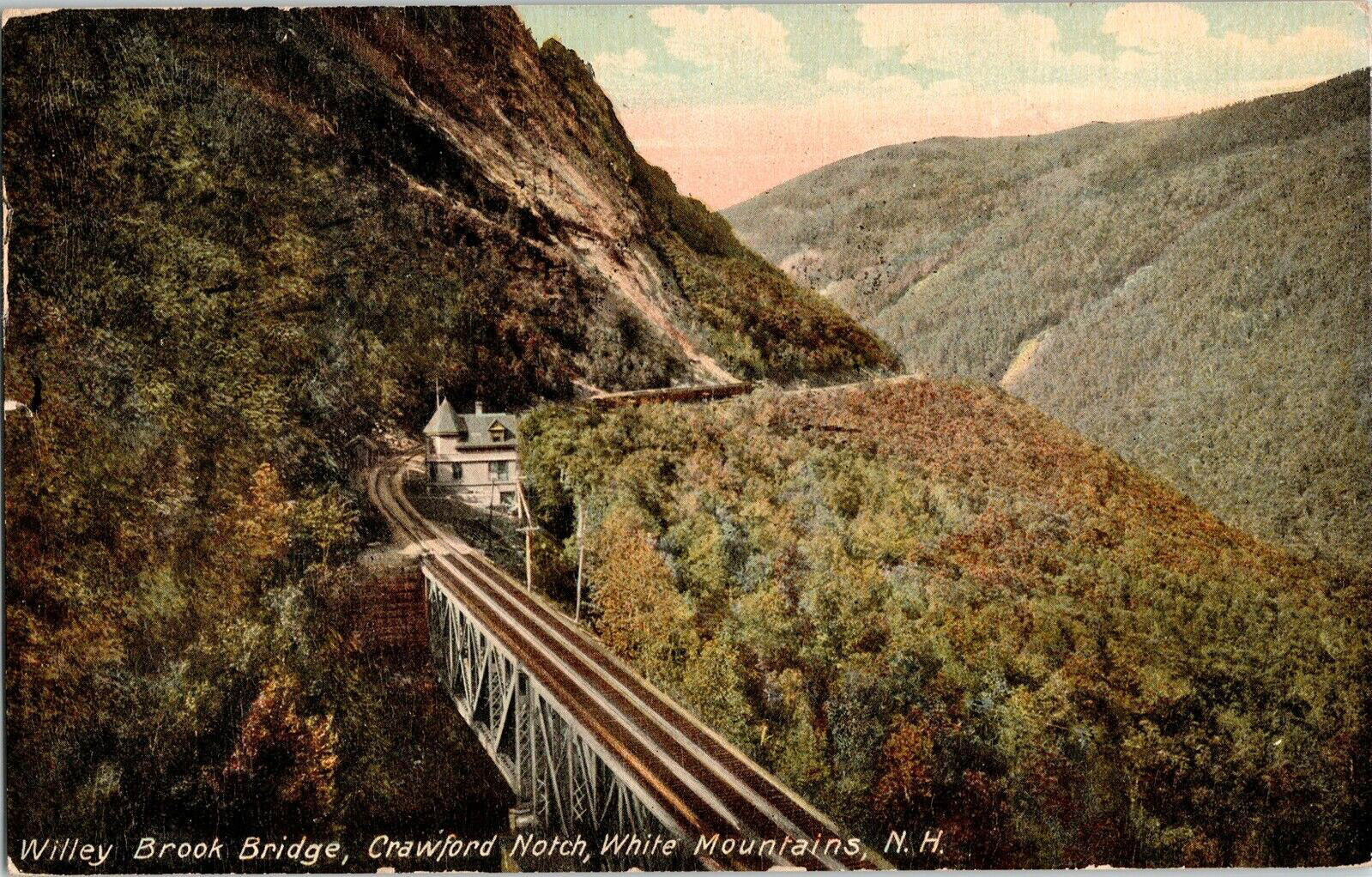
From there he sent Donald Wandrei a postcard of “The Flume, Franconia Notch, White Mountains, NH”.
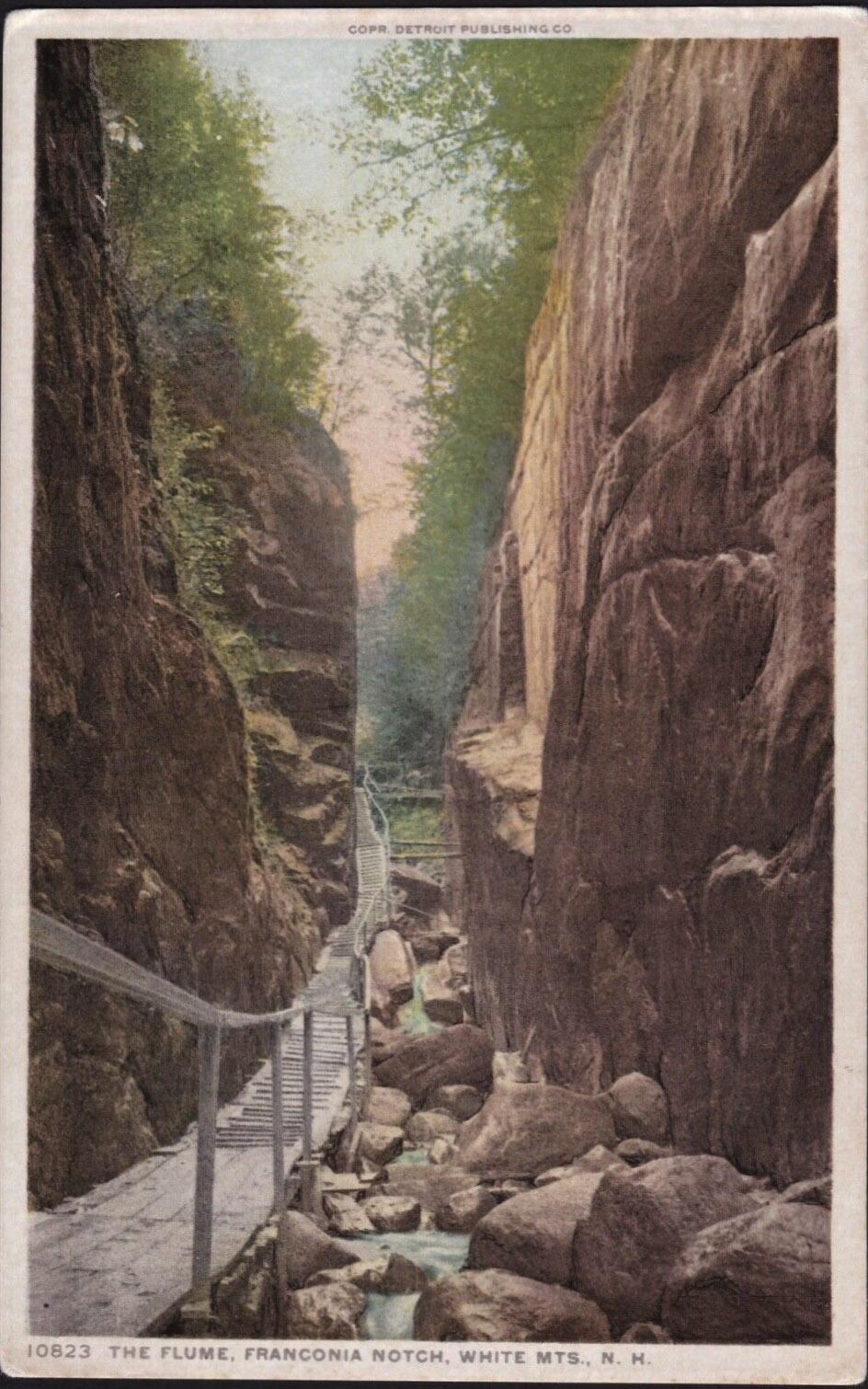
Note the ‘face’ that greets visitors, with an eel-like fish-head alongside it…

Further along the Franconia Notch…

Franconia Notch appears to be where the “Old Man of the Mountains” was, and presumably still is, located or at least to be viewed. This seems a natural place for an excursion to visit. My feeling is that the day’s itinerary was: Franconia Notch and the Old Man; Crawford Notch; and then the ascent of Mount Washington. The high stone head cannot have influenced Dream-quest, since the draft had been completed by 22nd January 1927 — unless Lovecraft knew of the excursion and was researching his August trip for summer 1927 before Dream-quest.

The postcard to Donald Wandrei appears to be the only evidence he was at Franconia Notch. But Lovecraft definitely mentions the Crawford Notch and its view. Here we see the train entering the ‘gate’ of the Crawford Notch…
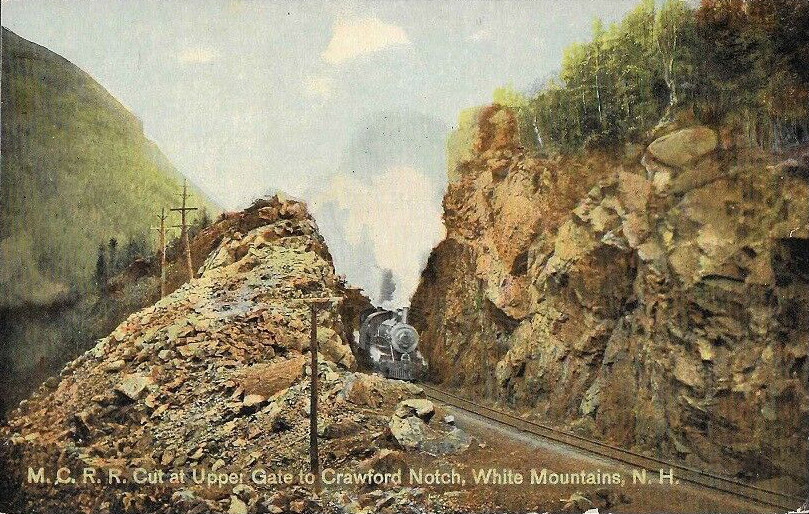
And one of the views, once arrived there…

S.T. Joshi notes that elevations “less than 6,300 feet above sea level” are not technically mountains, despite this large region being sold to tourists in the 1920s and 30s as ‘The Switzerland of America’. But they were impressive nonetheless and — unlike Tolkien who had by then walked the high passes of the actual Switzerland — Lovecraft had nothing to compare them with. In 1929 he recalled their “grandeur”, in a letter to Derleth…

in northern New England we see the same type of landscape features on an enhanced scale – with a ruggedness which now and then (as in the White Mountains and some parts of Vermont) ascends into positive grandeur.

By 1932 he had still not seen a comparable sight. He recalled for Miss Toldrige in August 1932…

I wouldn’t mind seeing some good-sized mountains sooner or later — my mountainous experience having been confined to a single excursion (1927) to New Hampshire’s White Mountains, On that occasion I took the cog-wheel railway up Mt. Washington, but was deprived by sudden mists of a view from the summit. Still, it was spectral up there — with no sign of the earth below, & cosmic winds sweeping by from out of the unknown depths of space. I felt more isolated from this planet — & more potentially in touch with the unplumbed abysses of outer ether — than on any other occasion. The image lingers, & I may make fictional use of it sooner or later.

The cog-wheel railway up Mt. Washington began at the base station…

Here day-trip passengers disembarked and boarded a special high-level ‘mountain train’, seen here in a brochure-leaflet of the period…
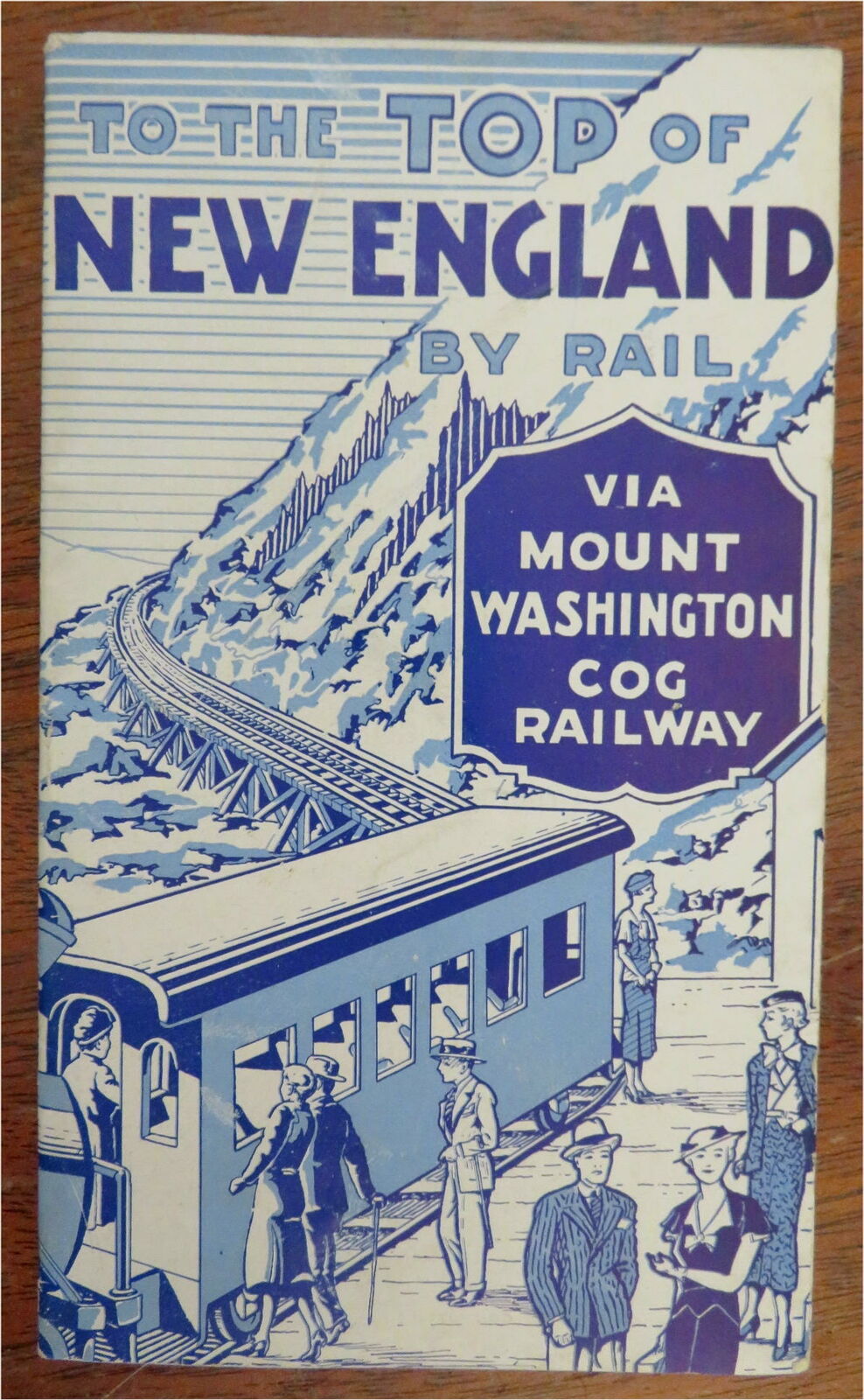
Coming down must have been a bit of a hair-raiser, too.

The same brochure reveals the summit was ‘arctic’ in nature.

Lovecraft had already written At the Mountains of Madness by this point, and one wonders what his comment on this arctic landscape — “I may make fictional use of it sooner or later” — might have led to had he lived.

Here is a view from the summit, as it was when rain and mist did not obscure…

Patreon thanks

I’m pleased to say that my Patreon is now at $92 a month, and the month’s payment has just come through to PayPal. Many thanks to those who have increased their monthly patronage during the last month, it’s much appreciated.

I have one new Tentaclii patron this month. Also one reader of my 3D arts blog was kind enough to also become a new patron, and seems to have joined Patreon just for me. So, two new patrons this month. The appeal to readers / users of my other projects (Creative Stoke / Wild Stoke, JURN etc) fell absolutely flat, sadly — just one promise on Creative Stoke that never materialised.

So… the $100 a month I had hoped for when beginning is now just about in sight. Thanks again to all who are helping me out in this way.

The Spirit of Revision, second edition

There looks set to be a…

hardcover, full-colour second edition of the book The Spirit of Revision: Lovecraft’s Letters to Zealia Reed Bishop

It’s one of the stretch goals for the HPLHS’s Miskatonic Missives crowd-funder. Possibly only available that way, though I guess you might eventually be able to get it via the regular HPLHS Store.

The HPLHS also have a new Voluminous podcast on H.P. Lovecraft, Detective, doggedly solving a dastardly crime at the Haverhill Post Office.

The valuable stolen ‘Dickeybird’ item is a little low-res on their page, so here’s a large one…

Along the way they’ve also found Morton’s article on the virtues of local natural history museums (Oregon Mineralogist, March 1934).

“The Return of the Undead”

Horrorbabble has a new 50-minute reading of “The Return of the Undead” (Weird Tales, November 1925) by Lovecraft’s friend Arthur Leeds. It proved a strong hit with the Weird Tales readers and Lovecraft called it a “splendid tale of a child vampire” in a fever hospital. As I wrote earlier, it is presumably nearly out of copyright now (1st January 2022) and might make for a timely visual adaptation.

Revista Planeta #01

New on Archive.org, Revista Planeta #01 (1964) from Buenos Aires, with an article on Lovecraft by Jacques Bergier in what I assume is Portuguese translated from French. Pages 84-85 of the journal are missing, presumably having having had another facing full-page picture of Lovecraft and thus been removed and framed at some point. One such remains…

Bergier credits Lovecraft with knowing Zulu and other African languages. Lovecraft might well have discussed it with the likes of Edward Lloyd Sechrist, and thus known a few phrases, but I suspect he did not have the patter…

In order to follow this path, Lovecraft began by absorbing much of human knowledge. I never corresponded with such an omniscient being. He knew an untold number of languages, including four African languages: Damora, Swahili, Zulu, and Zani, and numerous dialects. He wrote with identical scholarship on mathematics, relativistic cosmogony, Aztec civilization, ancient Crete, or organic chemistry.

Bergier’s article is followed by a Portuguese translation of “Hypnos”. This is illustrated by Pierre Balas…