New Facebook group: H.P. Lovecraft: Writing, Studies, Scholarship.
H.P. Lovecraft: Writing, Studies, Scholarship
22 Wednesday Oct 2014
Posted in Scholarly works

22 Wednesday Oct 2014
Posted in Scholarly works
New Facebook group: H.P. Lovecraft: Writing, Studies, Scholarship.
18 Saturday Oct 2014
Posted in New books, Scholarly works
17 Friday Oct 2014
Posted in Scholarly works
A handy single searchable PDF with the complete tables-of-contents for Rhode Island History journal, January 1942 through Fall 2007. All rather dry of Lovecraft interest, apart from the late 1970s when there are a few possibly interesting articles such as “The Ku Klux Klan in Rhode Island”, and “Sea Captains Carousing in Surinam,” by Robert W. Kenny. Kenny being the young 18th Century literature specialist at Brown, who was the initial source of Brobst’s information that Lovecraft was once spotted working as a cinema ticket-seller. (Thanks to Ken Faig for the Kenny-Brobst information, though I was the one who discovered that Kenny was an 18th Century literature specialist).
13 Monday Oct 2014
Posted in Scholarly works
* Alejandro Nariman Omidsalar (2014), “Eldritch desires : queer illegibility and proto-cosmicism in Melville’s ‘The Bell-Tower'” (M.A. dissertation for the University of Texas. Combines queer theory with the cosmicist philosophy of Lovecraft to ask new questions about Melville’s treatments of gender and genre in “The Bell-Tower”)
09 Thursday Oct 2014
Posted in Scholarly works
The Windy City Pulp and Paper Convention reports that the 2015 theme will be “H.P. Lovecraft’s 125th Birthday”. 17th-19th April 2015.

Also a call for papers, for the Pulp Studies section of the Popular Culture Association/American Culture Association (PCA/ACA) National Conference in New Orleans in 2015.
06 Monday Oct 2014
Posted in New books, Scholarly works
Steven J. Mariconda, H.P. Lovecraft: Art, Artifact, and Reality, Hippocampus Press, August 2013.
A print-on-demand trade paperback of 308 pages, with a good index. Footnotes are at the bottom of each page, rather than as endnotes. The book is not illustrated, other than on the front cover. There is no ebook edition, as of October 2014. Most of the essays previously appeared in the scholarly journal Lovecraft Studies, the fan journal Crypt of Cthulhu, or similar publications.
H.P. Lovecraft adored a far view of some darkling town in which the lights of old houses were slowly being turned on, one by one, especially if this followed a glorious sunset. Charles E. Burchfield’s art is thus an especially apt choice for the cover of Steven J. Mariconda’s new book. Dating from 1916 his sunset picture seems at first a typical bit of Americana, loose, dynamic, free, naïf, and rooted in place and atmosphere. Yet it is also proto-modernist in its feverishly visionary quality and, like Lovecraft, actually informed by careful training and European sensibilities. There is also an unintended layer of additional meaning: Burchfield’s view of the house could so easily be imagined to show Lovecraft’s upper floor room at 66 College St. And yet, Lovecraft’s room light is not on.
Mariconda certainly turns on the light for readers with this new collection of his essays. He opens his elegantly written new book by pointing to the canny ways in which H.P. Lovecraft “dovetails the real and unreal so seamlessly and pervasively”. He states that the study of Lovecraft thus requires a balance between proven academic methods and a “historical and biographical criticism” of almost Talmudic intensity and depth. Mariconda’s chosen academic methods are New Criticism, which originated in Lovecraft’s own time, and the reader-response methodologies. From which I hazily deduce that Mariconda probably trained in literary criticism during the late 1970s, when those two heavyweight approaches were apparently reconciled. My guess seems congruent with the dates of the key essays, which mostly range from the early 1980s through into the 1990s. Judging by the strength of the main essays in this vital collection, Mariconda has indeed found an apt mix by which to understand Lovecraft in depth.
The book opens with a fine and necessary defence of Lovecraft’s prose style, titled “H.P. Lovecraft: Consummate Prose Stylist”. The essay appears to be a new combination of several essays from 1982-85. Mariconda points out that for many decades the hostile reception of Lovecraft’s prose style more or less ignored Lovecraft’s intent, that of evoking atmosphere while subtly inculcating dread. I also wonder if many of the moaners were ignorant that their first traumatic encounter was actually with: prose that was purposely purple and self-parodic (“The Hound”); works never meant for publication (fragments and suchlike); works that were only in a rough first-draft stage (“Dream Quest”, popular among 1970s hippies); or work that had been chopped about or distorted wholesale by other hands (from sub-editors at Astounding to Derleth). We perhaps also forget the decline in reading ability in the 1970s and 80s, due to failed educational nostrums and policies, which meant that Lovecraft’s advanced vocabulary became a stumbling block for many. There was also the habit of skim-reading, encouraged by the rise of the padded-out doorstopper genre novel in the 1980s. Mariconda identifies “The Wall of Sleep” as the first Lovecraft story to really crack the HPL® ‘formula’, which is summed up here as: detailed descriptions of imaginative creations; neatly dovetailing real facts into fictions; and writing in a precise and learned manner. Later Lovecraft would become increasingly adept at seamlessly blending together real items into one fictional item, or grafting different places together to produce a composite place. Mariconda identifies “The Green Meadow” (1918-19) as the verdant sward through which Lovecraft first waded to reach his signature style, and amid which he came to realise the possibility of a story as “an actual hoax” (Lovecraft). Lovecraft soon realised that he could also “hoax” the reader by a carefully integrated references to art and philosophy, as well as to science. Mariconda then looks at the influences on Lovecraft’s style. Poe, via the ‘psychological realism’ in his horror, is underlined as a ‘baseline’ influence. As are Lovecraft’s adored 18th century satirists and stylists. Hawthorne is suggested as a writer who inspired Lovecraft to add a sense of local New England colour to his fiction, but — although I have closely read the recent Burleson essay on the topic in Lovecraft and Influence — I have yet to see anyone really pin down this claim with substantive and convincing evidence. In terms of Lovecraft’s technique Mariconda notes the influence of the 18th century gentleman observer, and specifically their new-found delight in precise naming and describing. Also noted is the 18th century use of ‘doubling’ (“the grandeur and the terror”) and tripling or quadruplicating (“He was at once a devil and a multitude, a charnel-house and a pageant.”) in descriptive language. From 18th century satire came the time-worn devices which enabled an author to disclaim responsibility for outré opinions— such as allegedly ‘discovered’ diaries, ‘found’ recollections and letters, ‘overheard’ remarks, and the like. Mariconda then points to Lovecraft’s abilities as a skilled poet, able to effortlessly slip alliteration, assonance, and rhythm into his fiction. Finally Mariconda proceeds to undertake close readings of a number of fine passages from Lovecraft. These include some of the much maligned ‘stream of consciousness’ passages — probably influenced by literary modernism, but used by Lovecraft to further heighten his realistic portrayal of deranged mental states.
The essay “Lovecraft’s Concept of ‘Background’” is from 1986, and undertakes the tricky task of divining the precise emotional textures of Lovecraft’s personal background in his heritage and tradition. This may seem a somewhat easier task today, nearly thirty years later and with many more points of scholarship from which to triangulate. So Mariconda is to be admired for providing a tight and excellent early survey, outlining how and why Lovecraft sought to use his fiction to re-evoke and recapture his own personal background and heritage. I would only point out here that Lovecraft’s intense Anglophilia meant this was not only a New England background. His was also a de facto English background, most especially in his intense adherence to the time-worn English tradition of the gentleman amateur and the allied tacit English traditions of topophilia and antiquarian chorography. Mariconda’s survey might thus have benefited from an understanding of the worldview and sense of ‘deep time’ embodied the tradition of the English conservative gentleman intellectual (see the early chapters of English philosopher Roger Scruton’s new book How to be a Conservative for a lucid and concise summary, and also Scruton’s earlier England: An Elegy). This same feeling was bound up with Lovecraft’s intense study of his genealogical landscapes of Devon/Cornwall and Northumbria, and the history and topography of London. Lovecraft’s desire to be in touch with his English background even pops up during his New York City sojourn, via his friendship with Ernest La Touche Hancock (see my essay on Hancock in my Lovecraft in Historical Context 5) and in his correspondence with other Empire loyalists. His Anglophilia was later bolstered by regular media consumption. For instance, I was interested to learn recently that Lovecraft listened to British radio, presumably via the Empire service which sent the signal from London toward Canada from 1932 onwards. He also had access to the conservative British weekly The Spectator, offering pithy opinion and book reviews, via the Providence Public Library.
The essay “Toward a Reader-Response Approach to the Lovecraft Mythos” is from 1995. It opens with a look at the inconsistencies in the various Mythos taxonomies, showing how the Mythos evades easy sorting and classification. This rather surprising difficulty, exemplified by Robert Price’s various taxonomies and anthologies, suggests that avid fans can take radically different meanings from certain stories and groups of stories. Mariconda follows this observation back into history and points out that the very existence of Weird Tales and its fans shaped the wayward emergence of the Mythos. He also suggests that the very unfamiliarity and unfixity of the Mythos must have made it tremendously exciting to attentive readers, and doubly so because it was dispersed across different authors. How was this brought about? By having a single platform for both his own work and for his revisions Lovecraft could subtly weave the Mythos through both, thus deepening the impact on regular readers. This practice then spread out to take in other writers, in an exemplary and ground-breaking sharing of intellectual property. Of course not all his readers rose above the “rabble” of “yaps and nitwits”, as Lovecraft called readers of Weird Tales. But the more intelligent and attentive readers of Weird Tales would have had a growing awareness of the Mythos. On this point Mariconda offers a very useful chronological table which gives the exact date order in which the Mythos was revealed to Weird Tales readers. Lovecraft’s loose and opportunistic approach to myth-making, I might add, served to mimic some of the primal methods of oral culture.
The short survey “Lovecraft’s Cosmic Imagery” dates from 1991. It opens by pointing out that Lovecraft already had a firm worldview and philosophy by the time he began writing his Mythos stories. Mariconda thus sees Lovecraft’s cosmic imagery, and its associated aural accompaniment, as “a natural and cohesive outgrowth of his philosophical position.” I might have added that Lovecraft’s position was continually being buffeted by a stream of new scientific discoveries and theories, not all of which Lovecraft fully grasped or understood when he first encountered them. In this, we can see the usefulness that misunderstandings and misapprehensions have for artists and writers. Lovecraft benefited from being forced to oscillate between the specific and the impressionistic, in order to convey his position to his audience. Mariconda follows with two pages on the role of sound on Lovecraft. This leads to a look at Lovecraft’s use of rhythm and pattern, and associated inhuman geometries. All of which seem to parallel the new developments in the modern art and music of the period.
Art is the topic of the next essay, “H.P. Lovecraft: Art, Artifact, and Reality”, dating from 1995. It opens with the observation that Lovecraft did with art what he did with many otherwise pleasurable things. He inverted it, for the purposes of weird fiction. Thus art became the means to perceive ancient lurking horrors, rather than beauty and timeless human truths. Mariconda first looks at actual items, artefacts of apparent human origin such as the doom-laden talismans in “The Temple” and “The Hound”. He goes on to examine how Lovecraft’s human artists reveal forms of nature other than our own via their art, while noting that their own appearance or family background (the “wrinkled satyr-like” Zann, the witch-descended Pickman) suggests why they have such access. Mariconda concludes by discussing the non-human artefacts in the stories (such as the Shining Trapezohedron, Legrasse’s Cthulhu idol, the Innsmouth tiara) which serve to offer the reader ‘proof’ of the threat.
“H.P. Lovecraft: Reluctant American Modernist” is a more recent essay, from 2001. It opens by pointing out that Lovecraft was anti-modern in all sorts of ways, not simply in his tastes in literature. Mariconda notes that Lovecraft was the product of the same implacable forces that gave rise to the moderns, but he omits to mention the elitism and fear of the masses that Lovecraft shared with the moderns of both the political left and right (on this see John Carey’s The Intellectuals and the Masses: Pride and Prejudice Among the Literary Intelligensia, 1880-1939). Although, to be fair, Mariconda does touch on this aspect in a later essay in relation to Lovecraft’s racialist stance. There then follows a usefully precise historical account of Lovecraft’s face-to-face engagement with modernists, starting in Cleveland in 1922 with the Crane-Loveman circle around Laukhuff’s Book Store, then in New York City from 1924-1926. I was tantalised to learn, via Mariconda’s access to an unpublished letter, that Lovecraft saw an exhibition of modernist paintings in September 1924 at the Grand Central Art Galleries in New York City (sadly I have been unable to discover the name of the show). Mariconda gives a detailed narrative of the meetings with Crane and his circle in New York City, showing that Lovecraft was exposed to literary modernist ideas and personalities there, and also to the relevant literary works when in book and mainstream magazine form (although he appears to have been very sniffy about the likes of The Dial and the ‘little magazines’ of bohemia). He was also exposed to the same new types of urban environments and the fears they engendered, and to the love-hate engagement with the new ‘machine age’. But was Lovecraft, in any real sense, a modernist? Mariconda suggests that Lovecraft mis-understood modernism. That is quite possible, but I wasn’t convinced on that point by this book. For instance, some of the quotes Mariconda uses (p.117) to argue his case seem to me to be Lovecraft talking about modernist visual art rather than literature. Mariconda also has a scarily airbrushed leftist view of U.S. political history during the early modernist period. For instance, the reader can finish page 124 with the firm impression that in 1919/20 a brutal police state inflicted waves of totally unprovoked arrests and deportations on harmless immigrants. That is rather like outlining the U.S. reactions to 9/11, without even once mentioning the terrorism which forced those reactions. There is not a single mention here of the intense provocations during this period: the forceful spreading of violent political doctrines that glorified terrorism, huge mob-handed riots and dangerous industrial disruption, all backed by a new revolution-exporting totalitarian state in Russia; a national U.S. terrorist movement able to simultaneously explode seven bombs in public places, including bombs which demolished a church, in cities that included Boston and Cleveland; a series of sophisticated and deadly mail bombs each specially designed to blow the hands off those who opened them; and a horse-drawn tram, packed with 100 pounds of dynamite and sawn-up iron curtain-weights as deadly shrapnel, being exploded in the middle of New York City. Nor is there any mention here that the police were able to deploy the first audio bugging devices, to gather hard conclusive evidence.
“‘Expect Great Revelations’: Lovecraft Criticism in His Centennial Year” surveys the then-recent Lovecraft scholarship of 1990. Mariconda’s discussion centres around a useful review of Joshi’s The Decline of The West, although many other fine volumes are also noted and perceptively discussed. Mariconda does rather gush about Cannon’s identification of Poe as the model for the older man in “Hypnos” — an identification resting, and only tangentially, on Frank Belknap Long’s notoriously shaky memory. But elsewhere in the book Mariconda realises that the primary model for the character was Samuel Loveman. The older man is actually a typical Lovecraft blending together of a handful of figures, as I will show in my forthcoming annotated critical edition of “Hypnos”.
“On ‘Amissa Minerva’” gives us an annotated version of this Lovecraft poem, explicating the various poets and poetic movements involved. I was fascinated to hear of the ‘Spectrists’, a hoax satirical movement which actually grew into a movement that some poets took seriously. This is another example, I think, of how misunderstandings can be creatively productive. But perhaps our hyper-informed Internet age should not mourn the increasing loss of misunderstanding as an engine of cultural production. Since our new world seems as gullible as it is informed, and thus the potential for an artful hoax remains unexpectedly undimmed.
The idea of jokes leads to the next essay, “’The Hound’—A Dead Dog?” The hilarious story “The Hound” is revealed to have been a literary joke written for close friends, its casket lined with yellowing references to the decadent literature of the 1890s. It seems that Lovecraft later forgot its origins as a joke. And I wonder if that forgetting can be seen as evidence for the depth of Lovecraft’s depression and distorted self-depreciation after 1930, when he came to see the story as a sort of ‘cone of shame’ around his neck (“I’m afraid ‘The Hound’ is a dead dog”). But then he was not a good judge of his own work, at one point deriding the likes of “Nyarlathotep” and “The Outsider” while thinking that “The Strange High House in the Mist” might actually be his best work.
The essay “’Hypnos’: Art, Philosophy, and Insanity” rightfully claims the enigmatic “Hypnos” as one of three outstanding early Lovecraft tales, alongside “Erich Zann” and “The Outsider”. Mariconda’s detailed discussion of the story is useful, but could have benefited from an investigation of the real mythology and classical symbolism at play underneath the story. Instead the story is treated as a parable of artistic over-ambition. The deeper layers of cultural meaning, which would have been apparent to Loveman, are thus left untouched. There is also an incorrect statement in the footnotes for this essay: “Ms. Greene was present when HPL debuted “Hypnos” … by reading it aloud to Loveman and several other friends”. This is not at all supported by the reference given to Selected Letters I, p.176. Sonia had actually gone shopping, tactfully leaving Lovecraft and Loveman alone to read each other their works (Lovecraft read “Hypnos”, which he had written for Loveman, Loveman read from his long poem “The Hermaphrodite”) and to get to know each other. I know of no evidence to suggest that Lovecraft read “Hypnos” to anyone other than Loveman at that time.
The essay “Curious Myths of the Middle Ages and ‘The Rats in the Walls’” presents Baring-Gould’s book Curious Myths of the Middle Ages as a source text for the setting of the sub-cellar in “The Rats in the Walls”, specifically via Baring-Gould’s recounting of the folk story of St. Patrick’s Purgatory. That may be so, but my own feeling is that Lovecraft took much more direct inspiration from details he found in the chapter “Hexham and Its Neighbourhood” in the book Highways and byways in Northumbria (1921), discovered during his genealogical research on the area (on this point see my essay “Of Rats and Legions: H.P. Lovecraft in Northumbria” in Lovecraft in Historical Context 4). Mariconda’s essay also notes the army of rats to be found in German medieval folklore.
“Lovecraft’s Elizabethtown” is a short essay on a place Lovecraft first found in November 1924, and considered an oasis of colonial architecture away from the pest-zone of New York City. It was there that he went one morning to write the story “He”, sitting in a local park. Mariconda examines claims that Lovecraft might have taken inspiration from some of the Elizabeth buildings. He also reports that little now remains of what Lovecraft saw in Elizabeth, and that all the benches are gone from Scott Park.
“On the Emergence of ‘Cthulhu’” is an important essay on the long draw-out genesis of “The Call of Cthulhu”, and an examination of its various known sources. This is certainly a vital essay for anyone interested in how the famous story came about. Although Mariconda doesn’t examine the possibility that there was a further “revising and finishing” (in Wandrei’s words) of the story in the summer of 1927.
“The Subversion of Sense in “’The Colour out of Space’” is an excellent close reading of the story, with a tight focus on the word-choices and phrasings deployed in this masterpiece.
“Tightening the Coil: The Revision of ‘The Whisperer in Darkness’” is a long and detailed essay, greatly aided by access to the original archival materials. Mariconda steps readers through the difficult genesis and the radical changes made to the climax of “Whisperer” in 1930, and shows how the tale eventually came right with the help of detailed advice from Bernard Austin Dwyer. Dwyer was one of the very few associates whom Lovecraft felt to be really in tune with ‘the cosmic’. After reading the essay one can understand how the difficult birth of “Whisperer” might have contributed to Lovecraft’s perception that 1930/31 had marked the “end [of] my effective fictional career”. The old days of dashing off a masterpiece in a few days must have seemed over, at least until the final flourish of “The Haunter of the Dark”.
“Lovecraft’s role in ‘The Tree on the Hill’” examines the revision of Rimel’s short story. Mariconda states that “it seems certain that almost the entire third section is Lovecraft’s writing” including the plotting.
“Some Antecedents of the Shining Trapezohedron” seeks sources for the Shining Trapezohedron, the central object of the Lovecraft late story “The Haunter of the Dark”. The far-seeing magic mirrors and crystal balls of folk tales are an obvious first suggestion, but Mariconda also notes the more involved crystallomancy of necromantic alchemists such as Dr. Dee. He also rather unconvincingly suggests H.G. Wells’s story “The Crystal Egg” (1896) as a source. I knew that Lovecraft had first read Wells’s classic The Time Machine in November 1924, but I was fascinated to learn via Mariconda that Lovecraft had also read Wells’s book Thirty Strange Stories in January 1924. Lovecraft wrote that he admired Wells’s deft plots in the volume, but not the style or atmosphere. Yet Thirty Strange Stories does not contain “The Crystal Egg” and, as Mariconda notes, such an influence was more likely to have come through Clark Ashton Smith’s apparent rewrite of “The Crystal Egg” in his story “Ubbo-Sathla” (1933). But eventually Mariconda alights on the idea that the immediate and more obvious spur for the Trapezohedron was the idea of the Cube in the round-robin story “The Challenge from Beyond” in November 1935, paired and blended with an idea buried in Lovecraft’s own “The Whisperer in Darkness” (1930). I would note evidence that Lovecraft’s dreams contained somewhat similar items, such as that which is described in “The Evil Clergyman”.
The remaining quarter of Mariconda’s stimulating book contains reprints of his long book reviews, of key Lovecraft editions and also key books by Lovecraft scholars. I found his most interesting comments to be those on Joshi’s shying away from the implications of Lovecraft’s seemingly endless string of handsome boy protégés, and Mariconda’s lengthy comments on Lovecraft’s boyish sense of play in everyday life and literary japes. Mariconda’s reviews of the collected Barlow and Derleth letters interested me, since I don’t currently have those volumes. I learned there of Lovecraft’s liking for the artist Ralph Blakelock (1847-1919), who seems to have been a sort of American Samuel Palmer.
The book concludes with a personal “Afterword”, in which Mariconda recalls how and where he was first introduced to Lovecraft’s work.
This is a vital book of scholarship on Lovecraft, and is all the more so for being remarkably well written. Despite the book’s impression of admirable completeness, I do hope that this is not to be Mariconda’s last word on Lovecraft. I read elsewhere that he has an excellent lecture on the topography of “The Colour out of Space”, yet to be written up for publication. Let us hope that it will eventually lead off a second book of Mariconda’s essays on Lovecraft.
05 Sunday Oct 2014
Posted in Scholarly works
More mainstream academic conferences where one might crowbar in a paper on Lovecraft…
* Company of Wolves: Sociality, Animality and Subjectivity in Literary and Cultural Narratives — Werewolves, Shapeshifters and Feral Humans. 2015, probably in the UK.
Lovecraft talked of doing a werewolf saga in the 1940s, perhaps inspired by what Munn had by then done with the idea, but didn’t live to explore the possibility. I guess a paper on his shape-changing protean shoggoths would best fit in here. Or perhaps a historical paper mapping his ideas of human degeneration and generational mutability back onto to the dysgenic science of his time.
* Fandom and Religion: an international, inter-disciplinary conference. 2015 at the University of Leicester in the East Midlands, UK…
“Has fandom replaced or become a form of religion? What can the study of religion learn from explorations of fandom?”
03 Friday Oct 2014
Posted in Scholarly works
* Francis Gene-Rowe (2013), “Speculative Landscapes: H.P. Lovecraft’s Weird System”. (Presented at ‘The Weird: Fugitive Fictions/Hybrid Genres’ conference, Institute of Advanced Studies, University of London. Discusses anti-Enlightenment epistemology emerging from weird landscapes and their cultural overlays)
02 Thursday Oct 2014
Posted in Historical context, New books, Scholarly works
I’m pleased to say that my new book is now shipping. It contains revised, expanded, and footnoted versions of my recent Tentaclii essays. Some of the new discoveries include a macabre Lovecraft revision poem not included in the new edition of The Ancient Track; a probable new photo of Lovecraft at age 9; a major new source for Suydam in “Red Hook”; a disproving of the claim that the Necronomicon was inspired by Hawthorne’s Notebooks; and a new previously unknown but obvious source for the name Cthulhu.
Lovecraft in Historical Context: fifth collection.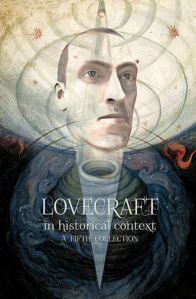
80,000 words of new scholarly essays on the author H.P. Lovecraft. 340 pages, as a perfect bound 6″ x 9″ paperback with colour covers. $20. Paypal accepted.
CONTENTS:
PART ONE: Topographies
1. The Catskill Mountains
“A mighty woodcutter”: on the trail of Bernard Austin Dwyer.
Two poems by Bernard Austin Dwyer, newly discovered.
The annotated “The Lurking Fear”.
2. New York City
Suydam revealed: a major new source for “The Horror at Red Hook”.
Reds in New York: an aspect of Lovecraft’s New York circle in the 1930s.
A note on the interior layout of 169 Clinton Street, Brooklyn.
3. Providence
H.P. Lovecraft and his local Public Library.
Found: a new photograph of the young H.P. Lovecraft?
The Ward of 100 Prospect St.
‘Ancients and Horribles’: the grotesque parade tradition in Rhode Island.
H.P. Lovecraft and the RISD Museum of Art, Providence
H.P. Lovecraft among the Jews: a snapshot in time.
Electro-quacks of Providence 1: Orville Livingston Leach.
Electro-quacks of Providence 2: Dr. William F. Channing.
H.P. Lovecraft’s star-charts.
4. Travels and places
The location of “Juan Romero”: Area 52.
The Isles of Shoals as a possible inspiration for Devil Reef.
Locating the Sentinel Elm at Athol.
A note on H.P. Lovecraft and Bolton, Mass.
The Boston North End as H.P. Lovecraft saw it.
On the trail to Dark Swamp.
PART TWO: Ancient secrets
The extent of the influence of “The Horla” on H.P. Lovecraft.
H.P. Lovecraft and Great Zimbabwe.
Finding Cthulhu: H.P. Lovecraft and Chthetho.
PART THREE: Friends and correspondents
Allan Grayson of New York: the young poet of Dunedin.
Some new biographical details for Henry S. Whitehead, and four texts:
Whitehead’s early biography, Harvard College Class of 1904 yearbook.
Cures Mentally Sick by Prayer (interview), Boston Post, 1921.
Editorial Prejudice Against The Occult (article), The Writer, 1922.
Henry S. Whitehead (obituary), The Evening Independent, 1932.
“Hell’s Turned Loose”: a ‘lost’ Lovecraft revision poem, found.
‘… Nor a Lender Be’: H.P. Lovecraft and Ernest La Touche Hancock.
Some new biographical details for Albert August Sandusky.
Some notes on Richard Ely Morse.
A note on Gordon Hatfield, composer and stage director.
A note on Edward Harold Cole.
A note on the H.P. Lovecraft correspondent Albert Chapin.
Samuel Loveman’s late and wayward hand.
Anne Tillery Renshaw (c.1890?-c.1940?).
PART FOUR: Influence
On Lovecraft’s glands.
Did Lovecraft read Moby Dick?
Hawthorne’s influence on the genesis of the Necronomicon.
Lovecraft’s pocket nuclear device.
A note on Lovecraft and Terence McKenna.
Book review: Lovecraft and Influence: his predecessors and successors.
Three additions and corrections for essays from previous volumes.
POEM: “The Harbour”
01 Wednesday Oct 2014
Posted in New books, Scholarly works
Hippocampus reports that the 812 page paperback edition of S.T. Joshi’s Unutterable Horror: A History of Supernatural Fiction is set to ship in October.
23 Tuesday Sep 2014
Posted in New books, Scholarly works
Newly arrived on Amazon, the revised paperback of A Look Behind the Derleth Mythos: Origins of the Cthulhu Mythos
dropping much of the academic apparatus he had in the hardback version — page numbers for quotes in the text and all that needless crap
So I suppose the first edition is still the one that scholars will want, errors and all, since at least it has the “needless crap” that means that all the quotes can actually be tracked back to a source page. Do any readers know if Haefele ever issued erratum pages for his first edition?

21 Sunday Sep 2014
Posted in Scholarly works
Some academic conferences already announced for 2015, of relevance to H.P. Lovecraft…
* Gothic Spaces: Boundaries, Mergence, Liminalities, 21st-22nd January 2015, Sydney, Australia.
“the meaning and impact of Gothic spaces not only in aesthetic terms, but also the physical, psychological, and the cultural”
* Monstrous Geographies: places and spaces of monstrosity, 22nd-24th March 2015, Lisbon, Portugal.
“the relationship between the monstrous and the geographic”
* 2nd Global Conference on Letters and Letter Writing, 22nd-24th March 2015, Lisbon, Portugal.
Very broad, seems to be open to anything on letters and correspondence circles.
* “The Once and Future Antiquity: Classical Traditions in Science Fiction and Fantasy” conference, Seattle, 27th-29th March 2015.
“What roles has classical antiquity played in visions of the future, the fantastic, the speculative, the might-have-been?”
* Enchanted Edwardians, 30th-31st March 2015, Bristol, England.
“…the ways in which the [British] Edwardians understood and employed the idea of the enchanted, the haunted and the supernatural.”
* Local Color Outside the Lines: American Literary Regionalism’s ‘Others’ (Northeast Modern Literature Assoc.), 30th April 2015, Toronto, Canada.
“This panel seeks papers that address [USA] literary regionalism’s ‘others’ construed narrowly or broadly”.
